Results by title
4038 books match the query 'Social aspects' and 174 start with b
BEYOND THE REPRODUCTIVE BODY
Politics of Women’s Health & Work in Early Victorian EnglandMarjorie Levine-Clark
The Ohio State University Press, 2004
BITS of Belonging
Information Technology, Water, and Neoliberal Governance in IndiaSimanti Dasgupta
Temple University Press, 2015
India’s global success in the Information Technology industry has also prompted the growth of neoliberalism and the re-emergence of the middle class in contemporary urban areas, such as Bangalore. In her significant study, BITS of Belonging, Simanti Dasgupta shows that this economic shift produces new forms of social inequality while reinforcing older ones. She investigates this economic disparity by looking at IT and water privatization to explain how these otherwise unrelated domains correspond to our thinking about citizenship, governance, and belonging.
Dasgupta’s ethnographic study shows how work and human processes in the IT industry intertwine to meet the market stipulations of the global economy. Meanwhile, in the recasting of water from a public good to a commodity, the middle class insists on a governance and citizenship model based upon market participation. Dasgupta provides a critical analysis of the grassroots activism involved in a contested water project where different classes lay their divergent claims to the city.
BODIES OF TECHNOLOGY
Women’s Involvement with Reproductive MedicineEdited by Ann R. Saetnan, Nelly Oudshoorn, and Marta Kirejczyk
The Ohio State University Press, 2000
Bodies of Technology is based on the premise that technology and society mutually shape one another, and on a concern for women’s health and autonomy. A basic question is one of cultural appropriation: Do technologies take on different shapes, different practices, and have different impacts as they spread from one place to another? By juxtaposing a number of culturally and historically contextualized studies of similar technologies, the editors demonstrate that although technologies globalize by spreading among cultures, they are also localized by the cultures they encounter.
The first part of the book investigates how potential users of hormone-based contraceptives are represented as these technologies are developed in laboratories and field tests. The next section explores the political and economic processes that regulate access to and practices of assisted fertilization. The final section focuses on individual users engaging with fetal diagnostic technologies in clinical practice. Taken as a whole, the book points out the need and the possibilities for women to become directly involved in the shaping of technologies that so strongly affect their health and their daily lives.

Babies In Bottles
Susan Merrill Squier
Rutgers University Press, 1994
Bacchanalian Sentiments
Musical Experiences and Political Counterpoints in TrinidadKevin K. Birth
Duke University Press, 2008
Birth draws on fieldwork he conducted in one of Trinidad’s ethnically diverse rural villages to explore the relationship between music and social and political consciousness on the island. He describes how Trinidadians use the affective power of music and the physiological experience of performance to express and work through issues related to identity, ethnicity, and politics. He looks at how the performers and audience members relate to different musical traditions. Turning explicitly to politics, Birth recounts how Trinidadians used music as a means of making sense of the attempted coup d’état in 1990 and the 1995 parliamentary election, which resulted in a tie between the two major political parties. Bacchanalian Sentiments is an innovative ethnographic analysis of the significance of music, and particular musical forms, in the everyday lives of rural Trinidadians.

Back Cast
Fly-Fishing and Other Such MattersJeff Metcalf
University of Utah Press, 2018
These essays are much more than fish stories; they reveal the community and communion of fishing and the bonds to place the author nurtured through it. Whether he recalls carousing and tale-swapping with friends or excellence found through the challenge of the cast, Metcalf’s words, sometimes roiling and turbulent, sometimes calm and reflective, like a western river, vividly convey the pull of the steelhead and the fight for survival. Whether or not you fish, Metcalf’s sharp-eyed, open and honest look at life will draw you in.
"These waters have been my home, and I fish them more than most. In truth, they have saved my life on more than a few occasions. I seek refuge in the quiet solitude of rivers, and in dark hours of my life—including this particular year—I need desperately to be fly-fishing." —From the book
Back Stages
Essays across Art, Performance, and Public LifeShannon Jackson
Northwestern University Press, 2022
At a time of increased aesthetic experimentation and political debate within the art world, these essays alight on artists, groups, and cultural organizations whose experiments have challenged conventions of curation and critique, including Theaster Gates, Paul Ramírez Jonas, Harrell Fletcher, and My Barbarian. Throughout, Jackson navigates the political ambivalences of performance, from the late nineteenth to the twenty-first century, tracking shifts in participatory art that seek to resist capitalism, even as such performance work paradoxically risks neoliberal appropriation by a post-Fordist experience economy.
Back Stages surfaces unexpected cross-disciplinary connections and provides new opportunities for mutual engagement within a wide network of educational, artistic, and civic sectors. A substantial introduction excavates the critical links between the essays and a variety of disciplines and movements.
Back to the Dance Itself
Phenomenologies of the Body in PerformanceEdited with Essays by Sondra Fraleigh
University of Illinois Press, 2018
Contributors: Karen Barbour, Christine Bellerose, Robert Bingham, Kara Bond, Hillel Braude, Sondra Fraleigh, Kimerer LaMothe, Joanna McNamara, Vida Midgelow, Ami Shulman, and Amanda Williamson.

Bacteria to AI
Human Futures with Our Nonhuman SymbiontsN. Katherine Hayles
University of Chicago Press, 2025
A new theory of mind that includes nonhuman and artificial intelligences.
The much-lauded superiority of human intelligence has not prevented us from driving the planet into ecological disaster. For N. Katherine Hayles, the climate crisis demands that we rethink basic assumptions about human and nonhuman intelligences. In Bacteria to AI, Hayles develops a new theory of mind—what she calls an integrated cognitive framework (ICF)—that includes the meaning-making practices of lifeforms from bacteria to plants, animals, humans, and some forms of artificial intelligence. Through a sweeping survey of evolutionary biology, computer science, and contemporary literature, Hayles insists that another way of life, with ICF at its core, is not only possible but necessary to safeguard our planet’s future.
Bad Boys
Public Schools in the Making of Black MasculinityAnn Arnett Ferguson
University of Michigan Press, 2020

Bad Education
Why Queer Theory Teaches Us NothingLee Edelman
Duke University Press, 2022

Bad Nature
How Rat Control Shapes Human and Nonhuman WorldsAndrew McCumber
University of Chicago Press, 2025
Apart from the occasional pet owner who has rats, most people regard rats as disease-carrying nocturnal pests, scurrying around dumpsters and dragging slices of pizza through New York City subways. Since rats are seemingly omnipresent in human life, why do we harbor such negative feelings about them, and why are they among the creatures most frequently targeted for systematic extermination?
In Bad Nature, sociologist Andrew McCumber draws out the cultural underpinnings of rat extermination across three countries and two continents. Drawing from ethnographic, interview, and textual data from the frigid prairie of Alberta, Canada; the heart of downtown Los Angeles, California; and the iconic Galápagos Islands of Ecuador, McCumber studies how humans have sought to suppress and exterminate rat populations in a variety of environmental, social, and political situations. He shows how, in these disparate locations, rat control is a social practice that draws and clarifies the spatial and symbolic boundaries between “good” and “bad” forms of nature. Rats are near the bottom of a symbolic hierarchy of species that places human life at the top, companion animals and majestic wildlife just below them, and the “invasive species” that call for systematic extermination at the very bottom. This hierarchy of living things that places rats at the bottom, McCumber argues, mirrors human systems of social inequalities and power dynamics.
Both original and engaging, Bad Nature urges readers to consider, when charting a just and sustainable future, where will the rats be placed in the worlds we envision?

Ball Don't Lie
Myth, Genealogy, and Invention in the Cultures of BasketballYago Colás
Temple University Press, 2016
Pro basketball player Rasheed Wallace often exclaimed the pragmatic truth “Ball don’t lie!” during a game. It is a protest against a referee’s bad calls. But the slogan, which originated in pickup games, brings the reality of a racialized urban playground into mainstream American popular culture.
In Ball Don’t Lie!, Yago Colás traces the various forms of power at work in the intersections between basketball and language from the game’s invention to the present day. He critiques existing popular myths concerning the history of basketball, contextualizes them, and presents an alternative history of the sport inspired by innovations. Colás emphasizes the creative prerogative of players and the ways in which their innovations shape—and are shaped by—broader cultural and social phenomena.
Ball Don't Lie! shows that basketball cannot be reduced to a single, fixed or timeless essence but instead is a continually evolving exhibition of physical culture that flexibly adapts to and sparks changes in American society.
Ballroom, Boogie, Shimmy Sham, Shake
A Social and Popular Dance ReaderEdited by Julie Malnig
University of Illinois Press, 2008
This dynamic collection documents the rich and varied history of social dance and the multiple styles it has generated, while drawing on some of the most current forms of critical and theoretical inquiry. The essays cover different historical periods and styles; encompass regional influences from North and South America, Britain, Europe, and Africa; and emphasize a variety of methodological approaches, including ethnography, anthropology, gender studies, and critical race theory. While social dance is defined primarily as dance performed by the public in ballrooms, clubs, dance halls, and other meeting spots, contributors also examine social dance’s symbiotic relationship with popular, theatrical stage dance forms.
Contributors are Elizabeth Aldrich, Barbara Cohen-Stratyner, Yvonne Daniel, Sherril Dodds, Lisa Doolittle, David F. García, Nadine George-Graves, Jurretta Jordan Heckscher, Constance Valis Hill, Karen W. Hubbard, Tim Lawrence, Julie Malnig, Carol Martin, Juliet McMains, Terry Monaghan, Halifu Osumare, Sally R. Sommer, May Gwin Waggoner, Tim Wall, and Christina Zanfagna.
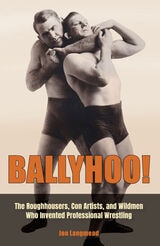
Ballyhoo!
The Roughhousers, Con Artists, and Wildmen Who Invented Professional WrestlingJon Langmead
University of Missouri Press, 2024
Ballyhoo! The Roughhousers, Con Artists, and Wildmen Who Invented Professional Wrestling is a history of professional wrestling’s formative period in the U.S., from roughly 1874 to 1941, and the contested interplay of wrestlers and promoters who built the “sport” as we know it. During this period, the major conventions that would define wrestling to the present day were perfected and codified, as wrestling morphed from a rough sport practiced on farms and at town gatherings to melodramatic mass entertainment that reliably drew large crowds in cities across the nation.
The narrative uses the life and career of Jack Curley—a boxing promoter whose fortune took a turn for the better when he began promoting wrestling matches—as a compass as it charts the development of wrestling. By the late 1910s, Curley’s shows were selling out Madison Square Garden monthly. Ballyhoo chronicles his competition with the other promoters, as well as the lives of colorful athletes like “Strangler” Ed Lewis, Frank Gotch, the “Masked Marvel,” Jim Londos, “Gorgeous George” Wagner, “Farmer” Martin Burns, and “Dynamite” Gus Sonnenberg.
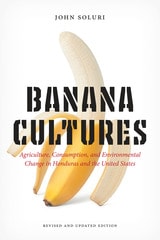
Banana Cultures
Agriculture, Consumption, and Environmental Change in Honduras and the United StatesBy John Soluri
University of Texas Press, 2021
Bananas, the most frequently consumed fresh fruit in the United States, have been linked to Miss Chiquita and Carmen Miranda, "banana republics," and Banana Republic clothing stores—everything from exotic kitsch, to Third World dictatorships, to middle-class fashion. But how did the rise in banana consumption in the United States affect the banana-growing regions of Central America? In this lively, interdisciplinary study, John Soluri integrates agroecology, anthropology, political economy, and history to trace the symbiotic growth of the export banana industry in Honduras and the consumer mass market in the United States.
Beginning in the 1870s, when bananas first appeared in the U.S. marketplace, Soluri examines the tensions between the small-scale growers, who dominated the trade in the early years, and the shippers. He then shows how rising demand led to changes in production that resulted in the formation of major agribusinesses, spawned international migrations, and transformed great swaths of the Honduran environment into monocultures susceptible to plant disease epidemics that in turn changed Central American livelihoods. Soluri also looks at labor practices and workers' lives, changing gender roles on the banana plantations, the effects of pesticides on the Honduran environment and people, and the mass marketing of bananas to consumers in the United States. His multifaceted account of a century of banana production and consumption adds an important chapter to the history of Honduras, as well as to the larger history of globalization and its effects on rural peoples, local economies, and biodiversity.
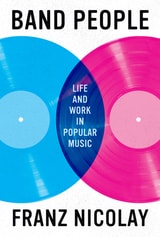
Band People
Life and Work in Popular MusicFranz Nicolay
University of Texas Press, 2024
A close look at the lives of working musicians who aren’t the center of their stage.
Secret (and not-so-secret) weapons, side-of-the-stagers, rhythm and horn sections, backup singers, accompanists—these and other “band people” are the anonymous but irreplaceable character actors of popular music. Through interviews and incisive cultural critique, writer and musician Franz Nicolay provides a portrait of the musical middle class. Artists talk frankly about their careers and attitudes toward their craft, work environment, and group dynamics, and shed light on how support musicians make sense of the weird combination of friend group, gang, small business consortium, long-term creative collaboration, and chosen family that constitutes a band. Is it more important to be a good hang or a virtuoso player? Do bands work best as democracies or autocracies? How do musicians with children balance their personal and professional lives? How much money is too little? And how does it feel to play on hundreds of records, with none released under your name? In exploring these and other questions, Band People gives voice to those who collaborate to create and dissects what it means to be a laborer in the culture industry.

Bankers in the Ivory Tower
The Troubling Rise of Financiers in US Higher EducationCharlie Eaton
University of Chicago Press, 2022
Exposes the intimate relationship between big finance and higher education inequality in America.
Elite colleges have long played a crucial role in maintaining social and class status in America, while public universities have offered a major stepping stone to new economic opportunities. However, as Charlie Eaton reveals in Bankers in the Ivory Tower, finance has played a central role in the widening inequality in recent decades, both in American higher education and in American society at large.
With federal and state funding falling short, the US higher education system has become increasingly dependent on financial markets and the financiers that mediate them. Beginning in the 1980s, the government, colleges, students, and their families took on multiple new roles as financial investors, borrowers, and brokers. The turn to finance, however, has yielded wildly unequal results. At the top, ties to Wall Street help the most elite private schools achieve the greatest endowment growth through hedge fund investments and the support of wealthy donors. At the bottom, takeovers by private equity transform for-profit colleges into predatory organizations that leave disadvantaged students with massive loan debt and few educational benefits. And in the middle, public universities are squeezed between incentives to increase tuition and pressures to maintain access and affordability. Eaton chronicles these transformations, making clear for the first time just how tight the links are between powerful financiers and America’s unequal system of higher education.
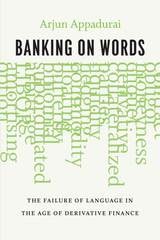
Banking on Words
The Failure of Language in the Age of Derivative FinanceArjun Appadurai
University of Chicago Press, 2015
Appadurai moves in four steps through his analysis. In the first, he highlights the importance of derivatives in contemporary finance, isolating them as the core technical innovation that markets have produced. In the second, he shows that derivatives are essentially written contracts about the future prices of assets—they are, crucially, a promise. Drawing on Mauss’s The Gift and Austin’s theories on linguistic performatives, Appadurai, in his third step, shows how the derivative exploits the linguistic power of the promise through the special form that money takes in finance as the most abstract form of commodity value. Finally, he pinpoints one crucial feature of derivatives (as seen in the housing market especially): that they can make promises that other promises will be broken. He then details how this feature spread contagiously through the market, snowballing into the systemic liquidity crisis that we are all too familiar with now.
With his characteristic clarity, Appadurai explains one of the most complicated—and yet absolutely central—aspects of our modern economy. He makes the critical link we have long needed to make: between the numerical force of money and the linguistic force of what we say we will do with it.

Banning Queer Blood
Rhetorics of Citizenship, Contagion, and ResistanceJeffrey A. Bennett
University of Alabama Press, 2009
In Banning Queer Blood, Jeffrey Bennett frames blood donation as a performance of civic identity closely linked to the meaning of citizenship. However, with the advent of HIV came the notion of blood donation as a potentially dangerous process. Bennett argues that the Food and Drug Administration, by employing images that specifically depict gay men as contagious, has categorized gay men as a menace to the nation. The FDA's ban on blood donation by gay men served to propagate the social misconceptions about gay men that continue to circulate within both the straight and LGBT/Queer communities.
Bennett explores the role of scientific research cited by these banned-blood policies and its disquieting relationship to government agencies, including the FDA. Bennett draws parallels between the FDA's position on homosexuality and the historical precedents of discrimination by government agencies against racial minorities. The author concludes by describing the resistance posed by queer donors, who either lie in order to donate blood or protest discrimination at donation sites, and by calling for these prejudiced policies to be abolished.
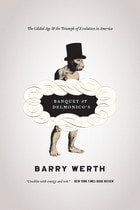
Banquet at Delmonico's
The Gilded Age and the Triumph of Evolution in AmericaBarry Werth
University of Chicago Press, 2011
In Banquet at Delmonico’s, Barry Werth draws readers inside the circle of intellectuals, scientists, politicians, businessmen, and clergymen who brought Charles Darwin’s controversial ideas to post-Civil-War America. Each chapter is dedicated to a crucial intellectual encounter, culminating with an exclusive farewell dinner held in English philosopher Herbert Spencer’s honor at the venerable New York restaurant Delmonico’s in 1882. In this thought-provoking and nuanced account, Werth firmly situates social Darwinism in the context of the Gilded Age. Banquet at Delmonico’s is social history at its finest.

Barbie's Queer Accessories
Erica Rand
Duke University Press, 1995
Rand begins by focusing on the production and marketing of Barbie, starting in 1959, including Mattel’s numerous tie-ins and spin-offs. These variations, which include the much-promoted multiethnic Barbies and the controversial Earring Magic Ken, helped make the doll one of the most profitable toys on the market. In lively chapters based on extensive interviews, the author discusses adult testimony from both Barbie "survivors" and enthusiasts and explores how memories of the doll fit into women’s lives. Finally, Rand looks at cultural reappropriations of Barbie by artists, collectors, and especially lesbians and gay men, and considers resistance to Barbie as a form of social and political activism.
Illustrated with photographs of various interpretations and alterations of Barbie, this book encompasses both Barbie glorification and abjection as it testifies to the irrefutably compelling qualities of this bestselling toy. Anyone who has played with Barbie—or, more importantly, thought or worried about playing with Barbie—will find this book fascinating.

Barbs, Bullets, and Blood
The 1880s Texas barbed Wire WarsHarold D. Jobes
University of North Texas Press, 2025

Baseball and Country Music
Don Cusic
University of Wisconsin Press, 2003

Baseball and Memory
Winning, Losing, and the Remembrance of Things PastLee Congdon
St. Augustine's Press, 2011

Baseball and Rhetorics of Purity
The National Pastime and American Identity During the War on TerrorMichael L. Butterworth
University of Alabama Press, 2010
An investigation into the culture and mythology of baseball, a study of its limits and failures, and an invitation to remake the game in a more democratic way.
Baseball has long been considered America’s “national pastime,” touted variously as a healthy diversion, a symbol of national unity, and a model of democratic inclusion. But, according to Michael Butterworth, such favorable rhetoric belies baseball’s complicity in the rhetorical construction of a world defined by good and evil.
Baseball and Rhetorics of Purity is an investigation into the culture and mythology of baseball, a study of its limits and failures, and an invitation to remake the game in a more democratic way. It pays special attention to baseball’s role in the reconstruction of American identity after September 11, 2001. This study is framed by a discussion that links the development of baseball to the discourses of innocence and purity in 19th-century America. From there, it examines ritual performances at baseball games; a traveling museum exhibit sponsored by the National Baseball Hall of Fame and Museum; the recent debate about the use of performance-enhancing drugs; the return of Major League Baseball to Washington, D.C., in 2005; and the advent of the World Baseball Classic in 2006.
Butterworth argues that by promoting myths of citizenship and purity, post-9/11 discourse concerning baseball ironically threatens the health of the democratic system and that baseball cannot be viewed as an innocent diversion or escape. Instead, Butterworth highlights how the game on the field reflects a more complex and diverse worldview, and makes a plea for the game’s recovery, both as a national pastime and as a site for celebrating the best of who we are and who we can be.
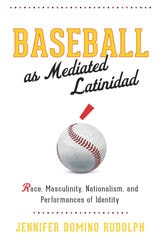
Baseball as Mediated Latinidad
Race, Masculinity, Nationalism, and Performances of IdentityJennifer Domino Rudolph
The Ohio State University Press, 2020

Basketball Trafficking
Stolen Black Panamanian DreamsJavier Wallace
Duke University Press, 2025

Battle
The Nature and Consequences of Civil War CombatEdited by Kent Gramm
University of Alabama Press, 2008
A critical, multidisciplinary examination of Civil War combat that interrogates the technological, medical, psychological, and cultural forces shaping battlefield experience and its enduring national legacy.
“In our youth, our hearts were touched with fire,” wrote Oliver Wendell Holmes of his generation’s Civil War days. Through the ages, war stories have gleamed with romantic glory, and American memories of the cataclysmic Civil War inspire pageantry and poetry even today.
The essays in Battle form a corrective to such celebratory histories by examining the lethal realities of Civil War combat—Enlightenment science applied to the creation of weapons that maimed and killed, which far outpaced advances in diet, sanitation, and medical treatment. The book reveals that behind the drums and trumpets, sashes and swords, the armies of the Union and Confederacy alike were haunted by fear, pain, and death.
The collection includes an introduction and afterword by editor Kent Gramm, who also contributes an essay titled “Numbers” that reveals the war in statistics. Paul Fussell contributes a powerful essay titled “The Culture of War.” D. Scott Hartwig examines the face of battle at Gettysburg. Bruce A. Evans discusses medical technology in “Wounds, Death, and Medical Care in the Civil War.” Eric T. Dean challenges the meanings and consequences of combat in “The Awful Shock and Rage of Battle.” The collection is rounded out by Alan T. Nolan’s masterful review of the national consequences of battle and the resultant myth of the Confederacy’s Lost Cause.

Bauhaus Culture
From Weimar To The Cold WarKathleen James-Chakraborty
University of Minnesota Press, 2006
In this book, editor Kathleen James-Chakraborty and seven other scholars analyze the accomplishments and dispel the myths of the Bauhaus, placing it firmly in a historical context from before the formation of the Weimar Republic through Nazi ascendancy and World War II into the cold war. Together, they investigate its professors’ and students’ interactions with mass culture; establish the complexity of its relationship with Wilhelmine, Nazi, and postwar German politics; and challenge the claim that its architects greatly influenced American architecture in the 1930s.
Their most explosive conclusions address the degree to which some aspects of Bauhaus design continued to flourish during the Third Reich before becoming one of the cold war’s most enduring emblems of artistic freedom. In doing so, Bauhaus Culture calls into question the degree to which this influential school should continue to symbolize an uncomplicated relationship between art, modern technology, and progressive politics.
Contributors: Greg Castillo, Juliet Koss, Rose-Carol Washton Long, John V. Maciuika, Wallis Miller, Winifried Nerdinger, Frederic J. Schwartz.
Kathleen James-Chakraborty is associate professor of architecture at the University of California, Berkeley, and author of German Architecture for a Mass Audience and Erich Mendelsohn and the Architecture of German Modernism.
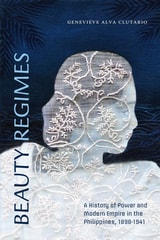
Beauty Regimes
A History of Power and Modern Empire in the Philippines, 1898–1941Genevieve Alva Clutario
Duke University Press, 2023
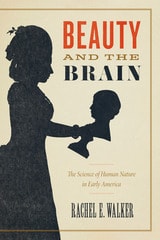
Beauty and the Brain
The Science of Human Nature in Early AmericaRachel E. Walker
University of Chicago Press, 2023
Between the 1770s and the 1860s, people all across the globe relied on physiognomy and phrenology to evaluate human worth. These once-popular but now-discredited disciplines were based on a deceptively simple premise: that facial features or skull shape could reveal a person’s intelligence, character, and personality. In the United States, these were culturally ubiquitous sciences that both elite thinkers and ordinary people used to understand human nature.
While the modern world dismisses phrenology and physiognomy as silly and debunked disciplines, Beauty and the Brain shows why they must be taken seriously: they were the intellectual tools that a diverse group of Americans used to debate questions of race, gender, and social justice. While prominent intellectuals and political thinkers invoked these sciences to justify hierarchy, marginalized people and progressive activists deployed them for their own political aims, creatively interpreting human minds and bodies as they fought for racial justice and gender equality. Ultimately, though, physiognomy and phrenology were as dangerous as they were popular. In addition to validating the idea that external beauty was a sign of internal worth, these disciplines often appealed to the very people who were damaged by their prejudicial doctrines. In taking physiognomy and phrenology seriously, Beauty and the Brain recovers a vibrant—if largely forgotten—cultural and intellectual universe, showing how popular sciences shaped some of the greatest political debates of the American past.

Becoming Frum
How Newcomers Learn the Language and Culture of Orthodox JudaismSarah Bunin Benor
Rutgers University Press, 2012
Winner, 2013 Sami Rohr Choice Award for Jewish Literature
When non-Orthodox Jews become frum (religious), they encounter much more than dietary laws and Sabbath prohibitions. They find themselves in the midst of a whole new culture, involving matchmakers, homemade gefilte fish, and Yiddish-influenced grammar. Becoming Frum explains how these newcomers learn Orthodox language and culture through their interactions with community veterans and other newcomers. Some take on as much as they can as quickly as they can, going beyond the norms of those raised in the community. Others maintain aspects of their pre-Orthodox selves, yielding unique combinations, like Matisyahu’s reggae music or Hebrew words and sing-song intonation used with American slang, as in “mamish (really) keepin’ it real.”
Sarah Bunin Benor brings insight into the phenomenon of adopting a new identity based on ethnographic and sociolinguistic research among men and women in an American Orthodox community. Her analysis is applicable to other situations of adult language socialization, such as students learning medical jargon or Canadians moving to Australia. Becoming Frum offers a scholarly and accessible look at the linguistic and cultural process of “becoming.”
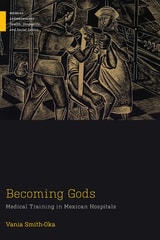
Becoming Gods
Medical Training in Mexican HospitalsVania Smith-Oka
Rutgers University Press, 2021
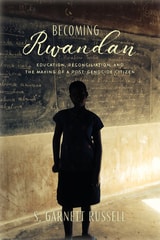
Becoming Rwandan
Education, Reconciliation, and the Making of a Post-Genocide CitizenS. Garnett Russell
Rutgers University Press, 2020
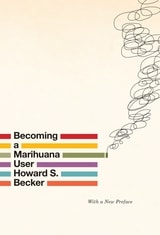
Becoming a Marihuana User
Howard S. Becker
University of Chicago Press, 2015
Becker doesn’t judge, but neither does he holler for legalization, tell you how to grow it in a hollowed-out dresser, or anything else like that for which there are plenty of other books you can buy. Instead, he looks at marijuana with a clear sociological lens—as a substance that some people enjoy, and that some others have decided none of us should. From there he asks: so how do people decide to get high, and what kind of experience do they have as a result of being part of the marijuana world? What he discovers will bother some, especially those who proselytize the irrefutably stunning effects of the latest strain: chemistry isn’t everything—the important thing about pot is how we interact with it. We learn to be high. We learn to like it. And from there, we teach others, passing the pipe in a circle that begins to resemble a bona fide community, defined by shared norms, values, and definitions just like any other community.
All throughout this book, you’ll see the intimate moments when this transformation takes place. You’ll see people doing it for the first time and those with considerable experience. You’ll see the early signs of the truths that have come to define the marijuana experience: that you probably won’t get high at first, that you have to hold the hit in, and that there are other people here who are going to smoke that, too.

Beer Places
The Microgeographies of Craft BeerDaina Cheyenne Harvey
University of Arkansas Press, 2023
With insight from social scientists, beer bloggers, travel writers, and food entrepreneurs who recount their experiences of taprooms, breweries, and bottle shops from North Carolina to Zimbabwe, Beer Places reveals differences in the craft beer scene across multiple geographies. Situating craft beer as an emerging and important component of food studies, the essays in this volume attest to the singular power of craft beer to connect people and places.

Before the Fire Dogs Steal the Sun
An ElegyCrystal Mun-hye Baik
Duke University Press, 2026
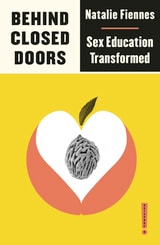
Behind Closed Doors
Sex Education TransformedNatalie Fiennes
Pluto Press, 2019
Fear-mongering, moral panic and outdated attitudes prevail, but if #MeToo has taught us anything, it's how dangerous it is to keep conversations about sex hidden from view. Behind Closed Doors invests in a radical, inclusive and honest sex education, taking us beyond learning about the 'birds and the bees', to identifying inequality that stands in the way of sexual freedom.
From contraceptives to virginity, consent to pornography, transphobia to sexual abuse, the book shows how our desires are influenced by powerful political processes that can be transformed.
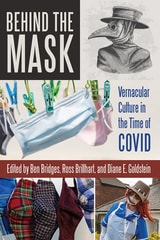
Behind the Mask
Vernacular Culture in the Time of COVIDBen Bridges
Utah State University Press, 2023
Despite vernacular’s potential nod to dominant or external culture, it is the strong connection to the local that grounds the vernacular within the experiential context that it occupies. Exploring the nature and shape of vernacular responses to the ongoing public health crisis, Behind the Mask documents processes that are otherwise likely to be forgotten. Including different ethnographic presents, contributors capture moments during the pandemic rather than upon reflection, making the work important to students and scholars of folklore and ethnology, as well as general readers interested in the COVID pandemic.
Being Dead Otherwise
Anne Allison
Duke University Press, 2023
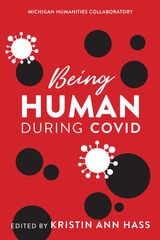
Being Human during COVID
Kristin Ann Hass, Editor
University of Michigan Press, 2021
Being Human during COVID documents the first year of the pandemic in real time, bringing together humanities scholars from the University of Michigan to address what it feels like to be human during the COVID-19 crisis. Over the course of the pandemic, the questions that occupy the humanities—about grieving and publics, the social contract and individual rights, racial formation and xenophobia, ideas of home and conceptions of gender, narrative and representations and power—have become shared life-or-death questions about how human societies work and how culture determines our collective fate. The contributors in this collection draw on scholarly expertise and lived experience to try to make sense of the unfamiliar present in works that range from traditional scholarly essays, to personal essays, to visual art projects. The resulting book is shot through with fear, dread, frustration, and prejudice, and, on a few occasions, with a thrilling sense of hope.

Being Human
The Search for OrderSeán Ó Nualláin
Intellect Books, 2013
We live at a time of unparallelled environmental and moral crisis. Not only do we not believe anything but, despite exponential advances in information production, we do not know very much either. This book is a guide for everyone who, understandably, feels perplexed.
Presenting an explanation of recent findings in science and their relationship with society and politics as we enter the third millennium, the book also seeks to provide guidance towards responsible political action in this current crisis. From new technology's power to preserve the status quo, to the true impetus behind the Human Genome Project, Sean Ó Nualláin brings to topical concerns some much needed clarity.
Complete with reader-friendly summaries to current thought in the biological, physical, and social sciences, the book is designed to be accessible to a general readership, it should also appeal to all those working or studying in the Sciences.
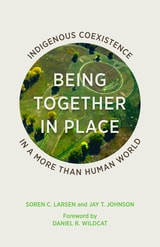
Being Together in Place
Indigenous Coexistence in a More Than Human WorldSoren C. Larsen
University of Minnesota Press, 2017
Being Together in Place explores the landscapes that convene Native and non-Native people into sustained and difficult negotiations over their radically different interests and concerns. Grounded in three sites—the Cheslatta-Carrier traditional territory in British Columbia; the Wakarusa Wetlands in northeastern Kansas; and the Waitangi Treaty Grounds in Aotearoa/New Zealand—this book highlights the challenging, tentative, and provisional work of coexistence around such contested spaces as wetlands, treaty grounds, fishing spots, recreation areas, cemeteries, heritage trails, and traditional village sites. At these sites, activists learn how to articulate and defend their intrinsic and life-supportive ways of being, particularly to those who are intent on damaging or destroying these places.
Using ethnographic research and a geographic perspective, Soren C. Larsen and Jay T. Johnson show how the communities in these regions challenge the power relations that structure the ongoing (post)colonial encounter in liberal democratic settler-states. Emerging from their conversations with activists was a distinctive sense that the places for which they cared had agency, a “call” that pulled them into dialogue, relationships, and action with human and nonhuman others. This being-together-in-place, they find, speaks in a powerful way to the vitalities of coexistence: where humans and nonhumans are working to decolonize their relationships; where reciprocal guardianship is being stitched back together in new and unanticipated ways; and where a new kind of “place thinking” is emerging on the borders of colonial power.
Bells of Change
Kathak Dance, Women and Modernity In IndiaPallabi Chakravorty
Seagull Books, 2008
Belonging and Identity in STEM Higher Education
Edited by Camille Kandiko Howson and Martyn Kingsbury
University College London, 2024
In Belonging and Identity in STEM Higher Education, Camille Kandiko Howson and Martyn Kingsbury examine the role of science, technology, engineering, and mathematics (STEM) pedagogies in facilitating belonging, variable impacts across student characteristics, and the experiences of STEM students in higher education. Through case study contributions, the book analyzes the unique educational environments for STEM staff and students throughout Europe and Asia, challenging the assumptions that STEM fields are inherently unemotional and impersonal disciplines.
Bending Archaeology toward Social Justice
Transformational Action for Positive PeaceBarbara J. Little
University of Alabama Press, 2023
Introduces an analytic model for how archaeologists can work toward social justice
In this time of Black Lives Matter, the demands of NAGPRA, and climate crises, the field of American archaeology needs a radical transformation. It has been largely a white, male, privileged domain that replicates an entrenched patriarchal, colonial, and capitalist system. In Bending Archaeology toward Social Justice, Barbara J. Little explores the concepts and actions required for such a change, looking to peace studies, anthropology, sociology, social justice activism, and the achievements of community-based archaeology for helpful approaches in keeping with the UN Sustainable Development Goals. She introduces an analytic model that uses the strengths of archaeology to destabilize violence and build peace.
As Little explains, the Diachronic Transformational Action model and the peace/violence triad of interconnected personal, cultural, and structural domains of power can help disrupt the injustice of all forms of violence. Diachronic connects the past to the present to understand how power worked in the past and works now. Transformational influences power now by disrupting the stability of the violence triad. Action refers to collaborative work to diagnose power relations and transform toward social justice.
Using this framework, Little confronts the country’s founding and myth of liberty and justice for all, as well as the American Dream. She also examines whiteness, antiracism, privilege, and intergenerational trauma, and offers white archaeologists concepts to grapple with their own racialized identities and to consider how to relinquish white supremacy. Archaeological case studies examine cultural violence and violent direct actions against women, Indigenous peoples, African Americans, and Japanese Americans, while archaeologies of poverty, precarity, and labor are used to show how archaeologists have helped expose the roots of these injustices. Because climate justice is integral to social justice, Little showcases insights that archaeology can bring to bear on the climate crisis and how lessons from the past can inform direct actions today. Finally, Little invites archaeologists to embrace inquiry and imagination so that they can both imagine and achieve the positive peace of social justice.
Bending the Future
Fifty Ideas for the Next Fifty Years of Historic Preservation in the United StatesEdited by Max Page and Marla R. Miller
University of Massachusetts Press, 2016
The year 2016 marks the fiftieth anniversary of the National Historic Preservation Act, the cornerstone of historic preservation policy and practice in the United States. The act established the National Register of Historic Places, a national system of state preservation offices and local commissions, set up federal partnerships between states and tribes, and led to the formation of the standards for preservation and rehabilitation of historic structures. This book marks its fiftieth anniversary by collecting fifty new and provocative essays that chart the future of preservation.
The commentators include leading preservation professionals, historians, writers, activists, journalists, architects, and urbanists. The essays offer a distinct vision for the future and address related questions, including, Who is a preservationist? What should be preserved? Why? How? What stories do we tell in preservation? How does preservation contribute to the financial, environmental, social, and cultural well-being of communities? And if the “arc of the moral universe . . . bends towards justice,” how can preservation be a tool for achieving a more just society and world?
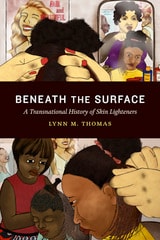
Beneath the Surface
A Transnational History of Skin LightenersLynn M. Thomas
Duke University Press, 2020

Benjamin Franklin's Printing Network
Disseminating Virtue in Early AmericaRalph Frasca
University of Missouri Press, 2005