Results by title
18284 books match the query 'United States' and 902 start with b
Blues Unlimited
Essential Interviews from the Original Blues MagazineEdited by Bill Greensmith, Mike Rowe, and Mark Camarigg
University of Illinois Press, 2015
Blues for Cannibals
The Notes from UndergroundBy Charles Bowden
University of Texas Press, 2018
Cultivated from the fierce ideas seeded in Blood Orchid, Blues for Cannibals is an elegiac reflection on death, pain, and a wavering confidence in humanity’s own abilities for self-preservation. After years of reporting on border violence, sex crimes, and the devastation of the land, Bowden struggles to make sense of the many ways in which we destroy ourselves and whether there is any way to survive. Here he confronts a murderer facing execution, sex offenders of the most heinous crimes, a suicidal artist, a prisoner obsessed with painting portraits of presidents, and other people and places that constitute our worst impulses and our worst truths. Painful, heartbreaking, and forewarning, Bowden at once tears us apart and yearns for us to find ourselves back together again.
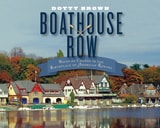
Boathouse Row
Waves of Change in the Birthplace of American RowingDotty Brown
Temple University Press, 2016
The history of Philadelphia’s Boathouse Row is both wide and deep.Dotty Brown, an avid rower and former editor at the Philadelphia Inquirer, immersed herself in boathouse archives to provide a comprehensive history of rowing in Philadelphia. She takes readers behind the scenes to recount the era when rowing was the spectator sport of its time—and the subject of Thomas Eakins’ early artwork—through the heyday of the famed Kelly dynasty, and the fight for women to get the right to row. (Yes, it really was a fight, and it took generations to win.)
With more than 160 photographs, a third of them in full color, Boathouse Row chronicles the “waves of change” as various groups of different races, classes, and genders fought for access to water and the sport. Chapters also discuss the architectural one-upmanship that defined Boathouse Row after Frank Furness designed the stunning and eclectic Undine Barge Club, and the regattas that continue to take place today on the Schuylkill River, including the forgotten forces that propelled high school rowing.
Beautifully written and illustrated, Boathouse Row will be a keepsake for rowers and spectators alike.
Bob Bullock
God Bless TexasBy Dave McNeely and Jim Henderson
University of Texas Press, 2008
Renowned for his fierce devotion to the people of Texas—as well as his equally fierce rages and unpredictable temper—Bob Bullock was the most powerful political figure in Texas at the end of the twentieth century. First elected to the Texas House of Representatives in 1956, Bullock held several key statewide posts before capturing the lieutenant governor's office in 1990. Though nominally the state's number two official, Bullock in fact became Texas's top power broker, wielding tremendous influence over the legislative agenda and state budget through the 1990s while also mentoring and supporting a future president—George W. Bush.
In this lively, yet thoroughly researched biography, award-winning journalists Dave McNeely and Jim Henderson craft a well-rounded portrait of Bob Bullock, underscoring both his political adroitness and his personal demons. They trace Bullock's rise through state government as Assistant Attorney General, Secretary of State, State Comptroller, and Lieutenant Governor, showing how he increased the power of every office he held. The authors spotlight Bullock's substantial achievements, which included hiring an unprecedented number of women and minorities, instituting a performance review to increase the efficiency of state agencies, restructuring the public school funding system, and creating the state's first water conservation and management plan.
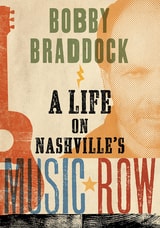
Bobby Braddock
A Life on Nashville’s Music RowBobby Braddock
Vanderbilt University Press, 2015
If you're looking for insight into Nashville, the life of music in this town, and the story of a force of nature on the Row to this day, Bobby Braddock will take you there.
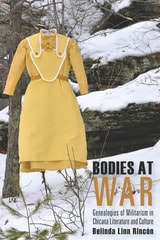
Bodies at War
Genealogies of Militarism in Chicana Literature and CultureBelinda Linn Rincón
University of Arizona Press, 2017
Bodies at War examines the rise of neoliberal militarism from the early 1970s to the present and its transformation of political, economic, and social relations. It charts neoliberal militarism’s impact on democratic practices, economic policies, notions of citizenship, race relations, and gender norms by focusing on how these changes affect the Chicana/o community and, more specifically, on how it shapes and is shaped by Chicana bodies. The book raises important questions about the cultural legacies of war and the gendering of violence—topics that reach across multiple disciplinary fields of inquiry, including cultural and media studies. It draws attention to the relationship between war and society, to neoliberal militarism’s destructive social impact, and to the future of Latina soldiering. Through Chicana art, activism, and writing, Rincón offers a visionary foundation for an antiwar feminist politic.
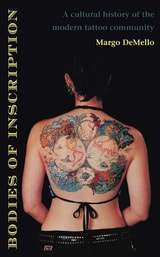
Bodies of Inscription
A Cultural History of the Modern Tattoo CommunityMargo DeMello
Duke University Press, 2004
Community publications, tattoo conventions, articles in popular magazines, and DeMello’s numerous interviews illustrate the interplay between class, culture, and history that orchestrated a shift from traditional Americana and biker tattoos to new forms using Celtic, tribal, and Japanese images. DeMello’s extensive interviews reveal the divergent yet overlapping communities formed by this class-based, American-style repackaging of the tattoo. After describing how the tattoo has moved from a mark of patriotism or rebellion to a symbol of exploration and status, the author returns to the predominantly middle-class movement that celebrates its skin art as spiritual, poetic, and self-empowering. Recognizing that the term “community” cannot capture the variations and class conflict that continue to thrive within the larger tattoo culture, DeMello finds in the discourse of tattooed people and their artists a new and particular sense of community and explores the unexpected relationship between this discourse and that of other social movements.
This ethnography of tattooing in America makes a substantive contribution to the history of tattooing in addition to relating how communities form around particular traditions and how the traditions themselves change with the introduction of new participants. Bodies of Inscription will have broad appeal and will be enjoyed by readers interested in cultural studies, American studies, sociology, popular culture, and body art.

Bodies of Knowledge
Sexuality, Reproduction, and Women's Health in the Second WaveWendy Kline
University of Chicago Press, 2010
Throughout the 1970s and ’80s, women argued that unless they gained access to information about their own bodies, there would be no equality. In Bodies of Knowledge, Wendy Kline considers the ways in which ordinary women worked to position the female body at the center of women’s liberation.
As Kline shows, the struggle to attain this knowledge unified women but also divided them—according to race, class, sexuality, or level of professionalization. Each of the five chapters of Bodies of Knowledge examines a distinct moment or setting of the women’s movement in order to give life to the ideas, expectations, and pitfalls encountered by the advocates of women’s health: the making of Our Bodies, Ourselves (1973); the conflicts surrounding the training and practice of women’s pelvic exams; the emergence of abortion as a feminist issue; the battles over contraceptive regulation at the 1983 Depo-Provera FDA hearings; and the rise of the profession of midwifery. Including an epilogue that considers the experiences of the daughters of 1970s feminists, Bodies of Knowledge is an important contribution to the study of the bodies—that marked the lives—of feminism’s second wave.
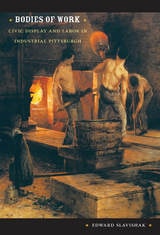
Bodies of Work
Civic Display and Labor in Industrial PittsburghEdward Slavishak
Duke University Press, 2008
Slavishak focuses on the workers whose bodies came to epitomize Pittsburgh, the men engaged in the arduous physical labor demanded by the city’s metals, glass, and coal industries. At the same time, he emphasizes how conceptions of Pittsburgh as quintessentially male limited representations of women in the industrial workplace. The threat of injury or violence loomed large for industrial workers at the turn of the twentieth century, and it recurs throughout Bodies of Work: in the marketing of artificial limbs, statistical assessments of the physical toll of industrial capitalism, clashes between labor and management, the introduction of workplace safety procedures, and the development of a statewide workmen’s compensation system.
Bodies on the Line
Performance and the Sixties Poetry ReadingRaphael Allison
University of Iowa Press, 2014
By comparing these two dominant styles of reading, Allison argues that attention to sixties poetry readings reveals poets struggling between the kind of immediacy and presence that readings suggested and a private retreat from such performance-based publicity, one centered on the text itself. Recordings of Robert Frost, Charles Olson, Gwendolyn Brooks, Larry Eigner, and William Carlos Williams—all of whom emphasized voice, breath, and spoken language and who were inveterate professional readers in the sixties—expose this struggle in often surprising ways. In deconstructing assertions about the role and importance of the poetry reading during this period, Allison reveals just how dramatic, political, and contentious poetry readings could be. By discussing how to "hear" as well as "read" poetry, Bodies on the Line offers startling new vantage points from which to understand American poetry since the 1960s as both performance and text.
Bodie’s Gold
Tall Tales and True History from a California Mining TownMarguerite Sprague
University of Nevada Press, 2011

Body Evidence
Intimate Violence against South Asian Women in AmericaEdited by Shamita Das Dasgupta
Rutgers University Press, 2007
In Body Evidence, more than twenty scholars and public health professionals uncover the unique challenges faced by victims of violence in intimate spaces . . . within families, communities and trusted relationships in South Asian American communities. Topics include cultural obsession with women's chastity and virginity; the continued silence surrounding intimate violence among women who identify themselves as lesbian, bisexual, or transgender; the consequences of refusing marriage proposals or failing to meet dowry demands; and, ultimately, the ways in which the United States courts often confuse and exacerbate the plights of these women.

Body Factory
Exploiting University Athletes' Healthcare for Profit in the Training RoomKaitlin Pericak
Temple University Press, 2025
Body Factory enters an NCAA Division I athletic training room to examine the disconnect between what the NCAA states as its goal of athlete healthcare and what is actually happening. Kaitlin Pericak conducts observations in this space and interviews injured athletes and sports medicine staff members to show how institutional control over “best interests” often ends up exploiting the individual athlete. The influences at work are part of a neoliberal paradigm that explains why interest in an athlete’s care is greatly diminished once they are injured and can no longer play.
Body Factory considers how race, gender, and health before and after injury are deciding factors in these university training centers. The bureaucratic organization has a goal of maintaining power to generate profit, and Pericak shows this is almost always at the expense of the athlete.
Body Language
Sisters in Shape, Black Women's Fitness, and Feminist Identity PoliticsKimberly J. Lau
Temple University Press, 2011
In her evocative ethnographic study, Body Language, Kimberly Lau traces the multiple ways in which the success of an innovative fitness program illuminates what identity means to its Black female clientele and how their group interaction provides a new perspective on feminist theories of identity politics—especially regarding the significance of identity to political activism and social change.
Sisters in Shape, Inc., Fitness Consultants (SIS), a Philadelphia company, promotes balance in physical, mental, and spiritual health. Its program goes beyond workouts, as it educates and motivates women to make health and fitness a priority. Discussing the obstacles at home and the importance of the group's solidarity to their ability to stay focused on their goals, the women speak to the ways in which their commitment to reshaping their bodies is a commitment to an alternative future.
Body Language shows how the group's explorations of black women's identity open new possibilities for identity-based claims to recognition, justice, and social change.

Body Love
The Amazing Career of Bernarr MacfaddenWilliam R. Hunt
University of Wisconsin Press, 1989
Bernarr Macfadden (1868–1955) entertained and instructed Americans for decades. He championed physical exercise, fasting, and diet reform and was the relentless scourge of established doctors. He presented his views in Physical Culture, a popular magazine featuring photographs of strong men and healthy women and articles promoting the healthy life. While some critics derided him as a health nut, no one could dispute his genius as a magazine publisher. He established the world’s greatest magazine publishing empire through the innovation of such popular publications as True Story, the first confession magazine; True Detective; and many others.
Body Parts of Empire
Visual Abjection, Filipino Images, and the American ArchiveNerissa S. Balce
University of Michigan Press, 2016
Rather than focusing on canonical American authors who wrote at the time of U.S. imperialism, this book examines abject texts—images of naked savages, corpses, clothed native elites, and uniformed American soldiers—as well as bodies of writing that document the goodwill and violence of American expansion in the Philippine colony. Contributing to the fields of American studies, Asian American studies, and gender studies, the book analyzes the actual archive of the Philippine-American War and how the racialization and sexualization of the Filipino colonial native have always been part of the cultures of America and U.S. imperialism. By focusing on the Filipino native as an abject body of the American imperial imaginary, this study offers a historical materialist optic for reading the cultures of Filipino America.

Body Story
Julia K. De Pree
Ohio University Press, 2004
For De Pree, between being a girl and being a woman, there was starvation. Body Story is her intimate account of girlhood, virginity, anorexia, and motherhood. De Pree's prose is spare and unguarded, revealing in vivid flashbacks and poignant vignettes the sources of her inner pain.
In high school, the five-foot-ten De Pree weighed as little as 114 pounds. She was too weak to raise her arms above her head. “In a paradoxical way, I starved my body in order to understand my life,” she writes. “I had to place my body in suspension before I could move physically into sexuality. Starving allowed me to create an interim space between innocence and experience.”
De Pree renders the starkness of anorexia along with the process of recovery, relapse, and, ultimately, redemption. She also tells the story of the physical landscape, from her origins in the Midwest to the American South, Paris, and the vast New Mexican desert, as well as the psychic landscape of her body as it encounters the joys and challenges of maturation, childbirth, and motherhood.
De Pree offers readers a new way of understanding women¿s bodily experience, as she writes about the mystery and the meaning of her illness. As many as eight million Americans suffer from eating disorders. Body Story, unlike clinical reports or news accounts, illuminates the complexity of anorexia as the narrative moves toward a subjective and deeply personal truth.
This evocative and often radiant vision is a unique window into womanhood and selfhood in middle-class, contemporary America.
Body and Nation
The Global Realm of U.S. Body Politics in the Twentieth CenturyEmily S. Rosenberg and Shanon Fitzpatrick, eds.
Duke University Press, 2014
Contributors. Frank Costigliola, Janet M. Davis, Shanon Fitzpatrick, Paul A. Kramer, Shirley Jennifer Lim, Mary Ting Yi Lui, Natalia Molina, Brenda Gayle Plummer, Emily S. Rosenberg, Kristina Shull, Annessa C. Stagner, Marilyn B. Young
Body and Soul
The Black Panther Party and the Fight against Medical DiscriminationAlondra Nelson
University of Minnesota Press, 2013
Between its founding in 1966 and its formal end in 1980, the Black Panther Party blazed a distinctive trail in American political culture. The Black Panthers are most often remembered for their revolutionary rhetoric and militant action. Here Alondra Nelson deftly recovers an indispensable but lesser-known aspect of the organization’s broader struggle for social justice: health care. The Black Panther Party’s health activism—its network of free health clinics, its campaign to raise awareness about genetic disease, and its challenges to medical discrimination—was an expression of its founding political philosophy and also a recognition that poor blacks were both underserved by mainstream medicine and overexposed to its harms.
Drawing on extensive historical research as well as interviews with former members of the Black Panther Party, Nelson argues that the Party’s focus on health care was both practical and ideological. Building on a long tradition of medical self-sufficiency among African Americans, the Panthers’ People’s Free Medical Clinics administered basic preventive care, tested for lead poisoning and hypertension, and helped with housing, employment, and social services. In 1971, the party launched a campaign to address sickle-cell anemia. In addition to establishing screening programs and educational outreach efforts, it exposed the racial biases of the medical system that had largely ignored sickle-cell anemia, a disease that predominantly affected people of African descent.
The Black Panther Party’s understanding of health as a basic human right and its engagement with the social implications of genetics anticipated current debates about the politics of health and race. That legacy—and that struggle—continues today in the commitment of health activists and the fight for universal health care.
Body, Remember
A MemoirKenny Fries
University of Wisconsin Press, 2003
In this poetic, introspective memoir, Kenny Fries illustrates his intersecting identities as gay, Jewish, and disabled. While learning about the history of his body through medical records and his physical scars, Fries discovers just how deeply the memories and psychic scars run. As he reflects on his relationships with his family, his compassionate doctor, the brother who resented his disability, and the men who taught him to love, he confronts the challenges of his life. Body, Remember is a story about connection, a redemptive and passionate testimony to one man’s search for the sources of identity and difference.
Boll Weevil Blues
Cotton, Myth, and Power in the American SouthJames C. Giesen
University of Chicago Press, 2011
Between the 1890s and the early 1920s, the boll weevil slowly ate its way across the Cotton South from Texas to the Atlantic Ocean. At the turn of the century, some Texas counties were reporting crop losses of over 70 percent, as were areas of Louisiana, Arkansas, and Mississippi. By the time the boll weevil reached the limits of the cotton belt, it had destroyed much of the region’s chief cash crop—tens of billions of pounds of cotton, worth nearly a trillion dollars.
As staggering as these numbers may seem, James C. Giesen demonstrates that it was the very idea of the boll weevil and the struggle over its meanings that most profoundly changed the South—as different groups, from policymakers to blues singers, projected onto this natural disaster the consequences they feared and the outcomes they sought. Giesen asks how the myth of the boll weevil’s lasting impact helped obscure the real problems of the region—those caused not by insects, but by landowning patterns, antiquated credit systems, white supremacist ideology, and declining soil fertility. Boll Weevil Blues brings together these cultural, environmental, and agricultural narratives in a novel and important way that allows us to reconsider the making of the modern American South.
Bombast And Broadsides
The Lives of George JohnstoneRobin F. A. Fabel
University of Alabama Press, 1987
George Johnstone has never received the scholarly attention he fully merits. Historians have assessed him, usually briefly, as governor of West Florida, or as naval commander, or as a member of parliament. Nevertheless, none has considered his important role in East India Company politics, nor, until Bombast and Broadsides, has one synthesized the various roles in which Johnstone was entrusted with high responsibilities.
Through research in Cardiff, Edinburgh, Kew, London, Philadelphia, and Washington in largely unpublished manuscripts, together with the use of secondary sources, the author has been able to present the first coherent picture of Johnstone, a vigorous and intelligent but turbulent and always controversial figure. Johnstone was effective as a colonial governor at a difficult time; in the navy he performed several coups de main; in parliament he was formidable in debate but an opportunist; and at East India House he was a doughty, conservative, and largely successful defender of the proprietary interest.

Bombs Away
Militarization, Conservation, and Ecological RestorationDavid G. Havlick
University of Chicago Press, 2018
Looking at particular international sites of transition—from Indiana’s Big Oaks National Wildlife Refuge to Cold War remnants along the former Iron Curtain—Havlick argues that these new frontiers of conservation must accomplish seemingly antithetical aims: rebuilding and protecting ecosystems, or restoring life, while also commemorating the historical and cultural legacies of warfare and militarization. Developing these ideas further, he shows that despite the ecological devastation often wrought by military testing and training, these activities need not be inconsistent with environmental goals, and in some cases can even complement them—a concept he calls ecological militarization. A profound, clear explication of landscapes both fraught and fecund, marked by death but also reservoirs of life, Bombs Away shows us how “military activities, conservation goals, and ecological restoration efforts are made to work together to create new kinds of places and new conceptions of place.”

Bombs in the Backyard
Atomic Testing and American PoliticsA. Constandina Titus
University of Nevada Press, 2001
Bonapartists in the Borderlands
French Exiles and Refugees on the Gulf Coast, 1815-1835Rafe Blaufarb
University of Alabama Press, 2005
Bonapartists in the Borderlands debunks the standard account of the Vine and Olive Colony, which stresses the failure of aristocratic, luxury-loving French to tame the wilderness. Rafe Blaufarb recounts how Napoleonic exiles and French refugees from Europe and the Caribbean joined forces with Latin American insurgents, Gulf pirates, and international adventurers to seek their fortune in the Gulf borderlands. The US Congress welcomed the French and granted them a capacious tract of rich Black Belt land near Demopolis, Alabama, on the condition that they would establish a Mediterranean-style Vine and Olive colony.
Blaufard shows that it was not a lack of grit that caused the enterprise to fail. Rather, the Napoleonic officers involved in the colony sold their land shares to speculators to finance an even more perilous adventure—invading the Texas borderlands contested by Spain and the US. Their departure left the Vine and Olive colony in the hands of French refugees from the Haitian slave revolt. They soon abandoned vine cultivation and fused with the neighboring communities of Anglo-American slaveholding cotton planters and speculators.
Rafe Blaufarb examines the underlying motivations and aims that inspired this endeavor and details the nitty-gritty politics, economics, and backroom bargaining that resulted in the settlement. He employs a wide variety of local, national, and international resources: from documents held by the Alabama State Archives, Marengo County court records, and French-language newspapers published in America to material from the War Ministry Archives at Vincennes, the Diplomatic Archives at the Quai d’Orasy, and the French National Archives.

Bonds of Enterprise
John Murray Forbes and Western Development in America's Railway AgeJohn Lauritz Larson
University of Iowa Press, 2001

Bonelight
Ruin And Grace In The New SouthwestMary Sojourner
University of Nevada Press, 2004
Bones of Texas
Photos and Stories from Bygone PlacesMorgan Page and Dustin Rice
University of Texas Press, 2026
Bones on the Ground
Elizabeth O'Maley
Indiana Historical Society Press, 2014

Bong Hits 4 Jesus
A Perfect Constitutional Storm in Alaska's CapitalJames C. Foster
University of Alaska Press, 2010
In January 2002, for the first time, the Olympic Torch Relay visited Alaska on its way to the Winter Games. When the relay runner and accompanying camera cars passed Juneau-Douglas High School, senior Joseph Frederick and several friends unfurled a fourteen-foot banner reading "BONG HiTS 4 JESUS."
An in-depth look at student rights within a public high school, this book chronicles the events that followed: Frederick's suspension, the subsequent suit against the school district, and, ultimately, the escalation of a local conflict into a federal case. Brought to life through interviews with the principal figures in the case, Bong Hits 4 Jesus is a gripping tale of the boundaries of free speech in an American high school.
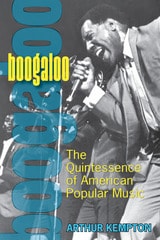
Boogaloo
The Quintessence of American Popular MusicArthur Kempton
University of Michigan Press, 2005
Praise for Boogaloo:
"From Thomas A. Dorsey and gospel to Sam Cooke and the classic age of boogaloo ('soul') to George Clinton and hip hop, this comprehensive analysis of African-American popular music is a deep and gorgeous meditation on its aesthetics and business."
---Henry Louis Gates, Jr., W.E.B. Du Bois Professor of the Humanities, Harvard
"Surpassingly sympathetic and probing. . . . a panoramic critical survey of black popular music over seventy-five years. . . .There is no book quite like it."
---New York Review of Books
". . . moving, dense, and fascinating. . . ."
---New Yorker
". . . a grand and sweeping survey of the history of soul music in America. . . . one of the best books of music journalism. . . ."
---Publisher's Weekly
". . . a fascinating and often original addition to the extensive literature. . . . an astute and witty account. . . . there is plenty in Boogaloo to set the mind and heart alight, as well as some flashes of brilliance and originality rare in music writing today."
---Times Literary Supplement
Boojoo!
An Introduction to Wisconsin WalloonKelly Biers
University of Wisconsin Press, 2026
Walloon is a language still spoken by a minority population in its home country of Belgium. It can also still be found among a few sparse communities descended from Belgian immigrants in northeastern Wisconsin. Although spoken by a small number of people, the language plays a vital role in the ethnic heritage of the state and is audible in local words like “booyah” and “trippe.”
This book is the first to introduce the language without recourse to French, of which Walloon is sometimes mistakenly described as a variant or dialect. With this text, English-language speakers will need nothing more than interest to pick up basic conversational Walloon, thanks to Kelly Biers’s clear guidance for pronunciation, vocabulary, and grammar. Additionally, readers will learn about how this minority language arrived in the Upper Midwest, the history of Belgian American immigration and settlement, and the language’s linguistic features.
Boojoo and welcome to Wisconsin Walloon!
Book Anatomy
Body Politics and the Materiality of Indigenous Book HistoryAmy Gore
University of Massachusetts Press, 2023
Winner of the Beatrice Medicine Award for Scholarship in American Indian Studies
From the marginalia of their readers to the social and cultural means of their production, books bear the imprint of our humanity. Embodying the marks, traces, and scars of colonial survival, Indigenous books are contested spaces. A constellation of nontextual components surrounded Native American–authored publications of the long nineteenth century, shaping how these books were read and understood—including illustrations, typefaces, explanatory prefaces, appendices, copyright statements, author portraits, and more.
Centering Indigenous writers, Book Anatomy explores works from John Rollin Ridge, Sarah Winnemucca Hopkins, Pretty Shield, and D’Arcy McNickle published between 1854 and 1936. In examining critical moments of junction between Indigenous books and a mainstream literary marketplace, Amy Gore argues that the reprints, editions, and paratextual elements of Indigenous books matter: they embody a frontline of colonization in which Native authors battle the public perception and reception of Indigenous books, negotiate representations of Indigenous bodies, and fight for authority and ownership over their literary work.
Book Club Reboot
71 Creative TwistsSarah Ostman
American Library Association, 2019
Book Clubs
Women and the Uses of Reading in Everyday LifeElizabeth Long
University of Chicago Press, 2003

Book Repair
A How-To-Do-It ManualAmerican Library Association, 2011
Booker T. Washington in American Memory
Kenneth M. Hamilton
University of Illinois Press, 2017
Booklist's 1000 Best Young Adult Books Since 2000
American Library Association, 2014
Books Under Fire
Pat R. Scales
American Library Association, 2015
Books Under Fire
A Hit List of Banned and Challenged Children's BooksPat R. Scales
American Library Association, 2021
In our polarized environment, the censorship and outright banning of children’s books which some deem to be controversial or objectionable remains a major concern for libraries. Intellectual freedom champion Scales returns to the fray with a new edition of her matchless guide, updating the focus to titles published since 2015 which have been the target of challenges. School and public librarians, LIS students, and classroom educators will find the assistance and support they need to defend these challenged books with an informed response while ensuring access to young book lovers. For each of the dozens of titles covered, readers will find
- a book summary;
- a report of the specific challenges;
- quotes from reviews, plus a list of awards and accolades;
- talking points for discussing the book's issues and themes;
- links to the book's website, additional resources about the book, and suggested further reading; and
- read-alikes that have been challenged for similar reasons.

Books for Idle Hours
Nineteenth-Century Publishing and the Rise of Summer ReadingDonna Harrington-Lueker
University of Massachusetts Press, 2019
Drawing on publishing records, book reviews, readers' diaries, and popular novels of the period, Donna Harrington-Lueker explores the beginning of summer reading and the backlash against it. Countering fears about the dangers of leisurely reading—especially for young women—publishers framed summer reading not as a disreputable habit but as a respectable pastime and welcome respite. Books for Idle Hours sheds new light on an ongoing seasonal publishing tradition.

Books, Bluster, and Bounty
Local Politics and Carnegie Library Building Grants in the Intermountain West, 1890-1920Susan H. Swetnam
Utah State University Press, 2012
Books, Bluster, and Bounty examines a cross-section of Carnegie library applications to determine how local support was mustered for cultural institutions in the late nineteenth and early twentieth century West. This comparative study considers the entire region between the Rockies and the Cascades/Sierras, including all of Idaho, Utah, Nevada, and Arizona; western Montana, Wyoming, and Colorado; eastern Oregon and Washington; and small parts of California and New Mexico. The author's purpose is to address not only the how of the process but also the variable why. Although virtually all citizens and communities in the West who sought Carnegie libraries expected tangible benefits for themselves that were only tangentially related to books, what they specifically wanted varied in correlation with the diverse nature of western communities. By looking at the detailed records of the Carnegie library campaigns, the author is able to provide an alternative lens through which to perceive and map the social-cultural makeup and town building of western communities at the turn of the century.

Books, Maps, and Politics
A Cultural History of the Library of Congress, 1783-1861Carl Ostrowski
University of Massachusetts Press, 2004
The author explores the relationship between the Library and the period's expanding print culture. He identifies the books that legislators required to be placed in the Library and establishes how these volumes were used. His analysis of the earliest printed catalogs of the Library reveals that law, politics, economics, geography, and history were the subjects most assiduously collected. These books provided government officials with practical guidance in domestic legislation and foreign affairs, including disputes with European powers over territorial boundaries.
Ostrowski also discusses a number of secondary functions of the Library, one of which was to provide reading material for the entertainment and instruction of government officials and their families. As a result, the richness of America's burgeoning literary culture from the 1830s to the 1860s was amply represented on the Library's shelves. For those with access to its Capitol rooms, the Library served an important social function, providing a space for interaction and the display and appreciation of American works of art.
Ostrowski skillfully demonstrates that the history of the Library of Congress offers a lens through which we can view changing American attitudes toward books, literature, and the relationship between the federal government and the world of arts and letters.
Bookwomen
Creating an Empire in Children’s Book Publishing, 1919–1939Jacalyn Eddy
University of Wisconsin Press, 2006
The most comprehensive account of the women who, as librarians, editors, and founders of the Horn Book, shaped the modern children's book industry between 1919 and 1939. The lives of Anne Carroll Moore, Alice Jordan, Louise Seaman Bechtel, May Massee, Bertha Mahony Miller, and Elinor Whitney Field open up for readers the world of female professionalization. What emerges is a vivid illustration of some of the cultural debates of the time, including concerns about "good reading" for children and about women's negotiations between domesticity and participation in the paid labor force and the costs and payoffs of professional life.
Published in collaboration among the University of Wisconsin Press, the Center for the History of Print Culture in Modern America (a joint program of the University of Wisconsin–Madison and the Wisconsin Historical Society), and the University of Wisconsin–Madison General Library System Office of Scholarly Communication.
Boomer Girls
Poems by Women from the Baby Boom GenerationPamela Gemin
University of Iowa Press, 1999
Where were you between Betty Crocker and Gloria Steinem? With that question in mind poets Pamela Gemin and Paula Sergi began collecting the poems in Boomer Girls, an anthology of coming-of-age poems written by women born between 1945 and 1964, give or take a few years on either side. The answers to that question fill this volume with the energy, passion, heartbreak, and giddiness of women's lives from childhood to adolescence to middle age.
The poems in Boomer Girls are by unknown, emerging, and established writers, women who participated in the second wave of feminism. From Sandra Cisneros' "My Wicked Wicked Ways" to Barbara Crooker's "Nearing Menopause, I Run into Elvis at Shoprite," from Wendy Mnookin's "Polio Summer" to Kyoko Mori's "Barbie Says Math Is Hard," these poems call for us to celebrate (in the words of poet Diane Seuss-Brakeman) "glances, romances, beauty and guilt, regret, remorse, rebates and rejuvenations."
Boomer Girls share a common culture, bound by their generation's political history, by pop icons like Barbie—that pedestaled Boomer Girl who's just turned forty—and by the music that's never stopped playing: Janis Joplin, Marvin Gaye, Jimi Hendrix, the Ronettes, Van Morrison, Patsy Cline, John Lennon. The Boomer poets in this feisty anthology speak with diverse voices and embody a wide range of experiences, yet their generation's universal images—the hula hoops, TV shows, finned automobiles, and other household gods of their youth—unite them in ways both hilarious and tender.
Boomtown Blues
Colorado Oil Shale, Revised EditionAndrew Gulliford
University Press of Colorado, 2011
Boomtown Columbus
Ohio’s Sunbelt City and How Developers Got Their WayKevin R. Cox
The Ohio State University Press, 2021
How have development interests become entwined with government? How has a policy of annexation reformed the city’s map? Why have airline service and major league prestige lagged behind its status as a regional center? And what, if anything, makes this city with a reputation for being average stand apart? In Boomtown Columbus, Cox applies both scholarly expertise and his personal experience as a long-time resident of the city to look at the real-life costs of policy. The resulting narrative will fascinate not only locals but anyone with a stake in understanding American cities and a path toward urban livability for all.
Boomtown Saloons
Archaeology And History In Virginia CityKelly J. Dixon
University of Nevada Press, 2006
The image of Old West saloons as sites of violence and raucous entertainment has been perpetuated by film and legend, but the true story of such establishments is far more complex. In Boomtown Saloons, archaeologist Kelly J. Dixon recounts the excavation of four historic saloon sites in Nevada’s Virginia City, one of the West’s most important boomtowns, and shows how the physical traces of this handful of disparate drinking places offer a new perspective on authentic life in the mining West. During the second half of the nineteenth century, the Comstock Lode’s mineral wealth attracted people from all over the world. At its peak, Virginia City had a cosmopolitan population of over 20,000 people. Like people everywhere, they sought to pass their leisure time in congenial company, often in one or another of the four saloons studied here. Dixon’s account of the role these four establishments played in the social and economic life of Virginia City offers keen insight into the businesses and people who made up the backdrop of a mining boomtown. The saloons in this study were quieter than legend would have us believe; they served relatively distinct groups and offered their customers a place of refuge, solidarity, and social contact with peers in a city where few people had longtime ties or initially any close contacts. Boomtown Saloons also offers an equally vivid portrait of the modern historical archaeologist who combines time-honored digging, reconstruction, and analysis methods with such cutting-edge technology as DNA analysis of saliva traces on a 150-year-old pipestem and chemical analysis of the residue in discarded condiment bottles. The book is illustrated with historical photographs and maps, as well as photographs of artifacts uncovered during the excavations of the four sites. Dixon’s sparkling text and thoughtful interpretation of evidence reveal an unknown aspect of daily life in one of the West’s most storied boomtowns and demonstrate that, contrary to legend, the traditional western saloon served an vital and complex social role in its community. Available in hardcover and paperback.

Boots, Bikes, and Bombers
Adventures of Alaska Conservationist Ginny Hill WoodEdited by Karen Brewster
University of Alaska Press, 2012
Border Bandits
Hollywood on the Southern FrontierBy Camilla Fojas
University of Texas Press, 2008
The southern frontier is one of the most emotionally charged zones in the United States, second only to its historical predecessor and partner, the western frontier. Though they span many genres, border films share common themes, trace the mood swings of public policy, and shape our cultural agenda.
In this examination, Camilla Fojas studies how major Hollywood films exploit the border between Mexico and the United States to tell a story about U.S. dominance in the American hemisphere. She charts the shift from the mythos of the open western frontier to that of the embattled southern frontier by offering in-depth analyses of particular border films, from post-World War II Westerns to drug-trafficking films to contemporary Latino/a cinema, within their historical and political contexts.
Fojas argues that Hollywood border films do important social work by offering a cinematic space through which viewers can manage traumatic and undesirable histories and ultimately reaffirm core "American" values. At the same time, these border narratives delineate opposing values and ideas.
Latino border films offer a critical vantage onto these topics; they challenge the presumptions of U.S. nationalism and subsequent cultural attitudes about immigrants and immigration, and often critically reconstruct their Hollywood kin.
By analyzing films such as Duel in the Sun, The Wild Bunch, El Norte, The Border, Traffic, and Brokeback Mountain, Fojas demands that we reexamine the powerful mythology of the Hollywood borderlands. This detailed scrutiny recognizes that these films are part of a national narrative comprised of many texts and symbols that create the myth of the United States as capital of the Americas.