Results by title
28167 books match the query 'History' and 1262 start with b
Bonds of the Dead
Temples, Burial, and the Transformation of Contemporary Japanese BuddhismMark Michael Rowe
University of Chicago Press, 2011
Despite popular images of priests seeking enlightenment in snow-covered mountain temples, the central concern of Japanese Buddhism is death. For that reason, Japanese Buddhism’s social and economic base has long been in mortuary services—a base now threatened by public debate over the status, treatment, and location of the dead. Bonds of the Dead explores the crisis brought on by this debate and investigates what changing burial forms reveal about the ways temple Buddhism is perceived and propagated in contemporary Japan.
Bone Flute to Auto-Tune
Forty Thousand Years of Music TechnologyDeirdre Loughridge
University of Chicago Press, 2026
An accessible history of music technology from the earliest days to the present.
For more than forty thousand years, humans have been using technologies simple and complex to fashion instruments for making music, the earliest surviving examples being simple bone flutes. The first book to offer a history of western music through the lens of tools, Bone Flute to Auto-Tune explores the relationship between music and technology from the Paleolithic Age to the present day. Taking an expansive view of music technology, Deirdre Loughridge develops critical perspectives on on the ways the past is built into the present, the affordances and constraints of tools, and the trade-offs made in adopting one tool rather than another. By examining music-technological transitions from across history, including the violin, piano, cymbal, electric guitar, and synthesizer, Bone Flute to Auto-Tune shows how earlier eras have been built into later technologies, influencing not only the sound of our music but also how our tools can both help and hinder us.
The result is a music history attuned to the possibilities that new technologies open up or reveal and those they foreclose or conceal, and that considers what is gained and lost in the transition from one technology to another. By identifying turning points and trade-offs, a long historical perspective enables us to see alternate paths along which music technologies might have developed, and to grapple with our own moment in the ongoing interplay between technological change and the enduring human need for music.

Bonelight
Ruin And Grace In The New SouthwestMary Sojourner
University of Nevada Press, 2004
Bones of Contention
The living archive of Vasil Levski and the making of Bulgaria's national heroMaria Todorova
Central European University Press, 2009
Bones of Texas
Photos and Stories from Bygone PlacesMorgan Page and Dustin Rice
University of Texas Press, 2026
Bones on the Ground
Elizabeth O'Maley
Indiana Historical Society Press, 2014
Bones, Bodies amd Behavior
Essays in Behavioral AnthropologyEdited by George W. Stocking, Jr.
University of Wisconsin Press, 1990
Bones, Clones, and Biomes
The History and Geography of Recent Neotropical MammalsEdited by Bruce D. Patterson and Leonora P. Costa
University of Chicago Press, 2012
As explorers and scientists have known for decades, the Neotropics harbor a fantastic array of our planet’s mammalian diversity, from capybaras and capuchins to maned wolves and mouse opossums to sloths and sakis. This biological bounty can be attributed partly to the striking diversity of Neotropical landscapes and climates and partly to a series of continental connections that permitted intermittent faunal exchanges with Africa, Antarctica, Australia, and North America. Thus, to comprehend the development of modern Neotropical mammal faunas requires not only mastery of the Neotropics’ substantial diversity, but also knowledge of mammalian lineages and landscapes dating back to the Mesozoic.
Bones, Clones, and Biomes offers just that—an exploration of the development and relationships of the modern mammal fauna through a series of studies that encompass the last 100 million years and both Central and South America. This work serves as a complement to more taxonomically driven works, providing for readers the long geologic and biogeographic contexts that undergird the abundance and diversity of Neotropical mammals. Rather than documenting diversity or distribution, this collection traverses the patterns that the distributions and relationships across mammal species convey, bringing together for the first time geology, paleobiology, systematics, mammalogy, and biogeography. Of critical importance is the book’s utility for current conservation and management programs, part of a rapidly rising conservation paleobiology initiative.
Boojoo!
An Introduction to Wisconsin WalloonKelly Biers
University of Wisconsin Press, 2026
Walloon is a language still spoken by a minority population in its home country of Belgium. It can also still be found among a few sparse communities descended from Belgian immigrants in northeastern Wisconsin. Although spoken by a small number of people, the language plays a vital role in the ethnic heritage of the state and is audible in local words like “booyah” and “trippe.”
This book is the first to introduce the language without recourse to French, of which Walloon is sometimes mistakenly described as a variant or dialect. With this text, English-language speakers will need nothing more than interest to pick up basic conversational Walloon, thanks to Kelly Biers’s clear guidance for pronunciation, vocabulary, and grammar. Additionally, readers will learn about how this minority language arrived in the Upper Midwest, the history of Belgian American immigration and settlement, and the language’s linguistic features.
Boojoo and welcome to Wisconsin Walloon!
Book Anatomy
Body Politics and the Materiality of Indigenous Book HistoryAmy Gore
University of Massachusetts Press, 2023
Winner of the Beatrice Medicine Award for Scholarship in American Indian Studies
From the marginalia of their readers to the social and cultural means of their production, books bear the imprint of our humanity. Embodying the marks, traces, and scars of colonial survival, Indigenous books are contested spaces. A constellation of nontextual components surrounded Native American–authored publications of the long nineteenth century, shaping how these books were read and understood—including illustrations, typefaces, explanatory prefaces, appendices, copyright statements, author portraits, and more.
Centering Indigenous writers, Book Anatomy explores works from John Rollin Ridge, Sarah Winnemucca Hopkins, Pretty Shield, and D’Arcy McNickle published between 1854 and 1936. In examining critical moments of junction between Indigenous books and a mainstream literary marketplace, Amy Gore argues that the reprints, editions, and paratextual elements of Indigenous books matter: they embody a frontline of colonization in which Native authors battle the public perception and reception of Indigenous books, negotiate representations of Indigenous bodies, and fight for authority and ownership over their literary work.

Book and Verse
A Guide to Middle English Biblical LiteratureJames H. Morey
University of Illinois Press, 2000
Book and Verse is an indispensable guide to the variety and extent of biblical literature in England, exclusive of drama and the Wycliffite Bible that appeared between the twelfth and the fifteenth centuries. Entries provide detailed information on how much of what parts of the Bible appear in Middle English and where this biblical material can be found. Comprehensive indexing by name, keyword, and biblical verse allows a researcher to find, for example, all the occurrences of the Flood Story or of the encounter between Elijah and the Widow of Sarephta. An invaluable resource, Book and Verse provides the first easy access to the "popular Bible" assembled before and after John Wyclif's translation of the Vulgate into English.
Book of Abraham Apologetics
A Review and CritiqueDan Vogel
Signature Books, 2021

Book of Beasts
A Facsimile of MS. Bodley 764Christopher de Hamel
Bodleian Library Publishing, 2008
Book of Healing
Joseph Odùmósù
University of Wisconsin Press, 2026
While the existence of Odùmósù’s massive work is well-known in southwestern Nigeria, it has not previously been available in English. Michael Ọládẹ̀jọ Afọláyan and Helen Tilley have translated the volume in its entirety, and here use it as an entrée into greater understandings of Yorùbá medicine, spirituality, and print culture during a time of rapid change under British colonialism and the spread of Christianity.

Bookchin
A Critical AppraisalDamian F. White
Pluto Press, 2008
This is the first comprehensive overview of the work of Murray Bookchin, the left-libertarian social theorist and political ecologist who is widely regarded as the visionary precursor of anti-corporate politics.
Bookchin's writing spans fifty years and engages with a wide variety of issues: from ecology to urban planning, from environmental ethics to debates about radical democracy. Weaving insights from Hegel and Marx, Kropotkin and Mumford, Bookchin presents a critical theory whose central utopian message is 'things could be other than they are'.
This accessible introduction maps the evolution of Bookchin’s project. It traces his controversial engagements with Marxism, anarchism, critical theory, postmodernism and eco-centric thought. It evaluates his attempt to develop a social ecology. Finally, it considers how his thinking relates to current debates in social theory and environmentalism, critical theory and philosophy, political ecology and urban theory.
Offering a clear account of Bookchin's key themes, this book provides a critical but sympathetic account of the strengths and weaknesses of Bookchin's writing.
Booker T. Washington Papers Volume 1
The Autobiographical WritingsBooker T. Washington
University of Illinois Press, 1972
Volume 1 contains Washington's Up from Slavery, one of the most widely read American autobiographies, in addition to The Story of My Life and Work, and six other autobiographical writings. Together, the selections provide readers with a first step toward understanding Washington and his immense impact. These writings reveal the moral values he absorbed from his mid-nineteenth-century experiences and teachers. As importantly, they present him to the world as he wished to be seen: as the black version of the American success hero and an exemplar of the Puritan work ethic that he believed to be the secret of his success. These works, along with so much of Washington's writing, served as a model for many black Americans striving to overcome poverty and prejudice.
Booker T. Washington Papers Volume 3
1889-95. Assistant editors, Stuart B. Kaufman and Raymond W. SmockBooker T. Washington. Edited by Louis R. Harlan, Assistant editors, Stuart B. Kaufman and Raymond W. Smock
University of Illinois Press, 1974
Booker T. Washington in American Memory
Kenneth M. Hamilton
University of Illinois Press, 2017

Books Like Sapphires
From the Library of Congress Judaica CollectionAnn Brener
Brandeis University Press, 2024
Books Like Sapphires showcases a wide range of Hebraic treasures from the storied collection at the Library of Congress, many of them for the first time. Tracing the history of Judaica collecting in the twentieth-century United States, the book illuminates varied works, telling their stories alongside vibrant color images. These include a unique manuscript about a betrothal scandal in Renaissance Crete, an illustrated Esther Scroll, a poem from 1477 celebrating the new technology of printing, amusing rhymed couplets in sixteenth-century Padua, and the Washington Haggadah. This book also tells the story of the patrons and collectors, first among them Jacob Schiff, as well as archivists and curators, who made the storied Judaica archive at the Library of Congress the precious resource that it is today.

Books against Tyranny
Catalan Publishers under FrancoLaura Vilardell
Vanderbilt University Press, 2022
Author Laura Vilardell examines documents including firsthand witness accounts, correspondence, memoirs, censorship files, newspapers, original interviews, and unpublished material housed in various Spanish archives. As such, Books against Tyranny opens up the field and serves as an informative tool for scholars of Franco's Spain, Catalan social movements, and censorship more generally.

Books for Idle Hours
Nineteenth-Century Publishing and the Rise of Summer ReadingDonna Harrington-Lueker
University of Massachusetts Press, 2019
Drawing on publishing records, book reviews, readers' diaries, and popular novels of the period, Donna Harrington-Lueker explores the beginning of summer reading and the backlash against it. Countering fears about the dangers of leisurely reading—especially for young women—publishers framed summer reading not as a disreputable habit but as a respectable pastime and welcome respite. Books for Idle Hours sheds new light on an ongoing seasonal publishing tradition.

Books of Secrets
Natural Philosophy in England, 1550-1600Allison Kavey
University of Illinois Press, 2007
Books of the Body
Anatomical Ritual and Renaissance LearningAndrea Carlino
University of Chicago Press, 1999
In Books of the Body, Andrea Carlino explores the nature and causes of this intellectual inertia. On the one hand, anatomical practice was constrained by a reverence for classical texts and the belief that the study of anatomy was more properly part of natural philosophy than of medicine. On the other hand, cultural resistance to dissection and dismemberment of the human body, as well as moral and social norms that governed access to cadavers and the ritual of their public display in the anatomy theater, also delayed anatomy's development.
A fascinating history of both Renaissance anatomists and the bodies they dissected, this book will interest anyone studying Renaissance science, medicine, art, religion, and society.
Books, Bluster, and Bounty
Local Politics and Carnegie Library Building Grants in the Intermountain West, 1890-1920Susan H. Swetnam
Utah State University Press, 2012
Books, Bluster, and Bounty examines a cross-section of Carnegie library applications to determine how local support was mustered for cultural institutions in the late nineteenth and early twentieth century West. This comparative study considers the entire region between the Rockies and the Cascades/Sierras, including all of Idaho, Utah, Nevada, and Arizona; western Montana, Wyoming, and Colorado; eastern Oregon and Washington; and small parts of California and New Mexico. The author's purpose is to address not only the how of the process but also the variable why. Although virtually all citizens and communities in the West who sought Carnegie libraries expected tangible benefits for themselves that were only tangentially related to books, what they specifically wanted varied in correlation with the diverse nature of western communities. By looking at the detailed records of the Carnegie library campaigns, the author is able to provide an alternative lens through which to perceive and map the social-cultural makeup and town building of western communities at the turn of the century.
Books, Maps, and Politics
A Cultural History of the Library of Congress, 1783-1861Carl Ostrowski
University of Massachusetts Press, 2004
The author explores the relationship between the Library and the period's expanding print culture. He identifies the books that legislators required to be placed in the Library and establishes how these volumes were used. His analysis of the earliest printed catalogs of the Library reveals that law, politics, economics, geography, and history were the subjects most assiduously collected. These books provided government officials with practical guidance in domestic legislation and foreign affairs, including disputes with European powers over territorial boundaries.
Ostrowski also discusses a number of secondary functions of the Library, one of which was to provide reading material for the entertainment and instruction of government officials and their families. As a result, the richness of America's burgeoning literary culture from the 1830s to the 1860s was amply represented on the Library's shelves. For those with access to its Capitol rooms, the Library served an important social function, providing a space for interaction and the display and appreciation of American works of art.
Ostrowski skillfully demonstrates that the history of the Library of Congress offers a lens through which we can view changing American attitudes toward books, literature, and the relationship between the federal government and the world of arts and letters.
Bookwomen
Creating an Empire in Children’s Book Publishing, 1919–1939Jacalyn Eddy
University of Wisconsin Press, 2006
The most comprehensive account of the women who, as librarians, editors, and founders of the Horn Book, shaped the modern children's book industry between 1919 and 1939. The lives of Anne Carroll Moore, Alice Jordan, Louise Seaman Bechtel, May Massee, Bertha Mahony Miller, and Elinor Whitney Field open up for readers the world of female professionalization. What emerges is a vivid illustration of some of the cultural debates of the time, including concerns about "good reading" for children and about women's negotiations between domesticity and participation in the paid labor force and the costs and payoffs of professional life.
Published in collaboration among the University of Wisconsin Press, the Center for the History of Print Culture in Modern America (a joint program of the University of Wisconsin–Madison and the Wisconsin Historical Society), and the University of Wisconsin–Madison General Library System Office of Scholarly Communication.
Boomtown Blues
Colorado Oil Shale, Revised EditionAndrew Gulliford
University Press of Colorado, 2011
Boomtown Columbus
Ohio’s Sunbelt City and How Developers Got Their WayKevin R. Cox
The Ohio State University Press, 2021
How have development interests become entwined with government? How has a policy of annexation reformed the city’s map? Why have airline service and major league prestige lagged behind its status as a regional center? And what, if anything, makes this city with a reputation for being average stand apart? In Boomtown Columbus, Cox applies both scholarly expertise and his personal experience as a long-time resident of the city to look at the real-life costs of policy. The resulting narrative will fascinate not only locals but anyone with a stake in understanding American cities and a path toward urban livability for all.
Boomtown Saloons
Archaeology And History In Virginia CityKelly J. Dixon
University of Nevada Press, 2006
The image of Old West saloons as sites of violence and raucous entertainment has been perpetuated by film and legend, but the true story of such establishments is far more complex. In Boomtown Saloons, archaeologist Kelly J. Dixon recounts the excavation of four historic saloon sites in Nevada’s Virginia City, one of the West’s most important boomtowns, and shows how the physical traces of this handful of disparate drinking places offer a new perspective on authentic life in the mining West. During the second half of the nineteenth century, the Comstock Lode’s mineral wealth attracted people from all over the world. At its peak, Virginia City had a cosmopolitan population of over 20,000 people. Like people everywhere, they sought to pass their leisure time in congenial company, often in one or another of the four saloons studied here. Dixon’s account of the role these four establishments played in the social and economic life of Virginia City offers keen insight into the businesses and people who made up the backdrop of a mining boomtown. The saloons in this study were quieter than legend would have us believe; they served relatively distinct groups and offered their customers a place of refuge, solidarity, and social contact with peers in a city where few people had longtime ties or initially any close contacts. Boomtown Saloons also offers an equally vivid portrait of the modern historical archaeologist who combines time-honored digging, reconstruction, and analysis methods with such cutting-edge technology as DNA analysis of saliva traces on a 150-year-old pipestem and chemical analysis of the residue in discarded condiment bottles. The book is illustrated with historical photographs and maps, as well as photographs of artifacts uncovered during the excavations of the four sites. Dixon’s sparkling text and thoughtful interpretation of evidence reveal an unknown aspect of daily life in one of the West’s most storied boomtowns and demonstrate that, contrary to legend, the traditional western saloon served an vital and complex social role in its community. Available in hardcover and paperback.

Boots, Bikes, and Bombers
Adventures of Alaska Conservationist Ginny Hill WoodEdited by Karen Brewster
University of Alaska Press, 2012

Borchert Field
Stories from Milwaukee’s Legendary BallparkBob Buege
Wisconsin Historical Society Press, 2017
Someone lucky enough to live on Milwaukee’s near north side between 1888 and 1952 could experience the world without ever leaving the neighborhood. Nestled between North Seventh and Eighth Streets and West Chambers and Burleigh, Borchert Field was Milwaukee’s major sports venue for 64 years. In this rickety wooden stadium (originally called Athletic Park), Wisconsin residents had a close-up view of sports history in the making, along with rodeos, thrill shows, and even multiple eruptions of Mount Vesuvius. In Borchert Field, baseball historian Bob Buege introduces the famous and fascinating athletes who dazzled audiences in Milwaukee’s venerable ballpark. All the legendary baseball figures—the Bambino, Satchel Paige, Ty Cobb, Joltin’ Joe, Jackie Robinson, the Say Hey Kid—played there. Olympic heroes Jim Thorpe, Babe Didrikson, and Jesse Owens displayed their amazing talents in Borchert. Knute Rockne’s Fighting Irish competed there, and Curly Lambeau’s Green Bay Packers took the field 10 times. Buege tells stories of other monumental moments at Borchert as well, including a presidential visit, women ballplayers, the arrival of television broadcasting, the 1922 national balloon race, and an appearance by scat-singing bandleader Cab Calloway. Borchert Field is long gone, but every page of this book takes readers back to the sights, sounds, and spectacle of its heyday.

Border Air
A History of US-Mexico Environmental CooperationLaura M. Uribarri
University of Texas Press, 0
Tracing a century of pollution and transnational collaboration in the Paso del Norte air basin.
The air knows no borders, which makes atmospheric pollution a devilish legal and environmental challenge. The problem is especially dangerous in the Paso del Norte, where the industry and urbanization of Juárez-El Paso stretch across the international boundary, and surrounding mountains trap airborne pollutants. Laura Uribarri traces the nineteenth- and twentieth-century transformations of the region, uncovering the sources of pollution and analyzing transnational efforts to regulate and improve the air.
Border Air shows how a favorable location, rail expansion, and numerous trade and labor agreements made Juárez-El Paso a global manufacturing hub, leading to unfettered growth and declining air quality. By the mid-1990s, El Paso and Juárez ranked among the most polluted cities on the continent. Environmental treaties crafted in Washington and Mexico City made little difference. But fronterizos themselves had an impact. Uribarri focuses on the Paso del Norte Air Quality Task Force, a citizen group that pioneered successful mitigation projects such as working with emitters to design cleaner production methods without disrupting workers’ livelihoods. This history shows what can be accomplished at the grassroots and offers lessons on how border communities can collaborate to address complex environmental problems.
Border Citizens
The Making of Indians, Mexicans, and Anglos in ArizonaBy Eric V. Meeks; foreword by Patricia Nelson Limerick
University of Texas Press, 2007
In Border Citizens, historian Eric V. Meeks explores how the racial classification and identities of the diverse indigenous, mestizo, and Euro-American residents of Arizona’s borderlands evolved as the region was politically and economically incorporated into the United States. First published in 2007, the book examines the complex relationship between racial subordination and resistance over the course of a century. On the one hand, Meeks links the construction of multiple racial categories to the process of nation-state building and capitalist integration. On the other, he explores how the region’s diverse communities altered the blueprint drawn up by government officials and members of the Anglo majority for their assimilation or exclusion while redefining citizenship and national belonging.
The revised edition of this highly praised and influential study features dozens of new images, an introductory essay by historian Patricia Nelson Limerick, and a chapter-length afterword by the author. In his afterword, Meeks details and contextualizes Arizona’s aggressive response to undocumented immigration and ethnic studies in the decade after Border Citizens was first published, demonstrating that the broad-based movement against these measures had ramifications well beyond Arizona. He also revisits the Yaqui and Tohono O’odham nations on both sides of the Sonora-Arizona border, focusing on their efforts to retain, extend, and enrich their connections to one another in the face of increasingly stringent border enforcement.
Border Contraband
A History of Smuggling across the Rio GrandeBy George T. Díaz
University of Texas Press, 2015
Border Dilemmas
Racial and National Uncertainties in New Mexico, 1848–1912Anthony Mora
Duke University Press, 2011

Border Diplomacy
The Caroline and McLeod Affairs in Anglo-American-Canadian Relations, 1837-1842Kenneth R. Stevens
University of Alabama Press, 1989
Long after Americans and Britons signed treaties ending the Revolutionary War and the War of 1812, ill will between the two nations simmered under the surface of their relations and periodically boiled over. In the mid-nineteenth century, Americans, the British, and British subjects in Canada continued to dispute borders, sovereign rights and responsibilities, and the American republican experiment.
Some of the antagonism arose from a fundamental difference in attitude toward democracy. Britons believed that democratic government was inadequate to control the baser elements of a population. Further, they disliked the aggressiveness and arrogance of their former colonists. Americans sensed and resented this contempt; in turn, they regarded British aristocratic pretensions with scorn and believed that country sought world domination. In view of such attitudes, even relatively minor incidents threatened to erupt into violence between the two nations. Such was the case in 1837, when British troops set fire to the American steamer Caroline in American waters, killing a United States citizen, and in 1840, when the state of New York arrested a Canadian, Alexander McLeod, for the murder.
These events, taken together, are not simply examples of diplomatic relations or political problems for particular administrations. The dash of attitudes and loyalties along the American-Canadian frontier also demonstrates the instability of the border region, socially as well as politically, and conflicting motives of patriotism and political opportunism in both the American and British governments. Thus, the Caroline and McLeod affairs, occurring as they did at a pivotal moment in American history, reveal how the republic began to mature in its relations with its long-established forebear, refined its own definitions of state and federal powers, and established itself as a nation contributing to, as well as influenced by, international law.

Border Land, Border Water
A History of Construction on the US-Mexico DivideBy C. J. Alvarez
University of Texas Press, 2019
Winner, Abbott Lowell Cummings Award, Vernacular Architecture Forum, 2020
Winner, Elisabeth Blair MacDougall Book Award, Society of Architectural Historians, 2021
From the boundary surveys of the 1850s to the ever-expanding fences and highway networks of the twenty-first century, Border Land, Border Water examines the history of the construction projects that have shaped the region where the United States and Mexico meet.
Tracing the accretion of ports of entry, boundary markers, transportation networks, fences and barriers, surveillance infrastructure, and dams and other river engineering projects, C. J. Alvarez advances a broad chronological narrative that captures the full life cycle of border building. He explains how initial groundbreaking in the nineteenth century transitioned to unbridled faith in the capacity to control the movement of people, goods, and water through the use of physical structures. By the 1960s, however, the built environment of the border began to display increasingly obvious systemic flaws. More often than not, Alvarez shows, federal agencies in both countries responded with more construction—“compensatory building” designed to mitigate unsustainable policies relating to immigration, black markets, and the natural world. Border Land, Border Water reframes our understanding of how the border has come to look and function as it does and is essential to current debates about the future of the US-Mexico divide.
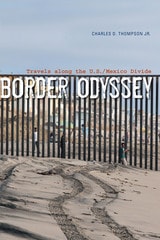
Border Odyssey
Travels along the U.S./Mexico DivideBy Charles D. Thompson, Jr.
University of Texas Press, 2015
“We were trying to change the vision and the conversation about border fears.”
Border Odyssey takes us on a drive toward understanding the U.S./Mexico divide: all 1,969 miles—from Boca Chica to Tijuana—pressing on with the useful fiction of a map.
“We needed to go to the place where countless innocent people had been kicked, cussed, spit on, arrested, detained, trafficked, and killed. It would become clear that the border, la frontera, was more multifaceted and profound than anything we could have invented about it from afar.”
Along the journey, five centuries of cultural history (indigenous, French, Spanish, Mexican, African American, colonist, and U.S.), wars, and legislation unfold. And through observation, conversation, and meditation, Border Odyssey scopes the stories of the people and towns on both sides.
“Stories are the opposite of walls: they demand release, retelling, showing, connecting, each image chipping away at boundaries. Walls are full stops. But stories are like commas, always making possible the next clause.”
Among the terrain traversed: walls and more walls, unexpected roadblocks and patrol officers; a golf course (you could drive a ball across the border); a Civil War battlefield (you could camp there); the southernmost plantation in the United States; a hand-drawn ferry, a road-runner tracked desert, and a breathtaking national park; barbed wire, bridges, and a trucking-trade thoroughfare; ghosts with guns; obscured, unmarked, and unpaved roads; a Catholic priest and his dogs, artwork, icons, and political cartoons; a sheriff and a chain-smoking mayor; a Tex-Mex eatery empty of customers and a B&B shuttering its doors; murder-laden newspaper headlines at breakfast; the kindness of the border-crossing underground; and too many elderly, impoverished, ex-U.S. farmworkers, braceros, lined up to have Thompson take their photograph.
Border Policing
A History of Enforcement and Evasion in North AmericaEdited by Holly M. Karibo and George T. Díaz
University of Texas Press, 2020
An interdisciplinary group of borderlands scholars provide the first expansive comparative history of the way North American borders have been policed—and transgressed—over the past two centuries.
An extensive history examining how North American nations have tried (and often failed) to police their borders, Border Policing presents diverse scholarly perspectives on attempts to regulate people and goods at borders, as well as on the ways that individuals and communities have navigated, contested, and evaded such regulation.
The contributors explore these power dynamics though a series of case studies on subjects ranging from competing allegiances at the northeastern border during the War of 1812 to struggles over Indian sovereignty and from the effects of the Mexican Revolution to the experiences of smugglers along the Rio Grande during Prohibition. Later chapters stretch into the twenty-first century and consider immigration enforcement, drug trafficking, and representations of border policing in reality television. Together, the contributors explore the powerful ways in which federal authorities impose political agendas on borderlands and how local border residents and regions interact with, and push back against, such agendas. With its rich mix of political, legal, social, and cultural history, this collection provides new insights into the distinct realities that have shaped the international borders of North America.
Border Renaissance
The Texas Centennial and the Emergence of Mexican American LiteratureBy John Morán González
University of Texas Press, 2009
The Texas Centennial of 1936, commemorated by statewide celebrations of independence from Mexico, proved to be a powerful catalyst for the formation of a distinctly Mexican American identity. Confronted by a media frenzy that vilified "Meskins" as the antithesis of Texan liberty, Mexican Americans created literary responses that critiqued these racialized representations while forging a new bilingual, bicultural community within the United States. The development of a modern Tejana identity, controversies surrounding bicultural nationalism, and other conflictual aspects of the transformation from mexicano to Mexican American are explored in this study. Capturing this fascinating aesthetic and political rebirth, Border Renaissance presents innovative readings of important novels by María Elena Zamora O'Shea, Américo Paredes, and Jovita González. In addition, the previously overlooked literary texts by members of the League of United Latin American Citizens (LULAC) are given their first detailed consideration in this compelling work of intellectual and literary history.
Drawing on extensive archival research in the English and Spanish languages, John Morán González revisits the 1930s as a crucial decade for the vibrant Mexican American reclamation of Texas history. Border Renaissance pays tribute to this vital turning point in the Mexican American struggle for civil rights.
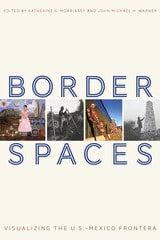
Border Spaces
Visualizing the U.S.-Mexico FronteraEdited by Katherine G. Morrissey and John-Michael H. Warner
University of Arizona Press, 2018
In Border Spaces, Katherine G. Morrissey, John-Michael H. Warner, and other essayists build on the insights of border dwellers, or fronterizos, and draw on two interrelated fields—border art history and border studies. The editors engage in a conversation on the physical landscape of the border and its representations through time, art, and architecture.
The volume is divided into two linked sections—one on border histories of built environments and the second on border art histories. Each section begins with a “conversation” essay—co-authored by two leading interdisciplinary scholars in the relevant fields—that weaves together the book’s thematic questions with the ideas and essays to follow.
Border Spaces is prompted by art and grounded in an academy ready to consider the connections between art, land, and people in a binational region.
Contributors
Maribel Alvarez
Geraldo Luján Cadava
Amelia Malagamba-Ansótegui
Mary E. Mendoza
Sarah J. Moore
Katherine G. Morrissey
Margaret Regan
Rebecca M. Schreiber
Ila N. Sheren
Samuel Truett
John-Michael H. Warner
Border Watch
Cultures of Immigration, Detention and ControlAlexandra Hall
Pluto Press, 2012
Questions over immigration and asylum face almost all Western countries. Should only economically useful immigrants be allowed? What should be done with unwanted or 'illegal' immigrants? In this bold and original intervention, Alexandra Hall shows that immigration detention centres offer a window onto society's broader attitudes towards immigrants.
Despite periodic media scandals, remarkably little has been written about the everyday workings of the grassroots immigration system, or about the people charged with enacting immigration policy at local levels. Detention, particularly, is a hidden side of border politics, despite its growing international importance as a tool of control and security. This book fills the gap admirably, analysing the everyday encounters between officers and immigrants in detention to explore broad social trends and theoretical concerns.
This highly topical book provides rare insights into the treatment of the 'other' and will be essential for policy makers and students studying anthropology and sociology.
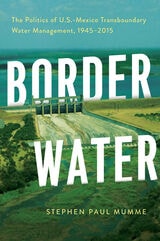
Border Water
The Politics of U.S.-Mexico Transboundary Water Management, 1945–2015Stephen Paul Mumme
University of Arizona Press, 2023
The international boundary between the United States and Mexico spans more than 1,900 miles. Along much of this international border, water is what separates one country from the other. Border Water provides a historical account of the development of governance related to transboundary and border water resources between the United States and Mexico in the last seventy years.
This work examines the phases and pivot points in the development of U.S.-Mexico border water resources and reviews the theoretical approaches and explanation that impart a better understanding of these events. Author Stephen Paul Mumme, a leading expert in water policy and border studies, describes three important periods in the chronology of transboundary water management. First, Mumme examines the 1944 Water Treaty, the establishment of the International Boundary and Water Commission (IBWC) in 1945, and early transborder politics between the two governments. Next, he describes the early 1970s and the rise of environmentalism. In this period, pollution and salinization of the Colorado River Delta come into focus. Mumme shows how new actors, now including environmentalists and municipalities, broadened and strengthened the treaty’s applications in transboundary water management. The third period of transborder interaction described covers the opening and restricting of borders due to NAFTA and then 9/11.
Border Water places transboundary water management in the frame of the larger binational relationship, offering a comprehensive history of transnational water management between the United States and Mexico. As we move into the next century of transnational water management, this important work offers critical insights into lessons learned and charts a path for the future.
Bordering on War
A Social and Political History of KhuzestanShaherzad Ahmadi
University of Texas Press, 2024
A study of transnational identity, migration, and state loyalties told through the social and political history of Iran’s Khuzestan province.
In 1980, Saddam Hussein’s Ba‘athist forces invaded Khuzestan, one of the oldest and richest provinces in Iran, triggering the Iran-Iraq War. Shaherzad Ahmadi’s Bordering on War examines the social history of Khuzestan and sheds light on how border dwellers, provincial leaders, and migrants in the region shaped Iran and Iraq's history before, during, and after the war.
Drawing from a rich collection of Persian- and Arabic-language archival sources—rarely used by western scholars due to restrictions in Iran—Ahmadi’s research focuses on Arab Iranians and argues that Iranian border dwellers and migrants formed local, non-national loyalties, thereby eschewing bureaucratic pressures to confine loyalties to a single nation-state. The transnational character and ethnically diverse composition of Khuzestan, especially in the oil-rich towns on the southwestern border, led many, including Iraq’s Ba‘ath Party, to question the national belonging of Arab Iranians. Bordering on War contributes to a wider discussion about the ability of individuals and communities to exert agency through migration, trade, education, and other activities.
Borderland Dreams
The Transnational Lives of Korean Chinese WorkersJune Hee Kwon
Duke University Press, 2023
Borderland Lives in Northern South Asia
David N. Gellner, ed.
Duke University Press, 2013
Contributors. Jason Cons, Rosalind Evans, Nicholas Farrelly, David N. Gellner, Radhika Gupta, Sondra L. Hausner, Annu Jalais, Vibha Joshi, Nayanika Mathur, Deepak K. Mishra, Anastasia Piliavsky, Jeevan R. Sharma, Willem van Schendel
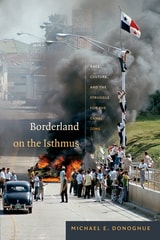
Borderland on the Isthmus
Race, Culture, and the Struggle for the Canal ZoneMichael E. Donoghue
Duke University Press, 2014
Borderlands Curanderos
The Worlds of Santa Teresa Urrea and Don Pedrito JaramilloBy Jennifer Koshatka Seman
University of Texas Press, 2021
2022 Americo Paredes Award, Center for Mexican American Studies at South Texas College
A historical exploration of the worlds and healing practices of two curanderos (faith healers) who attracted thousands, rallied their communities, and challenged institutional powers.
Santa Teresa Urrea and Don Pedrito Jaramillo were curanderos—faith healers—who, in the late nineteenth and early twentieth centuries, worked outside the realm of "professional medicine," seemingly beyond the reach of the church, state, or certified health practitioners whose profession was still in its infancy. Urrea healed Mexicans, Indigenous people, and Anglos in northwestern Mexico and cities throughout the US Southwest, while Jaramillo conducted his healing practice in the South Texas Rio Grande Valley, healing Tejanos, Mexicans, and Indigenous people there. Jennifer Koshatka Seman takes us inside the intimate worlds of both "living saints," demonstrating how their effective healing—curanderismo—made them part of the larger turn-of-the century worlds they lived in as they attracted thousands of followers, validated folk practices, and contributed to a modernizing world along the US-Mexico border.
While she healed, Urrea spoke of a Mexico in which one did not have to obey unjust laws or confess one's sins to Catholic priests. Jaramillo restored and fed drought-stricken Tejanos when the state and modern medicine could not meet their needs. Then, in 1890, Urrea was expelled from Mexico. Within a decade, Jaramillo was investigated as a fraud by the American Medical Association and the US Post Office. Borderlands Curanderos argues that it is not only state and professional institutions that build and maintain communities, nations, and national identities but also those less obviously powerful.
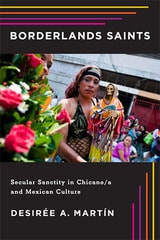
Borderlands Saints
Secular Sanctity in Chicano/a and Mexican CultureMartín, Desirée A
Rutgers University Press, 2013
Winner of the 2014 Latina/o Studies Section - LASA Outstanding Book Award
In Borderlands Saints, Desirée A. Martín examines the rise and fall of popular saints and saint-like figures in the borderlands of the United States and Mexico. Focusing specifically on Teresa Urrea (La Santa de Cabora), Pancho Villa, César Chávez, Subcomandante Marcos, and Santa Muerte, she traces the intersections of these figures, their devotees, artistic representations, and dominant institutions with an eye for the ways in which such unofficial saints mirror traditional spiritual practices and serve specific cultural needs.
Popular spirituality of this kind engages the use and exchange of relics, faith healing, pilgrimages, and spirit possession, exemplifying the contradictions between high and popular culture, human and divine, and secular and sacred. Martín focuses upon a wide range of Mexican and Chicano/a cultural works drawn from the nineteenth century to the present, covering such diverse genres as the novel, the communiqué, drama, the essay or crónica, film, and contemporary digital media. She argues that spiritual practice is often represented as narrative, while narrative—whether literary, historical, visual, or oral—may modify or even function as devotional practice.
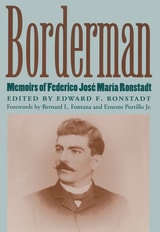
Borderman
Memoirs of Federico José María RonstadtEdited by Edward F. Ronstadt; Forewords by Bernard L. Fontana and Ernesto Portillo, Jr.
University of Arizona Press, 2003
Writing proudly of his Mexican and American heritages, Ronstadt offers readers an extraordinary portrait of the Arizona-Mexico borderlands during the late nineteenth century. His memoirs provide a richness of detail and insight unmatched by traditional histories, relating such scenarios as the hardships of Yaqui hardrock miners working under primitive conditions, the travails of pearl divers in the Gulf of California, and the insurrection of Francisco Serna in 1875 Sonora. They also depict the simple activities of childhood, with its schooling and musical training, its games and mischief. Ronstadt relates his apprenticeship to a wagon- and carriage-maker in Tucson, recalling labor relations in the shop, the establishment of his own business, and the joys and anguish of his personal life. He tells of how he drew on talents nurtured in childhood to become a musician and bandleader, playing weekly concerts with Club Filarmónica Tucsonense for nine years—musical talents that were eventually passed on to his children, his grandchildren (including Linda), and great-grandchildren.
Through Ronstadt's memories, we are better able to understand the sense of independence and self-reliance found today among many lifelong residents of Sonora and Baja California—people isolated from major supply sources and centers of power—and to appreciate a different view of Tucson's past. Enhanced by 22 historical photos, Borderman is a treasure trove of historical source material that will enlighten all readers interested in borderlands history.