1677 books match the query 'Archaeology' and 71 start with b
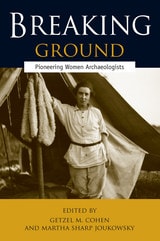
cover of Breaking Ground: Pioneering Women Archaeologists

Breaking Ground

Pioneering Women Archaeologists

Getzel M. Cohen and Martha Sharp Joukowsky, Editors

University of Michigan Press, 2004

"At the close of the Victorian era, two generations of intrepid women abandoned Grand Tour travel for the rigors of archaeological expeditions, shining the light of scientific exploration on Old World antiquity. Breaking Ground highlights the remarkable careers of twelve pioneers---a compelling narrative of personal, social, intellectual, and historical achievement."
-Claire Lyons, The Getty Museum


"Behind these pioneering women lie a wide range of fascinating and inspiring life stories. Though each of their tales is unique, they were all formidable scholars whose important contributions changed the field of archaeology. Kudos to the authors for making their stories and accomplishments known to us all!"
-Jodi Magness, University of North Carolina, Chapel Hill


This book presents twelve fascinating women whose contributions to the development and progress of Old World archaeology---in an area ranging from Italy to Mesopotamia---have been immeasurable. Each essay in this collection examines the life of a pioneer archaeologist in the early days of the discipline, tracing her path from education in the classics to travel and exploration and eventual international recognition in the field of archaeology. The lives of these women may serve as models both for those interested in gender studies and the history of archaeology because in fact, they broke ground both as women and as archaeologists.

The interest inherent in these biographies will reach well beyond defined disciplines and subdisciplines, for the life of each of these exciting and accomplished individuals is an adventure story in itself
[more]
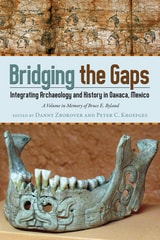
cover of Bridging the Gaps: Integrating Archaeology and History in Oaxaca, Mexico; A Volume in Memory of Bruce E. Byland

Bridging the Gaps

Integrating Archaeology and History in Oaxaca, Mexico; A Volume in Memory of Bruce E. Byland

Danny Zborover

University Press of Colorado, 2015

Bridging the Gaps: Integrating Archaeology and History in Oaxaca, Mexico does just that: it bridges the gap between archaeology and history of the Precolumbian, Colonial, and Republican eras of the state of Oaxaca, Mexico, a cultural area encompassing several of the longest-enduring literate societies in the world.

Fourteen case studies from an interdisciplinary group of archaeologists, anthropologists, ethnohistorians, and art historians consciously compare and contrast changes and continuities in material culture before and after the Spanish conquest, in Prehispanic and Colonial documents, and in oral traditions rooted in the present but reflecting upon the deep past. Contributors consider both indigenous and European perspectives while exposing and addressing the difficulties that arise from the application of this conjunctive approach.

Inspired by the late Dr. Bruce E. Byland’s work in the Mixteca, which exemplified the union of archaeological and historical evidence and inspired new generations of scholars, Bridging the Gaps promotes the practice of integrative studies to explore the complex intersections between social organization and political alliances, religion and sacred landscape, ethnic identity and mobility, colonialism and resistance, and territoriality and economic resources.
[more]
cover of Broken K Pueblo: Prehistoric Social Organization in the American Southwest

Broken K Pueblo

Prehistoric Social Organization in the American Southwest

James N. Hill

University of Arizona Press, 1970
This report presents an analysis of a prehistoric Pueblo community in structural, functional, and evolutionary terms; it is a sequel to William A. Longacre's Archaeology as Anthropology. The emphasis is on social organization (including the patterning of community activities) and on understanding changes in this organization in terms of adaptive responses to a shifting environment.
[more]
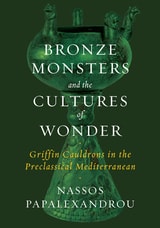
cover of Bronze Monsters and the Cultures of Wonder: Griffin Cauldrons in the Preclassical Mediterranean

Bronze Monsters and the Cultures of Wonder

Griffin Cauldrons in the Preclassical Mediterranean

Nassos Papalexandrou

University of Texas Press, 2021

The eighth and seventh centuries BCE were a time of flourishing exchange between the Mediterranean and the Near East. One of the period’s key imports to the Hellenic and Italic worlds was the image of the griffin, a mythical monster that usually possesses the body of a lion and the head of an eagle. In particular, bronze cauldrons bore griffin protomes—figurative attachments showing the neck and head of the beast. Crafted in fine detail, the protomes were made to appear full of vigor, transfixing viewers.

Bronze Monsters and the Cultures of Wonder takes griffin cauldrons as case studies in the shifting material and visual universes of preclassical antiquity, arguing that they were perceived as lifelike monsters that introduced the illusion of verisimilitude to Mediterranean arts. The objects were placed in the tombs of the wealthy (Italy, Cyprus) and in sanctuaries (Greece), creating fantastical environments akin to later cabinets of curiosities. Yet griffin cauldrons were accessible only to elites, ensuring that the new experience of visuality they fostered was itself a symbol of status. Focusing on the sensory encounter of this new visuality, Nassos Papalexandrou shows how spaces made wondrous fostered novel subjectivities and social distinctions.
[more]
cover of Building a Nation: Chickasaw Museums and the Construction of History and Heritage

Building a Nation

Chickasaw Museums and the Construction of History and Heritage

Joshua M. Gorman

University of Alabama Press, 2011

A groundbreaking study of Indigenous museums and cultural self-representation.

The Chickasaw Nation, an American Indian nation headquartered in southeastern Oklahoma, entered into a period of substantial growth in the late 1980s. Following its successful reorganization and expansion, which was enabled by federal policies for tribal self-determination, the Nation pursued gaming and other industries to affect economic growth. From 1987 to 2009 the Nation’s budget increased exponentially as tribal investments produced increasingly large revenues for a growing Chickasaw population. Coincident to this growth, the Chickasaw Nation began acquiring and creating museums and heritage properties to interpret their own history, heritage, and culture through diverse exhibitionary representations. By 2009, the Chickasaw Nation directed representation of itself at five museum and heritage properties throughout its historic boundaries.

Josh Gorman examines the history of these sites and argues that the Chickasaw Nation is using museums and heritage sites as places to define itself as a coherent and legitimate contemporary Indian nation. In doing so, they are necessarily engaging with the shifting historiographical paradigms as well as changing articulations of how museums function and what they represent. The roles of the Chickasaw Nation’s museums and heritage sites in defining and creating discursive representations of sovereignty are examined within their historicized local contexts. The work describes the museum exhibitions’ dialogue with the historiography of the Chickasaw Nation, the literature of new museum studies, and the indigenous exhibitionary grammars emerging from indigenous museums throughout the United States and the world.
 

[more]
cover of Building an Archaeology of Maya Urbanism: Planning and Flexibility in the American Tropics

Building an Archaeology of Maya Urbanism

Planning and Flexibility in the American Tropics

Damien B. Marken and M. Charlotte Arnauld

University Press of Colorado, 2023

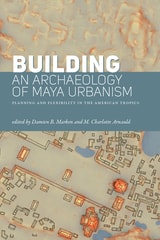
Building an Archaeology of Maya Urbanism tears down entrenched misconceptions of Maya cities to build a new archaeology of Maya urbanism by highlighting the residential dynamics that underwrote one of the most famous and debated civilizations of the ancient Americas. Exploring the diverse yet interrelated agents and processes that modified Maya urban landscapes over time, this volume highlights the adaptive flexibility of urbanization in the tropical Maya lowlands.
 
Integrating recent lidar survey data with more traditional excavation and artifact-based archaeological practices, chapters in this volume offer broadened perspectives on the patterns of Maya urban design and planning by viewing bottom-up and self-organizing processes as integral to the form, development, and dissolution of Classic lowland cities alongside potentially centralized civic designs. Full of innovative examples of how to build an archaeology of urbanism that can be applied not just to the lowland Maya and across the region, Building an Archaeology of Maya Urbanism simultaneously improves interpretations of lowland Maya culture history and contributes to empirical and comparative discussions of tropical, non-Western cities worldwide.
 
 
Contributors: Divina Perla Barrera, Arianna Campiani, Cyril Castanet, Adrian S. Z. Chase, Lydie Dussol, Sara Dzul Góngora, Keith Eppich, Thomas Garrison, María Rocio González de la Mata, Timothy Hare, Julien Hiquet, Takeshi Inomata, Eva Lemonnier, José Francisco Osorio León, Marilyn Masson, Elsa Damaris Menéndez, Timothy Murtha, Philippe Nondédéo, Keith M. Prufer, Louise Purdue, Francisco Pérez Ruíz, Julien Sion, Travis Stanton, Rodrigo Liendo Stuardo, Karl A. Taube, Marc Testé, Amy E. Thompson, Daniela Triadan
[more]
cover of Bulletin of ASOR, volume 386 number 1 (November 2021)

Bulletin of ASOR, volume 386 number 1 (November 2021)

The University of Chicago Press

University of Chicago Press Journals, 2021
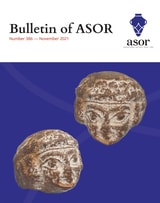
This is volume 386 issue 1 of Bulletin of the American Schools of Oriental Research. The Bulletin of ASOR (BASOR) is a leader among peer-reviewed academic journals of the ancient Near East. For nearly a century, since 1919 when William F. Albright originally founded it as the Bulletin of the American School of Oriental Research in Jerusalem, BASOR has served as a highly respected interdisciplinary English-language forum for scholars worldwide in subject areas such as archaeology, art, anthropology, archaeometry, bioarchaeology, archaeozoology, biblical studies, history, literature, philology, geography, and epigraphy.
[more]
cover of Bulletin of the American Schools of Oriental Research, volume 383 number 1 (May 2020)

Bulletin of the American Schools of Oriental Research, volume 383 number 1 (May 2020)

The University of Chicago Press

University of Chicago Press Journals, 2020
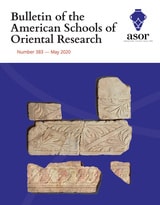
This is volume 383 issue 1 of Bulletin of the American Schools of Oriental Research. The Bulletin of ASOR (BASOR) is a leader among peer-reviewed academic journals of the ancient Near East. For nearly a century, since 1919 when William F. Albright originally founded it as the Bulletin of the American School of Oriental Research in Jerusalem, BASOR has served as a highly respected interdisciplinary English-language forum for scholars worldwide in subject areas such as archaeology, art, anthropology, archaeometry, bioarchaeology, archaeozoology, biblical studies, history, literature, philology, geography, and epigraphy.
[more]
cover of Bulletin of the American Society of Overseas Research, volume 387 number 1 (May 2022)

Bulletin of the American Society of Overseas Research, volume 387 number 1 (May 2022)

The University of Chicago Press

University of Chicago Press Journals, 2022
This is volume 387 issue 1 of Bulletin of the American Society of Overseas Research. The Bulletin of ASOR (BASOR) is a leader among peer-reviewed academic journals of the ancient Near East. For nearly a century, since 1919 when William F. Albright originally founded it as the Bulletin of the American School of Oriental Research in Jerusalem, BASOR has served as a highly respected interdisciplinary English-language forum for scholars worldwide in subject areas such as archaeology, art, anthropology, archaeometry, bioarchaeology, archaeozoology, biblical studies, history, literature, philology, geography, and epigraphy.
[more]
cover of Bulletin of the American Society of Overseas Research, volume 388 number 1 (November 2022)

Bulletin of the American Society of Overseas Research, volume 388 number 1 (November 2022)

The University of Chicago Press

University of Chicago Press Journals, 2022
This is volume 388 issue 1 of Bulletin of the American Society of Overseas Research. The Bulletin of ASOR (BASOR) is a leader among peer-reviewed academic journals of the ancient Near East. For nearly a century, since 1919 when William F. Albright originally founded it as the Bulletin of the American School of Oriental Research in Jerusalem, BASOR has served as a highly respected interdisciplinary English-language forum for scholars worldwide in subject areas such as archaeology, art, anthropology, archaeometry, bioarchaeology, archaeozoology, biblical studies, history, literature, philology, geography, and epigraphy.
[more]
cover of Bulletin of the American Society of Overseas Research, volume 389 number 1 (May 2023)

Bulletin of the American Society of Overseas Research, volume 389 number 1 (May 2023)

The University of Chicago Press

University of Chicago Press Journals, 2023
This is volume 389 issue 1 of Bulletin of the American Society of Overseas Research. The Bulletin of ASOR (BASOR) is a leader among peer-reviewed academic journals of the ancient Near East. For nearly a century, since 1919 when William F. Albright originally founded it as the Bulletin of the American School of Oriental Research in Jerusalem, BASOR has served as a highly respected interdisciplinary English-language forum for scholars worldwide in subject areas such as archaeology, art, anthropology, archaeometry, bioarchaeology, archaeozoology, biblical studies, history, literature, philology, geography, and epigraphy.
[more]
cover of Bulletin of the American Society of Overseas Research, volume 390 number 1 (November 2023)

Bulletin of the American Society of Overseas Research, volume 390 number 1 (November 2023)

The University of Chicago Press

University of Chicago Press Journals, 2023
This is volume 390 issue 1 of Bulletin of the American Society of Overseas Research. The Bulletin of ASOR (BASOR) is a leader among peer-reviewed academic journals of the ancient Near East. For nearly a century, since 1919 when William F. Albright originally founded it as the Bulletin of the American School of Oriental Research in Jerusalem, BASOR has served as a highly respected interdisciplinary English-language forum for scholars worldwide in subject areas such as archaeology, art, anthropology, archaeometry, bioarchaeology, archaeozoology, biblical studies, history, literature, philology, geography, and epigraphy.
[more]
cover of Bulletin of the American Society of Overseas Research, volume 391 number 1 (May 2024)

Bulletin of the American Society of Overseas Research, volume 391 number 1 (May 2024)

The University of Chicago Press

University of Chicago Press Journals, 2024
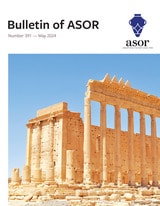
This is volume 391 issue 1 of Bulletin of the American Society of Overseas Research. The Bulletin of ASOR (BASOR) is a leader among peer-reviewed academic journals of the ancient Near East. For nearly a century, since 1919 when William F. Albright originally founded it as the Bulletin of the American School of Oriental Research in Jerusalem, BASOR has served as a highly respected interdisciplinary English-language forum for scholars worldwide in subject areas such as archaeology, art, anthropology, archaeometry, bioarchaeology, archaeozoology, biblical studies, history, literature, philology, geography, and epigraphy.
[more]
cover of Bulletin of the American Society of Overseas Research, volume 392 number 1 (November 2024)

Bulletin of the American Society of Overseas Research, volume 392 number 1 (November 2024)

The University of Chicago Press

University of Chicago Press Journals, 2024
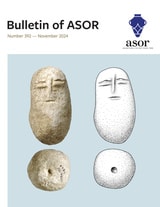
This is volume 392 issue 1 of Bulletin of the American Society of Overseas Research. The Bulletin of ASOR (BASOR) is a leader among peer-reviewed academic journals of the ancient Near East. For nearly a century, since 1919 when William F. Albright originally founded it as the Bulletin of the American School of Oriental Research in Jerusalem, BASOR has served as a highly respected interdisciplinary English-language forum for scholars worldwide in subject areas such as archaeology, art, anthropology, archaeometry, bioarchaeology, archaeozoology, biblical studies, history, literature, philology, geography, and epigraphy.
[more]
cover of Bulletin of the American Society of Overseas Research, volume 393 number 1 (May 2025)

Bulletin of the American Society of Overseas Research, volume 393 number 1 (May 2025)

The University of Chicago Press

University of Chicago Press Journals, 2025
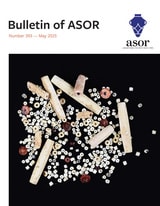
This is volume 393 issue 1 of Bulletin of the American Society of Overseas Research. The Bulletin of ASOR (BASOR) is a leader among peer-reviewed academic journals of the ancient Near East. For nearly a century, since 1919 when William F. Albright originally founded it as the Bulletin of the American School of Oriental Research in Jerusalem, BASOR has served as a highly respected interdisciplinary English-language forum for scholars worldwide in subject areas such as archaeology, art, anthropology, archaeometry, bioarchaeology, archaeozoology, biblical studies, history, literature, philology, geography, and epigraphy.
[more]
cover of Bulletin of the American Society of Overseas Research, volume 394 number 1 (November 2025)

Bulletin of the American Society of Overseas Research, volume 394 number 1 (November 2025)

The University of Chicago Press

University of Chicago Press Journals, 2025
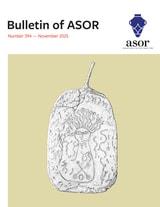
This is volume 394 issue 1 of Bulletin of the American Society of Overseas Research. The Bulletin of ASOR (BASOR) is a leader among peer-reviewed academic journals of the ancient Near East. For nearly a century, since 1919 when William F. Albright originally founded it as the Bulletin of the American School of Oriental Research in Jerusalem, BASOR has served as a highly respected interdisciplinary English-language forum for scholars worldwide in subject areas such as archaeology, art, anthropology, archaeometry, bioarchaeology, archaeozoology, biblical studies, history, literature, philology, geography, and epigraphy.
[more]
cover of Bulletin of the American Society of Overseas Research, volume 395 number 1 (May 2026)

Bulletin of the American Society of Overseas Research, volume 395 number 1 (May 2026)

The University of Chicago Press

University of Chicago Press Journals, 2026
This is volume 395 issue 1 of Bulletin of the American Society of Overseas Research. The Bulletin of ASOR (BASOR) is a leader among peer-reviewed academic journals of the ancient Near East. For nearly a century, since 1919 when William F. Albright originally founded it as the Bulletin of the American School of Oriental Research in Jerusalem, BASOR has served as a highly respected interdisciplinary English-language forum for scholars worldwide in subject areas such as archaeology, art, anthropology, archaeometry, bioarchaeology, archaeozoology, biblical studies, history, literature, philology, geography, and epigraphy.
[more]
cover of Bulletins and Supplementary Papers of the British School of Archaeology in Jerusalem, 1922–1931

Bulletins and Supplementary Papers of the British School of Archaeology in Jerusalem, 1922–1931

Jessica Holland

Council for British Research in the Levant, 2023
Bulletins and Supplementary Papers of the British School of Archaeology in Jerusalem, 1922–1931 has been republished by the Council for British Research in the Levant (CBRL) in 2023, with a newly commissioned introductory text. CBRL was formed as a merger from the British School of Archaeology in Jerusalem, and the British Institute at Amman for Archaeology and History in 1998. 100 years after their original publication, the republication of these bulletins and newsletters from the founding years of the British School of Archaeology in Jerusalem offers important insights into the history of the institution, and also into the discipline of archaeology in the period of the British Mandate in Palestine.
[more]
cover of Burnt Corn Pueblo: Conflict and Conflagration in the Galisteo Basin, A.D. 1250–1325

Burnt Corn Pueblo

Conflict and Conflagration in the Galisteo Basin, A.D. 1250–1325

Edited by James E. Snead and Mark W. Allen

University of Arizona Press, 2011

The Galisteo Basin of northern New Mexico has been a staple of archaeological research since it was first studied almost a century ago. This first book on the area since 1914 lays out an overview of the area, with research provided by the Tano Origins Project and funded by the National Science Foundation.

This volume covers the region’s history (including the Burnt Corn Pueblo, Petroglyph Hill, and Lodestar sites) during the Coalition Period (AD 1200–1300). Including chapters on architecture, ceramics, tree-ring samples, groundstone, and rock art, the book also addresses the stress that development has placed on the future of research in the area.
[more]
cover of Busayra excavations by Crystal-M. Bennett, 1971-1980

Busayra excavations by Crystal-M. Bennett, 1971-1980

Piotr Bienkowski

Council for British Research in the Levant, 2002

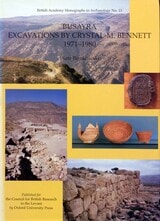
This volume is the long-awaited final report on the late Crystal Bennett's 1971-1980 excavations at Busayra, the major city of the Iron Age kingdom of Edom in southern Jordan. Dr. Bienkowski and specialist contributors describe and illustrate the architecture, stratigraphy, pottery and other finds of this impressive fortified administrative and religious center. The concluding chapter puts the nature and role of Busayra into its proper ancient context in the light of current research on tribal kingdoms.


Library of Congress subject headings for this publication:
Busayra Site (Bu�sayr�a, Jordan)
Excavations (Archaeology) -- Jordan -- Bu�sayr�a.
Iron age -- Jordan -- Bu�sayr�a.
[more]
cover of By Airship to the North Pole: An Archaeology of Human Exploration

By Airship to the North Pole

An Archaeology of Human Exploration

Capelotti, P. J

Rutgers University Press, 1999

 By Airship to the North Pole chronicles the adventures of Swedish engineer Salomon August Andree, who made the first failed attempt to reach the North Pole in a hydrogen balloon in 1897, and of American journalist Walter Wellman who organized and led three unsuccessful air expeditions from 1907 to 1909. The book investigates the stories behind the quests to reach this remote and inhospitable outpost by air and examines how those stories were created and reported by the press. What he uncovers allows readers to reflect on the distortions of the written historical record, particularly unkind to Wellman, and what that may tell us about our own age of exploration as we look to the last frontiers in space.
[more]