Results by title
4038 books match the query 'Social aspects' and 174 start with b
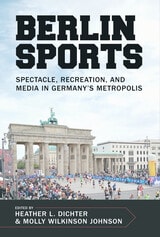
Berlin Sports
Spectacle, Recreation, and Media in Germany’s MetropolisHeather L. Dichter
University of Arkansas Press, 2024
This book begins with a long-distance equestrian race in the 1890s and continues with the role of media in spectacle, celebrity, urban life, and gender from the 1890s to the 1920s.It then turns to grassroots sport participation and spectatorship as well as sport diplomacy at the elite international level during the postwar period and the years of German division. Next, it explores recreational sport associations within the context of immigration and youth counterculture. It concludes with the 2015 European Maccabi Games, an international Jewish sports festival through which Berlin sought to grapple with the infamous 1936 Olympics and showcase Berlin as a cosmopolitan and multicultural city. Taken together, the book’s scholarly essays on all of these sporting endeavors reveal the rich and varied sporting culture in Berlin and yield fresh insights into spectacle, recreation, and media in the city.
Beside You in Time
Sense Methods and Queer Sociabilities in the American Nineteenth CenturyElizabeth Freeman
Duke University Press, 2019
Better Bankers, Better Banks
Promoting Good Business through Contractual CommitmentClaire A. Hill and Richard W. Painter
University of Chicago Press, 2015
In Better Bankers, Better Banks, Claire A. Hill and Richard W. Painter look back at the history of banking and show how the current culture of bad behavior—dramatized by the corrupt, cocaine-snorting bankers of The Wolf of Wall Street—came to be. In the early 1980s, banks went from partnerships whose partners had personal liability to corporations whose managers had no such liability and could take risks with other people’s money. A major reason bankers remain resistant to change, Hill and Painter argue, is that while banks have been faced with large fines, penalties, and legal fees—which have exceeded one hundred billion dollars since the onset of the crisis—the banks (which really means the banks’shareholders) have paid them, not the bankers themselves. The problem also extends well beyond the pursuit of profit to the issue of how success is defined within the banking industry, where highly paid bankers clamor for status and clients may regard as inevitable bankers who prioritize their own self-interest. While many solutions have been proposed, Hill and Painter show that a successful transformation of banker behavior must begin with the bankers themselves. Bankers must be personally liable from their own assets for some portion of the bank’s losses from excessive risk-taking and illegal behavior. This would instill a culture that discourages such behavior and in turn influence the sorts of behavior society celebrates or condemns.
Despite many sensible proposals seeking to reign in excessive risk-taking, the continuing trajectory of scandals suggests that we’re far from ready to avert the next crisis. Better Bankers, Better Banks is a refreshing call for bankers to return to the idea that theirs is a noble profession.
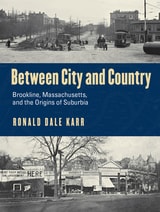
Between City and Country
Brookline, Massachusetts, and the Origins of SuburbiaRonald Dale Karr
University of Massachusetts Press, 2018
Already a fashionable retreat for wealthy Bostonians, Brookline began to suburbanize in the 1840s with the arrival of hundreds of commuter families—and significant numbers of Irish Catholic immigrants drawn by opportunities to work as laborers and servants. In Brookline the poor were segregated but not excluded altogether, as they would be from twentieth-century elite suburbs. A half century later, a distinct suburban way of life developed that combined rural activities with urban pastimes, and a political consensus emerged that sought efficient government and large expenditures on education and public works. Brookline had created the template for the concept of suburbia, not just in wealthy communities but in the less affluent communities of postwar America.
Between Feast and Famine
Food, Health, and the History of Ghana's Long Twentieth CenturyJohn Nott
University College London, 2025
Between Feast and Famine unravels the intertwined histories of food, health, and capitalism in Ghana, charting the country’s shifting nutritional landscape from colonial-era hunger crises to contemporary epidemics of obesity and diabetes. Moving between Ghana’s diverse ecological and economic zones, John Nott excavates how uneven capitalist transformation reshaped diets and childhood nutrition across the twentieth century. At the heart of this story is the evolving science of nutrition itself, from its colonial-era applications to its role in shaping modern health policies.
Using a new historical approach, Between Feast and Famine exposes how global scientific debates and local lived realities co-produced the country’s shifting nutritional conditions. A necessary contribution to African history and medical humanities, this book debunks preconceived notions about hunger and public health, suggesting crucial insights into the complex relationship between food systems and human well-being.
Between Foreign and Family
Return Migration and Identity Construction among Korean Americans and Korean ChineseLee, Helene K
Rutgers University Press, 2018
Between Foreign and Family explores the impact of inconsistent rules of ethnic inclusion and exclusion on the economic and social lives of Korean Americans and Korean Chinese living in Seoul. These actors are part of a growing number of return migrants, members of an ethnic diaspora who migrate “back” to the ancestral homeland from which their families emigrated. Drawing on ethnographic observations and interview data, Helene K. Lee highlights the “logics of transnationalism” that shape the relationships between these return migrants and their employers, co-workers, friends, family, and the South Korean state.
While Koreanness marks these return migrants as outsiders who never truly feel at home in the United States and China, it simultaneously traps them into a liminal space in which they are neither fully family, nor fully foreign in South Korea. Return migration reveals how ethnic identity construction is not an indisputable and universal fact defined by blood and ancestry, but a contested and uneven process informed by the interplay of ethnicity, nationality, citizenship, gender, and history.
Between Self and Society
Inner Worlds and Outer Limits in the British Psychological NovelBy John Rodden
University of Texas Press, 2016
Between Self and Society explores the psychosocial dramas that galvanize six major British novels written between the eighteenth and twentieth centuries. The book challenges an influential misconception that has for too long hindered appreciation of the psychological novel. John Rodden argues that there should be no simplifying antithesis between psychological, “inner” conflicts (within the mind or “soul”) and institutional, “outer” conflicts (within family, class, community). Instead, it is the overarching, dramatic—yet often tortuous—relations between self and society that demand our attention. Rodden presents fresh interpretations of an eclectic group of prose fiction classics, including Tobias Smollett’s The Adventures of Roderick Random, William Godwin’s Caleb Williams, Thomas Hardy’s The Mayor of Casterbridge, Ford Madox Ford’s The Good Soldier, Wyndham Lewis’s Tarr, and D. H. Lawrence’s Women in Love.
Far from being merely admirable experiments, let alone daring though interesting failures, these fictions are shown to possess aesthetic unity, stylistic consistency, and psychic force. Between Self and Society thus impels our careful reconsideration of novels that represent major artistic achievements, yet have been either unjustly neglected or appreciated in limiting ways that do injustice to their psychological aspects. Rodden’s vibrant discussion invites an upward revaluation of these works and encourages the full recognition of their value and significance in British literary history.

Beyond Adornment
Jewelry and Identity in ArtYvonne J. Markowitz
J. Paul Getty Trust, The, 2025
Why do people wear jewelry? What meaning does it hold for the wearer? And what does the wearer hope it will convey to those they encounter—or to someone viewing their image decades, even centuries, later?
Artistic renderings of the human figure—in portraiture, sculpture, and other media—in a range of allegorical, historical, and religious images often showcase jewelry. The ornaments depicted in such designs offer an abundance of information that not only heightens our understanding of the subject but also provides insights into the imagination of the artist. Jewelry enhances our enjoyment of works of art because it is visually compelling, sensuous, and laden with an array of associations and symbolic meanings.
Bringing together spectacular and significant art objects depicting figures wearing sumptuous personal adornments that define who they are within the specific milieus in which they lived, this richly illustrated and accessible volume represents a novel, interdisciplinary approach to the ways in which jewelry can be studied and understood.

Beyond Bach
Music and Everyday Life in the Eighteenth CenturyAndrew Talle
University of Illinois Press, 2018
Eschewing the great composer style of music history, Andrew Talle takes us on a journey that looks at how ordinary people made music in Bach's Germany. Talle focuses in particular on the culture of keyboard playing as lived in public and private. As he ranges through a wealth of documents, instruments, diaries, account ledgers, and works of art, Talle brings a fascinating cast of characters to life. These individuals--amateur and professional performers, patrons, instrument builders, and listeners--inhabited a lost world, and Talle's deft expertise teases out the diverse roles music played in their lives and in their relationships with one another. At the same time, his nuanced re-creation of keyboard playing's social milieu illuminates the era's reception of Bach's immortal works.
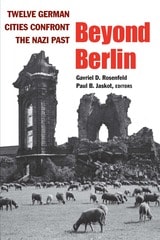
Beyond Berlin
Twelve German Cities Confront the Nazi PastGavriel D. Rosenfeld and Paul B. Jaskot, Editors
University of Michigan Press, 2015
Beyond Berlin breaks new ground in the ongoing effort to understand how memorials, buildings, and other spaces have figured in Germany's confrontation with its Nazi past. The contributors challenge reigning views of Germany's postwar memory work by examining how specific urban centers apart from the nation's capital have wrestled with their respective Nazi legacies. A wide range of West and East German cities is profiled in the volume: prominent metropolises like Hamburg, dynamic regional centers like Dresden, gritty industrial cities like Wolfsburg, and idyllic rural towns like Quedlinburg. In employing historical, art historical, anthropological, and geographical methodologies to examine these and other important urban centers, the volume's case studies shed new light upon the complex ways in which the confrontation with the Nazi past has directly shaped the German urban landscape since the end of the Second World War.
"Beyond Berlin is one of the most fascinating, deeply probing collections ever published on Germany's ongoing confrontation with its Nazi past. Its editors, Gavriel Rosenfeld and Paul Jaskot, have taken the exploration of Germany's urban memorial landscape to its highest level yet."
---James E. Young, Professor and Chair, Department of Judaic and Near Eastern Studies, University of Massachusetts Amherst, and author of The Texture of Memory and At Memory's Edge
"This is a top-notch collection of essays that positions itself in the populated field of memory studies by bringing together original contributions representing the best of new scholarship on architecture, urban design, monuments, and memory in East and West Germany. Taken together, the essays remind readers that the Nazi past is always present when German architects, urban planners, and politicians make decisions to tear down, rebuild, restore, and memorialize."
---S. Jonathan Wiesen, Department of History, Southern Illinois University, Carbondale
Beyond Conversation
Collaboration and the Production of WritingWilliam Duffy
Utah State University Press, 2020
While interrogating the institutional politics that circulate around debates about collaboration, this book offers a concise history of collaborative writing theory while proposing a new set of commonplaces for understanding the labor of coauthorship. Specifically, Beyond Conversation outlines an interactionist theory that explains collaboration as the rhetorical capacity that manifests in the discursive engagements coauthors enter into with the objects of their writing.
Drawing on new materialist philosophies, post-qualitative inquiry, and interactionist rhetorical theory, Beyond Conversation challenges writing and literacy educators to recognize the pedagogical benefits of collaborative writing in the work they do both as writers and as teachers of writing. The book will reinvigorate how teachers, scholars, and administrators advocate for the importance of collaborative writing in their work.
Beyond Exoticism
Western Music and the WorldTimothy D. Taylor
Duke University Press, 2007
Beginning with a focus on musical manifestations of colonialism and imperialism, Taylor discusses how the “discovery” of the New World and the development of an understanding of self as distinct from the other, of “here” as different from “there,” was implicated in the development of tonality, a musical system which effectively creates centers and margins. He describes how musical practices signifying nonwestern peoples entered the western European musical vocabulary and how Darwinian thought shaped the cultural conditions of early-twentieth-century music. In the era of globalization, new communication technologies and the explosion of marketing and consumption have accelerated the production and circulation of tropes of otherness. Considering western music produced under rubrics including multiculturalism, collaboration, hybridity, and world music, Taylor scrutinizes contemporary representations of difference. He argues that musical interpretations of the nonwestern other developed hundreds of years ago have not necessarily been discarded; rather they have been recycled and retooled.
Beyond Globalization
Making New Worlds in Media, Art, and Social PracticesAneesh, A.
Rutgers University Press, 2011
Does living in a globally networked society mean that we are moving toward a single, homogenous world culture? Or, are we headed for clashes between center and periphery, imperial and subaltern, Western and non-Western, First and Third World? The interdisciplinary essays in Beyond Globalization present us with another possibility—that new media will lead to new kinds of “worldmaking.”
This provocative volume brings together the best new work of scholars within such diverse fields as history, sociology, anthropology, film, media studies, and art. Whether examining the inauguration of a virtual community on the website Second Life or investigating the appropriation of biotechnology for transgenic art, this collection highlights how mediated practices have become integral to global culture; how social practices have emerged out of computer-related industries; how contemporary apocalyptic narratives reflect the anxieties of a U.S. culture facing global challenges; and how design, play, and technology help us understand the histories and ideals
behind the digital architectures that mediate our everyday actions.
Beyond Indigeneity
Coca Growing and the Emergence of a New Middle Class in BoliviaAlessandra Pellegrini Calderón
University of Arizona Press, 2016
Beyond Indigeneity offers new analysis into indigenous identity and social mobility that changes the discourse in Latin American social anthropology. Author Alessandra Pellegrini Calderón points out that Morales’s presidency has led to heightened publicity of coca issues and an intensification of indigeneity discourse, echoing a global trend of increased recognition of indigenous peoples’ claims. The “living well” attitude (vivir bien) enshrined in the new political constitution is generally represented as an indigenous way of life, one based on harmony and reciprocity, in sharp contrast to the capitalist logic of “living better” that is based on accumulation and expansion.
In this ethnography, Pellegrini explores the positioning of coca growers in Bolivia and their reluctance to embrace the politics of indigeneity by rejecting the “indigenous peoples’ slot,” even while they emerge as a new middle class. By staying in a space between ethnic categories and also between social classes, the coca growers break with the traditional model of social mobility in Latin America and create new forms of political positioning that challenge the dominant culturalist framework about indigeneity and peasants.
Beyond Machismo
Intersectional Latino MasculinitiesBy Aída Hurtado and Mrinal Sinha
University of Texas Press, 2016
Long considered a pervasive value of Latino cultures both south and north of the US border, machismo—a hypermasculinity that obliterates any other possible influences on men’s attitudes and behavior—is still used to define Latino men and boys in the larger social narrative. Yet a closer look reveals young, educated Latino men who are going beyond machismo to a deeper understanding of women’s experiences and a commitment to ending gender oppression. This new Latino manhood is the subject of Beyond Machismo.
Applying and expanding the concept of intersectionality developed by Chicana feminists, Aída Hurtado and Mrinal Sinha explain how the influences of race, class, ethnicity, sexuality, and gender shape Latinos’ views of manhood, masculinity, and gender issues in Latino communities and their acceptance or rejection of feminism. In particular, the authors show how encountering Chicana feminist writings in college, as well as witnessing the horrors of sexist oppression in the United States and Latin America, propels young Latino men to a feminist consciousness. By focusing on young, high-achieving Latinos, Beyond Machismo elucidates this social group’s internal diversity, thereby providing a more nuanced understanding of the processes by which Latino men can overcome structural obstacles, form coalitions across lines of difference, and contribute to movements for social justice.
Beyond Repair?
Mayan Women’s Protagonism in the Aftermath of Genocidal HarmAlison Crosby
Rutgers University Press, 2019
Honorable Mention, 2020 CALACS Book Prize
Beyond Repair? explores Mayan women’s agency in the search for redress for harm suffered during the genocidal violence perpetrated by the Guatemalan state in the early 1980s at the height of the thirty-six-year armed conflict. The book draws on eight years of feminist participatory action research conducted with fifty-four Q’eqchi’, Kaqchikel, Chuj, and Mam women who are seeking truth, justice, and reparation for the violence they experienced during the war, and the women’s rights activists, lawyers, psychologists, Mayan rights activists, and researchers who have accompanied them as intermediaries for over a decade. Alison Crosby and M. Brinton Lykes use the concept of “protagonism” to deconstruct dominant psychological discursive constructions of women as “victims,” “survivors,” “selves,” “individuals,” and/or “subjects.” They argue that at different moments Mayan women have been actively engaged as protagonists in constructivist and discursive performances through which they have narrated new, mobile meanings of “Mayan woman,” repositioning themselves at the interstices of multiple communities and in their pursuit of redress for harm suffered.
Beyond Slash, Burn, and Poison
Transforming Breast Cancer Stories into ActionMarcy Jane Knopf-Newman
Rutgers University Press, 2004
Depending on one’s vantage point, breast cancer can be a very different experience, and indeed, a very different concern. It is, for some, a personal struggle; for others, it is a disease posing scientific and environmental challenges; and for others it is a highly charged and politicized issue around which policy wars rage. Beyond Slash, Burn, and Poison brings a unique perspective to breast cancer by recognizing the overlapping relationship of all these realities.
Drawing on the writings of Rachel Carson, Betty Ford, Rose Kushner, and Audre Lorde, this book explores the various ways in which patient-centered texts continue to leave their mark on the political realm of breast cancer and, ultimately, the disease itself. Ordered chronologically, the selections trace the progression of discussions about breast cancer from a time when the subject was kept private and silent to when it became part of public discourse. The texts included are personal accounts, written by women struggling to play an active role in their healing process and, at the same time, hoping to help others do the same.
Knopf-Newman also shows us how these writings eventually changed public opinion and the underlying tendency to blame women for their illness. She argues that changes in medical practice and public policy are linked to textual interventions, and makes a case for the politicization of cultural studies of disease through personal and literary expression.
Passionately written and well-researched, Beyond Slash, Burn, and Poison transforms how we think about breast cancer. Rather than facilitating forums for separate discussions, this book brings conversations into dialog with each other. It is essential reading for anyone concerned with breast cancer and its history, as well as for those interested in the effect of the environment on public health and the role that literature plays in public policy and medicine.
Beyond Squid Game
Korean Media and the Netflix ParadigmBenjamin M. Han
University of Texas Press, 2026
Examining Netflix’s global influence through its complex global-local dynamics in Korean media.
Korea is a global entertainment powerhouse, thanks in no small part to Netflix. Analyzing the artistry and industry behind Netflix-produced Korean hits like Squid Game, The Glory, and Narco-Saints, Benjamin Han argues that Korea is ground zero for an emerging “Netflix Paradigm.” The US-based streaming platform generates massive profits by erasing boundaries of foreign and domestic production, even as it underscores the resilience of the national media within global popular culture.
Beyond Squid Game breaks down the intricate and often ambivalent relationship between Netflix and the Korean media business, drawing on interviews with creative workers navigating the streaming giant’s ever-increasing economic and cultural power. Challenging narratives that present Netflix as a revolutionary disruptor, Han shows how the company has replicated abroad the precarious labor conditions and tensions over intellectual property from which US studios have long benefited. At the same time, Beyond Squid Game underscores the complex dynamics of a globalized media industry in which cultural imperialism thrives on localization and perceived authenticity.
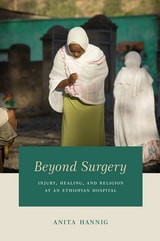
Beyond Surgery
Injury, Healing, and Religion at an Ethiopian HospitalAnita Hannig
University of Chicago Press, 2017
Through her in-depth ethnography of two repair and rehabilitation centers operating in Ethiopia, Hannig takes the reader deep into a world inside hospital walls, where women recount stories of loss and belonging, shame and delight. As she chronicles the lived experiences of fistula patients in clinical treatment, Hannig explores the danger of labeling “culture” the culprit, showing how this common argument ignores the larger problem of insufficient medical access in rural Africa. Beyond Surgery portrays the complex social outcomes of surgery in an effort to deepen our understanding of medical missions in Africa, expose cultural biases, and clear the path toward more effective ways of delivering care to those who need it most.
Beyond Tordesillas
New Approaches to Comparative Luso-Hispanic StudiesEdited by Robert Patrick Newcomb and Richard A. Gordon
The Ohio State University Press, 2017
The jumping-off point for Beyond Tordesillas is the critic Jorge Schwartz’s evocative call to arms, “Down with Tordesillas!” In this groundbreaking essay, Schwartz looks to the imaginary line created by the Treaty of Tordesillas (1494), which divided the known world into Spanish and Portuguese spheres of influence, to stand in for generations of literary and cultural noncommunication between the Spanish- and Portuguese-speaking spheres, and their attendant academic disciplines. This volume’s contributions range topically across continents, from the Iberian Peninsula to Latin American countries. They also range across genres, with studies that analyze fictional narrative, music, performance, and visual culture. Beyond Tordesillas forcefully challenges the disciplinary—and indeed, arbitrary—boundaries that for too long have separated Hispanic and Luso-Brazilian studies.
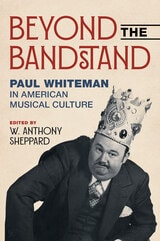
Beyond the Bandstand
Paul Whiteman in American Musical CultureEdited by W. Anthony Sheppard
University of Illinois Press, 2024
The most successful bandleader of the 1920s, Paul Whiteman was an entertainment icon who played a major role in the mainstreaming of jazz. Whiteman and his band premiered Gershwin’s Rhapsody in Blue. Duke Ellington acknowledged his achievements. His astonishing ear for talent vaulted a who’s who of artists toward prominence. But Whiteman’s oversized presence eclipsed Black jazz musicians while his middlebrow music prompted later generations to jettison him from jazz history.
W. Anthony Sheppard’s collection of essays confronts the racial implications of Whiteman’s career. The contributors explore Whiteman’s broad impact on popular culture, tracking his work and influence in American marketing, animated films, the Black press, Hollywood, and the music publication industry, and following him behind the scenes with arrangers, into grand concert halls, across the Atlantic, into the courtroom, and on television.
Multifaceted and cutting-edge, Beyond the Bandstand explores the racial politics and artistic questions surrounding a controversial figure in popular music.
Contributors: Ryan Raul Bañagale, Stephanie Doktor, John Howland, Katherine M. Leo, Sarah Caissie Provost, W. Anthony Sheppard, Catherine Tackley, Elijah Wald, and Christi Jay Wells

Beyond the Battlefield
Race, Memory, and the American Civil WarDavid W. Blight
University of Massachusetts Press, 2002
The book as a whole demonstrates several ways to probe the history of memory, to understand how and why groups of Americans have constructed versions of the past in the service of contemporary social needs. Topics range from the writing and thought of Frederick Douglass and W.E.B. Du Bois to a comparison of Abraham Lincoln and Douglass on the level of language and memory. The volume also includes a compelling study of the values of a single Union soldier, an analysis of Ken Burns's PBS series The Civil War, and a retrospective treatment of the distinguished African American historian Nathan I. Huggins.
Taken together, these lucidly written pieces offer a thoroughgoing assessment of the stakes of Civil War memory and their consequences for American race relations. Beyond the Battlefield demonstrates not only why we should preserve and study our Civil War battlefields, but also why we should lift our vision above those landscapes and ponder all the unfinished questions of healing and justice, of racial harmony and disharmony, that still bedevil our society and our historical imagination.
Beyond the Body Proper
Reading the Anthropology of Material LifeMargaret Lock and Judith Farquhar, eds.
Duke University Press, 2007
Beyond the Body Proper includes nine sections conceptually organized around themes such as everyday life, sex and gender, and science. Each section is preceded by interpretive commentary by the volume’s editors. Within the collection are articles and book excerpts focused on bodies using tools and participating in rituals, on bodies walking and eating, and on the female circumcision controversy, as well as pieces on medical classifications, spirit possession, the commodification of body parts, in vitro fertilization, and an artist/anatomist’s “plastination” of cadavers for display. Materialist, phenomenological, and feminist perspectives on embodiment appear along with writings on interpretations of pain and the changing meanings of sexual intercourse. Essays on these topics and many others challenge Eurocentric assumptions about the body as they speak to each other and to the most influential contemporary trends in the human sciences.
With selections by: Henry Abelove, Walter Benjamin, Janice Boddy, John Boswell, Judith Butler, Caroline Walker Bynum, Stuart Cosgrove, Michel de Certeau, Gilles Deleuze, Alice Domurat Dreger, Barbara Duden, Friedrich Engels, E. E. Evans-Pritchard, Judith Farquhar, Marcel Granet, Felix Guattari, Ian Hacking, Robert Hertz, Patricia Leyland Kaufert, Arthur Kleinman, Shigehisa Kuriyama, Jean Langford, Bruno Latour, Margaret Lock, Emily Martin, Karl Marx, Marcel Mauss, Maurice Merleau-Ponty, Nancy K. Miller, Lisa Jean Moore, John D. O’Neil, Aihwa Ong, Mariella Pandolfi, Susan Pedersen, Gregory M. Pflugfelder, Rayna Rapp, Nancy Scheper-Hughes, Kristofer Schipper, Matthew Schmidt, Peter Stallybrass, Michael Taussig, Charis Thompson, E.P. Thompson, Anna Lowenhaupt Tsing, Victor Turner, Terence Turner, Jose van Dijck, Keith Wailoo, Brad Weiss, Allon White

Beyond the Breast-Bottle Controversy
Penny Van Esterik
Rutgers University Press, 1989
--from the Foreword by Michael C. Latham, Cornell University
Penny Van Esterik takes the reader beyond the Nestle boycott and the activist campaigns against infant-formula manufacturers to the issues underlying the controversy. She shows how the controversy is embedded in the problem of urban poverty, the empowerment of women, the medicalization of infant feeding, and the commoditization of infant foods. She argues that the choice between bottle feeding and breast feeding has significant implications for developing countries. Beyond the Breast-Bottle Controversy raises a host of important questions: why has there been no consistent feminist position? How did infant feeding become medicalized in developing and developed countries? What mechanisms encourage the technology and taste transfer necessary for the expansion of bottle feeding? These questions are examined using documentary sources and interdisciplinary research in Thailand, Indonesia, Kenya, and Columbia.
For Van Esterik, the infant-formula controversy is a valuable case study for understanding the relations between women, the environment, and sustainable development. From this perspective, breast feeding has no long-term negative consequences. It depends on renewable resources, works on the principle that as demand increases so does supply, reduces the dependency of women on consumer products and multinational corporations, and puts pressure on governments to improve the health of mothers. On the other hand, the author argues that bottle feeding has definite long-term negative consequences. Her goal is not to have every woman breast-feed her child, but to create living and working conditions so that every woman can do so if she chooses.
Beyond the Checkpoint
Visual Practices in America's Global War on TerrorRebecca A. Adelman
University of Massachusetts Press, 2014
Tracing the connections between citizenship and spectatorship, and moving beyond the close reading of visual representations, this book focuses on the institutions and actors that create, monitor, and regulate the visual landscape of the GWOT. Adelman looks around and through common images to follow the complex patterns of practice by which institutions and audiences engage them in various contexts. In the process, she proposes a new methodology for studying visual cultures of conflict, and related phenomena like violence, terror, and suffering that are notoriously difficult to represent.
Attending to previously unanalyzed dimensions of this conflict, this book illustrates the complexity of GWOT visual culture and the variegated experiences of citizenship that result as Americans navigate this terrain.
Beyond the City and the Bridge
East Asian Immigration in a New Jersey SuburbMatsumoto, Noriko
Rutgers University Press, 2018
Winner of the Richard P. McCormick Prize from the New Jersey Historical Association
Honorable Mention, 2019 American Sociological Association Book Award - Asia/Asian American Section
In recent decades, the American suburbs have become an important site for immigrant settlement. Beyond the City and the Bridge presents a case study of Fort Lee, Bergen County, on the west side of the George Washington Bridge connecting Manhattan and New Jersey. Since the 1970s, successive waves of immigrants from East Asia have transformed this formerly white community into one of the most diverse suburbs in the greater New York region. Fort Lee today has one of the largest concentrations of East Asians of any suburb on the East Coast, with Chinese, Japanese, and Koreans forming distinct communities while influencing the structure and everyday life of the borough. Noriko Matsumoto explores the rise of this multiethnic suburb—the complex processes of assimilation and reproduction of ethnicities, the changing social relationships, and the conditions under which such transformations have occurred.
Beyond the Field
How Soccer Built Community in the United StatesBrian D. Bunk
University of Illinois Press, 2025
Played by both migrants and native-born Americans, soccer created communities across the United States. Brian D. Bunk ranges from Pawtucket to Honolulu as he illuminates the deep and diverse origins of the American sport.
Soccer took root as immigration, urbanization, and industrialization triggered immense changes across society. Matches built local pride as teams battled rival neighborhoods and towns. Teammates and supporters shared meals, raised money for fallen players, and attended each other’s weddings and funerals. If sometimes damaged by economic depression or shattered by war, clubs often bounced back to provide a steadying, resilient force in their towns. Bunk follows the story from the 1880s through World War I by profiling the struggles and joys of players while also tracing the overlooked impact of people of African, Chinese, Hawaiian, Jewish, and Filipino descent on American soccer culture.
Engaging and rich in detail, Beyond the Field draws on extensive original research to expand our idea of the people and places that formed the American game.

Beyond the Laboratory
Scientists as Political Activists in 1930s AmericaPeter J. Kuznick
University of Chicago Press, 1987
Beyond the Laboratory
Scientists as Political Activists in 1930s AmericaPeter J. Kuznick
University of Chicago Press, 1987
Beyond the Lettered City
Indigenous Literacies in the AndesJoanne Rappaport and Tom Cummins
Duke University Press, 2012
Beyond the Moment
Connecting Histories of Latinx Performance and ResistanceIrene Mata
University of Texas Press, 2026
Exploring cultural resistance by creating and archiving Latinx performance art
Performance is often seen as ephemeral, a condition that seemingly reduces its activist possibilities. After all, not everyone can take part or bear witness. Beyond the Moment shows how Latinx artists have responded with a theater of dissent that endures—performance art that also documents and can itself be archived, creating opportunities for sustained solidarity and resistance.
Through close readings of works such as Coco Fusco’s multi-genre performance A Field Guide for Female Interrogators, Irene Mata theorizes what she calls “textual mentoring.” This method involves tracing previous moments of resistance, archiving the creative process itself, and transforming the performance into a pedagogical tool. By means of textual mentoring, a work like The Panza Monologues becomes a lesson in confronting systemic oppression through collaborative storytelling. Mata also shows how the 2012 No Papers, No Fear Ride for Justice, a multistate immigrant-rights action, relies on a vocabulary of refusal of movements of the past—like the Freedom Rides of the Civil Rights era—and continues its activism beyond its immediate performance context by digitally archiving its process. With an emphasis on intersectional critique, Beyond the Moment positions performance as a radical form of resistance that educates and inspires across generations and movements.
Beyond the Ring
The Role of Boxing in American SocietyJeffrey T. Sammons
University of Illinois Press, 1988
Primitive, dangerous, low-paying, crooked, exploitive--boxing, in all but a few cases, offered its athletes very little while taking everything. Why does boxing exist? What accounted for its decades-long popularity? What does its presence on the sport history landscape say about America?
Jeffrey T. Sammons looks at how boxing reflected the society that fostered it at different points in history. In the time of John L. Sullivan, the sport provided an arena for testing law, order, and social growth. Jack Johnson's career reflected the racism, nationalism, and xenophobia of the Progressive era. At its popular peak in the 1920s, boxing expressed tensions as disparate as the tug-of-war between modernism and tradition and the women's rights movement. From there, Sammons traces how the sport intertwined with Nazi antisemitism, reflected the hopes of the New Deal, produced the seminal figure Joe Louis, and stood at the nexus of the union of organized crime with business and television. Finally, he shows how Muhammad Ali and reactions to him exposed the shifting tides of racial issues and American involvement in Vietnam.
Bhangra and Asian Underground
South Asian Music and the Politics of Belonging in BritainFalu Bakrania
Duke University Press, 2013
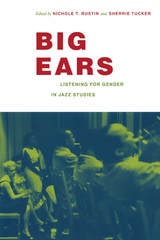
Big Ears
Listening for Gender in Jazz StudiesNichole T. Rustin and Sherrie Tucker, eds.
Duke University Press, 2008
Scholars of music, ethnomusicology, American studies, literature, anthropology, and cultural studies approach the question of gender in jazz from multiple perspectives. One contributor scrutinizes the tendency of jazz historiography to treat singing as subordinate to the predominantly male domain of instrumental music, while another reflects on her doubly inappropriate position as a female trumpet player and a white jazz musician and scholar. Other essays explore the composer George Russell’s Lydian Chromatic Concept as a critique of mid-twentieth-century discourses of embodiment, madness, and black masculinity; performances of “female hysteria” by Les Diaboliques, a feminist improvising trio; and the BBC radio broadcasts of Ivy Benson and Her Ladies’ Dance Orchestra during the Second World War. By incorporating gender analysis into jazz studies, Big Ears transforms ideas of who counts as a subject of study and even of what counts as jazz.
Contributors: Christina Baade, Jayna Brown, Farah Jasmine Griffin, Monica Hairston, Kristin McGee, Tracy McMullen, Ingrid Monson, Lara Pellegrinelli, Eric Porter, Nichole T. Rustin, Ursel Schlicht, Julie Dawn Smith, Jeffrey Taylor, Sherrie Tucker, João H. Costa Vargas
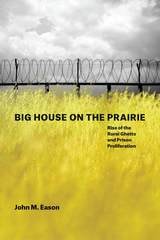
Big House on the Prairie
Rise of the Rural Ghetto and Prison ProliferationJohn M. Eason
University of Chicago Press, 2017
In 2007, John M. Eason moved his family to Forrest City, Arkansas, in search of answers to key questions about this trend: Why is America building so many prisons? Why now? And why in rural areas? Eason quickly learned that rural demand for prisons is complicated. Towns like Forrest City choose to build prisons not simply in hopes of landing jobs or economic wellbeing, but also to protect and improve their reputations. For some rural leaders, fostering a prison in their town is a means of achieving order in a rapidly changing world. Taking us into the decision-making meetings and tracking the impact of prisons on economic development, poverty, and race, Eason demonstrates how groups of elite whites and black leaders share power. Situating prisons within dynamic shifts that rural economies are undergoing and showing how racially diverse communities lobby for prison construction, Big House on the Prairie is a remarkable glimpse into the ways a prison economy takes shape and operates.

Bike Lust
Harleys, Women, And American SocietyBarbara Joans
University of Wisconsin Press, 2001
Bike Lust roars straight into the world of women bikers and offers us a ride. In this adventure story that is also an insider’s study of an American subculture, Barbara Joans enters as a passenger on the back of a bike, but soon learns to ride her own. As an anthropologist she untangles the rules, rituals, and rites of passage of the biker culture. As a new member of that culture, she struggles to overcome fear, physical weakness, and a tendency to shoot her mouth off—a tendency that very nearly gets her killed.
Bike Lust travels a landscape of contradictions. Outlaws still chase freedom on the highway, but so do thousands of riders of all classes, races, and colors. Joans introduces us to the women who ride the rear—the biker chick, the calendar slut straddling the hot engine, the back-seat Betty at the latest rally, or the underage groupie at the local run. But she also gives us the first close look at women who ride in their own right, on their own bikes, as well as a new understanding of changing world of male bikers. These are ordinary women’s lives made extraordinary, adding a dimension of courage to the sport not experienced by males, risking life and limb for a glimpse of the very edge of existence. This community of riders exists as a primal tribute to humanity's lust for freedom.
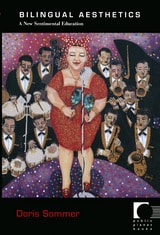
Bilingual Aesthetics
A New Sentimental EducationDoris Sommer
Duke University Press, 2004
Sommer encourages readers to entertain the creative possibilities inherent in multilingualism. With her characteristic wit and love of language, she focuses on humor—particularly bilingual jokes—as the place where tensions between and within cultures are played out. She draws on thinking about humor and language by a range of philosophers and others, including Sigmund Freud, Immanuel Kant, Ludwig Wittgenstein, Hannah Arendt, and Mikhail Bakhtin. In declaring the merits of allowing for crossed signals, Sommer sends a clear message: Making room for more than one language is about value added, not about remediation. It is an expression of love for a contingent and changing world.
Bioethics In Social Context
edited by Barry Hoffmaster
Temple University Press, 2001
The original essays in this volume use qualitative research methods to expose the multiple contexts within which the problems of bioethics arise, are defined and debated, and ultimately resolved. In a provocative concluding essay, one contributor asks his fellow ethnographers to reflect on the ethical problems of ethnography.

Biogenetic Paradoxes of the Nation
Finncattle, Apples, and Other Genetic-Resource PuzzlesSakari Tamminen
Duke University Press, 2019

Biological Relatives
IVF, Stem Cells, and the Future of KinshipSarah Franklin
Duke University Press, 2013
Biomedicalization
Technoscience, Health, and Illness in the U.S.Adele E. Clarke, Laura Mamo, Jennifer Ruth Fosket, Jennifer R. Fishman, and Janet K. Shim, eds.
Duke University Press, 2010
Contributors. Natalie Boero, Adele E. Clarke, Jennifer R. Fishman, Jennifer Ruth Fosket, Kelly Joyce, Jonathan Kahn, Laura Mamo, Jackie Orr, Elianne Riska, Janet K. Shim, Sara Shostak

Biotechnology and Society
An IntroductionHallam Stevens
University of Chicago Press, 2016

Biotic Borders
Transpacific Plant and Insect Migration and the Rise of Anti-Asian Racism in America, 1890–1950Jeannie N. Shinozuka
University of Chicago Press, 2022
In the late nineteenth century, increasing traffic of transpacific plants, insects, and peoples raised fears of a "biological yellow peril" when nursery stock and other agricultural products shipped from Japan to meet the growing demand for exotics in the United States. Over the next fifty years, these crossings transformed conceptions of race and migration, played a central role in the establishment of the US empire and its government agencies, and shaped the fields of horticulture, invasion biology, entomology, and plant pathology. In Biotic Borders, Jeannie N. Shinozuka uncovers the emergence of biological nativism that fueled American imperialism and spurred anti-Asian racism that remains with us today.
Shinozuka provides an eye-opening look at biotic exchanges that not only altered the lives of Japanese in America but transformed American society more broadly. She shows how the modern fixation on panic about foreign species created a linguistic and conceptual arsenal for anti-immigration movements that flourished in the early twentieth century. Xenophobia inspired concerns about biodiversity, prompting new categories of “native” and “invasive” species that defined groups as bio-invasions to be regulated—or annihilated. By highlighting these connections, Shinozuka shows us that this story cannot be told about humans alone—the plants and animals that crossed with them were central to Japanese American and Asian American history. The rise of economic entomology and plant pathology in concert with public health and anti-immigration movements demonstrate these entangled histories of xenophobia, racism, and species invasions.
Birthing Black Mothers
Jennifer C. Nash
Duke University Press, 2021
Birthing Fathers
The Transformation of Men in American Rites of BirthRichard K. Reed
Rutgers University Press, 2005
In the past two decades, men have gone from being excluded from the delivery room to being admitted, then invited, and, finally, expected to participate actively in the birth of their children. No longer mere observers, fathers attend baby showers, go to birthing classes, and share in the intimate, everyday details of their partners' pregnancies.
In this unique study, Richard Reed draws on the feminist critique of professionalized medical birthing to argue that the clinical nature of medical intervention distances fathers from child delivery. He explores men's roles in childbirth and the ways in which birth transforms a man's identity and his relations with his partner, his new baby, and society. In other societies, birth is recognized as an important rite of passage for fathers. Yet, in American culture, despite the fact that fathers are admitted into delivery rooms, little attention is given to their transition to fatherhood.
The book concludes with an exploration of what men's roles in childbirth tell us about gender and American society. Reed suggests that it is no coincidence that men's participation in the birthing process developed in parallel to changing definitions of fatherhood more broadly. Over the past twenty years, it has become expected that fathers, in addition to being strong and dependable, will be empathetic and nurturing.
Well-researched, candidly written, and enriched with personal accounts of over fifty men from all parts of the world, this book is as much about the birth of fathers as it is about fathers in birth.

Bits and Pieces
Screening Animal Life and DeathSarah O'Brien
University of Michigan Press, 2023
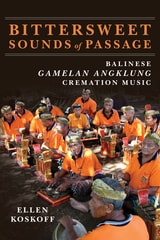
Bittersweet Sounds of Passage
Balinese Gamelan Angklung Cremation MusicEllen Koskoff
University of Illinois Press, 2025
Koskoff examines the history, cultural significance, and musical structures of contemporary gamelan angklung cremation music through the lens of three intertwined stories: existing scholarship on this music, written mostly by Western composers and scholars; the views of those performing and experiencing the music who regard it as dharma--ritual obligation, a basic concept in Balinese Hinduism; and the music itself, with a musical analysis focusing on changes in rasa--feeling, flavor and musical flow.
A journey inside a tradition, Bittersweet Sounds of Passage reveals the overlooked music of an important ritual in Balinese village life.
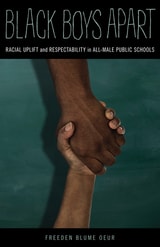
Black Boys Apart
Racial Uplift and Respectability in All-Male Public SchoolsFreeden Blume Oeur
University of Minnesota Press, 2018
How neoliberalism and the politics of respectability are transforming African American manhood
While single-sex public schools face much criticism, many Black communities see in them a great promise: that they can remedy a crisis for their young men. Black Boys Apart reveals triumphs, hope, and heartbreak at two all-male schools, a public high school and a charter high school, drawing on Freeden Blume Oeur’s ethnographic work. We meet young men who felt their schools empowered and emasculated them, parents who were frustrated with co-ed schools, teachers who helped pave the road to college, and administrators who saw in Black male academies the advantages of privatizing education.
While the two schools have distinctive histories and ultimately charted different paths, they were both shaped by the convergence of neoliberal ideologies and a politics of Black respectability. As Blume Oeur reveals, all-boys education is less a school reform initiative and instead joins a legacy of efforts to reform Black manhood during periods of stark racial inequality. Black male academies join long-standing attempts to achieve racial uplift in Black communities, but in ways that elevate exceptional young men and aggravate divisions within those communities.
Black Boys Apart shows all-boys schools to be an odd mix of democratic empowerment and market imperatives, racial segregation and intentional sex separation, strict discipline and loving care. Challenging narratives that endorse these schools for nurturing individual resilience in young Black men, this perceptive and penetrating ethnography argues for a holistic approach in which Black communities and their allies promote a collective resilience.
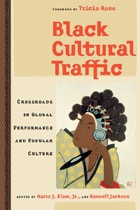
Black Cultural Traffic
Crossroads in Global Performance and Popular CultureEdited by Harry J. Elam, Jr. and Kennell Jackson
University of Michigan Press, 2005
"A shrewdly designed, generously expansive, timely contribution to our understanding of how 'black' expression continues to define and defy the contours of global (post)modernity. The essays argue persuasively for a transnational ethos binding disparate African and diasporic enactments, and together provide a robust conversation about the nature, history, future, and even possibility of 'blackness' as a distinctive mode of cultural practice."
--Kimberly Benston, author of Performing Blackness
"Black Cultural Traffic is nothing less than our generation's manifesto on black performance and popular culture. With a distinguished roster of contributors and topics ranging across academic disciplines and the arts (including commentary on film, music, literature, theater, television, and visual cultures), this volume is not only required reading for scholars serious about the various dimensions of black performance, it is also a timely and necessary teaching tool. It captures the excitement and intellectual innovation of a field that has come of age. Kudos!"
--Dwight A. McBride, author of Why I Hate Abercrombie & Fitch
"The explosion of interest in black popular culture studies in the past fifteen years has left a significant need for a reader that reflects this new scholarly energy. Black Cultural Traffic answers that need."
--Mark Anthony Neal, author of Songs in the Key of Black Life
"A revolutionary anthology that will be widely read and taught. It crisscrosses continents and cultures and examines confluences and influences of black popular culture -- music, dance, theatre, television, fashion and film. It also adds a new dimension to current discussions of racial, ethnic, and national identity."
--Horace Porter, author of The Making of a Black Scholar
Black Curators Matter
Conversations on Art and ChangeKellie Jones
J. Paul Getty Trust, The, 2026
Selected as one of Hyperallergic’s 15 Art Books We’re Excited to Read in 2026
This book chronicles the transformative impact of Black curators on American art museums since the 1970s as told by visionaries at the forefront of the change.
The relationship between Black Americans and U.S. art museums has historically been fraught and hard-won. In the late 1960s, the Black Emergency Cultural Coalition and other groups organized protests at major art museums, calling for the inclusion of Black artists and curators. Such advocacy led to acquisitions and exhibitions by Black artists at important institutions and spurred the establishment of museums and cultural organizations promoting Black art and culture. Today, Black curators hold significant positions at institutions nationwide. Black Curators Matter illuminates this critical history by spotlighting figures who have transformed the art world since the 1970s.
This book presents illuminating conversations between six pioneering curators—Lowery Stokes Sims, Deborah Willis, Richard J. Powell, Kellie Jones, Thelma Golden, and Franklin Sirmans—and a new generation of professionals, including Ashley James, Kalia Brooks, Aaron Bryant, Thomas Jean Lax, Rujeko Hockley, and LeRonn P. Brooks. Capturing the voices and experiences of Black curators, these discussions highlight their achievements and provide guidance for future generations aiming to diversify and enrich the cultural landscape. This volume reexamines the curatorial field to reveal the transformative strategies, critical interventions, and boundary-breaking exhibitions that reshaped American art museums toward greater inclusivity and experimentation.