Results by title
3258 books match the query 'Art' and 137 start with b
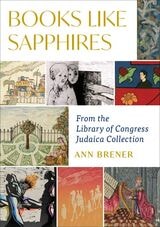
Books Like Sapphires
From the Library of Congress Judaica CollectionAnn Brener
Brandeis University Press, 2024
Books Like Sapphires showcases a wide range of Hebraic treasures from the storied collection at the Library of Congress, many of them for the first time. Tracing the history of Judaica collecting in the twentieth-century United States, the book illuminates varied works, telling their stories alongside vibrant color images. These include a unique manuscript about a betrothal scandal in Renaissance Crete, an illustrated Esther Scroll, a poem from 1477 celebrating the new technology of printing, amusing rhymed couplets in sixteenth-century Padua, and the Washington Haggadah. This book also tells the story of the patrons and collectors, first among them Jacob Schiff, as well as archivists and curators, who made the storied Judaica archive at the Library of Congress the precious resource that it is today.
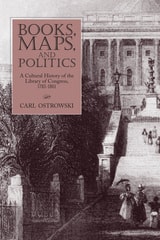
Books, Maps, and Politics
A Cultural History of the Library of Congress, 1783-1861Carl Ostrowski
University of Massachusetts Press, 2004
The author explores the relationship between the Library and the period's expanding print culture. He identifies the books that legislators required to be placed in the Library and establishes how these volumes were used. His analysis of the earliest printed catalogs of the Library reveals that law, politics, economics, geography, and history were the subjects most assiduously collected. These books provided government officials with practical guidance in domestic legislation and foreign affairs, including disputes with European powers over territorial boundaries.
Ostrowski also discusses a number of secondary functions of the Library, one of which was to provide reading material for the entertainment and instruction of government officials and their families. As a result, the richness of America's burgeoning literary culture from the 1830s to the 1860s was amply represented on the Library's shelves. For those with access to its Capitol rooms, the Library served an important social function, providing a space for interaction and the display and appreciation of American works of art.
Ostrowski skillfully demonstrates that the history of the Library of Congress offers a lens through which we can view changing American attitudes toward books, literature, and the relationship between the federal government and the world of arts and letters.
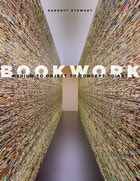
Bookwork
Medium to Object to Concept to ArtGarrett Stewart
University of Chicago Press, 2011
“There they rest, inert, impertinent, in gallery space—those book forms either imitated or mutilated, replicas of reading matter or its vestiges. Strange, after its long and robust career, for the book to take early retirement in a museum, not as rare manuscript but as functionless sculpture. Readymade or constructed, such book shapes are canceled as text when deposited as gallery objects, shut off from their normal reading when not, in some yet more drastic way, dismembered or reassembled.” So begins Bookwork, which follows our passion for books to its logical extreme in artists who employ found or simulated books as a sculptural medium. Investigating the conceptual labor behind this proliferating international art practice, Garrett Stewart looks at hundreds of book-like objects, alone or as part of gallery installations, in this original account of works that force attention upon a book’s material identity and cultural resonance.
Less an inquiry into the artist’s book than an exploration of the book form’s contemporary objecthood, Stewart’s interdisciplinary approach traces the lineage of these aggressive artifacts from the 1919 Unhappy Readymade of Marcel Duchamp down to the current crisis of paper-based media in the digital era. Bookwork surveys and illustrates a stunning variety of appropriated and fabricated books alike, ranging from hacksawed discards to the giant lead folios of Anselm Kiefer. The unreadable books Stewart engages with in this timely study are found, again and again, to generate graphic metaphors for the textual experience they preclude, becoming in this sense legible after all.
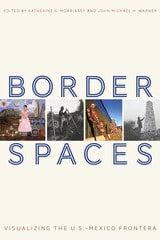
Border Spaces
Visualizing the U.S.-Mexico FronteraEdited by Katherine G. Morrissey and John-Michael H. Warner
University of Arizona Press, 2018
In Border Spaces, Katherine G. Morrissey, John-Michael H. Warner, and other essayists build on the insights of border dwellers, or fronterizos, and draw on two interrelated fields—border art history and border studies. The editors engage in a conversation on the physical landscape of the border and its representations through time, art, and architecture.
The volume is divided into two linked sections—one on border histories of built environments and the second on border art histories. Each section begins with a “conversation” essay—co-authored by two leading interdisciplinary scholars in the relevant fields—that weaves together the book’s thematic questions with the ideas and essays to follow.
Border Spaces is prompted by art and grounded in an academy ready to consider the connections between art, land, and people in a binational region.
Contributors
Maribel Alvarez
Geraldo Luján Cadava
Amelia Malagamba-Ansótegui
Mary E. Mendoza
Sarah J. Moore
Katherine G. Morrissey
Margaret Regan
Rebecca M. Schreiber
Ila N. Sheren
Samuel Truett
John-Michael H. Warner
Borderless Fashion Practice
Contemporary Fashion in the Metamodern AgeVanessa Gerrie
Rutgers University Press, 2023
Born of Resistance
Cara a Cara Encounters with Chicana/o Visual CultureEdited by Scott L. Baugh and Víctor A. Sorell
University of Arizona Press, 2015
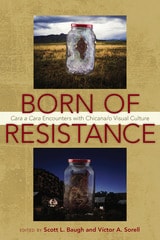
If Chicana/o culture was born of resistance amid assimilation and nationalistic forces, how has it evolved into the twenty-first century? This groundbreaking volume redresses the central idea of resistance in Chicana/o visual cultural expression through nine clustered discussions, each coordinating scholarly, critical, curatorial, and historical contextualizations alongside artist statements and interviews. Landmark artistic works—illustrations, paintings, sculpture, photography, film, and television—anchor each section. Contributors include David Avalos, Mel Casas, Ester Hernández, Nicholas Herrera, Luis Jiménez, Ellen Landis, Yolanda López, Richard Lou, Delilah Montoya, Laura Pérez, Lourdes Portillo, Luis Tapia, Chuy Treviño, Willie Varela, Kathy Vargas, René Yañez, Yvonne Yarbro-Bejarano, and more. Cara a cara, face-to-face, encounters across the collection reveal the varied richness of resistant strategies, movidas, as they position crucial terms of debate surrounding resistance, including subversion, oppression, affirmation, and identification.
The essays in the collection represent a wide array of perspectives on Chicana/o visual culture. Editors Scott L. Baugh and Víctor A. Sorell have curated a dialog among the many voices, creating an important new volume that redefines the role of resistance in Chicana/o visual arts and cultural expression.
Botanical Art from the Golden Age of Scientific Discovery
Anna Laurent
University of Chicago Press, 2016
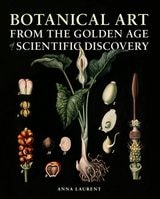
This beautifully illustrated oversized book gives the humble wall chart its due, reproducing more than two hundred of them in dazzling full color. Each wall chart is accompanied by captions that offer accessible information about the species featured, the scientists and botanical illustrators who created it, and any particularly interesting or innovative features the chart displays. And gardeners will be pleased to discover useful information about plant anatomy and morphology and species differences. We see lilies and tulips, gourds, aquatic plants, legumes, poisonous plants, and carnivorous plants, all presented in exquisite, larger-than-life detail.
A unique fusion of art, science, and education, the wall charts gathered here offer a glimpse into a wonderful scientific heritage and are sure to thrill naturalists, gardeners, and artists alike.
Botanical Revolutions
How Plants Changed the Course of ArtGiovanni Aloi
J. Paul Getty Trust, The, 2025
Desired for their aesthetic beauty, sought after for their medicinal properties, harvested for their scents and flavors, or grown as essential material resources, plants are indissolubly entwined with our existence. In art it is no different: plants have played a critical role. Yet despite their significant material and conceptual contributions, plants have been sidelined in the commentary of art historians and critics.
Botanical Revolutions presents a global history of plants in art, focusing on the crucial moments that signaled the formation of new movements and styles, as well as the creation of media that could not have occurred without the involvement of and interaction with the vegetal world. In this fascinating and beautifully illustrated book, author Giovanni Aloi delves deeply into the history and representation of plants in art, advocates for a change in our relationship with the botanical world, and presents an alternative history of art that foregrounds the truly indispensable contributions of plants.
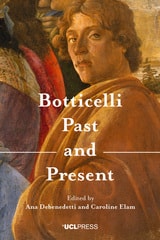
Botticelli Past and Present
Edited by Ana Debenedetti and Caroline Elam
University College London, 2019
In four chapters, spanning centuries of Botticelli’s artistic fame and reception, Botticelli Past and Present engages with the significant debates about Botticelli. Each chapter collects several essays and includes a short introduction that positions them within the wider scholarly literature on Botticelli. The chapters are organized chronologically, beginning with discussion of the artist and his work in his own time, moving on to the progressive rediscovery of his work from the late eighteenth to the turn of the twentieth century, through to his enduring impact on contemporary art and design.
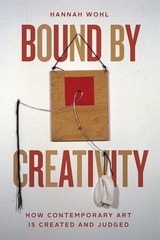
Bound by Creativity
How Contemporary Art Is Created and JudgedHannah Wohl
University of Chicago Press, 2021
Bound by Creativity reveals how artists develop conceptions of their distinctive creative visions through experimentation and social interactions. Ultimately, we come to appreciate how judgment is integral to the creative process, both resulting in the creation of original works while also limiting an artist’s ability to break new ground. Exploring creativity through the lens of judgment sheds new light on the production of cultural objects, markets, and prestige.
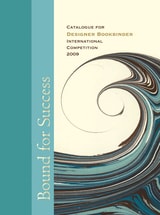
Bound for Success
Catalogue for Designer Bookbinders International Competition 2009Edited by Jeanette Koch
Bodleian Library Publishing, 2009
Published to celebrate the winning entries in the prestigious 2009 Designer Bookbinders International Bookbinding Competition held at the Bodleian Library, Bound for Success presents nearly four hundred of the most skillful and creative examples of contemporary bookbinding across the world.
Designer Bookbinders is one of the foremost international bookbinding societies, and this competition catalog features a remarkable range of styles, materials, and approaches to an ancient technique, attracting top binders from around the world. Beautifully designed, Bound for Success is as stunning a book as the bindings it displays. This showcase of the best in modern bookbinding is likely to become a collector’s item among aficionados of bookbinding--as well as a handsome addition to any personal library.
Exhibition Dates:
12 June - 1 August 2009 Bodleian Library, Oxford
18 September - 13 December 2009 Boston Public Library
12 February - 6 March 2010 Bonhams & Butterfields, San Francisco
19 May - 31 July 2010 The Grolier Club of New York
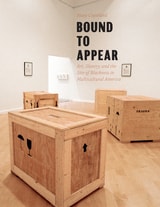
Bound to Appear
Art, Slavery, and the Site of Blackness in Multicultural AmericaHuey Copeland
University of Chicago Press, 2013
Boundless
Native American Abundance in Art and LiteratureLisa A. Crossman and Heid E. Erdrich
Amherst College Press, 2025
Amherst College’s Collection of Native American Literature contains thousands of Indigenous-authored works spanning centuries. The Collection’s abundance of books, prints, music, ephemera, and artist-made works, all by Native people, provide rich selections for Boundless. Crosscurrents of Indigenous visual art and literature are considered in this broad and interdisciplinary project. Boundless crosses generations to explore relatedness, kinship, and collegiality.
Boundless brings artists and writers together across generations, often drawing together works by members of the same tribe or even the same family to show the history, presence, and futurity of Native American creative and intellectual production.
Brain of the Earth’s Body
Art, Museums, and the Phantasms of ModernityDonald Preziosi
University of Minnesota Press, 2003
Brazilian Art under Dictatorship
Antonio Manuel, Artur Barrio, and Cildo MeirelesClaudia Calirman
Duke University Press, 2012

Bread, Wine, and Money
The Windows of the Trades at Chartres CathedralJane Welch Williams
University of Chicago Press, 1993
Williams weaves a tight net of historical circumstances, iconographic traditions, exegetical implications, political motivations, and liturgical functions to explain the imagery in the windows of the trades. Her account of changing social relationships in thirteenth-century Chartres focuses on the bakers, tavern keepers, and money changers whose bread, wine, and money were used as means of exchange, tithing, and offering throughout medieval society. Drawing on a wide variety of original documents and scholarly work, this book makes important new contributions to our knowledge of one of the great monuments of Western culture.
Breathless Days, 1959-1960
Serge Guilbaut and John O'Brien, editors
Duke University Press, 2017
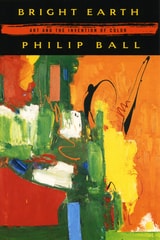
Bright Earth
Art and the Invention of ColorPhilip Ball
University of Chicago Press, 2003
Finalist for the 2002 National Book Critics Circle Award.
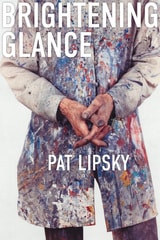
Brightening Glance
Art and LifePat Lipsky
University of Iowa Press, 2025
Brightening Glance offers a stunningly self-revealing portrait of the struggles and sacrifices, joys and excitement inherent in a modern painter’s life, and captures the evergreen allure of New York’s art world between 1970 and 2010. In stripped down, elegant prose, Lipsky summons a New York that no longer exists and ponders why we love (and hate) the art world. Ultimately, it’s a story of a contemporary woman, a mother, and a painter, who dares a career in a field where only a handful of women have succeeded.
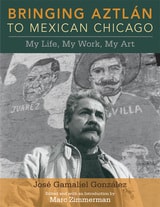
Bringing Aztlan to Mexican Chicago
My Life, My Work, My ArtJose Gamaliel Gonzalez, Edited and with an Introduction by Marc Zimmerman
University of Illinois Press, 2010

Britpop Cinema
From Trainspotting to This is EnglandMatt Glasby
Intellect Books, 2019
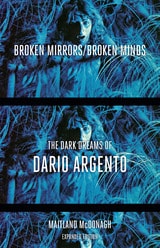
Broken Mirrors/Broken Minds
The Dark Dreams of Dario ArgentoMaitland McDonagh
University of Minnesota Press, 2010
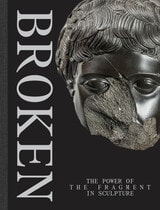
Broken
The Power of the Fragment in SculptureEdited by C. D. Dickerson III and Andrew Sears
University of Chicago Press, 2026
A compelling exploration of fragments in sculpture across time and cultures.
Some objects draw power from the way they have been broken. Becoming beautiful abstract shapes, they provoke consideration of how destruction can create something so aesthetically appealing. Beyond the visual, these fragments are compelling because they force us to confront the often unsettling stories of their breakage.
Published in conjunction with the National Gallery of Art and accompanying a traveling exhibition, this lavishly illustrated book explores our enduring fascination with broken statues through a range of interdisciplinary perspectives, featuring contributions by scholars and artists, along with examples of striking works from around the world spanning the third millennium BCE to the present.
Organized in three sections, Broken begins by investigating what makes fragments so intriguing and reveals the optical and neurological processes behind the strong emotions they evoke. It then moves to the act of breaking itself, exploring the forces—both natural and human—that shaped these objects, the power dynamics of iconoclastic dismantling and defacement, and how various cultures treat broken statues. The book concludes by considering one of the most powerful ways humans have responded to fragments over the course of history: by creating new works that are intentionally fractured.
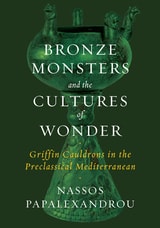
Bronze Monsters and the Cultures of Wonder
Griffin Cauldrons in the Preclassical MediterraneanNassos Papalexandrou
University of Texas Press, 2021
The eighth and seventh centuries BCE were a time of flourishing exchange between the Mediterranean and the Near East. One of the period’s key imports to the Hellenic and Italic worlds was the image of the griffin, a mythical monster that usually possesses the body of a lion and the head of an eagle. In particular, bronze cauldrons bore griffin protomes—figurative attachments showing the neck and head of the beast. Crafted in fine detail, the protomes were made to appear full of vigor, transfixing viewers.
Bronze Monsters and the Cultures of Wonder takes griffin cauldrons as case studies in the shifting material and visual universes of preclassical antiquity, arguing that they were perceived as lifelike monsters that introduced the illusion of verisimilitude to Mediterranean arts. The objects were placed in the tombs of the wealthy (Italy, Cyprus) and in sanctuaries (Greece), creating fantastical environments akin to later cabinets of curiosities. Yet griffin cauldrons were accessible only to elites, ensuring that the new experience of visuality they fostered was itself a symbol of status. Focusing on the sensory encounter of this new visuality, Nassos Papalexandrou shows how spaces made wondrous fostered novel subjectivities and social distinctions.

Browning’s Beginnings
The Art of DisclosureHerbert F. Tucker Jr.
University of Minnesota Press, 1980
Browning's Beginnings was first published in 1980. Minnesota Archive Editions uses digital technology to make long-unavailable books once again accessible, and are published unaltered from the original University of Minnesota Press editions.
Browning's Beginnings offers a fresh approach to the poet who, among major Victorians, has proved at once the most congenial and most inscrutable to modern readers. Drawing on recent developments in literary theory and in the criticism of romantic poetry, Herbert
F. Tucker, Jr., argues that Browning's stylistic "obscurity" is the result of a principled poetics of evasion. This art of disclosure, in deferring formal and semantic finalities, constitutes an aesthetic counterpart to his open-ended moral philosophy of"incompleteness," Browning's poems, like his enormously productive career, find their motivation and sustenance in his optimistic love of the future—a love that is indistinguishable from his lifelong fear that there will be nothing left to say.The opening chapters trace the workings of Browning's art of disclosure with extensive and original interpretations of the unduly neglected early poems, Pauline, Paracelsus, and Sordello, and place special emphasis on Browning's attitudes toward poetic tradition and language. A chapter on Browning's attitudes toward poetic tradition and language. A chapter on Browning's plays identifies dynamics of representation in Pippa Passes, Strafford,and King Victor and King Charles. Tucker discusses the pervasive analogy between Browning's ideas about poetic representation and about representation in its erotic and religious aspects, and shows how the early poems and plays illustrate correlative developments in poetics and in the exploration and dramatic rendering of human psychology. The remaining chapters follow the poetic psychology of Browning to its culmination in the great poems of his middle years; exemplary readings of selected dramatic lyrics and monologues suggest that the ways of meaning in Browning's mature work variously bear out the sense of endlessness or perpetual initiation that is central to his poetic beginnings.
Tucker thus contends that the "romantic" and the "Victorian" Browning have more in common than is generally supposed, and his book should appeal to students of both periods. Its discussion of general literary issues - poetic influence, closure, representation, and meaning - in application to particular texts should further recommend Browning's Beginnings to the nonspecialist reader interested in poetry and poetic theory.
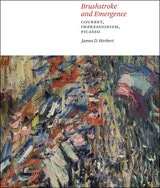
Brushstroke and Emergence
Courbet, Impressionism, PicassoJames D. Herbert
University of Chicago Press, 2015
Yet the question of how much we can credit to the individual brushstroke is complicated—and in Brushstroke and Emergence, James D. Herbert uses that question as a starting point for an extended essay that draws on philosophy of mind, the science of emergence, and art history. Brushstrokes, he reminds us, are as much creatures of habit and embodied experience as they are of intent. When they gather in great numbers they take on a life of their own, out of which emerge complexity and meaning. Analyzing ten paintings by Courbet, Manet, Cézanne, Monet, Seurat, and Picasso, Herbert exposes vital relationships between intention and habit, the singular and the complex. In doing so, he uncovers a space worthy of historical and aesthetic analysis between the brushstroke and the self.
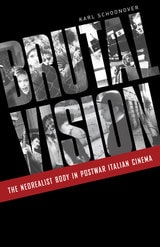
Brutal Vision
The Neorealist Body in Postwar Italian CinemaKarl Schoonover
University of Minnesota Press, 2012
Film history identifies Italian neorealism as the exemplar of national cinema, a specifically domestic response to wartime atrocities. Brutal Vision challenges this orthodoxy by arguing that neorealist films—including such classics as Rome, Open City; Paisan; Shoeshine; and Bicycle Thieves—should be understood less as national products and more as complex agents of a postwar reorganization of global politics. For these films, cinema facilitates the liberal humanist sympathy required to usher in a new era of world stability.
In his readings of crucial films and newly discovered documents from the archives of neorealism’s international distribution, Karl Schoonover reveals how these films used images of the imperiled body to reconstitute the concept of the human and to recalibrate the scale of human community. He traces how Italian neorealism emerges from and consolidates the transnational space of the North Atlantic, with scenarios of physical suffering dramatizing the geopolitical stakes of a newly global vision. Here we see how—in their views of injury, torture, and martyrdom—these films propose a new mode of spectating that answers the period’s call for extranational witnesses, makes the imposition of limited sovereignty palatable, and underwrites a new visual politics of liberal compassion that Schoonover calls brutal humanism.
These films redefine moviegoing as a form of political action and place the filmgoer at the center of a postwar geopolitics of international aid. Brutal Vision interrogates the role of neorealism’s famously heart-wrenching scenes in a new global order that requires its citizenry to invest emotionally in large-scale international aid packages, from the Marshall Plan to the liberal charity schemes of NGOs. The book fundamentally revises ideas of cinematic specificity, the human, and geopolitical scale that we inherit from neorealism and its postwar milieu—ideas that continue to set the terms for political filmmaking today.
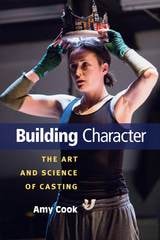
Building Character
The Art and Science of CastingAmy Cook
University of Michigan Press, 2018
Building a Nation
Chickasaw Museums and the Construction of History and HeritageJoshua M. Gorman
University of Alabama Press, 2011
A groundbreaking study of Indigenous museums and cultural self-representation.
The Chickasaw Nation, an American Indian nation headquartered in southeastern Oklahoma, entered into a period of substantial growth in the late 1980s. Following its successful reorganization and expansion, which was enabled by federal policies for tribal self-determination, the Nation pursued gaming and other industries to affect economic growth. From 1987 to 2009 the Nation’s budget increased exponentially as tribal investments produced increasingly large revenues for a growing Chickasaw population. Coincident to this growth, the Chickasaw Nation began acquiring and creating museums and heritage properties to interpret their own history, heritage, and culture through diverse exhibitionary representations. By 2009, the Chickasaw Nation directed representation of itself at five museum and heritage properties throughout its historic boundaries.
Josh Gorman examines the history of these sites and argues that the Chickasaw Nation is using museums and heritage sites as places to define itself as a coherent and legitimate contemporary Indian nation. In doing so, they are necessarily engaging with the shifting historiographical paradigms as well as changing articulations of how museums function and what they represent. The roles of the Chickasaw Nation’s museums and heritage sites in defining and creating discursive representations of sovereignty are examined within their historicized local contexts. The work describes the museum exhibitions’ dialogue with the historiography of the Chickasaw Nation, the literature of new museum studies, and the indigenous exhibitionary grammars emerging from indigenous museums throughout the United States and the world.
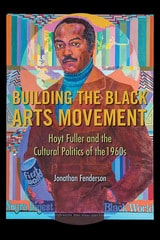
Building the Black Arts Movement
Hoyt Fuller and the Cultural Politics of the 1960sJonathan Fenderson
University of Illinois Press, 2019
Bulletin of the Detroit Institute of Arts, volume 95 number 1 (January 2021)
The University of Chicago Press
University of Chicago Press Journals, 2021
Bulletin of the Detroit Institute of Arts, volume 96 number 1 (January 2022)
The University of Chicago Press
University of Chicago Press Journals, 2022
Bulletin of the Detroit Institute of Arts, volume 97 number 1 (January 2023)
The University of Chicago Press
University of Chicago Press Journals, 2023
Bulletin of the Detroit Institute of Arts, volume 98 number 1 (January 2024)
The University of Chicago Press
University of Chicago Press Journals, 2024
Bulletin of the Detroit Institute of Arts, volume 99 number 1 (2025)
The University of Chicago Press
University of Chicago Press Journals, 2025
Bureaucratizing the Muse
Public Funds and the Cultural WorkerSteven C. Dubin
University of Chicago Press, 1987
Bureaucratizing the Muse is a study of the Chicago AIR program. By its very nature art is a nonrational process, even at times antirational, and the idea of organizing artists in this kind of work environment was an unusual one. Steven C. Dubin's account is a fascinating story of the tensions between struggling artists who need a paycheck but fear the compromise of their art and bureaucrats who need to produce measurable results.
Buyers Beware
Insurgency and Consumption in Caribbean Popular CulturePatricia Joan Saunders
Rutgers University Press, 2022