Results by title
5448 books match the query 'History and criticism' and 252 start with b
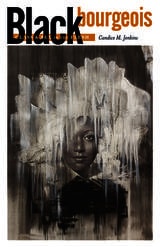
Black Bourgeois
Class and Sex in the FleshCandice M. Jenkins
University of Minnesota Press, 2019
Exploring the forces that keep black people vulnerable even amid economically privileged lives
At a moment in U.S. history with repeated reminders of the vulnerability of African Americans to state and extralegal violence, Black Bourgeois is the first book to consider the contradiction of privileged, presumably protected black bodies that nonetheless remain racially vulnerable. Examining disruptions around race and class status in literary texts, Candice M. Jenkins reminds us that the conflicted relation of the black subject to privilege is not, solely, a recent phenomenon.
Focusing on works by Toni Morrison, Spike Lee, Danzy Senna, Rebecca Walker, Reginald McKnight, Percival Everett, Colson Whitehead, and Michael Thomas, Jenkins shows that the seemingly abrupt discursive shift from post–Civil Rights to Black Lives Matter, from an emphasis on privilege and progress to an emphasis on vulnerability and precariousness, suggests a pendulum swing between two interrelated positions still in tension. By analyzing how these narratives stage the fraught interaction between the black and the bourgeois, Jenkins offers renewed attention to class as a framework for the study of black life—a necessary shift in an age of rapidly increasing income inequality and societal stratification.
Black Bourgeois thus challenges the assumed link between blackness and poverty that has become so ingrained in the United States, reminding us that privileged subjects, too, are “classed.” This book offers, finally, a rigorous and nuanced grasp of how African Americans live within complex, intersecting identities.
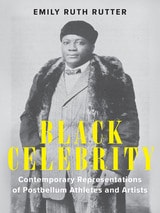
Black Celebrity
Contemporary Representations of Postbellum Athletes and ArtistsEmily Ruth Rutter
University of Delaware Press, 2022
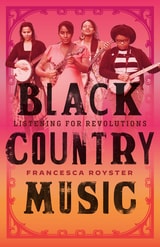
Black Country Music
Listening for RevolutionsFrancesca T. Royster
University of Texas Press, 2022
2023 Ralph J. Gleason Music Book Award, Rock & Roll Hall of Fame
2024 Woody Guthrie Book Award, International Association for the Study of Popular Music-US Branch (IASPM-US)
2023 Certificate of Merit, ARSC Awards for Excellence in Historical Recorded Sound Research, Association for Recorded Sound Collections
2023 The Judy Tsou Critical Race Studies Award, American Musicological Society
How Black musicians have changed the country music landscape and brought light to Black creativity and innovation.
After a century of racist whitewashing, country music is finally reckoning with its relationship to Black people. In this timely work—the first book on Black country music by a Black writer—Francesca Royster uncovers the Black performers and fans, including herself, who are exploring the pleasures and possibilities of the genre.
Informed by queer theory and Black feminist scholarship, Royster’s book elucidates the roots of the current moment found in records like Tina Turner’s first solo album, Tina Turns the Country On! She reckons with Black “bros” Charley Pride and Darius Rucker, then chases ghosts into the future with Valerie June. Indeed, it is the imagination of Royster and her artists that make this music so exciting for a genre that has long been obsessed with the past. The futures conjured by June and others can be melancholy, and are not free of racism, but by centering Black folk Royster begins to understand what her daughter hears in the banjo music of Our Native Daughters and the trap beat of Lil Nas X’s “Old Town Road.” A Black person claiming country music may still feel a bit like a queer person coming out, but, collectively, Black artists and fans are changing what country music looks and sounds like—and who gets to love it.
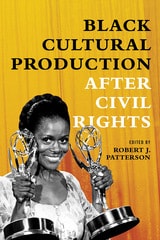
Black Cultural Production after Civil Rights
Edited by Robert J. Patterson
University of Illinois Press, 2019
This collection's fascinating spectrum of topics begins with the literary and cinematic representations of slavery from the 1970s to the present. Other authors delve into visual culture from Blaxploitation to the art of Betye Saar to stage works like A Movie Star Has to Star in Black and White as well as groundbreaking literary works like Corregidora and Captain Blackman. A pair of concluding essays concentrate on institutional change by looking at the Seventies surge of black publishing and by analyzing Ntozake Shange's for colored girls. . . in the context of current controversies surrounding sexual violence. Throughout, the writers reveal how Seventies black cultural production anchors important contemporary debates in black feminism and other issues while spurring the black imagination to thrive amidst abject social and political conditions.
Contributors: Courtney R. Baker, Soyica Diggs Colbert, Madhu Dubey, Nadine Knight, Monica White Ndounou, Kinohi Nishikawa, Samantha Pinto, Jermaine Singleton, Terrion L. Williamson, and Lisa Woolfork

Black Gathering
Art, Ecology, Ungiven LifeSarah Jane Cervenak
Duke University Press, 2021
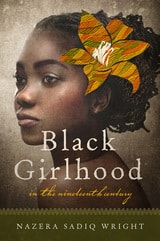
Black Girlhood in the Nineteenth Century
Nazera Sadiq Wright
University of Illinois Press, 2016
As Wright shows, the figure of the black girl in African American literature provided a powerful avenue for exploring issues like domesticity, femininity, and proper conduct. The characters' actions, however fictional, became a rubric for African American citizenship and racial progress. At the same time, their seeming dependence and insignificance allegorized the unjust treatment of African Americans. Wright reveals fascinating girls who, possessed of a premature knowing and wisdom beyond their years, projected a courage and resiliency that made them exemplary representations of the project of racial advance and citizenship.
Black Internationalist Feminism
Women Writers of the Black Left, 1945-1995Cheryl Higashida
University of Illinois Press, 2013
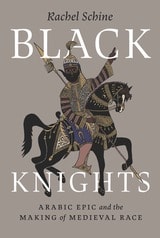
Black Knights
Arabic Epic and the Making of Medieval RaceRachel Schine
University of Chicago Press, 2024
In Black Knights, Rachel Schine reveals how the Arabic-speaking world developed a different form of racial knowledge than their European neighbors during the Middle Ages. Unlike in European vernaculars, Arabic-language ideas about ethnic difference emerged from conversations extending beyond the Mediterranean, from the Sahara to the Indian Ocean. In these discourses, Schine argues, racialized blackness became central to ideas about a global, ethnically inclusive Muslim world.
Schine traces the emergence of these new racial logics through popular Islamic epics, drawing on legal, medical, and religious literatures from the period to excavate a diverse and ever-changing conception of blackness and race. The result is a theoretically nuanced case for the existence and malleability of racial logics in premodern Islamic contexts across a variety of social and literary formations.
Black Love, Black Hate
Intimate Antagonisms in African American LiteratureFelice D. Blake
The Ohio State University Press, 2018
Most importantly, the book shows how literature constitutes an alternative public sphere for Black people. In a society largely controlled by white supremacist actors and institutions, Black authors have conjured fiction into a space where hard questions can be asked and answered and where the work of combatting collective, racist suppression can occur without replicating oppressive hierarchies. Intimate Antagonisms uncovers a key theme in Black fiction and argues that literature itself is a vital institutional site within Black life. Through the examination of intimate conflicts in a wide array of twentieth- and twenty-first-century novels, Blake demonstrates the centrality of intraracial relations to the complexity and vision of Black social movements and liberation struggles and the power and promise of Black narrative in reshaping struggle.
Black Madness
: Mad BlacknessTherí Alyce Pickens
Duke University Press, 2019
Black Magic
White Hollywood and African American CultureKrin Gabbard
Rutgers University Press, 2004
As Krin Gabbard brilliantly reveals in Black Magic, we duly recognize the cultural heritage of African Americans in literature, music, and art, but there is a disturbing pattern in the roles that blacks are asked to play-particularly in the movies. Many recent films, including The Matrix, Fargo, The Green Mile, Ghost, The Talented Mr. Ripley, Pleasantville, The Bridges of Madison County, and Crumb, reveal a fascination with black music and sexuality even as they preserve the old racial hierarchies. Quite often the dependence on African American culture remains hidden-although it is almost perversely pervasive. In the final chapters of Black Magic, Gabbard looks at films by Robert Altman and Spike Lee that attempt to reverse many of these widespread trends.
Black Manhood in James Baldwin, Ernest J. Gaines, and August Wilson
Keith Clark
University of Illinois Press, 2002
Challenging the standard portrayals of Black men in African American literature
From Frederick Douglass to the present, the preoccupation of black writers with manhood and masculinity is a constant. Black Manhood in James Baldwin, Ernest J. Gaines, and August Wilson explores how in their own work three major African American writers contest classic portrayals of black men in earlier literature, from slave narratives through the great novels of Richard Wright and Ralph Ellison.
Keith Clark examines short stories, novels, and plays by Baldwin, Gaines, and Wilson, arguing that since the 1950s the three have interrupted and radically dismantled the constricting literary depictions of black men who equate selfhood with victimization, isolation, and patriarchy. Instead, they have reimagined black men whose identity is grounded in community, camaraderie, and intimacy.
Delivering original and startling insights, this book will appeal to scholars and students of African American literature, gender studies, and narratology.

Black Paris
THE AFRICAN WRITERS' LANDSCAPEBennetta Jules-Rosette
University of Illinois Press, 1998
Bennetta Jules-Rosette explores African writing and identity in France from the early négritude movement and the founding of the Présence Africaine publishing house in 1947 to the mid-1990s. Examining the relationship between African writing and French anthropology as well as the emergence of new styles and discourses, Jules-Rosette covers French Pan-Africanism and the revolutionary writing of the 1960s and 1970s. She also discusses the new generation of African writers who appeared in Paris during the 1980s and 1990s.
Black Pearls
Blues Queens of the 1920sDaphne Duval Harrison
Rutgers University Press, 1990
Blues music spawned legendary performers whose influence has been felt in many musical forms here and around the world. Until now the important role of the great women blues singers has largely gone unexplored. This book tells of the cultural and social impact of the blues during the 1920s when the genre was dominated by women, both on stage and on record. Harrison (Afro-American Studies Department, University of Maryland) writes with authority, focusing particularly on Sippie Wallace, Edith Wilson, Victoria Spivey, and Alberta Hunter as she analyzes the music and the collective black experience out of which it grew. A significant book, particularly for collections of music history, black studies, and women's studies. -- Library Journal
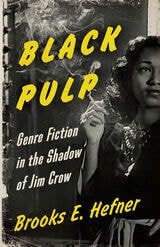
Black Pulp
Genre Fiction in the Shadow of Jim CrowBrooks E. Hefner
University of Minnesota Press, 2021
A deep dive into mid-century African American newspapers, exploring how Black pulp fiction reassembled genre formulas in the service of racial justice
In recent years, Jordan Peele’s Get Out, Marvel’s Black Panther, and HBO’s Watchmen have been lauded for the innovative ways they repurpose genre conventions to criticize white supremacy, celebrate Black resistance, and imagine a more racially just world—important progressive messages widely spread precisely because they are packaged in popular genres. But it turns out, such generic retooling for antiracist purposes is nothing new.
As Brooks E. Hefner’s Black Pulp shows, this tradition of antiracist genre revision begins even earlier than recent studies of Black superhero comics of the 1960s have revealed. Hefner traces it back to a phenomenon that began in the 1920s, to serialized (and sometimes syndicated) genre stories written by Black authors in Black newspapers with large circulations among middle- and working-class Black readers. From the pages of the Pittsburgh Courier and the Baltimore Afro-American, Hefner recovers a rich archive of African American genre fiction from the 1920s through the mid-1950s—spanning everything from romance, hero-adventure, and crime stories to westerns and science fiction. Reading these stories, Hefner explores how their authors deployed, critiqued, and reassembled genre formulas—and the pleasures they offer to readers—in the service of racial justice: to criticize Jim Crow segregation, racial capitalism, and the sexual exploitation of Black women; to imagine successful interracial romance and collective sociopolitical progress; and to cheer Black agency, even retributive violence in the face of white supremacy.
These popular stories differ significantly from contemporaneous, now-canonized African American protest novels that tend to represent Jim Crow America as a deterministic machine and its Black inhabitants as doomed victims. Widely consumed but since forgotten, these genre stories—and Hefner’s incisive analysis of them—offer a more vibrant understanding of African American literary history.
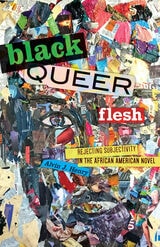
Black Queer Flesh
Rejecting Subjectivity in the African American NovelAlvin J. Henry
University of Minnesota Press, 2021
A groundbreaking examination of how twentieth-century African American writers use queer characters to challenge and ultimately reject subjectivity
Black Queer Flesh reinterprets key African American novels from the Harlem Renaissance to Black Modernism to contemporary literature, showing how authors have imagined a new model of Black queer selfhood. African American authors blame liberal humanism’s model of subjectivity for double consciousness and find that liberal humanism’s celebration of individual autonomy and agency is a way of disciplining Black queer lives. These authors thus reject subjectivity in search of a new mode of the self that Alvin J. Henry names “Black queer flesh”—a model of selfhood that is collective, plural, fluctuating, and deeply connected to the Black queer past.
Henry begins with early twentieth-century authors such as Jessie Redmon Fauset and James Weldon Johnson. These authors adapted the Bildungsroman, the novel of self-formation, to show African Americans gaining freedom and agency by becoming a liberal, autonomous subjects. These authors, however, discovered that the promise of liberal autonomy held out by the Bildungsroman was yet another tool of antiblack racism. As a result, they tentatively experimented with repurposing the Bildungsroman to throw off subjectivity and its attendant double consciousness. In contrast, Nella Larsen, Henry shows, was the first author to fully reject subjectivity. In Quicksand and Passing, Larsen invented a new genre showing her queer characters—characters whose queerness already positioned them on the margins of subjectivity—escaping subjectivity altogether. Using Ralph Ellison’s archival drafts, Henry then powerfully rereads Invisible Man, revealing that the protagonist as a queer, disabled character taught by the novel’s many other queer, disabled characters to likewise seek a selfhood beyond subjectivity. Although Larsen and Ellison sketch glimpses of this selfhood beyond subjectivity, only Saidiya Hartman’s Wayward Lives, Beautiful Experiments shows a protagonist fully inhabiting Black queer flesh—a new mode of selfhood that is collective, plural, always evolving, and no longer alienated from the black past.
Black Queer Flesh is an original and necessary contribution to Black literary studies, offering new ways to understand and appreciate the canonical texts and far more.

Black Regions of the Imagination
African American Writers between the Nation and the WorldEve Dunbar
Temple University Press, 2012
Zora Neale Hurston, Richard Wright, James Baldwin, and Chester Himes were all pressured by critics and publishers to enlighten mainstream (white) audiences about race and African American culture. Focusing on fiction and non-fiction they produced between the Harlem Renaissance and the Black Arts Movement, Eve Dunbar’s important book, Black Regions of the Imagination, examines how these African American writers—who lived and traveled outside the United States—both document and re-imagine their “homegrown” racial experiences within a worldly framework.
From Hurston’s participant-observational accounts and Wright’s travel writing to Baldwin’s Another Country and Himes’ detective fiction, these writers helped develop the concept of a “region” of blackness that resists boundaries of genre and geography. Each writer represents—and signifies—blackness in new ways and within the larger context of the world. As they negotiated issues of “belonging,” these writers were more critical of social segregation in America as well as increasingly resistant to their expected roles as cultural “translators.”
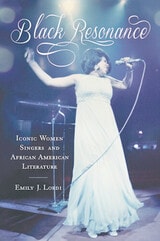
Black Resonance
Iconic Women Singers and African American LiteratureLordi, Emily J.
Rutgers University Press, 2013
Ever since Bessie Smith’s powerful voice conspired with the “race records” industry to make her a star in the 1920s, African American writers have memorialized the sounds and theorized the politics of black women’s singing. In Black Resonance, Emily J. Lordi analyzes writings by Richard Wright, Ralph Ellison, James Baldwin, Gayl Jones, and Nikki Giovanni that engage such iconic singers as Bessie Smith, Billie Holiday, Mahalia Jackson, and Aretha Franklin.
Focusing on two generations of artists from the 1920s to the 1970s, Black Resonance reveals a musical-literary tradition in which singers and writers, faced with similar challenges and harboring similar aims, developed comparable expressive techniques. Drawing together such seemingly disparate works as Bessie Smith’s blues and Richard Wright’s neglected film of Native Son, Mahalia Jackson’s gospel music and Ralph Ellison’s Invisible Man, each chapter pairs one writer with one singer to crystallize the artistic practice they share: lyricism, sincerity, understatement, haunting, and the creation of a signature voice. In the process, Lordi demonstrates that popular female singers are not passive muses with raw, natural, or ineffable talent. Rather, they are experimental artists who innovate black expressive possibilities right alongside their literary peers.
The first study of black music and literature to centralize the music of black women, Black Resonance offers new ways of reading and hearing some of the twentieth century’s most beloved and challenging voices.
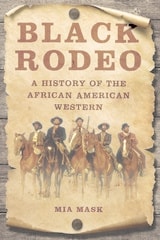
Black Rodeo
A History of the African American WesternMia Mask
University of Illinois Press, 2023
A first-of-its kind survey, Black Rodeo illuminates the figure of the Black cowboy while examining the intersection of African American film history and the western.

Black Space
Imagining Race in Science Fiction FilmBy Adilifu Nama
University of Texas Press, 2008
Winner, Rollins Book Award, Southwest Texas Popular Culture Association/American Culture Association, 2008
Science fiction film offers its viewers many pleasures, not least of which is the possibility of imagining other worlds in which very different forms of society exist. Not surprisingly, however, these alternative worlds often become spaces in which filmmakers and film audiences can explore issues of concern in our own society. Through an analysis of over thirty canonic science fiction (SF) films, including Logan's Run, Star Wars, Blade Runner, Back to the Future, Gattaca, and Minority Report, Black Space offers a thorough-going investigation of how SF film since the 1950s has dealt with the issue of race and specifically with the representation of blackness.
Setting his study against the backdrop of America's ongoing racial struggles and complex socioeconomic histories, Adilifu Nama pursues a number of themes in Black Space. They include the structured absence/token presence of blacks in SF film; racial contamination and racial paranoia; the traumatized black body as the ultimate signifier of difference, alienness, and "otherness"; the use of class and economic issues to subsume race as an issue; the racially subversive pleasures and allegories encoded in some mainstream SF films; and the ways in which independent and extra-filmic productions are subverting the SF genre of Hollywood filmmaking.
The first book-length study of African American representation in science fiction film, Black Space demonstrates that SF cinema has become an important field of racial analysis, a site where definitions of race can be contested and post-civil rights race relations (re)imagined.
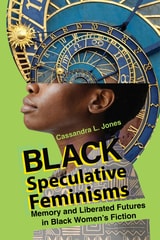
Black Speculative Feminisms
Memory and Liberated Futures in Black Women's FictionCassandra L. Jones
The Ohio State University Press, 2024
Black Studies, Rap, and the Academy
Houston A. Baker Jr.
University of Chicago Press, 1993
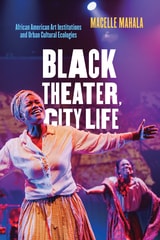
Black Theater, City Life
African American Art Institutions and Urban Cultural EcologiesMacelle Mahala
Northwestern University Press, 2022
Black Theater, City Life looks at Karamu House Theatre, the August Wilson African American Cultural Center, Pittsburgh Playwrights’ Theatre Company, the Lorraine Hansberry Theatre, the African American Shakespeare Company, the Atlanta Black Theatre Festival, and Kenny Leon’s True Colors Theatre Company to demonstrate how each organization articulates the cultural specificities, sociopolitical realities, and histories of African Americans. These companies have faced challenges that mirror the larger racial and economic disparities in arts funding and social practice in America, while their achievements exemplify such institutions’ vital role in enacting an artistic practice that reflects the cultural backgrounds of their local communities. Timely, significant, and deeply researched, this book spotlights the artistic and civic import of Black theaters in American cities.
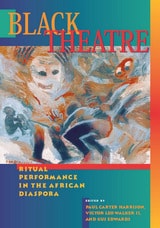
Black Theatre
Ritual Performance In The African Diasporaedited by Paul Carter Harrison, Victor Leo Walker II and Gus Edwards
Temple University Press, 2002
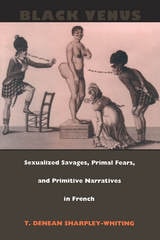
Black Venus
Sexualized Savages, Primal Fears, and Primitive Narratives in FrenchT. Denean Sharpley-Whiting
Duke University Press, 1999
The book opens with an exploration of scientific discourse on black females, using Sarah Bartmann, the so-called Hottentot Venus, and natural scientist Georges Cuvier as points of departure. To further show how the image of a savage was projected onto the bodies of black women, Sharpley-Whiting moves into popular culture with an analysis of an 1814 vaudeville caricature of Bartmann, then shifts onto the terrain of canonical French literature and colonial cinema, exploring the representation of black women by Baudelaire, Balzac, Zola, Maupassant, and Loti. After venturing into twentieth-century film with an analysis of Josephine Baker’s popular Princesse Tam Tam, the study concludes with a discussion of how black Francophone women writers and activists countered stereotypical representations of black female bodies during this period. A first-time translation of the vaudeville show The Hottentot Venus, or Hatred of Frenchwomen supplements this critique of the French male gaze of the nineteenth and early twentieth centuries.
Both intellectually rigorous and culturally intriguing, this study will appeal to students and scholars in the fields of nineteenth- and twentieth-century French literature, feminist and gender studies, black studies, and cultural studies.
Black Women Writing Autobiography
A Tradition Within a TraditionJoanne Braxton
Temple University Press, 1990
Black Women and Music
More Than the BluesEdited by Eileen M. Hayes and Linda F. Williams
University of Illinois Press, 2006
Individual essays concern the experiences of black women in classical music and in contemporary blues, the history of black female gospel-inflected voices in the Broadway musical, and "hip-hop feminism" and its complications. Focusing on under-examined contexts, authors introduce readers to the work of a prominent gospel announcer, women’s music festivals (predominantly lesbian), and to women’s involvement in an early avant-garde black music collective. In contradistinction to a compilation of biographies, this volume critically illuminates themes of black authenticity, sexual politics, access, racial uplift through music, and the challenges of writing (black) feminist biography. Black Women and Music is a strong reminder that black women have been and are both social actors and artists contributing to African American thought.
Black Women, Identity, and Cultural Theory
(Un)Becoming the SubjectKevin Everod Quashie
Rutgers University Press, 2004
In Black Women, Identity, and Cultural Theory, Kevin Everod Quashie explores the metaphor of the “girlfriend” as a new way of understanding three central concepts of cultural studies: self, memory, and language. He considers how the work of writers such as Toni Morrison, Ama Ata Aidoo, Dionne Brand, photographer Lorna Simpson, and many others, inform debates over the concept of identity. Quashie argues that these authors and artists replace the notion of a stable, singular identity with the concept of the self developing in a process both communal and perpetually fluid, a relationship that functions in much the same way that an adult woman negotiates with her girlfriend(s). He suggests that memory itself is corporeal, a literal body that is crucial to the process of becoming. Quashie also explores the problem language poses for the black woman artist and her commitment to a mastery that neither colonizes nor excludes.
The analysis throughout interacts with schools of thought such as psychoanalysis, postmodernism, and post-colonialism, but ultimately moves beyond these to propose a new cultural aesthetic, one that ultimately aims to center black women and their philosophies.
Black Writing, Culture, and the State in Latin America
Jerome C. Branche
Vanderbilt University Press, 2015
All too often, the disciplines of film studies, literary criticism, and art history ignore the opportunity to collaborate in a dialogue. Branche and his contributors present a unified approach, however, suggesting that cultural production should not be viewed narrowly, especially when studying the achievements of the Afro-Latin world.
Black and Blue TV
Industry Responses to the Black Lives Matter MovementLaurena Bernabo
Rutgers University Press, 2026
Black and Blue TV explores the ways television productions have responded to the Black Lives Matter movement. Television programs’ engagement with BLM was common before George Floyd’s murder sparked international protests in the summer of 2020, at which point it became nearly unavoidable for many series. Images of police using violence against Black Americans fueled criticisms of the role of television—especially cop shows—in perpetuating “copaganda,” highlighting the fact that television’s cops are nearly always the good guys, even when they break the law and use excessive force. Black and Blue TV identifies trends and anomalies in television’s engagement with BLM but also investigates the people who influence what those representations look like. Pairing textual criticism with interviews with television creatives, executives, and media activists, author Laurena Bernabo traces shifts in how these individuals understand their role in televisual culture and the cultural forum of narratives that are produced and distributed as a result.
Black and White Cinema
A Short HistoryWheeler Winston Dixon
Rutgers University Press, 2015
Black and White Cinema is the first study to consider the use of black-and-white as an art form in its own right, providing a comprehensive and global overview of the era when it flourished, from the 1900s to the 1960s. Acclaimed film scholar Wheeler Winston Dixon introduces us to the masters of this art, discussing the signature styles and technical innovations of award-winning cinematographers like James Wong Howe, Gregg Toland, Freddie Francis, and Sven Nykvist. Giving us a unique glimpse behind the scenes, Dixon also reveals the creative teams—from lighting technicians to matte painters—whose work profoundly shaped the look of black-and-white cinema.
More than just a study of film history, this book is a rallying cry, meant to inspire a love for the artistry of black-and-white film, so that we might work to preserve this important part of our cinematic heritage. Lavishly illustrated with more than forty on-the-set stills, Black and White Cinema provides a vivid and illuminating look at a creatively vital era.

Black and White Strangers
Race and American Literary RealismKenneth W. Warren
University of Chicago Press, 1993
Black devil and iron angel
the railway in nineteenth-century German realismPaul A. Youngman
Catholic University of America Press, 2005
Black, White, and Huckleberry Finn
Re-imagining the American DreamElaine Mensh
University of Alabama Press, 2001
Takes a hard, systematic look at the depiction of blacks, whites, and race relations in Mark Twain's classic novel, raising questions about its canonical status in American literature
Huckleberry Finn, one of the most widely taught novels in American literature, has long been the subject of ongoing debates over issues ranging from immorality to racism. Here, Elaine Mensh and Harry Mensh enter the debate with a careful and thoughtful examination of racial messages imbedded in the tale of Huck and Jim.Using as a gauge for analysis the historical record left by both slaves and slaveholders, the Menshes compare Twain's depiction with historical reality, attempting to determine where the book either undermines or upholds traditional racial attitudes. Surveying the opinions of fellow critics, they challenge the current consensus that Huckleberry Finn fosters rapport between blacks and whites, arguing that the book does not subvert ingrained beliefs about race, and demonstrating that the argument over black-white relations in the novel is also an argument over non-fictional racial relations and conflicting perceptions of racial harmony.
Reading the novel in its historical context, the Menshes conclude that Twain, in the character of Huck, never questions the institution of slavery, and even supports it in both thought and action. In response to student and parent challenges to the inclusion of the book in literature classes, they suggest that it should remain in school libraries but not be required reading.Of importance to scholars of Mark Twain and American literature, African American cultural studies, or anyone interested in issues of literature and race, this book adds a strong voice to the long-ranging debate over Huckleberry Finn.
Black, White, and in Color
Essays on American Literature and CultureHortense J. Spillers
University of Chicago Press, 2003
Black, White, and in Color offers a long-awaited collection of major essays by Hortense Spillers, one of the most influential and inspiring black critics of the past twenty years. Spanning her work from the early 1980s, in which she pioneered a broadly poststructuralist approach to African American literature, and extending through her turn to cultural studies in the 1990s, these essays display her passionate commitment to reading as a fundamentally political act-one pivotal to rewriting the humanist project.
Spillers is best known for her race-centered revision of psychoanalytic theory and for her subtle account of the relationships between race and gender. She has also given literary criticism some of its most powerful readings of individual authors, represented here in seminal essays on Ralph Ellison, Gwendolyn Brooks, and William Faulkner. Ultimately, the essays collected in Black, White, and in Color all share Spillers's signature style: heady, eclectic, and astonishingly productive of new ideas. Anyone interested in African American culture and literature will want to read them.
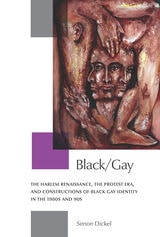
Black/Gay
The Harlem Renaissance, the Protest Era, and the Constructions of Black Gay Identity in the 1980s and 90sSimon Dickel
Michigan State University Press, 2011
This book explores key texts of the black gay culture of the 1980s and ’90s. Starting with an analysis of the political discourse in anthologies such as In the Life and Brother to Brother, it identifies the references to the Harlem Renaissance and the Protest Era as common elements of black gay discourse. This connection to African American cultural and political traditions legitimizes black gay identity and criticizes the construction of gay identity as white. Readings of Isaac Julien’s Looking for Langston, Samuel R. Delany’s “Atlantis: Model 1924” and The Motion of Light in Water, Melvin Dixon’s Vanishing Rooms, Randall Kenan’s A Visitation of Spirits, and Steven Corbin’s No Easy Place to Be demonstrate how these strategies of signifying are used in affirmative, humorous, and ironic ways.
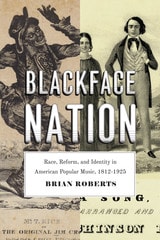
Blackface Nation
Race, Reform, and Identity in American Popular Music, 1812-1925Brian Roberts
University of Chicago Press, 2017
The Hutchinson Family Singers, the Northeast’s most popular middle-class singing group during the mid-nineteenth century, is perhaps the best example of the first strain of music. The group’s songs expressed an American identity rooted in communal values, with lyrics focusing on abolition, women’s rights, and socialism. Blackface minstrelsy, on the other hand, emerged out of an audience-based coalition of Northern business elites, Southern slaveholders, and young, white, working-class men, for whom blackface expressed an identity rooted in individual self-expression, anti-intellectualism, and white superiority. Its performers embodied the love-crime version of racism, in which vast swaths of the white public adored African Americans who fit blackface stereotypes even as they used those stereotypes to rationalize white supremacy. By the early twentieth century, the blackface version of the American identity had become a part of America’s consumer culture while the Hutchinsons’ songs were increasingly regarded as old-fashioned. Blackface Nation elucidates the central irony in America’s musical history: much of the music that has been interpreted as black, authentic, and expressive was invented, performed, and enjoyed by people who believed strongly in white superiority. At the same time, the music often depicted as white, repressed, and boringly bourgeois was often socially and racially inclusive, committed to reform, and devoted to challenging the immoralities at the heart of America’s capitalist order.
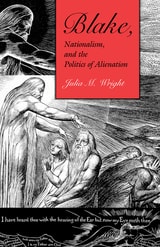
Blake, Nationalism, and the Politics of Alienation
Julia M. Wright
Ohio University Press, 2027
William Blake’s reputation as a staunch individualist is based in large measure on his repeated attacks on institutions and belief systems that constrain the individual’s imagination. Blake, however, rarely represents isolation positively, suggesting that the individual’s absolute freedom from communal pressures is not the ideal. Instead, as Julia Wright argues in her award-winning study Blake, Nationalism, and the Politics of Alienation, Blake’s concern lies with the kind of community that is being established. Moreover, writing at the moment of the emergence of modern nationalism, Blake reveals a concern with the national community in particular.
Beginning with a discussion of the priority of national narrative in late-eighteenth-century art theory and antiquarianism, Blake, Nationalism, and the Politics of Alienation traces its relevance in Blake’s printed works, from The Poetical Sketches and the Lambeth Prophecies to The Laocoön. Professor Wright then turns to Europe, America, and Visions of the Daughters of Albion, focusing on Blake’s portrayals of particular characters’ alienation from the groups and ideologies represented in the texts. The book closes by arguing that Blake’s major printed works, Milton and Jerusalem, are explicit and extensive engagements with the question of nation—and empire.
Although nationalism existed in various forms during the Romantic period, Blake’s contemporaries generally assumed that nations should progress continuously, producing a clear narrative line from an auspicious origin to the perfect fulfillment of that promise. Wright argues that these mutually determining constructs of national character and national narrative inform Blake’s handling of the problem of the individual-within-a-community.
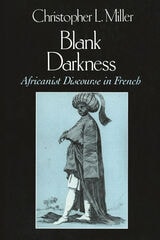
Blank Darkness
Africanist Discourse in FrenchChristopher L. Miller
University of Chicago Press, 1986
Blank Verse
A Guide to Its History and UseRobert B. Shaw
Ohio University Press, 2007
With its compact but inclusive survey of more than four centuries of poetry, Blank Verse is filled with practical advice for poets of our own day who may wish to attempt the form or enhance their mastery of it. Enriched with numerous examples, Shaw’s discussions of verse technique are lively and accessible, inviting not only to apprentice poets but to all readers of poetry.
Shaw’s approach should reassure those who find prosody intimidating, while encouraging specialists to think more broadly about how traditional poetic forms can be taught, learned, practiced, and appreciated in the twenty-first century. Besides filling a conspicuous gap in literary history, Blank Verse points the way ahead for poets interested in exploring blank verse and its multitude of uses.
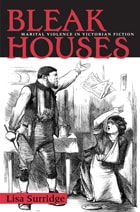
Bleak Houses
Marital Violence in Victorian FictionLisa Surridge
Ohio University Press, 2005
The Offenses Against the Person Act of 1828 opened magistrates' courts to abused working-class wives. Newspapers in turn reported on these proceedings, and in this way the Victorian scrutiny of domestic conduct began. But how did popular fiction treat “private” family violence? Bleak Houses: Marital Violence in Victorian Fiction traces novelists' engagement with the wife-assault debates in the public press between 1828 and the turn of the century.
Lisa Surridge examines the early works of Charles Dickens and reads Dombey and Son and Anne Brontë's The Tenant of Wildfell Hall in the context of the intense debates on wife assault and manliness in the late 1840s and early 1850s. Surridge explores George Eliot's Janet's Repentance in light of the parliamentary debates on the 1857 Divorce Act. Marital cruelty trials provide the structure for both Wilkie Collins's The Woman in White and Anthony Trollope's He Knew He Was Right.
Locating the New Woman fiction of Mona Caird and the reassuring detective investigations of Sherlock Holmes in the context of late-Victorian feminism and the great marriage debate in the Daily Telegraph, Surridge illustrates how fin-de-siècle fiction brought male sexual violence and the viability of marriage itself under public scrutiny. Bleak Houses thus demonstrates how Victorian fiction was concerned about the wife-assault debates of the nineteenth century, debates which both constructed and invaded the privacy of the middle-class home.

Bleak Liberalism
Amanda Anderson
University of Chicago Press, 2016
Amanda Anderson examines canonical works of high realism, political novels from England and the United States, and modernist works to argue that liberalism has engaged sober and even stark views of historical development, political dynamics, and human and social psychology. From Charles Dickens’s Bleak House and Hard Times to E. M. Forster’s Howards End to Doris Lessing’s The Golden Notebook, this literature demonstrates that liberalism has inventive ways of balancing sociological critique and moral aspiration. A deft blend of intellectual history and literary analysis, Bleak Liberalism reveals a richer understanding of one of the most important political ideologies of the modern era.
Blood Lines
Myth, Indigenism, and Chicana/o LiteratureBy Sheila Marie Contreras
University of Texas Press, 2008
2009 — Runner-up, Modern Language Association Prize in United States Latina and Latino and Chicana and Chicano Literary and Cultural Studies
Blood Lines: Myth, Indigenism, and Chicana/o Literature examines a broad array of texts that have contributed to the formation of an indigenous strand of Chicano cultural politics. In particular, this book exposes the ethnographic and poetic discourses that shaped the aesthetics and stylistics of Chicano nationalism and Chicana feminism. Contreras offers original perspectives on writers ranging from Alurista and Gloria Anzaldúa to Lorna Dee Cervantes and Alma Luz Villanueva, effectively marking the invocation of a Chicano indigeneity whose foundations and formulations can be linked to U.S. and British modernist writing.
By highlighting intertextualities such as those between Anzaldúa and D. H. Lawrence, Contreras critiques the resilience of primitivism in the Mexican borderlands. She questions established cultural perspectives on "the native," which paradoxically challenge and reaffirm racialized representations of Indians in the Americas. In doing so, Blood Lines brings a new understanding to the contradictory and richly textured literary relationship that links the projects of European modernism and Anglo-American authors, on the one hand, and the imaginary of the post-revolutionary Mexican state and Chicano/a writers, on the other hand.
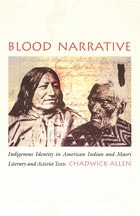
Blood Narrative
Indigenous Identity in American Indian and Maori Literary and Activist TextsChadwick Allen
Duke University Press, 2002
Allen shows how both Maori and Native Americans resisted the assimilationist tide rising out of World War II and how, in the 1960s and 1970s, they each experienced a renaissance of political and cultural activism and literary production that culminated in the formation of the first general assembly of the World Council of Indigenous Peoples. He focuses his comparison on two fronts: first, the blood/land/memory complex that refers to these groups' struggles to define indigeneity and to be freed from the definitions of authenticity imposed by dominant settler cultures. Allen's second focus is on the discourse of treaties between American Indians and the U.S. government and between Maori and Great Britain, which he contends offers strong legal and moral bases from which these indigenous minorities can argue land and resource rights as well as cultural and identity politics.
With its implicit critique of multiculturalism and of postcolonial studies that have tended to neglect the colonized status of indigenous First World minorities, Blood Narrative will appeal to students and scholars of literature, American and European history, multiculturalism, postcolonialism, and comparative cultural studies.
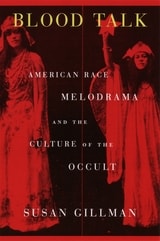
Blood Talk
American Race Melodrama and the Culture of the OccultSusan Gillman
University of Chicago Press, 2003
Blood Talk shows how race melodrama emerged from abolitionist works such as Uncle Tom's Cabin and surprisingly manifested itself in a set of more aesthetically and politically varied works, such as historical romances, sentimental novels, the travel literature of Mark Twain, the regional fiction of Kate Chopin and George Washington Cable, and the work of W. E. B. Du Bois. Gillman then uses the race melodrama to show how racial discourses in the United States have been entangled with occultist phenomena, from the rituals of the Ku Klux Klan and the concept of messianic second-sight to the production of conspiracy theories and studies of dreams and trances.
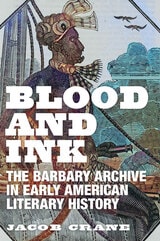
Blood and Ink
The Barbary Archive in Early American Literary HistoryJacob Crane
University of Massachusetts Press, 2023
In the late eighteenth and early nineteenth centuries, Algerian piracy in the Mediterranean loomed large in the American imagination. An estimated seven hundred American citizens, sailors, and naval officers were taken captive over the course of the Barbary Crises (1784–1815), and this overseas danger threatened to grow and irreparably harm the young republic.
Blood and Ink reconstructs the largely forgotten influence of these early American conflicts with North Africa on notions of publicity, print culture, and racial and national identity from independence to the Civil War. Exploring the extensive archive of texts inspired by the conflicts—from captivity narratives, novels, plays, and poems to broadsides, travel narratives, children’s literature, newspaper articles, and visual ephemera—Jacob Crane connects anxieties surrounding North African piracy and white slavery to both the development of American abolitionism and representations of transatlantic African and Jewish identities in the early national and antebellum periods.
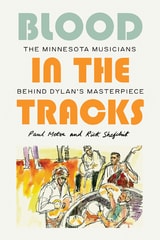
Blood in the Tracks
The Minnesota Musicians behind Dylan's MasterpiecePaul Metsa
University of Minnesota Press, 2023
The story of the Minneapolis musicians who were unexpectedly summoned to re-record half of the songs on Bob Dylan's most acclaimed album
When Bob Dylan recorded Blood on the Tracks in New York in September 1974, it was a great album. But it was not the album now ranked by Rolling Stone as one of the ten best of all time. “When something’s not right, it’s wrong,” as Dylan puts it in “You’re Gonna Make Me Lonesome When You Go”—and something about that original recording led him to a studio in his native Minnesota to re-record five songs, including “Idiot Wind” and “Tangled Up in Blue.” Six Minnesota musicians participated in that two-night recording session at Sound 80, bringing their unique sound to some of Dylan’s best-known songs—only to have their names left off the album and their contribution unacknowledged for more than forty years. This book tells the story of those two nights in Minneapolis, introduces the musicians who gave the album so much of its ultimate form and sound, and describes their decades-long fight for recognition.
Blood in the Tracks takes readers behind the scenes with these “mystery” Minnesota musicians: twenty-one-year-old mandolin virtuoso Peter Ostroushko; drummer Bill Berg and bass player Billy Peterson, the house rhythm section at Sound 80; progressive rock keyboardist Gregg Inhofer; guitarist Chris Weber, who owned The Podium guitar shop in Dinkytown; and Kevin Odegard, whose own career as a singer-songwriter had paralleled Dylan’s until he had to take a job as a railroad brakeman to make ends meet. Through in-depth interviews and assiduous research, Paul Metsa and Rick Shefchik trace the twists of fate that brought these musicians together and then set them on different paths in its wake: their musical experiences leading up to the December 1974 recording session, the divergent careers that followed, and the painstaking work required to finally obtain the official credit that they were due.
A rare look at the making—or remaking—of an all-time great album, and a long overdue recognition of the musicians who made it happen, Blood in the Tracks brings to life a transformative moment in the history of rock and roll, for the first time in its true context and with its complete cast of players.
Blood is the Life
Vampires in LiteratureLeonard G. Heldreth
University of Wisconsin Press, 1999
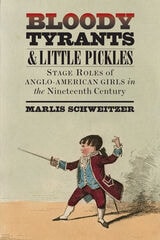
Bloody Tyrants and Little Pickles
Stage Roles of Anglo-American Girls in the Nineteenth CenturyMarles Schweitzer
University of Iowa Press, 2020
Bloody Tyrants and Little Pickles traces the theatrical repertoire of a small group of white Anglo-American actresses as they reshaped the meanings of girlhood in Britain, North America, and the British West Indies during the first half of the nineteenth century. It is a study of the possibilities and the problems girl performers presented as they adopted the manners and clothing of boys, entered spaces intended for adults, and assumed characters written for men. It asks why masculine roles like Young Norval, Richard III, Little Pickle, and Shylock came to seem “normal” and “natural” for young white girls to play, and it considers how playwrights, managers, critics, and audiences sought to contain or fix the at-times dangerous plasticity they exhibited both on and off the stage.
Schweitzer analyzes the formation of a distinct repertoire for girls in the first half of the nineteenth century, which delighted in precocity and playfulness and offered up a model of girlhood that was similarly joyful and fluid. This evolving repertoire reflected shifting perspectives on girls’ place within Anglo-American society, including where and how they should behave, and which girls had the right to appear at all.
Blowin' Hot and Cool
Jazz and Its CriticsJohn Gennari
University of Chicago Press, 2006
In Blowin’ Hot and Cool, John Gennari provides a definitive history of jazz criticism from the 1920s to the present. The music itself is prominent in his account, as are the musicians—from Louis Armstrong and Duke Ellington to Charlie Parker, John Coltrane, Roscoe Mitchell, and beyond. But the work takes its shape from fascinating stories of the tradition’s key critics—Leonard Feather, Martin Williams, Whitney Balliett, Dan Morgenstern, Gary Giddins, and Stanley Crouch, among many others. Gennari is the first to show the many ways these critics have mediated the relationship between the musicians and the audience—not merely as writers, but in many cases as producers, broadcasters, concert organizers, and public intellectuals as well.
For Gennari, the jazz tradition is not so much a collection of recordings and performances as it is a rancorous debate—the dissonant noise clamoring in response to the sounds of jazz. Against the backdrop of racial strife, class and gender issues, war, and protest that has defined the past seventy-five years in America, Blowin’ Hot and Cool brings to the fore jazz’s most vital critics and the role they have played not only in defining the history of jazz but also in shaping jazz’s significance in American culture and life.