51 books match the query 'Berlin' and 5 start with c
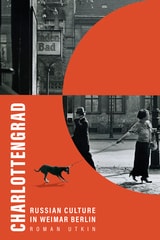
cover of Charlottengrad: Russian Culture in Weimar Berlin

Charlottengrad

Russian Culture in Weimar Berlin

Roman Utkin

University of Wisconsin Press, 2023

As many as half a million Russians lived in Germany in the 1920s, most of them in Berlin, clustered in and around the Charlottenburg neighborhood to such a degree that it became known as “Charlottengrad.” Traditionally, the Russian émigré community has been understood as one of exiles aligned with Imperial Russia and hostile to the Bolshevik Revolution and the Soviet government that followed. However, Charlottengrad embodied a full range of personal and political positions vis-à-vis the Soviet project, from enthusiastic loyalty to questioning ambivalence and pessimistic alienation.

By closely examining the intellectual output of Charlottengrad, Roman Utkin explores how community members balanced their sense of Russianness with their position in a modern Western city charged with artistic, philosophical, and sexual freedom. He highlights how Russian authors abroad engaged with Weimar-era cultural energies while sustaining a distinctly Russian perspective on modernist expression, and follows queer Russian artists and writers who, with their German counterparts, charted a continuous evolution in political and cultural attitudes toward both the Weimar and Soviet states.

Utkin provides insight into the exile community in Berlin, which, following the collapse of the tsarist government, was one of the earliest to face and collectively process the peculiarly modern problem of statelessness. Charlottengrad analyzes the cultural praxis of “Russia Abroad” in a dynamic Berlin, investigating how these Russian émigrés and exiles navigated what it meant to be Russian—culturally, politically, and institutionally—when the Russia they knew no longer existed.
[more]
cover of Cold War on the Airwaves: The Radio Propaganda War against East Germany

Cold War on the Airwaves

The Radio Propaganda War against East Germany

Nicholas J. Schlosser

University of Illinois Press, 2015

Founded as a counterweight to the Communist broadcasters in East Germany, Radio in the American Sector (RIAS) became one of the most successful public information operations conducted against the Soviet Bloc. Cold War on the Airwaves examines the Berlin-based organization's history and influence on the political worldview of the people--and government--on the other side of the Iron Curtain.

Nicholas J. Schlosser draws on broadcast transcripts, internal memoranda, listener letters, and surveys by the U.S. Information Agency to profile RIAS. Its mission: to undermine the German Democratic Republic with propaganda that, ironically, gained in potency by obeying the rules of objective journalism. Throughout, Schlosser examines the friction inherent in such a contradictory project and propaganda's role in shaping political culture. He also portrays how RIAS's primarily German staff influenced its outlook and how the organization both competed against its rivals in the GDR and pushed communist officials to alter their methods in order to keep listeners.

From the occupation of Berlin through the airlift to the construction of the Berlin Wall, Cold War on the Airwaves offers an absorbing view of how public diplomacy played out at a flashpoint of East-West tension.
[more]
cover of Contested Ground: The Tunnel and the Struggle over Television News in Cold War America

Contested Ground

The Tunnel and the Struggle over Television News in Cold War America

Mike Conway

University of Massachusetts Press, 2019

In 1962, an innovative documentary on a Berlin Wall tunnel escape brought condemnation from both sides of the Iron Curtain during one of the most volatile periods of the Cold War. The Tunnel, produced by NBC's Reuven Frank, clocked in at ninety minutes and prompted a range of strong reactions. While the television industry ultimately awarded the program three Emmys, the U.S. Department of State pressured NBC to cancel the program, and print journalists criticized the network for what they considered to be a blatant disregard of journalistic ethics.

It was not just The Tunnel's subject matter that sparked controversy, but the medium itself. The surprisingly fast ascendance of television news as the country's top choice for information threatened the self-defined supremacy of print journalism and the de facto cooperation of government officials and reporters on Cold War issues. In Contested Ground, Mike Conway argues that the production and reception of television news and documentaries during this period reveals a major upheaval in American news communications.
[more]
cover of Cruel Attachments: The Ritual Rehab of Child Molesters in Germany

Cruel Attachments

The Ritual Rehab of Child Molesters in Germany

John Borneman

University of Chicago Press, 2015

There is no more seemingly incorrigible criminal type than the child sex offender. Said to suffer from a deeply rooted paraphilia, he is often considered as outside the moral limits of the human, profoundly resistant to change. Despite these assessments, in much of the West an increasing focus on rehabilitation through therapy provides hope that psychological transformation is possible. Examining the experiences of child sex offenders undergoing therapy in Germany—where such treatments are both a legal right and duty—John Borneman, in Cruel Attachments, offers a fine-grained account of rehabilitation for this reviled criminal type.
           
Carefully exploring different cases of the attempt to rehabilitate child sex offenders, Borneman details a secular ritual process aimed not only at preventing future acts of molestation but also at fundamentally transforming the offender, who is ultimately charged with creating an almost entirely new self. Acknowledging the powerful repulsion felt by a public that is often extremely skeptical about the success of rehabilitation, he challenges readers to confront the contemporary contexts and conundrums that lie at the heart of regulating intimacy between children and adults.

[more]
cover of Cultural Revolution in Berlin: Jews in the Age of Enlightenment

Cultural Revolution in Berlin

Jews in the Age of Enlightenment

Shmuel Feiner and Natalie Naimark-Goldberg

Bodleian Library Publishing, 2011

The Enlightenment, which marked a social and philosophical turn away from religion and toward science and reason, swept across Europe in the eighteenth century, and these civil and rational values were embraced byJewish intellectuals, bringing about a cultural revolution within traditional Jewish society. The story of this transformation is presented here through a close look at the works held in the Leopold Müller Memorial Library of the Oxford Centre for Hebrew and Jewish Studies, which was the private library of Leopold Zunz, the father of the “Science of Judaism.”
 
As Shmuel Feiner and Natalie Naimark-Goldberg reveal in this insightful and approachable history, the Jewish Enlightenment (Haskalah) was a multifaceted movement, articulated in many different ways in the varied settings where Jews lived. Rather than providing a comprehensive story of the Haskalah, Feiner and Naimark-Goldberg use these impressive literary treasures to trace the cultural transformation that took place mainly in Germany, from its moderate and scattered beginnings in the early 1700s, through the height of the movement in the second half of the eighteenth century, until its final stage around 1800, when the Haskalah began to give way to new movements and ideologies.
 
Richly illustrated with images of eighteenth-century manuscripts, books, and pamphlets, Cultural Revolution in Berlin provides an excellent guide to the significant cultural metamorphosis brought about by the Jewish Enlightenment.
[more]