Results by title
211 books match the query 'Campaigns & Elections' and 18 start with c
CHEAP SEATS
The Democratic Party’s Advantage in U.S. House ElectionsJames E. Campbell
The Ohio State University Press, 1996
The longest continuous majority in the history of the U.S. House of Representatives came to a dramatic close with the 1994 midterm elections. The Democratic Party had controlled the House for forty years—two and a half times as long as any previous majority. In Cheap Seats, James E. Campbell considers the reasons why the Democrats dominated House elections for four decades and why they ultimately lost that control.
Examining the structural advantages that helped congressional Democrats, Campbell finds that their unprecedented success in the House was due in no small measure to a favorable election system, an advantage in the way in which votes are translated into House seats. His straightforward analysis indicates that Democrats consistently win most of the very-low-turnout districts, or “cheap seats.” In fact, because of the party's continued hold on such districts, the new Democratic minority is considerably larger than it would otherwise have been.
Cheap Seats is a thorough and innovative investigation into the electoral system's impact on partisan politics and representation in Congress. Campbell presents an impressive array of evidence, including both quantitative analysis of election returns from 1936 to 1994 and in-depth studies of several cheap-seat districts. He also explores the important theoretical issues of representation that cheap seats raise and offers several proposals to reform the system. This well-written and provocative volume is accessible to anyone interested in American politics, in addition to scholars especially interested in the areas of Congress, elections, electoral systems, and political parties.
Campaign Advertising and American Democracy
Michael M. Franz, Paul B. Freedman, Kenneth M. Goldstein and Travis N. Ridout
Temple University Press, 2007
Were viewers turned off by political advertising to the extent that it disuaded them from voting, as some critics suggest? Did they feel more connected to political issues and the political system or were they alienated? These are the questions this book answers, based on a unique, robust, and extensive database dedicated to political advertising.
Confronting prevailing opinion, the authors of this carefully researched work find that political ads may actually educate, engage, and mobilize American voters. Only in the rarest of circumstances do they have negative impacts.
Campaign Crossroads
Presidential Politics in Indiana from Lincoln to ObamaAndrew E. Stoner
Indiana Historical Society Press, 2017
Campaign Dynamics
The Race for GovernorThomas M. Carsey
University of Michigan Press, 2001
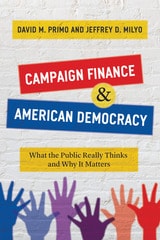
Campaign Finance and American Democracy
What the Public Really Thinks and Why It MattersDavid M. Primo and Jeffrey D. Milyo
University of Chicago Press, 2020
Primo and Milyo probe original survey data to determine Americans’ sentiments on the role of money in politics, what drives these sentiments, and why they matter. What Primo and Milyo find is that while many individuals support the idea of reform, they are also skeptical that reform would successfully limit corruption, which Americans believe stains almost every fiber of the political system. Moreover, support for campaign finance restrictions is deeply divided along party lines, reflecting the polarization of our times. Ultimately, Primo and Milyo contend, American attitudes toward money in politics reflect larger fears about the health of American democracy, fears that will not be allayed by campaign finance reform.
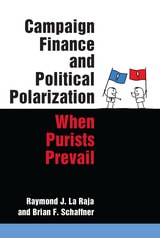
Campaign Finance and Political Polarization
When Purists PrevailRaymond J. La Raja and Brian F. Schaffner
University of Michigan Press, 2015
La Raja and Schaffner conclude the book with policy recommendations for campaign finance in the United States. They are among the few non-libertarians who argue that less regulation, particularly for political parties, may in fact improve the democratic process.
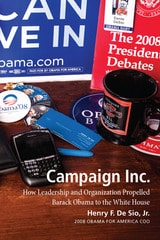
Campaign Inc.
How Leadership and Organization Propelled Barack Obama to the White HouseHenry F. De Sio., Jr.
University of Iowa Press, 2014
De Sio shows readers that Obama himself was direct about his vision for the campaign when he instructed his staff to “run it like a business.” Thus, this is less the story of Barack Obama, candidate, and more the story of Barack Obama, CEO. Because campaigns are launched from scratch during every election cycle, they are the ultimate entrepreneurial experience. In the course of the election, the Obama campaign scaled up from a scrappy start-up to a nearly $1 billion operation, becoming a hothouse environment on which the glare of the media spotlight was permanently trained.
Campaign Inc. allows readers to peek behind the curtain at the underdog organization that brought down the Clinton campaign and later went on to defeat the Republican machine, while offering lessons in leadership and organization to innovators, executives, and entrepreneurs.
Campaign Reform
Insights and EvidenceLarry M. Bartels and Lynn Vavreck, Editors
University of Michigan Press, 2000
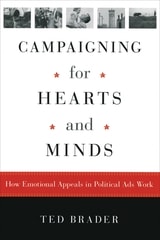
Campaigning for Hearts and Minds
How Emotional Appeals in Political Ads WorkTed Brader
University of Chicago Press, 2005
At the heart of this book are ingenious experiments, conducted by Brader during an election, with truly eye-opening results that upset conventional wisdom. They show, for example, that simply changing the music or imagery of ads while retaining the same text provokes completely different responses. He reveals that politically informed citizens are more easily manipulated by emotional appeals than less-involved citizens and that positive "enthusiasm ads" are in fact more polarizing than negative "fear ads." Black-and-white video images are ten times more likely to signal an appeal to fear or anger than one of enthusiasm or pride, and the emotional appeal triumphs over the logical appeal in nearly three-quarters of all political ads.
Brader backs up these surprising findings with an unprecedented survey of emotional appeals in contemporary political campaigns. Politicians do set out to campaign for the hearts and minds of voters, and, for better or for worse, it is primarily through hearts that minds are won. Campaigning for Hearts and Minds will be indispensable for anyone wishing to understand how American politics is influenced by advertising today.
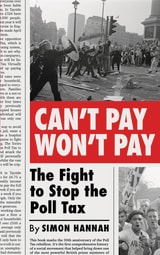
Can't Pay, Won't Pay
The Fight to Stop the Poll TaxSimon Hannah
Pluto Press, 2020
Starting in Scotland where the 'Community Charge' was first trialled, Can't Pay, Won't Pay immerses the reader in the gritty history of the rebellion. Amidst the drama of large scale protests and blockaded estates a number of key figures and groups emerge: Neil Kinnock and Tommy Sheridan; Militant, Class War and the Metropolitan Police.
Assessing this legacy today, Hannah demonstrates the centrality of the Poll Tax resistance as a key chapter in the history of British popular uprisings, Labour Party factionalism, the anti-socialist agenda and failed Tory ideology.

Canada at the Polls, 1984
A Study of the Federal General ElectionsHoward R. Penniman, ed.
Duke University Press, 1988
Capturing Campaign Effects
Henry E. Brady and Richard Johnston, eds.
University of Michigan Press, 2006
"Capturing Campaign Effects is an accessible and penetrating account of modern scholarship on electoral politics. It draws critical insights from a range of innovative analyses."
--Arthur Lupia, University of Michigan
"What a wonderful way to usher in the new era of election studies! This book spotlights fascinating paradoxes in the literature of voting behavior, highlights many promising approaches to resolving those paradoxes, and shows how these strategies can yield important findings with terrific payoffs for our understanding of contemporary democracy. Fasten your seatbelts, folks: scholarship on elections is about to speed up thanks to this collection of great essays."
--Jon Krosnick, Stanford University
"The past decade has seen a renewed interest in understanding campaign effects. How and when do voters learn? Does the election campaign even matter at all? Capturing Campaign Effects draws on leading political scientists to address these matters. The result is a collection that will become the major reference for the study of campaigns. The lesson that emerges is that campaigns do affect voter decision making, usually for the better."
--Robert S. Erikson, Columbia University
Henry E. Brady is Class of 1941 Monroe Deutsch Professor of Political Science and Public Policy, and Director of the Survey Research Center at the University of California, Berkeley.
Richard Johnston is Professor and Head of Political Science and Distinguished University Scholar at the University of British Columbia.
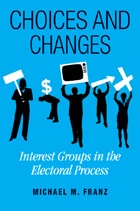
Choices and Changes
Interest Groups in the Electoral ProcessMichael M. Franz
Temple University Press, 2008
Choices and Changes is the most comprehensive examination to date of the impact of interest groups on recent American electoral politics. Richly informed, theoretically and empirically, it is the first book to explain the emergence of aggressive interest group electioneering tactics in the mid-1990s—including “soft money” contributions, issue ads, and “527s” (IRS-classified political organizations).
Michael Franz argues that changing political and legal contexts have clearly influenced the behavior of interest groups. To support his argument, he tracks in detail the evolution of campaign finance laws since the 1970s, examines all soft money contributions—nearly $1 billion in total—to parties by interest groups from 1991-2002, and analyzes political action committee (PAC) contributions to candidates and parties from 1983-2002. He also draws on his own interviews with campaign finance leaders.
Based on this rigorous data analysis and a formidable knowledge of its subject, Choices and Changes substantially advances our understanding of the significance of interest groups in U.S. politics.
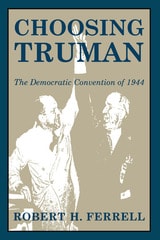
Choosing Truman
The Democratic Convention of 1944Robert H. Ferrell
University of Missouri Press, 2000
As Franklin D. Roosevelt's health deteriorated in the months leading up to the Democratic National Convention of 1944, Democratic leaders confronted a dire situation. Given the inevitability of the president's death during a fourth term, the choice of a running mate for FDR was of profound importance. The Democrats needed a man they could trust. They needed Harry S. Truman.
Robert Ferrell tells an engrossing tale of ruthless ambition, secret meetings, and party politics. Roosevelt emerges as a manipulative leader whose desire to retain power led to a blatant disregard for the loyalty of his subordinates and the aspirations of his vice presidential hopefuls. Startling in its conclusions, impeccable in its research, Choosing Truman is an engrossing, behind-the-scenes look at the making of the nation's thirty-third president.
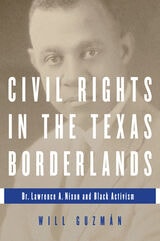
Civil Rights in the Texas Borderlands
Dr. Lawrence A. Nixon and Black ActivismWill Guzman
University of Illinois Press, 2016
Will Guzmán delves into Nixon's lifelong struggle against Jim Crow. Linking Nixon's activism to his independence from the white economy, support from the NAACP, and the man's own indefatigable courage, Guzmán also sheds light on Nixon's presence in symbolic and literal borderlands--as an educated professional in a time when few went to college, as an African American who made waves when most feared violent reprisal, and as someone living on the mythical American frontier as well as an international boundary.
A powerful addition to the literature on African Americans in the Southwest, Civil Rights in the Texas Borderlands explores seldom-studied corners of the Black past and the civil rights movement.
Competitive Elections in Developing Countires
Myron Weiner and Ergun Özbudun
Duke University Press, 1987
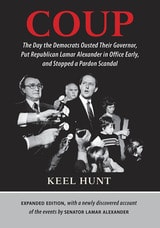
Coup
The Day the Democrats Ousted Their Governor, Put Republican Lamar Alexander in Office Early, and Stopped a Pardon ScandalKeel Hunt
Vanderbilt University Press, 2017
On January 17, 1979, driven by new information that some of the worst criminals in the state's penitentiaries were about to be released (and fears that James Earl Ray might be one of them), a small bipartisan group chose to take charge. Senior Democratic leaders, friends of the sitting governor, together with the Republican governor-elect Lamar Alexander (now US Senator from Tennessee), agreed to oust Blanton from office before another night fell. It was a maneuver unique in American political history.
Expanded edition, with a newly discovered account of the events by Senator Lamar Alexander:
"In December 2015 something unexpected happened. Keel [Hunt] delivered to my Nashville office a brown three-ring binder. He had only recently discovered it in a box that had been in storage for thirty years." —Senator Lamar Alexander
This binder contained the forgotten typescript, written in 1985, of Alexander's recollections of the events leading up to his early inauguration on January 17, 1979. In this expanded edition of Coup, the Senator's 22,000-word text has been added as a lost footnote to Hunt's definitive account.
From the foreword by John L. Seigenthaler:
"The individual stories of those government officials involved in the coup—each account unique, but all of them intersecting—were scattered like disconnected pieces of a jigsaw puzzle on the table of history until the author conceived this book. Perhaps because it happened so quickly, and without major disagreement, protest, or dissent, this truly historic moment has been buried in the public mind. In unearthing the drama in gripping detail, Keel Hunt assures that the 'dark day' will be remembered as a bright one in which conflicted politicians came together in the public interest."
Crosstalk
Citizens, Candidates, and the Media in a Presidential CampaignMarion R. Just, Ann N. Crigler, Dean E. Alger, Timothy E. Cook, Montague Kern, a
University of Chicago Press, 1996
Examining political advertisements, news coverage, ad watches, and talk shows in Los Angeles, Boston, Winston-Salem, and Fargo/Moorhead, the authors chart the impact of different information environments on citizens and show how people developed images of candidates over the course of the campaign. Crosstalk presents persuasive evidence that campaigns do matter, that citizens are active participants in the campaign process, and their perceptions of a candidate's character is the central factor in the voting process.
This innovative study contributes significantly to our understanding of the 1992 presidential campaign and of campaigns in general, and shows how election campaigns can play an important role in the long-term vitality of democracy.