Results by title
71 books match the query 'Conservation and restoration' and 9 start with c
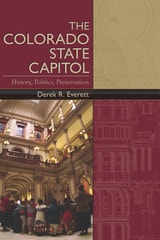
Colorado State Capitol
History, Politics, PreservationDerek Everett
University Press of Colorado, 2005
In one comprehensive volume historian Derek Everett traces the establishment, planning, construction, and history of Colorado's state capitol - including a discussion on the importance of restoring and preserving the building for current and future generations of Coloradoans.

Comprehensive Guide To Emergency And Disaster Prepar
Frances Wilkinson
Assoc of College & Research Libraries, 2010
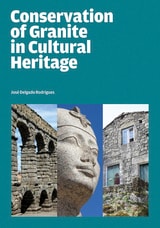
Conservation of Granite in Cultural Heritage
José Delgado Rodrigues
J. Paul Getty Trust, The, 2025
The field of stone conservation has long needed a holistic perspective that embraces the needs of conservation professionals and provides scientific support to enable them to better analyze preservation issues and implement efficient, long-lasting treatments. Conservation of Granite in Cultural Heritage offers such a perspective by bridging scholarly research on the available literature related to granite decay and best practices from conservators working in the field and laboratory.
First offering an overview of granitic rocks and their natural weathering, this volume then outlines the issues that arise when removing granite from quarries and incorporating it into what eventually becomes built heritage. Case studies are presented alongside guidelines for assessing conservation problems. This book will serve as a fundamental manual for students, conservation scientists, conservators, and restorers alike.
Conserving Active Matter
Edited by Peter N. Miller and Soon Kai Poh
Bard Graduate Center, 2022
This volume brings together the findings from a five-year research project that seeks to reimagine the relationship between conservation knowledge and the humanistic study of the material world. The project, “Cultures of Conservation,” was supported by the Andrew W. Mellon Foundation and included events, seminars, and an artist-in-residence.
The effort to conserve things amid change is part of the human struggle with the nature of matter. For as long as people have made things and kept things, they have also cared for and repaired them. Today, conservators use a variety of tools and categories developed over the last one hundred and fifty years to do this work, but in the coming decades, new kinds of materials and a new scale of change will pose unprecedented challenges. Looking ahead to this moment from the perspectives of history, philosophy, materials science, and anthropology, this volume explores new possibilities for both conservation and the humanities in the rethinking of active matter.
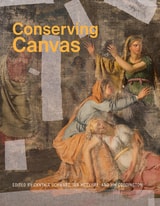
Conserving Canvas
Cynthia Schwarz
J. Paul Getty Trust, The, 2023
In 2019, Yale University, with the support of the Getty Foundation, held an international conference, where nearly four hundred attendees from more than twenty countries gathered to discuss a vital topic: how best to conserve paintings on canvas. It was the first major symposium on the subject since 1974, when wax-resin and glue-paste lining reigned as the predominant conservation techniques. Over the past fifty years, such methods, which were often destructive to artworks, have become less widely used in favor of more minimalist approaches to intervention. More recent decades have witnessed the reevaluation of traditional practices as well as focused research supporting significant new methodologies, procedures, and synthetic materials for the care and conservation of paintings on fabric supports.
Conserving Canvas compiles the proceedings of the conference, presenting a wide array of papers and posters that provide important global perspectives on the history, current state, and future needs of the field. Featuring an expansive glossary of terms that will be an invaluable resource for conservators, this publication promises to become a standard reference for the international conservation community.
The free online edition of this open-access publication is available at getty.edu/publications/conserving-canvas. Also available are free PDF and EPUB downloads of the book.
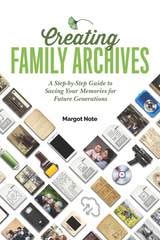
Creating Family Archives
A Step-by-Step Guide to Saving Your Memories for Future GenerationsMargot Note
Society of American Archivists, 2019
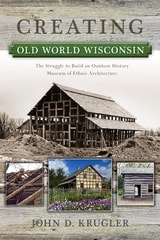
Creating Old World Wisconsin
The Struggle to Build an Outdoor History Museum of Ethnic ArchitectureJohn D. Krugler
University of Wisconsin Press, 2013
Visionaries, researchers, curators, and volunteers launched a massive preservation initiative to salvage fast-disappearing immigrant and migrant architecture. Dozens of historic buildings in the 1970s were transported from locations throughout the state to the Kettle Moraine State Forest. These buildings created a backdrop against which twenty-first-century interpreters demonstrate nineteenth- and early twentieth-century agricultural techniques and artisanal craftsmanship. The site, created and maintained by the Wisconsin Historical Society, offers visitors a unique opportunity to learn about the state’s rich and ethnically diverse past through depictions of the everyday lives of its Norwegian, Danish, Finnish, German, Polish, African American, and Yankee inhabitants.
Creating Old World Wisconsin chronicles the fascinating and complex origins of this outdoor museum, highlighting the struggles that faced its creators as they worked to achieve their vision. Even as Milwaukee architect and preservationist Richard W. E. Perrin, the Society's staff, and enthusiastic volunteers opened the museum in time for the national bicentennial in 1976, the site was plagued by limited funds, bureaucratic tangles, and problems associated with gaining public support. By documenting the engaging story of the challenges, roadblocks, false starts, and achievements of the site's founders, Krugler brings to life the history of the dedicated corps who collected and preserved Wisconsin's diverse social history and heritage.
Cultural Resource Management in the Great Basin 1986–2016
Alice M. Baldrica, Patricia A. DeBunch, and Don D. Fowler
University of Utah Press, 2019
Cultural Resource Management (CRM) refers to the discovery, evaluation, and preservation of culturally significant sites, focusing on but not limited to archaeological and historical sites of significance. CRM stems from the National Historic Preservation Act, passed in 1966. In 1986, archaeologists reviewed the practice of CRM in the Great Basin. They concluded that it was mainly a system of finding, flagging, and avoiding—a means of keeping sites and artifacts safe. Success was measured by counting the number of sites recorded and acres surveyed.
This volume provides an updated review some thirty years later. The product of a 2016 symposium, its measures are the increase in knowledge obtained through CRM projects and the inclusion of tribes, the general public, industry, and others in the discovery and interpretation of Great Basin prehistory and history. Revealing both successes and shortcomings, it considers how CRM can face the challenges of the future. Chapters offer a variety of perspectives, covering highway archaeology, inclusion of Native American tribes, and the legacy of the NHPA, among other topics.
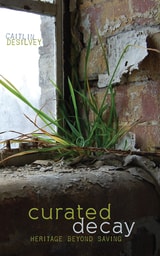
Curated Decay
Heritage beyond SavingCaitlin DeSilvey
University of Minnesota Press, 2017
Transporting readers from derelict homesteads to imperiled harbors, postindustrial ruins to Cold War test sites, Curated Decay presents an unparalleled provocation to conventional thinking on the conservation of cultural heritage. Caitlin DeSilvey proposes rethinking the care of certain vulnerable sites in terms of ecology and entropy, and explains how we must adopt an ethical stance that allows us to collaborate with—rather than defend against—natural processes.
Curated Decay chronicles DeSilvey’s travels to places where experiments in curated ruination and creative collapse are under way, or under consideration. It uses case studies from the United States, Europe, and elsewhere to explore how objects and structures produce meaning not only in their preservation and persistence, but also in their decay and disintegration. Through accessible and engaging discussion of specific places and their stories, it traces how cultural memory is generated in encounters with ephemeral artifacts and architectures.
An interdisciplinary reframing of the concept of the ruin that combines historical and philosophical depth with attentive storytelling, Curated Decay represents the first attempt to apply new theories of materiality and ecology to the concerns of critical heritage studies.