Results by title
2728 books match the query 'Education' and 242 start with c

CANCELED - Notes from Home
Jonna McKone
Rutgers University Press, 2021
Through portraiture, oral history, writing, and family archives, the contributors explore childhood, geography, immigration, education, and family relationships, recovering misunderstood or overlooked moments. In the process of making this work, the group found old family photos, returned to sites of significance, and made new friendships, discovering the transformational potential of this kind of storytelling to reframe hardship, loss, and uncertainty. In the words of one contributor, “I felt like this process was a necessary step that allowed me to acknowledge and comprehend what I was experiencing at the time. It allowed me to create a more coherent understanding that I am who I am because of my past and because I was the one who had control of molding my own, better path.” Each chapter, encompassing one person’s story, is strikingly unique in its vision and approach.
CASE 2.1 Brenna Schneider at 99Degrees
Carole Carlson and Rachael Weiker
Brandeis University Press, 2024
CASE 2.2 The Kindness of Human Milk
The Founding of Mothers’ MilkBank NortheastNaomi Bromberg Bar-Yam and Mark I. Rosen
Brandeis University Press, 2024
CASE 3.1 Engage or Divest? Trillium Asset Management, Facebook Governance,and Shareholder Advocacy
Monique DeSimone, Jess Lynch-Foust, Douglass Guernsey, and Laura Burroughs
Brandeis University Press, 2024
CASE 3.2A SAMRIDH Blended Finance Facility
Accelerating Pandemic Responseand Building Equitable Health Systems in India (A)Archita Adlakha, Neeta Rao, Achin B. N. Biyani, Ritika Pandey, and Sudheer Nadipally
Brandeis University Press, 2024
CASE 3.2B SAMRIDH Blended Finance Facility
Accelerating Pandemic Responseand Building Equitable Health Systems in India (B)Archita Adlakha, Neeta Rao, Achin B. N. Biyani, Ritika Pandey, and Sudheer Nadipally
Brandeis University Press, 2024
CASE 4.1 HopeWell, Inc.
Della M. Hughes and Marji Erickson Warfield
Brandeis University Press, 2024
CASE 4.2A Tufts Medicine Health Care System
Merging Hospitals in a New Model (A)Maher Tabba and Jon Chilingerian
Brandeis University Press, 2024
CASE 4.2B Tufts Medicine Health Care System
Merging Hospitals in a New Model (B)Maher Tabba and Jon Chilingerian
Brandeis University Press, 2024
CASE 4.3 Aligning Transition Supports and Services for Students With Disabilities
Jennifer Stewart
Brandeis University Press, 2024
CASE 4.4 The Native Plant Ordinance Meeting
Elizabeth V. Sessions
Brandeis University Press, 2024
CASE 5.1 Boston MedFlight
Leveraging Data to Design a New Helicopter AlgorithmMatthew Kriegsman
Brandeis University Press, 2024
CASE 5.2 Ford Hall 2015
Avery Brien, Mónica García, Sonia Kikeri, and Miya Ward
Brandeis University Press, 2024
CASE 5.3 The Interfaith Worker Rights Council Call Center
Joel Cutcher-Gershenfeld
Brandeis University Press, 2024
CASE 6.1 JA Worldwide
Creating a Global BrandKeshia Engwenyi, Julia Robinson-Rosendorff, and Sean C. Rush
Brandeis University Press, 2024
CASE 7.1 Breaking Down Silos to Build Collaborative Systems
Lauren Hajjar, Jody Hoffer Gittell, Ninna Meier, and Bill Gunn
Brandeis University Press, 2024
CASE 7.2 The Unit-BasedTeam Meeting
Joel Cutcher-Gershenfeld
Brandeis University Press, 2024
COMPUGIRLS
How Girls of Color Find and Define Themselves in the Digital AgeKimberly A. Scott
University of Illinois Press, 2021
Kimberly A. Scott explores this question and others as she details the National Science Foundation-funded enrichment project COMPUGIRLS. This groundbreaking initiative teaches tech skills to adolescent girls of color but, as importantly, offers a setting that emphasizes empowerment, community advancement, and self-discovery. Scott draws on her experience as an architect of COMPUGIRLS to detail the difficulties of translating participants' lives into a digital context while tracing how the program evolved. The dramatic stories of the participants show them blending newly developed technical and communication skills in ways designed to spark effective action and bring about important change.
A compelling merger of theory and storytelling, COMPUGIRLS provides a much-needed roadmap for understanding how girls of color can find and define their selves in today's digital age.
Call My Name, Clemson
Documenting the Black Experience in an American University CommunityRhondda Robinson Thomas
University of Iowa Press, 2020
Between 1890 and 1915, a predominately African American state convict crew built Clemson University on John C. Calhoun’s Fort Hill Plantation in upstate South Carolina. Calhoun’s plantation house still sits in the middle of campus. From the establishment of the plantation in 1825 through the integration of Clemson in 1963, African Americans have played a pivotal role in sustaining the land and the university. Yet their stories and contributions are largely omitted from Clemson’s public history.
This book traces “Call My Name: African Americans in Early Clemson University History,” a Clemson English professor’s public history project that helped convince the university to reexamine and reconceptualize the institution’s complete and complex story from the origins of its land as Cherokee territory to its transformation into an increasingly diverse higher-education institution in the twenty-first century. Threading together scenes of communal history and conversation, student protests, white supremacist terrorism, and personal and institutional reckoning with Clemson’s past, this story helps us better understand the inextricable link between the history and legacies of slavery and the development of higher education institutions in America.

Call School
Rural Education in the Midwest to 1918Paul Theobald
Southern Illinois University Press, 1995
Paul Theobald chronicles the history of the one-room country schools that were spread throughout the rural Midwest during the nineteenth and early twentieth centuries.
Focusing on the region’s educational history in light of the religious, economic, and political atmosphere, Theobald explores the tight connection between educational preferences and religious views, between the economics of the countryside and the educational experiences of children, and between the politics of local power and the educational prospects of the powerless.
Basing his study on extensive archival research, including findings from eight midwestern states, Theobald neither condemns nor lauds the one-room school experience. Providing an objective evaluation, he examines rural school records, correspondence of early school officers, contemporary texts, and diaries and letters of rural students and teachers.
As he weaves together a contextualized account of the circumstances surrounding and within the one-room country schools of the Midwest, Theobald stresses that religion was of primary importance in nineteenth-century American life. Yet he also looks carefully at the shifting economic environment at work in the countryside, particularly in regard to the development of widespread farm tenancy and the consolidation of agricultural and related industries. He challenges readers to analyze how a national move from an agrarian to an industrial view caused conflict and confusion, thereby introducing irrevocable change into rural American life.
Theobald’s study illuminates the history of education on the plains and sheds light on the social foundations of the period.
Called to Reckon
Replacing History and Reclaiming Mission at a Midwestern CollegeEdited by Jane E. Simonsen
Southern Illinois University Press, 2025

Campaigns of Knowledge
U.S. Pedagogies of Colonialism and Occupation in the Philippines and JapanMalini Johar Schueller
Temple University Press, 2019
The creation of a new school system in the Philippines in 1898 and educational reforms in occupied Japan, both with stated goals of democratization, speaks to a singular vision of America as savior, following its politics of violence with benevolent recuperation. The pedagogy of recovery—in which schooling was central and natives were forced to accept empire through education—might have shown how Americans could be good occupiers, but it also created projects of Orientalist racial management: Filipinos had to be educated and civilized, while the Japanese had to be reeducated and “de-civilized.”
In Campaigns of Knowledge, Malini Schueller contrapuntally reads state-sanctioned proclamations, educational agendas, and school textbooks alongside political cartoons, novels, short stories, and films to demonstrate how the U.S. tutelary project was rerouted, appropriated, reinterpreted, and resisted. In doing so, she highlights how schooling was conceived as a process of subjectification, creating particular modes of thought, behaviors, aspirations, and desires that would render the natives docile subjects amenable to American-style colonialism in the Philippines and occupation in Japan.
Campus Life
Undergraduate Cultures from the End of the Eighteenth Century to the PresentHelen Lefkowitz Horowitz
University of Chicago Press, 1988
Campus with Purpose
Building a Mission-Driven CampusStephen Lehmkuhle
Rutgers University Press, 2021
Campuses of Consent
Sexual and Social Justice in Higher EducationTheresa A. Kulbaga and Leland G. Spencer
University of Massachusetts Press, 2019
Winner of the 2020 OSCLG Outstanding Book Award
This new book for scholars and university administrators offers a provocative critique of sexual justice language and policy in higher education around the concept of consent. Complicating the idea that consent is plain common sense, Campuses of Consent shows how normative and inaccurate concepts about gender, gender identity, and sexuality erase queer or trans students' experiences and perpetuate narrow, regressive gender norms and individualist frameworks for understanding violence.
Theresa A. Kulbaga and Leland G. Spencer prove that consent in higher education cannot be meaningfully separated from larger issues of institutional and structural power and oppression. While sexual assault advocacy campaigns, such as It's On Us, federal legislation from Title IX to the Clery Act, and more recent affirmative-consent measures tend to construct consent in individualist terms, as something “given” or “received” by individuals, the authors imagine consent as something that can be constructed systemically and institutionally: in classrooms, campus communication, and shared campus spaces.
Cancel Wars
How Universities Can Foster Free Speech, Promote Inclusion, and Renew DemocracySigal R. Ben-Porath
University of Chicago Press, 2023
College campuses have become flashpoints of the current culture war and, consequently, much ink has been spilled over the relationship between universities and the cultivation or coddling of young American minds. Philosopher Sigal R. Ben-Porath takes head-on arguments that infantilize students who speak out against violent and racist discourse on campus or rehash interpretations of the First Amendment. Ben-Porath sets out to demonstrate the role of the university in American society and, specifically, how it can model free speech in ways that promote democratic ideals.
In Cancel Wars, she argues that the escalating struggles over “cancel culture,” “safe spaces,” and free speech on campus are a manifestation of broader democratic erosion in the United States. At the same time, she takes a nuanced approach to the legitimate claims of harm put forward by those who are targeted by hate speech. Ben-Porath’s focus on the boundaries of acceptable speech (and on the disproportional impact that hate speech has on marginalized groups) sheds light on the responsibility of institutions to respond to extreme speech in ways that proactively establish conversations across difference. Establishing these conversations has profound implications for political discourse beyond the boundaries of collegiate institutions. If we can draw on the truth, expertise, and reliable sources of information that are within the work of academic institutions, we might harness the shared construction of knowledge that takes place at schools, colleges, and universities against truth decay. Of interest to teachers and school leaders, this book shows that by expanding and disseminating knowledge, universities can help rekindle the civic trust that is necessary for revitalizing democracy.
Cancel Wars
How Universities Can Foster Free Speech, Promote Inclusion, and Renew DemocracySigal R. Ben-Porath
University of Chicago Press, 2023
An even-handed exploration of the polarized state of campus politics that suggests ways for schools and universities to encourage discourse across difference.
College campuses have become flashpoints of the current culture war and, consequently, much ink has been spilled over the relationship between universities and the cultivation or coddling of young American minds. Philosopher Sigal R. Ben-Porath takes head-on arguments that infantilize students who speak out against violent and racist discourse on campus or rehash interpretations of the First Amendment. Ben-Porath sets out to demonstrate the role of the university in American society and, specifically, how it can model free speech in ways that promote democratic ideals.
In Cancel Wars, she argues that the escalating struggles over “cancel culture,” “safe spaces,” and free speech on campus are a manifestation of broader democratic erosion in the United States. At the same time, she takes a nuanced approach to the legitimate claims of harm put forward by those who are targeted by hate speech. Ben-Porath’s focus on the boundaries of acceptable speech (and on the disproportional impact that hate speech has on marginalized groups) sheds light on the responsibility of institutions to respond to extreme speech in ways that proactively establish conversations across difference. Establishing these conversations has profound implications for political discourse beyond the boundaries of collegiate institutions. If we can draw on the truth, expertise, and reliable sources of information that are within the work of academic institutions, we might harness the shared construction of knowledge that takes place at schools, colleges, and universities against truth decay. Of interest to teachers and school leaders, this book shows that by expanding and disseminating knowledge, universities can help rekindle the civic trust that is necessary for revitalizing democracy.
Canons by Consensus
Critical Trends and American Literature AnthologiesJoseph Csicsila, with a foreword by Tom Quirk
University of Alabama Press, 2004
The first systematic analysis of American literature textbooks used by college instructors in the last century
Scholars have long noted the role that college literary anthologies play in the rising and falling reputations of American authors. Canons by Consensus examines this classroom fixture in detail to challenge and correct a number of assumptions about the development of the literary canon throughout the 20th century.
Joseph Csicsila analyzes more than 80 anthologies published since 1919 and traces not only the critical fortunes of individual authors, but also the treatment of entire genres and groupings of authors by race, region, gender, and formal approach. In doing so, he calls into question accusations of deliberate or inadvertent sexism and racism. Selections by anthology editors, Csicsila demonstrates, have always been governed far more by prevailing trends in academic criticism than by personal bias.
Academic anthologies are found to constitute a rich and often overlooked resource for studying American literature, as well as an irrefutable record of the academy’s changing literary tastes throughout the last century.

Capital of Mind
The Idea of a Modern American UniversityAdam R. Nelson
University of Chicago Press, 2024
Capital of Mind is the second volume in a breathtakingly ambitious new economic history of American higher education. Picking up from the first volume, Exchange of Ideas, Adam R. Nelson looks at the early decades of the nineteenth century, explaining how the idea of the modern university arose from a set of institutional and ideological reforms designed to foster the mass production and mass consumption of knowledge. This “industrialization of ideas” mirrored the industrialization of the American economy and catered to the demands of a new industrial middle class for practical and professional education. From Harvard in the north to the University of Virginia in the south, new experiments with the idea of a university elicited intense debate about the role of scholarship in national development and international competition, and whether higher education should be supported by public funds, especially in periods of fiscal austerity. The history of capitalism and the history of the university, Nelson reveals, are intimately intertwined—which raises a host of important questions that remain salient today. How do we understand knowledge and education as commercial goods? Should they be public or private? Who should pay for them? And, fundamentally, what is the optimal system of higher education for a capitalist democracy?
Case Studies in Deaf Education
Inquiry, Application, and ResourcesCaroline Guardino
Gallaudet University Press, 2018
The authors address the diversity of d/Dhh students by examining a multitude of learner characteristics that influence communication and educational services. These characteristics and their interactions include a student’s background experiences, language and communication mode (sign and/or listening and spoken language), language and academic proficiency levels, use of assistive hearing devices (hearing aids or cochlear implants), and family dynamics. The case studies are supported with authentic supplemental materials, such as audiograms and Individualized Educational Plans, and are accompanied by discussion questions, activities, resource lists, and a glossary of essential terms. Case Studies in Deaf Education will help teachers and allied professionals develop the knowledge and skills to use a collaborative, problem-solving process that leads to the provision of quality, effective services for students who are d/Dhh.
The accompanying Instructor’s Manual contains key information for each case study and provides PowerPoint slides that can be displayed during in-class or online discussions. Find it at the GU Press website as a downloadable file.

Case for Critical Literacy
A History of Reading in Writing StudiesAlice S. Horning
Utah State University Press, 2024
This book examines how college-level instruction reached this point and provides pedagogical strategies that writing instructors and teachers can use to address the problem. Alice Horning makes the case for the importance of critical reading in the teaching of writing with intentionality and imagination, while sharing glimpses of her own personal history with reading and writing. Horning provides the context for understanding what college faculty face in their classrooms and offers a history of critical literacy that explains why, to date, it has mostly neglected or ignored the diverse statuses of students’ reading challenges.
The Case for Critical Literacy explores actionable options to better meet students’ literacy needs. College and university faculty, especially writing instructors, will benefit from an understanding of what has happened in the field and what needs to change.

Censorship and Selection
Issues and Answers for SchoolsHenry Reichman
American Library Association, 2001
Censorship and Self-Censorship in History Education
A Comparative Approach to Backsliding DemocraciesRuben Zeeman
Central European University Press, 2026
Centering Student Activism
Feminist Rhetorical Interruptions of Sexual Assault CultureShari J. Stenberg
Utah State University Press, 2026
Centering Student Activism is a deep exploration of institutional responses to sexual assault. It addresses critical issues facing campuses today, examining how students navigate institutional dynamics and utilize the power of new and traditional rhetorical strategies to effect change. In doing so, it provides a profound understanding of the mechanisms by which coalitions can transform educational environments.
Centering Student Activism features a national interview-based study of contemporary student activists who deploy rhetorical strategies and tactics—old and new, embodied and digital—with agility and awareness. They aim their strategies and tactics of “intersectional rhetorical feminism” to interrupt and transform a sedimented culture. The students’ activism highlights not only the harms experienced by survivors in the aftermath of their assaults but also how their efforts to communicate those harms are often stymied or silenced by official responses and practices. These student activists pair interruption with rhetorical transformation as they seek to create a survivor-centric culture. In so doing they spotlight the systemic roots of sexual violence and respond to sexual assault through intersectional, coalition-based work.
Through detailed analysis and compelling narratives, Shari J. Stenberg underscores the importance of community care and mutual support in advocacy efforts. Centering Student Activism is an essential work for navigating institutional dynamics, providing an important resource to students, educators, and administrators who seek to understand how universities silence survivors and how students create ways to speak back and transform institutional culture.
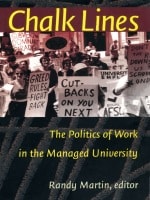
Chalk Lines
The Politics of Work in the Managed UniversityRandy Martin, ed.
Duke University Press, 1999
While tracing the socioeconomic conditions that have led to the present labor situation on campuses, the contributors consider such topics as the political implications of managerialism and the conceptual status of academic labor.
They examine the trend toward restructuring and downsizing, the particular plight of the adjunct professor, the growing emphasis on vocational training in the classroom, and union organizing among university faculty, staff, and graduate students. Placing such issues within the context of the history of labor movements as well as governmental initiatives to train a workforce capable of competing in the global economy, Chalk Lines explores how universities have attempted to remake themselves in the image of the corporate sector. Originally published as an issue of Social Text, this expanded volume, which includes four new essays, offers a broad view of academic labor in the United States.
With its important, timely contribution to debates concerning the future of higher education, Chalk Lines will interest a wide array of academics, administrators, policymakers, and others invested in the state—and fate—of academia.
Contributors. Stanley Aronowitz, Jan Currie, Zelda F. Gamson, Emily Hacker, Stefano Harney, Randy Martin, Bart Meyers, David Montgomery, Frederick Moten, Christopher Newfield, Gary Rhoades, Sheila Slaughter, Jeremy Smith, Vincent Tirelli, William Vaughn, Lesley Vidovich, Ira Yankwitt
Challenged by Coeducation
Women's Colleges Since the 1960sLeslie Miller-Bernal
Vanderbilt University Press, 2007
In the mid-twentieth century colleges' concerns about finances and enrollments, as well as ideological pressures to integrate formerly separate social groups, led men's colleges, and some women's colleges, to become coeducational. The admission of women to practically all men's colleges created a serious challenge for women's colleges. Most people no longer believed women's colleges were necessary since women had virtually unlimited access to higher education. Even though research spawned by the women's movement indicated the benefits to women of a "room of their own," few young women remained interested in applying to women's colleges.
Challenged by Coeducation details the responses of women's colleges to this latest wave of coeducation. Case studies written expressly for this volume include many types of women's colleges-Catholic and secular; Seven Sisters and less prestigious; private and state; liberal arts and more applied; northern, southern, and western; urban and rural; independent and coordinated with a coeducational institution. They demonstrate the principal ways women's colleges have adapted to the new coeducational era: some have been taken over or closed, but most have changed by admitting men and thereby becoming coeducational, or by offering new programs to different populations. Some women's colleges, mostly those that are in cities, connected to other colleges, and prestigious with a high endowment, still enjoy success.
Despite their dramatic drop in numbers, from 250 to fewer than 60 today, women's colleges are still important, editors Miller-Bernal and Poulson argue. With their commitment to enhancing women's lives, women's colleges and formerly women's colleges can serve as models of egalitarian coeducation.

Change and Harmonization in European Education
Robert Beck
University of Minnesota Press, 1971

Change and Promise
Bilingual Deaf Education and Deaf Culture in Latin AmericaBarbara Gerner Gerner de Garcia
Gallaudet University Press, 2016
Change and Promise describes the historical, cultural, and political contexts for providing bilingual deaf education in Latin America. Bilingual deaf education uses students’ sign language, while simultaneously giving them access to and teaching them the majority spoken/written language. This book describes current bilingual deaf education programs in the region that have increased society’s understandings of Deaf culture and sign languages. This cause, as well as others, have been championed by successful social movements including the push for official recognition of Libras, the sign language of Brazil. Change and Promise covers this expanding empowerment of Deaf communities as they fight for bilingual deaf education, sign language rights, and deaf civil rights.
Despite the vast political and cultural differences throughout Latin America, an epistemological shift has occurred regarding how Deaf people are treated and their stories narrated, from labeling “deaf as handicapped” to being recognized as a linguistic minority. This panoramic study of these challenges and triumphs will provide an invaluable resource for improving outcomes in deaf education and help to secure the rights of deaf children and adults in all societies.
Changing Conceptions, Changing Practices
Innovating Teaching across Disciplinesedited by Angela Glotfelter, Caitlin Martin, Mandy Olejnik, Ann Updike & Elizabeth Wardle
Utah State University Press, 2022
The authors draw on the threshold concepts framework, research in writing studies, and theories of learning, leadership, and change to deftly explore why faculty are often stymied in their efforts to design meaningful curricula for deep learning and how carefully scaffolded professional development for faculty teams can help make such change possible. This book is a powerful demonstration of how faculty members can be empowered when professional development leaders draw on a range of scholarship that is not typically connected.
In today’s climate, courses, programs, and institutions are often assessed by and rewarded for proxy metrics that have little to do with learning, with grave consequences for students. The stakes have never been higher, particularly for public higher education. Faculty members need opportunities to work together using their own expertise and to enact meaningful learning opportunities for students. Professional developers have an important role to play in such change efforts.
WAC scholars and practitioners, leaders of professional development and centers for teaching excellence, program administrators and curriculum committees from all disciplines, and faculty innovators from many fields will find not only hope but also a blueprint for action in Changing Conceptions, Changing Practices.
Contributors: Juan Carlos Albarrán, José Amador, Annie Dell'Aria, Kate de Medeiros, Keith Fennen, Jordan A. Fenton, Carrie E. Hall, Elena Jackson Albarrán, Erik N. Jensen, Vrinda Kalia, Janice Kinghorn, Jennifer Kinney, Sheri Leafgren, Elaine Maimon, Elaine Miller, Gaile Pohlhaus Jr., Jennifer J. Quinn, Barbara J. Rose, Scott Sander, Brian D. Schultz, Ling Shao, L. James Smart, Pepper Stetler

Changing Populations/Changing Schools
Edited by Erwin Flaxman and A. Harry Passow
University of Chicago Press, 1995
The studies trace defects in schooling to specific methods of instruction, the practice of separating students according to ability, poorly executed government education policies, and a lack of research on the benefits of programs aimed at expanding the role of families in education or providing social services in low income neighborhoods. Topics include vocational training, programs for gifted students, "skills and drills" teaching techniques, the organization of schools and districts, the interrelationship of educational development, family, and community, and the progress of government programs designed to compensate for deficiencies, accommodate differences, and overcome imbalances.
The researchers also address arguments that attribute the low performance of some students to their lack of character, motivation, or self-esteem and outline new approaches to instruction, curricula, and intervention to improve the education of students with special needs.
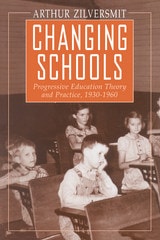
Changing Schools
Progressive Education Theory and Practice, 1930-1960Arthur Zilversmit
University of Chicago Press, 1993
Through a focus on actual classroom practices in several school systems in the Chicago area, Zilversmit examines the impact of Dewey's ideas at a national and local level. He looks at the course of progressivism from the 1930s, when its influence was at its height but reform was difficult because of the Depression, through the post-World War II period when the baby boom led to rapid school expansion. The new affluence made reform possible, but the Cold War put progressivism on the defensive.
Zilversmit's goal is to illuminate the role of the ideas of the progressives in determining school practices so we can develop a better understanding of the relationship between education ideas and educational practices. This understanding, argues Zilversmit, will better enable us to determine new directions for educational reform, and to determine how reforms can be successfully implemented.
Changing the Playbook
How Power, Profit, and Politics Transformed College SportsHoward Chudacoff
University of Illinois Press, 2015
- the failed 1950 effort to pass a Sanity Code regulating payments to football players;
- the thorny racial integration of university sports programs;
- the boom in television money;
- the 1984 Supreme Court decision that settled who could control skyrocketing media revenues;
- Title IX's transformation of women's athletics;
- the cheating, eligibility, and recruitment scandals that tarnished college sports in the 1980s and 1990s;
- the ongoing controversy over paying student athletes a share of the enormous moneys harvested by schools and athletic departments.
A thought-provoking journey into the whos and whys of college sports history, Changing the Playbook reveals how the turning points of yesterday and today will impact tomorrow."
Charter School City
What the End of Traditional Public Schools in New Orleans Means for American EducationDouglas N. Harris
University of Chicago Press, 2020
New Orleans became the first US city ever to adopt a school system based on the principles of markets and economics. When the state took over all of the city’s public schools, it turned them over to non-profit charter school managers accountable under performance-based contracts. Students were no longer obligated to attend a specific school based upon their address, allowing families to act like consumers and choose schools in any neighborhood. The teacher union contract, tenure, and certification rules were eliminated, giving schools autonomy and control to hire and fire as they pleased.
In Charter School City, Douglas N. Harris provides an inside look at how and why these reform decisions were made and offers many surprising findings from one of the most extensive and rigorous evaluations of a district school reform ever conducted. Through close examination of the results, Harris finds that this unprecedented experiment was a noteworthy success on almost every measurable student outcome. But, as Harris shows, New Orleans was uniquely situated for these reforms to work well and that this market-based reform still required some specific and active roles for government. Letting free markets rule on their own without government involvement will not generate the kinds of changes their advocates suggest.
Combining the evidence from New Orleans with that from other cities, Harris draws out the broader lessons of this unprecedented reform effort. At a time when charter school debates are more based on ideology than data, this book is a powerful, evidence-based, and in-depth look at how we can rethink the roles for governments, markets, and nonprofit organizations in education to ensure that America’s schools fulfill their potential for all students.

Charting Your Path to Full
A Guide for Women Associate ProfessorsVicki L. Baker
Rutgers University Press, 2020

Cheating the Spread
Gamblers, Point Shavers, and Game Fixers in College Football and BasketballAlbert J. Figone
University of Illinois Press, 2012
Checklist for Change
Making American Higher Education a Sustainable EnterpriseZemsky, Robert
Rutgers University Press, 2013
Robert Zemsky details the complications that have impeded every credible reform intended to change American higher education. He demythologizes such initiatives as the Morrill Act, the GI Bill, and the Higher Education Act of 1972, shedding new light on their origins and the ways they have shaped higher education in unanticipated and not commonly understood ways. Next, he addresses overly simplistic arguments about the causes of the problems we face and builds a convincing argument that well-intentioned actions have combined to create the current mess for which everyone is to blame.
Using provocative case studies, Zemsky describes the reforms being implemented at a few institutions with the hope that these might serve as harbingers of the kinds of change needed: the University of Minnesota at Rochester’s compact curriculum in the health sciences only, Whittier College’s emphasis on learning outcomes, and the University of Wisconsin Oshkosh’s coherent overall curriculum.
In conclusion, Zemsky describes the principal changes that must occur not singly but in combination. These include a fundamental recasting of federal financial aid; new mechanisms for better channeling the competition among colleges and universities; recasting the undergraduate curriculum; and a stronger, more collective faculty voice in governance that defines not why, but how the enterprise must change.

Chemical Demonstrations, Volume 1
A Handbook for Teachers of ChemistryBassam Z. Shakhashiri
University of Wisconsin Press, 1983
The demonstrations capture interest, teach, inform, fascinate, amaze, and perhaps, most importantly, involve students in chemistry. Nowhere else will you find books that answer, "How come it happens? . . . Is it safe? . . . What do I do with all the stuff when the demo is over?"
Shakhashiri and his collaborators offer 282 chemical demonstrations arranged in 11 chapters. Each demonstration includes seven sections: a brief summary, a materials list, a step-by-step account of procedures to be used, an explanation of the hazards involved, information on how to store or dispose of the chemicals used, a discussion of the phenomena displayed and principles illustrated by the demonstration, and a list of references.

Chemical Demonstrations, Volume 2
A Handbook for Teachers of ChemistryBassam Z. Shakhashiri
University of Wisconsin Press, 1985
The demonstrations capture interest, teach, inform, fascinate, amaze, and perhaps, most importantly, involve students in chemistry. Nowhere else will you find books that answer, "How come it happens? . . . Is it safe? . . . What do I do with all the stuff when the demo is over?"
Shakhashiri and his collaborators offer 282 chemical demonstrations arranged in 11 chapters. Each demonstration includes seven sections: a brief summary, a materials list, a step-by-step account of procedures to be used, an explanation of the hazards involved, information on how to store or dispose of the chemicals used, a discussion of the phenomena displayed and principles illustrated by the demonstration, and a list of references.

Chemical Demonstrations, Volume 3
A Handbook for Teachers of ChemistryBassam Z. Shakhashiri
University of Wisconsin Press, 1989
The demonstrations capture interest, teach, inform, fascinate, amaze, and perhaps, most importantly, involve students in chemistry. Nowhere else will you find books that answer, "How come it happens? . . . Is it safe? . . . What do I do with all the stuff when the demo is over?"
Shakhashiri and his collaborators offer 282 chemical demonstrations arranged in 11 chapters. Each demonstration includes seven sections: a brief summary, a materials list, a step-by-step account of procedures to be used, an explanation of the hazards involved, information on how to store or dispose of the chemicals used, a discussion of the phenomena displayed and principles illustrated by the demonstration, and a list of references. You'll find safety emphasized throughout the book in each demonstration.

Chemical Demonstrations, Volume 4
A Handbook for Teachers of ChemistryBassam Z. Shakhashiri
University of Wisconsin Press, 1992
The demonstrations capture interest, teach, inform, fascinate, amaze, and perhaps, most importantly, involve students in chemistry. Nowhere else will you find books that answer, "How come it happens? . . . Is it safe? . . . What do I do with all the stuff when the demo is over?"
Shakhashiri and his collaborators offer 282 chemical demonstrations arranged in 11 chapters. Each demonstration includes seven sections: a brief summary, a materials list, a step-by-step account of procedures to be used, an explanation of the hazards involved, information on how to store or dispose of the chemicals used, a discussion of the phenomena displayed and principles illustrated by the demonstration, and a list of references. You'll find safety emphasized throughout the book in each demonstration.