Results by title
3388 books match the query 'Fiction' and 151 start with c
C'est la Guerre
Louis Calaferte
Northwestern University Press, 1999
COME BACK IRISH
Wendy Rawlings
The Ohio State University Press, 2001

Cabin, Clearing, Forest
Zach Falcon
University of Alaska Press, 2015
Cactus Thorn
(A Novella)Mary Austin
University of Nevada Press, 1994
Café Shapiro Anthology 2018
Theresa Stanko
Michigan Publishing Services, 2018

Café Shapiro Anthology 2020
Theresa Stanko
Michigan Publishing Services, 2020
Café Shapiro Anthology 2022
Charles Saadiq
Michigan Publishing Services, 2022

Caldera Ridge
Jack Harrell
Signature Books, 2018
graduation traveling the country, hoping to make it
all the way to San Francisco before returning home
to Illinois. However, a broken motorcycle leaves him
stuck in Idaho, where he surprises himself by falling
in love with the mountains and the local culture.
He converts to Mormonism and marries Charlene
Simmons—a perfect Mormon girl deeply dedicated
to her church.
After a fifteen-year hiatus in Arizona, Kail moves
his family back to Idaho to solve some unresolved
issues between his wife and God. What he and Charlene
find are shocking surprises beneath the surface
of every beautiful thing, from the Idaho mountains to
Charlene’s deceptively devout family.
Acclaimed author Jack Harrell creates a world
of complex and troubled characters, each seeking
happiness from a God simultaneously familiar and
mysterious, each wrestling with the doubts and eternal
optimism integral to their faith.

Caldera Ridge
Jack Harrell
Signature Books, 2021
After a fifteen-year hiatus in Arizona, Kail moves his family back to Idaho to solve some unresolved issues between his wife and God. What he and Charlene find are shocking surprises beneath the surface of every beautiful thing, from the Idaho mountains to Charlene’s deceptively devout family. Acclaimed author Jack Harrell creates a world of complex and troubled characters, each seeking happiness from a God simultaneously familiar and mysterious, each wrestling with the doubts and eternal optimism integral to their faith.
Calendar of Regrets
Lance Olsen
University of Alabama Press, 2010
The poisoning of the painter Hieronymus Bosch; anchorman Dan Rather’s mysterious mugging on Park Avenue as he strolls home alone one October evening; a series of postcard meditations on the idea of travel from a young American journalist visiting Burma; a husband-and-wife team of fundamentalist Christian suicide bombers; the myth of Iphigenia from Agamemnon’s daughter’s point of view—these and other stories form a mosaic, connected through a pattern of musical motifs, transposed scenes, and recurring characters. It is a narrative about narrativity itself, the human obsession with telling ourselves and our worlds over and over again in an attempt to stabilize a truth that, as Nabokov once said, should only exist within quotation marks.
Caliburn
Merlin's TaleVirgil Renzulli
Arizona Center for Medieval and Renaissance Studies, 2015
Call Me Henri
Lorraine López
Northwestern University Press, 2006
Lorraine López (author of Soy la Avon Lady and Other Stories) has created a vivid picture of barrio life, filled with honesty, insight, and humor for young adults. She paints a balanced and detailed landscape of Enrique's world. Although Enrique is confused and angered by his mother's refusal to stand up for him against the abuse of his stepfather, he also draws strength from the supportive and loving family of his friend Francisco. While some of his teachers are uncaring or inept, others provide help and encouragement at critical moments in his life.
When Enrique witnesses his friend Horacio gunned down in a drive-by shooting and is seen by the assailants, gang members set out to kill him. As the novel reaches its climax, Enrique must make some agonizing decisions.
Although specifically about barrio life, this novel is universal in its themes—the drive for success, the desire for love and family support, and the need for true friendship. López's fully delineated characters provide a rich and credible mural of our human comedy.
Call the Next Witness
Philip Mason
University of Chicago Press, 1986
Calligraphers Secret
Rafik Schami and Anthea Bell
Haus Publishing, 2011

Calvert Casey
The Collected StoriesCalvert Casey
Duke University Press, 1998
Born in the United States, Casey was raised in Cuba and spent most of his life there and in Europe. He chose Spanish as his primary artistic tongue. A member of the intelligentsia surrounding Castro in the early years of the revolution, he was eventually exiled—and in 1969 committed suicide in Rome at the age of forty-five. Although most of his luminous stories are set in Havana, his is not a touristy, picturesque landscape but an often strange and nightmarish theater of human passions, inhabited by figures—silhouettes, really—that live on the edge of normality. This volume, which showcases Casey’s mastery of the skill of indirect and gradual revelation, is the most complete to appear in any language and includes a biographical and critical introduction written by Ilan Stavans, the noted novelist and scholar of Hispanic culture.
Readers interested in the art of fiction and in the complexities of the human psyche will find Casey’s work irresistible.

Camera Lake
Alex Pickett
University of Wisconsin Press, 2024
Camille in October
Mireille Best
Seagull Books, 2019
But an intellectual and sexual relationship with her dentist’s wife opens a world of new possibilities to Camille. Where will this lead her? Suicide, murder, accidental death—all are possible in this unconventional narrative from Mireille Best. As a young adult, Camille is not always the most reliable narrator, but she charms with her intelligence, lack of pretention, and strong connection to her roots. Through Camille’s eyes, we embark on a fundamental and universal quest to balance where we come from with who we need to become.
Camille's Lakou
A NovelMarie Léticée; Translated from French and Guadeloupean Kreyol by Kevin Meehan
Vanderbilt University Press, 2025
Camille’s Lakou tells the story of Camille, a young Caribbean girl living with her single‑parent mother in a 1960s urbanized zone at the edge of Pointe‑à‑Pitre, Guadeloupe, following her through her adult life as a Caribbean migrant in Florida. Author Marie Léticée explores neocolonial culture clash and identity conflict themes that will be familiar to readers of the Francophone Caribbean coming‑of‑age novel and its revisions by women writers such as Capécia, Lacrosil, Manicom, Schwarz‑Bart, Condé, Pineau, and others. Léticée makes it her own by fleshing out a time and place not well‑represented in Guadeloupean literature. While previous bildungsromane from the writers mentioned here typically focus on rural peasant or urban bourgeois settings, Camille’s Lakou shifts location to an impoverished urban environment. “Lakou” is translated as “courtyard” or, more colloquially, “yard.” The author explores the culture and politics of lakou society while raising the issue of how this social dynamic is transformed through the impact of globalization and dispersal into a diasporic experience outside the island milieu of Camille’s childhood.
In a collaborative translation effort between the author and Kevin Meehan, Camille’s Lakou will bring the realities and joys of Léticée’s Guadeloupe to an English audience for the first time.
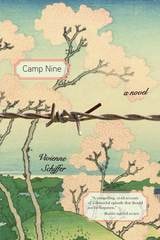
Camp Nine
A NovelVivienne Schiffer
University of Arkansas Press, 2011
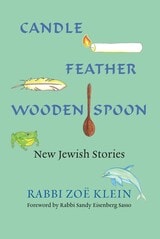
Candle Feather Wooden Spoon
New Jewish StoriesRabbi Zoe Klein
Central Conference of American Rabbis, 2023

Cannel Coal Oil Days
A NovelTheophile Maher
West Virginia University Press, 2021
Based mostly on his own experiences, Theophile Maher’s local color novel Cannel Coal Oil Days challenges many popular ideas about antebellum Appalachia, bringing it more fully into the broader story of the United States. Written in 1887, discovered in 2018, and published here for the first time, it offers a narrative of life between 1859 and 1861 in what was then western Virginia as it became West Virginia.
Cannel coal (a soft form of coal whose oil, when distilled, was competitive in the lighting oil business after overfishing reduced the whale oil supply) was at the center of one of Appalachia’s first extractive industries. Using the development of coal oil manufacturing in the Kanawha valley as its launching point, Maher’s semiautobiographical novel tells of a series of interrelated changes, each reflecting larger transformations in the United States as a whole. It shows how coal oil manufacturing was transformed from an amateurish endeavor to a more professional industry, with implications for Appalachian environment and labor. Then, Maher foreshadows the coming Progressive Era by insisting on moral and environmental reforms based in democratic and Christian principles. Finally, he tells the story of the coming of the Civil War to the region, as the novel’s protagonist, a mining engineer, works closely with a Black family to organize the local abolitionist mountain folk into a Union militia to aid in the secession of West Virginia from Virginia.

Capitalism's Other Times
Fiction, Speculation, and FuturityGreg Forter
Northwestern University Press, 2027
Reorienting critical theory and literary criticism to consider how the present contains seeds of a future beyond capitalism
Critical theorists have long held to the axiom that it is easier to imagine the end of the world than the end of capitalism. Greg Forter starts this wide-ranging study of contemporary literature by suggesting that this position is increasingly hard to maintain. In the wake of the 2008 financial crisis, the global rise of the New Right, and the mass disruptions and despair wrought by COVID-19, the story that capital had built about itself has begun to reveal cracks in its foundations. Capitalism has not succeeded in fully flattening or homogenizing time. Developing in combined and uneven fashion, it has retained the residues of pasts that suggest other futures are possible. Forter assembles a corpus of novels that theorize this insight. He names these fictions speculative realism to highlight how they map the closures of our present while opening that present onto other, more speculative orders of time. In the face of ongoing, overlapping crises, Forter posits, these fictions locate flickering intimations of a utopian somewhen; they illuminate a present charged with precipitates of a transfigured but now imaginable future.
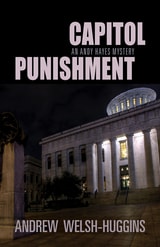
Capitol Punishment
An Andy Hayes MysteryAndrew Welsh-Huggins
Ohio University Press, 2016
The job seems simple enough: Reporter Lee Hershey needs protection for a couple of weeks as he pursues the biggest story of his career with all eyes on swing state Ohio in the midst of a presidential election. Columbus private eye Andy Hayes, broke as usual, doesn’t have much choice but to sign on, even with his girlfriend falling for the charming journalist.
Then murder strikes at the Statehouse and Andy finds himself partly responsible for the death. With an innocent man behind bars, a mysterious vehicle following Andy around the city, and more lives in danger, the detective has his hands full trying to solve a killing in a poisonous political environment where everyone has a motive for murder and anyone could be the next target.
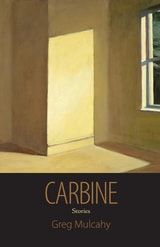
Carbine
StoriesGreg Mulcahy
University of Massachusetts Press, 2010
Written with keen intelligence and biting humor, Carbine is a book about the ridiculousness of contemporary life—a book about what cannot be said.

Carbon 14
Ann Deagon
University of Massachusetts Press, 1974
Ann Deagon first began writing poetry “vigorously” in 1970, “in some kind of forty-year-old renaissance.” Since then her poems have been published widely and have been received numerous awards.
“When I came to forty
that three-headed dog love death and poetry
took me in its teeth and shook me…”
Carbon 14 is the result, a counterpoint of serious and ironic excavations into the mythic and the personal past of a middle-aged woman. Although these poems have grown from her lifelong involvement in the Classics and are basically classical in their structure and concentration, their strength is not academic.
Ann Deagon's poems interweave past and present, person, place, and event, with unexpected and often violent insights. In “The Sybil's Bath,” for example, the sacrifice of a young girl to a god leads to unprecedented counterviolence and to questions which are both contemporary and absolute.
According to Deagon, “All identity is in some sense a translation from the Greek: it cannot be defined except with hyphens. The meaning hovers precisely at the hyphen.” in Carbon 14 Deagon proclaims her identity as poet-woman, woman-teacher, teacher-poet.
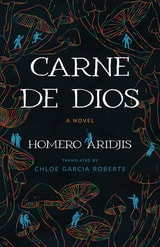
Carne de Dios
A NovelHomero Aridjis; Translated by Chloe Garcia Roberts
University of Arizona Press, 2025
María Sabina, the renowned Mazatec healer, spends her days in the small town of Huautla de Jiménez selling produce at the market and foraging under the new moon for the sacred mushrooms that grow near her home—her Holy Children, Carne de Dios, or Flesh of God. But her life changes forever when an amateur mycologist from New York, with a cameraman in tow, visits her to experience for himself the mushroom ceremony, or velada, he knows only from whispers in anthropological records. When he publishes an unauthorized article about his experience in LIFE Magazine 1957, the stage is set for an explosive encounter between the burgeoning international counterculture and the woman who became an unwilling icon of the psychedelic revolution.
Homero Aridjis’s novel, vividly translated by Chloe Garcia Roberts, tells the story of the motley crew of bohemians, researchers, and holy fools, both real and imagined, who descend on the town of Huautla de Jiménez searching for inspiration, distraction, and salvation in the sacred mushrooms. These seekers melt in and out of a narrative infiltrated by the slipstream logic of dreams. As John Lennon plays jazz on the patio of the Hotel Grande, Juan Rulfo contemplates horror movies, and Allen Ginsberg recites mantras at Philip Lamantia’s wedding, María Sabina’s life is increasingly thrown into turmoil.
Carne de Dios is a masterful and often humorous blend of history, myth, and poetic imagination, captured in a translation that mirrors the hallucinatory beauty of Aridjis’s original Spanish. Aridjis’s intimate portrayal of María Sabina, informed by his personal connection to her, serves as both a tribute to her enduring legacy and a critical reflection on the wave of global interest in mushroom culture still gaining momentum today.
This English translation includes an introduction by the translator and an afterword by the author.
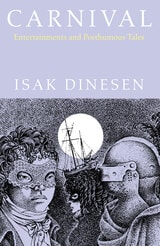
Carnival
Entertainments and Posthumous TalesIsak Dinesen
University of Chicago Press, 1979
"The editors have included only material that will stand easily with her more familiar work and satisfy her large following. . . . The rough drafts and variant treatments have been set aside for scholars."—Joseph McLellan, Washington Post
"The wit, the imagination, the elevated philosophical dialogue mark most of the stories in this volume as vintage Dinesen . . . of special interest to Dinesen fans."—Robert Langbaum, New York Times Book Review
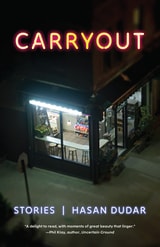
Carryout
Hasan Dudar
University of Iowa Press, 2026
A Poets & Writers First Fiction 2026 Debut Selection
In the late 1970s, Ziad Idilbi, a Palestinian refugee from Lebanon, marries Salma, a Lebanese refugee escaping the war in Beirut. Resolving to start over for the very last time, the couple opens a corner store in Toledo, Ohio, across from the General Motors factory, where Toledo’s Arab community intermingles with the working class. Over the decades, whether it’s bigotry (pre- and post-9/11), financial ruin, or terminal illness, the Idilbis find themselves on life’s outskirts, attempting to build something new.
Achingly poignant and slyly funny, the linked stories in Carryout follow the Idilbis and their children as they teeter on the brink of catastrophe. Walid, the youngest child of Ziad and Salma, navigates the heartbreaks of youth as well as the colorful characters who haunt his parents’ corner store. As he grows up into a writer, Walid’s gaze fixes on his father and the long shadow of displacement and occupation. Mustafa, the eldest son, is forever trying to outrun the disasters that seem to seek him out, while Nawal, the only daughter, is dumped by a friend and hatches a scheme to win her back. Unsure whether to run toward each other or away from each other, the characters in Dudar’s exquisite debut suffer the absurdities and indignities of life in America with wry obstinance and striking wisdom.
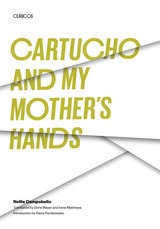
Cartucho and My Mother's Hands
By Nellie Campobello
University of Texas Press, 1988
Nellie Campobello, a prominent Mexican writer and "novelist of the Revolution," played an important role in Mexico's cultural renaissance in the 1920s and early 1930s, along with such writers as Rafael Muñoz and Gregorio López y Fuentes and artists Diego Rivera, Orozco, and others. Her two novellas, Cartucho (first published in 1931) and My Mother's Hands (first published as Las manos de Mamá in 1938), are autobiographical evocations of a childhood spent amidst the violence and turmoil of the Revolution in Mexico. Campobello's memories of the Revolution in the north of Mexico, where Pancho Villa was a popular hero and a personal friend of her family, show not only the stark realism of Cartucho but also the tender lyricism of My Mother's Hands. They are noteworthy, too, as a first-person account of the female experience in the early years of the Mexican Revolution and unique in their presentation of events from a child's perspective.
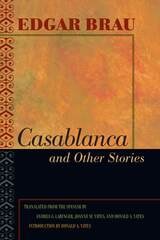
Casablanca and Other Stories
Edgar Brau
Michigan State University Press, 2006
Edgar Brau, one of the most exciting South American writers to emerge in the past twenty years, debuts his first English-language collection with the publication of Casablanca and Other Stories. The fiction of Edgar Brau draws not only upon the rich literary heritage of his native Argentina but also upon the body of work that has now rightly been formed into a South American canon, embracing those such as Jorge Luis Borges, Gabriel García Marquez, and Isabelle Allende. He brings a unique perspective to his narratives—narratives forged in the political and social upheaval that has been modern South America. Employing a fantasy-like aspect that goes beyond magical realism, his work is reminiscent of Edgar Allan Poe in his use of atmosphere as an additional character. These short stories signal a new era, much as the publication of Jorge Luis Borges’ Labyrinths in 1962 heralded a coming-of-age for his generation.
Translated by Donald A. Yates, Andrea Labinger, and Joanne M. Yates, this collection includes stories from two of Edgar Brau’s collections—El poema y otras historias and Tres cuentos—to bring to a fresh audience the very best new work of a major Argentinean author.
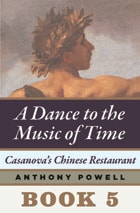
Casanova's Chinese Restaurant
Book 5 of A Dance to the Music of TimeAnthony Powell
University of Chicago Press, 1995
Anthony Powell’s universally acclaimed epic A Dance to the Music of Time offers a matchless panorama of twentieth-century London. Now, for the first time in decades, readers in the United States can read the books of Dance as they were originally published—as twelve individual novels—but with a twenty-first-century twist: they’re available only as e-books.
Casanova’s Chinese Restaurant (1960), the fifth book, finds Nick marrying Isobel Tolland and launching happily into family life—including his new role as brother-in-law to Isobel’s many idiosyncratic siblings. But even as Nick’s life is settling down, those of his friends are full of drama and heartache: his best friend, Hugh Moreland, is risking his marriage on a hopeless affair, while Charles Stringham has nearly destroyed himself with drink. Full of Powell’s typically sharp observations about life and love, Casanova’s Chinese Restaurant offers all the rewards and frustrations, pleasures and regrets of one’s thirties.
"Anthony Powell is the best living English novelist by far. His admirers are addicts, let us face it, held in thrall by a magician."—Chicago Tribune
"A book which creates a world and explores it in depth, which ponders changing relationships and values, which creates brilliantly living and diverse characters and then watches them grow and change in their milieu. . . . Powell's world is as large and as complex as Proust's."—Elizabeth Janeway, New York Times
"One of the most important works of fiction since the Second World War. . . . The novel looked, as it began, something like a comedy of manners; then, for a while, like a tragedy of manners; now like a vastly entertaining, deeply melancholy, yet somehow courageous statement about human experience."—Naomi Bliven, New Yorker
“The most brilliant and penetrating novelist we have.”—Kingsley Amis

Cases of Circumstantial Evidence
Janet Lewis
Ohio University Press, 2013
This is the first digital version of Cases of Circumstantial Evidence, a collection of three historical novels by noted American writer Janet Lewis. For the first time, these works have been brought together in a single edition, each with a new introduction by Kevin Haworth:
The Wife of Martin Guerre
Based on a notorious trial in sixteenth-century France, The Wife of Martin Guerre follows Bertrande de Rois and her lost-and-returned husband through a tale of impersonation, conspiracy, and small-town intrigue. Their fascinating story has also inspired a bestselling historical study and two films, including The Return of Martin Guerre.
The Trial of Sören Qvist
Although set in seventeenth-century Denmark, The Trial of Sören Qvist has a contemporary feel and has been praised for its intriguing plot and for Lewis’s powerful writing. In this second novel in the Cases of Circumstantial Evidence, Lewis recounts the story of a murder, an investigation, and a pious town pastor who confesses to the crime, driven perhaps more by a recognition of his own moral flaws than by guilt for the acts of which he stood accused.
The Ghost of Monsieur Scarron
The court of Louis XIV and a modest Paris street provide the incongruous settings for this tale of a humble bookbinder, his wife, and the young craftsman who seduces her and blackmails her husband into covering up a terrible crime. This third and last case of circumstantial evidence bristles with character, the smell of blood, and considerable suspense against a backdrop of national political unrest in the cruel and dingy Paris of the seventeenth century.
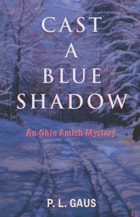
Cast a Blue Shadow
An Amish Country MysteryP. L. Gaus
Ohio University Press, 2003
In Cast a Blue Shadow, his fourth Amish mystery, P. L. Gaus spins a suspenseful tale of power, pride, and tested faith. As always, Gaus explores the threshold of culture and faith among the Amish sects and their English neighbors, combining it here with the political divisions unique to the academic world.
After an early winter blizzard in Holmes County, Ohio, a wealthy socialite is found murdered in her mansion. That same morning, a troubled student, Martha Lehman, turns up at her psychiatrist’s office, bloody and unable to speak.
Professor Michael Branden and Sheriff Bruce Robertson begin an investigation that threatens to tear Millersburg College apart. Mute for many years as a child, Martha is once again unable (or unwilling) to speak. As Branden wrestles with the murder of the college’s leading benefactor, the real story of Martha Lehman begins to emerge—born Amish, converted to Mennonite, and drawn to the “English” world for the worst of reasons.
This new edition of Cast a Blue Shadow features an exclusive interview with the author, reading group materials, and a detailed map and driving guide to Holmes County, Ohio, with everything one needs to visit the iconic scenes depicted in the story.
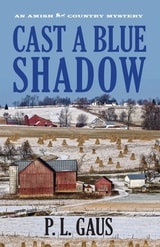
Cast a Blue Shadow
An Amish Country MysteryP. L. Gaus
Ohio University Press, 2003
In Cast a Blue Shadow, his fourth Amish mystery, P. L. Gaus spins a suspenseful tale of power, pride, and tested faith. As always, Gaus explores the threshold of culture and faith among the Amish sects and their English neighbors, combining it here with the political divisions unique to the academic world.
After an early winter blizzard in Holmes County, Ohio, a wealthy socialite is found murdered in her mansion. That same morning, a troubled student, Martha Lehman, turns up at her psychiatrist’s office, bloody and unable to speak.
Professor Michael Branden and Sheriff Bruce Robertson begin an investigation that threatens to tear Millersburg College apart. Mute for many years as a child, Martha is once again unable (or unwilling) to speak. As Branden wrestles with the murder of the college’s leading benefactor, the real story of Martha Lehman begins to emerge—born Amish, converted to Mennonite, and drawn to the “English” world for the worst of reasons.
This new edition of Cast a Blue Shadow features an exclusive interview with the author, reading group materials, and a detailed map and driving guide to Holmes County, Ohio, with everything one needs to visit the iconic scenes depicted in the story.
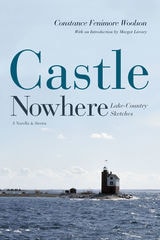
Castle Nowhere
Lake-Country SketchesConstance Fenimore Woolson
University of Michigan Press, 2004
Castle Nowhere is Constance Woolson's collection of stories set for the most part in the Great Lakes, in particular northern Lake Michigan and Lake Huron near Detroit.
Several themes inhabit Woolson's writing: an environmental consciousness and concern with landscapes; an awareness of the complexities of race; and an abidingly careful eye for the shallowness that sometimes accompanies wealth or social pretensions. She also had a unique perspective as a woman who pioneered the use of controversial subjects---such as unrequited or misplaced passion---and methods in fiction during a time that valorized domesticity.
As Margot Livesey notes in her introduction, reading about thwarted love is only one of the pleasures to be found in Castle Nowhere. "The majority of these stories are set in remote areas on the shores of Lake Michigan, which Woolson evokes with great vividness and beauty while always remaining keenly aware that beauty in no way mitigates hardship. As a writer, she was nearly always looking over her shoulder, and many, if not all, of these stories were written at a time when she no longer visited the Lake and her beloved Mackinac Island."
Contemporary readers will find a curiously modern atmosphere in Woolson's stories, as well as a distinct regional flavor in her careful renderings of the Great Lakes landscape. As such, Castle Nowhere represents a rare woman's voice in literature of its period and setting.
Constance Fenimore Woolson (1840-1894) was born in New Hampshire and moved to Cleveland shortly thereafter. She spent time on Mackinac Island, Michigan, then traveled to Florida before moving to Europe. Much of her time there was spent in Italy. She died in Venice in 1894. Novelist Margot Livesey is the author of Eva Moves the Furniture and Homework.
Cat in the Agraharam and Other Stories
Dilip Kumar, Translated from the Tamil by Martha Ann Selby
Northwestern University Press, 2020
The volume is introduced by its award-winning translator, Martha Ann Selby, who worked closely with the author. The universal appeal of these stories is rooted in their utterly truthful local specificity as they explore complex themes of abduction and restoration, humiliation and despair, and related issues of identity and wholeness. Known by Tamil readers for his description and detail, Dilip Kumar also writes with humor and a deep compassion for his characters, highlighting their strengths in the face of degradation and strife. His perspective and insight build on his own status as a northerner in this southern setting for whom Tamil is a second language—much like his characters.
Catering an Affair
Alberta Skaggs
Southern Illinois University Press, 2018
Catherine
A StoryWilliam Makepeace Thackeray
University of Michigan Press, 1999
The Thackeray Edition proudly announces two additions to its collection: Catherine and The Luck of Barry Lyndon. The Thackeray Edition is the first full-scale scholarly edition of William Makepeace Thackeray's works to appear in over seventy years, and the only one ever to be based on an examination of manuscripts and relevant printed texts. It is also a concrete attempt to put into practice a theory of scholarly editing that gives new insight into Thackeray's own compositional process.
Written in 1839-40 for Fraser's Magazine, Catherine was Thackeray's first novel. Although originally intended as a spoof of the 1830s Newgate school of criminal romance, it has intrinsic merit of its own for its cynical narrator and roguish heroine, both of whom harbinger similar creations in Vanity Fair eight years later.
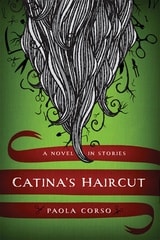
Catina’s Haircut
A Novel in StoriesPaola Corso
University of Wisconsin Press, 2010
Catina’s Haircut: A Novel in Stories spans four generations of a peasant family in the brutal poverty of post-Unification southern Italy and in an immigrant’s United States. The women in these tales dare to cross boundaries by discovering magical leaps inherent in the landscape, in themselves, and in the stories they tell and retell of family tragedy at a time of political unrest. Through an oral tradition embedded in the stone of memory and the flow of its reinvention, their passionate tale of resistance and transformation courses forward into new generations in a new world.
A woman threatens to join the land reform struggle in her Calabrian hill town, against her husband’s will, during a call for revolution in 1919. A brother and sister turn to the village sorceress in Fascist Italy to bring rain to their father’s drought-stricken farm. In Pittsburgh, new immigrants witness a miraculous rescue during the Great Flood of 1936. A young girl courageously dives into the Allegheny River to save her grandfather’s only memento of the old country. With only broken English to guide her, a widow hops a bus in search of live chickens to cook for Easter dinner in her husband’s memory. An aging woman in the title story is on a quest to cut the ankle-length hair as hard as the rocky soil of Calabria in a drought. A lonely woman who survived World War II bombings in her close-knit village, struggles to find community as a recent immigrant. A daughter visits her mother’s hill town to try and fulfill a wish for her to see the Fata Morgana. These haunting images permeate Corso’s linked stories of loss, hope, struggle, and freedom.
An official selection of The Sons of Italy® Book Club
Best Books for General Audiences, selected by the Public Library Association
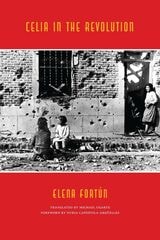
Celia in the Revolution
Elena Fortún
Swan Isle Press, 2023
Set during the Spanish Civil War (1936–39), Celia in the Revolution is the last in a series of young adult novels written by Encarnación Aragoneses, known by the pen name Elena Fortún, one of the most prolific and popular Spanish authors of the mid-twentieth century.
In a series of more than twenty novels, Fortún’s protagonist is Celia Gálvez de Montalbán, a precocious and rebellious girl from an affluent family who’s not afraid to question authority and dream, and that often gets her into trouble. Readers watch her grow from age seven through adolescence to the threshold of womanhood at seventeen, which is her age in this dark, inspiring novel about the war that changed Spain.
In this last narrative in the legendary series, Celia has an awakening that not even her lively imagination could have anticipated. The once carefree, innocent child prone to playful fantasies must suddenly confront a world that’s utterly changed, finding herself amid a bloody conflict, la Guerra Civil. Celia, now a madrecita, a little mother to her two younger sisters since the death of their mother, is forced into a life of hardship, a world of hunger, witness to violence, executions, bombing raids, and death. With Celia’s sorrows come her courageous and profound compassion, consoling and caring for virtually every war victim that crosses her path, no matter their political inclinations, and no matter all that Celia must contend with herself. Celia, despite all her travails, manages to survive with determination, defiance, and dignity.
Written immediately after the war, Celia in the Revolution was not published during Elena Fortún’s lifetime, until after the death of the dictator, Francisco Franco, due to censorship. This first major English translation by eminent scholar and Hispanist Michael Ugarte captures the narrative and nuances of Celia’s voice and others in this character-rich novel, and fellow eminent scholar and Hispanist Nuria Capdevila-Arguëlles’s preface brings powerful insights into this remarkable work by Elena Fortún that transcends young adult literature.
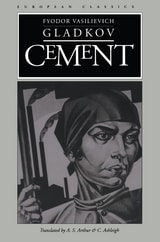
Cement
Fyodor Vasilievich Gladkov
Northwestern University Press, 1994

Cement Guitar
Michael Carlson
University of Massachusetts Press, 2003
In this striking debut collection, Michael Carlson offers poems that combine the concrete and the musical, while embodying a tendency toward contradiction. He writes by working with rhythms, structures, images, associational leaps, and an obsession with the sound of words, as opposed to narrative. The book begins, “A thing wants to pounce but can't,” and this spirit of hesitation continues throughout the volume.
The first section of the book contains heavily rhythmic poems measured sometimes by syllable, sometimes by stress, dealing with rural landscapes, a struggle with disillusionment, and a reconciliation of knowledge and belief. The second section confronts the terrain and people of Carlson's childhood in Rhode Island, using longer sentences, riskier enjambments, and a more colloquial and emotional language.
The poems in the third section—which range from Manhattan to Florida, Vietnam, and Paris—share a tendency to be more fantastic and are formal in weird ways. They include an homage to Ezra Pound borrowing the vocabulary of his first book and the syntax of his last, a nod to John Donne borrowing some of his stanza shapes, a sonnet whose constraint is that each of its fourteen lines contains a piece of armor, and a sestina composed of four syllable lines with four end words that rhyme. In the fourth section, Carlson returns to Brooklyn, speaks from the present, and resolves his stances in a brief notational way that is reminiscent of Chinese poetry.

Centerville
A NovelKaren Osborn
West Virginia University Press, 2012
Certificate of Absence
By Sylvia Molloy
University of Texas Press, 1989
Originally published in 1981 as En breve cárcel,Certificate of Absence is the first novel of the Argentinian scholar-critic Sylvia Molloy. Innovative in its treatment of women's relationships and in its assertion of woman's right to author her own text, the novel has won wide approval in Latin America and the United States.
The novel centers around a woman writing in a small room. As she writes, remembering a past relationship and anticipating a future one, the room becomes a repository for nostalgia, violence, and desire, a space in which writing and remembering become life-sustaining ceremonies. The narrator reflects on the power of love to both shelter and destroy. She meditates on the act of writing, specifically on writing as a woman, in a voice that goes against the grain of established, canonical voices.
Latin American male writers are prone to self-portrayal in their texts. Certifcate of Absence is one of the few novels by Latin American women that successfully use this technique to open new windows on women's experiences.
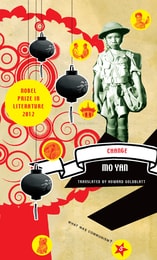
Change
Mo Yan
Seagull Books, 2010
In Change, Mo Yan, the 2012 Nobel Laureate in Literature, personalizes the political and social changes in his country over the past few decades in this novella disguised as autobiography—or vice-versa. Unlike most historical narratives from China, which are pegged to political events, Change is a representative of “people’s history,” a bottom-up rather than top-down view of a country in flux. By moving back and forth in time and focusing on small events and everyday people, Mo Yan breathes life into history by describing the effects of larger-than-life events on the average citizen.
“Through a mixture of fantasy and reality, historical and social perspectives, Mo Yan has created a world reminiscent in its complexity of those in the writings of William Faulkner and Gabriel García Márquez, at the same time finding a departure point in old Chinese literature and in oral tradition.”— Nobel Committee for Literature
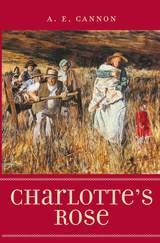
Charlotte's Rose
A. E. Cannon
University of Utah Press, 2011
Charlotte’s Rose—justifiably back in print—tells the story of a young Welsh girl, Charlotte Edwards, who, soon after her mother dies, sails with her father from England to the United States to become part of a company of Mormon handcart pioneers—emigrants with no horses or oxen who themselves pulled the heavy carts filled with their belongings. These were arduous journeys. While on the Mormon Trail, Charlotte befriends a young mother who later dies in childbirth. Though only 12 years old, Charlotte assumes responsibility for the infant and carries her to Utah. Over the course of their journey together, Charlotte becomes deeply attached to the baby she calls Rose, which makes Charlotte’s choice at the novel’s end particularly poignant.
The author, A. E. Cannon, is adept at creating vivid, multifaceted, believable characters and has crafted a story of pioneers that will seem relevant to today’s young people. The reader will quickly be drawn into the story as Charlotte struggles to navigate the trials of an adolescent moving into adulthood. Although this is a book about Mormon pioneers, it is in fact about the larger American experience of immigration—a drama still unfolding today—and Charlotte’s coming-of-age journey will resonate with readers young and old.
Chase
Alejo Carpentier
University of Minnesota Press, 2001
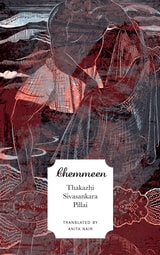
Chemmeen
Thakazhi Sivasankara Pillai
Seagull Books, 2016
Previously available only in India, this hugely successful novel was adapted into a film, winning great critical acclaim and commercial success. Anita Nair’s evocative translation from Malayalam brings this tale of love and longing, a classic of Indian literature, to a new audience.
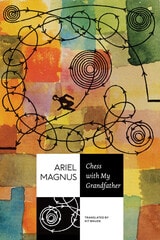
Chess with My Grandfather
Ariel Magnus
Seagull Books, 2020
Ariel Magnus leaves no stone unturned in his efforts to learn more about his grandfather and the country to which he emigrated in the 1930s. Chess with My Grandfather is a playful, genre-shifting novel combining tales of international espionage, documentary evidence, and family lore. In this extraordinary book, Magnus blends fact and fiction in a delirious exploration of a dark period of history, family, identity, the power of art and literature and, of course, the fascinating world of chess.

Chez Charlotte and Emily
Jonathan Baumbach
University of Alabama Press, 1979