Results by title
486 books match the query 'LGBTQ+' and 35 start with c
C. P. Cavafy
The Economics of MetonymyPanagiotis Roilos
University of Illinois Press, 2009
Konstantinos P. Kavafis--known to the English-reading world as C. P. Cavafy--has been internationally recognized as an important poet and attracted the admiration of eminent literary figures such as E. M. Forster, F. T. Marinetti, W. H. Auden, George Seferis, and James Merrill. Cavafy's idiosyncratic poetry remains one of the most influential and perplexing voices of European modernism.
Focusing on Cavafy's intriguing work, this book navigates new territories in critical theory and offers an interdisciplinary study of the construction of (homo)erotic desire in poetry in terms of metonymic discourse and anti-economic libidinal modalities. Panagiotis Roilos shows that problematizations of art production, market economy, and trafficability of erôs in diverse late-nineteenth and early twentieth-century European sociocultural and political contexts were re-articulated in Cavafy's poetry in new subversive ways that promoted an "unorthodox" discursive and libidinal anti-economy of jouissance.

Call Me by Your Name
Perspectives on the FilmEdited by Edward Lamberti and Michael Williams
Intellect Books, 2026
This edited collection explores how Luca Guadagnino’s film Call Me by Your Name speaks powerfully to questions of contemporary sexual identity and romance.
Adapted by James Ivory from André Aciman’s novel and directed by Luca Guadagnino, the film Call Me by Your Name has been passionately received among audiences and critics ever since its 2017 release. A love story between seventeen-year-old Elio (Timothée Chalamet) and graduate student Oliver (Armie Hammer) set in 1983 “somewhere in northern Italy,” Call Me by Your Name presents a gay relationship in a romantic idyll seemingly untroubled by outside pressures, prejudices, or tragedy.
While this means it offers audiences welcome opportunities to swoon in front of an LGBTQ+ romance that equals classic heterosexual romances onscreen, its relevance or political significance today may not be immediately apparent. This edited collection points out the ways in which the film is abundantly infused with narrative, thematic, and stylistic elements that can be interpreted as speaking powerfully to contemporary audiences on questions of sexual identity. How does this love story explore wider tensions that exist between the specific and the general, between the open and the hidden, and between the past and the present? The contributors to this collection provide stimulating and contemplative responses to this question.
Called Back
Rosa Lane
Tupelo Press, 2024
In bold tribute with a title utilizing the last two words Emily Dickinson wrote, Rosa Lane’s Called Back converses with one of our greatest poets in theatrical monologue—decoding secrets amid the blatant. Evoked by epigraphs selected from Dickinson’s work, Lane’s poems, through her I-speaker, reveal the extraordinary to be found in the ordinary and speak to the struggle of sexual orientation, otherness, and the challenges of living in a Calvinistic socioreligious world of oughts and noughts as evidenced in Dickinson’s poems. From sapphic eroticism and subsequent pangs of nonbelonging to tacking next life as a welcome reprieve, poems in Called Back create a de novo dot-connecting lyrical narrative.
Canto hondo / Deep Song
Francisco X. Alarcón
University of Arizona Press, 2015
In this new collection, Alarcón creates poetry with roots in Gypsy songs clapped out in the distinctively short rhythms of flamenco music. Each page lifts the heart and stirs the soul by delving deep into the struggle for self and sexual identity.
Canto hondo / Deep Song includes 106 poems divided into four sections that articulate struggle, otherness, and the meaning of the poetic landscape. Like Lorca, Alarcón seeks out the fault lines where the lyric and the political bleed productively and proactively into one another.
An important voice in Chicano and GLBT poetry, Alarcón writes with a complex, emotionally powerful style that is accessible to students and all lovers of poetry and poetic traditions.
Chamorrita Song
Danielle P. Williams
University of Arizona Press, 2026
Rooted in oral tradition, Chamorrita Song pays homage to Black and Chamorro cultures, honoring the artistic expressions that these communities have created to reconcile lifetimes of imposed trauma. Bearing witness to these many narratives, Williams intertwines spoken word poetry and gospel music with Chamorro storytelling, weaving together the nuanced histories of queer, Black, and Indigenous existence and literature.
Here Williams reveals capacious contemporary forms that speak to the future as well as to the past and that further ground lineages in homelands, finding strength and beauty in collective pain and triumph. These poems transform and spread the messages of those long silenced. They act as song and prayer.
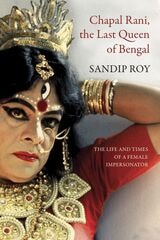
Chapal Rani, the Last Queen of Bengal
The Life and Times of a Female ImpersonatorSandip Roy
Seagull Books, 2025
As the last great female impersonator of Bengali theater, Chapal Bhaduri—known as Chapal Rani—once held audiences spellbound in the jatra tradition, where men became goddesses and heroines. But when women finally took their place on stage, Chapal found himself exiled from the world he had ruled. In this groundbreaking biography, Sandip Roy captures the rise and fall of a performer whose art was inseparable from his identity.
Told in Chapal’s own voice and interwoven with evocative fictional vignettes, Chapal Rani, the Last Queen of Bengal brings to life Kolkata’s golden age of theater and the resilience of a man who refused to disappear. Through decades of research and deeply personal interviews, Roy crafts a moving portrait of gender and belonging.
Chaucer's (Anti-)Eroticisms and the Queer Middle Ages
Tison Pugh
The Ohio State University Press, 2014
For Chaucer, erotic pursuits establish the thrust and tenor of many of his narratives, as they also expose the frustrations inherent in pursuing desires frowned upon by the religious foundations of Western medieval culture. One cannot love freely within an ideological framework that polices sexuality and privileges the anti-erotic Christian ideals of virginity and chastity, yet loving queerly creates escapes from social structures inimical to amour and its expressions in the medieval period. Thus Chaucer is not just England’s foundational love poet, he is also England’s foundational queer poet.
Chocolate and Other Writings on Male Homoeroticism
Pandey Bechan Sharma
Duke University Press, 2009
The stories depict male homoeroticism in quotidian situations: a man brings a lover to his disapproving friend’s house; a good-looking young man becomes the object of desire at his school. The love never ends well, but the depictions are not always unsympathetic. Although Ugra claimed that the stories were aimed at suppressing homosexuality by exposing it, Vanita highlights the ambivalence of his characterizations. Cosmopolitan, educated, and hedonistic, the Hindu and Muslim men he portrayed quote Hindi and Urdu poetry to express their love, and they justify same-sex desire by drawing on literature, philosophy, and world history. Vanita’s introduction includes anecdotal evidence that Chocolate was enthusiastically received by India’s homosexual communities.
Cinnamon
Samar Yazbek
Haus Publishing, 2012
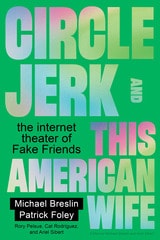
Circle Jerk and This American Wife
the internet theater of Fake FriendsMichael Breslin, Patrick Foley, Rory Pelsue, Cat Rodríguez, and Ariel Sibert, edited by Michael Breslin and Ariel Sibert
Northwestern University Press, 2026
Two plays along with process essays on the cacophonous world of pop culture, politics, and personal testimony that we call the internet
In March 2020, the New York theater company Fake Friends was pushed off the stage and into the land of the internet. This book marks the first publication of two of their deliciously absurd and toxically serious internet plays, Circle Jerk (the first-ever work in digital theater to be shortlisted for the Pulitzer Prize in Drama) and This American Wife. Circle Jerk tells the social media–infused tale of gay white supremacists creating an AI-influencer to dominate the global discourse, and This American Wife spins a surrealist web of queer devotion to the stars and performance strategies of reality television; both plays are unapologetically theatrical and digitally native, born out of the exigencies of the pandemic. This collection features an electrifying visual archive as well as individual essays from each company member reflecting on the practical and interpersonal processes of bringing these award-winning plays to life in our ever-more online, political, and personal world.
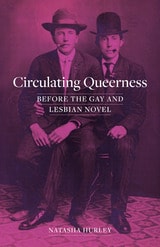
Circulating Queerness
Before the Gay and Lesbian NovelNatasha Hurley
University of Minnesota Press, 2018
A new history of the queer novel shows its role in constructing gay and lesbian lives
The gay and lesbian novel has long been a distinct literary genre with its own awards, shelving categories, bookstore spaces, and book reviews. But very little has been said about the remarkable history of its emergence in American literature, particularly the ways in which the novel about homosexuality did not just reflect but actively produced queer life.
Drawing on Mikhail Bakhtin’s insight that the history of society is connected to the history of language, author Natasha Hurley charts the messy, complex movement by which the queer novel produced the very frames that made it legible as a distinct literature and central to the imagination of queer worlds. Her vision of the queer novel's development revolves around the bold argument that literary circulation is the key ingredient that has made the gay and lesbian novel and its queer forebears available to its audiences.
Challenging the narrative that the gay and lesbian novel came into view in response to the emergence of homosexuality as a concept, Hurley posits a much longer history of this novelistic genre. In so doing, she revises our understanding of the history of sexuality, as well as of the processes of producing new concepts and the evolution of new categories of language.

Cisgender
Disorienting a CategoryPerry Zurn
Duke University Press, 2026
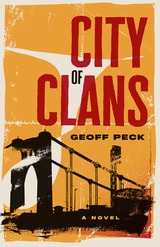
City of Clans
Geoff Peck
University of Iowa Press, 2025
Jeremy begins a journey of healing and self-reflection that carries him back to his family and his one true friend, Katrina Kovacs, a photography major who opens his eyes to societal issues he’s always ignored. A story of redemption, City of Clans captures the resiliency of the human spirit and explores hidden truths of masculinity, sexuality, and self.
Classics Beyond the Pleasure Principle
Edited by Paul Allen Miller and Mario Telò
The Ohio State University Press, 2026
Contributors:
Karen Bassi, Martin Devecka, Micaela Janan, Hagi Kenaan, Vered Lev Kenaan, Sara Lindheim, Paul Allen Miller, Helen Morales, Jay Oliver, Victoria Rimell, Mario Telò
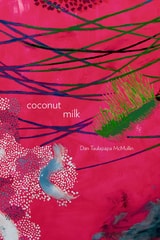
Coconut Milk
Dan Taulapapa McMullin
University of Arizona Press, 2013
McMullin seamlessly flows between exposing the ironies of Tiki kitsch–inspired cultural appropriation and intimate snapshots of Samoan people and place. In doing so, he disrupts popular notions of a beautiful Polynesia available for the taking, and carves out new avenues of meaning for Pacific Islanders of Oceania. Throughout the collection, McMullin illustrates various manifestations of geopolitical, cultural, linguistic, and sexual colonialism. His work illuminates the ongoing resistance to colonialism and the remarkable resilience of Pacific Islanders and queer-identified peoples.
McMullin’s Fa’a Fafine identity—the ability to walk between and embody both the masculine and feminine—creates a grounded and dynamic voice throughout the collection. It also fosters a creative dialogue between Fa’a Fafine people and trans-Indigenous movements. Through a uniquely Samoan practice of storytelling, McMullin contributes to the growing and vibrant body of queer Indigenous literature.
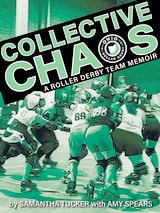
Collective Chaos
A Roller Derby Team MemoirSamantha Tucker
Ohio University Press, 2023
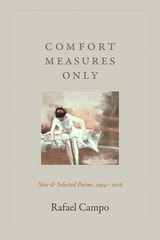
Comfort Measures Only
New and Selected Poems, 1994–2016Rafael Campo
Duke University Press, 2018
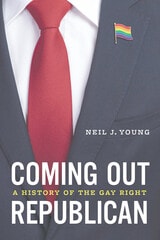
Coming Out Republican
A History of the Gay RightNeil J. Young
University of Chicago Press, 2024
One of the most maligned, misunderstood, and even mocked constituencies in American politics, gay Republicans regularly face condemnation from both the LGBTQ+ community and their own political party. Yet they’ve been active and influential for decades. Gay conservatives were instrumental, for example, in ending “Don’t Ask, Don’t Tell” and securing the legalization of same-sex marriage—but they also helped lay the groundwork for the rise of Donald Trump.
In Coming Out Republican, political historian and commentator Neil J. Young provides the first comprehensive history of the gay Right. From the 1950s up to the present day, Young excavates the multifarious origins, motivations, and evolutions of LGBTQ+ people who found their way to the institutions and networks of modern conservatism. Many on the gay Right have championed conservative values—like free markets, a strong national defense, and individual liberty—and believed that the Republican Party therefore offered LGBTQ+ people the best pathway to freedom. Meanwhile, that same party has actively and repeatedly demonized them. With his precise and provocative voice, Young details the complicated dynamics of being in—and yet never fully accepted into—the Republican Party.
Coming Out Republican provides striking insight into who LGBTQ+ conservatives are, what they want, and why many of them continue to align with a party whose rank and file largely seem to hate them. As the Republican Party renews its assaults on LGBTQ+ rights, understanding the significant history of the gay Right has never been more critical.

Coming Out of My Skin
Jean-Baptiste Phou
Seagull Books, 2023
Born to Chinese-Cambodian parents in France, Jean-Baptiste Phou has pursued a diverse artistic career since 2008. Through his public views and artistic works, he has focused mainly on the experiences of Asians in France. Up until now, he’s always been careful not to raise issues of sexuality—in particular, his homosexuality.
In this searing memoir, Phou faces his fears and shame to examine the role his ethnic origin has played in the construction of his sexual identity and his romantic relationships in a predominantly white environment. An astute observer of the various ways in which his body has been perceived, Phou explores how these perceptions have shaped his relationship with himself and others. How does a marginalized person develop emotionally and build, reclaim, and express their sexuality? Drawing on various works of history, sociology, gender studies, literature, and popular culture, Phou sensitively examines various strategies developed in response to this question.
Being gay in a largely straight world is difficult but being Asian within this sexual minority can be a doubly oppressive experience. Coming Out of My Skin deftly tackles this challenge and aspires for a reconciliation that can empower people of sexual and racial minorities to joyfully inhabit their bodies.
Companion Grasses
Brian Teare
Omnidawn, 2013
Company
Sam Ross
Four Way Books, 2019
Confessions of a Presidential Speechwriter
Craig R. Smith
Michigan State University Press, 2014
Confessions of the Letter Closet
Epistolary Fiction and Queer Desire in Modern SpainPatrick Paul Garlinger
University of Minnesota Press, 2005
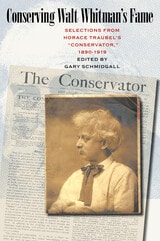
Conserving Walt Whitman's Fame
Selections from Horace Traubel's Conservator, 1890-1919Schmidgall, Gary
University of Iowa Press, 2006
Contingent Figure
Chronic Pain and Queer EmbodimentMichael D. Snediker
University of Minnesota Press, 2021
A masterful synthesis of literary readings and poetic reflections, making profound contributions to our understanding of chronic pain
At the intersection of queer theory and disability studies, acclaimed theorist Michael D. Snediker locates something unexpected: chronic pain. Starting from this paradigm-shifting insight, Snediker elaborates a bracing examination of the phenomenological peculiarity of disability, articulating a complex idiom of figuration as the lived substance of pain’s quotidian. This lexicon helps us differently inhabit both the theoretical and phenomenal dimensions of chronic pain and suffering by illuminating where these modes are least distinguishable.
Suffused with fastidious close readings, and girded by a remarkably complex understanding of phenomenal experience, Contingent Figure resides in the overlap between literary theory and lyric experiment. Snediker grounds his exploration of disability and chronic pain in dazzling close readings of Herman Melville, Emily Dickinson, Henry James, and many others. Its juxtaposition of these readings with candid autobiographical accounts makes Contingent Figure an exemplary instance of literary theory as a practice of lyric attention.
Thoroughly rigorous and anything but predictable, this stirring inquiry leaves the reader with a rich critical vocabulary indebted to the likes of Maurice Blanchot, Gilles Deleuze, D. O. Winnicott, and Eve Kosofsky Sedgwick. A master class in close reading’s inseparability from the urgency of lived experience, this book is essential for students and scholars of disability studies, queer theory, formalism, aesthetics, and the radical challenge of Emersonian poetics across the long American nineteenth century.

Country Songs for Alice
Emma Binder
Tupelo Press, 2024
In Country Songs for Alice, a nonbinary, queer narrator passes through the crucible of love, romance, and heartbreak against the backdrop of rural America—a landscape which offers luminous belonging, even as the hazards of homophobia, loneliness, and isolation loom large. Part roadtrip, part mixtape, these poems are explorations of love, music, romance, pageantry, loneliness, and belonging in the rural places and small towns that seem to preclude queer culture. Country Songs for Alice not only tells the story of a relationship and its dissolution but reclaims country western imagery and aesthetics for a queer audience, dousing the narrator’s experience in the language of cowboys, horses, rodeos, trucks, and desert skies.
Courtly and Queer
Deconstruction, Desire, and Medieval French LiteratureCharlie Samuelson
The Ohio State University Press, 2022
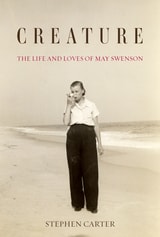
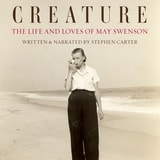
Creature
The Life and Loves of May SwensonCarter, Stephen
Signature Books, 2026
In the summer of 1936, twenty-three-year-old May Swenson boarded a bus heading east out of her Mormon hometown of Logan, Utah. Her destination was New York City, where she had a single goal: become a poet. Creature tells the story of how this small-town woman fought to achieve her dreams in the Depression-era big city, keeping a roof over her head and honing her craft as she pursued romantic relationships with both men and women. After decades of struggle, Swenson became one of mid-century America’s most beloved and prolific poets.
What is it that makes her poetry so extraordinary? How did she see and reveal the world? How did she teach the art of poetry? And how does her work interact with her Mormon roots? Readers will learn the answers to these questions and more in this artfully written biography.
Creature
The Life and Loves of May SwensonCarter, Stephen
Signature Books, 2026
In the summer of 1936, twenty-three-year-old May Swenson boarded a bus heading east out of her Mormon hometown of Logan, Utah. Her destination was New York City, where she had a single goal: become a poet. Creature tells the story of how this small-town woman fought to achieve her dreams in the Depression-era big city, keeping a roof over her head and honing her craft as she pursued romantic relationships with both men and women. After decades of struggle, Swenson became one of mid-century America’s most beloved and prolific poets.
What is it that makes her poetry so extraordinary? How did she see and reveal the world? How did she teach the art of poetry? And how does her work interact with her Mormon roots? Readers will learn the answers to these questions and more in this artfully written biography.
Creolized Sexualities
Undoing Heteronormativity in the Literary Imagination of the Anglo-CaribbeanAlison Donnell
Rutgers University Press, 2022
Critical Fandom
Representations of Race, Gender, and Sexuality in Fan FictionCara Marta Messina
University of Iowa Press, 2026
Critical Fandom positions fan authors as rhetoricians and fan fiction as an action. Every fan author navigates—implicitly or explicitly—the politics of their fandom, the media they love, their lived experiences, digital technologies, reader expectations, and a larger culture. To better understand critical fans, Cara Marta Messina analyzes Archive of Our Own tagging practices, fan fictions, and interviews from four different fandoms.
Fans of The Legend of Korra celebrate queer relationships while understanding representation is just the first step in the face of systemic homophobia. Game of Thrones fan authors challenge racism and heteronormativity in both the community and the show. In online forums for Black Panther, fans make space for sapphic romances and explore the humanity of Erik Killmonger, ultimately contending with harmful stereotypes of radical Black men. And the Our Flag Means Death fandom demonstrates how a show can flourish when it centers queerness, especially for trans fans. Even in these moments of joy, there’s conflict. Critical Fandom seeks to answer what comes next.
Criticism Without Authority
Gene Swenson's and Jill Johnston’s Queer PracticesJennifer Sichel
University of Chicago Press, 2025
In the early 1960s, Gene Swenson and Jill Johnston began to imagine art criticism as something unruly and expansive, rejecting modernist appeals to purity and coherence that had overtaken the field. These critics were deeply enmeshed in New York’s avant-garde art scene, and both were explicitly and unapologetically queer. First working independently of one another, then later in dialogue, Swenson and Johnston demanded criticism become life-sustaining, subverting protocols and distorting its form beyond recognition. They utilized criticism as a means of navigating queer existence and reclaimed terms like lesbian, homosexual, mad, and psychotic as their own.
Jennifer Sichel follows the intertwined paths of Swenson and Johnston, providing a history of queer practices that were central to the development of avant-garde art but have been largely overlooked. Criticism Without Authority makes their work visible not just as criticism, but as its own form of art. As Sichel shows, Swenson's and Johnston’s practices, bucking categories and disciplinary formations, resist historical streamlining and stand as a key for unlocking the queerness of postwar art history.
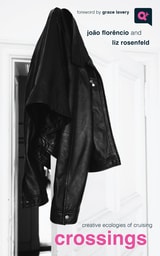
Crossings
Creative Ecologies of CruisingJoão Florêncio
Rutgers University Press, 2025
A creative dialogue between a queer artist and a queer academic reminiscing about and thinking with their cruising experiences, Crossings takes queer sex practices and cultures seriously as ways of knowing and world-making. The result is an erotic hybrid form hovering between scholarship and avant-garde experimentation, between critical manifesto and sex memoir. Here, the voices of each author, merged together in one, invite the reader to inhabit the erotic spacetime between self and other, the familiar and the strange, desire and pleasure, climax and release. That is, the spaces and temporalities of cruising itself.
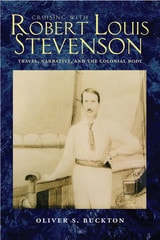
Cruising with Robert Louis Stevenson
Travel, Narrative, and the Colonial BodyOliver S. Buckton
Ohio University Press, 2007
Cutlish
Rajiv Mohabir
Four Way Books, 2021