Results by title
1787 books match the query 'Literary Collections' and 87 start with c
C'est la Guerre
Louis Calaferte
Northwestern University Press, 1999
Cabin Stories
The Best of Dark Winter Nights: True Stories from AlaskaRob Prince
University of Alaska Press, 2022
From the humorous to the heart-wrenching, these are the stories told up north on dark winter nights. Anyone curious about what living in Alaska is really like will appreciate this wild and fun anthology.
Contributors: Glenner Anderson, Kat Betters, Randy Brown, Melissa Buchta, JB Carnahan, Philip Charette, Roy Churchwell, Richard Coleman, Michael Daku, Wendy Demers, Alexandra Dunlap, Alyssa Enriquez, Jan Hanscom, Mike Hopper, James Mennaker, Ken Moore, Steve Neumeth, Kaiti Ott, Lori Schoening, Bill Schnabel, Guy Schroder, Ed Shirk, Eric Stevens, Chris Zwolinski
Café Shapiro Anthology 2021
Theresa Stanko
Michigan Publishing Services, 2021
California And The Fictions Of Capital
George Henderson
Temple University Press, 2003
Calling Home
Working-Class Women's WritingsZandy, Janet
Rutgers University Press, 1990
The geography of home, identity, parents, sex, motherhood, the dominance of the job, the overlapping of private and public worlds, the promise of solidarity and community are a few of the themes of this book. Here is a chorus of working class women's voices: Sandra Cisneros, Barbara Garson, Meridel Le Sueur, Tillie Olsen, Barbara Smith, Endesha I. M. Holland, Mother Jones, Nellie Wong, Agnes Smedley, Bobbie Louise Hawkins, Sharon Doubiago, Carol Tarlen, Hazel Hall, Margaret Randall, Judy Grahn, and many others!
The aesthetic impulse is shaped by class, but not limited to one ruling class. What connects these writers is a collective consciousness, a class, which rejects bondage and lays claim to liberation through all the possibilities of language. Calling Home is illustrated with family photographs as well as images of working women by professional photographers.
Camden County, New Jersey
The Making of a Metropolitan Community, 1626-2000Dorwart, Jeffery M
Rutgers University Press, 2001
In this book, Jeffery M. Dorwart chronicles more than three centuries of Camden County history. He takes readers on a journey, from the earliest days as a Native American settlement, to the county's important roles in the Revolutionary and Civil Wars, Camden City's booms and busts, the county's increasing suburbanization, and concluding with current inner-city revitalization efforts.
Dorwart details how the earliest European settlers radically changed the local Native American culture and introduced black slavery. In the Revolutionary War, the county's location directly across the Delaware River from Philadelphia placed it at the crossroads of the American Revolution. Dorwart examines the county's conflicted roles during the Civil War, when the older agrarian population, which held traditional social and economic ties to the slave-owing South, clashed with the increasingly industrialized interests of the urban waterfront, which showed strong Unionist tendencies. He explores the changing demographics of the area as waves of European immigrants came to work in the factories. He surveys the rise and fall of first Camden City, then of the suburbs, as both areas experienced population ebbs and flows. Finally, Dorwart looks at the revitalization efforts of 2000 when Camden County began efforts to reinvent the riverfront community where it all began.
Camino del Sol
Fifteen Years of Latina and Latino WritingEdited by Rigoberto González
University of Arizona Press, 2010
Featuring both established writers and first-time authors, Camino del Sol has published poetry and prose that convey something about the Latina/o experience—works that tap into universal truths through a distinct cultural lens. This volume celebrates fifteen years of books by bringing together some of the series’ best work, such as poetry from Francisco X. Alarcón, fiction from Christine Granados, and nonfiction from Luis Alberto Urrea. These voices echo the entire spectrum of Latina/o writing, from Chicana/o to Puerto Rican to Brazilian-American, and take in themes ranging from migration to gender.
Awards bestowed upon Camino del Sol titles include the PEN/Beyond Margins Award to Richard Blanco’s Directions to the Beach of the Dead; Before Columbus Foundation American Book Awards to Diana García’s When Living Was a Labor Camp and Luis Alberto Urrea’s Nobody’s Son; International Latino Book Awards to Pat Mora’s Adobe Odes and Kathleen Alcalá’s The Desert Remembers My Name; the Premio Aztlán literary prize to Sergio Troncoso’s The Last Tortilla; and the PEN Oakland-Josephine Miles National Literary Award to Kathleen de Azevedo’s Samba Dreamers. All of these works are represented in this outstanding collection.
In a short span of time, Camino del Sol has cultivated an admirable and sizeable list of distinguished contemporary authors—and even garnered the first National Book Critics Circle Award for a Chicana/o for Juan Felipe Herrera’s Half of the World in Light. Camino del Sol: Fifteen Years of Latina and Latino Writing is a benchmark for the series and a wonderful introduction to the world of Latina/o literature.
Camp Notes and Other Writings
Yamada, Mitsuye
Rutgers University Press, 1998
Honorable Mention of the 1999 Gustavus Myers Outstanding Book Awards
Two collections by an important Asian American writer -- Camp Notes and Other Poeems and Desert Run: Poems and Stories -- return to print in one volume.
Mitsuye Yamada was born in Kyushu, Japan, and raised in Seattle, Washington, until the outbreak of World War II when her family was removed to a concentration camp in Idaho. Camp Notes and Other Writings recounts this experience.
Yamada's poetry yields a terse blend of emotions and imagery. Her twist of words creates a twist of vision that make her poetry come alive. The weight of her cultural experience-the pain of being perceived as an outsider all of her life-permeates her work.
Yamada's strength as a poet stems from the fact that she has managed to integrate both individual and collective aspects of her background, giving her poems a double impact. Her strong portrayal of individual and collective life experience stands out as a distinct thread in the fabric of contemporary literature by women.
"The core poems of Camp Notes and the title come from the notes I had taken when I was in camp, and it wasn’t published until thirty years after most of it was written. I was simply describing what was happening to me, and my thoughts. But, in retrospect, the collection takes on a kind of expanded meaning about that period in our history. As invariably happens, because Japanese American internment became such an issue in American history, I suppose I will be forever identified as the author of Camp Notes. Of course, I try to show that it’s not the only thing I ever did in my whole life; I did other things besides go to an internment camp during World War II. So, in some ways I keep producing to counteract that one image that gets set in the public mind. At the time that I was writing it, I wasn’t necessarily a political person. Now, when I reread it, even to myself, I think it probably has a greater warning about the dangers of being not aware, not aware of one’s own rights, not aware of helping other people who may be in trouble. I think that it does speak to our present age very acutely." -- Mitsuye Yamada, "You should not be invisible”: An Interview with Mitsuye Yamada, Contemporary Women's Writing, March 2014, Vol. 8 Issue 1
Read the whole interview at: https://academic.oup.com/cww/article/8/1/1/414906/You-should-not-be-invisible-An-Interview-with
Captives in Blue
The Civil War Prisons of the ConfederacyRoger Pickenpaugh
University of Alabama Press, 2013
A gripping account of Union soldiers behind Confederate bars—where survival, sacrifice, and the unforgiving realities of Civil War imprisonment collide.
In Captives in Blue, Roger Pickenpaugh examines the ways the Confederate army contended with the growing prison population, the variations in the policies and practices of different Confederate prison camps, the effects these policies and practices had on Union prisoners, and the logistics of prisoner exchanges. He explores conditions that arose from conscious government policy decisions and conditions that were the product of local officials or unique local situations. He also considers how Confederate prisons and policies dealt with African American Union soldiers. Black soldiers held captive in Confederate prisons faced uncertain fates; many former slaves were returned to their former owners, while others faced harsh treatment in the camps. Drawing on prisoner diaries, Pickenpaugh provides compelling first-person accounts of life in prison camps often overlooked by scholars in the field.
This study of Union captives in Confederate prisons is a companion to Roger Pickenpaugh’s earlier groundbreaking book Captives in Gray: The Civil War Prisons of the Union and extends his examination of Civil War prisoner-of-war facilities into the Confederacy.
Captives in Gray
The Civil War Prisons of the UnionRoger Pickenpaugh
University of Alabama Press, 2009
“This is a vivid description of conditions and events rarely described: the imprisonment of captured Confederate soldiers during the Civil War. Its many parallels to circumstances in Andersonville are especially intriguing.” —Jimmy Carter, 39th President of the United States
Contains contemporary reports from prisoners and witnesses humanize the grim realities of the POW camps.
Captives in Gray is Civil War prison camp authority Roger Pickenpaugh’s acclaimed and definitive account of the Union’s POW camps. Combining his own extensive research into official records and a rich variety of letters and diaries with the best contemporary scholarship, Pickenpaugh covers every major northern camp.
Because the Union won few victories in 1861 and took few prisoners, the North had time to plan and build prison camps, an opportunity it largely squandered. Pickenpaugh gives illuminating accounts of the role and leadership of thrifty Lieutenant Colonel William Hoffman, the commissary general of prisoners for most of the conflict, and President Abraham Lincoln's secretaries of war, the incompetent Simon Cameron and the malignant Edwin M. Stanton.
Death came in many ways. Soldiers from the Deep South had no experience with extreme cold, and they died by the hundreds each winter. In one memorable freeze, Rock Island, Illinois, saw temperatures between twenty-eight and thirty-one degrees below zero. With insufficient fuel and inadequate shelter, clothing, and blankets, prisoners there and in other camps froze to death. Food rations varied widely. A few Confederates enjoyed better rations than they had in the CSA armies, but the majority supplemented their meager rations by eating rats, dogs, cats, and seagulls.
Poor medical care added to the death toll. Treatment was bad even by the standards of Civil War medicine, often due to Hoffman's reluctance to spend. Prisoners suffered from lice and scurvy, as well as pneumonia, measles, and a variety of fevers. As in both armies, diarrhea and dysentery were chronic. Smallpox epidemics killed many. Poor sanitation and drainage caused 385 deaths at Elmira, New York, in September 1864 alone.
During the war, over 12 percent of rebel prisoners, or 25,976 of the 214,865, died in captivity. Together with his Captives in Blue, Captives in Gray gives the fullest account of the experiences of prisoners of war in the American Civil War.
Caribbeana
An Anthology of English Literature of the West Indies, 1657-1777Edited by Thomas W. Krise
University of Chicago Press, 1999
Caribbeana offers invaluable period commentaries on slavery, colonialism, gender relations, African and European history, natural history, agriculture, and medicine. Highlights include several of the earliest protests against slavery; a superb ode by the Cambridge-educated Afro-Jamaican poet Francis Williams; James Grainger's extended georgic poem, The Sugar Cane; Frances Seymour's poignant tale of the Englishman Inkle who sells his Indian savior-lover Yarico into slavery; and several descriptions of the West Indies during the early years of settlement.

Cases of Circumstantial Evidence
Janet Lewis
Ohio University Press, 2013
This is the first digital version of Cases of Circumstantial Evidence, a collection of three historical novels by noted American writer Janet Lewis. For the first time, these works have been brought together in a single edition, each with a new introduction by Kevin Haworth:
The Wife of Martin Guerre
Based on a notorious trial in sixteenth-century France, The Wife of Martin Guerre follows Bertrande de Rois and her lost-and-returned husband through a tale of impersonation, conspiracy, and small-town intrigue. Their fascinating story has also inspired a bestselling historical study and two films, including The Return of Martin Guerre.
The Trial of Sören Qvist
Although set in seventeenth-century Denmark, The Trial of Sören Qvist has a contemporary feel and has been praised for its intriguing plot and for Lewis’s powerful writing. In this second novel in the Cases of Circumstantial Evidence, Lewis recounts the story of a murder, an investigation, and a pious town pastor who confesses to the crime, driven perhaps more by a recognition of his own moral flaws than by guilt for the acts of which he stood accused.
The Ghost of Monsieur Scarron
The court of Louis XIV and a modest Paris street provide the incongruous settings for this tale of a humble bookbinder, his wife, and the young craftsman who seduces her and blackmails her husband into covering up a terrible crime. This third and last case of circumstantial evidence bristles with character, the smell of blood, and considerable suspense against a backdrop of national political unrest in the cruel and dingy Paris of the seventeenth century.
Catalogue of the Slavonic Cyrillic Manuscripts of the National Szechenyi Library
Ralph Cleminson
Central European University Press, 2007
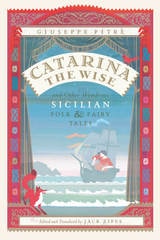
Catarina the Wise and Other Wondrous Sicilian Folk and Fairy Tales
Collected by Giuseppe Pitrè
University of Chicago Press, 2017
So begins the title story in this collection of fifty Sicilian folk and fairy tales edited and translated by noted folklore scholar Jack Zipes. But while some of the stories may sound as if they’ve been told time and again—such as variations on Cinderella and Puss in Boots—many will enchant English-language readers and storytellers for the first time. From “The Pot of Basil” to “The Talking Belly,” “The Little Mouse with the Stinky Tail” to “Peppi, Who Wandered out into the World,” the stories in Catarina the Wise range from simple tales of getting a new dress or something good to eat to fantastical plots for outwitting domineering husbands, rescuing impoverished fathers, or attracting wealthy suitors (frequently the Prince of Portugal). Many feature strong, clever women (usually daughters who become queen). Many are funny; many are wise. Some are very, very strange.
As Zipes relates, the true story of their origins is as extraordinary as the tales themselves. Born to a poor family of sailors in Palermo, Giuseppe Pitrè would go on to serve with Garibaldi, become a traveling country doctor, and gather one of the most colossal collections of folk and fairy tales of the nineteenth century. But while his work as a folklorist rivaled that of the Brothers Grimm, Pitrè remains a relative unknown. Catarina the Wise highlights some of the most delectable stories at the heart of his collection. Featuring new, original illustrations, this book is a beautiful, charming treasure for any fan of story, storytelling, and heroines and heroes living happily ever after—sometimes.
Centering Anishinaabeg Studies
Understanding the World through StoriesJill Doerfler
Michigan State University Press, 2013
Central American Women in Diaspora
Testimonios of the GenerationsEdited by Karina Alma and Ester E. Hernández
University of Arizona Press, 2026
This collection centers Central American women’s voices within the growing narrative of the Central American diaspora. It provides a tapestry of testimonios—from grandmothers, mothers, daughters, and sisters—who explore what it means to be Central American women in the United States.
Through the practice of testimonio, contributors create intergenerational dialogues between mothers and daughters, engage with Indigenous oral traditions, and reflect on the violent histories of war in Guatemala, El Salvador, Honduras, and Nicaragua. The volume is organized around five themes: political histories, migration, gender and sexuality, navigating institutions, and healing. Within each theme contributors tackle a range of issues, including Central American political histories, healing, grief, Indigenous knowledge, memory, trauma, post-traumatic growth, organizing, creativity, and agency.
This anthology spans genres such as poetry, essay, and visual art to present diverse perspectives, including Indigenous, Afro-Indigenous, queer, and working-class voices. An intervention that centers gendered experiences and challenges oppressive structures, this volume celebrates the solidarity, cultural memory, and healing found within transnational ties.
Contributors
Leisy J. Abrego
Margoth Abrego
Bella
Juanita Cabrera López
Jennifer A. Cárcamo
Sandra Castro
Karla Cativo
Kency Cornejo
Gabriela Corona Valencia
Carolina Rivera Escamilla
Rafael Escamilla
Mildred Fuentes-Chung
Diana Gamez
Joanna Beltrán Girón
Ruth Girón
Victoria Gonzalez-Rivera
Claudia D. Hernández
Jessica Hernandez
Leticia Hernández-Linares
Leigh-Anna Hidalgo
Andrea Nikté Juarez Mendoza
Amanda Macal
Carla Macal
Patricia Veliz Macal
Kiara Aileen Machado
Beatriz Maldonado
Jacqueline Munguía
Joanna B. Pérez
Rossana Pérez
Katy Pinto
Claudia A. Portillo
Suyapa Portillo Villeda
Nalya Rodriguez
Jessica Saravia
Andrea Zelaya
Challenges to Traditional Authority
Plays by French Women Authors, 1650-1700Françoise Pascal, Mary-Catherine Desjardins, Antoinette Deshoulières, and Catherine Durand
Iter Press, 2015
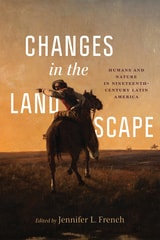
Changes in the Landscape
Humans and Nature in Nineteenth-Century Latin AmericaEdited by Jennifer L. French
Vanderbilt University Press, 2024
Ranging from the immediate aftermath of the Spanish‑American Wars of Independence (1810–1826) to the early twentieth century (1925), the volume’s essays cover a wide variety of genres and forms of cultural production, from José Hernández’s epic poem Martín Fierro to prose fiction, painting and photography, and the personal albums compiled by Spanish-American women. Individually and collectively, the essays engage with scientific writing as both a discourse of power and a source of potentially significant, even revelatory information about human and nonhuman nature. Changes in the Landscape enables readers to more fully understand the transition from colonial regimes to the ecocidal extractivism of the export boom (1870–1930) by drawing out and analyzing some of the cognitive resources and rhetorical strategies that were available to imagine, protest, or enact new norms and expectations regarding the relations between human and nonhuman life, be it the life of wildflowers, waterfalls, or Cuba’s Ciénaga de Zapata.
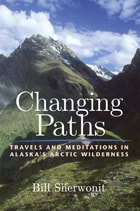
Changing Paths
Travels and Meditations in Alaska's Arctic WildernessBill Sherwonit
University of Alaska Press, 2009
Changing Paths: Travels and Meditations in Alaska’s Arctic Wilderness is an autobiographical exploration of author Bill Sherwonit’s relationship with the Alaska wilderness. Written in three parts, it first describes Sherwonit’s introduction to the Brooks Range and his years as an exploration geologist. Taking a step back, the author then takes us into the past to explore his childhood roots in rural Connecticut and his recognition of wild nature as a refuge. He concludes with his emergence as a nature writer and wilderness advocate.
An engrossing, fascinating, and eye-opening tale of one man’s life and of wilderness conceptions, this vivid description of an area of Alaska that few people get to experience is authentic and enlightening. It is an extraordinary contribution to the literature of place from one of Alaska’s most accomplished nature writers.
Chaos, Creativity, Completion
New Approaches to Writing and ADHDEdited by Chloe Martinez and Lisa Van Orman Hadley
University of Chicago Press, 2026
A rising number of ADHD diagnoses, particularly among adults, is not only confirmed by medical studies and mainstream reporting but also borne out across social media and elsewhere among people who’d been privately coping with persistent, often inexpressible challenges. Many of the contributors to this collection can attest to how a later-in-life diagnosis radically demystified the patterns, impulses, and impasses that had affected their lives and their writing. The essays in Chaos, Creativity, Completion reflect the ways poets, novelists, memoirists, filmmakers, and others have come to understand and engage the relationship between their ADHD and their creative tool kits.
These essays consider how writers can embrace rather than mask their neurodifference, offering multiple ways of finding writing practices that work for ADHD brains—including techniques that often look quite different from traditional writing instruction. Some essays are analytical, some are reflective, and some are delightfully weird, employing humor, research, personal narrative, deep description, close reading, and experimental approaches to genre and form. Each essay also concludes with a writing prompt, providing readers with opportunities to expand their own creative toolkits. Finally, the book includes an interview with David Kessler, a licensed therapist and nationally recognized ADHD advocate, and an appendix with a glossary of helpful terms and a list of recommended resources, from books and organizations to apps and gadgets.
Just as the experience of ADHD varies from person to person, so, too, do the ways those experiences can be expressed. Chaos, Creativity, Completion is a kaleidoscopic, adventurous series of takes on what writing looks like today.
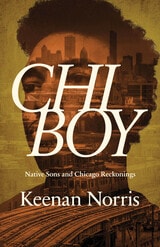
Chi Boy
Native Sons and Chicago ReckoningsKeenan Norris
The Ohio State University Press, 2022
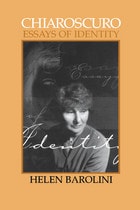
Chiaroscuro
Essays on Identity: Revised EditionHelen Barolini
University of Wisconsin Press, 1999
“A lively, lucid, and often extremely moving collection of essays.”—Sandra Gilbert, author of Wrongful Death: A Memoir
“Barolini’s essays moved me. Their commitment, their passion, their intelligence struck me very powerfully and made them among the most incisive essays on Italian-Americana, ethnicity, and diversity in literature that I have ever read.”—Fred Misurella, author of Understanding Milan Kundera: Public Events, Private Affairs and Short Time
Part memoir, part social commentary, and part literary criticism, Chiaroscuro is not only profoundly original but also of crucial importance in establishing the contours of an Italian-American tradition. Spanning a quarter century of work, the essays in Helen Barolini’s essays explore her personal search; literature as a formative influence; and the turning of the personal into the political. Included in Chiaroscuro is an updated re-introduction to Barolini’s American Book Award-winning collection, The Dream Book: An Anthology of Writings by Italian-American Women.
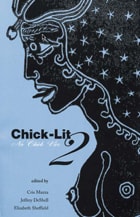
Chick Lit 2
No Chick VicsChris Mazza, Jeffrey DeShell, and Elisabeth Sheffield
University of Alabama Press, 1996
Chick-Lit 2: No Chick Vics features new work by Rikki Ducornet, Eurydice, Elizabeth Graver, Ursule Molinaro, and fourteen other witty and deadly serious writers.
Chick-Lit 2 discovers new and alternative voices in women’s fiction whose stories do not involve trauma that comes from the outside. As Mazza writes in her introduction, “Sexual assaults and harassments and injurious poor body images do exist and have waged a war on women (the American Medical Association says so). But for this book, I was interested in seeing what action(s) women characters can incite on their own, whether bad or good, hopeful or dead-end, progressive or destructive.”
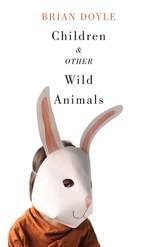
Children and Other Wild Animals
Notes on badgers, otters, sons, hawks, daughters, dogs, bears, air, bobcats, fishers, mascots, Charles Darwin, newts, sturgeon, roasting squirrels, parrots, elk, foxes, tigers and various other zoological mattersBrian Doyle
Oregon State University Press, 2014
In these short vignettes, Doyle explores the seethe of life on this startling planet, the astonishing variety of our riveting companions, and the joys available to us when we pause, see, savor, and celebrate the small things that are not small in the least.
Doyle’s trademark quirky prose is at once lyrical, daring, and refreshing; his essays poignant but not pap, sharp but not sermons, and revelatory at every turn. Throughout there is humor and humility and a palpable sense of wonder, with passages of reflection so true and hard earned they make you stop and reread a line, a paragraph, a page.
Children & Other Wild Animals gathers previously unpublished work with selections that have appeared in Orion, The Sun, Utne Reader, High Country News, and The American Scholar, as well as Best American Essays (“The Greatest Nature Essay Ever”) and Best American Nature and Science Writing (“Fishering”). “The Creature Beyond the Mountain,” Doyle’s paean to the mighty and mysterious sturgeon of the Pacific Northwest, won the John Burroughs Award for Outstanding Nature Essay. As he notes in that tribute to all things “sturgeonness”:
“Sometimes you want to see the forest and not the trees. Sometimes you find yourself starving for what’s true, and not about a person but about all people. This is how religion and fascism were born, but it’s also why music is the greatest of arts, and why stories matter, and why we all cannot help staring at fires and great waters.”
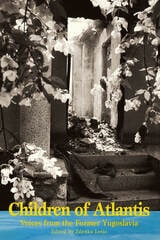
Children of Atlantis
Zdenko Lešic
Central European University Press, 1995

Children of the Albatross
Anaïs Nin
Ohio University Press, 1959
Children of the Albatross is divided into two sections: “The Sealed Room” focuses on the dancer Djuna and a set of characters, chiefly male, who surround her; “The Café” brings together a cast of characters already familiar to Nin’s readers, but it is their meeting place that is the focal point of the story.
As always, in Children of the Albatross, Nin’s writing is inseparable from her life. From Djuna’s story, told in “The Sealed Room” through hints and allusions, hazy in their details and chronology, the most important event to emerge is her father’s desertion (like Nin’s) when she was sixteen. By rejecting realistic writing for the experience and intuitions she drew from her diary, Nin was able to forge a novelistic style emphasizing free association, spontaneity, and improvisation, a technique that finds its parallel in the jazz music performed at the café where Nin’s characters meet.
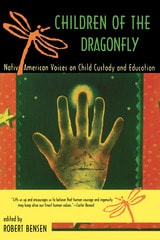
Children of the Dragonfly
Native American Voices on Child Custody and EducationRobert Bensen
University of Arizona Press, 2001
Native American children have long been subject to removal from their homes for placement in residential schools and, more recently, in foster or adoptive homes. The governments of both the United States and Canada, having reduced Native nations to the legal status of dependent children, historically have asserted a surrogate parentalism over Native children themselves.
Children of the Dragonfly is the first anthology to document this struggle for cultural survival on both sides of the U.S.-Canadian border. Through autobiography and interviews, fiction and traditional tales, official transcripts and poetry, these voices— Seneca, Cherokee, Mohawk, Navajo, and many others— weave powerful accounts of struggle and loss into a moving testimony to perseverance and survival. Invoking the dragonfly spirit of Zuni legend who helps children restore a way of life that has been taken from them, the anthology explores the breadth of the conflict about Native childhood.
Included are works of contemporary authors Sherman Alexie, Joy Harjo, Luci Tapahonso, and others; classic writers Zitkala-Sa and E. Pauline Johnson; and contributions from twenty important new writers as well. They take readers from the boarding school movement of the 1870s to the Sixties Scoop in Canada and the Indian Child Welfare Act of 1978 in the United States. They also spotlight the tragic consequences of racist practices such as the suppression of Indian identity in government schools and the campaign against Indian childbearing through involuntary sterilization.
CONTENTS
Part 1. Traditional Stories and Lives
Severt Young Bear (Lakota) and R. D. Theisz, To Say "Child"
Zitkala-Sa (Yankton Sioux), The Toad and the Boy
Delia Oshogay (Chippewa), Oshkikwe's Baby
Michele Dean Stock (Seneca), The Seven Dancers
Mary Ulmer Chiltoskey (Cherokee), Goldilocks Thereafter
Marietta Brady (Navajo), Two Stories
Part 2. Boarding and Residential Schools
Embe (Marianna Burgess), from Stiya: or, a Carlisle Indian Girl at Home
Black Bear (Blackfeet), Who Am I?
E. Pauline Johnson (Mohawk), As It Was in the Beginning
Lee Maracle (Stoh:lo), Black Robes
Gordon D. Henry, Jr. (White Earth Chippewa), The Prisoner of Haiku
Luci Tapahonso (Navajo), The Snakeman
Joy Harjo (Muskogee), The Woman Who Fell from the Sky
Part 3. Child Welfare and Health Services
Problems That American Indian Families Face in Raising Their Children, United States Senate, April 8 and 9, 1974
Mary TallMountain (Athabaskan), Five Poems
Virginia Woolfclan, Missing Sister
Lela Northcross Wakely (Potawatomi/Kickapoo), Indian Health
Sherman Alexie (Spokane/Coeur d'Alene), from Indian Killer
Milton Lee (Cheyenne River Sioux) and Jamie Lee, The Search for Indian
Part 4. Children of the Dragonfly
Peter Cuch (Ute), I Wonder What the Car Looked Like
S. L. Wilde (Anishnaabe), A Letter to My Grandmother
Eric Gansworth (Onondaga), It Goes Something Like This
Kimberly Roppolo (Cherokee/Choctaw/Creek), Breeds and Outlaws
Phil Young (Cherokee) and Robert Bensen, Wetumka
Lawrence Sampson (Delaware/Eastern Band Cherokee), The Long Road Home
Beverley McKiver (Ojibway), When the Heron Speaks
Joyce carlEtta Mandrake (White Earth Chippewa), Memory Lane Is the Next Street Over
Alan Michelson (Mohawk), Lost Tribe
Patricia Aqiimuk Paul (Inupiaq), The Connection
Terry Trevor (Cherokee/Delaware/Seneca), Pushing up the Sky
Annalee Lucia Bensen (Mohegan/Cherokee), Two Dragonfly Dream Songs

Christmas on the Great Plains
Dorothy Dodge Robbins
University of Iowa Press, 2004
Cicero on Oratory and Orators
Translated by J.S. Watson. Introduction by Ralph A. Micken. Foreword by David Potter. Preface by Richard Leo Enos
Southern Illinois University Press, 1986
Contains Cicero’s De Oratore and Brutus, influential sources over the centuries for ideas on rhetoric and training for public leadership.
The De Oratore, written in 55 B.C., argues that rhetoric is socially significant because states are established and maintained through the leadership of eloquent men.
The three books of dialogues in this volume feature discussions between well-known figures in Roman history, including Lucius Crassus, Marcus Antonius, Quintus Lutatius Catulus, Quintus Marcius Scaevola, Caius Aurelius Cotta, Julius Caesar Strabo Vopicus, and Publius Sulpicus Rufus.
The Brutus continues the theme of the dialogues, giving a history of eminent orators whose performances exemplify the Ciceronian theory that rhetoric finally adds up to leadership.
Circling Faith
Southern Women on SpiritualityWendy Reed
University of Alabama Press, 2012
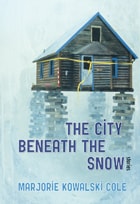
City Beneath the Snow
StoriesMarjorie Kowalski Cole
University of Alaska Press, 2012
"Marjorie Kowalski Cole's characters live, work, and struggle in interior Alaska, and she depicts life here with a keen eye and with compassion. We see the daughter of a Fairbanks junkyard owner struggling with her isolation. We meet a bartender at Circle Hot Springs who's also a certified nurse's assistant at Fairbanks Memorial Hospital. . . . These are inner lives, revealed with care and with skill, the true material of good literature."—Peggy Shumaker, Alaska State Writer Laureate
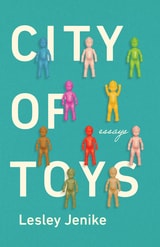
City of Toys
EssaysLesley Jenike
The Ohio State University Press, 2026
Composed in a postpartum blur and finessed as Lesley Jenike settled into established motherhood, the essays in City of Toys careen from exteriority to interiority, from high to low culture, and from the manufactured to the natural world, all on a quest to understand creativity, mothering, and how art drives and shapes us. With madcap acuity, Jenike casts her eye on cultural flash points from Harambe the gorilla to Steven Spielberg and Ada Lovelace to Yayoi Kusama. At times she doubles back to her own experience as a young performer, and at others hurtles into her children’s possible futures, when AI starts to dream, imagination is commodified, and the polar bear drowns. All the while she wonders what we owe our children and what we believe (rightly or wrongly) our children owe us. Fascinated by creativity and peopled by dolls, automatons, robots, ghosts, puppets, and historical figures, this exuberant and devastating debut asks, What world are we building, and what are we tearing down?
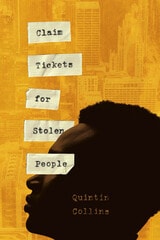
Claim Tickets for Stolen People
Quintin Collins
The Ohio State University Press, 2022
In Claim Tickets for Stolen People, Quintin Collins embraces a range of poetic forms and registers to show the resilience of Blackness in a colonized world. The tension between mortality and vitality is ever-present, whether Collins is charting his daughter’s emergence into being, cataloging the toll of white violence, or detailing the exuberance of community, family, and Chicago and Boston life. In Collins’s hands, the world is exquisitely physical and no element is without its own perspective, whether it is a truck sheared by a highway bridge or bees working through the knowledge that humans will kill them, burn their homes, and steal their honey. All goes toward honoring Black grief, Black anger, Black resistance, Black hope—and the persistence of Black love.
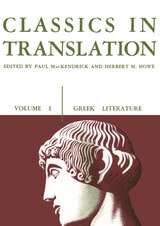
Classics in Translation, Volume I
Greek LiteratureEdited by Paul L. MacKendrick and Herbert M. Howe
University of Wisconsin Press, 1959
Here, translated into modern English, are the works of literature, history, science, oratory, and philosophy that constitute the mainstream of classical Greek thought and continue to influence world civilizations. This volume includes:
· Complete translations of Aeschylus’ Agamemnon, Sophocles’ Antigone, Euripides’ Medea, Aristophanes’ Frogs, and The Constitution of Athens by the “Old Oligarch.”
· Abridged translations of Homer’s Iliad and Odyssey, The Homeric Hymn to Hermes, and Plutarch’s Life of Tiberius Gracchus.
· Selections from Hesiod and Lucian; from twenty-eight lyric poets including Sappho, Pindar, and Meleagar; from the histories of Herodotus and Thucydides; and from eight Attic orators, including Isocrates and Demosthenes.
· Selections from the scientific writings of Hippocrates, Archimedes, and Galen.
· Selections from the pre-Socratic philosophers and from Plato, Aristotle, Epicurus, and Epictetus.
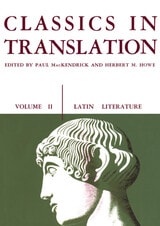
Classics in Translation, Volume II
Latin LiteratureEdited by Paul L. MacKendrick and Herbert M. Howe
University of Wisconsin Press, 1959
Here, translated into modern English, are the works of literature, history, science, oratory, and philosophy that constitute the mainstream of Roman thought and continue to influence world civilizations. This volume includes:
· Complete translations of Plautus’ The Haunted House, Terence’s Woman from Andros, Seneca’s Medea, and the Deeds of the Deified Augustus.
· Selections from Vergil’s Georgics and Aeneid, the poems of Catullus, Horace’s Odes, Ovid’s Metamorphoses and Fasti, the Satyricon of Petronius, and the Sixth Satire of Juvenal.
· Selections from Lucretius’ On the Nature of Things, Cicero’s speeches and philosophical works, and Quintilian’s The Training of the Orator.
· Selections from histories by Sallust, Livy’s History of Rome, Tacitus’ Annals and Germania, and letters of Pliny the Younger.
Close Formation
My Friendship with James SalterWilliam Benton
University of Iowa Press, 2027

Closed Encounters
Literary Politics and Public CultureJeffrey Wallen
University of Minnesota Press, 1998
Closed Encounters was first published in 1998. Minnesota Archive Editions uses digital technology to make long-unavailable books once again accessible, and are published unaltered from the original University of Minnesota Press editions.
It's committed. It's political. It's socially engaged. It's academic criticism in the nineties. But what does it achieve? In a provocative and fair-minded look at current critical practices and the future of the academy, Jeffrey Wallen draws a disturbing picture of public intellectuals in search of a public and cultural critics unable to enter a dialogue with others.
Wallen argues that literary politics is no substitute for debate on genuine political issues. Taking up several of the most influential critics of recent years-Edward Said, Eve Kosofsky Sedgwick, Michael Bérubé, Gerald Graff, Richard Rorty, Stanley Fish, and many others-Wallen asks: Can their desire to persuade an audience beyond the classroom be fulfilled? And can cultural critics realize their ambitious social and institutional goals for change? In a work that is neither of the Left nor of the Right, but likely to unsettle both, Wallen argues that literary criticism actually undermines the prospects for the dialogue it calls out for.
In addition, Wallen argues that the institutionalization of critiques of truth and difference-critiques that appear to liberate us by revealing that knowledge and values are constructed, and can therefore be transformed-often leads to a further constraining of thought and narrowing of outlooks. In his analysis of the administration of conflict, Wallen describes the troubled state of academic freedom and points to a shift from the institutional protection of dissenting views to the institutional protection from views one finds unpleasant.
Yet the prospects are not bleak: Wallen emphasizes that academic critics continue to play a crucial role in crafting what we expect from discussion. In this spirit, Closed Encounters lays the groundwork for fashioning a truly public, socially engaged criticism.
Closing Arguments
Clarence Darrow on Religion, Law, and SocietyClarence Darrow
Ohio University Press, 2005
Clarence Darrow, son of a village undertaker and coffinmaker, rose to become one of America’s greatest attorneys—and surely its most famous. The Ohio native gained renown for his central role in momentous trials, including his 1924 defense of Leopold and Loeb and his defense of Darwinian principles in the 1925 Scopes “Monkey Trial.” Some have traced Darrow’s lifelong campaign against capital punishment to his boyhood terror at seeing a Civil War soldier buried—and no client of Darrow’s was ever executed, not even black men who were accused of murder for killing members of a white mob.
Closing Arguments: Clarence Darrow on Religion, Law, and Society collects, for the first time, Darrow’s thoughts on his three main preoccupations, revealing a carefully conceived philosophy expressed with delightful pungency and clarity. His thoughts on social issues, especially on the dangers of religious fundamentalism, are uncannily prescient. A dry humor infuses his essays, and his reflections on himself and his philosophy reveal a quiet dignity at the core of a man better known for provoking Americans during an era of unprecedented tumult. From the wry “Is the Human Race Getting Anywhere?” to the scornful “Patriotism” and his elegiac summing up, “At Seventy-two,” Darrow’s writing still stimulates, pleases and challenges.
A rebel who always sided intellectually and emotionally with the minority, Darrow remains a figure to contend with sixty-seven years after his death. “Inside every lawyer is the wreck of a poet,” Darrow once said. Closing Arguments demonstrates that, in his case, that statement is true.
Codex Chimalpopoca
The Text in Nahuatl with a Glossary and Grammatical NotesJohn Bierhorst
University of Arizona Press, 2011
Cold Flashes
Literary Snapshots of AlaskaEdited by Michael Engelhard
University of Alaska Press, 2010
As the old adage goes, "if you can't say it in a few pages, you won't in a hundred." The selections in Cold Flashes—very short prose and black-and-white photographs—embody perfectly this transparency, thrift, and restraint. Found here are highly polished micro-narratives, both fiction and nonfiction, and a series of eloquent and artistic halftones that capture their sizeable subjects in a nutshell. By minimizing the exposition, the selections stimulate the imagination to reflect on the rich diversity of people and places that make up Alaska. To be savored piecemeal at coffee shops, on the bus, or while waiting in line, the images and text in Cold Flashes will resonate with both the reader and each other, fusing into something profound yet elusive.
Cold Latitudes
Rosemary McGuire
University of Alaska Press, 2021

Cold Spell
Deb Vanasse
University of Alaska Press, 2014
From the moment Ruth Sanders rips a glossy photo of a glacier from a magazine, she believes her fate is intertwined with the ice. Her unsettling fascination bewilders her daughter, sixteen-year-old Sylvie, still shaken by her father’s leaving. When Ruth uproots Sylvie and her sister from their small Midwestern town to follow her growing obsession—and a man—to Alaska, they soon find themselves entangled with an unfamiliar wilderness, a divided community, and one another. As passions cross and braid, the bond between mother and daughter threatens to erode from the pressures of icy compulsion and exposed secrets.
Inspired by her own experience arriving by bush plane to live on the Alaska tundra, Deb Vanasse vividly captures the reality of life in Alaska and the emotional impact of loving a remote and unforgiving land.
Collages
Anaïs Nin
Ohio University Press, 1964
“Collages began with an image which had haunted me. A friend, Renate, had told me about her trip to Vienna where she was born, and of her childhood relationships to statues. She told me stories of her childhood, her relationship to her father, her first love.
I begin the novel with:
Vienna was the city of statues. They were as numerous as the people who walked the streets. They stood on the top of the highest towers, law down on stone tombs, sat on horseback, kneeled, prayed, fought animals and wars, danced, drank wine and read books made of stone. They adorned cornices like the figureheads of old ships. They stood in the heart of fountains glistening with water as if they had just been born. They sat under the trees in the parks summer and winter. Some wore costumes of other periods, and some no clothes at all. Men, women, children, kings, dwarfs, gargoyles, unicorns, lions, clowns, heroes, wise men, prophets, angels, saints, and soldiers preserved for Vienna a vision of eternity.
As a child Renate could see them from her bedroom window. At night, when the white muslin curtains fluttered out like ballooning wedding dresses, she heard them whispering like figures which had been petrified by a spell during the day and came alive only at night. Their silence by day taught her to read their frozen lips as one reads the messages of deaf mutes. On rainy days their granite eye sockets shed tears mixed with soot.
Renate would never allow anyone to tell her the history of the statues, or to identify them. This would have situated them in the past. She was convinced that people did not die, they became statues. They were people under a spell and if she were watchful enough they would tell her who they were and how they lived now.
If I had been asked then what was going to follow the description of the statues, I could not have answered. I was fascinated by the image of these many statues and of the child Renate inventing stories about them and dialoguing with them. It may have been that this image expressed the feeling I often had that people appear to us as a one-dimensional statue until we go deeper into their life story. People are like mute statues under a spell of appearance, and static, until we let them whisper their secrets. And this only happens at night. That is, when we are able to dream, imagine, and explore the unconscious. We see the external self. Because Collages took its images from painting and sculpture, I liked the idea that sculpture and painting could become animated, speaking, confessing, and then in daylight returning to their previous forms as statues or paintings. They spoke only to the artist. To me it meant dramatizing our relation to art, one feeding the other, the interrelation between human beings and the artist’s conception of them. In daylight (consciousness) we catch them all only in one attitude, one form. At night, we discover their lives.”
—Anaïs Nin, “The Novel of the Future,” (Athens: Ohio University Press, 1986), 128
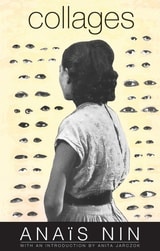
Collages
Anaïs Nin
Ohio University Press, 2019
Collected Poems of Hazel Hall, The
Hazel Hall
Oregon State University Press, 2020
Confined to a wheelchair since childhood, Hall viewed life from the window of an upper room in her family’s house in Portland, Oregon. To better observe passersby on the sidewalk, she positioned a small mirror on her windowsill. Hall was an accomplished seamstress; her fine needlework helped to support the family and provided a vivid body of imagery for her precisely crafted, often gorgeously embellished poems.
Hall’s writings convey the dark undertones of the lives of working women in the early twentieth century, while bringing into focus her own private, reclusive life—her limited mobility, her isolation and loneliness, her gifts with needlework and words. In his updated introduction to this volume, John Witte examines Hall’s brief and brilliant career and highlights her remarkably modern sensibilities. In a new afterword, Anita Helle considers Hall’s work in an era when modes of literary historical recovery have been widened and expanded—and what that means in the afterlife of Hazel Hall.
Collected Poems, 1936-1976
Robert Francis
University of Massachusetts Press, 1976
Gathered here in their entirety are the seven previous volumes of Robert Francis poetry—Stand with Me Here, Valhalla and Other Poems, The Sound I Listened For, The Face against the Glass, The Orb Weaver, Come Out into the Sun, and Like Ghosts of Eagles—together with a group of recent poems, many not previously published but “saved” to end this volume on a note of newness.
Because the original seven volumes are kept in chronological order, the reader can follow the author's journey from his quiet early work to poetry of greater color, warmth, vitality, vivacity, and sportiveness; and can note just when and where Francis' style becomes more and more diversified, with word-count, fragmented surface, and the celebration of words themselves.
The book is graced with eight wood engravings by Wang Hui-Ming.
Collected Works of Nana Asma'u
Daughter of Usman 'dan Fodiyo (1793-1864)Jean Boyd
Michigan State University Press, 1997
Nana Asma'u Bint Usman 'dan Fodiyo, a nineteenth-century Muslim scholar, lived in the region now known as northern Nigeria and was an eyewitness to battles of the largest of the West-African jihads of the era. The preparation and conduct of the jihad provide the topics for Nana Asma'u's poetry. Her work also includes treatises on history, law, mysticism, theology, and politics, and was heavily influenced by the Arabic poetic tradition.
This volume contains annotated translations of works by the 19th century intellectual giant, Nana Asma'u, including 54 poems and prose texts. Asma'u rallied public opinion behind a movement devoted to the revival of Islam in West Africa, and organized a public education system for women.

College Girls
A Century in FictionShirley Marchalonis
Rutgers University Press, 1995
Since the opening of Vassar College in 1865, objections to higher education for women have ranged from charges that females were mentally and physically incapable of learning to the belief that educating women would destroy society. Underlying all arguments was the folk wisdom which declared that women could not live and work together. To counteract such beliefs, women’s colleges tried to create a special kind of space and new role models that would allow women to exist for a short time in idyllic (or, at least, idealized) conditions. The debate over women’s education, for the good or ill of society, generated a great deal of "print," including short stories and novels. Shirley Marchalonis guides us through the history of this fiction, its depiction of the complexities of the college experience, and the conflicting attitudes that teetered between fascination and fear, celebration and regret.
Using novels, short stories, and some juvenile fiction from 1865 to 1940--all of it specifically about college “girls”--she examines these ideas, the way they developed over time, and their significance in understanding women’s education and women’s history. The debate over separate colleges for women continues to this day and can be better understood in the context of this informative and entertaining look at the past.

Colorado River Reader
Richard F. Fleck
University of Utah Press, 2000
"This canyon world where water yearns toward the ocean is a place so large I can’t take it in. Instead, I am taken in, traveling a near dream as we journey by water, contained by rock walls. In order to see this shorn-away world, I narrow my vision to the small and nearly secret. Never mind the stone’s illusion of permanence or the great strength of water. I look to the most fragile of things here, to the plant world of the canyon. The other river travelers seem taken in by stone, time, and water, and do not see the small things that tempt my attention, the minute fern between stones, the tiny black snails in a pond of water. I am drawn in by the growing life and not by the passing."
- from 'Plant Journey' by Linda Hogan
The mystique of the Colorado River is no less enduring and powerful than is its physical presence in the landscape of the West. Little wonder that narratives about the Colorado still arouse and intrigue readers, or that the river continues to inspire new writing among contemporary authors. What is surprising is that no anthology offering a comprehensive introduction to these works existed - until now.
A Colorado River Reader spans hundreds of years and many cultures and voices to capture an array of responses to this mighty river and tributaries. The collection opens with a Paiute creation myth set in the Grand Canyon and progresses through time, encompassing the Spanish and American exploration narratives of the eighteenth and nineteenth centuries and culminating in the adventure and nature writings of the twentieth.
This is a book that deserves a place next to every armchair and in a pocket of every backpack.
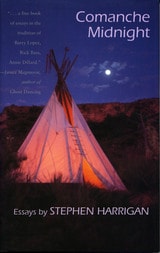
Comanche Midnight
Essays by Stephen Harrigan
University of Texas Press, 1995
Writing timeless essays that capture vanished worlds and elusive perceptions, Stephen Harrigan is emerging as a national voice with an ever-expanding circle of enthusiastic readers. For those who have already experienced the pleasures of his writing—and especially for those who haven't—Comanche Midnight collects fifteen pieces that originally appeared in the pages of Texas Monthly, Travel Holiday, and Audubon magazines.
The worlds Harrigan describes in these essays may be vanishing, but his writing invests them with an enduring reality. He ranges over topics from the past glories and modern-day travails of America's most legendary Indian tribe to the poisoning of Austin's beloved Treaty Oak, from the return-to-the-past realism of the movie set of Lonesome Dove to the intimate, off-season languor of Monte Carlo.
If the personal essay can be described as journalism about that which is timeless, then Stephen Harrigan is a reporter of people, events, and places that will be as newsworthy years from now as they are today. Read Comanche Midnight and see if you don't agree.