Results by title
353 books match the query 'World War II' and 21 start with c
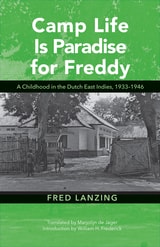
Camp Life Is Paradise for Freddy
A Childhood in the Dutch East Indies, 1933–1946Fred Lanzing
Ohio University Press, 2017
“Children see and hear what is there; adults see and hear what they are expected to and mainly remember what they think they ought to remember,” David Lowenthal wrote in The Past Is a Foreign Country. It is on this fraught foundation that Fred Lanzing builds this memoir of his childhood in a Japanese internment camp for Dutch colonialists in the East Indies during the World War II.
When published in the Netherlands in 2007, the book triggered controversy, if not vitriol, for Lanzing’s assertion that his time in the camp was not the compendium of horrors commonly associated with the Dutch internment experience. Despite the angry reception, Lanzing’s account corresponds more closely with the scant historical record than do most camp memoirs. In this way, Lanzing’s work is a substantial addition to ongoing discussions of the politics of memory and the powerful—if contentious—contributions that subjective accounts make to historiography and to the legacies of the past.
Lanzing relates an aspect of the war in the Pacific seldom discussed outside the Netherlands and, by focusing on the experiences of ordinary people, expands our understanding of World War II in general. His compact, beautifully detailed account will be accessible to undergraduate students and a general readership and, together with the introduction by William H. Frederick, is a significant contribution to literature on World War II, the Dutch colonial experience, the history of childhood, and Southeast Asian history.
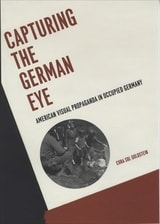
Capturing the German Eye
American Visual Propaganda in Occupied GermanyCora Sol Goldstein
University of Chicago Press, 2009
Shedding new light on the American campaign to democratize Western Germany after World War II, Capturing the German Eye uncovers the importance of cultural policy and visual propaganda to the U.S. occupation.
Cora Sol Goldstein skillfully evokes Germany’s political climate between 1945 and 1949, adding an unexpected dimension to the confrontation between the United States and the USSR. During this period, the American occupiers actively vied with their Soviet counterparts for control of Germany’s visual culture, deploying film, photography, and the fine arts while censoring images that contradicted their political messages. Goldstein reveals how this U.S. cultural policy in Germany was shaped by three major factors: competition with the USSR, fear of alienating German citizens, and American domestic politics. Explaining how the Americans used images to discredit the Nazis and, later, the Communists, she illuminates the instrumental role of visual culture in the struggle to capture German hearts and minds at the advent of the cold war.

Charisma and Factionalism in the Nazi Party
Joseph Nyomarkay
University of Minnesota Press, 1967
Charisma and Factionalism in the Nazi Party was first published in 1967. Minnesota Archive Editions uses digital technology to make long-unavailable books once again accessible, and are published unaltered from the original University of Minnesota Press editions.
Few aspects of the history of the German Nazi party have had as little scholarly attention as has the nature or pattern of the intraparty factionalism. References to conflicts within the party may be found in most accounts dealing with the Nazi movement, but this book presents the first systematic study of those conflicts and their significance to an understanding of Nazism.
Professor Nyomarkay bases his study on extensive research in which he had access to original source materials, including diaries and memoirs of party leaders and documents from Nazi trials and party archives. His study is concerned with the issues, attitudes, motivations, and actions of the various factions. His conclusions suggest new interpretations of such turning points in the history of Nazism as the Hanover and Bamberg conferences of 1925 and 1926, respectively, the Strasser crisis of 1930, and the stormtrooper purge of 1934.
The author examines the role of Hitler's charisma in the party and shows that this trait elevated Hitler above factional strife, making him the object rather than the subject of rivalries. The discussion of charisma points up the difference between the Nazi factionalism and that which has occurred in other totalitarian movements, such as communism, where authority rests on ideology rather than on charisma.
Through his study Professor Nyomarkay offers a new theory of the relationship between factional conflict and legitimacy of power, presenting a hypothesis of possible typologies of factional behavior based on the nature and degree of group cohesion.
The book is important for students of political science and history and particularly for those interested in totalitarian movements and comparative political parties.
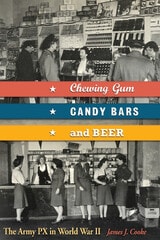
Chewing Gum, Candy Bars, and Beer
The Army PX in World War IIJames J. Cooke
University of Missouri Press, 2009
The AES was dedicated to providing soldiers with some of the comforts they had enjoyed in civilian life—candy, beer, cigarettes, razor blades, soap—whether by operating an exchange close to where they were fighting or by sending goods forward to the lines, free of charge. The beer may have been only “3.2,” but it was cheap and, unlike British beer, was served cold, thanks to PX coolers. And a constant supply of cigarettes and chewing gum gave GIs an advantage when flirting with the local girls.
In chronicling the history of the AES, James J. Cooke harks back to the Civil War, in which sutlers sold basic items to the Yankee troops for exorbitant prices, and to the First World War, when morale-building provisions were brought in by agencies such as the Red Cross. He then traces the evolution of the PX through World War II from the point of view of those who ran the service and that of the soldiers who used it, blending administrative history with colorful anecdotes and interspersing letters from GIs.
Cooke views the PX as a manifestation of American mobility, materialism, and the cultural revolution of mass consumerism that flourished in the 1920s, serving soldiers who were themselves products of this new American way of retail and expected a high level of material support in time of war. He emphasizes the accomplishments of Major General Joseph W. Byron, chief PX officer from 1941 to 1943, and his deputy, Colonel Frank Kerr. He also tells how the PX dealt with the presence of large numbers of women in uniform and the need to meet their demands in exchange offerings.
By 1945, General Byron could boast that the Army Exchange Service operated the world’s largest department store chain, serving the grandest army the United States had ever put in the field, and today the PX is still a central factor of military life. Yet as Cooke shows, the key to the AES’s importance was ultimately the way it bolstered morale—and helped give our fighting men the will to keep fighting.
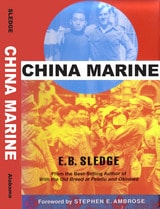
China Marine
E. B. Sledge
University of Alabama Press, 2002
From the respected author of one of the best books on World War II combat, comes an equally captivating saga of battle recovery, healing, and homecoming.
China Marine is the long-awaited sequel to E. B. Sledge’s critically acclaimed memoir, With the Old Breed at Peleliu and Okinawa. Picking up where his previous memoir leaves off, Sledge, a young marine in the First Division, traces his company’s movements and charts his own difficult passage to peace following his horrific experiences in the Pacific. He reflects on his duty in the ancient city of Peiping (now Beijing) and recounts the difficulty of returning to his hometown of Mobile, Alabama, and resuming civilian life haunted by the shadows of close combat.
Distinguished historians have praised Sledge’s first book as the definitive rifleman’s account of World War II, ranking it with the Civil War’s Red Badge of Courage and World War I’s All Quiet on the Western Front. Although With the Old Breed ends with the surrender of Japan, marines in the Pacific were still faced with the mission of disarming the immense Japanese forces on the Asian mainland and reestablishing order. For infantrymen so long engaged in the savage and surreal world of close combat, there remained the personal tasks of regaining normalcy and dealing with suppressed memories, fears, and guilt.
In China Marine, E. B. Sledge completes his story and provides emotional closure to the searing events detailed in his first memoir. He speaks frankly about the real costs of war, emotional and psychological as well as physical, and explains the lifetime loyalties that develop between men who face fear, loss, and horror together. That bond becomes one of the newfound treasures of life after battle.
With his hallmark style of simplicity, directness, and lack of sentimentality, "Sledgehammer" has given us yet another great document of war literature.

China Marine
25th Anniversary EditionE. B. Sledge with a new foreword by John C. McManus and a new preface by John S. Sledge
University of Alabama Press, 2002
From the Pacific’s brutality to China’s uneasy peace—one Marine’s fight to reclaim himself.
In this powerful anniversary edition of China Marine, Eugene B. Sledge—acclaimed author of the classic WWII memoir With the Old Breed—offers an unforgettable portrait of a young Marine navigating the uneasy peace that followed history’s most brutal war. Already celebrated for his visceral honesty and humanity, Sledge deepened his legacy with this rare account of the U.S. occupation of North China, a period as volatile as it was transformative.
Sledge’s memoirs remain enduringly popular because they never flinch from the truth. His reflections resonate across generations, offering readers not only a veteran’s hard-won wisdom but a moving story of survival, friendship, trauma, and the long journey back to ordinary life. His life and words have become part of American cultural memory, featured prominently in both Ken Burns’s PBS series The War and the HBO production The Pacific.
This special anniversary edition honors that legacy with a new preface by his son, bestselling author John Sledge and a new foreword by the eminent military historian John McManus, who together illuminate Sledge’s continued relevance in understanding war and its aftermath.
Intimate, vivid, and deeply human, China Marine stands as a timeless testament to courage, resilience, and the costs of peace after war.
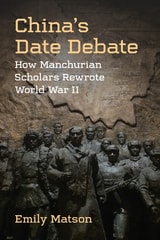
China’s Date Debate
How Manchurian Scholars Rewrote World War IIEmily Matson
University of Michigan Press, 2026
China’s Date Debate is an in-depth investigation of the Chinese Communist Party’s remapping of China’s World War II timeline from eight years (1937–1945) to fourteen years (1931–1945). Instead of the previously accepted starting date of the Marco Polo Bridge Incident on July 7, 1937, the Chinese Communist Party defined the war’s starting date as the Mukden Incident on September 18, 1931, which triggered the Japanese Kwantung Army’s invasion of Manchuria. Since the 1980s, scholars from Manchuria have demanded a fourteen-year war timeline to encompass the invasion of their homeland. By the 1990s, other scholars took notice and started to counter with claims that the eight-year timeline was the more accurate. Subsequently, a fierce “date debate” emerged between the two sides that was only resolved by the 2017 proclamation from the Ministry of Education.
Emily Matson demonstrates that the decision to set China’s World War II timeline at fourteen years was not merely a top-down decision, but was influenced by decades of Manchurian scholarship on the war. China’s Date Debate recenters Manchuria as a region of critical importance for China’s national identity today and the implications of this “date debate” on the Chinese Communist Party’s domestic legitimacy and international image.
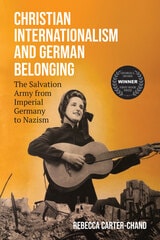
Christian Internationalism and German Belonging
The Salvation Army from Imperial Germany to NazismRebecca Carter-Chand
University of Wisconsin Press, 2025
In this groundbreaking reevaluation, Rebecca Carter-Chand argues that the Salvation Army was able to emphasize different aspects of its identity to bolster and repair its reputation as needed in varied political contexts, highlighting the variability of Nazi practices of inclusion and exclusion. In that way, the organization was similar to other Christian groups in Germany. Counter to common hypotheses that minority religious groups are more likely to show empathy to other minorities, dynamics within Nazi Germany reveal that many religious minorities sought acceptance from the state in an effort to secure self-preservation.
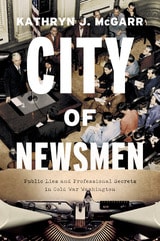
City of Newsmen
Public Lies and Professional Secrets in Cold War WashingtonKathryn J. McGarr
University of Chicago Press, 2022
Americans’ current trust in journalists is at a dismayingly low ebb, particularly on the subject of national and international politics. For some, it might be tempting to look back to the mid-twentieth century, when the nation’s press corps was a seemingly venerable and monolithic institution that conveyed the official line from Washington with nary a glint of anti-patriotic cynicism. As Kathryn McGarr’s City of Newsmen shows, however, the real story of what Cold War–era journalists did and how they did it wasn’t exactly the one you’d find in the morning papers.
City of Newsmen explores foreign policy journalism in Washington during and after World War II—a time supposedly defined by the press’s blind patriotism and groupthink. McGarr reveals, though, that DC reporters then were deeply cynical about government sources and their motives, but kept their doubts to themselves for professional, social, and ideological reasons. The alliance and rivalries among these reporters constituted a world of debts and loyalties: shared memories of harrowing wartime experiences, shared frustrations with government censorship and information programs, shared antagonisms, and shared mentors. McGarr ventures into the back hallways and private clubs of the 1940s and 1950s to show how white male reporters suppressed their skepticism to build one of the most powerful and enduring constructed realities in recent US history—the Washington Cold War consensus. Though by the 1960s, this set of reporters was seen as unduly complicit with the government—failing to openly critique the decisions and worldviews that led to disasters like the Vietnam War—McGarr shows how self-aware these reporters were as they negotiated for access, prominence, and, yes, the truth—even as they denied those things to their readers.
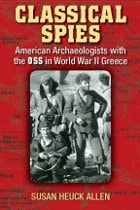
Classical Spies
American Archaeologists with the OSS in World War II GreeceSusan Heuck Allen
University of Michigan Press, 2013
“Classical Spies will be a lasting contribution to the discipline and will stimulate further research. Susan Heuck Allen presents to a wide readership a topic of interest that is important and has been neglected.”
—William M. Calder III, University of Illinois, Urbana-Champaign
Classical Spies is the first insiders’ account of the operations of the American intelligence service in World War II Greece. Initiated by archaeologists in Greece and the eastern Mediterranean, the network drew on scholars’ personal contacts and knowledge of languages and terrain. While modern readers might think Indiana Jones is just a fantasy character, Classical Spies disclosesevents where even Indy would feel at home: burying Athenian dig records in an Egyptian tomb, activating prep-school connections to establish spies code-named Vulture and Chickadee, and organizing parachute drops.
Susan Heuck Allen reveals remarkable details about a remarkable group of individuals. Often mistaken for mild-mannered professors and scholars, such archaeologists as University of Pennsylvania’s Rodney Young, Cincinnati’s Jack Caskey and Carl Blegen, Yale’s Jerry Sperling and Dorothy Cox, and Bryn Mawr’s Virginia Grace proved their mettle as effective spies in an intriguing game of cat and mouse with their Nazi counterparts. Relying on interviews with individuals sharing their stories for the first time, previously unpublished secret documents, private diaries and letters, and personal photographs, Classical Spies offers an exciting and personal perspective on the history of World War II.

Clothing Goes to War
Creativity Inspired by Scarcity in World War IINan Turner
Intellect Books, 2021
Manufacturing for civilians across the globe nearly stopped at the outset of World War II, as outfitting troops took precedence over nonmilitary production. Raw materials were prioritized for the armed forces and the majority of nonmilitary factories were shifted to war work, resulting in shortages and rationing of consumer products. Civilians, especially women, responded to the resulting scarcity of goods by using ingenuity and creativity to “make do.” In Clothing Goes to War, Nan Turner offers a critical look at some of the resourceful results of this period as necessity paved the way for fashionable invention.
Collisions With History
Latin American Fiction and Social Science from “El Boom” to the New World OrderFrederick M. Nunn
Ohio University Press, 2001
Latin American intellectuals have traditionally debated their region’s history, never with so much agreement as in the fiction, commentary, and scholarship of the late twentieth century. Collisions with History shows how “fictional histories” of discovery and conquest, independence and early nationhood, and the recent authoritarian past were purposeful revisionist collisions with received national versions. These collisions occurred only because of El Boom, thus making Latin America’s greatest literary movement a historical phenomenon as well. Frederick M. Nunn discusses the cataclysmic view of history conveyed in Boom novels and examines the thought and self-perception of selected authors whose political activism enhanced the appeal of their works—historical and otherwise: Alejo Carpentier, Carlos Fuentes, Gabriel García Márquez, and Augusto Roa Bastos; Julio Cortázar, Isabel Allende, Mario Vargas Llosa, and Darcy Ribeiro.
Collisions with History demonstrates how their commentary on history, literature, politics, and international affairs reveals a conscious sense of purpose. From between the lines of their nonfiction emerges a consensus that outside forces have defined as well as controlled Latin America’s history.
Professor Nunn also suggests that, with novelists now no longer very interested in colliding with history, it may fall to social scientists to speak for what remains of the region’s past in the New World Order.
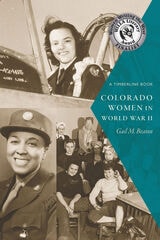
Colorado Women in World War II
Gail M. Beaton
University Press of Colorado, 2023
Four months before the attack on Pearl Harbor on December 7, 1941, Mildred McClellan Melville, a member of the Denver Woman’s Press Club, predicted that war would come for the United States and that its long arm would reach into the lives of all Americans. And reach it did. Colorado women from every corner of the state enlisted in the military, joined the workforce, and volunteered on the home front. As military women, they served as nurses and in hundreds of noncombat positions. In defense plants they riveted steel, made bullets, inspected bombs, operated cranes, and stored projectiles. They hosted USO canteens, nursed in civilian hospitals, donated blood, drove Red Cross vehicles, and led scrap drives; and they processed hundreds of thousands of forms and reports. Whether or not they worked outside the home, they wholeheartedly participated in a kaleidoscope of activities to support the war effort.
In Colorado Women in World War II Gail M. Beaton interweaves nearly eighty oral histories—including interviews, historical studies, newspaper accounts, and organizational records—and historical photographs (many from the interviewees themselves) to shed light on women’s participation in the war, exploring the dangers and triumphs they felt, the nature of their work, and the lasting ways in which the war influenced their lives. Beaton offers a new perspective on World War II—views from field hospitals, small steel companies, ammunition plants, college classrooms, and sugar beet fields—giving a rare look at how the war profoundly transformed the women of this state and will be a compelling new resource for readers, scholars, and students interested in Colorado history and women’s roles in World War II.
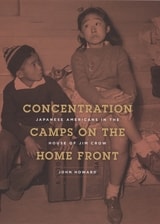
Concentration Camps on the Home Front
Japanese Americans in the House of Jim CrowJohn Howard
University of Chicago Press, 2008
While the basic facts of Japanese-American incarceration are well known, John Howard’s extensive research gives voice to those whose stories have been forgotten or ignored. He highlights the roles of women, first-generation immigrants, and those who forcefully resisted their incarceration by speaking out against dangerous working conditions and white racism. In addition to this overlooked history of dissent, Howard also exposes the government’s aggressive campaign to Americanize the inmates and even convert them to Christianity. After the war ended, this movement culminated in the dispersal of the prisoners across the nation in a calculated effort to break up ethnic enclaves.
Howard’s re-creation of life in the camps is powerful, provocative, and disturbing. Concentration Camps on the Home Front rewrites a notorious chapter in American history—a shameful story that nonetheless speaks to the strength of human resilience in the face of even the most grievous injustices.
Confronting the "Good Death"
Nazi Euthanasia on Trial, 1945-1953Michael S. Bryant
University Press of Colorado, 2022
The first author to address the impact of geopolitics on the courts’ representation of Nazi euthanasia, Bryant argues that international power relationships wreaked havoc on the prosecutions.
Drawing on primary sources, this provocative investigation of the Nazi campaign against the mentally ill and the postwar quest for justice will interest general readers and provide critical information for scholars of Holocaust studies, legal history, and human rights. Support for this publication was generously provided by the Eugene M. Kayden Fund at the University of Colorado.

Conjuring Hitler
How Britain and America Made the Third ReichGuido Giacomo Preparata
Pluto Press, 2005
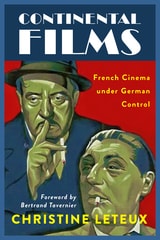
Continental Films
French Cinema under German ControlChristine Leteux
University of Wisconsin Press, 2022
Using recently opened archival documents, including reams of testimony from the épuration (purification) hearings conducted shortly after the war, Christine Leteux has produced the most authoritative and complete history of the company and its impact on the French film industry—both during the war and after. She captures the wide range of responses to the firm from those who were eager to work for a company whose ideology matched their own, to others who reluctantly accepted contracts out of necessity, to those who abhorred the company but felt compelled to participate in order to protect family members from Nazi reprisals. She examines not only the formation and management of Continental Films but also the personalities involved, the fraught and often deadly political circumstances of the period, the critical reception of the films, and many of the more notorious and controversial events.
As Bertrand Tavernier explains in his foreword, Leteux overturns many of the preconceptions and clichés that have come to be associated with Continental Films. Published to rave reviews in French and translated by the author into English, this work shatters expectations and will reinvigorate study of a lesser-known but significant period of French film history.
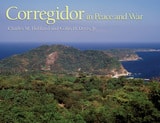
Corregidor in Peace and War
Charles M. Hubbard & Collis H. Davis, Jr.
University of Missouri Press, 2007
A picturesque island strategically located at the entrance of Manila Bay, Corregidor has had military significance since the days of the Spanish galleon trade. Although its dramatic role in the defense of the Philippines during World War II is well documented, relatively little is known about its history apart from military involvement. This richly illustrated book tells the story of the island and sheds new light on the geopolitical forces that shaped its destiny.
Corregidor in Peace and War is a biography of a mysterious island known simply as “the Rock.” It traces the buildup of armaments and fortifications on the island after the American occupation of the Philippines in 1898, then chronicles clandestine military preparations for an expected war with Imperial Japan. It vividly documents aspects of island life before World War II—including the enviable lifestyle of the American officer corps stationed there, the development of the island’s rail system using imported American streetcars, and the creation of the Philippine Scouts coastal artillery units—and then records its loss and recapture during the struggle with Japan. The final chapter reviews the island’s history since the war.
More than 150 illustrations include maps and photos from both the Spanish and American periods up to the present day—some photographs published more than a century ago and impeccably restored, many never before seen in print. Interweaving new and old photos with informative text, Charles Hubbard and Collis Davis, Jr., provide a guided tour that captures the natural beauty of an island once enjoyed by early residents but subsequently decimated by cannon fire and aerial bombardment. Brilliant color images evoke a place where flora and wildlife coexist alongside abandoned fortifications, documenting stark reminders from times of war. Other photographs show the majestic “suicide cliffs” where Japanese soldiers are said to have jumped to their deaths rather than become prisoners.
Now a tourist destination and historic monument, Corregidor remains a formidable island worthy of its nickname. Corregidor in Peace and War uncovers its many unknown facets and singularly reflects the experiences of both a place and a people that deserve a prominent place in history.
Creating Rosie the Riveter
Class, Gender, and Propaganda during World War IIMaureen Honey
University of Massachusetts Press, 1984
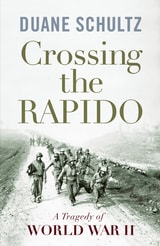
Crossing the Rapido
A Tragedy of World War IIDuane Schultz
Westholme Publishing, 2010
The True Story of an Impossible Mission During the Liberation of Italy
"World War II history writing at its best.” —Dallas Morning News
“Schultz convey stories of individual courage and fear. He presents the Rapido crossing as part of an experience that changed lives utterly.” —Publishers Weekly
“Well written, superbly documented and containing many helpful illustrations and maps, this fine book will appeal to military history enthusiasts of all ages.” —Read@MPL (Milwaukee Public Library)
“Duane Schultz has written another powerful account of the Second World War.” —Daily News, Iron Mountain, Michigan
“A fast-paced, dramatic account of World War II combat.”—Global War StudiesThe Rapido River was the last natural barrier between General Mark W. Clark’s Fifth U.S. Army and Rome. Ignoring intelligence reports that the Germans had significant forces protecting the opposite side of the river, Clark ordered the 36th Division to make a nighttime crossing on January 20, 1944. The division, already coming through some of the heaviest fighting in Italy, knew they could not succeed: they had to cross a fast-flowing river at night in bitter cold and face one of the strongest, most formidable German defensive lines in Europe, full of minefields, veteran troops, and withering artillery and mortar fire. Once in the water, men in full field gear were borne away by the current or vanished in massive explosions. The few who managed to reach the other side found themselves pinned down unable to move. Soldiers died by the hundreds, yet the stunned survivors who fell back to the launch site were ordered to attack again, this time in daylight. Of the 4,000 men who attempted the crossing, more than half did not return. General Clark never accepted blame for ordering the assault despite the numerous warnings he received from both British and American commanders. Although they were decimated, the division went on to lead a key surprise attack that opened Rome to Allied forces, and ultimately fought in France, where they had the distinction of capturing Hermann Goering and Field Marshal Gerd von Rundstedt.
In Crossing the Rapido: A Tragedy of World War II, Duane Schultz follows the action at the ground level using survivors’ interviews and army documents to tell the story of one division’s sacrifice in war. In doing so, he demonstrates that the American soldier will face the greatest odds without protest, but expects those in command to share any failure or success.“Those of us who were present will always remember the men of the 36th, climbing silently in the night behind the enemy, armed with little but their American competence and a personal faith in their quiet, retiring general who had never let them down. If Generals Alexander and Clark received the key to the city of Rome, it was General Walker who turned the key and handed it to them.” —Eric Sevareid, reporting from Italy during World War II
“I have never seen so many dead as on that day.” —John Huston, Academy Award winning director during his wartime filming of The Battle of San Pietro
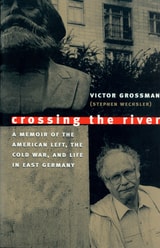
Crossing the River
A Memoir of the American Left, the Cold War, and Life in East GermanyVictor Grossman
University of Massachusetts Press, 2003
What could possibly impel a relatively privileged twenty-four-year-old American-serving in the U.S. Army in Germany in 1952 to swim across the Danube River to what was then referred to as the Soviet Zone? How are we to understand his decision to forsake the land of his birth and build a new life in the still young German Democratic Republic? These are the questions at the core of this memoir by Victor Grossman, who was born Stephen Wechsler but changed his name after defecting to the GDR.
A child of the Depression, Grossman witnessed firsthand the dislocations wrought by the collapse of the U.S. economy during the 1930s. Widespread unemployment and poverty, CIO sit-down strikes, and the fight to save Republican Spain from fascism-all made an indelible impression as he grew up in an environment that nurtured a commitment to left-wing causes. He continued his involvement with communist activities as a student at Harvard in the late 1940s and after graduation, when he took jobs in two factories in Buffalo, New York, and tried to organize their workers.
Fleeing McCarthyite America and potential prosecution, Grossman worked in the GDR with other Western defectors and eventually became, as he notes, the “only person in the world to attend Harvard and Karl Marx universities.” Later, he was able to establish himself as a freelance journalist, lecturer, and author. Traveling throughout East Germany, he evaluated the failures as well as the successes of the GDR's “socialist experiment.” He also recorded his experiences, observations, and judgments of life in East Berlin after reunification, which failed to bring about the post-Communist paradise so many had expected.
Written with humor as well as candor, Crossing the River provides a rare look at the Cold War from the other side of the ideological divide.
Mark Solomon, a distinguished historian of the American left, provides a historical afterword that places Grossman's experiences in a larger Cold War context.