Results by title
8812 books match the query 'Political Science' and 698 start with c
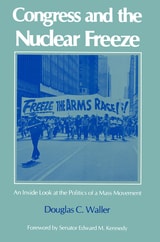
Congress and the Nuclear Freeze
An Inside Look at the Politics of a Mass MovementDouglas Waller
University of Massachusetts Press, 1987
Congress and the Rent-Seeking Society
Glenn R. Parker
University of Michigan Press, 1996
Skillfully blending historical data with microeconomic theory, Glenn Parker argues that the incentives for congressional service have declined over the years, and that with that decline has come a change in the kind of person who seeks to enter Congress. The decline in the attractiveness of Congress is a consequence of congressional careerists and of the growth in the rent-seeking society, a term which describes the efforts of special interests to obtain preferential treatment by using the machinery of government--legislation and regulations.
Parker provides a fresh and controversial perspective to the debate surrounding the relative merits of career or amateur politicians. He argues that driving career politicians from office can have pernicious effects on the political system: it places the running of Congress in the hands of amateur politicians, who stand to lose little if they are found engaging in illegal or quasi-legal practices. On the other hand, career legislators risk all they have invested in their long careers in public service if they engage in unsavory practices. As Parker develops this controversial argument, he provides a fresh perspective on the debate surrounding the value of career versus amateur politicians.
Little attention has been given to the long-term impact of a rent-seeking society on the evolution of political institutions. Parker examines empirically and finds support for hypotheses that reflect potential symptoms of adverse selection in the composition of Congress: (1) rent-seeking politicians are more inclined than others to manipulate institutional arrangements for financial gain; (2) the rent-seeking milieu of legislators are more likely to engage in rent-seeking activity than earlier generations; (3) and the growth of rent-seeking activity has hastened the departure of career legislators.
Glenn R. Parker is Distinguished Research Professor, Florida State University.
Congress in Reverse
Repeals from Reconstruction to the PresentJordan M. Ragusa and Nathaniel A. Birkhead
University of Chicago Press, 2020
Congress in Reverse is the first book to attempt to answer these questions. Jordan M. Ragusa and Nathaniel A. Birkhead examine when and why existing statutes are successfully “undone,” arguing that repeals are most common when the parties are united on the issue—which was not the case when it came to Obamacare for the Republican Party—and the majority party wins control of Congress after a long stint in the minority. By shifting focus from the making of laws to their un-making, Congress in Reverse opens up a new arena for studying legislative activity in Congress.
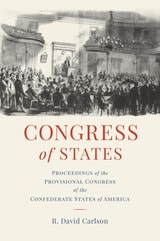
Congress of States
Proceedings of the Provisional Congress of the Confederate States of AmericaR. David Carlson
University of Alabama Press, 2023
A landmark publication of public reports that reveal the founding of the Confederate government
Past publications of the proceedings of the Confederate Congress have focused on the public sessions of the Regular Confederate States Congress that met in Richmond, Virginia from February 1862 to March 1865. Omitted were the formative early sessions of the Montgomery, Alabama and Richmond, Virginia Provisional Congresses of 1861 and 1862. In Congress of States, David Carlson reveals these critical early meetings.
To illuminate this pivot point in American and Southern history, Carlson has drawn on detailed and often verbatim minutes reported in Richmond, Montgomery, Charleston, New Orleans, Savannah, and Augusta newspapers, assembling here a unique set of transcriptions that reveal the birth of the Confederate government.
Congress of States provides an introduction to the Provisional Confederate Congress and the purpose of this work relative to the Southern Historical Society’s landmark 1923 publication “Proceedings of the Confederate Congress,” which detailed the 1862–1865 Regular Confederate Congress. He also includes a chronology outlining the major events of the secession crisis, annotated minutes for the Provisional Confederate Congress’s five sessions, appendices featuring the leadership and committees of the Provisional Congress, and fascinating examples of the proposed Confederate emblem and flags debated by the delegates.
A key set of primary sources that scholars, historians, librarians, and political scientists will value for years to come, Congress of States will also be essential reading for the general reader interested in American and Southern history, the Antebellum South, and the Civil War.
Congress on Display, Congress at Work
William T. Bianco, Editor
University of Michigan Press, 2000
Congress, the President, and the Federal Reserve
The Politics of American Monetary Policy-MakingIrwin L. Morris
University of Michigan Press, 2002
Current formal theories of the general policy-making process are utilized to construct an explanatory framework that identifies the mechanisms through which congressional and executive influence is exercised. The theoretical framework presented in the text also helps to explain the political dynamics of several of the most significant policy decisions of the Federal Reserve during the last half-century. In addition, this book provides a unique perspective on the manner in which Fed policymakers attempt to shield themselves from unwelcome political influence.
While the main focus of Congress, the President, and the Federal Reserve is monetary policy-making, it also speaks to the political nature of policy-making in a more general sense and provides a guide for the future study of the political dynamics in a wide variety of substantive policy areas. Thus it will interest not only political scientists and economists interested in monetary policy-making specifically but also those interested in the nature of public policy-making more generally.
Irwin L. Morris is Assistant Professor of Political Science, University of Maryland.
Congressional Communication
Content and ConsequencesDaniel Lipinski
University of Michigan Press, 2004
--Bruce Oppenheimer, Vanderbilt University
"The communication between representatives and their constituents is where election strategy and policy explanations are merged and, until now, we have had only anecdotal evidence. Lipinski's book sheds light on this important part of American political life."
--David Brady, Stanford University
Congressional Communication challenges the notion that legislators "run against Congress" by routinely denigrating the institution. Using a unique, systematic analysis of the communication from members of Congress to their constituents over a five-year period, Daniel Lipinski challenges this notion, demonstrating key partisan differences in representatives' portrayals of congressional activities. While members of the majority party tend to report that the institution-and, hence, their party-is performing well, members of the minority party are more likely to accuse Congress of doing a poor job.
The findings in Congressional Communication offer the first strong empirical evidence from the electoral arena in support of controversial party government theories. Moving beyond previous studies that look only at legislators' messages, Lipinski's research also reveals the effects of these politically strategic claims on voters, whose interpretations don't necessarily bear out the legislators' intended effects.
Daniel Lipinski is Assistant Professor of Political Science at the University of Tennessee.
Congressional Parties, Institutional Ambition, and the Financing of Majority Control
Eric S. Heberlig and Bruce A. Larson
University of Michigan Press, 2013
With the need for ever increasing sums of money to fuel the ongoing campaign for majority control, both Republicans and Democrats have made large donations to the party and its candidates mandatory for members seeking advancement within party and congressional committee hierarchies. Eric S. Heberlig and Bruce A. Larson analyze this development and discuss its implications for American government and democracy. They address the consequences of selecting congressional leaders on the basis of their fundraising skills rather than their legislative capacity and the extent to which the battle for majority control leads Congress to prioritize short-term electoral gains over long-term governing and problem-solving.
Congressional Realignment, 1925-1978
By Barbara Sinclair
University of Texas Press, 1982
Ronald Reagan's election in 1980 brought with it a major shift in the composition of the U.S. Congress for the first time in several decades. The subsequent introduction of an enormous amount of new legislation sparked debate among many political observers that a new coalition was being built in American politics and that a significant change in the issues on the agenda before Congress heralded a Republican realignment.
Barbara Sinclair's study is a major contribution to our understanding of realignment politics in the House of Representatives. It also provides important insight into the changes in American political life in the late twentieth century.
Congressional Realignment poses three basic, related questions: What are the sources of agenda change? What determines congressional voting alignments and alignment change? Under what conditions are the barriers to major policy change overcome? Sinclair's answers are impressive both in their scholarship and in the depth and intelligence of her insights.
Congressmen's Voting Decisions
John W. Kingdon
University of Michigan Press, 1989
Connections after Colonialism
Europe and Latin America in the 1820sEdited by Mathew Brown and Gabriel Pacquette
University of Alabama Press, 2013
Contributing to the historiography of transnational and global transmission of ideas, Connections after Colonialism examines relations between Europe and Latin America during the tumultuous 1820s.
In the Atlantic World, the 1820s was a decade marked by the rupture of colonial relations, the independence of Latin America, and the ever-widening chasm between the Old World and the New. Connections after Colonialism, edited by Matthew Brown and Gabriel Paquette, builds upon recent advances in the history of colonialism and imperialism by studying former colonies and metropoles through the same analytical lens, as part of an attempt to understand the complex connections—political, economic, intellectual, and cultural—between Europe and Latin America that survived the demise of empire.
Historians are increasingly aware of the persistence of robust links between Europe and the new Latin American nations. This book focuses on connections both during the events culminating with independence and in subsequent years, a period strangely neglected in European and Latin American scholarship. Bringing together distinguished historians of both Europe and America, the volume reveals a new cast of characters and relationships including unrepentant American monarchists; compromise-seeking liberals in Lisbon and Madrid who envisioned transatlantic federations; British merchants in the River Plate who saw opportunity where others saw risk; public moralists whose audiences spanned from Paris to Santiago de Chile; and plantation owners in eastern Cuba who feared that slave rebellions elsewhere in the Caribbean would spread to their island.
Contributors
Matthew Brown / Will Fowler / Josep M. Fradera / Carrie Gibson / Brian Hamnett / Maurizio Isabella / Iona Macintyre / Scarlett O’Phelan Godoy / Gabriel Paquette / David Rock / Christopher Schmidt-Nowara / Jay Sexton / Reuben Zahler
Conscripts of Modernity
The Tragedy of Colonial EnlightenmentDavid Scott
Duke University Press, 2004
Scott explores the political and epistemological implications of how the past is conceived in relation to the present and future through a reconsideration of C. L. R. James’s masterpiece of anticolonial history, The Black Jacobins, first published in 1938. In that book, James told the story of Toussaint L’Ouverture and the making of the Haitian Revolution as one of romantic vindication. In the second edition, published in the United States in 1963, James inserted new material suggesting that that story might usefully be told as tragedy. Scott uses James’s recasting of The Black Jacobins to compare the relative yields of romance and tragedy. In an epilogue, he juxtaposes James’s thinking about tragedy, history, and revolution with Hannah Arendt’s in On Revolution. He contrasts their uses of tragedy as a means of situating the past in relation to the present in order to derive a politics for a possible future.
Consensual Policy-making in the Nordic World
Peter Munk Christiansen
University of Wisconsin Press, 2023
The preconditions for these policies are strong civil societies, that is, strong capacities for collective mobilization and collective action among groups, relatively strong unitary states, and high levels of generalized trust. The institutional apparatus of these consensual policies has been labeled corporatism. Scandinavian corporatism has implied consent to a norm of affected interests. Groups that are supposedly affected by state policies have access to the processes leading up to political decision-making and are involved in the implementation of policies. This access often has public commissions or committees charged with preparing political decisions and delivering advice, as well as policy implementation committees.
Corporatist and consensual policymaking come at a price. The exchange between interest groups (in pursuit of policy influence) and state actors (in pursuit of information and political support from groups) tends to be time-consuming and confined to solutions that are accepted by all actors. Corporatist policies are consequently not very conducive to more radical reforms. After the heyday of corporatist policymaking in the 1970s, all the Scandinavian countries have loosened their corporatist structures to pave the way for reforms.

Conservation Is Our Government Now
The Politics of Ecology in Papua New GuineaPaige West
Duke University Press, 2006
West reveals how every aspect of the Crater Mountain Wildlife Management Area—including ideas of space, place, environment, and society—was socially produced, created by changing configurations of ideas, actions, and material relations not only in Papua New Guinea but also in other locations around the world. Complicating many of the assumptions about nature, culture, and development underlying contemporary conservation efforts, Conservation Is Our Government Now demonstrates the unique capacity of ethnography to illuminate the relationship between the global and the local, between transnational processes and individual lives.
Conservatism and Southern Intellectuals, 1789-1861
Liberty, Tradition, and the Good SocietyAdam L. Tate
University of Missouri Press, 2005
Conservative Counterrevolution
Challenging Liberalism in 1950s MilwaukeeTula A. Connell
University of Illinois Press, 2016
Conservative Ideology in the Making
Ivan Zoltan Denes
Central European University Press, 2009
Conservative Innovators
How States Are Challenging Federal PowerBen Merriman
University of Chicago Press, 2019
Conservative Innovators traces the activity of far-right conservatives in Kansas who have in the past decade used the powers of state-level offices to fight federal regulation on a range of topics from gun control to voting processes to Medicaid. Telling their story, Ben Merriman then expands the scope of the book to look at the tactics used by conservative state governments across the country to resist federal regulations, including coordinated lawsuits by state attorneys general, refusals to accept federal funds and spending mandates, and the creation of programs designed to restrict voting rights. Through this combination of state-initiated lawsuits and new administrative practices, these state officials weakened or halted major parts of the Obama Administration’s healthcare, environmental protection, and immigration agendas and eroded federal voting rights protections. Conservative Innovators argues that American federalism is entering a new, conflict-ridden era that will make state governments more important in American life than they have been at any time in the past century.

Conservative Thought in Twentieth Century Latin America
The Ideas of Laureano GomezJames D. Henderson
Ohio University Press, 1988
Laureano Gómez was president of Colombia in the early 1950s until overthrown by a military coup. He was also, for some fifty years, the leading exponent of Latin American conservatism, a political philosophy with roots in both nineteenth–century politics and religion. Focusing on Gómez, and other prominent conservative politicians, Henderson traces the evolution of Latin American conservatism and demonstrates the scope of its influence throughout the continent.
While much has been written about particular Marxist movements and right–wing regimes in contemporary Latin America, little attention has been devoted, in recent years, to the more moderate political institutions and individuals which dominate twentieth–century Latin America. This first account of Latin American conservatism should be of interest to all students of the history and politics of the region.
Conserving Nature in Greater Yellowstone
Controversy and Change in an Iconic EcosystemRobert B. Keiter
University of Chicago Press, 2025
For more than 150 years, the Yellowstone region—now widely known as the twenty-three million acre Greater Yellowstone Ecosystem—has played a prominent role in the United States’ nature conservation agenda. In this book, Robert B. Keiter, an award-winning public land law and policy expert, traces the evolution and application of fundamental ecological conservation concepts tied to Yellowstone.
Keiter’s book highlights both the conservation successes and controversies connected with this storied region, which has been enmeshed in change. During the 1980s, leaders in Yellowstone embraced ecosystem management concepts to recover a dwindling grizzly bear population and to support wolf reintroduction. Since then, management policies in the region’s two national parks and adjacent national forests have largely followed suit, prioritizing ecosystem-level conservation over industrial activity. Groundbreaking efforts are currently afoot to protect elk, deer, and pronghorn migration corridors and to maintain the park’s bison population, effectively expanding the scope of regional conservation initiatives. But in the face of explosive human population growth and related development pressures, new efforts must also account for the region’s privately owned lands along with accelerating recreational activities that present quite different problems.
Indeed, the Greater Yellowstone Ecosystem—extending across three states and twenty counties and embracing more than sixteen million acres of federal land as well as private and tribal lands —can only be characterized as a complex, jurisdictionally fragmented landscape. As Keiter makes clear, the quest for common ground among federal land managers, state officials, local communities, conservationists, ranchers, Indigenous tribes, and others is a vital, enduring task.
Exploring both notable conservation accomplishments and the ongoing challenges confronting this special place, Keiter’s book explains the many forces—scientific, political, economic, legal, cultural, climatic, and more—at work driving controversy and change across the region. But more than this, Conserving Nature in Greater Yellowstone shows us that the lessons gleaned from Yellowstone’s expansive nature conservation efforts are profoundly important for both the country and the world.
Conserving Nature in Greater Yellowstone
Controversy and Change in an Iconic EcosystemRobert B. Keiter
University of Chicago Press, 2025
The story of how Yellowstone, established in 1872 as the world’s first national park, has become synonymous with nature conservation—and an examination of today’s challenges to preserve the region’s wilderness heritage.
For more than 150 years, the Yellowstone region—now widely known as the twenty-three million acre Greater Yellowstone Ecosystem—has played a prominent role in the United States’ nature conservation agenda. In this book, Robert B. Keiter, an award-winning public land law and policy expert, traces the evolution and application of fundamental ecological conservation concepts tied to Yellowstone.
Keiter’s book highlights both the conservation successes and controversies connected with this storied region, which has been enmeshed in change. During the 1980s, leaders in Yellowstone embraced ecosystem management concepts to recover a dwindling grizzly bear population and to support wolf reintroduction. Since then, management policies in the region’s two national parks and adjacent national forests have largely followed suit, prioritizing ecosystem-level conservation over industrial activity. Groundbreaking efforts are currently afoot to protect elk, deer, and pronghorn migration corridors and to maintain the park’s bison population, effectively expanding the scope of regional conservation initiatives. But in the face of explosive human population growth and related development pressures, new efforts must also account for the region’s privately owned lands along with accelerating recreational activities that present quite different problems.
Indeed, the Greater Yellowstone Ecosystem—extending across three states and twenty counties and embracing more than sixteen million acres of federal land as well as private and tribal lands —can only be characterized as a complex, jurisdictionally fragmented landscape. As Keiter makes clear, the quest for common ground among federal land managers, state officials, local communities, conservationists, ranchers, Indigenous tribes, and others is a vital, enduring task.
Exploring both notable conservation accomplishments and the ongoing challenges confronting this special place, Keiter’s book explains the many forces—scientific, political, economic, legal, cultural, climatic, and more—at work driving controversy and change across the region. But more than this, Conserving Nature in Greater Yellowstone shows us that the lessons gleaned from Yellowstone’s expansive nature conservation efforts are profoundly important for both the country and the world.
Conspicuous Corporation
Business, Public Policy, and Representative DemocracyNeil J. Mitchell
University of Michigan Press, 1997

Conspiracies in Broad Daylight?
Conspiracism, Fascism, and the Radical RightMarco Bresciani
Central European University Press, 2027
Conspiracies in Broad Daylight?
Conspiracism, Fascism, and the Radical RightMarco Bresciani
Central European University Press, 2027
Conspiracies of Conspiracies
How Delusions Have Overrun AmericaThomas Milan Konda
University of Chicago Press, 2019
In this sweeping book, Thomas Milan Konda traces the country’s obsession with conspiratorial thought from the early days of the republic to our own anxious moment. Conspiracies of Conspiracies details centuries of sinister speculations—from antisemitism and anti-Catholicism to UFOs and reptilian humanoids—and their often incendiary outcomes. Rather than simply rehashing the surface eccentricities of such theories, Konda draws from his unprecedented assemblage of conspiratorial writing to crack open the mindsets that lead people toward these self-sealing worlds of denial. What is distinctively American about these theories, he argues, is not simply our country’s homegrown obsession with them but their ongoing prevalence and virulence. Konda proves that conspiracy theories are no harmless sideshow. They are instead the dark and secret heart of American political history—one that is poisoning the bloodstream of an increasingly sick body politic.
Conspiracy Theories
Secrecy and Power in American CultureMark Fenster
University of Minnesota Press, 2008
In this new edition of the landmark work, and the first in-depth look at the conspiracy communities that formed to debunk the 9/11 Commission Report, Fenster shows that conspiracy theories play an important role in U.S. democracy. Examining how and why they circulate through mass culture, he contends, helps us better understand society as a whole. Ranging from The Da Vinci Codeto the intellectual history of Richard Hofstadter, he argues that dismissing conspiracy theories as pathological or marginal flattens contemporary politics and culture because they are—contrary to popular portrayal—an intense articulation of populism and, at their essence, are strident calls for a better, more transparent government. Fenster has demonstrated once again that the people who claim someone’s after us are, at least, worth hearing.
Conspiracy Theory in America
By Lance deHaven-Smith
University of Texas Press, 2013
Ever since the Warren Commission concluded that a lone gunman assassinated President John F. Kennedy, people who doubt that finding have been widely dismissed as conspiracy theorists, despite credible evidence that right-wing elements in the CIA, FBI, and Secret Service—and possibly even senior government officials—were also involved. Why has suspicion of criminal wrongdoing at the highest levels of government been rejected out-of-hand as paranoid thinking akin to superstition?
Conspiracy Theory in America investigates how the Founders’ hard-nosed realism about the likelihood of elite political misconduct—articulated in the Declaration of Independence—has been replaced by today’s blanket condemnation of conspiracy beliefs as ludicrous by definition. Lance deHaven-Smith reveals that the term “conspiracy theory” entered the American lexicon of political speech to deflect criticism of the Warren Commission and traces it back to a CIA propaganda campaign to discredit doubters of the commission’s report. He asks tough questions and connects the dots among five decades’ worth of suspicious events, including the assassinations of John and Robert Kennedy, the attempted assassinations of George Wallace and Ronald Reagan, the crimes of Watergate, the Iran-Contra arms-for-hostages deal, the disputed presidential elections of 2000 and 2004, the major defense failure of 9/11, and the subsequent anthrax letter attacks.
Sure to spark intense debate about the truthfulness and trustworthiness of our government, Conspiracy Theory in America offers a powerful reminder that a suspicious, even radically suspicious, attitude toward government is crucial to maintaining our democracy.
Conspiracy/Theory
Joseph Masco and Lisa Wedeen, editors
Duke University Press, 2024
Contributors. Nadia Abu El-Haj, Hussein Ali Agrama, Kathleen Belew, Elizabeth Anne Davis, Joseph Dumit, Faith Hillis, Lochlann Jain, Demetra Kasimis, Susan Lepselter, Darryl Li, Louisa Lombard, Joseph Masco, Robert Meister, Timothy Melley, Rosalind C. Morris, George Shulman, Lisa Wedeen
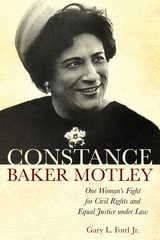
Constance Baker Motley
One Woman's Fight for Civil Rights and Equal Justice under LawGary L. Ford Jr.
University of Alabama Press, 2017
The story of NAACP’s sole female attorney. She shaped civil rights history as lead strategist and litigator from 1946–1964, arguing landmark desegregation cases and defending Martin Luther King Jr. and countless freedom fighters.
Constance Baker Motley was an African American woman; the daughter of immigrants from Nevis, British West Indies; a wife; and a mother who became a pioneer and trailblazer in the legal profession. She broke down barriers, overcame gender constraints, and operated outside the boundaries placed on black women by society and the civil rights movement. In Constance Baker Motley: One Woman’s Fight for Civil Rights and Equal Justice under Law, Gary L. Ford Jr. explores the key role Motley played in the legal fight to desegregate public schools as well as colleges, universities, housing, transportation, lunch counters, museums, libraries, parks, and other public accommodations.
The only female attorney at the NAACP Legal Defense and Educational Fund, Inc., Motley was also the only woman who argued desegregation cases in court during much of the civil rights movement. From 1946 through 1964, she was a key litigator and legal strategist for landmark civil rights cases including the Montgomery Bus Boycott and represented Martin Luther King Jr. as well as other protesters arrested and jailed as a result of their participation in sit-ins, marches, and freedom rides.
Motley was a leader who exhibited a leadership style that reflected her personality traits, skills, and strengths. She was a visionary who formed alliances and inspired local counsel to work with her to achieve the goals of the civil rights movement. As a leader and agent of change, she was committed to the cause of justice and she performed important work in the trenches in the South and behind the scene in courts that helped make the civil rights movement successful.
"Highly recommended."
—CHOICE
Constituent Interests and U.S. Trade Policies
Alan V. Deardorff and Robert M. Stern
University of Michigan Press, 1998
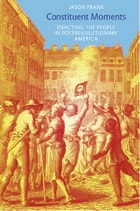
Constituent Moments
Enacting the People in Postrevolutionary AmericaJason Frank
Duke University Press, 2010
Elaborating his theory of constituent moments, Frank focuses on specific historical instances when under-authorized individuals or associations seized the mantle of authority, and, by doing so, changed the inherited rules of authorization and produced new spaces and conditions for political representation. He looks at crowd actions such as parades, riots, and protests; the Democratic-Republican Societies of the 1790s; and the writings of Walt Whitman and Frederick Douglass. Frank demonstrates that the revolutionary establishment of the people is not a solitary event, but rather a series of micropolitical enactments, small dramas of self-authorization that take place in the informal contexts of crowd actions, political oratory, and literature as well as in the more formal settings of constitutional conventions and political associations.
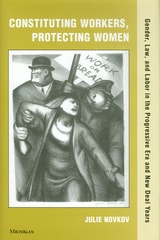
Constituting Workers, Protecting Women
Gender, Law and Labor in the Progressive Era and New Deal YearsJulie Novkov
University of Michigan Press, 2001
During the Progressive Era and New Deal, courts often invalidated generalized protective legislation, but frequently upheld measures that limited women's terms and conditions of labor. The book explores the reasoning in such cases that were decided between 1873 and 1937. By analyzing all reported opinion on the state and federal level, as well as materials from the women's movement and briefs filed in the U.S. Supreme Court, the study demonstrates that considerations of cases involving women's measures ultimately came to drive the development of doctrine.
The study combines historical institutionalism and feminism to address constitutional interpretation, showing that an analysis of conflict over the meaning of legal categories provides a deeper understanding of constitutional development. In doing so, it rejects purely political interpretations of the so-called Lochner era, in which the courts invalidated many legislative efforts to ameliorate the worst effects of capitalism. By addressing the dynamic interactions among interested laypersons, attorneys, and judges, it demonstrates that no individuals or institutions have complete control over the generation of constitutional meaning.
Julie Novkov is Assistant Professor of Political Science, University of Oregon

Constituting Workers, Protecting Women
Gender, Law and Labor in the Progressive Era and New Deal YearsJulie Novkov
University of Michigan Press, 0
During the Progressive Era and New Deal, courts often invalidated generalized protective legislation, but frequently upheld measures that limited women's terms and conditions of labor. The book explores the reasoning in such cases that were decided between 1873 and 1937. By analyzing all reported opinion on the state and federal level, as well as materials from the women's movement and briefs filed in the U.S. Supreme Court, the study demonstrates that considerations of cases involving women's measures ultimately came to drive the development of doctrine.
The study combines historical institutionalism and feminism to address constitutional interpretation, showing that an analysis of conflict over the meaning of legal categories provides a deeper understanding of constitutional development. In doing so, it rejects purely political interpretations of the so-called Lochner era, in which the courts invalidated many legislative efforts to ameliorate the worst effects of capitalism. By addressing the dynamic interactions among interested laypersons, attorneys, and judges, it demonstrates that no individuals or institutions have complete control over the generation of constitutional meaning.
Julie Novkov is Assistant Professor of Political Science, University of Oregon
Constitution for a Disunited Nation
On Hungary's 2011 Fundamental LawGábor Attila Tóth
Central European University Press, 2013
Constitutional Deliberation in Congress
The Impact of Judicial Review in a Separated SystemJ. Mitchell Pickerill
Duke University Press, 2004
Pickerill combines legislative histories, extensive empirical findings, and interviews with current and former members of Congress, congressional staff, and others. He examines data related to all of the federal legislation struck down by the Supreme Court from the beginning of the Warren Court in 1953 through the 1996–97 term of the Rehnquist Court. By looking at the legislative histories of Congressional acts that invoked the Commerce Clause and presented Tenth Amendment conflicts—such as the Child Labor Act (1916), the Civil Rights Act (1965), the Gun-Free School Zones Act (1990), and the Brady Bill (1994)—Pickerill illuminates how Congressional deliberation over newly proposed legislation is shaped by the possibility of judicial review. The Court’s invalidation of the Gun-Free School Zones Act in its 1995 ruling United States v. Lopez signaled an increased judicial activism regarding issues of federalism. Pickerill examines that case and compares congressional debate over constitutional issues in key pieces of legislation that preceded and followed it: the Violence Against Women Act of 1994 and the Hate Crimes Prevention Act of 1997. He shows that Congressional attention to federalism increased in the 1990s along with the Court’s greater scrutiny.
Constitutional Democracy
János Kis
Central European University Press, 2003
Constitutional Judiciary in a New Democracy
The Hungarian Constitutional CourtLaszlo Solyom and Georg Brunner, Editors
University of Michigan Press, 2000
How was it possible that a new Court established in 1990, in a country just released from forty years of Communist rule, was able to enforce a Constitution, maintain the rule of law, and protect the freedom of its citizens in a way comparable to the U.S. Supreme Court? This new Court has issued decisions on topics ranging from the establishment of democracy and a market economy--privatization, compensation for the nationalization of property, and retroactive criminal legislation--as well as such issues as the constitutionality of capital punishment, abortion, freedom of speech and the media, and the separation of powers.
U.S. Supreme Court Justice Stephen Breyer provides the foreword and introduces the two essays that begin the book. In the first essay, Georg Brunner explains how the Court was set up and what its procedures are. In the second, Lázszló Sólyom describes systematically the emergence of the case-law of the Court and its jurisprudence on constitutional rights and on the powers and procedures of the other branches of government. The models followed by the Court are outlined, and its contribution to global constitutionalism explored.
Lázszló Sólyom is President of the Constitutional Court of Hungary and Professor of Law, ELTE University of Budapest. Georg Brunner is Professor of Law, University of Cologne, Germany.
Constitutional Revolutions
Pragmatism and the Role of Judicial Review in American ConstitutionalismRobert Justin Lipkin
Duke University Press, 2000
Drawing on ethical theory, philosophy of science, and constitutional theory, Lipkin provides a progressive, postmodern, and pragmatic theory of constitutional law that justifies the critical role played by the judiciary in American democracy. Judicial review, he claims, operates as a mechanism to allow “second thought,” or principled reflection, on the values of the wider culture. Without this revolutionary function, American democracy would be left without an effective institutional means to formulate the community’s considered judgments about good government and individual rights. Although judicial review is not the only forum for protecting this dimension of constitutional democracy, Lipkin maintains that we would be wise not to abandon judicial review unless a viable alternative emerges.
Judges, lawyers, law professors, and constitutional scholars will find this book a valuable resource.
Constitutional Theory
Carl Schmitt
Duke University Press, 2008
Constitutional Theory is a significant departure from Schmitt’s more polemical Weimar-era works not just in terms of its moderate tone. Through a comparative history of constitutional government in Europe and the United States, Schmitt develops an understanding of liberal constitutionalism that makes room for a strong, independent state. This edition includes an introduction by Jeffrey Seitzer and Christopher Thornhill outlining the cultural, intellectual, and political contexts in which Schmitt wrote Constitutional Theory; they point out what is distinctive about the work, examine its reception in the postwar era, and consider its larger theoretical ramifications. This volume also contains extensive editorial notes and a translation of the Weimar Constitution.
Constitutionalism and Its Discontents
Mark Tushnet and Bojan Bugaric
University of Chicago Press, 2026
A thoughtful and provocative meditation on both the potential and limits of constitutionalism.
In the early twenty-first century, constitutionalism confronts numerous pressures and critiques. Some prominent critics are concerned that constitutionalism’s modern form, in which high courts play a large role, limits popular self-governance. By committing their nations to detailed social and economic policies—from neoliberal requirements for balanced budgets to constitutionalized social welfare and environmental rights—many modern constitutions might make promises they cannot keep and be unduly rigid in the face of changing social, economic, and environmental conditions. Meanwhile, the rise of proto-authoritarian elected leaders around the world shows that constitutions are vulnerable to, and may even enable, democratic backsliding.
Mark Tushnet and Bojan Bugarič argue that addressing each of these serious concerns through constitutional design and innovation is potentially valuable, but paradoxically, every remedy also carries with it the possibility that it will intensify the very conditions it seeks to ameliorate. Instead, Tushnet and Bugarič propose a “thin” idea of constitutionalism and suggest that we should scale back our expectations for what constitutionalism can achieve. Political mobilization, led by people attuned to the economic and cultural causes of democratic backsliding, is a better bet.
Constitutions and the Dialectics of Human Rights in Malawi and Kenya
Eunice N. Sahle
University of Wisconsin Press, 2026
As in many other countries, the protection of human rights and other practices of constitutionalism remains uneven in Malawi and Kenya. In this book, Eunice N. Sahle argues that the adoption in 1994 and 2010 in Malawi and Kenya, respectively, of new constitutional frameworks, which have the markings of “critical constitutional events,” provided significant openings for the promotion of human rights. Nonetheless, the emergence of such opportunities does not mean that the protection of human rights is automatic. Sahle zeroes in on the tension between the possibilities of human rights promotion on one hand, and the historical and contemporary factors influencing that process on the other. In that regard, her analysis shows the importance and limits of transformative constitutional frameworks as tools for social change. Further, by focusing on the promotion of human rights by a diverse range of social actors—individuals, civil society, organizations, and public institutions—she demonstrates the need to broaden who “counts” as an agent of human rights and to go beyond a strictly state-centric approach.
Constitutions, Courts, and History
Historical Narratives in Constitutional AdjudicationRenata Uitz
Central European University Press, 2005

Constructing China
Clashing Views of the People's RepublicMobo Gao
Pluto Press, 2018
Constructing China presents a detailed examination of the means through which our knowledge of China is created. Rejecting the supposed objectivity of empirical statistics and challenging the assumption of a dichotomy between Western liberal democracy and Chinese authoritarianism, Mobo Gao dissects the political agenda and conceptual framework of commentators on China and urges those on the right and the left alike to be carefully critical of their own views on the nation’s politics, economics, and history.
Constructing Cooperation
The Evolution of Institutions of ComanagementSara Singleton
University of Michigan Press, 1999
This book will appeal to policy makers concerned with the management of natural resources as well as to economists, political scientists, and sociologists concerned with collective action problems.
Sara Singleton is Assistant Professor of Political Science, Tulane University.
Constructing Culture and Power in Latin America
Daniel H. Levine, Editor
University of Michigan Press, 1993
Constructing Identities in Mexican-American Political Organizations
Choosing Issues, Taking SidesBy Benjamin Márquez
University of Texas Press, 2003
A Choice Outstanding Academic Book, 2002
The formation of a group identity has always been a major preoccupation of Mexican American political organizations, whether they seek to assimilate into the dominant Anglo society or to remain separate from it. Yet organizations that sought to represent a broad cross section of the Mexican American population, such as LULAC and the American G.I. Forum, have dwindled in membership and influence, while newer, more targeted political organizations are prospering—clearly suggesting that successful political organizing requires more than shared ethnicity and the experience of discrimination.
This book sheds new light on the process of political identity formation through a study of the identity politics practiced by four major Mexican American political organizations—the Southwest Network for Environmental and Economic Justice, the Southwest Industrial Areas Foundation, the Texas Association of Mexican American Chambers of Commerce, and the Mexican American Women's National Association (now known as MANA—A National Latina Organization). Through interviews with activists in each organization and research into their records, Benjamin Marquez clarifies the racial, class-based, and cultural factors that have caused these organizations to create widely differing political identities. He likewise demonstrates why their specific goals resonate only with particular segments of the Mexican American community.
Constructing Muslims in France
Discourse, Public Identity, and the Politics of CitizenshipJennifer Fredette
Temple University Press, 2014
Constructing Peace
Conscientious Objectors and the Boundaries of State Power in East Germany in the 1960sDavid Doellinger
Central European University Press, 2026

Constructing Singapore
Elitism, Ethnicity and the Nation-building ProjectMichael D. Barr and Zlatko Skrbis
National University of Singapore Press, 2008
Constructing Tomorrow's Federalism
New Perspectives on Canadian GovernanceIan Peach
University of Manitoba Press, 2007