Results by title
18284 books match the query 'United States' and 1260 start with c
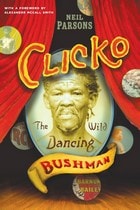
Clicko
The Wild Dancing BushmanNeil Parsons
University of Chicago Press, 2010
During the 1920s and ’30s, Franz Taibosh—whose stage name was Clicko—performed in front of millions as one of the stars of the Ringling Brothers and Barnum & Bailey Circus. Prior to his fame in the United States, Taibosh toured the world as the “Wild Dancing Bushman,” showing off his frenzied dance moves in freak shows, sideshows, and music halls from Australia to Cuba. When he died in 1940, the New York Times called him “the only African bushman ever exhibited in this country.” In Clicko, Neil Parsons unearths the untold story of Taibosh’s journey from boyhood on a small farm in South Africa to top billing as one of the travelling World’s Fair Freaks.
Through Taibosh’s tale, Parsons brings to life the bizarre golden age of entertainment as well as the role that the dubious new science of race played in it. Beginning with Taibosh’s early life, Clicko untangles the real story of his ancestry from the web of myths spun around him on his rise to international stardom. Parsons then chronicles the unhappy middle period of Taibosh’s career, when he suffered under the heel of a vicious manager. Left to freeze and nearly starve in an unheated apartment, Taibosh was rescued by Frank Cook, Barnum & Bailey’s lawyer. The Cooks adopted Taibosh as a member of their family of circus managers and performers, and his happy—if far from average—years with them make up the final chapter of this remarkable story.
Equal parts entertaining and disturbing, Clicko vividly evokes a forgotten era when vaudeville drew massive crowds and circus freaks were featured in Billboard and Variety. Parsons introduces us to colorful characters such as George Auger the giant and the original Zip the Pinhead, but above all, he gives us an unforgettable portrait of Franz Taibosh, rescued at last from the racists and the romantics and revealed here as an ordinary man with an extraordinary life.
Clifford Geertz by His Colleagues
Edited by Richard A. Shweder and Byron Good
University of Chicago Press, 2005
As part of the American Anthropological Association's centennial celebration, the executive board sponsored a presidential session honoring Geertz. Clifford Geertz by His Colleagues compiles the twelve speeches given then by a distinguished panel of social scientists along with a concluding piece by Geertz in which he responds to each speaker and reflects on his own career. These edited speeches cover a broad range of topics, including Geertz's views on morality, cultural critique, interpretivism, time and change, Islam, and violence.
A fitting tribute to one of the great thinkers of our age, this collection will be enjoyed by anthropologists as well as students of psychology, history, and philosophy.
Climatic Media
Transpacific Experiments in Atmospheric ControlYuriko Furuhata
Duke University Press, 2022

Climber’s Guide to Devil’s Lake
Sven Olof Swartling
University of Wisconsin Press, 2008
•a summary of the geologic and natural history of the Baraboo hills by Patricia K. Armstrong
•locations and updated descriptions of nearly 1,800 climbs
•landmark photographs from most major climbing areas
•GPS waypoints, map coordinates, altimeter readings, and approach information
•detailed diagrams locating climbing routes at most major climbing areas
•6 new diagrams, 5 new climbing areas, and 120 new routes
Climbing a Broken Ladder
Contributors of College Success for Youth in Foster CareNathanael J. Okpych
Rutgers University Press, 2021
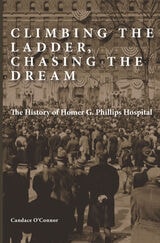
Climbing the Ladder, Chasing the Dream
The History of Homer G. Phillips HospitalCandace O’Connor
University of Missouri Press, 2022
When the beautiful, up-to-date hospital opened, it attracted more black residents than any other such program in the United States. Patients also flocked to the hospital, as did nursing students who found there excellent training, ready employment, and a boost into the middle class. For decades, the hospital thrived; by the 1950s, three-quarters of African-American babies in St. Louis were born at Homer G.
But the 1960s and 1970s brought less need for all-black hospitals, as faculty, residents, and patients were increasingly welcome in the many newly integrated institutions. Ever-tightening city budgets meant less money for the hospital, and in 1979, despite protests from the African-American community, HGPH closed. Years later, the venerated, long-vacant building came to life again as the Homer G. Phillips Senior Living Community.
Candace O’Connor draws upon contemporary newspaper articles, institutional records, and dozens of interviews with former staff members to create the first, full history of the Homer G. Phillips Hospital. She also brings new facts and insights into the life and mysterious murder (still an unsolved case) of the hospital’s namesake, a pioneering Black attorney and civil rights activist who led the effort to build the sorely needed medical facility in the Ville neighborhood.

Clinic in the Cornfields
The Improbable Rise of the Mayo Clinic, 1864-1945Anthony Bianco
University of Minnesota Press, 2027
From a remote prairie outpost to a global medical empire—the definitive early history of the Mayo Clinic
Founded by William Worrall Mayo more than 160 years ago, the Mayo Clinic, now considered one of the world’s preeminent medical institutions, was established in the small town of Rochester, Minnesota. The Clinic’s founding in the hinterlands might have been serendipitous, but through unprecedented access to the institution’s archives, Anthony Bianco shows how its remote location was essential to the success of what has always been a powerfully idiosyncratic institution. Tracing the highs and lows of Mayo Clinic’s early years, Bianco reveals how it shaped Rochester into what a New York Times reporter dubbed in 1928 “the only clinic city in America”—and transformed the practice and culture of medicine worldwide.
At a confluence of character, industry, location, and timing, the Mayo Clinic invented a revolutionary model of clinical care: multispecialty group practice. This approach was so innovative that it was condemned by America’s medical establishment as a treasonous manifestation of socialism. In this definitive history, Bianco chronicles how an institution founded on operating room excellence achieved astonishing medical breakthroughs: the Clinic was instrumental in first introducing insulin as a diabetes treatment following World War I and later performed the clinical trials that catalyzed mass distribution of penicillin during World War II. By establishing itself as a leader in aviation medicine, the Mayo Clinic engineered oxygen masks, g-suits, and other life-saving devices while also staffing Army field hospitals deployed around the world.
Alongside these remarkable advancements, an appalling institutional paradox is also uncovered by Bianco’s analysis. Throughout this era, the Clinic violated its own professed code of conduct by systemically discriminating against Black people, Jews, and non–Northern European immigrants and by participating in Minnesota’s state program mandating the sterilization of citizens deemed “unfit.”
The first of a two-volume history recounting Mayo’s growth and behind-the-scenes stories, Clinic in the Cornfields draws on sources ranging from the Mayo brothers’ personal papers to internal operational records, creating a riveting narrative inextricably linked to the birth of modern medicine.
Retail e-book files for this title are screen-reader friendly with images accompanied by short alt text and/or extended descriptions.
Clio's Favorites
Leading Historians of the United States, 1945-2000Robert Allen Rutland
University of Missouri Press, 2000
Although historians talk about each other's work routinely, they have been reluctant to record their thoughts about the leading practitioners of U.S. history. Robert Allen Rutland attempts to remedy this state of things with this collection named for Clio, the Greek muse vested with the inspirations of history. The volume offers a glimpse of the lives and work of historians who must be considered among the most remarkable from the last half of the twentieth century.
The roll call of excellence for Clio's Favorites was established after Rutland informally polled some twenty-five historians, asking them to name the outstanding workers in the field of U.S. history since the end of World War II. Among the criteria for selection were: quality (not volume) of the historian's work; influence in the field of study; importance of his or her graduate and undergraduate teaching; and the figure's public persona as reflected by awards, honors, and involvement in public service. The historians profiled in Clio's Favorites, most of whom broke new ground, met and surpassed these standards. The list could have gone on, but Rutland believes these twelve represent the cream of the crop. They are: Bernard Bailyn, Merle Curti, David Herbert Donald, John Hope Franklin, Richard Hofstadter, Howard Roberts Lamar, Gerda Lerner, Arthur S. Link, Edmund S. Morgan, David M. Potter, Arthur M. Schlesinger, Jr., and C. Vann Woodward.
Just as the subject of each essay in Clio's Favorites is a remarkably distinguished historian, the authors of these twelve essays are accomplished historians themselves. Good historical writing is never outdated, Rutland argues. The extensive work of the scholars profiled here has endured and will continue to endure. Likewise, the writing in Clio's Favorites, by twelve expert historians, will survive. This book will be a lasting record of the contributions made by the best U.S. historians practicing their craft over the last fifty years.
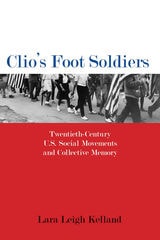
Clio's Foot Soldiers
Twentieth-Century U.S. Social Movements and Collective MemoryLara Leigh Kelland
University of Massachusetts Press, 2018
In Clio's Foot Soldiers, Lara Leigh Kelland investigates these questions by examining 1960s and 1970s social movements comprised of historically marginalized peoples: Civil Rights, Black Power, Women's and Gay Liberation, and American Indian. These movements sought ownership over their narratives to create historical knowledge reflective of their particular experiences. To accomplish their goals, activists generated new forms of adult education, published movement newspapers, and pursued campus activism and speeches, public history efforts and community organizations. Through alternative means, marginalized communities developed their own historical discourses to mobilize members, define movement goals, and become culturally sovereign. In so doing, they provided a basis for achieving political liberation and changed the landscape of liberal cultural institutions.
Clio's Southern Sisters
Interviews with Leaders of the Southern Association for Women HistoriansEdited by Constance B. Schulz & Elizabeth Hayes Turner
University of Missouri Press, 2004
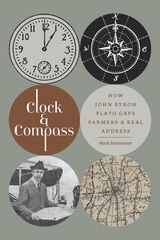
Clock and Compass
How John Byron Plato Gave Farmers a Real AddressMark Monmonier
University of Iowa Press, 2022
Plato’s solution was a map-and-directory combo that used direction and distance from a local business center to give farmers a real address, just like city dwellers. He patented his invention called the “Clock System” and tried to sell it to the Post Office Department. What follows is a tale of persistence and failure as rural farming declined and technology and capitalism overtook John Byron Plato’s chances at geographic immortality.
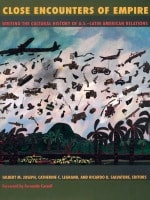
Close Encounters of Empire
Writing the Cultural History of U.S.-Latin American RelationsGilbert M. Joseph, Catherine C. LeGrand, and Ricardo D. Salvatore, eds.
Duke University Press, 1998
Exploring a variety of nineteenth- and twentieth-century encounters in Latin America, these theoretically engaged essays by distinguished U.S. and Latin American historians and anthropologists illuminate a wide range of subjects. From the Rockefeller Foundation’s public health initiatives in Central America to the visual regimes of film, art, and advertisements; these essays grapple with new ways of conceptualizing public and private spheres of empire. As such, Close Encounters of Empire initiates a dialogue between postcolonial studies and the long-standing scholarship on colonialism and imperialism in the Americas as it rethinks the cultural dimensions of nationalism and development.
Close Writing
Kathy Acker, Cookie Mueller, and Love-in-PiecesAlice Butler
Duke University Press, 2026
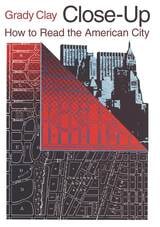
Close-Up
How to Read the American CityGrady Clay
University of Chicago Press, 1980
"The emphasis on the informal aspects of city-shaping—topographical, historical, economic and social—does much to counteract the formalist approach to American urban design. Close-Up...should be required reading for anyone wishing to understand Americans and their cities."—Roger Cunliffe, Architectural Review
"Close-Up is a provocative and stimulating book."—Thomas J. Schlereth, Winterthur Portfolio
"Within this coherent string of essays, the urban dweller or observer, as well as the student, will find refreshing strategies for viewing the environmental 'situations' interacting to form a landscape."—Dallas Morning News
"Clay's Close-Up, first published in 1973, is still a key book for looking at the real American city. Too many urban books and guidebooks concentrate on the good parts of the city....Clay looks at all parts of the city, the suburbs, and the places between cities, and develops new terms to describe parts of the built environment—fronts, strips, beats, stacks, sinks, and turf. No one who wants to understand American cities or to describe them, should fail to know this book. The illustrations are of special interest to the guidebook writer."—American Urban Guidenotes
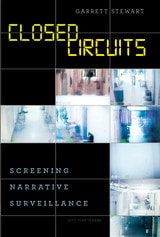
Closed Circuits
Screening Narrative SurveillanceGarrett Stewart
University of Chicago Press, 2015
In Closed Circuits, Garrett Stewart analyzes a broad spectrum of films, from M and Rear Window through The Conversation to Déjà Vu, Source Code, and The Bourne Legacy, in which cinema has articulated—and performed—the drama of inspection’s unreturned look. While mainstays of the thriller, both the act and the technology of surveillance, Stewart argues, speak to something more foundational in the very work of cinema. The shared axis of montage and espionage—with editing designed to draw us in and make us forget the omnipresence of the narrative camera—extends to larger questions about the politics of an oversight regime that is increasingly remote and robotic. To such a global technopticon, one telltale response is a proliferating mode of digitally enhanced “surveillancinema.”
Closed Doors, Opportunities Lost
The Continuing Costs of Housing DiscriminationJohn Yinger
Russell Sage Foundation, 1995
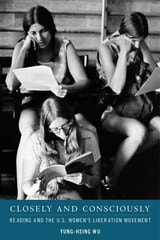
Closely and Consciously
Reading and the US Women's Liberation MovementYung-Hsing Wu
University of Massachusetts Press, 2024
The significant archive of writing that came out of the women’s liberation movement in the United States, from 1965 to 1980, speaks to the value activists placed on reading as an act that is at once personal and yet also about the collective good. Yung-Hsing Wu examines the importance of reading—personal, professional, vocational, aesthetic, and always political—and how the act itself brought a host of women, each with their own history with the movement, into relation, and into a belief in that relation. The value given to reading can be seen in the ways feminists pursued media representation; in consciousness-raising (CR) groups including shared reading in their meetings; in women opening bookstores, developing newsletters, establishing journals, and starting presses; and in corporate publishers pursuing feminist fiction.
Closely and Consciously crisscrosses distinct print spheres, including newsletters and periodicals produced by feminist cells and consciousness-raising groups, feminist presses seeking to articulate their visions for women’s writing, the emergence of feminist literary criticism in first-time monographs and newly established journals, personal and editorial correspondence, press records, and the publishing histories of bestsellers that testified to the increasingly broad popularity of women’s writing. Uniting all these disparate activists and media outlets, and providing crucial relationality, was reading. With a mix of close readings and archival research, Wu unpacks and interprets this central act of reading and why it matters during a crucial moment of feminist history.

Closet Writing/Gay Reading
The Case of Melville's PierreJames Creech
University of Chicago Press, 1994
In Closet Writing/Gay Reading, Creech shows how a literary critic can be receptive to implicit and closeted sexual content. Forcefully advocating a tactic of identification and projection in literary analysis, he lends renewed currency to the kind of "sentimental" response to literature that continental theory—particularly deconstruction—has sought to discredit.
In the second half of his book, Creech sets out to analyze what he considers the exemplary novel of the nineteenth-century closet, Melville's Pierre, or: The Ambiguities. By approaching Pierre as the gay man Melville longed to have as its reader, Creech is able to decipher the novel's "encrypted erotics" and to reveal that Melville's apparent tale of incest is actually a homosexual novel in disguise. The closeted "address" to queer-sensitive readers that Pierre disseminates finally receives a critical reading that strives to be explicit, shareable, and public.
Closing Arguments
Clarence Darrow on Religion, Law, and SocietyClarence Darrow
Ohio University Press, 2005
Clarence Darrow, son of a village undertaker and coffinmaker, rose to become one of America’s greatest attorneys—and surely its most famous. The Ohio native gained renown for his central role in momentous trials, including his 1924 defense of Leopold and Loeb and his defense of Darwinian principles in the 1925 Scopes “Monkey Trial.” Some have traced Darrow’s lifelong campaign against capital punishment to his boyhood terror at seeing a Civil War soldier buried—and no client of Darrow’s was ever executed, not even black men who were accused of murder for killing members of a white mob.
Closing Arguments: Clarence Darrow on Religion, Law, and Society collects, for the first time, Darrow’s thoughts on his three main preoccupations, revealing a carefully conceived philosophy expressed with delightful pungency and clarity. His thoughts on social issues, especially on the dangers of religious fundamentalism, are uncannily prescient. A dry humor infuses his essays, and his reflections on himself and his philosophy reveal a quiet dignity at the core of a man better known for provoking Americans during an era of unprecedented tumult. From the wry “Is the Human Race Getting Anywhere?” to the scornful “Patriotism” and his elegiac summing up, “At Seventy-two,” Darrow’s writing still stimulates, pleases and challenges.
A rebel who always sided intellectually and emotionally with the minority, Darrow remains a figure to contend with sixty-seven years after his death. “Inside every lawyer is the wreck of a poet,” Darrow once said. Closing Arguments demonstrates that, in his case, that statement is true.
Closing The Book On Homework
Enhancing Public EducationJohn Buell
Temple University Press, 2003
Closing the Education Achievement Gaps for African American Males
Theodore S. Ransaw
Michigan State University Press, 2016
The distinguished and expert contributors whose work comprises this volume include an achievement-gap specialist for males of color, two psychologists, a math teacher, an electrical engineer, a former school principal, a social worker, and a former human rights commissioner. From black male learning styles to STEM, this book shows that issues pertaining to educational outcomes for black males are nuanced and complex but not unsolvable.
With its combination of fresh new approaches to closing achievement gaps and up-to-date views on trends, this volume is an invaluable resource on vital contemporary social and educational issues that aims to improve learning, equity, and access for African American males.
Closures
Heterosexuality and the American SitcomGrace Lavery
Duke University Press, 2024
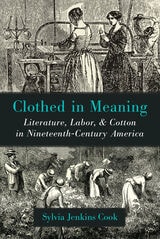
Clothed in Meaning
Literature, Labor, and Cotton in Nineteenth-Century AmericaSylvia Jenkins Cook
University of Michigan Press, 2020
Cloth and clothing provide potent tropes not only for physical but also for intellectual forms of self-expression. Drawing on sources ranging from fugitive slave narratives, newspapers, manifestos, and mill workers’ magazines to fiction, poetry, and autobiographies, Clothed in Meaning examines the significant part played by mill workers and formerly enslaved people, many of whom still worked picking cotton, in this revolution of literary self-expression. They created a new literature from their palpable daily intimacy with cotton, cloth, and clothing, as well as from their encounters with grimly innovative modes of work. In the materials of their labor they discovered vivid tropes for formulating their ideas and an exotic and expert language for articulating them. The harsh conditions of their work helped foster in their writing a trenchant irony toward the demeaning reduction of human beings to “hands” whose minds were unworthy of interest. Ultimately, Clothed in Meaning provides an essential examination of the intimate connections between oppression and luxury as recorded in the many different voices of nineteenth-century labor.
Clotilda
The History and Archaeology of the Last Slave ShipJames P. Delgado, Deborah E. Marx, Kyle Lent, Joseph Grinnan, and Alexander DeCaro
University of Alabama Press, 2023
Documents the maritime historical research and archaeological fieldwork used to identify the wreck of the notorious schooner Clotilda
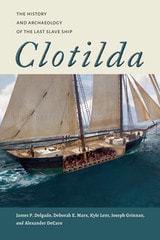
Clotilda: The History and Archaeology of the Last Slave Ship is the first definitive work to examine the maritime historical and archaeological record of one of the most infamous ships in American history. Clotilda was owned by Alabama businessman Timothy Meaher, who, on a dare, equipped it to carry captured Africans from what is now Benin and bring them to Alabama in 1860—some fifty years after the import of captives to be enslaved was banned. To hide the evidence, Clotilda was set afire and sunk.
What remained was a substantially intact, submerged, and partially buried shipwreck located in a backwater of the Mobile River. The site of the wreck was an open secret to some people who knew Meaher, but its identity remained unknown for more than a century as various surveys through the years failed to locate the ship.
This volume, authored by the archaeological team who conducted a comprehensive, systematic survey of a forgotten “ship graveyard,” details the exhaustive forensic work that conclusively identified the wreck, as well as the stories and secrets that have emerged from the partly burned hulk. James P. Delgado and his coauthors discuss the various searches for Clotilda, sharing the forensic data and other analyses showing how those involved concluded that this wreck was indeed Clotilda. Additionally, they offer physical evidence not previously shared that situates the schooner and its voyage in a larger context of the slave trade.
Clotilda: The History and Archaeology of the Last Slave Ship serves as a nautical biography of the ship as well. After reviewing the maritime trade in and out of Mobile Bay, this account places Clotilda within the larger landscape of American and Gulf of Mexico schooners and chronicles its career before being used as a slave ship. All of its voyages had a link to slavery, and one may have been another smuggling voyage in violation of federal law. The authors have also painstakingly reconstructed Clotilda’s likely appearance and characteristics.
Clout City
The Rise and Fall of the Chicago Political MachineDominic A. Pacyga
University of Chicago Press, 2025
Unearths the religious and cultural roots of a powerful political machine that empowered some everyday Chicagoans but ruled all of the city for decades.
In politics, clout is essential. Too often, it determines whether insider access is granted or denied, favors are given or withheld, and payoffs are made or received. But Chicago clout, as we know it today, is even more potent than that—it’s the absolute currency of a social, cultural, and political order that is self-reinforcing and self-dealing. Or, at least, it was.
In Clout City, award-winning historian Dominic A. Pacyga reveals how cultural, ethnic, and religious forces created this distinctive system—and ultimately led to its collapse. Tracing clout’s origins in the Irish Catholic–dominated working-class neighborhood of Bridgeport, shaped by De La Salle Institute and home to the legendary Daley family, Pacyga shows how communal ties can be a force for good and also the deepest wellspring of corruption. He maps Chicago’s unique politics to its remarkable history, from the Great Fire of 1871 through its rise and decline as an industrial center to its emergence as a global city in the early twenty-first century. With deep research and firsthand experience from a lifetime in the city, Pacyga argues that Chicago’s politics is understood best as a mixture of cultural and religious influences and more worldly pursuits, exploring how both Jewish and Catholic communalism played central roles in the creation and sustenance of the Chicago machine.
Chicago’s politics today aren’t as defined by its distinctive brand of clout. But they are shaped by clout’s decline and the ghost of the machine. Pacyga’s tour of the city’s multilayered past is an indispensable guide to its present and future.
Clout City
The Rise and Fall of the Chicago Political MachineDominic A. Pacyga
University of Chicago Press, 2025
This is an auto-narrated audiobook version of this book.
Unearths the religious and cultural roots of a powerful political machine that empowered some everyday Chicagoans but ruled all of the city for decades.
In politics, clout is essential. Too often, it determines whether insider access is granted or denied, favors are given or withheld, and payoffs are made or received. But Chicago clout, as we know it today, is even more potent than that—it’s the absolute currency of a social, cultural, and political order that is self-reinforcing and self-dealing. Or, at least, it was.
In Clout City, award-winning historian Dominic A. Pacyga reveals how cultural, ethnic, and religious forces created this distinctive system—and ultimately led to its collapse. Tracing clout’s origins in the Irish Catholic–dominated working-class neighborhood of Bridgeport, shaped by De La Salle Institute and home to the legendary Daley family, Pacyga shows how communal ties can be a force for good and also the deepest wellspring of corruption. He maps Chicago’s unique politics to its remarkable history, from the Great Fire of 1871 through its rise and decline as an industrial center to its emergence as a global city in the early twenty-first century. With deep research and firsthand experience from a lifetime in the city, Pacyga argues that Chicago’s politics is understood best as a mixture of cultural and religious influences and more worldly pursuits, exploring how both Jewish and Catholic communalism played central roles in the creation and sustenance of the Chicago machine.
Chicago’s politics today aren’t as defined by its distinctive brand of clout. But they are shaped by clout’s decline and the ghost of the machine. Pacyga’s tour of the city’s multilayered past is an indispensable guide to its present and future.
Clowns to the Left of Me, Jokers to the Right
American Life in ColumnsMichael A. Smerconish
Temple University Press, 2020
Opinionated talk show host and columnist Michael Smerconish has been chronicling local, state, and national events for the Philadelphia Daily News and the Philadelphia Inquirer for more than 15 years. He has sounded off on topics as diverse as the hunt for Osama bin Laden and what the color of your Christmas lights says about you. In this collection of 100 of his most memorable columns, Smerconish reflects on American political life with his characteristic feistiness. A new Afterword for each column provides updates on both facts and feelings, indicating how the author has evolved over the years, moving from a reliable Republican voter to a political Independent.
Clowns to the Left of Me, Jokers to the Right covers the post-9/11 years, Barack Obama’s ascension, and the rise of Donald Trump. Smerconish describes meeting Ronald Reagan, having dinner with Fidel Castro, barbequing with the band YES in his backyard, spending the same night with Pete Rose and Ted Nugent, drinking champagne from the Stanley Cup, and conducting Bill Cosby’s only pretrial interview. He also writes about local Philadelphia culture, from Sid Mark to the Rizzo statue.
Smerconish’s outlook as expressed in these impassioned opinion pieces goes beyond “liberal” or “conservative.” His thought process continues to evolve and change, and as it does, he aims to provoke readers to do the same.
All author proceeds benefit the Children’s Crisis Treatment Center, a Philadelphia- based, private, nonprofit agency that provides behavioral health services to children and their families.
Club Icarus
Matt W. Miller
University of North Texas Press, 2013

Club Programs for Teens
100 Activities for the Entire YearAmy Alessio
American Library Association, 2015
Co. Aytch, or a Side Show of the Big Show
A New Edition Introduced and Annotated by Philip LeighSam Watkins
Westholme Publishing, 2013
Co. Aytch, or a Side Show of the Big Show is perhaps the finest memoir of an ordinary Confederate soldier. According to Margaret Mitchell, “a better book there never was.” Sam Watkins served in Company H of the First Tennessee Infantry for the duration of the Civil War. Remarkably, he survived some of the most intense battles of the war, including Shiloh, Chickamauga, Kennesaw Mountain, Atlanta, and Franklin. He was one of only seven of the original members of Company H when it surrendered in April 1865. Watkins’s memoir was written in the winter of 1882–83. The humor and depth of writing at times rises to a level resembling Mark Twain; thus, twenty-first-century readers can still discover the everlasting treasures of Private Sam Watkins’s story just as it was. It is this reason that excerpts were featured frequently in Ken Burns’s documentary on the Civil War. However, since most of Sam’s original readers—or some of their family members—actually lived through the Civil War, much of the context for the narrative was common knowledge. But what was once received history has gradually disappeared, and presently only specialists can fully understand and appreciate Sam’s tale.
The chief aim for this new annotated edition of Co. Aytch—the first of its kind—is to amplify the experience for today’s readers by providing the missing context. Over 240 annotations clarify the situational backgrounds, personalities, and terminology that might not be familiar to most readers. The annotations also identify and explain errors mostly resulting from Sam’s occasionally faulty memory or limited perspective. Similarly, twentyfour battlefield and war theater maps enable readers to track Sam’s combat participation as well as his journeys while marching with the army. Finally fifteen photographs and prints illustrate some of the battles, people, towns, buildings, tools of war, and ruins that Sam witnessed. As someone once cleverly observed, “It’s not an adventure until something goes wrong.” If nothing else, Sam’s memoir is a foot soldier’s view of the resulting horrors, heroics, and healing humor when war planning routinely goes awry.
Coach Royal
Conversations with a Texas Football LegendBy Darrell Royal, with John Wheat
University of Texas Press, 2005
Many legendary men have been associated with University of Texas football, but for most fans one man will always be "Coach"—Darrell K Royal. One of the most successful coaches in college football, Royal led the Longhorns to three national championships and eleven Southwest Conference titles during his twenty years (1956-1976) as UT's head coach. He coached some of the Horns' best players, including future Heisman Trophy winner Earl Campbell, and was named NCAA Coach of the Year three times. In 1969, an ABC-TV poll of sportswriters called Royal the Coach of the Decade. In 1996 UT recognized his unrivalled contribution to Longhorn football when it designated Memorial Stadium the Darrell K Royal-Texas Memorial Stadium in his honor.
Now, for the first time, Darrell Royal tells his life story in his own words. He remembers growing up poor in Hollis, Oklahoma, during the Great Depression, and describes playing college football for the University of Oklahoma and then coaching a succession of college teams and one pro team before settling in at UT for the rest of his career. He gives a fascinating, behind-the-scenes look at Longhorn football during his time-recruiting strategies, coaching techniques, the famous wishbone offense, unforgettable wins and losses, and his impressions of rival teams and coaches, including Bear Bryant of Texas A&M and Alabama and Frank Broyles of Arkansas.
Proving that he's still the same straight shooter as always, Darrell Royal even discusses some of the controversies he's dealt with, including early charges of racism in the UT football program, the impact of Title IX on college athletics, his association with Jim Bob Moffett and the Freeport-MacMoRan Corporation, his longtime friendship with Willie Nelson, and his decision to retire from coaching. But whether he's describing the tough times he's faced professionally and personally or the rewards of being UT's most beloved coach and goodwill ambassador, Royal maintains the same plainspoken honesty and sense of honor that—as much as the winning seasons—have made him a legend to so many people.
Coaching Copyright
Erin L. Ellis
American Library Association, 2019
From researching to remixing, library users need your guidance on a wide range of copyright topics. The way to move beyond “yes, you can” or “no, you can’t” is to become a copyright coach. In this collection librarian and attorney Smith teams up with information literacy expert Ellis to offer a framework for coaching copyright, empowering users to take a practical approach to specific situations. Complete with in-depth case studies, this collection provides valuable information rooted in pragmatic techniques, including
- in-depth discussion of the five questions that will help you clarify any copyright situation;
- storytelling techniques to enliven copyright presentations, plus ways to use music or YouTube to hook students into copyright topics;
- three coaching scenarios that tie into ACRL’s Framework for Information Literacy for Higher Education and bring real-world applications to your library instruction;
- how-to guidance on leading mock negotiations over real journal publishing agreements;
- a 90-minute lesson plan on author rights for writers in a student journal;
- tips for teaching instructional designers how to apply copyright and fair use principles to course management systems; and
- an LIS copyright course assessment model.
This resource will help you become a copyright coach by showing you how to discern the most important issues in a situation, determine which questions you need to ask, and give a response that is targeted to the specific need.
Coaching in the Library
A Management Strategy for Achieving ExcellenceRuth F. Metz
American Library Association, 2010
Coaching in the Library
A Management Strategy for Achieving ExcellenceAmerican Library Association, 2001
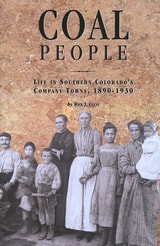
Coal People
Life in Southern Colorado's Company Towns, 1890-1930Rick J. Clyne
University Press of Colorado, 1999
Clyne reveals that a strong sense of community and tolerance existed in the camps, into which families journeyed from such far-flung locales as eastern and southern Europe to carve out a living. The shared immigrant experience—and the shared risks of mining—more often than not strengthened the bonds between both miners and families.
Coal People contains historic images of coal-town life culled from the collections of the Colorado Historical Society, as well as the author's own photographs of how several of these camps appear today.
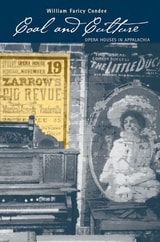
Coal and Culture
Opera Houses in AppalachiaWilliam Faricy Condee
Ohio University Press, 2005
Opera houses were fixtures of Appalachian life from the end of the Civil War through the 1920s. Most towns and cities had at least one opera house during this golden age. Coal mining and railroads brought travelers, money, and change to the region. Many aspects of American life converged in the opera house.
Coal and Culture: Opera Houses in Appalachia is a critical appreciation of the opera house in the coal-mining region of Appalachia from the mid-1860s to the early 1930s. Author William Faricy Condee demonstrates that these were multipurpose facilities that were central to the life of their communities. In the era before radio, movies, television, and malls, these buildings were essential. They housed little, if any, opera, but were used for almost everything else, including traveling theater, concerts, religious events, lectures, commencements, boxing matches, benefits, union meetings, and—if the auditorium had a flat floor—skating and basketball.
The only book on opera houses that stresses their cultural context, Condee’s unique study will interest cultural geographers, scholars of Appalachian studies, and all those who appreciate the gaudy diversity of the American scene.
Coal in our Veins
A Personal JourneyErin Ann Thomas
Utah State University Press, 2012
In Coal in Our Veins, Erin Thomas employs historical research, autobiography, and journalism to intertwine the history of coal, her ancestors' lives mining coal, and the societal and environmental impacts of the United States' dependency on coal as an energy source. In the first part of her book, she visits Wales, native ground of British coal mining and of her emigrant ancestors. The Thomases' move to the coal region of Utah—where they witnessed the Winter Quarters and Castle Gate mine explosions, two of the worst mining disasters in American history—and the history of coal development in Utah form the second part.
Then Thomas investigates coal mining and communities in West Virginia, near her East Coast home, looking at the Sago Mine collapse and more widespread impacts of mining, including population displacement, mountain top removal, coal dust dispersal, and stream pollution, flooding, and decimation. The book's final part moves from Washington D.C.—and an examination of coal, CO2, and national energy policy—back to Utah, for a tour of a coal mine, and a consideration of the Crandall Canyon mine cave-in, back to Wales and the closing of the oldest operating deep mine in the world and then to a look at energy alternatives, especially wind power, in West Virginia and Pennsylvania.
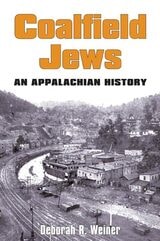
Coalfield Jews
An Appalachian HistoryDeborah R. Weiner
University of Illinois Press, 2006
The stories of vibrant eastern European Jewish communities in the Appalachian coalfields
Coalfield Jews explores the intersection of two simultaneous historic events: central Appalachia’s transformative coal boom (1880s-1920), and the mass migration of eastern European Jews to America. Traveling to southern West Virginia, eastern Kentucky, and southwestern Virginia to investigate the coal boom’s opportunities, some Jewish immigrants found success as retailers and established numerous small but flourishing Jewish communities.
Deborah R. Weiner’s Coalfield Jews provides the first extended study of Jews in Appalachia, exploring where they settled, how they made their place within a surprisingly receptive dominant culture, how they competed with coal company stores, interacted with their non-Jewish neighbors, and maintained a strong Jewish identity deep in the heart of the Appalachian mountains. To tell this story, Weiner draws on a wide range of primary sources in social, cultural, religious, labor, economic, and regional history. She also includes moving personal statements, from oral histories as well as archival sources, to create a holistic portrayal of Jewish life that will challenge commonly held views of Appalachia as well as the American Jewish experience.
Coalition of the unWilling and unAble
European Realignment and the Future of American GeopoliticsJohn R. Deni
University of Michigan Press, 2022
Why does the United States need European allies, and why is it getting more difficult for those allies to partner with Washington in standing up to China, pushing back against Russia, and pursuing other common interests around the world? This book addresses the economic, demographic, political, and military trends that are fundamentally upending the ability and willingness of European allies to work with Washington. Brexit and its impact on Britain’s economy and its military, Germany’s seemingly relentless economic and political rise, France’s continuing economic malaise, Italy’s aging population and its withdrawal from major overseas operations, and Poland’s demographic decline and single-minded obsession with Russia will combine to make partnership with Washington nearly impossible. In short, the constellation of allies and partners the United States has relied on since 9/11 will look very different a decade from now. How should Washington respond? It doesn’t hold all the cards, but this book offers an array of practical recommendations for American leaders. By leveraging these proposals, U.S. policy-makers can avoid the worst-case scenarios and make the most of limited opportunities.

Coastal Landscapes
South Jersey from the AirKenneth W. Able
Rutgers University Press, 2023
Based on numerous aerial images from helicopter and drone flights between 2015 and 2021, this book provides extensive photographs and maps of the New Jersey coast, from the Pine Barrens to the ocean beaches. The text associated with each exceptional image describes it in detail, including its location, ecological setting, and relative position within the larger landscape. Author Kenneth Able, director of the Rutgers University Marine Field Station for over thirty years, has thoroughly ground-truthed each image by observations made through kayaks, boats, and wading through marshes. Calling upon his decades of expertise, Able paints a compelling portrait of coastal New Jersey’s stunning natural features, resources, history, and possible futures in an era of rising sea levels.
Coastal Marshes
Ecology and Wildlife ManagementRobert H. Chabreck
University of Minnesota Press, 1988
Coastal Marshes was first published in 1988. Minnesota Archive Editions uses digital technology to make long-unavailable books once again accessible, and are published unaltered from the original University of Minnesota Press editions.
The coastal regions of the United States form a highly diversified environment. In addition to sandy beaches and rocky shorelines, there are lagoons, rivers, estuaries, and marshes. The last are a dominant features of many coastal areas and serve as a transition between sea and uplands. Coastal marshes have been a zone for human development, attractive to industrial and residential building because they provide water frontage. But the public is becoming aware of the great value of these wetlands to fisheries and wildlife and to the local economy that depends on them.
This book describes coastal marshes in terms of form, function, ecology, wildlife value, and management. Robert H. Chabreck's emphasis is on the marshes of the northern coast of the Gulf of Mexico (there are 5,500 square miles of marshland in Louisiana alone), but he also deals with marshes on the Atlantic and Pacific coasts. Plant and animal communities are each given a chapter, and the book concludes with considerations of future uses and needs. The author provides references, a glossary, and a list of scientific names, along with numerous illustrations, including a section of color photographs.
For thirty years, Robert H. Chabreck has been engaged in research and management of coastal marshes and has often served as a consultant in wetland ecology. He is a professor of wildlife at Louisiana State University.
Coca-Cola Socialism
Americanization of Yugoslav Culture in the SixtiesRadina Vucetic
Central European University Press, 2018
This book is about the Americanization of Yugoslav culture and everyday life during the nineteen-sixties. After falling out with the Eastern bloc, Tito turned to the United States for support and inspiration. In the political sphere the distance between the two countries was carefully maintained, yet in the realms of culture and consumption the Yugoslav regime was definitely much more receptive to the American model. For Titoist Yugoslavia this tactic turned out to be beneficial, stabilising the regime internally and providing an image of openness in foreign policy.
Coca-Cola Socialism addresses the link between cultural diplomacy, culture, consumer society and politics. Its main argument is that both culture and everyday life modelled on the American way were a major source of legitimacy for the Yugoslav Communist Party, and a powerful weapon for both USA and Yugoslavia in the Cold War battle for hearts and minds.
Radina Vučetić explores how the Party used American culture in order to promote its own values and what life in this socialist and capitalist hybrid system looked like for ordinary people who lived in a country with communist ideology in a capitalist wrapping. Her book offers a careful reevaluation of the limits of appropriating the American dream and questions both an uncritical celebration of Yugoslavia’s openness and an exaggerated depiction of its authoritarianism.
Cocaine
From Coca Fields to the StreetsEnrique Desmond Arias and Thomas Grisaffi, editors
Duke University Press, 2021
Contributors. Enrique Desmond Arias, Lilian Bobea, Philippe Bourgois, Anthony W. Fontes, Robert Gay, Paul Gootenberg, Romain Le Cour Grandmaison, Thomas Grisaffi, Laurie Kain Hart, Annette Idler, George Karandinos, Fernando Montero, Dennis Rodgers, Taniele Rui, Cyrus Veeser, Autumn Zellers-León
Cocaine
White Gold Rush in PeruEdmundo Morales
University of Arizona Press, 1989
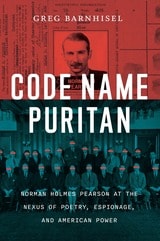
Code Name Puritan
Norman Holmes Pearson at the Nexus of Poetry, Espionage, and American PowerGreg Barnhisel
University of Chicago Press, 2024
Although his impact on twentieth-century American cultural life was profound, few people know the story of Norman Holmes Pearson. Pearson’s life embodied the Cold War alliances among US artists, scholars, and the national-security state that coalesced after World War II. As a Yale professor and editor, he helped legitimize the study of American culture and shaped the public’s understanding of literary modernism—significantly, the work of women poets such as Hilda Doolittle and Gertrude Stein. At the same time, as a spy, recruiter, and cultural diplomat, he connected the academy, the State Department, and even the CIA.
In Code Name Puritan, Greg Barnhisel maps Pearson’s life, from his childhood injury that led to a visible, permanent disability to his wartime counterespionage work neutralizing the Nazis’ spy network to his powerful role in the cultural and political heyday sometimes called the American Century. Written with clarity and informed by meticulous research, Barnhisel’s revelatory portrait of Pearson details how his unique experiences shaped his beliefs about the American character, from the Puritans onward.
Codependent Forevermore
The Invention of Self in a Twelve Step GroupLeslie Irvine
University of Chicago Press, 1999
Codependent Forevermore is thus an insider's look at the world of people "in recovery" and the society that produced them. Through extensive interviews with CoDA members, case studies, and the meetings she attended regularly, Irvine develops a galvanizing perspective on contemporary Americans' sense of self. She explores the idea that selfhood is a narrative accomplishment, achieved by people telling stories to themselves and about themselves. She shows how Alex, Paul, Liz, and many others create a sense of self by combining elements of autobiography, culture, and social structure all within the adopted language of psycho-spirituality.
By following the progress and tribulations of CoDA members, Irvine gets to the heart of widespread American conceptions of relationships, selfhood, and community. Amidst the increasingly shrill criticism of the Twelve Step ethos, her reasoned and considered analysis of these groups reveals the sources of both their power and their popularity.
Codes of Conduct
Race, Ethics, and the Color of Our CharacterHolloway, Karla F. C.
Rutgers University Press, 1995
In Codes of Conduct, Karla Holloway meditates on the dynamics of race and ethnicity as they are negotiated in the realms of power. Her uniquely insightful and intelligent analysis guides us in a fresh way through Anita Hill’s interrogation, the assault on Tawana Brawley, the mass murders of Atlanta’s children, the schisms between the personal and public domains of her life as a black professor, and––in a moving epilogue––the story of her son’s difficulties growing up as a young black male in contemporary society. Its three main sections: “The Body Politic,” “Language, Thought, and Culture,” and “The Moral Lives of Children,” relate these issues to the visual power of the black and female body, the aesthetic resonance and racialized drama of language, and our children’s precarious habits of surviving. Throughout, Holloway questions the consequences in African-American community life of citizenship that is meted out sparingly when one’s ethnicity is colored.
This is a book of a culture’s stories––from literature, public life, contemporary and historical events, aesthetic expression, and popular culture––all located within the common ground of African-American ethnicity. Holloway writes with a passion, urgency, and wit that carry the reader swiftly through each chapter. The book should take its place among those other important contemporary works that speak to the future relationships between whites and blacks in this country.
Cognitive Fictions
Joseph Tabbi
University of Minnesota Press, 2002
The first comprehensive look at the effect of new technologies on contemporary American fiction
Bringing together cognitive science and literary analysis to map a new "media ecology," Cognitive Fictions limns an evolutionary process in which literature must find its place in an artificial environment partly produced and thoroughly mediated by technological means. Joseph Tabbi provides a penetrating account of a developing consciousness emerging from the struggle between print and electronic systems of communication.
Central to Tabbi’s work is the relation between the arrangement of communicating "modules" that cognitive science uses to describe the human mind and the arrangement of visual, verbal, and aural media in our technological culture. He looks at particular literary works by Thomas Pynchon, Richard Powers, David Markson, Lynne Tillman, Paul Auster, and others as both inscriptions of thought consistent with distributed cognitive models, and as self-creations out of the media environment. The first close reading of contemporary American writing in the light of systems theory and cognitive science, Cognitive Fictions makes needed sense of how the moment-by-moment operations of human thought find narrative form in a world increasingly defined by competing and often incompatible representations.
Coining for Capital
Movies, Marketing, and the Transformation of ChildhoodKapur, Jyotsna
Rutgers University Press, 2005
Since the 1980s, a peculiar paradox has evolved in American film. Hollywood’s children have grown up, and the adults are looking and behaving more and more like children. In popular films such as Harry Potter, Toy Story, Pocahantas, Home Alone, and Jumanji, it is the children who are clever, savvy, and self-sufficient while the adults are often portrayed as bumbling and ineffective.
Is this transformation of children into "little adults" an invention of Hollywood or a product of changing cultural definitions more broadly? In Coining for Capital, Jyostna Kapur explores the evolution of the concept of childhood from its portrayal in the eighteenth century as a pure, innocent, and idyllic state—the opposite of adulthood—to its expression today as a mere variation of adulthood, complete with characteristics of sophistication, temptation, and corruption. Kapur argues that this change in definition is not a media effect, but rather a structural feature of a deeply consumer-driven society.
Providing a new and timely perspective on the current widespread alarm over the loss of childhood, Coining for Capital concludes that our present moment is in fact one of hope and despair. As children are fortunately shedding false definitions of proscribed innocence both in film and in life, they must now also learn to navigate a deeply inequitable, antagonistic, and consumer-driven society of which they are both a part and a target.
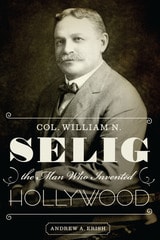
Col. William N. Selig, the Man Who Invented Hollywood
By Andrew A. Erish
University of Texas Press, 2012
All histories of Hollywood are wrong. Why? Two words: Colonel Selig. This early pioneer laid the foundation for the movie industry that we know today. Active from 1896 to 1938, William N. Selig was responsible for an amazing series of firsts, including the first two-reel narrative film and the first two-hour narrative feature made in America; the first American movie serial with cliffhanger endings; the first westerns filmed in the West with real cowboys and Indians; the creation of the jungle-adventure genre; the first horror film in America; the first successful American newsreel (made in partnership with William Randolph Hearst); and the first permanent film studio in Los Angeles. Selig was also among the first to cultivate extensive international exhibition of American films, which created a worldwide audience and contributed to American domination of the medium.
In this book, Andrew Erish delves into the virtually untouched Selig archive at the Academy of Motion Picture Arts and Sciences Library to tell the fascinating story of this unjustly forgotten film pioneer. He traces Selig’s career from his early work as a traveling magician in the Midwest, to his founding of the first movie studio in Los Angeles in 1909, to his landmark series of innovations that still influence the film industry. As Erish recounts the many accomplishments of the man who first recognized that Southern California is the perfect place for moviemaking, he convincingly demonstrates that while others have been credited with inventing Hollywood, Colonel Selig is actually the one who most deserves that honor.