Results by title
1832 books match the query 'Essays' and 94 start with c
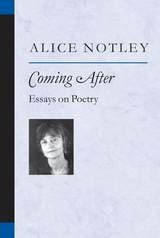
Coming After
Essays on PoetryAlice Notley
University of Michigan Press, 2005
Notley explores the work of second-generation New York School poets and their allies: Ted Berrigan, Anne Waldman, Joanne Kyger, Ron Padgett, Lorenzo Thomas, and others. These essays and reviews are among the first to deal with a generation of poets notorious for their refusal to criticize and theorize, assuming the stance that "only the poems matter." The essays are characterized by Notley's strong, compelling voice, which transfixes the reader even in the midst of professional detail. Coming After revives the possibility of the readable book of criticism.
Common Knowledge (Inaugural issue marking return to publication), Volume 8
Jeffrey M. Perl, ed.
Duke University Press, 0
Described by the New York Times as one of two American journals in which public intellectuals and other scholars prefer to publish, the highly acclaimed Common Knowledge has returned to publication after a two-year hiatus. In an effort to place itself in the ferment of intellectual life and broaden its geographical range, the journal has moved to the Middle East, to Israel. Born in an attempt to moderate and get past the "culture wars" of the 90s, Common Knowledge has moved, literally, to a war zone, and accordingly its editorial interests have broadened to include culture wars of a less metaphorical kind.
Its mission is both incredibly ambitious and shockingly simple: to open up lines of communication between the academy and the community of thoughtful people outside its walls. Common Knowledge was created to form a new intellectual model, one based on conversation or cooperation rather than on metaphors adopted from sports and war, of "sides" that one must "take." The journal will collect work from a variety of fields and specialties, including philosophy, religion, psychology, literary criticism, cultural studies, art history, political science, and social, cultural, and intellectual history.
Scholars such as Richard Rorty, Bruno Latour, Clifford Geertz, Julia Kristeva, Karma Nabulsi, and J. G. A. Pocock will cross paths with political figures like Prince Hassan of Jordan and President Arpad Goncz of Hungary, novelists like Susan Sontag, poets like Yves Bonnefoy, composers like Alexander Goehr, and journalists like Adam Michnik. The pages of Common Knowledge are sure to challenge the ways we think about theory and its relevance to humanity. The first volume will feature the beginning of a Seriatim Symposium, “Disagreement, Enmity, and Dispute,” which will include discussions of the title concepts from a variety of theoretical perspectives. The Symposium asks why, in an intellectual context in which “true” and “real” are words that can be used only in condescending scare quotes, there is so much absolute conflict. If truth and reality are constructions, then why aren’t we constructing consensual orders (metaphysical and social) that are conducive to peace, calm, and cooperation?
Contributors for forthcoming issues include: Manfred Frank, Jacques Le Goff, Vicki Hearne, Sissela Bok, Edward Cardinal Cassidy, Linda Hutcheon, G. Thomas Tanselle, Arlette Farge, Marcel Detienne, Caryl Emerson, Stanley Katz, and Peter Laslett.
Commons and Lords
A Short Anthropology of ParliamentEmma Crewe
Haus Publishing, 2015
Based on fieldwork within both Houses, this volume in the Haus Curiosities series provides a surprising twist in how relationships in each play out. The high social status of peers in the House of Lords gives the impression of hierarchy and, more specifically, patriarchy. In contrast, the House of Commons conjures impressions of equality and fairness between members. But actual observation reveals the opposite: while the House of Lords has an egalitarian and cooperative ethos that is also supportive of female members, the competitive and aggressive House of Commons is a far less comfortable place for women. Offering many surprises and secrets, this book exposes the sheer oddity of the British parliament system.
Comparative Musicology and Anthropology of Music
Essays on the History of EthnomusicologyEdited by Bruno Nettl and Philip V. Bohlman
University of Chicago Press, 1991
"This is a useful and enriching collection of articles of interest to musicologists and ethnomusicologists. . . . The authors manage to cover much ground, presenting fascinating insights into the history of the discipline while also exploring new directions in both theory and analysis. . . . the most sweeping work of this kind to be published since the 1960s."—L. D. Loeb, University of Utah, for Choice
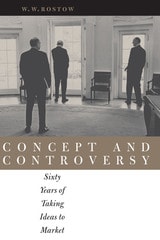
Concept and Controversy
Sixty Years of Taking Ideas to MarketBy W. W. Rostow
University of Texas Press, 2003
A trusted advisor to Presidents Eisenhower, Kennedy, and Johnson and one of America's leading professors of economic history, W. W. Rostow has helped shape the intellectual debate and governmental policies on major economic, political, and military issues since World War II. In this thought-provoking memoir, he takes a retrospective look at eleven key policy problems with which he has been involved to show how ideas flow into concrete action and how actions taken or not taken in the short term actually determine the long run that we call "the future."
The issues that Rostow discusses are these:
- The use of air power in Europe in the 1940s
- Working toward a united Europe during the Cold War
- The death of Joseph Stalin and early attempts to end the Cold War
- Eisenhower's Open Skies policy
- The debate over foreign aid in the 1950s
- The economic revival of Korea
- Efforts to control inflation in the 1960s
- Waiting for democracy in China
- The Vietnam War and Southeast Asian policy
- U.S. urban problems in disadvantaged neighborhoods
- The challenges posed by declining population in the twenty-first century
In discussing how he and others have worked to meet these challenges, Rostow builds a compelling case for including long-term forces in the making of current policy. He concludes his memoir with provocative reflections on the twentieth and twenty-first centuries and on how individual actors shape history.
Condition Red
Essays, Interviews, and CommentariesYusef Komunyakaa; Edited by Radiclani Clytus
University of Michigan Press, 2017
Conditions Handsome and Unhandsome
The Constitution of Emersonian Perfectionism: The Carus Lectures, 1988Stanley Cavell
University of Chicago Press, 1991
"Cavell's 'readings' of Wittgenstein and Heidegger and Emerson and other thinkers surely deepen our understanding of them, but they do much more: they offer a vision of what life can be and what culture can mean. . . . These profound lectures are a wonderful place to make [Cavell's] acquaintance."—Hilary Putnam
Confessions of a Prosaic Dreamer
Charles Lamb's Art of AutobiographyGerald Monsman
Duke University Press, 1984
Gerald Monsman in this study abandons the customary chronological approach to Lamb's life in favor of a more incisive, open-ended discussion of the Elia essays. By a close textual examination of Lamb's language, he relates the essayist's use of symbol and autobiographical concerns. Monsman contends and demonstrates that "as sharply and as pertinently as any artistic voice, Elia, the most celebrated persona in the nineteenth century, focuses the problems inherent in the modern literary imagination." Elia's "textual identity is a function of the author's actual life, of losses and imperfections artistically utilized and harmonized, employed against themselves to produce the rehabilitating symbol."
Confluences
Religion, Health, and Diversity in MissouriSigne Cohen
University of Missouri Press, 2025
The contributors to this volume explore connections between religious affiliation, race, gender, ethnicity, epidemiology, and attitudes towards health and medicine in Missouri from the nineteenth century to the present day. They ask what role religious belief systems play in healthcare outcomes and offer important arguments for building a dialogue between faith communities and medical caregivers. Centering on Missouri as a site for religious transformation and diversity, this volume documents how religious perspectives shape contemporary America.
Initial chapters outline the religious history of Missouri, relaying the history of medicine in the region before and after Missouri statehood. Subsequent essays document Missouri’s religious diversity by contemplating Native American, Asian American, and African American religious experiences in Missouri, intentionally recovering and respectfully contextualizing understudied events and forgotten individuals. The volume’s remaining essays consider religious responses to the Cholera, Influenza, and Covid-19 epidemics and show how Native American, Euro-American, and African American Missourians have transformed U.S. history and healthcare. Collectively, the essays in this book demonstrate that religious freedom, medical knowledge, and transnational encounters are woven into the historical fabric of the region.
Featuring essays by experts in Religious Studies and Health Sciences, this volume will be of interest to scholars of religion, sociology, public health, and medicine, as well as readers more generally interested in the history and culture of Missouri.
Confronting Torture
Essays on the Ethics, Legality, History, and Psychology of Torture TodayEdited by Scott A. Anderson and Martha C. Nussbaum
University of Chicago Press, 2018
Confronting Torture offers a multidisciplinary investigation of this wrenching topic. Editors Scott A. Anderson and Martha C. Nussbaum bring together a diversity of scholars to grapple with many of torture’s complexities, including: How should we understand the impetus to use torture? Why does torture stand out as a particularly heinous means of war-fighting? Are there any sound justifications for the use of torture? How does torture affect the societies that employ it? And how can we develop ethical or political bulwarks to prevent its use? The essays here resist the temptation to oversimplify torture, drawing together work from scholars in psychology, history, sociology, law, and philosophy, deepening and broadening our grasp of the subject. Now, more than ever, torture is something we must think about; this important book offers a diversity of timely, constructive responses on this resurgent and controversial subject.
Constantinople and the West
Essays on the Late Byzantine (Palaeologan) and Italian Renaissances and the Byzantine and Roman ChurchesDeno John Geanakoplos
University of Wisconsin Press, 1989
Consuelo Jimenez Underwood
Art, Weaving, VisionLaura E. Pérez and Ann Marie Leimer, editors
Duke University Press, 2021
Contributors. Constance Cortez, Karen Mary Davalos, Carmen Febles, M. Esther Fernández, Christine Laffer, Ann Marie Leimer, Amalia Mesa-Bains, Robert Milnes, Jenell Navarro, Laura E. Pérez, Marcos Pizarro, Verónica Reyes, Clara Román-Odio, Carol Sauvion, Cristina Serna, Emily Zaiden
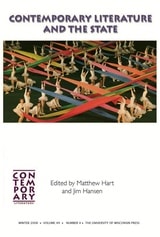
Contemporary Literature and the State
A special issue of Contemporary Literature 49:4 (Winter 2008)Matthew Hart
University of Wisconsin Press, 2009
Contesting the Master Narrative
Essays In Social HistoryJeffrey Cox
University of Iowa Press, 1998
Critically examining past master narratives in light of emerging alternatives, these essayists ask us to reevaluate the stories we tell, the narrative traditions within which they are situated, and the audiences they are designed to persuade. The first essays explore the gendered character of social history rhetoric by exposing alternative, feminist traditions of social scientific and social historical writing. The second section focuses on alternative narrative traditions of historical writing in non-European contexts, specifically India, Japan, and China. And the third group spotlights the rhetorical uses of synthesis in the writings of social historians.
The essays feature the range of narrative possibilities available to historians who have become self-critical about the pervasive use of unexamined master narratives; they show how limited that tradition can be compared with the diverse alternatives derived from, for example, gendered traditions of Latin American travel writers of the nineteenth century, Victorian women's historical writing, or the lively subaltern tradition in Indian social history. Together they argue not for the abandonment of historical materialism or the elimination of all master narratives but for the reinvigoration of social history through the use of new and more persuasive arguments based on alternative narratives.
Continuing Revelation
Essays on DoctrineBryan Buchanan
Signature Books, 2021
Determining what is and what is not Mormon doctrine is a difficult endeavor. The Church of Jesus Christ of Latter-day Saints embraces four books of scripture as its canon, but also believes the church is led by a living prophet. Additions to the canon have been rare since the death of church founder Joseph Smith. Joseph Fielding Smith, tenth church president, said that if the prophet ever contradicts canon, canon prevails. On the other hand, Ezra Taft Benson, the church’s thirteenth president, said that the living prophet’s words are more important than cannon. Such messages create no shortage of confusion among church members.
The question “What is doctrine?” opens the door for theologians and historians to wrestle over the answer, and to do so thoughtfully and insightfully. In Continuing Revelation, editor Bryan Buchanan has compiled essays that seek greater understanding about what doctrine is and why it matters.
The Challenge of Defining LDS Doctrine, by Loyd Isao Ericson • LDS Theology and the Omnis: The Dangers of Theological Speculation, by David H. Bailey • Crawling out of the Primordial Soup: A Step toward the Emergence of an LDS Theology Compatible with Organic Evolution, by Steven L. Peck • “To Destroy the Agency of Man”: The War in Heaven in LDS Thought, by Boyd Petersen • Three Sub-Degrees in the Celestial Kingdom?, by Shannon P. Flynn • Heavenly Mother: The Mother of All Women, by Blaire Ostler • Mormonism and the Problem of Heterodoxy, by Kelli D. Potter • Women at the Gates of Mortality: Relief Society Birth and Death Rituals, by Susanna Morrill • “Shake Off the Dust of Thy Feet”: The Rise and Fall of Mormon Ritual Cursing, by Samuel R. Weber • “Satan Mourns Naked Upon the Earth: Locating Mormon Possession and Exorcism Rituals in the American Religious Landscape, 1830–1977, by Stephen C. Taysom
Continuing the Reformation
Essays on Modern Religious ThoughtB. A. Gerrish
University of Chicago Press, 1993
Gerrish devotes three essays to each of four topics: Martin Luther and the Reformation; religious belief and the Age of Reason; Friedrich Schleiermacher and the renewal of Protestant theology; and Schleiermacher's disciple Ernst Troeltsch, for whom the theological task was to give a rigorous account of the faith prevailing in a particular religious community at a particular time. Gerrish shows how faith itself has become a primary object of inquiry, not only in the newly emerging philosophy of religion but also in a new style of church theology which no longer assumes that faith rests on immutable dogmas. For Gerrish, the new theology of Protestant liberalism takes for its primary object of inquiry the changing forms of the religious life. This important book will interest scholars of systematic Christian theology, modern intellectual and cultural history, and the history and philosophy of religion.
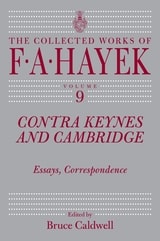
Contra Keynes and Cambridge
Essays, CorrespondenceF. A. Hayek
University of Chicago Press, 1995
When the journal Economica published a review of Keynes's Treatise on Money by Hayek in 1931, Keynes's response consisted principlally of an attack on Hayek's own work on monetary theory, Prices and Production. Conducted almost entirely in economics journals, the battle that followed revealed two very different responses to a world in economic crisis. Keynes sought a revision of the liberal political order—arguing for greater government intervention in the hope of protecting against the painful fluctuations of the business cycle. Hayek instead warned that state involvement would cause irreparable damage to the economy.
This volume begins with Hayek's 1963 reminiscence "The Economics of the 1930s as Seen from London," which has never been published before. The articles, letters, and reviews from journals published in the 1930s are followed by Hayek's later reflections on Keynes's work and influence. The Introduction by Bruce Caldwell puts the debate in context, providing detailed information about the economists in Keynes's circle at Cambridge, their role in the acceptance of his ideas, and the ways in which theory affected policy during the interwar period.
Caldwell calls the debate between Hayek and Keynes "a battle for the minds of the rising generation of British-trained economists." There is no doubt that Keynes won the battle during his lifetime. Now, when many of Hayek's ideas have been vindicated by the collapse of collectivist economies and the revival of the free market around the world, this book clarifies Hayek's work on monetary theory—formed in heated opposition to Keynes—and illuminates his efforts to fight protectionism in an age of economic crisis.
F. A. Hayek (1899-1992), recipient of the Medal of Freedom in 1991 and co-winner of the Nobel Memorial Prize in Economics in 1974, was a pioneer in monetary theory and the principal proponent of classical liberal thought in the twentieth century. He taught at the University of London, the University of Chicago, and the University of Freiburg.

Coordinates
Placing Science Fiction and FantasyGeorge E Slusser
Southern Illinois University Press, 1983
These thirteen original essays were written specifically for the Third J. Lloyd Eaton Conference on Science Fiction and Fantasy Literature, held February 21–22, 1981, at the University of California, Riverside.
Leslie Fiedler sets the tone of this volume by fixing a basic set of coordinates—that of “elitist” and “popular” standards.
Those replying to his charge are: Eric S. Rabkin, Professor of English at the University of Michigan and author of The Fantasticin Literature, “The Descent of Fantasy”; Gerald Prince, Professor of French at the University of Pennsylvania, “How New is New?”; Mark Rose, Professor of English at the University of California at Santa Barbara, author of Alien Encounters, “Jules Verne: Journey to the Center of Science Fiction”; Joseph Lenz, who teaches English Literature at the University of Michigan, “Manifest Destiny: Science Fiction Epic and Classical Forms”; Michelle Massé, of the English Department at the George Mason University, “‘All you have to do is know what you want’: Individual Expectations in Triton”;Gary K. Wolfe, who teaches English at Roosevelt University, author of The Known and the Unknown, “Autoplastic and Alloplastic Adaptations in Science Fiction: ‘Waldo’ and ‘Desertion’”; Robert Hunt, an editor with Glencoe Press, “Science Fiction for the Age of Inflation: Reading Atlas Shrugged in the 1980s”; George R. Guffey, Professor of English at UCLA, “Fahrenheit 451and the ‘Cubby-Hole Editors’ of Ballantine Books”; H. Bruce Franklin, Professor of English and American Literature at Rutgers University at Newark, “America as Science Fiction: 1939”; Sandra M. Gilbert, Professor of English at the University of California at Davis, and coauthor with Susan Gubar of Madwoman in the Attic, “Rider Haggard’s Heart of Darkness”; the aforementioned Susan Gubar, Professor of English at Indiana University, “She in Her/and: Feminism as Fantasy”; and George R. Slusser, Curator of the Eaton Collection, “Death and the Mirror: Existential Fantasy.”
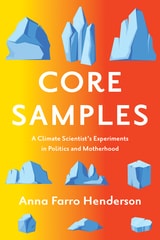
Core Samples
A Climate Scientist's Experiments in Politics and MotherhoodAnna Farro Henderson
University of Minnesota Press, 2024
People live by their stories—how can we use them to accelerate action on climate change?
Climate scientist and policy expert Anna Farro Henderson embarks on a remarkable narrative journey in Core Samples, exploring how science is done, discussed, legislated, and imagined. Through stories both raucous and poignant—of far-flung expeditions, finding artistic inspiration in research, and traversing the systemic barriers women and mothers face in science and politics—she brings readers into the daily rhythms and intimacies of scientific research and political negotiation.
Grounded in her experiences as a climate scientist, an environmental policy advisor to Minnesota Senator Al Franken and Governor Mark Dayton, and a constant juggler of the many roles and responsibilities of professional moms, Henderson’s eclectic, unconventional essays range from observations, confessions, and meditations on lab and fieldwork to a packing list for a trip to the State Capitol and a lactation diary. Readers are invited on voyages as far afield as the Trinity nuclear test site in New Mexico, the Juneau Icefield in Alaska, and a meteor crater in Ghana—and as close to home as a town hall meeting in America’s corn belt.
A love letter to science and a bracing (and sometimes hilarious) portrait of the many obstacles women, mothers, and people digging for truth navigate, Core Samples illuminates the messy, contradictory humanity of our scientific and political institutions. Bringing us behind the closed doors of discovery and debate, Henderson exposes the flaws in research institutions, the halls of government, and the role of science in policy, yet she shows how each crack is also an invitation for camaraderie, creativity, and change.
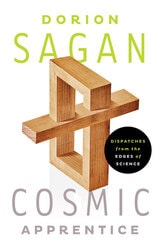
Cosmic Apprentice
Dispatches from the Edges of ScienceDorion Sagan
University of Minnesota Press, 2013
In the pursuit of knowledge, Dorion Sagan argues in this dazzlingly eclectic, rigorously crafted, and deliciously witty collection of essays, scientific authoritarianism and philosophical obscurantism are equally formidable obstacles to discovery. As science has become more specialized and more costly, its questing spirit has been constrained by dogma. And philosophy, perhaps the discipline best placed to question orthodoxy, has retreated behind dense theoretical language and arcane topics of learning.
Guided by a capacious, democratic view of science inspired by the examples set by his late parents—Carl Sagan, who popularized the study of the cosmos, and Lynn Margulis, an evolutionary biologist who repeatedly clashed with the scientific establishment—Sagan draws on classical and contemporary philosophy to intervene provocatively in often-charged debates on thermodynamics, linear and nonlinear time, purpose, ethics, the links between language and psychedelic drugs, the search for extraterrestrial intelligence, and the occupation of the human body by microbial others. Informed by a countercultural sensibility, a deep engagement with speculative thought, and a hardheaded scientific skepticism, he advances controversial positions on such seemingly sacrosanct subjects as evolution and entropy. At the same time, he creatively considers a wide range of thinkers, from Socrates to Bataille and Descartes to von Uexküll, to reflect on sex, biopolitics, and the free will of Kermit the Frog.
Refreshingly nonconformist and polemically incisive, Cosmic Apprentice challenges readers to reject both dogma and cliché and instead recover the intellectual spirit of adventure that should—and can once again—animate both science and philosophy.
Could it Happen Here?
The Day a Prime Minister Refuses to ResignPeter Hennessy
Haus Publishing, 2025
In light of the resurgence of the far Right across Europe and some of the rhetoric of the 2024 General Election, which carried whiffs of political authoritarianism, Could It Happen Here? explores the possible consequences of a British prime minister refusing to leave office. Mapping out the processes that might occur after such an eventuality, the responsibilities of key players in the United Kingdom’s democratic system, and the integrity of that system after years of stress, Peter Hennessy and Andrew Blick analyze the United Kingdom’s “unwritten” constitution and provide a crucial recommendation for protecting and strengthening the resilience of its parliamentary democracy.
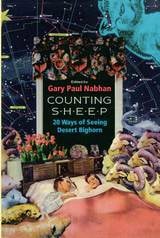
Counting Sheep
Twenty Ways of Seeing Desert BighornGary Paul Nabhan
University of Arizona Press, 1993
Contributors:
Charles Bowden
David E. Brown
Bill Broyles
Julian Hayden
William T. Hornaday
Paul Krausman
Danny Lopez
Eric Mellink
Mauricio Mixco
Gale Monson
Gary Paul Nabhan
Doug Peacock
Kermit Roosevelt
Harley G. Shaw
Charles Sheldon
Peter Steinhart
Anita Alvarez de Williams
Terry Tempest Williams
Ann Zwinger
Courting Justice
Ten New Jersey Cases That Shook the NationEdited by Paul L. Tractenberg with a Foreword by Deborah T. Poritz
Rutgers University Press, 2013
Paul Tractenberg has selected ten of the court’s landmark decisions between 1960 and 2011 to illustrate its extensive involvement in major public issues, and to assess its impact. Each case chapter is authored by a distinguished academic or professional expert, several of whom were deeply involved in the cases’ litigation, enabling them to provide special insights. An overview chapter provides context for the court’s distinctive activity.
Many of the cases are so widely known that they have become part of the national conversation about law and policy. In the Karen Ann Quinlan decision, the court determined the right of privacy extends to refusing life-sustaining treatment. The Baby M case reined in surrogate parenting and focused on the child’s best interests. In the Mount Laurel decision, the court sought to increase affordable housing for low- and moderate-income residents throughout the state. The Megan’s Law case upheld legal regulation of sex offender community notification. A series of decisions known as Abbott/Robinson required the state to fund poor urban school districts at least on par with suburban districts.
Other less well known cases still have great public importance. Henningsen v. Bloomfield Motors reshaped product liability and tort law to protect consumers injured by defective cars; State v. Hunt shielded privacy rights from unwarranted searches beyond federal standards; Lehmann v. Toys ‘R’ Us protected employees from sexual harassment and a hostile work environment; Right to Choose v. Byrne expanded state constitutional abortion rights beyond the federal constitution; and Marini v. Ireland protected low-income tenants against removal from their homes.
For some observers, the New Jersey Supreme Court represents the worst of judicial activism; others laud it for being, in its words, “the designated last-resort guarantor of the Constitution's command.” For Tractenberg, the court’s activism means it tends to find for the less powerful over the more powerful and for the public good against private interests, an approach he applauds.
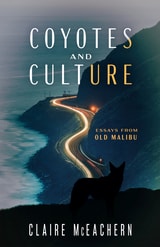
Coyotes and Culture
Essays from Old MalibuClaire McEachern
University of Nevada Press, 2025
This unique collection of essays offers a gripping exploration of the precarious beauty and peril of California’s iconic coastline. Through essays blending personal narrative, cultural analysis, and history, author Claire McEachern takes us behind the scenes of surf and celebrities to paint a vivid portrait of life on the edge —both literally and metaphorically. From the rugged Santa Monica Mountains to the shimmering Pacific, this work captures the paradoxes of Old Malibu: a place of luxury and risk, natural splendor and ecological vulnerability.
As an East Coast academic married to a fifth-generation Californian cowboy, McEachern brings a wry yet tender lens to the modern American story, delving into what happens to love and community in a land of both devastating wildfires and extravagant wildflowers. Her reflections weave together questions of beauty, resilience, and humanity’s uneasy relationship with nature, creating an unforgettable narrative of place and survival. Readers drawn to the drama of human stories set against larger cultural and environmental forces will find this book both thought-provoking and deeply moving.
Creative Tension
Essays On Science & ReligionMichael Heller
Templeton Press, 2003
The voice of a renowned professor of philosophy in Poland, who is also a Roman Catholic priest, is introduced to the United States in this collection of his provocative essays on the interplay of science and religion. Michael Heller progressively outlines systematic steps that might lead to a peaceful coexistence of these traditionally separate fields of study. Some essays have their roots in the author's work in physics and cosmology, while others present his theories on the language of God, creation, and transcendence, inspired by his work in the applications of so-called noncommutative geometry, an emerging field of study.
- Part one deals with methodology, evaluate the theological interpretation of scientific theories, and proposes a program for a "theology of science."
- Part two looks at the interaction of science and religion from a historical perspective. Topics include the evolution of ideas connected with the place of man in the Universe and the evolution of matter, among others.
- Part three concentrates on the "creation and science" quandary, including the big bang theory, the role of probability and chance in science, and their impact on theological questions.
- Part four looks for vestiges of transcendence in contemporary science.
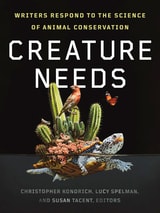
Creature Needs
Writers Respond to the Science of Animal ConservationChristopher Kondrich
University of Minnesota Press, 2024
A kaleidoscopic literary exploration of extinction and conservation, inspired by the latest scientific research
Creature Needs is a polyvocal call to arms about animal extinction and habitat loss that harnesses the power of literature and scientific research to move us, and stir our hearts and minds, toward action and change. A collection of new literary works by prominent writers paired with excerpts from recent scientific articles that inspired and informed them, this innovative anthology engages the collaborative, cross-disciplinary spirit and energy that is necessary to address the impact of humans on all other animals on our planet.
Divided into six sections representing the basic needs for survival—air, food, water, shelter, room to move, and each other—the stories and poems in Creature Needs vividly portray how these essential conditions are under assault through climate change, habitat loss, plastic and industrial pollution, and human intervention in natural landscapes. As the dominant species on Earth, humans not only control access to survival resources but we also overconsume and harm them. Rather than surrender to despair, the writers here believe that we have the power, if we choose, to change course and protect these resources.
A collaboration with the nonprofit organization Creature Conserve, Creature Needs is a path-setting fusion of literary art and scientific research that deepens our understanding of the interdependence between life and habitat, illuminating the stark choices we face to conserve resources and ensure that the basic needs of all species are met.
Contributors: Kazim Ali, Mary-Kim Arnold, Ramona Ausubel, David Baker, Charles Baxter, Aimee Bender, Kimberly Blaeser, Oni Buchanan, Tina Cane, Ching-In Chen, Mónica de la Torre, Tongo Eisen-Martin, Thalia Field, Ben Goldfarb, Annie Hartnett, Sean Hill, Hester Kaplan, Donika Kelly, Robin McLean, Miranda Mellis, Rajiv Mohabir, Kyoko Mori, David Naimon, Craig Santos Perez, Beth Piatote, Rena Priest, Alberto Ríos, Eléna Rivera, Sofia Samatar, Sharma Shields, Eleni Sikelianos, Maggie Smith, Juliana Spahr, Tim Sutton, Jodie Noel Vinson, Asiya Wadud, Claire Wahmanholm, Marco Wilkinson, Jane Wong.
Critical Essays
Roland Barthes
Northwestern University Press, 1972

Critical Library Pedagogy Handbook Volume One
Essays and Workbooks ActivitiesNicole Pagowsky
Assoc of College & Research Libraries, 2016

Critical Passions
Selected EssaysJean Franco
Duke University Press, 1999
A key participant in the major debates in Latin American studies—beginning with the “boom” period of the 1960s and continuing through debates on ideology and discourse, Marxism, mass culture, and postmodernism—Franco is recognized for her feminist critique of Latin American writing. While her principal books are all readily available, Franco’s several dozen articles are dispersed in a variety of periodicals in Latin America, Europe, and the United States. Although many of these essays are considered pioneering and classic, they have never before been collected in a single work. In this volume, Mary Louise Pratt and Kathleen Newman have organized the essays into four interrelated sections: feminism and the critique of authoritarianism, mass and popular culture, Latin American literature from the “boom” onward, and the cultural history of Mexico. As a group, these writings demonstrate Franco’s ability to reflect on and judge with equal seriousness all spheres of expression, whether subway graffiti, a fashion manual, or an avant-garde haiku. A bona fide fan of popular and mass media, Franco never allows her critiques to dissolve into the puritanical or reductive; instead, she finds ways to present and debate complex theoretical questions in direct and accessible language.
This volume will draw an extensive readership in Latin American, cultural, and women’s studies.
Critical Terms for Religious Studies, Second Edition
Edited by Sarah Hammerschlag
University of Chicago Press, 2025
First published nearly thirty years ago, Critical Terms for Religious Studies proved a vital resource for an emerging interdisciplinary conversation. We still use much of the same language in the study of religion, but fresh concerns have both changed the meaning of terms and given rise to new terms altogether. This edition consists of twenty-three entirely new essays that offer students and scholars alike the tools to historicize and evaluate the shifting role of familiar and emerging critical terms in religious studies.
These are “critical terms” both because they are important in our cultural moment and because thinking through them reveals how religions are embedded in and shaped by material, social, economic, and political forces. A shared conviction unites contributors from a range of traditions and methodologies: a recognition that our world is saturated by the persistence of religious traditions as shape-shifting (not static or transcendent) forces of authority, as powerful today as ever before.
Crossing Cultures
Essays in the Displacement of Western CivilizationDaniel Segal
University of Arizona Press, 1992
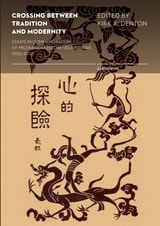
Crossing between Tradition and Modernity
Essays in Commemoriation of Milena Doležalová-Velingerová (1932–2012)Edited by Kirk A. Denton
Karolinum Press, 2017
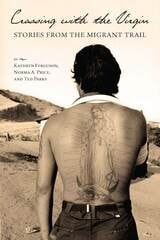
Crossing with the Virgin
Stories from the Migrant TrailKathryn Ferguson, Norma A. Price, and Ted Parks
University of Arizona Press, 2010
Crossing With the Virgin collects stories heard from migrants about these treacherous treks—firsthand accounts told to volunteers for the Samaritans, a humanitarian group that seeks to prevent such unnecessary deaths by providing these travelers with medical aid, water, and food. Other books have dealt with border crossing; this is the first to share stories of immigrant suffering at its worst told by migrants encountered on desert trails.
The Samaritans write about their encounters to show what takes place on a daily basis along the border: confrontations with Border Patrol agents at checkpoints reminiscent of wartime; children who die in their parents’ desperate bid to reunite families; migrants terrorized by bandits; and hovering ghost-like above nearly every crossing, the ever-present threat of death.
These thirty-nine stories are about the migrants, but they also tell how each individual author became involved with this work. As such, they offer not only a window into the migrants’ plight but also a look at the challenges faced by volunteers in sometimes compromising situations—and at their own humanizing process.
Crossing With the Virgin raises important questions about underlying assumptions and basic operations of border enforcement, helping readers see past political positions to view migrants as human beings. It will touch your heart as surely as it reassures you that there are people who still care about their fellow man.

Crow's Range
An Environmental History Of The Sierra NevadaDavid Beesley
University of Nevada Press, 2007
John Muir called it the "Range of Light, the most divinely beautiful of all the mountain chains I’ve ever seen." The Sierra Nevada—a single unbroken mountain range stretching north to south over four hundred miles, best understood as a single ecosystem but embracing a number of environmental communities—has been the site of human activity for millennia. From the efforts of ancient Native Americans to encourage game animals by burning brush to create meadows to the burgeoning resort and residential development of the present, the Sierra has endured, and often suffered from, the efforts of humans to exploit its bountiful resources for their own benefit. Historian David Beesley examines the history of the Sierra Nevada from earliest times, beginning with a comprehensive discussion of the geologic development of the range and its various ecological communities. Using a wide range of sources, including the records of explorers and early settlers, scientific and government documents, and newspaper reports, Beesley offers a lively and informed account of the history, environmental challenges, and political controversies that lie behind the breathtaking scenery of the Sierra. Among the highlights are discussions of the impact of the Gold Rush and later mining efforts, as well as the supporting industries that mining spawned, including logging, grazing, water-resource development, market hunting, urbanization, and transportation; the politics and emotions surrounding the establishment of Yosemite and other state and national parks; the transformation of the Hetch Hetchy into a reservoir and the desertification of the once-lush Owens Valley; the roles of the Forest Service, Park Service, and other regulatory agencies; the consequences of the fateful commitment to wildfire suppression in Sierran forests; and the ever-growing impact of tourism and recreational use. Through Beesley’s wide-ranging discussion, John Muir’s "divinely beautiful" range is revealed in all its natural and economic complexity, a place that at the beginning of the twenty-first century is in grave danger of being loved to death. Available in hardcover and paperback.
Crowned with Hope
Essays in Honor of Paul O'CallaghanKenny Ang
St. Augustine's Press, 2026
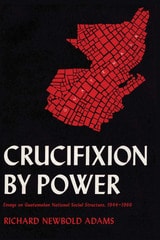
Crucifixion by Power
Essays on Guatemalan National Social Structure, 1944–1966By Richard Newbold Adams
University of Texas Press, 1970
"Quite the contrary of old generals, nations do not fade away; they have to be killed."
Richard Adams' view of the nation as a basic social unit is central to this pioneering study in social anthropology. The result of many years of research in Guatemala, this volume utilizes the author's fieldwork as well as that of his colleagues and students to construct a set of concepts explaining how Guatemala reached the difficult circumstances in which it found itself in the 1960s—and still finds itself today.
With the breakup of the great colonial empires after the Second World War, the curtain that had been drawn around Marx by Western social scientists fell away; countries once called "primitive" began to be seen as "underdeveloped," while those once thought to be stable and advanced began to appear predatory and conflict ridden. The theme of Mr. Adams' book is that, in the world as a whole, there is a structural escalation of power concentration.
The author believes that Guatemala, as a small nation within the general domain of the United States, is caught in the developmental hinterland of that powerful neighbor and that the United States, within its own capitalistic development pattern and in competition with other leading world powers, cannot allow the smaller nation to resolve its own political and social problems. Thus Guatemala, he declares, finds itself crucified by unyielding and uncontrollable power plays beyond its national borders.
As a background for the study of specific sectors in Guatemalan society, the author discusses the theoretical nature of complex societies. He shows the cohesive force of a nation to be its power structure and then examines mechanisms whereby this structure is kept intact in Guatemala. Special emphasis is given to the lack of access to power by the poor, the development of the military, the organization of power within the Catholic Church, and the expansion of upper-sector interest groups.
While there was important growth in the power of upper-sector Guatemalan society over the two decades of the study, there was no comparable increase in distribution; the position of the lower sectors within the power structure has therefore changed very slightly. "Development," then, in Guatemala was principally in terms of what was advantageous to the major powers.
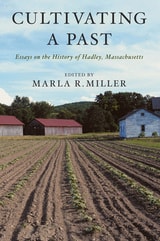
Cultivating a Past
Essays on the History of Hadley, MassachusettsMarla R. Miller
University of Massachusetts Press, 2009
Edited with an introduction by Marla R. Miller, Cultivating a Past brings together fifteen essays, some previously published and others new, that tell the story of Hadley from a variety of disciplinary vantage points. Archaeologists Elizabeth Chilton, Siobhan Hart, Christopher Donta, Edward Hood, and Rita Reinke investigate relations between Native and European communities, while historians Gregory Nobles, Alice Nash, and Pulitzer Prize winner Laurel Thatcher Ulrich explore the social, cultural, and political past of this New England town. Musicologist Andrea Olmstead surveys the career of composer Roger Sessions, costume specialist Lynne Bassett interprets the wardrobes of the town's seventeenth-century residents, Douglas Wilson investigates the connection between Hadley and the regicides William Goffe and Edward Whalley, and Martin Antonetti charts the course of a 1599 Bible alleged to have belonged Goffe.
Taken together, the essays capture how men and women in this small community responded to the same challenges that have faced other New Englanders from the seventeenth century to the present. They also reveal how the town's historical sense of itself evolved along the way, as stories of the alleged "Angel of Hadley," of favorite sons Joseph Hooker and Clarence Hawkes, and of daughters Mary Webster and Elizabeth Porter Phelps contributed to a civic identity that celebrates strength of character.
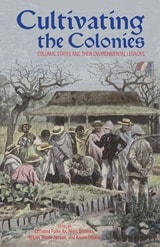
Cultivating the Colonies
Colonial States and their Environmental LegaciesChristina Folke Ax
Ohio University Press, 2011
The essays collected in Cultivating the Colonies demonstrate how the relationship between colonial power and nature revealsthe nature of power. Each essay explores how colonial governments translated ideas about the management of exoticnature and foreign people into practice, and how they literally “got their hands dirty” in the business of empire.
The eleven essays include studies of animal husbandry in the Philippines, farming in Indochina, and indigenous medicine in India. They are global in scope, ranging from the Russian North to Mozambique, examining the consequences of colonialismon nature, including its impact on animals, fisheries, farmlands, medical practices, and even the diets of indigenouspeople.
Cultivating the Colonies establishes beyond all possible doubt the importance of the environment as a locus for studyingthe power of the colonial state.
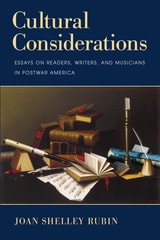
Cultural Considerations
Essays on Readers, Writers, and Musicians in Postwar AmericaJoan Shelley Rubin
University of Massachusetts Press, 2013
Focusing on aspects of American literary and musical culture in the decades after World War II, Rubin examines the contests between critics and their readers over the authority to make aesthetic judgments; the effort of academics to extend the university outward by bringing the humanities to a wide public; the politics of setting poetic texts to music; the role of ideology in the practice of commissioning and performing choral works; and the uses of reading in the service of both individualism and community. Specific topics include the 1957 attack by the critic John Ciardi on the poetry of Anne Morrow Lindbergh in the Saturday Review; the radio broadcasts of the classicist Gilbert Highet; Dwight Macdonald's vitriolic depiction of the novelist James Gould Cozzens as a pernicious middlebrow; the composition and reception of Howard Hanson's "Song of Democracy"; the varied career of musician Gunther Schuller; the liberal humanism of America's foremost twentieth-century choral conductor, Robert Shaw; and the place of books in the student and women's movements of the 1960s.
What unites these essays is the author's ongoing concern with cultural boundaries, mediation, and ideology--and the contradictions they frequently entail.
Cultural Semantics
Keywords of Our TimeMartin Jay
University of Massachusetts Press, 1998
A selection of Martin Jay's recent writings on contemporary thought and culture, this is a book about ideas that matter—and about why ideas matter. Borrowing from Flaubert's notion of a dictionary of “received ideas” and Raymond Williams's explorations of the “keywords” of the modern age, Jay investigates some of the central concepts by which we currently organize our thoughts and lives. His topics range from “theory” and “experience” to the meaning of “multiculturalism” and the dynamics of cultural “subversion.” Among the thinkers he engages are Bataille and Foucault, Adorno and Lacoue-Labarthe, Walter Benjamin, Christa Wolf, and Jean-François Lyotard.
By looking closely at what “words do and perform,” Jay makes us aware of the extent to which the language we use mediates and shapes our experience. By helping to distance us from much that we now take for granted, he makes it difficult for us to remain comfortably certain about what we think we know.
Elegantly written and richly insightful, this is a work of cultural criticism and intellectual analysis of the first order.
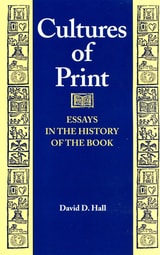
Cultures of Print
Essays in the History of the BookDavid D. Hall
University of Massachusetts Press, 1996
David D. Hall examines the interchange between popular and learned cultures and the practices of reading and writing. His writings deal with change and continuity, exploring the possibility of a reading revolution and arguing for the long duration of a Protestant vernacular tradition. A newly written essay on book culture in the early Chesapeake describes a system of scribal publication. The pieces reflect Hall's belief that the better we understand the production and consumption of books, the closer we come to a social history of culture.
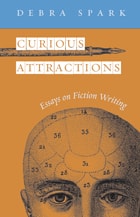
Curious Attractions
Essays on Fiction WritingDebra Spark
University of Michigan Press, 2005
While the book will have immediate appeal for students of writing, it will also be of interest to general readers for its in-depth reading of contemporary fiction and for its take on important issues of the day: Should writers try to be more uplifting? How is emotion best conveyed in fiction? Why are serious writers in North America wedded to the realist tradition?
When she was only twenty-three, Debra Spark's best-selling anthology 20 Under 30 introduced readers to some of today's best writers, including David Leavitt, Susan Minot, Lorrie Moore, Ann Patchett, and Mona Simpson. Almost twenty years later, Spark brings this same keen critical eye to Curious Attractions, discussing a broad range of authors from multiple genres and generations.
A collection of essays in the belles-lettres tradition, Curious Attractions offers lively and instructive discussions of craft flavored with autobiographical reflections and commentary on world events. Throughout, Spark's voice is warm, articulate, and engaging as it provides valuable insights to readers and writers alike.

Curious Encounters with the Natural World
From Grumpy Spiders to Hidden TigersMichael Jeffords
University of Illinois Press, 2017
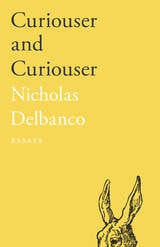
Curiouser and Curiouser
EssaysNicholas Delbanco
The Ohio State University Press, 2017
Whether exploring the history of personal viewing in the business of museum-going, musing on the process of rewriting one’s earliest published work, or looking back on the twists and turns of a life that spans the greater part of the twentieth century and into the twenty-first, Delbanco’s Curiouser and Curiouser invites adventurous readers to follow him down the rabbit hole as he reflects on life as a student, an observer, a writer, a lover, a father, a teacher, and most importantly, a participant in the everyday experiences of human life.