Results by title
3388 books match the query 'Fiction' and 151 start with c
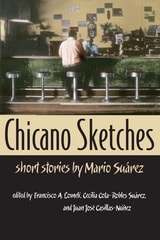
Chicano Sketches
Short Stories by Mario SuárezMario Suárez; Edited by Francisco A. Lomelí, Cecilia Cota-Robles Suárez, and Juan Casillas-Núñez
University of Arizona Press, 2004
A key figure in the foundation of Chicano literature, Mario Suárez (1923–1998) was among the first writers to focus not only on Chicano characters but also on the multicultural space in which they live, whether a Tucson barbershop or a Manhattan boxing ring. Many of his stories have received wide acclaim through publication in periodicals and anthologies; this book presents those eleven previously published stories along with eight others from the archive of his unpublished work. It also includes a biographical introduction and a critical analysis of the stories that will broaden readers’ appreciation for his place in Chicano literature.
In most of his stories, Suárez sought to portray people he knew from Tucson’s El Hoyo barrio, a place usually thought of as urban wasteland when it is thought of at all. Suárez set out to fictionalize this place of ignored men and women because he believed their human stories were worth telling, and he hoped that through his depictions American literature would recognize their existence. By seeking to record the so-called underside of America, Suárez was inspired to pay close attention to people’s mannerisms, language, and aspirations. And by focusing on these barrio characters he also crafted a unique, mild-mannered realism overflowing with humor and pathos.
Along with Fray Angélico Chávez, Suárez stands as arguably the mid-twentieth century’s most important short story writer of Mexican descent. Chicano Sketches reclaims Suárez as a major figure of the genre and offers lovers of fine fiction a chance to rediscover this major talent.
Chick Lit 2
No Chick VicsChris Mazza, Jeffrey DeShell, and Elisabeth Sheffield
University of Alabama Press, 1996
Chick-Lit 2: No Chick Vics features new work by Rikki Ducornet, Eurydice, Elizabeth Graver, Ursule Molinaro, and fourteen other witty and deadly serious writers.
Chick-Lit 2 discovers new and alternative voices in women’s fiction whose stories do not involve trauma that comes from the outside. As Mazza writes in her introduction, “Sexual assaults and harassments and injurious poor body images do exist and have waged a war on women (the American Medical Association says so). But for this book, I was interested in seeing what action(s) women characters can incite on their own, whether bad or good, hopeful or dead-end, progressive or destructive.”
Chick Lit Postfeminist Fiction
Cris Mazza
University of Alabama Press, 2000
A provocative critique of chick lit’s glossy narratives and their complex relationship with postfeminist ideals.
Chick-Lit: Postfeminist Fiction is the fourth volume in “On the Edge: New Women’s Fiction,” FC2’s ongoing effort to discover new and innovative voices in women’s fiction. Determined to contradict the myth that “women don't write experimental fiction,” Chick-Lit discovers women writers with a fresh and irreverent wit and honesty, but no less powerful in their rendering of human experience.
Chick-Lit collects the original fiction of newly discovered writers, but also the award winning work of notable writers like Carole Maso, Jonis Agee, Stacy Levinne and Carolyn Banks. Marked by innovations in form and point-of-view, the writers in this collection are not satisfied with the terrain commonly referred to as “women’s writing.” Insane asylum sex, board games that control people’s lives, a masochistic pedophile humiliated by his victim, an obese woman paying nickels and quarters for attention from teenage girls, a deranged hair stylist and her disloyal dog, a men's impotence therapy group, a surreal landscape constantly producing the body of a woman's mother: this is writing that shouts, yes, there is such a thing as postfeminist fiction.
Child of the Holy Ghost
Robert Laxalt
University of Nevada Press, 1997
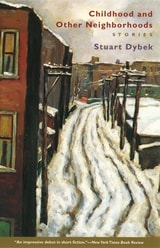
Childhood and Other Neighborhoods
StoriesStuart Dybek
University of Chicago Press, 2003

Children of the Albatross
Anaïs Nin
Ohio University Press, 1959
Children of the Albatross is divided into two sections: “The Sealed Room” focuses on the dancer Djuna and a set of characters, chiefly male, who surround her; “The Café” brings together a cast of characters already familiar to Nin’s readers, but it is their meeting place that is the focal point of the story.
As always, in Children of the Albatross, Nin’s writing is inseparable from her life. From Djuna’s story, told in “The Sealed Room” through hints and allusions, hazy in their details and chronology, the most important event to emerge is her father’s desertion (like Nin’s) when she was sixteen. By rejecting realistic writing for the experience and intuitions she drew from her diary, Nin was able to forge a novelistic style emphasizing free association, spontaneity, and improvisation, a technique that finds its parallel in the jazz music performed at the café where Nin’s characters meet.

Children of the Albatross
Anaïs Nin
Ohio University Press, 2023
The second novel in Anaïs Nin’s Cities of the Interior series, Children of the Albatross is divided into two sections: “The Sealed Room” focuses on the dancer Djuna and a set of characters, chiefly male, who surround her; “The Café” brings together a cast of characters already familiar to Nin’s readers, but it is their meeting place that is the focal point of the story.
As always, in Children of the Albatross, Nin’s writing is inseparable from her life. From Djuna’s story, told in “The Sealed Room” through hints and allusions, hazy in their details and chronology, the most important event to emerge is her father’s desertion (as Nin’s father did) when she was sixteen. By rejecting realistic writing for the experience and intuitions she drew from her diary, Nin was able to forge a novelistic style emphasizing free association, spontaneity, and improvisation, a technique that finds its parallel in the jazz music performed at the café where Nin’s characters meet.
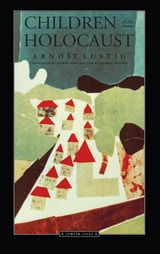
Children of the Holocaust
Arnost Lustig
Northwestern University Press, 1995
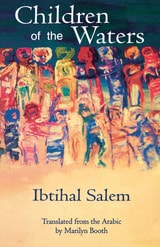
Children of the Waters
By Ibtihal Salem
University of Texas Press, 2002
Ibtihal Salem's writing provides an excellent forum for studying both everyday life in Egypt and current literary experimentation in the Middle East. Her poignant pieces hover between the structure of story-telling, the visuality of vignettes, and the compression of poetry. They both record and evoke a literary ferment going on in Egypt today.
Salem's writing of the last thirty years is lauded for its social messages also. Finding the expression of sexuality necessary to explicate problems of Egyptian identity, Salem often links poverty to gender marginality. Her heroines, however, celebrate the heritages that have shaped them, even as they resist certain aspects of them. Like many writers in Egypt, Salem honors traditional folktales, even as she deals with contemporary problems from class and economic perspectives.
Marilyn Booth, one of the best translators of Arabic fiction working today, has dealt in her introduction to this collection with the unusual experimental form by examining Salem's craft as well as the contextual history surrounding the stories. Since Salem is writing "across genres," Booth helps the reader also by opening each piece with an explanatory comment, often quoting the author, and thus further illuminating Salem's portrayals of lives bounded by Egypt's waters—the Canal, the Nile, and the Mediterranean.
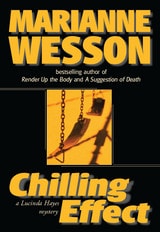
Chilling Effect
A Lucinda Hayes MysteryMarianne Wesson
University Press of Colorado, 2004
When attorney Lucinda Hayes reluctantly agrees to represent the mother of a brutally slain child, she must convince the court that the makers of a pornographic film are liable for the murder. As the case unfolds, Lucinda calls upon all her personal strength and legal talent, facing down her own ghosts as well as the powerful entertainment industry's star lawyers.
In Chilling Effect, Wesson affirms the power of free speech to inspire the best and the worst human behavior and explores the tension between freedom and accountability
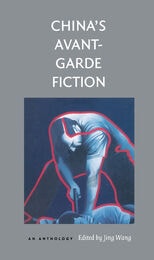
China's Avant-Garde Fiction
An AnthologyJing Wang, ed.
Duke University Press, 1998
Jing Wang has selected provocative examples of this new school of writing, which gained prominence in the late 1980s. Contradicting many long-cherished beliefs about Chinese writers—including the alleged tradition of writing as a political act against authoritarianism—these stories make a dramatic break from conventions of modern Chinese literature by demonstrating an irreverence toward history and culture and by celebrating the artificiality of storytelling. Enriched by the work of a distinguished group of translators, this collection presents an aesthetic experience that may have outraged many revolutionary-minded readers in China, but one that also occupies an important place in the canon of Chinese literature. China’s Avant-Garde Fiction brings together a group of exceptional writers (including Raise the Red Lantern author Su Tong) to the attention of an English-speaking audience.
This book will be enjoyed by those interested in Chinese literature, culture, and society—particularly readers of contemporary fiction.
Contributors. Bei Cun, Can Xue, Gei Fei, Ma Yuan, Su Tong, Sun Ganlu, Yu Hua
Translators. Eva Shan Chou, Michael S. Duke, Howard Goldblatt, Ronald R. Janssen, Andrew F. Jones, Denis C. Mair, Victor H. Mair, Caroline Mason, Beatrice Spade, Kristina M. Torgeson, Jian Zhang, Zhu Hong
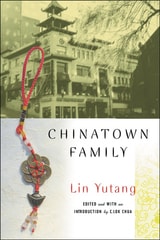
Chinatown Family
Yutang, Lin
Rutgers University Press, 2006
Lin Yutang (1895–1976), author of more than thirty-five books, was arguably the most distinguished Chinese American writer of the twentieth century. In Chinatown Family, he brings humor and wisdom to issues of culture, race, and religion as he tells the engrossing and heart-warming story of an immigrant, working-class Chinese American family that settled in New York City during the 1930s and 1940s. Tracing their sometimes troubled and sometimes rewarding journey, Lin paints a vivid portrait of the wonder and the woe of settling into a new land. In an era when interracial marriages were frowned upon and it was forbidden for working-class Chinese men to bring their families to America, this story shows how one family struggled to become new Americans by applying their Taoist philosophy to resist peacefully the discriminatory laws and racism they encountered.
Beyond the quest for acceptance and economic success, Chinatown Family also probes deep into the heart of the immigration experience by presenting the perils of assimilation. The burgeoning tensionbetween the desire for material wealth and the traditional Chinese belief in the primary importance of family poses the question: Is it possible to attain the American dream without damaging these primary ties? For each family member, the answer to this question turns out to be different. Through the varied paths that each character takes, the novel dramatizes the ways that Chinese immigrants have negotiated between the competing interests of economic opportunity and traditional values.
Chiquinho
A Novel of Cabo VerdeBaltazar Lopes
Tagus Press, 2019
Chocolate and Other Writings on Male Homoeroticism
Pandey Bechan Sharma
Duke University Press, 2009
The stories depict male homoeroticism in quotidian situations: a man brings a lover to his disapproving friend’s house; a good-looking young man becomes the object of desire at his school. The love never ends well, but the depictions are not always unsympathetic. Although Ugra claimed that the stories were aimed at suppressing homosexuality by exposing it, Vanita highlights the ambivalence of his characterizations. Cosmopolitan, educated, and hedonistic, the Hindu and Muslim men he portrayed quote Hindi and Urdu poetry to express their love, and they justify same-sex desire by drawing on literature, philosophy, and world history. Vanita’s introduction includes anecdotal evidence that Chocolate was enthusiastically received by India’s homosexual communities.
Choke Box
a Fem-NoirChristina Milletti
University of Massachusetts Press, 2019
When Edward Tamlin disappears while writing his memoir, Jane Tamlin (his wife and the mother of his young children) begins to write a secret, corrective “counter-memoir” of her own. Calling the book Choke Box, she reveals intimate, often irreverent, details about her family and marriage, rejecting—and occasionally celebrating—her suspected role in her husband's disappearance.
Choke Box isn't Jane's first book. From her room in the Buffalo Psychiatric Institute, she slowly reveals a hidden history of the ghost authorship that has sabotaged her family and driven her to madness. Her latest work, finally written under her own name, is designed to reclaim her dark and troubled story. Yet even as Jane portrays her life as a wife, mother, and slighted artist with sardonic candor, her every word is underscored by one belief above all others: the complete truth is always a secret. But the stories we tell may help us survive—if they don't kill us first.

Christmas on the Great Plains
Dorothy Dodge Robbins
University of Iowa Press, 2004
Cinco Becknell
LEE MAYNARD
West Virginia University Press, 2015
Cinco Becknell is the story of a homeless man with no memory. Locked in the emptiness of his mind is a secret, a past, which will either keep him alive or get him killed.
As Cinco staggers through a dangerous journey of rediscovery, he is hunted by psychopaths who want to kill him, and he has no idea why; he is shadowed by a woman who may keep him alive—or not; and he is finally helped by another woman who can bring back to him the light he looks for—if he can stay alive. But he is running out of time, and people around him are dying, always violently.
Gradually, he begins to understand the true, brutal, nature of himself and of the darkness of his past. But it is a past, and a present, that he may never fully understand.
This novel, based on generations of violent, local family history, is set in the underbelly of the pseudo-glitzy streets of Santa Fe, New Mexico.
Cinnamon
Samar Yazbek
Haus Publishing, 2012
Circus Commentary
Alexander Kluge
Seagull Books, 2024
The circus has fascinated Alexander Kluge ever since he was a child, and his devotion to it has been preserved throughout his cinematic output and his most recent literary work. In the circus, he finds both the shadow image of work and the epitome of human excellence, from love to war to revolution. As surfaces onto which utopias are projected, these elaborate performances offer a tangible representation of developments within civilization, with its nearly infinite possibilities and sometimes inevitable crashes—from the excited roar of the crowd to death on the floor of the ring.
In Circus Commentary, Kluge’s montage of modernities moves back and forth through time and space, expressing his unique mix of fictional and non-fictional reports, histories, and stories through semantic fields, images, and film sequences inserted in the book via QR codes. We encounter a broad panorama of perplexed artists and sophisticated surgeons cavorting alongside fighter pilots, sans-culottes drunk with dreams of omnipotence, and, most importantly, animals—to whose superhuman performances, this book creates a lasting memorial.
Cities in the Sea
Maura Stanton
University of Michigan Press, 2003
Cities of the Interior
Anaïs Nin
Ohio University Press, 1996
Ladders to Fire, Children of the Albatross, The Four-Chambered Heart, A Spy in the House of Love, Seduction of the Minotaur. Haunting and hypnotic, these five novels by Anaïs Nin began in 1946 to appear in quiet succession. Though published separately over the next fifteen years, the five were conceived as a continuous experience—a continuous novel like Proust’s, real and flowing as a river.
The full impact of Anaïs Nin’s genius is only to be found through reading the novels in context and in succession. They form a rich, luminous tapestry whose overall theme Nin has called “woman at war with herself.” Characters, symbols appear and reappear: now one, now another unfolding, gradually revealing, changing, struggling, growing, and Nin had forged an evocative language all her own for the telling.
“The diary taught me that there were no neat ends to novels, no neat denouement, no neat synthesis,” she explains. “So I began an endless novel, a novel in which the climaxes consisted of discoveries in awareness, each step in awareness becoming a stage in the growth like the layers in trees.”
Cities of the Interior fulfills a long–time desire on the part of readers, publisher, and Anaïs Nin herself to reunite the five novels in a single volume.
City in Love
The New York MetamorphosesAlex Shakar
University of Alabama Press, 2026
WINNER OF THE 1996 FC2 NATIONAL FICTION COMPETITION
New York. 1 BC. A mythic metropolis. Dangerous, seductive, and strange.
A Queens schoolchild rises to become a powerful superhero. A scavenger fashions love from the city’s castoffs. A weary detective keeps vigil as the city shifts. A serial prankster spells secrets across the skyline.
Through seven transformative tales, fate-struck characters undertake urgent journeys for belonging and survival in the city that tests, nurtures, and remakes them. Alex Shakar’s debut collection metamorphoses the familiar into the marvelous—sharp, luminous, and wondrously alive.
City of Clans
Geoff Peck
University of Iowa Press, 2025
Jeremy begins a journey of healing and self-reflection that carries him back to his family and his one true friend, Katrina Kovacs, a photography major who opens his eyes to societal issues he’s always ignored. A story of redemption, City of Clans captures the resiliency of the human spirit and explores hidden truths of masculinity, sexuality, and self.
City of Dreadful Night
A Tale of Horror and the Macabre in IndiaLee Siegel
University of Chicago Press, 1995
But what started out as a study of other people's stories became a compelling story itself. City of Dreadful Night is an astonishing work of fiction, a tangle of tales that transports the reader from the Medieval India of magicians, witches, and vampires, through the British India of Brahm Kathuwala's childhood, into the chaos and political terror of contemporary India. Vividly recreating Indian literary and oral traditions, Siegel weaves a web of possession, reincarnation, and magical transformation unlike any found in the Western tradition. Flesh-eating demons, Rajiv Gandhi's assassin, even Bram Stoker and Dracula populate the serpentine narrative, which intermingles stories about the characters with the terrifying tales they tell.
Siegel pursues Brahm Kathuwala from the ghastly lights of the cremation ground at Banaras through villages all over north India. Brahm's life story is revealed through countless tales along the way. We learn that he was raised, and abandoned, by two mothers—one the destitute floor sweeper who bore him; the other her employer, a wealthy Irish woman who read and reread to him the story of Dracula. We hear of his marriage to the daughter of a cremation ground attendant, his battles against her demonic possession, and their painful parting. We come to understand the daily life and motivations of this "horror professional," who uses terrifying tales to ward off the evil he himself fears.
This unorthodox book is more than a story; it blends scholarship, fantasy, travelogue, and autobiography—fusing and overlapping historical accounts and newscasts, literary texts and films, dreams and nocturnal tales. Siegel uses imagination to explore the relation of real terror to horror fiction and to contemplate the ways fear and disgust become thrilling elements in stories of the macabre.
This book is the product of Siegel's deep knowledge of both Indian and Western literary and philosophical traditions. It is also an attempt to come to grips with the omnipresence of political and religious terror in contemporary India. Shocking, original, beautifully written, City of Dreadful Night offers readers a captivating immersion in the wonder and terror of India, past and present.

Classics in Film and Fiction
Edited by Deborah Cartmell, Heidi Kaye, I. Q. Hunter, and Imelda Whelehan
Pluto Press, 2000
Classics in Film and Fiction looks at a wide range of texts and their adaptations. Authors discussed are Shakespeare, Charlotte Bronte, Henry James, Franz Kafka, Thomas Mann, Virginia Woolf, Nathaniel Hawthorne, Arthur Miller, Truman Capote and Lewis Carroll. Book to film adaptations analysed include Jane Eyre, The Crucible, The Tempest and Alice in Wonderland. The collection also evaluates the term 'classic' in a wider context, including a comparison of Joyce's Ulysses with Hitchcock's Rear Window. Throughout, the contributors challenge the dichotomy between high culture and pop culture.
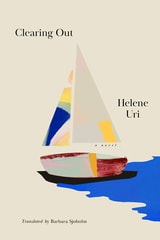
Clearing Out
A NovelHelene Uri
University of Minnesota Press, 2024
Winner of the Nadia Christensen Prize for translation from the American-Scandinavian Foundation
In a masterful blend of fiction and autobiography, a Norwegian novelist sends her character to the far north to learn what she can about their Sami ancestry
Inspired by Helene Uri’s own journey into her family’s ancestry, Clearing Out, an emotionally resonant novel by one of Norway’s most celebrated authors, tells two intertwining stories. A novelist, named Helene, is living in Oslo with her husband and children and contemplating her new protagonist, Ellinor Smidt—a language researcher, divorced and in her late thirties, with a doctorate but no steady job.
An unexpected call from a distant relative reveals that Helene’s grandfather, Nicolai Nilsen, was the son of a coastal (sjø) Sami fisherman—something no one in her family ever talked about. Uncertain how to weave this new knowledge into who she believes she is, Helene continues to write her novel, in which her heroine Ellinor travels to Finnmark in the far north to study the dying languages of the Sami families there. What Ellinor finds among the Sami people she meets is a culture little known in her own world; she discovers history richer and more alluring than rumor and a connection charged with mystery and promise. Through her persistence in approaching an elderly Sami activist, and her relationship with a local Sami man, Ellinor confronts a rift that has existed between two families for generations.
Intricate and beautifully constructed, Clearing Out offers a solemn reflection on how identities, like families, are formed and fractured and recovered as stories are told. In its depiction of the forgotten and the fiercely held memories among the Sea (sjø) Sami of northern Norway, the novel is a powerful statement on what is lost, and what remains in reach, in the character and composition of contemporary life.
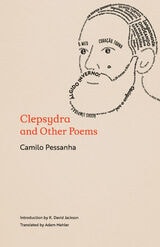
Clepsydra and Other Poems
Camilo Pessanha, Translated by Adam Mahler, Introduction by K. David Jackson
Tagus Press, 2021
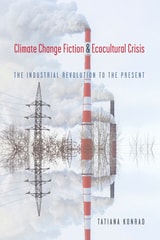
Climate Change Fiction and Ecocultural Crisis
The Industrial Revolution to the PresentTatiana Konrad
University of Nevada Press, 2024
Focusing on a diverse range of issues, including fossil fuels, cheap energy, the intricacies of human–more-than-human relationships, and postcolonial geographies, Konrad illustrates how cli-fi transcends mere storytelling. The genre ultimately emerges as an important means to forecast, imagine, and contemplate climatic events.
The book invites a broadening of the environmental humanities discourse, asking readers not only to deepen their understanding of the current climate crisis, but also to consider how cli-fi culture can be viewed as an effective method to address climate change.
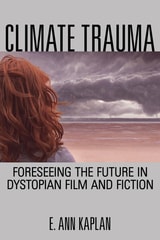
Climate Trauma
Foreseeing the Future in Dystopian Film and FictionKaplan, E. Ann
Rutgers University Press, 2015
Drawing from recent scholarship that analyzes climate change as a form of “slow violence” that humans are inflicting on the environment, Climate Trauma theorizes that such violence is accompanied by its own psychological condition, what its author terms “Pretraumatic Stress Disorder.” Examining a variety of films that imagine a dystopian future, renowned media scholar E. Ann Kaplan considers how the increasing ubiquity of these works has exacerbated our sense of impending dread. But she also explores ways these films might help us productively engage with our anxieties, giving us a seemingly prophetic glimpse of the terrifying future selves we might still work to avoid becoming.
Examining dystopian classics like Soylent Green alongside more recent examples like The Book of Eli, Climate Trauma also stretches the limits of the genre to include features such as Blindness, The Happening, Take Shelter, and a number of documentaries on climate change. These eclectic texts allow Kaplan to outline the typical blind-spots of the genre, which rarely depicts climate catastrophe from the vantage point of women or minorities. Lucidly synthesizing cutting-edge research in media studies, psychoanalytic theory, and environmental science, Climate Trauma provides us with the tools we need to extract something useful from our nightmares of a catastrophic future.
Cloak of Ashes
The Women of Beowulf Book ThreeDonnita L. Rogers
Arizona Center for Medieval and Renaissance Studies, 2000
Closed for Repairs
Nancy Alonso, translated from the Spanish by Anne Fountain
Northwestern University Press, 2007
Closed for Repairs is a series of eleven vignettes that depict Cuban ingenuity in the face of urban problems. Each solution is framed with humor and irony and gives a glimpse of life on the island today.
In a clever fashion, Nancy Alonso shows us the spirit of resolve on the part of Cubans when faced with such issues as transportation problems, lack of water, and the shortage of consumer goods and construction materials caused by the embargo.
Illuminating the endurance and resilience of the Cuban people, these stories will make you chuckle. Alonso's sly wit is compelling as she satirizes the bureaucracy—an element of her work that will resonate universally.
Closely Watched Trains
Bohumil Hrabal
Northwestern University Press, 1995
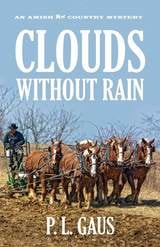
Clouds Without Rain
An Amish Country MysteryP. L. Gaus
Ohio University Press, 2001
Written in the tradition of Tony Hillerman, in Clouds without Rain, P. L. Gaus once again provides compelling intrigue and insight into Amish culture and tradition alongside contemporary American life.
In the wake of a fatal accident involving an Amish buggy and an eighteen-wheeler, Professor Michael Branden, working with the Holmes County Sheriff’s Department, becomes suspicious about the true nature of the crash. His suspicions only grow when the trustee of the dead man’s estate disappears a few days later.
Faced with Amish teenagers in goat masks robbing buggies on dusty lanes, land swindles involving out-of-town developers, several mysterious deaths, and the disappearance of a bank official, Branden realizes that there is far more to the story than a buggy crash on a sleepy country road.
This new edition of Clouds without Rain features an exclusive interview with the author, reading group materials, and a detailed map and driving guide to Holmes County, Ohio with everything one needs to visit the iconic scenes depicted in the story.
Clouds without Rain
An Amish Country MysteryP. L. Gaus
Ohio University Press, 2001
Written in the tradition of Tony Hillerman, in Clouds without Rain, P. L. Gaus once again provides compelling intrigue and insight into Amish culture and tradition alongside contemporary American life.
In the wake of a fatal accident involving an Amish buggy and an eighteen-wheeler, Professor Michael Branden, working with the Holmes County Sheriff’s Department, becomes suspicious about the true nature of the crash. His suspicions only grow when the trustee of the dead man’s estate disappears a few days later.
Faced with Amish teenagers in goat masks robbing buggies on dusty lanes, land swindles involving out-of-town developers, several mysterious deaths, and the disappearance of a bank official, Branden realizes that there is far more to the story than a buggy crash on a sleepy country road.
This new edition of Clouds without Rain features an exclusive interview with the author, reading group materials, and a detailed map and driving guide to Holmes County, Ohio with everything one needs to visit the iconic scenes depicted in the story.
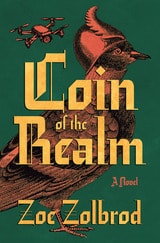
Coin of the Realm
A NovelZoe Zolbrod
Northwestern University Press, 2027
Can liberation be found in the unexpected corners of a Renaissance faire?
In a near-future United States, the government has just stripped away the protections of birthright citizenship, and eighteen-year-old Raven is facing deportation. Her best hope: finding her long-gone father, an off-the-grid Renaissance faire entrepreneur called Tom the Hunter. If Raven can convince Tom to affirm his paternity, she will be able to remain in the only country she has ever known.
But Tom is no easy man locate, let alone tell what to do. The charismatic leader of an underground resistance movement based at a Ren faire in Bristol, Wisconsin, he has spent his life agitating against the ever-increasing reach of corporate and government surveillance while avoiding its gaze. In a society overrun by drones, self-driving cars, and wearable devices that track mood and behavior, he sends messages by pigeon and trains hawks to attack invaders. The only thing from the “regular world” allowed to enter his self-contained realm has been Gwen, his new lover. Facing economic and emotional headwinds after losing her job, Gwen has fled her family and a home dangerously in need of remediation, and she dives headfirst into an affair with the passionate yet conniving Tom. But when Tom’s machinations threaten those around him, Gwen begins to question her choice to leave her children behind for a world that may not be as empowering as it seems.
As Raven and Gwen become enmeshed in the vibrant and insurgent community of Bristol’s Ren faire and Tom’s antics reach unsettling new heights, each must make a choice on where they stand—and with whom.

Cold
John Smolens
Michigan State University Press, 2017
In the frozen reaches of Michigan’s Upper Peninsula, fierce winter storms hit without warning. The white opacity of one such blizzard allows Norman Haas to walk away from his prison work detail. Dangerously close to freezing to death, Norman is given shelter by Liesl Tiomenen, a middle-aged woman who lives in a house she and her late husband built in the woods. Armed with a rifle, she tries to turn him in, but when they set out on snowshoes, she suffers a fall, allowing him to flee again. Thus begins Norman’s journey back to his past, back to the woman he loved who betrayed him, back to the brother who helped put him away, back to a dangerous web of family allegiances, deceptions, and intrigue.
After finding Liesl injured and abandoned in the woods, Yellow Dog Township’s sole full-time law enforcement officer Del Maki pursues Norman through a storm of mythic proportions.
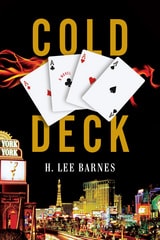
Cold Deck
A NovelH. Lee Barnes
University of Nevada Press, 2013
Cold Deck is the exciting story of an ordinary man who finds himself in extraordinary circumstances. Moving from Las Vegas’s mean streets to the insider’s world of casino workers, this is a story of survival set against the greed, fears, and glitz of Sin City.
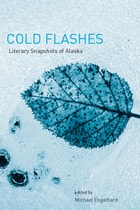
Cold Flashes
Literary Snapshots of AlaskaEdited by Michael Engelhard
University of Alaska Press, 2010
As the old adage goes, "if you can't say it in a few pages, you won't in a hundred." The selections in Cold Flashes—very short prose and black-and-white photographs—embody perfectly this transparency, thrift, and restraint. Found here are highly polished micro-narratives, both fiction and nonfiction, and a series of eloquent and artistic halftones that capture their sizeable subjects in a nutshell. By minimizing the exposition, the selections stimulate the imagination to reflect on the rich diversity of people and places that make up Alaska. To be savored piecemeal at coffee shops, on the bus, or while waiting in line, the images and text in Cold Flashes will resonate with both the reader and each other, fusing into something profound yet elusive.

Cold Spell
Deb Vanasse
University of Alaska Press, 2014
From the moment Ruth Sanders rips a glossy photo of a glacier from a magazine, she believes her fate is intertwined with the ice. Her unsettling fascination bewilders her daughter, sixteen-year-old Sylvie, still shaken by her father’s leaving. When Ruth uproots Sylvie and her sister from their small Midwestern town to follow her growing obsession—and a man—to Alaska, they soon find themselves entangled with an unfamiliar wilderness, a divided community, and one another. As passions cross and braid, the bond between mother and daughter threatens to erode from the pressures of icy compulsion and exposed secrets.
Inspired by her own experience arriving by bush plane to live on the Alaska tundra, Deb Vanasse vividly captures the reality of life in Alaska and the emotional impact of loving a remote and unforgiving land.
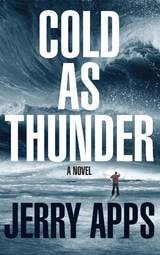
Cold as Thunder
Jerry Apps
University of Wisconsin Press, 2018
In the Midwest, a massive storm sends Lake Michigan surging over the Door County peninsula, and thousands of refugees flee inland. In the midst of this apocalypse, a resourceful band of Wisconsin sixty-somethings calling themselves the Oldsters lays secret plans to fight the ruling regime's propaganda and show people how to think for themselves.
Collages
Anaïs Nin
Ohio University Press, 1964
“Collages began with an image which had haunted me. A friend, Renate, had told me about her trip to Vienna where she was born, and of her childhood relationships to statues. She told me stories of her childhood, her relationship to her father, her first love.
I begin the novel with:
Vienna was the city of statues. They were as numerous as the people who walked the streets. They stood on the top of the highest towers, law down on stone tombs, sat on horseback, kneeled, prayed, fought animals and wars, danced, drank wine and read books made of stone. They adorned cornices like the figureheads of old ships. They stood in the heart of fountains glistening with water as if they had just been born. They sat under the trees in the parks summer and winter. Some wore costumes of other periods, and some no clothes at all. Men, women, children, kings, dwarfs, gargoyles, unicorns, lions, clowns, heroes, wise men, prophets, angels, saints, and soldiers preserved for Vienna a vision of eternity.
As a child Renate could see them from her bedroom window. At night, when the white muslin curtains fluttered out like ballooning wedding dresses, she heard them whispering like figures which had been petrified by a spell during the day and came alive only at night. Their silence by day taught her to read their frozen lips as one reads the messages of deaf mutes. On rainy days their granite eye sockets shed tears mixed with soot.
Renate would never allow anyone to tell her the history of the statues, or to identify them. This would have situated them in the past. She was convinced that people did not die, they became statues. They were people under a spell and if she were watchful enough they would tell her who they were and how they lived now.
If I had been asked then what was going to follow the description of the statues, I could not have answered. I was fascinated by the image of these many statues and of the child Renate inventing stories about them and dialoguing with them. It may have been that this image expressed the feeling I often had that people appear to us as a one-dimensional statue until we go deeper into their life story. People are like mute statues under a spell of appearance, and static, until we let them whisper their secrets. And this only happens at night. That is, when we are able to dream, imagine, and explore the unconscious. We see the external self. Because Collages took its images from painting and sculpture, I liked the idea that sculpture and painting could become animated, speaking, confessing, and then in daylight returning to their previous forms as statues or paintings. They spoke only to the artist. To me it meant dramatizing our relation to art, one feeding the other, the interrelation between human beings and the artist’s conception of them. In daylight (consciousness) we catch them all only in one attitude, one form. At night, we discover their lives.”
—Anaïs Nin, “The Novel of the Future,” (Athens: Ohio University Press, 1986), 128
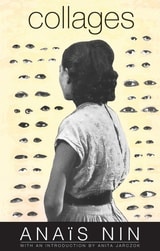
Collages
Anaïs Nin
Ohio University Press, 2019
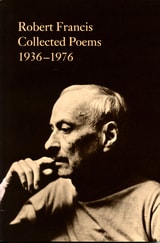
Collected Poems, 1936-1976
Robert Francis
University of Massachusetts Press, 1976
Gathered here in their entirety are the seven previous volumes of Robert Francis poetry—Stand with Me Here, Valhalla and Other Poems, The Sound I Listened For, The Face against the Glass, The Orb Weaver, Come Out into the Sun, and Like Ghosts of Eagles—together with a group of recent poems, many not previously published but “saved” to end this volume on a note of newness.
Because the original seven volumes are kept in chronological order, the reader can follow the author's journey from his quiet early work to poetry of greater color, warmth, vitality, vivacity, and sportiveness; and can note just when and where Francis' style becomes more and more diversified, with word-count, fragmented surface, and the celebration of words themselves.
The book is graced with eight wood engravings by Wang Hui-Ming.
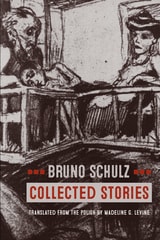
Collected Stories
Bruno Schulz, Translated from the Polish by Madeline G. Levine Foreword by Rivka Galchen
Northwestern University Press, 2018
Collected Stories is an authoritative new translation of the complete fiction of Bruno Schulz, whose work has influenced writers as various as Salman Rushdie, Cynthia Ozick, Jonathan Safran Foer, Philip Roth, Danilo Kiš, and Roberto Bolaño.
Schulz’s prose is renowned for its originality. Set largely in a fictional counterpart of his hometown of Drohobych, his stories merge the real and the surreal. The most ordinary objects—the wind, an article of clothing, a plate of fish—can suddenly appear unfathomably mysterious and capable of illuminating profound truths. As Father, one of his most intriguing characters, declaims: “Matter has been granted infinite fecundity, an inexhaustible vital force, and at the same time, a seductive power of temptation that entices us to create forms.”
This comprehensive volume brings together all of Schulz's published stories—Cinnamon Shops, his most famous collection (sometimes titled The Street of Crocodiles in English), The Sanatorium under the Hourglass, and an additional four stories that he did not include in either of his collections. Madeline G. Levine’s masterful new translation shows contemporary readers how Schulz, often compared to Proust and Kafka, reveals the workings of memory and consciousness.

College Girls
A Century in FictionShirley Marchalonis
Rutgers University Press, 1995
Since the opening of Vassar College in 1865, objections to higher education for women have ranged from charges that females were mentally and physically incapable of learning to the belief that educating women would destroy society. Underlying all arguments was the folk wisdom which declared that women could not live and work together. To counteract such beliefs, women’s colleges tried to create a special kind of space and new role models that would allow women to exist for a short time in idyllic (or, at least, idealized) conditions. The debate over women’s education, for the good or ill of society, generated a great deal of "print," including short stories and novels. Shirley Marchalonis guides us through the history of this fiction, its depiction of the complexities of the college experience, and the conflicting attitudes that teetered between fascination and fear, celebration and regret.
Using novels, short stories, and some juvenile fiction from 1865 to 1940--all of it specifically about college “girls”--she examines these ideas, the way they developed over time, and their significance in understanding women’s education and women’s history. The debate over separate colleges for women continues to this day and can be better understood in the context of this informative and entertaining look at the past.
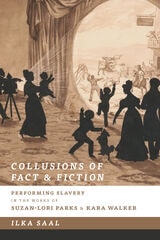
Collusions of Fact and Fiction
Performing Slavery in the Works of Suzan-Lori Parks and Kara WalkerSaal, Ilka
University of Iowa Press, 2021
Saal argues that the attempt to reconstruct or recuperate the experience of African Americans under slavery is no longer at stake in the works of artists growing up in the post–Civil Rights era. Instead, they lay bare the discursive dimension of our contemporary understanding of the past and address the continued impact of its various verbal and visual signs upon contemporary identities. In this manner, Parks and Walker stake out new possibilities for engaging the past and inhabiting the present and future.
Color of Law
A NovelDavid Milofsky
University Press of Colorado, 2000
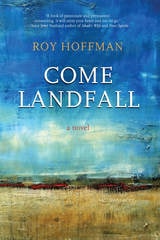
Come Landfall
A NovelRoy Hoffman
University of Alabama Press, 2014
The Gulf Coast serves as more than just a setting—it is a character unto itself. With casinos lining one side of the highway, antebellum homes along the other, and a Vietnamese neighborhood up the road, here the old South collides with the new. From households along this stretch of US 90, lineages and emotional connections stretch all over the world.
Inspired by true events, Roy Hoffman’s novel has its seeds in the saga of his uncle, Maj. Roy Robinton, US Marine Corps, a WWII prisoner of war in the Philippines who disappeared as captive on a Japanese “hellship.” His young bride, back home, was ground down, waiting.
Christiane returns in her mind to the man she married at twenty-one—Rosey, a flyer with the Army Air Corps who was in the Philippines at the outbreak of WWII. Angela meets Frank, an airman at Keesler Air Force base who is proudly patriotic, deeply religious, and a student of weather. Cam falls in love with Joe, a Biloxi cop, and her own tumultuous story begins to interweave with that of Angela’s and Nana’s. What’s taken from Nana, Angela, and Cam (and so many others when storms make their landfall), what’s given back, and what’s kept forever sit at the heart of this
intimate yet expansive novel.
Come in at the Door
William March
University of Alabama Press, 1934
Come in at the Door is the first in March’s “Pearl County” collection, and it tells the story of Chester, a boy who lives with his withholding, widowed father, and Mitty, who keeps house and serves as a surrogate wife to Chester’s father and a mother to Chester. One morning before dawn, Mitty takes Chester to the Athlestan courthouse to watch the hanging of a man who’d killed “a grotesque, dwarflike creature” he thought had “laid a conjure” on him.
Throughout Chester’s rambunctious young manhood, the gruesome memory hovers just below the surface of his mind, recalled in detail only at his father’s death, when the book sweeps forward to its shattering denouement. A classic of Southern Gothic that illuminates family, class, race, and gender, Come in at the Door marks the homecoming of a Southern storyteller at the peak of his craft.
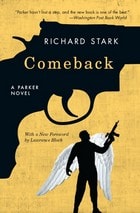
Comeback
A Parker NovelRichard Stark
University of Chicago Press, 2011
Parker returned to action after 23 years away, and he did so with a bang in this classic entry in the long-running hard-boiled crime series
Richard Stark's Parker novels are the hardest of hard-boiled, classic crime novels where the heists are huge, the body counts are high, and the bad guys usually win.
The Parker novels have been a huge influence on countless writers and filmmakers, including Quentin Tarantino, Stephen King, George Pelecanos, Colson Whitehead, Lucy Sante, John Banville, and many more. Their stripped-down language and hard-as-nails amorality create an unforgettable world where the next score could be the big one, but your next mistake could also be your last. There's nothing else like them.
After the bloodbath of Butcher’s Moon, the action-filled blowout Parker adventure, Donald Westlake said, "Richard Stark proved to me that he had a life of his own by simply disappearing. He was gone." And for nearly twenty-five years, he stayed away, while readers waited.
But nothing bad is truly gone forever, and Parker’s as bad as they come. According to Westlake, one day in 1997, “suddenly, he came back from the dead, with a chalky prison pallor”—and the resulting novel, Comeback, showed that neither Stark nor Parker had lost a single step. Knocking over a highly lucrative religious revival show, Parker reminds us that not all criminals don ski masks—some prefer to hide behind the wings of fallen angels.