Results by title
1917 books match the query 'Law' and 180 start with c
Comparative Law and Economics
Ugo Mattei
University of Michigan Press, 1998
Mattei shows how concepts from economics can be applied to the study of comparative law. He then applies the concepts to several significant problems in comparative law, including the history and sources of law, differences between civil and common law systems, and the reasons for legal change and the movement of law from one country to another. He looks at specific problems in property, contracts, and trust law. Finally he uses the insights he has developed to understand the issues involved in changing law in developing countries and in formerly socialist countries.
This book will be of interest to scholars of law, economics, and development, as well as those interested in transformation in formerly communist states.
Ugo Mattei is Alfred and Hanna Fromm Professor of International and Comparative Law, Hastings College of Law, University of California; and Professor of Civil Law, University of Trento.
Conceiving Normalcy
Rhetoric, Law, and the Double Binds of InfertilityElizabeth C. Britt
University of Alabama Press, 2001
This ground-breaking rhetorical analysis examines a 1987 Massachusetts law affecting infertility treatment and the cultural context that makes such a law possible
Elizabeth C. Britt uses a Massachusetts statute requiring insurance coverage for infertility as a lens through which the work of rhetoric in complex cultural processes can be better understood. Countering the commonsensical notion that mandatory insurance coverage functions primarily to relieve the problem of infertility, Britt argues instead that the coverage serves to expose its contours.
Britt finds that the mandate, operating as a technology of normalization, helps to identify the abnormal (the infertile) and to create procedures by which the abnormal can be subjected to reform. In its role in normalizing processes, the mandate is more successful when it sustains, rather than resolves, the distinction between the normal and the abnormal. This distinction is achieved in part by the rhetorical mechanism of the double bind. For the middle-class white women who are primarily served by the mandate, these double binds are created both by the desire for success, control, and order and by adherence to medical models that often frustrate these same desires. The resulting double binds help to create and sustain the tension between fertility and infertility, order and discontinuity, control and chaos, success and failure, tensions that are essential for the process of normalization to continue.
Britt uses extensive interviews with women undergoing fertility treatments to provide the foundation for her detailed analysis. While her study focuses on the example of infertility, it is also more broadly a commentary on the power of definition to frame experience, on the burdens and responsibilities of belonging to social collectives, and on the ability of rhetorical criticism to interrogate cultural formations.
Conceptual Activism
Radical Sense-Making and the Struggle for GenderDavina Cooper
Duke University Press, 2026
Confident Pluralism
Surviving and Thriving through Deep DifferenceJohn D. Inazu
University of Chicago Press, 2016
In Confident Pluralism, John D. Inazu analyzes the current state of the country, orients the contemporary United States within its broader history, and explores the ways that Americans can—and must—strive to live together peaceably despite our deeply engrained differences. Pluralism is one of the founding creeds of the United States—yet America’s society and legal system continues to face deep, unsolved structural problems in dealing with differing cultural anxieties and differing viewpoints. Inazu not only argues that it is possible to cohabitate peacefully in this country, but also lays out realistic guidelines for our society and legal system to achieve the new American dream through civic practices that value toleration over protest, humility over defensiveness, and persuasion over coercion.
The paperback edition includes a new preface that addresses the election of Donald Trump, the decline in civic discourse after the election, the Nazi march in Charlottesville, and more, this new edition of Confident Pluralism is an essential clarion call during one of the most troubled times in US history. Inazu argues for institutions that can work to bring people together as well as political institutions that will defend the unprotected. Confident Pluralism offers a refreshing argument for how the legal system can protect peoples’ personal beliefs and differences and provides a path forward to a healthier future of tolerance, humility, and patience.
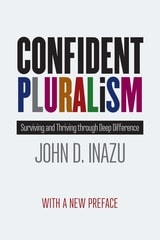
Confident Pluralism
Surviving and Thriving through Deep DifferenceJohn D. Inazu
University of Chicago Press, 2018
In Confident Pluralism, John D. Inazu analyzes the current state of the country, orients the contemporary United States within its broader history, and explores the ways that Americans can—and must—strive to live together peaceably despite our deeply engrained differences. Pluralism is one of the founding creeds of the United States—yet America’s society and legal system continues to face deep, unsolved structural problems in dealing with differing cultural anxieties and differing viewpoints. Inazu not only argues that it is possible to cohabitate peacefully in this country, but also lays out realistic guidelines for our society and legal system to achieve the new American dream through civic practices that value toleration over protest, humility over defensiveness, and persuasion over coercion.
With a new preface that addresses the election of Donald Trump, the decline in civic discourse after the election, the Nazi march in Charlottesville, and more, this new edition of Confident Pluralism is an essential clarion call during one of the most troubled times in US history. Inazu argues for institutions that can work to bring people together as well as political institutions that will defend the unprotected. Confident Pluralism offers a refreshing argument for how the legal system can protect peoples’ personal beliefs and differences and provides a path forward to a healthier future of tolerance, humility, and patience.
Confident Pluralism
Surviving and Thriving through Deep DifferenceJohn D. Inazu
University of Chicago Press, 2018
In the years since Donald Trump first announced his plans to run for president, the United States seems to become more dramatically polarized and divided with each passing month. There are seemingly irresolvable differences in the beliefs, values, and identities of citizens across the country that too often play out in our legal system in clashes on a range of topics such as the tensions between law enforcement and minority communities. How can we possibly argue for civic aspirations like tolerance, humility, and patience in our current moment?
In Confident Pluralism, John D. Inazu analyzes the current state of the country, orients the contemporary United States within its broader history, and explores the ways that Americans can—and must—strive to live together peaceably despite our deeply engrained differences. Pluralism is one of the founding creeds of the United States—yet America’s society and legal system continues to face deep, unsolved structural problems in dealing with differing cultural anxieties and differing viewpoints. Inazu not only argues that it is possible to cohabitate peacefully in this country, but also lays out realistic guidelines for our society and legal system to achieve the new American dream through civic practices that value toleration over protest, humility over defensiveness, and persuasion over coercion.
With a new preface that addresses the election of Donald Trump, the decline in civic discourse after the election, the Nazi march in Charlottesville, and more, this new edition of Confident Pluralism is an essential clarion call during one of the most troubled times in US history. Inazu argues for institutions that can work to bring people together as well as political institutions that will defend the unprotected. Confident Pluralism offers a refreshing argument for how the legal system can protect peoples’ personal beliefs and differences and provides a path forward to a healthier future of tolerance, humility, and patience.
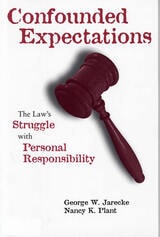
Confounded Expectations
The Law's Struggle with Personal ResponsibilityGeorge W. Jarecke and Nancy K. Plant
Southern Illinois University Press, 2000
George W. Jarecke and Nancy K. Plant present a selection of cases across a broad spectrum of American law to demonstrate that our society relies inappropriately on the legal system to cure ills the system was not designed to address.
Jarecke and Plant note that while we in the United States worry considerably about the problem of individual assumption of responsibility—whether for personal mistakes, financial setbacks, or pure bad luck—we appear uneasy about the concept and unclear about what it means on a daily basis. Not only are we incapable of accepting personal responsibility; we barely know what it means to do so.
Mistakenly, we turn to the legal system to solve this dilemma. Yet our laws as our legislators write them, as judges interpret them, as lawyers argue them, and as juries apply them send mixed messages about whether and how we should exercise personal responsibility.
Each chapter of Confounded Expectations features one main case to explain one legal theory, with other cases noted as examples of facets of each theory. To demonstrate the law that requires merchants to guarantee the quality of their products, for example, Jarecke and Plant discuss the case of the band mothers whose fund-raising luncheon menu included turkey salad contaminated by salmonella. Peripheral cases include a horse falsely sold as a gelding, a riding mower that tipped over when used as instructed, makeup that was guaranteed to be safe but caused a rash, and pigs sick with hog cholera.
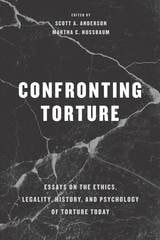
Confronting Torture
Essays on the Ethics, Legality, History, and Psychology of Torture TodayEdited by Scott A. Anderson and Martha C. Nussbaum
University of Chicago Press, 2018
Confronting Torture offers a multidisciplinary investigation of this wrenching topic. Editors Scott A. Anderson and Martha C. Nussbaum bring together a diversity of scholars to grapple with many of torture’s complexities, including: How should we understand the impetus to use torture? Why does torture stand out as a particularly heinous means of war-fighting? Are there any sound justifications for the use of torture? How does torture affect the societies that employ it? And how can we develop ethical or political bulwarks to prevent its use? The essays here resist the temptation to oversimplify torture, drawing together work from scholars in psychology, history, sociology, law, and philosophy, deepening and broadening our grasp of the subject. Now, more than ever, torture is something we must think about; this important book offers a diversity of timely, constructive responses on this resurgent and controversial subject.

Confronting the "Good Death"
Nazi Euthanasia on Trial, 1945-1953Michael S. Bryant
University Press of Colorado, 2022
The first author to address the impact of geopolitics on the courts’ representation of Nazi euthanasia, Bryant argues that international power relationships wreaked havoc on the prosecutions.
Drawing on primary sources, this provocative investigation of the Nazi campaign against the mentally ill and the postwar quest for justice will interest general readers and provide critical information for scholars of Holocaust studies, legal history, and human rights. Support for this publication was generously provided by the Eugene M. Kayden Fund at the University of Colorado.
Congress and the Constitution
Neal Devins and Keith E. Whittington, eds.
Duke University Press, 2005
Several contributors offer wide-ranging accounts of the workings of Congress. They look at lawmakers’ attitudes toward Congress’s role as a constitutional interpreter, the offices within Congress that help lawmakers learn about constitutional issues, Congress’s willingness to use its confirmation power to shape constitutional decisions by both the executive and the courts, and the frequency with which congressional committees take constitutional questions into account. Other contributors address congressional deliberation, paying particular attention to whether Congress’s constitutional interpretations are sound. Still others examine how Congress and the courts should respond to one another’s decisions, suggesting how the courts should evaluate Congress’s work and considering how lawmakers respond to Court decisions that strike down federal legislation. While some essayists are inclined to evaluate Congress’s constitutional interpretation positively, others argue that it could be improved and suggest institutional and procedural reforms toward that end. Whatever their conclusions, all of the essays underscore the pervasive and crucial role that Congress plays in shaping the meaning of the Constitution.
Contributors. David P. Currie, Neal Devins, William N. Eskridge Jr.. John Ferejohn, Louis Fisher, Elizabeth Garrett, Michael J. Gerhardt, Michael J. Klarman, Bruce G. Peabody, J. Mitchell Pickerill, Barbara Sinclair, Mark Tushnet, Adrian Vermeule, Keith E. Whittington, John C. Yoo
Congress and the Crisis of the 1850s
Paul Finkelman
Ohio University Press, 2011
During the long decade from 1848 to 1861 America was like a train speeding down the track, without an engineer or brakes. The new territories acquired from Mexico had vastly increased the size of the nation, but debate over their status—and more importantly the status of slavery within them—paralyzed the nation. Southerners gained access to the territories and a draconian fugitive slave law in the Compromise of 1850, but this only exacerbated sectional tensions. Virtually all northerners, even those who supported the law because they believed that it would preserve the union, despised being turned into slave catchers. In 1854, in the Kansas-Nebraska Act, Congress repealed the ban on slavery in the remaining unorganized territories. In 1857, in the Dred Scott case, the Supreme Court held that all bans on slavery in the territories were unconstitutional. Meanwhile, northern whites, free blacks, and fugitive slaves resisted the enforcement of the 1850 fugitive slave law. In Congress members carried weapons and Representative Preston Brooks assaulted Senator Charles Sumner with a cane, nearly killing him. This was the decade of the 1850s and these were the issues Congress grappled with.
This volume of new essays examines many of these issues, helping us better understand the failure of political leadership in the decade that led to the Civil War.
Contributors
Spencer R. Crew
Paul Finkelman
Matthew Glassman
Amy S. Greenberg
Martin J. Hershock
Michael F. Holt
Brooks D. Simpson
Jenny Wahl
Congress and the People’s Contest
The Conduct of the Civil WarPaul Finkelman
Ohio University Press, 2018
Conservative Innovators
How States Are Challenging Federal PowerBen Merriman
University of Chicago Press, 2019
Conservative Innovators traces the activity of far-right conservatives in Kansas who have in the past decade used the powers of state-level offices to fight federal regulation on a range of topics from gun control to voting processes to Medicaid. Telling their story, Ben Merriman then expands the scope of the book to look at the tactics used by conservative state governments across the country to resist federal regulations, including coordinated lawsuits by state attorneys general, refusals to accept federal funds and spending mandates, and the creation of programs designed to restrict voting rights. Through this combination of state-initiated lawsuits and new administrative practices, these state officials weakened or halted major parts of the Obama Administration’s healthcare, environmental protection, and immigration agendas and eroded federal voting rights protections. Conservative Innovators argues that American federalism is entering a new, conflict-ridden era that will make state governments more important in American life than they have been at any time in the past century.
Conserving Nature in Greater Yellowstone
Controversy and Change in an Iconic EcosystemRobert B. Keiter
University of Chicago Press, 2025
For more than 150 years, the Yellowstone region—now widely known as the twenty-three million acre Greater Yellowstone Ecosystem—has played a prominent role in the United States’ nature conservation agenda. In this book, Robert B. Keiter, an award-winning public land law and policy expert, traces the evolution and application of fundamental ecological conservation concepts tied to Yellowstone.
Keiter’s book highlights both the conservation successes and controversies connected with this storied region, which has been enmeshed in change. During the 1980s, leaders in Yellowstone embraced ecosystem management concepts to recover a dwindling grizzly bear population and to support wolf reintroduction. Since then, management policies in the region’s two national parks and adjacent national forests have largely followed suit, prioritizing ecosystem-level conservation over industrial activity. Groundbreaking efforts are currently afoot to protect elk, deer, and pronghorn migration corridors and to maintain the park’s bison population, effectively expanding the scope of regional conservation initiatives. But in the face of explosive human population growth and related development pressures, new efforts must also account for the region’s privately owned lands along with accelerating recreational activities that present quite different problems.
Indeed, the Greater Yellowstone Ecosystem—extending across three states and twenty counties and embracing more than sixteen million acres of federal land as well as private and tribal lands —can only be characterized as a complex, jurisdictionally fragmented landscape. As Keiter makes clear, the quest for common ground among federal land managers, state officials, local communities, conservationists, ranchers, Indigenous tribes, and others is a vital, enduring task.
Exploring both notable conservation accomplishments and the ongoing challenges confronting this special place, Keiter’s book explains the many forces—scientific, political, economic, legal, cultural, climatic, and more—at work driving controversy and change across the region. But more than this, Conserving Nature in Greater Yellowstone shows us that the lessons gleaned from Yellowstone’s expansive nature conservation efforts are profoundly important for both the country and the world.
Conserving Nature in Greater Yellowstone
Controversy and Change in an Iconic EcosystemRobert B. Keiter
University of Chicago Press, 2025
The story of how Yellowstone, established in 1872 as the world’s first national park, has become synonymous with nature conservation—and an examination of today’s challenges to preserve the region’s wilderness heritage.
For more than 150 years, the Yellowstone region—now widely known as the twenty-three million acre Greater Yellowstone Ecosystem—has played a prominent role in the United States’ nature conservation agenda. In this book, Robert B. Keiter, an award-winning public land law and policy expert, traces the evolution and application of fundamental ecological conservation concepts tied to Yellowstone.
Keiter’s book highlights both the conservation successes and controversies connected with this storied region, which has been enmeshed in change. During the 1980s, leaders in Yellowstone embraced ecosystem management concepts to recover a dwindling grizzly bear population and to support wolf reintroduction. Since then, management policies in the region’s two national parks and adjacent national forests have largely followed suit, prioritizing ecosystem-level conservation over industrial activity. Groundbreaking efforts are currently afoot to protect elk, deer, and pronghorn migration corridors and to maintain the park’s bison population, effectively expanding the scope of regional conservation initiatives. But in the face of explosive human population growth and related development pressures, new efforts must also account for the region’s privately owned lands along with accelerating recreational activities that present quite different problems.
Indeed, the Greater Yellowstone Ecosystem—extending across three states and twenty counties and embracing more than sixteen million acres of federal land as well as private and tribal lands —can only be characterized as a complex, jurisdictionally fragmented landscape. As Keiter makes clear, the quest for common ground among federal land managers, state officials, local communities, conservationists, ranchers, Indigenous tribes, and others is a vital, enduring task.
Exploring both notable conservation accomplishments and the ongoing challenges confronting this special place, Keiter’s book explains the many forces—scientific, political, economic, legal, cultural, climatic, and more—at work driving controversy and change across the region. But more than this, Conserving Nature in Greater Yellowstone shows us that the lessons gleaned from Yellowstone’s expansive nature conservation efforts are profoundly important for both the country and the world.
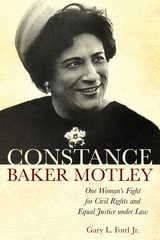
Constance Baker Motley
One Woman's Fight for Civil Rights and Equal Justice under LawGary L. Ford Jr.
University of Alabama Press, 2017
The story of NAACP’s sole female attorney. She shaped civil rights history as lead strategist and litigator from 1946–1964, arguing landmark desegregation cases and defending Martin Luther King Jr. and countless freedom fighters.
Constance Baker Motley was an African American woman; the daughter of immigrants from Nevis, British West Indies; a wife; and a mother who became a pioneer and trailblazer in the legal profession. She broke down barriers, overcame gender constraints, and operated outside the boundaries placed on black women by society and the civil rights movement. In Constance Baker Motley: One Woman’s Fight for Civil Rights and Equal Justice under Law, Gary L. Ford Jr. explores the key role Motley played in the legal fight to desegregate public schools as well as colleges, universities, housing, transportation, lunch counters, museums, libraries, parks, and other public accommodations.
The only female attorney at the NAACP Legal Defense and Educational Fund, Inc., Motley was also the only woman who argued desegregation cases in court during much of the civil rights movement. From 1946 through 1964, she was a key litigator and legal strategist for landmark civil rights cases including the Montgomery Bus Boycott and represented Martin Luther King Jr. as well as other protesters arrested and jailed as a result of their participation in sit-ins, marches, and freedom rides.
Motley was a leader who exhibited a leadership style that reflected her personality traits, skills, and strengths. She was a visionary who formed alliances and inspired local counsel to work with her to achieve the goals of the civil rights movement. As a leader and agent of change, she was committed to the cause of justice and she performed important work in the trenches in the South and behind the scene in courts that helped make the civil rights movement successful.
"Highly recommended."
—CHOICE
Constituent Interests and U.S. Trade Policies
Alan V. Deardorff and Robert M. Stern
University of Michigan Press, 1998
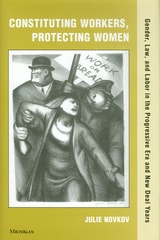
Constituting Workers, Protecting Women
Gender, Law and Labor in the Progressive Era and New Deal YearsJulie Novkov
University of Michigan Press, 2001
During the Progressive Era and New Deal, courts often invalidated generalized protective legislation, but frequently upheld measures that limited women's terms and conditions of labor. The book explores the reasoning in such cases that were decided between 1873 and 1937. By analyzing all reported opinion on the state and federal level, as well as materials from the women's movement and briefs filed in the U.S. Supreme Court, the study demonstrates that considerations of cases involving women's measures ultimately came to drive the development of doctrine.
The study combines historical institutionalism and feminism to address constitutional interpretation, showing that an analysis of conflict over the meaning of legal categories provides a deeper understanding of constitutional development. In doing so, it rejects purely political interpretations of the so-called Lochner era, in which the courts invalidated many legislative efforts to ameliorate the worst effects of capitalism. By addressing the dynamic interactions among interested laypersons, attorneys, and judges, it demonstrates that no individuals or institutions have complete control over the generation of constitutional meaning.
Julie Novkov is Assistant Professor of Political Science, University of Oregon

Constituting Workers, Protecting Women
Gender, Law and Labor in the Progressive Era and New Deal YearsJulie Novkov
University of Michigan Press, 0
During the Progressive Era and New Deal, courts often invalidated generalized protective legislation, but frequently upheld measures that limited women's terms and conditions of labor. The book explores the reasoning in such cases that were decided between 1873 and 1937. By analyzing all reported opinion on the state and federal level, as well as materials from the women's movement and briefs filed in the U.S. Supreme Court, the study demonstrates that considerations of cases involving women's measures ultimately came to drive the development of doctrine.
The study combines historical institutionalism and feminism to address constitutional interpretation, showing that an analysis of conflict over the meaning of legal categories provides a deeper understanding of constitutional development. In doing so, it rejects purely political interpretations of the so-called Lochner era, in which the courts invalidated many legislative efforts to ameliorate the worst effects of capitalism. By addressing the dynamic interactions among interested laypersons, attorneys, and judges, it demonstrates that no individuals or institutions have complete control over the generation of constitutional meaning.
Julie Novkov is Assistant Professor of Political Science, University of Oregon
Constitution for a Disunited Nation
On Hungary's 2011 Fundamental LawGábor Attila Tóth
Central European University Press, 2013
Constitution-Making in the Region of Former Soviet Dominance
Rett R. Ludwikowski
Duke University Press, 1996
Beginning with a review of the constitutional traditions of Eastern and Central Europe, Ludwikowski goes on to offer analysis of the recent process of political change in the region. A second section focuses specifically on the the new constitutions and such issues as the selection of the form of government, concepts of divisions of power, unicameralism vs. bicameralism, the flexibility or rigidity of constitutions as working documents, and the process of reviewing the constitutionality of laws. Individual states as framed in these documents are analyzed in economic, political, and cultural terms. Although it is too soon to fully consider the implementation of these constitutions, special attention is devoted to the effect of reform on human rights protection, a notorious problem of continuing concern in the region. A final section offers an insightful comparative study of constitutional law by reviewing the post-Soviet process of constitution-making against the backdrop of Western constitutional traditions.
Constitution-Making in the Region of Former Soviet Dominance is both a comprehensive study of constitutional developments in the former Soviet bloc and a primary reference tool for scholars of constitutional law, and Eastern European and post-Soviet studies.
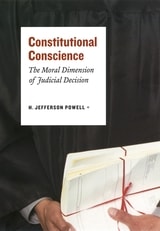
Constitutional Conscience
The Moral Dimension of Judicial DecisionH. Jefferson Powell
University of Chicago Press, 2008
Powell argues that almost every controversial decision has more than one constitutionally defensible resolution. In such cases, he goes on to contend, the language and ideals of the Constitution require judges to decide in good faith, exercising what Powell calls the constitutional virtues: candor, intellectual honesty, humility about the limits of constitutional adjudication, and willingness to admit that they do not have all the answers. Constitutional Conscience concludes that the need for these qualities in judges—as well as lawyers and citizens—is implicit in our constitutional practices, and that without them judicial review would forfeit both its own integrity and the credibility of the courts themselves.
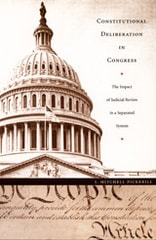
Constitutional Deliberation in Congress
The Impact of Judicial Review in a Separated SystemJ. Mitchell Pickerill
Duke University Press, 2004
Pickerill combines legislative histories, extensive empirical findings, and interviews with current and former members of Congress, congressional staff, and others. He examines data related to all of the federal legislation struck down by the Supreme Court from the beginning of the Warren Court in 1953 through the 1996–97 term of the Rehnquist Court. By looking at the legislative histories of Congressional acts that invoked the Commerce Clause and presented Tenth Amendment conflicts—such as the Child Labor Act (1916), the Civil Rights Act (1965), the Gun-Free School Zones Act (1990), and the Brady Bill (1994)—Pickerill illuminates how Congressional deliberation over newly proposed legislation is shaped by the possibility of judicial review. The Court’s invalidation of the Gun-Free School Zones Act in its 1995 ruling United States v. Lopez signaled an increased judicial activism regarding issues of federalism. Pickerill examines that case and compares congressional debate over constitutional issues in key pieces of legislation that preceded and followed it: the Violence Against Women Act of 1994 and the Hate Crimes Prevention Act of 1997. He shows that Congressional attention to federalism increased in the 1990s along with the Court’s greater scrutiny.
Constitutional Democracy
János Kis
Central European University Press, 2003
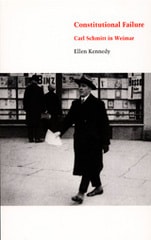
Constitutional Failure
Carl Schmitt in WeimarEllen Kennedy
Duke University Press, 2004
Kennedy reveals how Schmitt’s argument for a strong but neutral state supported the maximization of market freedom at the cost of the political constitution. She argues that the major fault lines of Weimar liberalism—emergency powers, the courts as “defenders of the constitution,” mass mobilization of anti-liberal politics, ethnic-identity politics, a culture of resentment and contested legitimacy—are not exceptions within the liberal-democratic orders of the West, but central to them. Contending that Schmitt’s thought remains vital today because liberal norms are inadequate to the political challenges facing constitutional systems as diverse as those of Eastern Europe and the United States, Kennedy develops a compelling, rigorous argument that unsettles many assumptions about liberalism, democracy, and dictatorship.
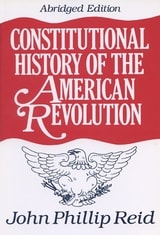
Constitutional History of the American Revolution
John Phillip Reid
University of Wisconsin Press, 1995
Designed for use in courses, this abridged edition of the four-volume Constitutional History of the American Revolution demonstrates how significant constitutional disputes were in instigating the American Revolution. John Phillip Reid addresses the central constitutional issues that divided the American colonists from their English legislators: the authority to tax, the authority to legislate, the security of rights, the nature of law, the foundation of constitutional government in custom and contractarian theory, and the search for a constitutional settlement. Reid's distinctive analysis discusses the irreconcilable nature of this conflict—irreconcilable not because leaders in politics on both sides did not desire a solution, but because the dynamics of constitutional law impeded a solution that permitted the colonies to remain part of the dominions of George III.
Constitutional History of the American Revolution, Volume I
The Authority Of RightsJohn Phillip Reid
University of Wisconsin Press, 1987
Constitutional History of the American Revolution
Volume I: The Authority of Rights
Volume II: The Authority to Tax
Volume III: The Authority to Legislate
Volume IV: The Authority of Law
John Phillip Reid addresses the central constitutional issues that divided the American colonists from their English legislators: the authority to tax, the authority to legislate, the security of rights, the nature of law, the foundation of constitutional government in custom and contractarian theory, and the search for a constitutional settlement.
Constitutional History of the American Revolution, Volume III
The Authority to LegislateJohn Phillip Reid
University of Wisconsin Press, 1992
This is the first comprehensive study of the constitutionality of the Parliamentary legislation cited by the American Continental Congress as a justification for its rebellion against Great Britain in 1776. The content and purpose of that legislation is well known to historians, but here Reid places it in the context of eighteenth-century constitutional doctrine and discusses its legality in terms of the intellectual premises of eighteenth-century Anglo-American legal values.
The third installment in a planned four-volume work, The Authority to Legislate follows The Authority to Tax and The Authority of Rights. In this volume, Reid shows that the inflexibility of British constitutional principle left no room for settlement or change; Parliament became entrapped by the imperatives of the constitution it was struggling to preserve. He analyzes the legal theories put forward in support of Parliament’s authority to legislate and the specific precedents cited as evidence of that authority.
Reid’s examination of both the debate over the authority to legislate and the constitutional theory underlying the debate shows the extent to which the American Revolution and the Declaration of Independence were actions taken in defense of the rule of law. Considered as a whole, Reid’s Constitutional History of the American Revolution contributes to an understanding of the central role of legal and constitutional standards, especially concern for rule by law, in the development of the American nation.
Constitutional History of the American Revolution, Volume IV
The Authority of LawJohn Phillip Reid
University of Wisconsin Press, 1993
This is the first comprehensive study of the constitutionality of the Parliamentary legislation cited by the American Continental Congress as a justification for its rebellion against Great Britain in 1776. The content and purpose of that legislation is well known to historians, but here John Phillip Reid places it in the context of eighteenth-century constitutional doctrine and discusses its legality in terms of the intellectual premises of eighteenth-century Anglo-American legal values.
The Authority of Law is the last of a four-volume work, preceded by The Authority to Tax, The Authority of Rights, and The Authority to Legislate. In these previous volumes, Reid argued that there would have been no rebellion had taxation been the only constitutional topic of controversy, that issues of rights actually played a larger role in the drafting of state and federal constitutions than they did in instigating a rebellion, and that the American colonists finally took to the battlefield against the British because of statutes that forced Americans to either concede the authority to legislate or leave the empire.
Expanding on the evidence presented in the first three volumes, The Authority of Law determines the constitutional issues dividing American whigs from British imperialists. Reid summarizes these issues as “the supremacy issue,” “the Glorious Revolution issue,” “the liberty issue,” and the “representation issue.” He then raises a compelling question: why, with so many outstanding lawyers participating in the debate, did no one devise a constitutionally legal way out of the standoff? Reid makes an original suggestion. No constitutional solution was found because the British were more threatened by American legal theory than the Americans were by British theory. British lawyers saw the future of liberty in Great Britain endangered by the American version of constitutional law.
Considered as a whole, Reid’s Constitutional History of the American Revolution contributes to an understanding of the central role of legal and constitutional standards, especially concern for rule by law, in the development of the American nation.
Constitutional Judiciary in a New Democracy
The Hungarian Constitutional CourtLaszlo Solyom and Georg Brunner, Editors
University of Michigan Press, 2000
How was it possible that a new Court established in 1990, in a country just released from forty years of Communist rule, was able to enforce a Constitution, maintain the rule of law, and protect the freedom of its citizens in a way comparable to the U.S. Supreme Court? This new Court has issued decisions on topics ranging from the establishment of democracy and a market economy--privatization, compensation for the nationalization of property, and retroactive criminal legislation--as well as such issues as the constitutionality of capital punishment, abortion, freedom of speech and the media, and the separation of powers.
U.S. Supreme Court Justice Stephen Breyer provides the foreword and introduces the two essays that begin the book. In the first essay, Georg Brunner explains how the Court was set up and what its procedures are. In the second, Lázszló Sólyom describes systematically the emergence of the case-law of the Court and its jurisprudence on constitutional rights and on the powers and procedures of the other branches of government. The models followed by the Court are outlined, and its contribution to global constitutionalism explored.
Lázszló Sólyom is President of the Constitutional Court of Hungary and Professor of Law, ELTE University of Budapest. Georg Brunner is Professor of Law, University of Cologne, Germany.
Constitutional Revolutions
Pragmatism and the Role of Judicial Review in American ConstitutionalismRobert Justin Lipkin
Duke University Press, 2000
Drawing on ethical theory, philosophy of science, and constitutional theory, Lipkin provides a progressive, postmodern, and pragmatic theory of constitutional law that justifies the critical role played by the judiciary in American democracy. Judicial review, he claims, operates as a mechanism to allow “second thought,” or principled reflection, on the values of the wider culture. Without this revolutionary function, American democracy would be left without an effective institutional means to formulate the community’s considered judgments about good government and individual rights. Although judicial review is not the only forum for protecting this dimension of constitutional democracy, Lipkin maintains that we would be wise not to abandon judicial review unless a viable alternative emerges.
Judges, lawyers, law professors, and constitutional scholars will find this book a valuable resource.
Constitutional Theory
Carl Schmitt
Duke University Press, 2008
Constitutional Theory is a significant departure from Schmitt’s more polemical Weimar-era works not just in terms of its moderate tone. Through a comparative history of constitutional government in Europe and the United States, Schmitt develops an understanding of liberal constitutionalism that makes room for a strong, independent state. This edition includes an introduction by Jeffrey Seitzer and Christopher Thornhill outlining the cultural, intellectual, and political contexts in which Schmitt wrote Constitutional Theory; they point out what is distinctive about the work, examine its reception in the postwar era, and consider its larger theoretical ramifications. This volume also contains extensive editorial notes and a translation of the Weimar Constitution.
Constitutionalism and Its Discontents
Mark Tushnet and Bojan Bugaric
University of Chicago Press, 2026
A thoughtful and provocative meditation on both the potential and limits of constitutionalism.
In the early twenty-first century, constitutionalism confronts numerous pressures and critiques. Some prominent critics are concerned that constitutionalism’s modern form, in which high courts play a large role, limits popular self-governance. By committing their nations to detailed social and economic policies—from neoliberal requirements for balanced budgets to constitutionalized social welfare and environmental rights—many modern constitutions might make promises they cannot keep and be unduly rigid in the face of changing social, economic, and environmental conditions. Meanwhile, the rise of proto-authoritarian elected leaders around the world shows that constitutions are vulnerable to, and may even enable, democratic backsliding.
Mark Tushnet and Bojan Bugarič argue that addressing each of these serious concerns through constitutional design and innovation is potentially valuable, but paradoxically, every remedy also carries with it the possibility that it will intensify the very conditions it seeks to ameliorate. Instead, Tushnet and Bugarič propose a “thin” idea of constitutionalism and suggest that we should scale back our expectations for what constitutionalism can achieve. Political mobilization, led by people attuned to the economic and cultural causes of democratic backsliding, is a better bet.
Constitutionalism, Identity, Difference, and Legitimacy
Theoretical PerspectivesMichel Rosenfeld
Duke University Press, 1994
Sharing a common focus on the interplay between constitutional identity and individual or group diversity, these essays offer challenging new insights on subjects ranging from universal constitutional norms and whether constitutional norms can be successfully transplanted between cultures to a consideration of whether constitutionalism affords the means to reconcile a diverse society’s quest for identity with its need to properly account for its differences; from the relation between constitution-making and revolution to that between collective interests and constitutional liberty and equality.
This collection’s broad scope and nontechnical style will engage scholars from the fields of political theory, social theory, international studies, and law.
Contributors. Andrew Arato, Aharon Barak, Jon Elster, George P. Fletcher, Louis Henkin, Arthur J. Jacobson, Carlos Santiago Nino, Ulrich K. Preuss, David A. J. Richards, Michel Rosenfeld, Dominique Rousseau, András Sajó, Frederick Schauer, Bernhard Schlink, M. M. Slaughter, Cass R. Sunstein, Ruti G. Teitel, Robin West
Constitutions, Courts, and History
Historical Narratives in Constitutional AdjudicationRenata Uitz
Central European University Press, 2005
Constructing Basic Liberties
A Defense of Substantive Due ProcessJames E. Fleming
University of Chicago Press, 2022
From reproductive rights to marriage for same-sex couples, many of our basic liberties owe their protection to landmark Supreme Court decisions that have hinged on the doctrine of substantive due process. This doctrine is controversial—a battleground for opposing views around the relationship between law and morality in circumstances of moral pluralism—and is deeply vulnerable today.
Against recurring charges that the practice of substantive due process is dangerously indeterminate and irredeemably undemocratic, Constructing Basic Liberties reveals the underlying coherence and structure of substantive due process and defends it as integral to our constitutional democracy. Reviewing the development of the doctrine over the last half-century, James E. Fleming rebuts popular arguments against substantive due process and shows that the Supreme Court has constructed basic liberties through common law constitutional interpretation: reasoning by analogy from one case to the next and making complex normative judgments about what basic liberties are significant for personal self-government.
Elaborating key distinctions and tools for interpretation, Fleming makes a powerful case that substantive due process is a worthy practice that is based on the best understanding of our constitutional commitments to protecting ordered liberty and securing the status and benefits of equal citizenship for all.
Constructing Basic Liberties
A Defense of Substantive Due ProcessJames E. Fleming
University of Chicago Press, 2022
A strong and lively defense of substantive due process.
From reproductive rights to marriage for same-sex couples, many of our basic liberties owe their protection to landmark Supreme Court decisions that have hinged on the doctrine of substantive due process. This doctrine is controversial—a battleground for opposing views around the relationship between law and morality in circumstances of moral pluralism—and is deeply vulnerable today.
Against recurring charges that the practice of substantive due process is dangerously indeterminate and irredeemably undemocratic, Constructing Basic Liberties reveals the underlying coherence and structure of substantive due process and defends it as integral to our constitutional democracy. Reviewing the development of the doctrine over the last half-century, James E. Fleming rebuts popular arguments against substantive due process and shows that the Supreme Court has constructed basic liberties through common law constitutional interpretation: reasoning by analogy from one case to the next and making complex normative judgments about what basic liberties are significant for personal self-government.
Elaborating key distinctions and tools for interpretation, Fleming makes a powerful case that substantive due process is a worthy practice that is based on the best understanding of our constitutional commitments to protecting ordered liberty and securing the status and benefits of equal citizenship for all.
Constructing a Democracy
The History, Law, and Politics of Redistricting in OregonNorman R. Williams
Oregon State University Press, 2023
In Constructing a Democracy, legal scholar Norman Williams presents a comprehensive history of legislative and congressional redistricting in Oregon. Because redistricting impacts the representativeness of the ensuing legislative body, Oregon’s constitutional framers, legislators, and courts alike have understandably focused on developing legal rules to constrain the redistricting process. Williams is primarily interested in identifying and understanding the scope of those rules: What legal constraints have existed over time? How aggressively have the courts enforced those restraints? How have political actors undertaken the redistricting task in light of the various rules and the judicial pronouncements regarding those constraints?
The redistricting process in Oregon has not drawn national attention the way it has in states like North Carolina and Pennsylvania. But the process in Oregon is notable in several ways, including an early attention to malapportionment, the use of the initiative to reform the process, and and the impact of women leaders on the redistricting process. The Oregon process, however, has also notably lagged behind other states, particularly in considering issues of race and minority representation and preventing gerrymandering.
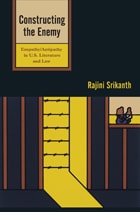
Constructing the Enemy
Empathy/Antipathy in U.S. Literature and LawRajini Srikanth
Temple University Press, 2011
In her engaging book, Constructing the Enemy, Rajini Srikanth probes the concept of empathy, attempting to understand its different types and how it is—or isn't—generated and maintained in specific circumstances.
Using literary texts to illuminate issues of power and discussions of law, Srikanth focuses on two case studies— the internment of Japanese citizens and Japanese Americans in World War II, after the bombing of Pearl Harbor, and the detainment of Muslim Americans and individuals from various nations in the U.S. prison at Guantanamo Bay.
Through primary documents and interviews that reveal why and how lawyers become involved in defending those who have been designated “enemies,” Srikanth explores the complex conditions under which engaged citizenship emerges. Constructing the Enemy probes the seductive promise of legal discourse and analyzes the emergence and manifestation of empathy in lawyers and other concerned citizens and the wider consequences of this empathy on the institutions that regulate our lives.
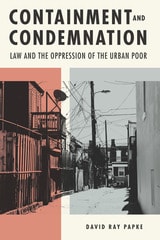
Containment and Condemnation
Law and the Oppression of the Urban PoorDavid Ray Papke
Michigan State University Press, 2019

Contemporary Challenges in Securing Human Rights
Edited by Corinne Lennox
University of London Press, 2015
Contesting Copyright
A History of Intellectual Property in East Central Europe and the BalkansAugusta Dimou
Central European University Press, 2026
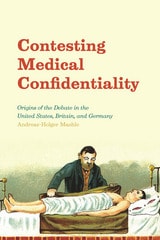
Contesting Medical Confidentiality
Origins of the Debate in the United States, Britain, and GermanyAndreas-Holger Maehle
University of Chicago Press, 2016
In Contesting Medical Confidentiality, Andreas-Holger Maehle travels back to the origins of this increasingly relevant issue. He offers the first comparative analysis of professional and public debates on medical confidentiality in the United States, Britain, and Germany during the late nineteenth and early twentieth centuries, when traditional medical secrecy first came under pressure from demands of disclosure in the name of public health. Maehle structures his study around three representative questions of the time that remain salient today: Do physicians have a privilege to refuse court orders to reveal confidential patient details? Is there a medical duty to report illegal procedures to the authorities? Should doctors breach confidentiality in order to prevent the spread of disease? Considering these debates through a unique historical perspective, Contesting Medical Confidentiality illuminates the ethical issues and potentially grave consequences that continue to stir up public debate.
Continuity, Change and Pragmatism in the Law
Essays in Memory of Professor Angelo ForteAndrew R.C. Simpson, Scott Crichton Styles, Euan West and Adelyn L.M. Wilson
Aberdeen University Press, 2016
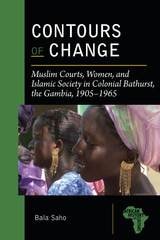
Contours of Change
Muslim Courts, Women, and Islamic Society in Colonial Bathurst, the Gambia, 1905-1965Bala Saho
Michigan State University Press, 2018
Contract Law in Hong Kong
Michael J. Fisher and Desmond G. Greenwood
Hong Kong University Press, 2024
This fourth edition of Contract Law in Hong Kong is the most comprehensive contemporary textbook on Hong Kong contract law written primarily for law students. The sixteen chapters of the book cover all basic contract concepts in a reader-friendly style and make ample use of case illustrations, including over 200 new cases since the third edition. The book deals with the core areas of contract law. The new legislative rules, such as the Contract Ordinance regarding the rights of third parties, have also been covered.
The first two chapters introduce the major themes and explain the multiple sources of law in Hong Kong. The subsequent thirteen chapters cover the formation of a valid contract, its contents, "vitiating" elements, the consequences of illegality, the termination of contracts, and remedies for breach of contract. The book concludes with an explanation of the doctrine of privity and the legislative reform of the operation of privity in Hong Kong. Particular attention is given to what makes Hong Kong law different from other common law jurisdictions, and to the continuing significance of English case law in Hong Kong.
Controlling Voices
Intellectual Property, Humanistic Studies, and the InternetTyAnna K. Herrington. Foreword by Jay David Bolter
Southern Illinois University Press, 2001
TyAnna K. Herrington explains current intellectual property law and examines the effect of the Internet and ideological power on its interpretation. Promoting a balanced development of our national culture, she advocates educators’ informed participation in ensuring egalitarian public access to information. She discusses the control of information and the creation of knowledge in terms of the way control functions under current property law.
Cooperation without Submission
Indigenous Jurisdictions in Native Nation–US EngagementsJustin B. Richland
University of Chicago Press, 2021
It is well-known that there is a complicated relationship between Native American Tribes and the US government. Relations between Tribes and the federal government are dominated by the principle that the government is supposed to engage in meaningful consultations with the tribes about issues that affect them.
In Cooperation without Submission, Justin B. Richland, an associate justice of the Hopi Appellate Court and ethnographer, closely examines the language employed by both Tribes and government agencies in over eighty hours of meetings between the two. Richland shows how Tribes conduct these meetings using language that demonstrates their commitment to nation-to-nation interdependency, while federal agents appear to approach these consultations with the assumption that federal law is supreme and ultimately authoritative. In other words, Native American Tribes see themselves as nations with some degree of independence, entitled to recognition of their sovereignty over Tribal lands, while the federal government acts to limit that authority. In this vital book, Richland sheds light on the ways the Tribes use their language to engage in “cooperation without submission.”
Cops, Teachers, Counselors
Stories from the Front Lines of Public ServiceSteven Maynard-Moody and Michael Musheno
University of Michigan Press, 2003
Steven Maynard-Moody is Director of the Policy Research Institute and Professor of Public Administration at the University of Kansas.
Michael Musheno is Professor of Justice and Policy Studies at Lycoming College and Professor Emeritus of Justice Studies, Arizona State University.

Copyright in Historical Perspective
L. Ray Patterson
Vanderbilt University Press, 1968