Results by title
1210 books match the query 'Mexico' and 108 start with c
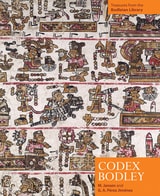
Codex Bodley
A Painted Chronicle from the Mixtec Highlands, MexicoMaarten Jansen and Gabina Aurora Pérez Jiménez
Bodleian Library Publishing, 2005
Codex Bodley explores the enormous wealth of information contained in the manuscript, which documents precolonial Mixtec genealogical relationships and historical events spanning from 900 AD to 1521. Maarten Jansen and Gabina Aurora Pérez Jiménez provide insightful and expert commentary on the manuscript, explaining its history as they consider key characteristics of Mixtec pictography. They then provide an engaging and masterful interpretation of the manuscript's narrative, with a detailed explanatory reading of its pictograms and their significance. Accompanied by vivid and colorful illustrations, Codex Bodley is an invaluable text for scholars of precolonial Mexican history, art, and culture.
Codex Chimalpopoca
The Text in Nahuatl with a Glossary and Grammatical NotesJohn Bierhorst
University of Arizona Press, 2011
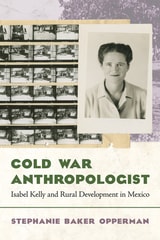
Cold War Anthropologist
Isabel Kelly and Rural Development in MexicoStephanie Baker Opperman
University of Arizona Press, 2024
Kelly’s transition from a prominent archaeologist to a key figure in applied anthropology is meticulously chronicled, unveiling her pivotal role in shaping rural development strategies in Mexico amidst the geopolitical context of the Cold War. Through an extensive examination of her correspondence, archival material, and scholarly output, Kelly’s evolving viewpoints offer profound insights into the intricate dynamics of U.S.-Mexico relations and the challenges encountered by female academics during this era.
Organized chronologically, each chapter of this work delves into distinct facets of Kelly’s international journey, with a particular emphasis on her involvement in cooperative programs aimed at fostering diplomatic relations with Mexico. Through this narrative framework, readers are immersed in a compelling exploration of Kelly’s enduring impact on both the field of anthropology and the realm of international diplomacy.
This book is indispensable for historians, anthropologists, and individuals intrigued by the nuanced complexities of Cold War politics, presenting pioneering research at the intersection of history and anthropology. Opperman skillfully brings to light the previously untold narratives of Isabel Kelly, unveiling her influence on mid-twentieth-century Mexico.
Cold War Exiles in Mexico
U.S. Dissidents and the Culture of Critical ResistanceRebecca M. Schreiber
University of Minnesota Press, 2008
As Schreiber recounts, the first exiles to arrive in Mexico after World War II were visual artists, many of them African-American, including Elizabeth Catlett, Charles White, and John Wilson. Individuals who were blacklisted from the Hollywood film industry, such as Dalton Trumbo and Hugo Butler, followed these artists, as did writers, including Willard Motley. Schreiber examines the artists’ work with the printmaking collective Taller de Gráfica Popular and the screenwriters’ collaborations with filmmakers such as Luis Buñuel, as well as the influence of the U.S. exiles on artistic and political movements.
The Cold War culture of political exile challenged American exceptionalist ideology and, as Schreiber reveals, demonstrated the resilience of oppositional art, literature, and film in response to state repression.
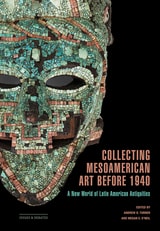
Collecting Mesoamerican Art before 1940
A New World of Latin American AntiquitiesAndrew D. Turner
J. Paul Getty Trust, The, 2024
This book traces the fascinating history of how and why ancient Mesoamerican objects have been collected. It begins with the pre-Hispanic antiquities that first entered European collections in the sixteenth century as gifts or seizures, continues through the rise of systematic collecting in Europe and the Americas during the nineteenth and twentieth centuries, and ends in 1940—the start of Europe’s art market collapse at the outbreak of World War II and the coinciding genesis of the large-scale art market for pre-Hispanic antiquities in the United States.
Drawing upon archival resources and international museum collections, the contributors analyze the ways shifting patterns of collecting and taste—including how pre-Hispanic objects changed from being viewed as anthropological and scientific curiosities to collectible artworks—have shaped modern academic disciplines as well as public, private, institutional, and nationalistic attitudes toward Mesoamerican art. As many nations across the world demand the return of their cultural patrimony and ancestral heritage, it is essential to examine the historical processes, events, and actors that initially removed so many objects from their countries of origin.
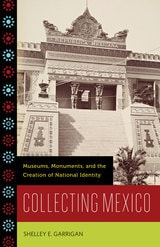
Collecting Mexico
Museums, Monuments, and the Creation of National IdentityShelley E. Garrigan
University of Minnesota Press, 2012
Collecting Mexico centers on the ways in which aesthetics and commercialism intersected in officially sanctioned public collections and displays in late nineteenth-century Mexico. Shelley E. Garrigan approaches questions of origin, citizenry, membership, and difference by reconstructing the lineage of institutionally collected objects around which a modern Mexican identity was negotiated. In doing so, she arrives at a deeper understanding of the ways in which displayed objects become linked with nationalistic meaning and why they exert such persuasive force.
Spanning the Porfiriato period from 1867 to 1910, Collecting Mexico illuminates the creation and institutionalization of a Mexican cultural inheritance. Employing a wide range of examples—including the erection of public monuments, the culture of fine arts, and the representation of Mexico at the Paris World’s Fair of 1889—Garrigan pursues two strands of thought that weave together in surprising ways: national heritage as a transcendental value and patrimony as potential commercial interest.
Collecting Mexico shows that the patterns of institutional collecting reveal how Mexican public collections engendered social meaning. Using extensive archival materials, Garrigan’s close readings of the processes of collection building offer a new vantage point for viewing larger issues of identity, social position, and cultural/capital exchange.
Collective Biologies
Healing Social Ills through Sexual Health Research in MexicoEmily A. Wentzell
Duke University Press, 2021
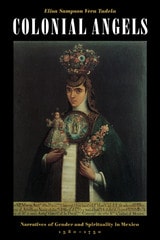
Colonial Angels
Narratives of Gender and Spirituality in Mexico, 1580-1750By Elisa Sampson Vera Tudela
University of Texas Press, 2000
Spain's attempt to establish a "New Spain" in Mexico never fully succeeded, for Spanish institutions and cultural practices inevitably mutated as they came in contact with indigenous American outlooks and ways of life. This original, interdisciplinary book explores how writing by and about colonial religious women participated in this transformation, as it illuminates the role that gender played in imposing the Spanish empire in Mexico.
The author argues that the New World context necessitated the creation of a new kind of writing. Drawing on previously unpublished writings by and about nuns in the convents of Mexico City, she investigates such topics as the relationship between hagiography and travel narratives, male visions of the feminine that emerge from the reworking of a nun's letters to her confessor into a hagiography, the discourse surrounding a convent's trial for heresy by the Inquisition, and the reports of Spanish priests who ministered to noble Indian women. This research rounds out colonial Mexican history by revealing how tensions between Spain and its colonies played out in the local, daily lives of women.
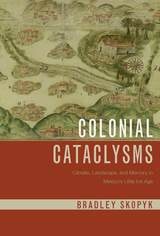
Colonial Cataclysms
Climate, Landscape, and Memory in Mexico’s Little Ice AgeBradley Skopyk
University of Arizona Press, 2020
The contiguous river basins that flowed in Tlaxcala and San Juan Teotihuacan formed part of the agricultural heart of central Mexico. As the colonial project rose to a crescendo in the sixteenth and seventeenth centuries, the Indigenous farmers of central Mexico faced long-term problems standard historical treatments had attributed to drought and soil degradation set off by Old World agriculture. Instead, Bradley Skopyk argues that a global climate event called the Little Ice Age brought cold temperatures and elevated rainfall to the watersheds of Tlaxcala and Teotihuacan. With the climatic shift came cataclysmic changes: great floods, human adaptations to these deluges, and then silted wetlands and massive soil erosion.
This book chases water and soil across the colonial Mexican landscape, through the fields and towns of New Spain’s Native subjects, and in and out of some of the strongest climate anomalies of the last thousand or more years. The pursuit identifies and explains the making of two unique ecological crises, the product of the interplay between climatic and anthropogenic processes. It charts how Native farmers responded to the challenges posed by these ecological rifts with creative use of plants and animals from the Old and New Worlds, environmental engineering, and conflict within and beyond the courts. With a new reading of the colonial climate and by paying close attention to land, water, and agrarian ecologies forged by farmers, Skopyk argues that colonial cataclysms—forged during a critical conjuncture of truly unprecedented proportions, a crucible of human and natural forces—unhinged the customary ways in which humans organized, thought about, and used the Mexican environment.
This book inserts climate, earth, water, and ecology as significant forces shaping colonial affairs and challenges us to rethink both the environmental consequences of Spanish imperialism and the role of Indigenous peoples in shaping them.
Colonial Itineraries of Contemporary Mexico
Literary and Cultural InquiriesEdited by Oswaldo Estrada and Anna M. Nogar
University of Arizona Press, 2014
Through a transformative interdisciplinary lens, this book studies the ultra-contemporary chronicles of Carlos Monsiváis, the poetry of Carmen Boullosa and Luis Felipe Fabre, and the novels of Enrique Serna, Héctor de Mauleón, Mónica Lavín, and Pablo Soler Frost, among others. The book also pays close attention to a good sample of recent children’s literature that revisit Mexico’s colonia. It includes the transatlantic perspective of Spanish novelist Inma Chacón, and a detailed analysis of the strategies employed by Laura Esquivel in the creation of a best seller. Other chapters are devoted to the study of transnational film productions, a play by Flavio González Mello, and a set of novels set in the nineteenth-century colonia that problematize static notions of both personal and national identity within specific cultural palimpsests. Taken together, these incisive readings open broader conversations about Mexican coloniality as it continues well into the twenty-first century.
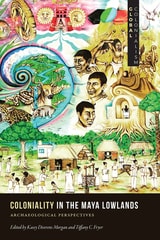
Coloniality in the Maya Lowlands
Archaeological Perspectivesedited by Kasey Diserens Morgan &Tiffany C. Fryer
University Press of Colorado, 2022
The work takes a hemispheric approach to the historical and material analysis of colonialism, bridging the often disparate literatures on coloniality and settler colonialism. Archaeologists and anthropologists working in what are today southeastern Mexico, Belize, Guatemala, and Honduras grapple with the material realities of coloniality at a regional level. They provide sustained discussions of Maya experiences with wide-ranging colonial endurances: violence, resource insecurity, land rights, refugees, the control of borders, the movement of contraband, surveillance, individual and collective agency, consumption, and use of historic resources.
Considering a future for historical archaeologies of the Maya region that bridges anthropology, ethnohistory, Indigenous studies, settler colonial studies, and Latin American studies, Coloniality in the Maya Lowlands presents a new understanding of how ways of being in the Maya world have formed and changed over time, as well as the shared investments of historical archaeologists and sociocultural anthropologists working in the Maya region.
Contributors: Fernando Armstrong-Fumero, Alejandra Badillo Sánchez, Adolfo Iván Batún Alpuche, A. Brooke Bonorden, Maia C. Dedrick, Scott L. Fedick, Fior García Lara, John Gust, Brett A. Houk, Rosemary A. Joyce, Gertrude B. Kilgore, Jennifer P. Mathews, Patricia A. McAnany, James W. Meierhoff, Fabián A. Olán de la Cruz, Julie K. Wesp
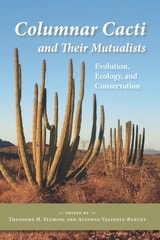
Columnar Cacti and Their Mutualists
Evolution, Ecology, and ConservationEdited by Theodore H. Fleming and Alfonso Valiente-Banuet
University of Arizona Press, 2002
This book summarizes our current knowledge about the ecology, evolution, and conservation of columnar cacti and their vertebrate mutualists to show that the very survival of these cacti depends on animals who pollinate them and disperse their seeds. Contributors from the United States, Mexico, Venezuela, and Colombia explore aspects of geology and evolution that have forged this relationship, review findings in anatomy and physiology, and discuss recent research in population and community ecology as well as conservation issues. Ranging from the Sonoran Desert to the northern Andes, these studies reflect recent progress in understanding how abiotic and biotic factors interact to influence the evolution, distribution, and abundance of cacti and mutualists alike.
In addition, this book examines the ways in which humans, through the process of domestication, have modified these plants for economic benefit. The contributors also review phylogenetic relationships between cacti and nectar-feeding bats in an effort to understand how bat-plant interactions have influenced the evolution of diversity and ecological specialization of both. Because of the number of migratory pollinators feeding on columnar cacti, the authors make conservation recommendations aimed at preserving fully functional ecosystems in arid portions of the New World tropics and subtropics.
No other book treats the pollination ecology of cacti in such depth or offers such a wealth of up-to-date material on the nectar-feeding bats of the New World. As scientists become increasingly concerned with the need to protect biotic interactions, Columnar Cacti and Their Mutualists provides a benchmark for both conservation efforts and future research.
Coming of Age(ncy) on the Migrant Trail
Adolescent Journeys in Contemporary Latinx Young Adult LiteratureSusana S. Martínez
The Ohio State University Press, 2025
Communism in Mexico
A Study in Political FrustrationBy Karl M. Schmitt
University of Texas Press, 1965
The ease with which Cuba slipped into its relationship with Communism revived in the United States its recurring nightmare in which other Latin American countries, particularly Mexico, become satellites of Russia or Red China. But such an occurrence is most unlikely in Mexico, according to Karl Schmitt, former intelligence research analyst with the United States Department of State.
Communism in Mexico traces efforts during the early twentieth century to create a Soviet-style society in one of the largest and most strategically situated of the Latin American countries. Schmitt writes authoritatively of the Mexican Communist movement, tracing its development from an early and potentially powerful political-economic base to the increasingly fragmented and weakened collection of parties and front groups of the 1960s. He follows the various schisms and factional divisions to the mid-1950s, when the process of disintegration became most noticeable, and explores and analyzes in detail Communist attempts since then to establish unity among the many quarreling and frustrated groups of the now-splintered movement.
Three Communist parties in Mexico, a score of front groups, and numerous infiltration cells in non-Communist organizations such as student and labor groups, all recognize in a broad way a common and ultimate goal: the creation of a Soviet-style society. But their attempts at unity have consistently led only to further bickering and frustration. This period is subjected to a thorough study and analysis in an effort to understand and explain the Communists' lack of success. Schmitt presciently concludes that Communism's future in Mexico will be as cloudy as its past, and that the accelerating economy and improving social conditions there will serve to weaken the movement still further.
Confabulario and Other Inventions
By Juan José Arreola
University of Texas Press, 1964
This biting commentary on the follies of humankind by a noted Mexican author cuts deeply yet leaves readers laughing—at themselves as well as at others. With his surgical intelligence, Juan José Arreola exposes the shams and hypocrisies, the false values and vices, the hidden diseases of society. Confabulario total, 1941–1961, of which this book is a translation, combines three earlier books—Varia invención (1949), Confabulario (1952), Punta de plata (1958)—and numerous later pieces.
Although some of the pieces have a noticeably Mexican orientation, most of them transcend strictly regional themes to interpret the social scene in aspects common to all civilized cultures. Arreola’s view is not limited; much of his sophistication comes from his broad, deep, and varied knowledge of present and past, and from his almost casual use both of this knowledge and of his insight into its meaning for humanity. His familiarity with many little-known arts and sciences, numerous literatures, history, anthropology, and psychology, and his telling allusions to this rich lode of fact, increase the reader’s delight in his learned but witty, scalding but poetic, satire.
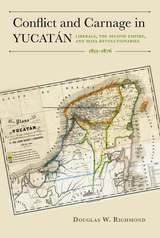
Conflict and Carnage in Yucatán
Liberals, the Second Empire, and Maya Revolutionaries, 1855–1876Douglas W. Richmond
University of Alabama Press, 2015
Synthesizing an extensive and heterogeneous range of sources, Douglas W. Richmond covers three tumultuous political upheavals of this period. First, Mexico’s fledgling republic attempted to impose a liberal ideology at odds with traditional Maya culture on Yucatán; then, the French-backed regime of Emperor Maximilian began to reform Yucatán; and, finally, the republican forces of Benito Juárez restored the liberal hegemony. Many issues spurred resistance to these liberal governments. Instillation of free trade policies, the suppression of civil rights, and persecution of the Roman Catholic Church mobilized white opposition to liberal governors. The Mayas fought the seizure of their communal properties. A long-standing desire for regional autonomy united virtually all Yucatecans. Richmond advances the thought-provoking argument that Yucatán both fared better under Maximilian’s Second Empire than under the liberal republic and would have thrived more had the Second Empire not collapsed.
The most violent and bloody manifestation of these broad conflicts was the Caste War (Guerra de Castas), the longest sustained peasant revolt in Latin American history. Where other scholars have advocated the simplistic position that the war was a Maya uprising designed to reestablish a mythical past civilization, Richmond’s sophisticated recounting of political developments from 1855 to 1876 restores nuance and complexity to this pivotal time in Yucatecan history.
Richmond’s Conflict and Carnage in Yucatán is a welcome addition to scholarship about Mexico and Yucatán as well as about state consolidation, empire, and regionalism.
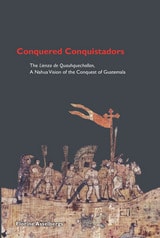
Conquered Conquistadors
The <i>Lienzo de Quauhquechollan,</i> A Nahua Vision of the Conquest of GuatemalaFlorine Asselbergs
University Press of Colorado, 2004
The people of the Nahua community of Quauhquechollan (present-day San Martín Huaquechula), in central Mexico, allied with Cortés during the Spanish-Aztec War and were assigned to the Spanish conquistador Jorge de Alvarado. De Alvarado and his allies, including the Quauhquecholteca and thousands of other indigenous warriors, set off for Guatemala in 1527 to start a campaign against the Maya. The few Quauhquecholteca who lived to tell the story recorded their travels and eventual victory on the huge cloth map, the Lienzo de Quauhquechollan.
Conquered Conquistadors, published in a European edition in 2004, overturned conventional views of the European conquest of indigenous cultures. American historians and anthropologists will relish this new edition and Asselbergs's astute analysis, which includes context, interpretation, and comparison with other pictographic accounts of the "Spanish" conquest. This heavily illustrated edition includes an insert reproduction of the Lienzo de Quauhquechollan.
Constructing Citizenship
Transnational Workers and Revolution on the Mexico-Guatemala Border, 1880--1950Catherine A. Nolan-Ferrell
University of Arizona Press, 2012
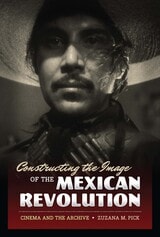
Constructing the Image of the Mexican Revolution
Cinema and the ArchiveBy Zuzana M. Pick
University of Texas Press, 2009
Katherine Singer Kovács Book Award, Society for Cinema and Media Studies, 2011
With a cast ranging from Pancho Villa to Dolores del Río and Tina Modotti, Constructing the Image of the Mexican Revolution demonstrates the crucial role played by Mexican and foreign visual artists in revolutionizing Mexico's twentieth-century national iconography. Investigating the convergence of cinema, photography, painting, and other graphic arts in this process, Zuzana Pick illuminates how the Mexican Revolution's timeline (1910–1917) corresponds with the emergence of media culture and modernity.
Drawing on twelve foundational films from Que Viva Mexico! (1931–1932) to And Starring Pancho Villa as Himself (2003), Pick proposes that cinematic images reflect the image repertoire produced during the revolution, often playing on existing nationalist themes or on folkloric motifs designed for export. Ultimately illustrating the ways in which modernism reinvented existing signifiers of national identity, Constructing the Image of the Mexican Revolution unites historicity, aesthetics, and narrative to enrich our understanding of Mexicanidad.
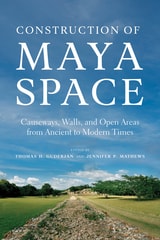
Construction of Maya Space
Causeways, Walls, and Open Areas from Ancient to Modern TimesThomas H. Guderjan
University of Arizona Press, 2023
Through fifteen engaging chapters, contributors examine the construction of spatial features by ancient, historic, and contemporary Maya elite and nonelite peoples to understand how they used spaces differently. Through cutting-edge methodologies and case studies, chapters consider how and why Maya people connected and divided the spaces they used daily in their homes, in their public centers, in their sacred places such as caves, and across their regions to inform us about the mental constructs they used to create their lives and cultures of the past.
Contributors
Elias Alcocer Puerto
Alejandra Alonso Olvera
Traci Ardren
Jaime J. Awe
Alejandra Badillo Sánchez
Nicolas C. Barth
Grace Lloyd Bascopé
Adolpho Iván Batún-Alpuche
Elizabeth Beckner
M. Kathryn Brown
Bernadette Cap
Miguel Covarrubias Reyna
Juan Fernandez Diaz
Alberto G. Flores Colin
Thomas H. Guderjan
C. Colleen Hanratty
Héctor Hernández Álvarez
Scott R. Hutson
Joshua J. Kwoka
Whitney Lytle
Aline Magnoni
Jennifer P. Mathews
Stephanie J. Miller
Shawn G. Morton
Holley Moyes
Shannon Plank
Dominique Rissolo
Patrick Rohrer
Carmen Rojas Sandoval
Justine M. Shaw
J. Gregory Smith
Travis W. Stanton
Karl A. Taube
Daniel Vallejo-Cáliz
Consumers And Citizens
Globalization and Multicultural ConflictsNestor Garcia Canclini
University of Minnesota Press, 2001
An essential analysis of the ways consumerism and globalization intersect with political power.
In Consumers and Citizens, Néstor García Canclini, the best-known and most innovative cultural studies scholar in Latin America, maps the critical effects of urban sprawl and global media and commodity markets on citizens-and shows at the same time that the complex results mean not only a shrinkage of certain traditional rights (particularly those of the welfare or client state) but also new openings for expanding citizenship.
García Canclini focuses on the diverse ways in which democratic societies recognize markets of citizen opinions, however heterogeneous and dissonant, as in the fashion and entertainment industries. He shows how identity issues, brought to the fore by the aligning of citizenship and consumption, can no longer be understood strictly within the purview of territory or nation. Rather, the postmodern citizen-consumer inhabits a transterritorial and multilingual space, structured more along the lines of markets than states. Defining this space, García Canclini seeks to formulate a participatory and critical approach to consumption in which national culture, far from being extinguished, is reconstituted in transnational, cultural interactions.
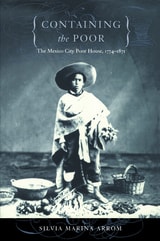
Containing the Poor
The Mexico City Poor House, 1774-1871Silvia Marina Arrom
Duke University Press, 2001
For a nation that had traditionally regarded the needy as having the undisputed right to receive alms and whose affluent citizens felt duty-bound to dispense them, the experiment was doomed from the start, explains Arrom. She uses deep archival research to reveal that—much to policymakers’ dismay—the Poor House became an orphanage largely because the government had underestimated the embeddedness of this moral economy of begging. While tracing the course of an eventful century that also saw colonialism give way to republicanism in Mexico, Arrom links the Poor House’s transformation with other societal factors as well, such as Mexican women’s increasing impact on social welfare policies.
With poverty, begging, and homelessness still rampant in much of Latin America today, this study of changing approaches to social welfare will be particularly valuable to student and scholars of Mexican and Latin American society and history, as well as those engaged in the study of social and welfare policy.
Contemporary Mexican Women Writers
Five VoicesBy Gabriella de Beer
University of Texas Press, 1996
Mexican women writers moved to the forefront of their country's literature in the twentieth century. Among those who began publishing in the 1970s and 1980s are Maria Luisa Puga, Silvia Molina, Brianda Domecq, Carmen Boullosa, and Angeles Mastretta. Sharing a range of affinities while maintaining distinctive voices and outlooks, these are the women whom Gabriella de Beer has chosen to profile in Contemporary Mexican Women Writers.
De Beer takes a three-part approach to each writer. She opens with an essay that explores the writer's apprenticeship and discusses her major works. Next, she interviews each writer to learn about her background, writing, and view of herself and others. Finally, de Beer offers selections from the writer's work that have not been previously published in English translation. Each section concludes with a complete bibliographic listing of the writer's works and their English translations.
These essays, interviews, and selections vividly recreate the experience of being with the writer and sharing her work, hearing her tell about and evaluate herself, and reading the words she has written. The book will be rewarding reading for everyone who enjoys fine writing.
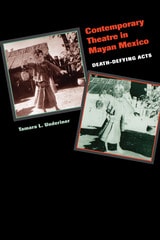
Contemporary Theatre in Mayan Mexico
Death-Defying ActsBy Tamara L. Underiner
University of Texas Press, 2004
From the dramatization of local legends to the staging of plays by Shakespeare and other canonical playwrights to the exploration of contemporary sociopolitical problems and their effects on women and children, Mayan theatre is a flourishing cultural institution in southern Mexico. Part of a larger movement to define Mayan self-identity and reclaim a Mayan cultural heritage, theatre in Mayan languages has both reflected on and contributed to a growing awareness of Mayans as contemporary cultural and political players in Mexico and on the world's stage.
In this book, Tamara Underiner draws on fieldwork with theatre groups in Chiapas, Tabasco, and Yucatán to observe the Maya peoples in the process of defining themselves through theatrical performance. She looks at the activities of four theatre groups or networks, focusing on their operating strategies and on close analyses of selected dramatic texts. She shows that while each group works under the rubric of Mayan or indigenous theatre, their works are also in constant dialogue, confrontation, and collaboration with the wider, non-Mayan world. Her observations thus reveal not only how theatre is an agent of cultural self-definition and community-building but also how theatre negotiates complex relations among indigenous communities in Mayan Mexico, state governments, and non-Mayan artists and researchers.
Contested Ground
Comparative Frontiers on the Northern and Southern Edges of the Spanish EmpireEdited by Donna J. Guy and Thomas E. Sheridan
University of Arizona Press, 1998
Continental Crossroads
Remapping U.S.-Mexico Borderlands HistorySamuel Truett and Elliott Young, eds.
Duke University Press, 2004
The U.S.-Mexico borderlands have long supported a web of relationships that transcend the U.S. and Mexican nations. Yet national histories usually overlook these complex connections. Continental Crossroads rediscovers this forgotten terrain, laying the foundations for a new borderlands history at the crossroads of Chicano/a, Latin American, and U.S. history. Drawing on the historiographies and archives of both the U.S. and Mexico, the authors chronicle the transnational processes that bound both nations together between the early nineteenth century and the 1940s, the formative era of borderlands history.
A new generation of borderlands historians examines a wide range of topics in frontier and post-frontier contexts. The contributors explore how ethnic, racial, and gender relations shifted as a former frontier became the borderlands. They look at the rise of new imagined communities and border literary traditions through the eyes of Mexicans, Anglo-Americans, and Indians, and recover transnational border narratives and experiences of African Americans, Chinese, and Europeans. They also show how surveillance and resistance in the borderlands inflected the “body politics” of gender, race, and nation. Native heroine Bárbara Gandiaga, Mexican traveler Ignacio Martínez, Kiowa warrior Sloping Hair, African American colonist William H. Ellis, Chinese merchant Lee Sing, and a diverse cast of politicos and subalterns, gendarmes and patrolmen, and insurrectos and exiles add transnational drama to the formerly divided worlds of Mexican and U.S. history.
Contributors. Grace Peña Delgado, Karl Jacoby, Benjamin Johnson, Louise Pubols, Raúl Ramos, Andrés Reséndez, Bárbara O. Reyes, Alexandra Minna Stern, Samuel Truett, Elliott Young

Convictions of the Heart
Jim Corbett and the Sanctuary MovementMiriam Davidson
University of Arizona Press, 1988
Corbett first worked within the law to help refugees process applications for asylum, but the U.S. Immigration and Naturalization Service soon began a program of arrests; then he began to smuggle refugees from the Mexican border to the homes of citizens willing to provide shelter, making hundreds of trips over the next two years; finally he enlisted the support of the Tucson Ecumenical Council and persuaded John Fife, pastor of the Southside Presbyterian Church, to open that building as a refuge. When legal action against Corbett and the others seemed imminent, Southside became, on March 24, 1982, the first of two hundred churches in the country to declare itself a sanctuary.
Convictions of the Heart takes readers inside the santuary movement to reveal its founders' motives and underlying beliefs, and inside the courtroom to describe the government's efforts to stop it. Although the book addresses many points of view, its primary focus is on the philosophy of Jim Corbett. Rooted in the nonviolence of Gandhi, the Society of Friends, and Martin Luther King, Corbett's beliefs challenged individuals and communities of faith across the country to examine the strength of their commitment to the needs and rights of others.
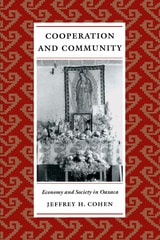
Cooperation and Community
Economy and Society in OaxacaBy Jeffrey H. Cohen
University of Texas Press, 2000
In the villages and small towns of Oaxaca, Mexico, as in much of rural Latin America, cooperation among neighbors is essential for personal and community survival. It can take many forms, from godparenting to sponsoring fiestas, holding civic offices, or exchanging agricultural or other kinds of labor. This book examines the ways in which the people of Santa Ana del Valle practice these traditional cooperative and reciprocal relationships and also invent new relationships to respond to global forces of social and economic change at work within their community.
Based on fieldwork he conducted in this Zapotec-speaking community between 1992 and 1996, Jeffrey Cohen describes continuities in the Santañeros' practices of cooperation, as well as changes resulting from transnational migration, tourism, increasing educational opportunities, and improved communications. His nuanced portrayal of the benefits and burdens of cooperation is buttressed by the words of many villagers who explain why and how they participate-or not-in reciprocal family and community networks. This rich ethnographic material offers a working definition of community created in and through cooperative relationships.
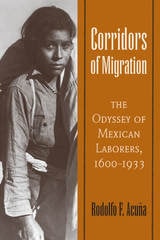
Corridors of Migration
The Odyssey of Mexican Laborers, 1600-1933Rodolfo F. Acuña
University of Arizona Press, 2007
In the San Joaquin Valley Cotton Strike of 1933, frenzied cotton farmers murdered three strikers, intentionally starved at least nine infants, wounded dozens of people, and arrested more. While the story of this incident has been recounted from the perspective of both the farmers and, more recently, the Mexican workers, this is the first book to trace the origins of the Mexican workers’ activism through their common experience of migrating to the United States.
Rodolfo F. Acuña documents the history of Mexican workers and their families from seventeenth-century Chihuahua to twentieth-century California, following their patterns of migration and describing the establishment of communities in mining and agricultural regions. He shows the combined influences of racism, transborder dynamics, and events such as the industrialization of the Southwest, the Mexican Revolution, and World War I in shaping the collective experience of these people as they helped to form the economic, political, and social landscapes of the American Southwest in their interactions with agribusiness and absentee copper barons.
Acuña follows the steps of one of the murdered strikers, Pedro Subia, reconstructing the times and places in which his wave of migrants lived. By balancing the social and geographic trends in the Mexican population with the story of individual protest participants, Acuña shows how the strikes were in fact driven by choices beyond the Mexican workers’ control. Their struggle to form communities graphically retells how these workers were continuously uprooted and their organizations destroyed by capital. Corridors of Migration thus documents twentieth-century Mexican American labor activism from its earliest roots through the mines of Arizona and the Great San Joaquin Valley cotton strike.
From a founding scholar of Chicano studies and the author of fifteen books comes the culmination of three decades of dedicated research into the causes and effects of migration and labor activism. The narrative documents how Mexican workers formed communities against all odds.
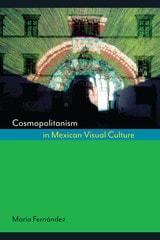
Cosmopolitanism in Mexican Visual Culture
By María Fernández
University of Texas Press, 2014
Since the colonial era, Mexican art has emerged from an ongoing process of negotiation between the local and the global, which frequently involves invention, synthesis, and transformation of diverse discursive and artistic traditions. In this pathfinding book, María Fernández uses the concept of cosmopolitanism to explore this important aspect of Mexican art, in which visual culture and power relations unite the local and the global, the national and the international, the universal and the particular. She argues that in Mexico, as in other colonized regions, colonization constructed power dynamics and forms of violence that persisted in the independent nation-state. Accordingly, Fernández presents not only the visual qualities of objects, but also the discourses, ideas, desires, and practices that are fundamental to the very existence of visual objects.
Fernández organizes episodes in the history of Mexican art and architecture, ranging from the seventeenth century to the end of the twentieth century, around the consistent but unacknowledged historical theme of cosmopolitanism, allowing readers to discern relationships among various historical periods and works that are new and yet simultaneously dependent on their predecessors. She uses case studies of art and architecture produced in response to government commissions to demonstrate that established visual forms and meanings in Mexican art reflect and inform desires, expectations, memories, and ways of being in the world—in short, that visual culture and cosmopolitanism are fundamental to processes of subjectification and identity.
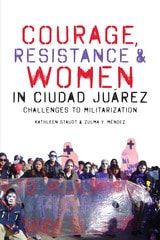
Courage, Resistance, and Women in Ciudad Juárez
Challenges to MilitarizationBy Kathleen Staudt and Zulma Y. Méndez
University of Texas Press, 2015
Ciudad Juárez has recently become infamous for its murder rate, which topped 3,000 in 2010 as competing drug cartels grew increasingly violent and the military responded with violence as well. Despite the atmosphere of intimidation by troops, police, and organized criminals, women have led the way in civil society activism, spurring the Juárez Resistance and forging powerful alliances with anti-militarization activists.
An in-depth examination of la Resistencia Juarense, Courage, Resistance, and Women in Ciudad Juárez draws on ethnographic research to analyze the resistance’s focus on violence against women, as well as its clash with the war against drugs championed by Mexican President Felipe Calderón with the support of the United States. Through grounded insights, the authors trace the transformation of hidden discourses into public discourses that openly challenge the militarized border regimes. The authors also explore the advocacy carried on by social media, faith-based organizations, and peace-and-justice activist Javier Sicilia while Calderón faced U.S. political schisms over the role of border trade in this global manufacturing site.
Bringing to light on-the-ground strategies as well as current theories from the fields of sociology, political anthropology, and human rights, this illuminating study is particularly significant because of its emphasis on the role of women in local and transnational attempts to extinguish a hot zone. As they overcome intimidation to become game-changing activists, the figures featured in Courage, Resistance, and Women in Ciudad Juárez offer the possibility of peace and justice in the wake of seemingly irreconcilable conflict.
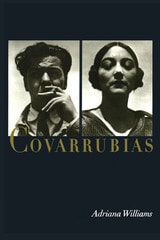
Covarrubias
By Adriana Williams
University of Texas Press, 1994
At the center of an artistic milieu as vital and exciting as the Left Bank of Paris or Greenwich Village, Rosa and Miguel Covarrubias knew almost everyone in the limelight of the 1930s and 1940s—Langston Hughes, Carl Van Vechten, John Huston, Diego Rivera, and Frida Kahlo, to name just a few. As fascinating themselves as any of their friends, the couple together fostered a renaissance of interest in the history and traditional arts of Mexico's indigenous peoples, while amassing an extraordinary collection of art that ranged from pre-Hispanic Olmec and Aztec sculptures to the work of Diego Rivera.
Written by a long-time friend of Rosa, this book presents a sparkling account of the life and times of Rosa and Miguel. Adriana Williams begins with Miguel's birth in 1904 and follows the brilliant early flowering of his artistic career as a renowned caricaturist for Vanity Fair and the New Yorker magazines, his meeting and marriage with Rosa at the height of her New York dancing career, and their many years of professional collaboration on projects ranging from dance to anthropology to painting and art collecting to the development of museums to preserve Mexico's pre-Columbian heritage. Interviewing as many of their friends as possible, Williams fills her narrative with reminiscences that illuminate Miguel's multifaceted talents, Rosa's crucial collaboration in many of his projects, and their often tempestuous relationship.
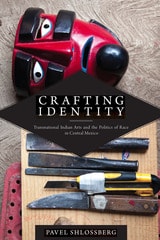
Crafting Identity
Transnational Indian Arts and the Politics of Race in Central MexicoPavel Shlossberg
University of Arizona Press, 2015
The first ethnographic study of its kind, the book examines how indigenous and mestizo mask makers, both popular and elite, view and contest relations of power and inequality through their craft. Using data from his interviews with mask makers, collectors, museum curators, editors, and others, Pavel Shlossberg places the artisans within the larger context of their relationships with the nation-state and Mexican elites, as well as with the production cultures that inform international arts and crafts markets. In exploring the connection of mask making to capitalism, the book examines the symbolic and material pressures brought to bear on Mexican artisans to embody and enact self-racializing stereotypes and the performance of stigmatized indigenous identities.
Shlossberg’s weaving of ethnographic data and cultural theory demystifies the way mask makers ascribe meaning to their practices and illuminates how these practices are influenced by state and cultural institutions. Demonstrating how the practice of mask making negotiates ethnoracial identity with regard to the Mexican state and the United States, Shlossberg shows how it derives meaning, value, and economic worth in the eyes of the state and cultural institutions that mediate between the mask maker and the market.
Crafting Mexico
Intellectuals, Artisans, and the State after the RevolutionRick A. López
Duke University Press, 2010
Crafting Prehispanic Maya Kinship
Bradley E. Ensor
University of Alabama Press, 2013
By contextualizing classes and their kinship behavior within the overall political economy, Crafting Prehispanic Maya Kinship provides an example of how archaeology can help to explain the formation of disparate classes and kinship patterns within an ancient state-level society.
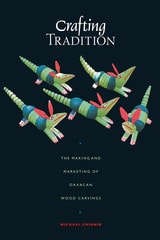
Crafting Tradition
The Making and Marketing of Oaxacan Wood CarvingsBy Michael Chibnik
University of Texas Press, 2003
Since the mid-1980s, whimsical, brightly colored wood carvings from the Mexican state of Oaxaca have found their way into gift shops and private homes across the United States and Europe, as Western consumers seek to connect with the authenticity and tradition represented by indigenous folk arts. Ironically, however, the Oaxacan wood carvings are not a traditional folk art. Invented in the mid-twentieth century by non-Indian Mexican artisans for the tourist market, their appeal flows as much from intercultural miscommunication as from their intrinsic artistic merit.
In this beautifully illustrated book, Michael Chibnik offers the first in-depth look at the international trade in Oaxacan wood carvings, including their history, production, marketing, and cultural representations. Drawing on interviews he conducted in the carving communities and among wholesalers, retailers, and consumers, he follows the entire production and consumption cycle, from the harvesting of copal wood to the final purchase of the finished piece. Along the way, he describes how and why this "invented tradition" has been promoted as a "Zapotec Indian" craft and explores its similarities with other local crafts with longer histories. He also fully discusses the effects on local communities of participating in the global market, concluding that the trade in Oaxacan wood carvings is an almost paradigmatic case study of globalization.
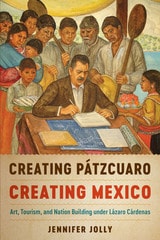
Creating Pátzcuaro, Creating Mexico
Art, Tourism, and Nation Building under Lázaro CárdenasBy Jennifer Jolly
University of Texas Press, 2018
LASA Visual Culture Studies Section Book Prize, Latin American Studies Association (LASA)
Winner, Arthur P. Whitaker Prize, Middle Atlantic Council of Latin American Studies, 2019In the 1930s, the artistic and cultural patronage of celebrated Mexican president Lázaro Cárdenas transformed a small Michoacán city, Pátzcuaro, into a popular center for national tourism. Cárdenas commissioned public monuments and archeological excavations; supported new schools, libraries, and a public theater; developed tourism sites and infrastructure, including the Museo de Artes e Industrias Populares; and hired artists to paint murals celebrating regional history, traditions, and culture. The creation of Pátzcuaro was formative for Mexico; not only did it provide an early model for regional economic and cultural development, but it also helped establish some of Mexico’s most enduring national myths, rituals, and institutions.
In Creating Pátzcuaro, Creating Mexico, Jennifer Jolly argues that Pátzcuaro became a microcosm of cultural power during the 1930s and that we find the foundations of modern Mexico in its creation. Her extensive historical and archival research reveals how Cárdenas and the artists and intellectuals who worked with him used cultural patronage as a guise for radical modernization in the region. Jolly demonstrates that the Pátzcuaro project helped define a new modern body politic for Mexico, in which the population was asked to emulate Cárdenas by touring the country and seeing and embracing its land, history, and people. Ultimately, by offering Mexicans a means to identify and engage with power and privilege, the creation of Pátzcuaro placed art and tourism at the center of Mexico’s postrevolutionary nation building project.
Crimes against the State, Crimes against Persons
Detective Fiction in Cuba and MexicoPersephone Braham
University of Minnesota Press, 2004
An interpretation of the ideologies and kinships of detective fiction in Cuba and Mexico
The transplanted, inherently modern detective genre serves as an especially effective lens for exposing the fissures and divergences of modernity in post-1968 Mexico and revolutionary Cuba.
Combining in-depth critical analyses with the theoretical insights of current literary and cultural theory and Latin American postmodern studies, Crimes against the State, Crimes against Persons shows how the Cuban novela negra examines the Revolution through an incisive chronicle of life under a decaying regime, and how the Mexican neopoliciaco reveals the oppressive politics of modernization and globalization in Latin America.International in scope, comparative in approach, Braham’s study presents a unique inquiry into the ethical and aesthetic complexities that Latin American authors face in adapting genre detective fiction—a modern, metropolitan model—to radically diverse creative and ideological programs. Considering the work of writers such as Leonardo Padura Fuentes and Paco Ignacio Taibo II, as well as such English-language influences as G. K. Chesterton and Chester Himes, Braham also addresses Marxist critiques of the culture industry and emergent Latin American concepts of postmodernity.
Crossing Borders, Reinforcing Borders
Social Categories, Metaphors, and Narrative Identities on the U.S.-Mexico FrontierBy Pablo Vila
University of Texas Press, 2000
Along the U.S.-Mexico frontier, where border crossings are a daily occurrence for many people, reinforcing borders is also a common activity. Not only does the U.S. Border Patrol strive to "hold the line" against illegal immigrants, but many residents on both sides of the border seek to define and bound themselves apart from groups they perceive as "others."
This pathfinding ethnography charts the social categories, metaphors, and narratives that inhabitants of El Paso and Ciudad Juárez use to define their group identity and distinguish themselves from "others." Pablo Vila draws on over 200 group interviews with more than 900 area residents to describe how Mexican nationals, Mexican immigrants, Mexican Americans, African Americans, and Anglos make sense of themselves and perceive their differences from others.
This research uncovers the regionalism by which many northern Mexicans construct their sense of identity, the nationalism that often divides Mexican Americans from Mexican nationals, and the role of ethnicity in setting boundaries among Anglos, Mexicans, and African Americans. Vila also looks at how gender, age, religion, and class intertwine with these factors. He concludes with fascinating excerpts from re-interviews with several informants, who modified their views of other groups when confronted by the author with the narrative character of their identities.
Crossing Borders
Changing Social Identities in Southern MexicoKimberly M. Grimes
University of Arizona Press, 1998
Crossing the Border
Research from the Mexican Migration ProjectJorge Durand
Russell Sage Foundation, 2004
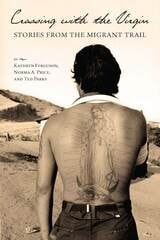
Crossing with the Virgin
Stories from the Migrant TrailKathryn Ferguson, Norma A. Price, and Ted Parks
University of Arizona Press, 2010
Crossing With the Virgin collects stories heard from migrants about these treacherous treks—firsthand accounts told to volunteers for the Samaritans, a humanitarian group that seeks to prevent such unnecessary deaths by providing these travelers with medical aid, water, and food. Other books have dealt with border crossing; this is the first to share stories of immigrant suffering at its worst told by migrants encountered on desert trails.
The Samaritans write about their encounters to show what takes place on a daily basis along the border: confrontations with Border Patrol agents at checkpoints reminiscent of wartime; children who die in their parents’ desperate bid to reunite families; migrants terrorized by bandits; and hovering ghost-like above nearly every crossing, the ever-present threat of death.
These thirty-nine stories are about the migrants, but they also tell how each individual author became involved with this work. As such, they offer not only a window into the migrants’ plight but also a look at the challenges faced by volunteers in sometimes compromising situations—and at their own humanizing process.
Crossing With the Virgin raises important questions about underlying assumptions and basic operations of border enforcement, helping readers see past political positions to view migrants as human beings. It will touch your heart as surely as it reassures you that there are people who still care about their fellow man.

Cuba Under Castro
Ambassadorial ReflectionsDavid Brighty, Andrew Palmer, Philip McLean, and David Ridgway
University of London Press, 2004
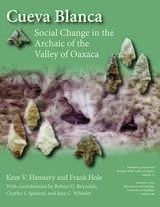
Cueva Blanca
Social Change in the Archaic of the Valley of OaxacaKent V. Flannery and Frank Hole
University of Michigan Press, 2019
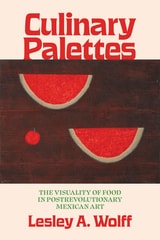
Culinary Palettes
The Visuality of Food in Postrevolutionary Mexican ArtLesley A. Wolff
University of Texas Press, 2025
2026 Mejor libro Humanidades, Mexico Section of the Latin American Studies Association
2026 Honorable Mention, First Book Prize, Cultural Studies Association
2025 Excellence in Scholarly Research and Publication Award, SECAC (formerly the Southeastern College Art Conference)
How the visual culture of food, cookery, and consumption played a central role in the making of postrevolutionary Mexico.
Postrevolutionary Mexico City was a site of anxious nation-building, as rampant modernization converged and clashed with the nation’s growing nostalgia for its pre-Columbian heritage. During this volatile period, food became a meaningful symbol for a Mexican citizenry seeking new modes of national participation.
Culinary Palettes explores how the artistic invocation of food cultures became an arena in which to negotiate the political entanglements of postrevolutionary Mexico. Lesley Wolff casts a nuanced eye on the work of visual artists such as Tina Modotti, Carlos González, and Rufino Tamayo, who nurtured the symbolic and performative power of iconic foods such as pulque, mole poblano, and watermelon. Through analysis of a wide array of visual evidence, including paintings, architecture, vintage postcards, menus, and cookbooks, Culinary Palettes demonstrates how these artists positioned their work within a broad visual landscape that relied upon the power of Mexican foodways in the urban and national imagination. In the studios of modernists, Wolff argues, artistic production, foodways, and Indigeneity proved to be mutually constitutive—and at times weaponized—agents in articulating competing claims to a new nationhood.
Cultural Capital
Mountain Zapotec Migrant Associations in Mexico CityLane Ryo Hirabayashi
University of Arizona Press, 1993
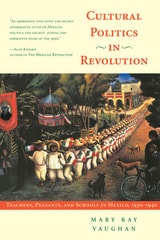
Cultural Politics in Revolution
Teachers, Peasants, and Schools in Mexico, 1930-1940Mary Kay Vaughan
University of Arizona Press, 1997
To show the significance of this facet of the Revolution, Mary Kay Vaughan analyzes the educational effort of the state during the 1930s, locating it within the broader sweep of Mexican history to illustrate how the government sought to nationalize and modernize rural society. Vaughan focuses on activities in rural schools, where central state policy makers, teachers, and people of the countryside came together to forge a national culture. She examines the cultural politics of schooling in four rural societies in the states of Sonora and Puebla that are representative of the peasant societies in revolutionary Mexico, and she shows how the state's program of socialist education became an arena for intense negotiations over power, culture, knowledge, rights, and gender practices. The real cultural revolution, Vaughan observes, lay not in the state's efforts at socialist education but in the dialogue between state and society that took place around this program. In the 1930s, rural communities carved out a space to preserve their local identities while the state succeeded in nurturing a multi-ethnic nationalism based on its promise of social justice and development.
Vaughan brings to her analysis a comparative understanding of peasant politics and educational history, extensive interviews, and a detailed examination of national, regional, and local archives to create an evocative and informative study of Mexican politics and society during modern Mexico's formative years. Cultural Politics in Revolution clearly shows that only by expanding the social arena in which culture was constructed and contested can we understand the Mexican Revolution's real achievements.
Culture Change and Shifting Populations in Central Northern Mexico
William B. Griffen
University of Arizona Press, 1969
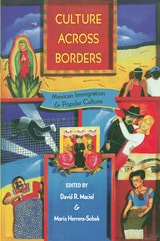
Culture across Borders
Mexican Immigration and Popular CultureEdited by David R. Maciel and María Herrera-Sobek
University of Arizona Press, 1998
Culture and Global Change
Social Perceptions of Deforestation in the Lacandona Rain Forest in MexicoLourdes Arizpe, Fernanda Paz, and Margarita Velazquez
University of Michigan Press, 1996
The authors of this compelling book argue that before suitable solutions can be found to pressing environmental problems, we need a way to gather information on the human dimensions of global changes. How do small and everyday individual actions add up to the intricate networks of global interactions? What are our rights and responsibilities as humans toward the planet and its natural resources?
The Lacandon rain forest in Mexico provides a vivid example of an environmental challenge that will demand the concerted efforts of many different groups, and not only technical solutions, to resolve successfully. Using data taken largely from in-depth interviews with landowners, farm workers, cattle raisers, housewives, professionals, and civil servants, the authors draw a rich portrait of the varied perceptions and positions these groups and individuals hold. At issue are the social, rather than psychological, bases of their perspectives.
Culture and Global Change offers a model for how the social sciences, and anthropology in particular, can lead the way in developing comprehensive understandings of the interrelationships between groups at the local, regional, and international levels that affect perceptions of the environment and thus the viability of solutions. It is required reading for anthropologists and environmental activists alike.
Lourdes Arizpe is Assistant Director-General for Culture, UNESCO. Fernanda Paz and Margarita Vel´zquez work for the Centro Regional de Investigaciones Multidisciplinarias, Universidad Nacional Autonoma de México.