Results by title
2018 books match the query 'Political aspects' and 167 start with c
Cities in the Anthropocene
New Ecology and Urban PoliticsIhnji Jon
Pluto Press, 2021
Climate change is real, and extreme weather events are its physical manifestations. These extreme events affect how we live and work in cities, and subsequently the way we design, plan, and govern them. Taking action ‘for the environment’ is not only a moral imperative; instead, it is activated by our everyday experience in the city.
Based on the author’s site visits and interviews in Darwin (Australia), Tulsa (Oklahoma), Cleveland (Ohio), and Cape Town (South Africa), this book tells the story of how cities can lead a transformative pro-environment politics.
National governments often fail to make binding agreements that bring about radical actions for the environment. This book shows how cities, as local sites of mobilizing a collective, political agenda, can be frontiers for activating the kind of environmental politics that appreciates the role of ‘nature’ in the everyday functioning of our urban life.
Cities in the Urban Age
A DissentRobert A. Beauregard
University of Chicago Press, 2018
For Beauregard, the city is a cauldron for four haunting contradictions. First, cities are equally defined by both their wealth and their poverty. Second, cities are simultaneously environmentally destructive and yet promise sustainability. Third, cities encourage rule by political machines and oligarchies, even as they are essentially democratic and at least nominally open to all. And fourth, city life promotes tolerance among disparate groups, even as the friction among them often erupts into violence. Beauregard offers no simple solutions or proposed remedies for these contradictions; indeed, he doesn’t necessarily hold that they need to be resolved, since they are generative of city life. Without these four tensions, cities wouldn’t be cities. Rather, Beauregard argues that only by recognizing these ambiguities and contradictions can we even begin to understand our moral obligations, as well as the clearest paths toward equality, justice, and peace in urban settings.
Citizens and Sportsmen
Fútbol and Politics in Twentieth-Century ChileBy Brenda Elsey
University of Texas Press, 2011
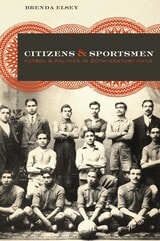
Fútbol, or soccer as it is called in the United States, is the most popular sport in the world. Millions of people schedule their lives and build identities around it. The World Cup tournament, played every four years, draws an audience of more than a billion people and provides a global platform for displays of athletic prowess, nationalist rhetoric, and commercial advertising. Fútbol is ubiquitous in Latin America, yet few academic histories of the sport exist, and even fewer focus on its relevance to politics in the region. To fill that gap, this book uses amateur fútbol clubs in Chile to understand the history of civic associations, popular culture, and politics.
In Citizens and Sportsmen, Brenda Elsey argues that fútbol clubs integrated working-class men into urban politics, connected them to parties, and served as venues of political critique. In this way, they contributed to the democratization of the public sphere. Elsey shows how club members debated ideas about class, ethnic, and gender identities, and also how their belief in the uniquely democratic nature of Chile energized state institutions even as it led members to criticize those very institutions. Furthermore, she reveals how fútbol clubs created rituals, narratives, and symbols that legitimated workers' claims to political subjectivity. Her case study demonstrates that the relationship between formal and informal politics is essential to fostering civic engagement and supporting democratic practices.
Citizens of Photography
The Camera and the Political ImaginationEdited by Christopher Pinney with the PhotoDemos Collective (Naluwembe Binaisa, Vindhya Buthpitiya, Konstantinos Kalantzis, Christopher Pinney, Ileana L. Selejan, and Sokphea Young)
Duke University Press, 2023
Citizens of Scandal
Journalism, Secrecy, and the Politics of Reckoning in MexicoVanessa Freije
Duke University Press, 2020
Citizens on Stage
Comedy and Political Culture in the Athenian DemocracyJames F. McGlew
University of Michigan Press, 2002
Old Comedy gives Citizens on Stage its chronological backbone; the beginning and end of Aristophanes' career roughly define the period on which the book concentrates. Reading and interpreting comedy provides a model for reading Athenian politics itself. McGlew argues that the plays of Old Comedy, with their fantastic stories of common individuals triumphing over the various social and political dilemmas of democratic Athens, interpreted the relationship of private life and political activity for an Athenian audience, dramatically reaffirming the ties between citizens' personal desires and the will of the collective body. In particular, McGlew argues that comedy transforms private fantasies of personal power and pleasures--what seem most to keep the individual audience members apart--into a collective possession and touchstone of democratic citizen identity.
Citizens on Stage focuses primarily on the democratic citizen and on contemporary representations of him as a decision maker. McGlew shows that the democratic individual, sometimes idealized, sometimes despised, was a dominant concern of the literature and politics of late fifth- and early fourth-century Athens. This book will appeal to students of ancient theater and drama, Athenian politics and democracy, and the relationships between theater and politics. Social historians will also find it an invaluable resource.
James F. McGlew is Assistant Professor of Foreign Languages and Literatures and Classical Studies, Iowa State University.
Citizenship in Cold War America
The National Security State and the Possibilities of DissentAndrea Friedman
University of Massachusetts Press, 2014
The stories told here capture a wide-ranging debate about the workings of the national security state and the meaning of American citizenship. Some of the participants in this debate—women like war bride Ellen Knauff and Pentagon employee Annie Lee Moss—were able to make their own experiences compelling examples of the threats posed by the national security regime. Others, such as Ruth Reynolds and Lolita Lebrón, who advocated an end to American empire in Puerto Rico, or the psychiatrist Fredric Wertham, who sought to change the very definition of national security, were less successful. Together, however, they exposed the gap between democratic ideals and government policies.
Friedman traverses immigration law and loyalty boards, popular culture and theoretical treatises, U.S. court-rooms and Puerto Rican jails, to demonstrate how Cold War repression made visible in new ways the unevenness and limitations of American citizenship. Highlighting the ways that race and gender shaped critiques and defenses of the national security regime, she offers new insight into the contradictions of Cold War political culture.
Citizenship in Question
Evidentiary Birthright and StatelessnessBenjamin N. Lawrance and Jacqueline Stevens, editors
Duke University Press, 2017
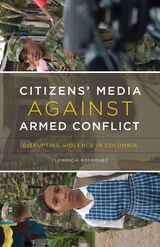
Citizens’ Media against Armed Conflict
Disrupting Violence in ColombiaClemencia Rodríguez
University of Minnesota Press, 2011
For two years, Clemencia Rodríguez did fieldwork in regions of Colombia where leftist guerillas, right-wing paramilitary groups, the army, and drug traffickers made their presence felt in the lives of unarmed civilians. Here, Rodríguez tells the story of the ways in which people living in the shadow of these armed intruders use community radio, television, video, digital photography, and the Internet to shield their communities from armed violence’s negative impacts.
Citizens’ media are most effective, Rodríguez posits, when they understand communication as performance rather than simply as persuasion or the transmission of information. Grassroots media that are deeply embedded in the communities they serve and responsive to local needs strengthen the ability of community members to productively react to violent incursions. Rodríguez demonstrates how citizens’ media privilege aspects of community life not hijacked by violence, providing people with the tools and the platform to forge lives for themselves and their families that are not entirely colonized by armed conflict and its effects.
Ultimately, Rodríguez shows that unarmed civilian communities that have been cornered by armed conflict can use community media to repair torn social fabrics, reconstruct eroded bonds, reclaim public spaces, resolve conflict, and sow the seeds of peace and stability.
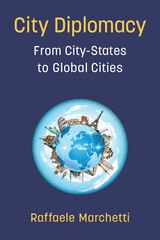
City Diplomacy
From City-States to Global CitiesRaffaele Marchetti
University of Michigan Press, 2021
While the view that only states act as global actors is conventional, significant diplomatic and cross-cultural activity is taking place in cities today. Economic growth and fiscal experiments all occur in urban contexts. Political reforms, social innovation, and protests and revolutions generate in cities. Criminal activities, terrorist actions, counterinsurgency, missile attacks (indeed, atomic bombs), and wars are centered in big cities. They are sources of global pollution as well as of environmental transformations such as urban gardening. Knowledge production, big data collection, and tech innovation all spur from intense interaction in cities. They are the meeting points between different cultures, religions, and identities.
These increasingly international cities develop twinning networks and projects, share information, sign cooperation agreements, contribute to the drafting of national and international policies, provide development aid, promote assistance to refugees, and do territorial marketing through decentralized city-city or district-district cooperation. Cities do what “municipalities” used to do many centuries ago: they cooperate but also enter into intense competitive dynamics. To understand current sociopolitical dynamics on a planetary level, we need to have two mental maps in mind: the state-centered map and the nonstate centered map. We must take into account the existence of a complex diplomatic regime based on different overlapping levels—the urban and the state.
Civic Talk
Peers, Politics, and the Future of DemocracyAuthored by Casey A. Klofstad
Temple University Press, 2011
Does talking about civic issues encourage civic participation? In his innovative book, Civic Talk, Casey Klofstad shows that our discussions about politics and current events with our friends, colleagues, and relatives—"civic talk"—has the ability to turn thought into action—from voting to volunteering in civic organizations.
Klofstad’s path breaking research is the first to find evidence of a causal relationship between the casual chatting and civic participation. He employs survey information and focus groups consisting of randomly assigned college freshman roommates to show this behavior in action. Klofstad also illustrates how civic talk varies under different circumstances and how the effects can last years into the future. Based on these findings, Klofstad contends that social context plays a central role in maintaining the strength of democracy. This conclusion cuts against the grain of previous research, which primarily focuses on individual-level determinants of civic participation, and negates social-level explanations.
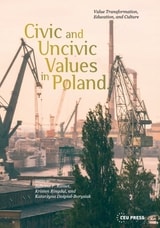
Civic and Uncivic Values in Poland
Value Transformation, Education, and CultureSabrina P. Ramet
Central European University Press, 2019
Civil Becomings
Performative Politics in the Amazon and the MediterraneanRaúl Acosta
University of Alabama Press, 2020
An anthropological approach to an emerging form of transnational political engagement by independent civil society organizations
Activism and advocacy have drawn academic interest as alternative ways of achieving collective ends outside established political institutions. However, there has been very little theoretical attention aimed at the interconnections between the two spheres. In Civil Becomings: Performative Politics in the Amazon and the Mediterranean, Raúl Acosta examines the manner in which progressive nongovernmental organizations (NGOs) and activists act in a more intermingled and processual way than scholars have previously acknowledged.
Acosta focuses on networks from the vantage point of two NGOs: one in Brazil that concentrated on environmental issues in the Amazon and another in Barcelona called the Mediterranean Social Forum. The focus of this research is not on organizational aspects of collaboration, but rather on the practices and contexts in which such cooperation occurs. Three major aspects of activist and advocacy networks are analyzed: their communicative characters, their collective performances of the political, and the negotiations they engage in between vernacular and cosmopolitan values.
This volume theorizes the cooperative actions of activist and advocacy networks as legitimating processes for the work of participating groups. In doing so, Acosta argues, they address the issues that justify a joint campaign or effort and also crucially underpin each participating collective as a worthy organization of civil society.
Civilizing the Enemy
German Reconstruction and the Invention of the WestPatrick Thaddeus Jackson
University of Michigan Press, 2006
By examining German reconstruction under the Marshall Plan, author Patrick Jackson shows how the rhetorical invention of a West that included Germany was critical to the emergence of the postwar world order. Civilizing the Enemy convincingly describes how concepts are strategically shaped and given weight in modern international relations, by expertly dissecting the history of "the West" and demonstrating its puzzling persistence in the face of contradictory realities.
"By revisiting the early Cold War by means of some carefully conducted intellectual history, Patrick Jackson expertly dissects the post-1945 meanings of "the West" for Europe's emergent political imaginary. West German reconstruction, the foundation of NATO, and the idealizing of 'Western civilization' all appear in fascinating new light."
--Geoff Eley, University of Michigan
"Western civilization is not given but politically made. In this theoretically sophisticated and politically nuanced book, Patrick Jackson argues that Germany's reintegration into a Western community of nations was greatly facilitated by civilizational discourse. It established a compelling political logic that guided the victorious Allies in their occupation policy. This book is very topical as it engages critically very different, and less successful, contemporary theoretical constructions and political deployments of civilizational discourse."
--Peter J. Katzenstein, Cornell University
"What sets Patrick Jackson's book apart is his attention, on the one hand, to philosophical issues behind the kinds of theoretical claims he makes and, on the other hand, to the methodological implications that follow from those claims. Few scholars are willing and able to do both, and even fewer are as successful as he is in carrying it off. Patrick Jackson is a systematic thinker in a field where theory is all the rage but systematic thinking is in short supply."
--Nicholas Onuf, Florida International University
Patrick Thaddeus Jackson is Assistant Professor of International Relations in American University's School of International Service.
Class Act
The Cultural and Political Life of Ewan MaccollBen Harker
Pluto Press, 2007
MacColl became a communist at fourteen and spent six decades at the cultural forefront of numerous political struggles, producing plays, songs and radio programmes on subjects ranging from the Spanish Civil War to the Poll Tax. Charting his involvement in radical theatre, his ground breaking radio work in the UK and the USA, as well as his musical influences and legacy, his three marriages, and his relationship with his songwriter daughter Kirstie MacColl, this is a lively account of a much-loved icon of 20th century folk music.
Drawing on extensive research, Class Act is a freshly conceived and energetically written account of a highly creative and controversial activist.
Cleansing the Nation
India, the Hindu Modern, and Mediations of GenderRaka Shome
Duke University Press, 2025
Clearer Than Truth
The Polygraph and the American Cold WarJohn Philipp Baesler
University of Massachusetts Press, 2018
In this first comprehensive history of the polygraph as a tool and symbol of American Cold War policies, John Philipp Baesler tells the story of a technology with weak scientific credentials that was nevertheless celebrated as a device that could expose both internal and external enemies. Considered the go-to technology to test agents' and employees' loyalty, the polygraph's true power was to expose deep ideological and political fault lines. While advocates praised it as America's hard-nosed yet fair answer to communist brainwashing, critics claimed that its use undermined the very values of justice, equality, and the presumption of innocence for which the nation stood.
Clearer Than Truth demonstrates that what began as quick-fix technology promising a precise test of honesty and allegiance eventually came to embody tensions in American Cold War culture between security and freedom, concerns that reach deep into the present day.
Clicas
Gender, Sexuality, and Struggle in Latina/o/x Gang Literature and FilmFrank García
University of Texas Press, 2024
2025 First Book Prize Honorable Mention, Cultural Studies Association
How Latina/o/x gang literature and film represent women and gay gang members’ challenges to gendered, sexual, racial, and class oppression.
Clicas examines Latina/o/x literature and film by and/or about gay and women gang members. Through close readings of literature and film, Frank García reimagines the typical narratives describing gang membership and culture, amplifying and complicating critical gang studies in the social sciences and humanities and looking at gangs across racial, ethnic, and national identities. Analyzing how the autobiographical poetry of Ana Castillo presents gang fashion, culture, and violence to the outside world, the effects of women performing female masculinity in the novel Locas, and gay gang members’ experiences of community in the documentary Homeboy, García complicates the dialogue regarding hypermasculine gang cultures. He shows how they are accessible not only to straight men but also to women and gay men who can appropriate them in complicated ways, which can be harming and also, at times, emancipating. Reading gang members as (de)colonial agents who contest the power relations, inequalities, oppressions, and hierarchies of the United States, Clicas considers how women and gay gang members resist materially and psychologically within a milieu shaped by the intersection of race, gender, sexuality, and class.
Climate Machines, Fascist Drives, and Truth
William E. Connolly
Duke University Press, 2019
Climate in Motion
Science, Empire, and the Problem of ScaleDeborah R. Coen
University of Chicago Press, 2018
Clocking Out
The Machinery of Life in 1960s Italian CinemaKaren Pinkus
University of Minnesota Press, 2020
An original reflection on Italy’s postwar boom considers potentials for resistance in today’s neoliberal (dis)order
What can 1960s Italian cinema teach us about how to live and work today? Clocking Out challenges readers to think about labor, cinema, and machines as they are intertwined in complex ways in Italian cinema of the early ’60s. Drawing on critical theory and archival research, this book asks what kinds of fractures we might exploit for living otherwise, for resisting traditional narratives, and for anticapitalism.
Italy in the 1960s was a place where the mass-producing factory was the primary mode of understanding what it meant to work, but it was also a time when things might have gone another way. This thinking and living differently appears in the cracks, lapses, or moments of film. Clocking Out is organized into scenes from an obscure 1962 Italian comedy (Renzo e Luciana, from Boccaccio 70). Reconsidering the origins of paradigms such as clocking in and out, “society is a factory,” and the gendered division of labor, Karen Pinkus challenges readers to think through cinema, enabling us to see gaps and breakdowns in the postwar order. She focuses on the Olivetti typewriter company and a little-known film from an Italian anthology movie, thinking with cinema about the power of the Autonomia movement, the refusal to work, and the questions of wages, paternalism, and sexual difference.
Alternating microscopic attention to details and zooming outward, Pinkus examines rituals of production, automation, repetition, and fractures in a narrative of labor that begins in the 1960s and extends to the present—the age of the precariat, right-wing resentment, and nostalgia for an order that was probably never was.
Cloning Terror
The War of Images, 9/11 to the PresentW. J. T. Mitchell
University of Chicago Press, 2010
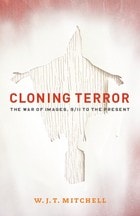
The phrase “War on Terror” has quietly been retired from official usage, but it persists in the American psyche, and our understanding of it is hardly complete. Nor will it be, W. J. T Mitchell argues, without a grasp of the images that it spawned, and that spawned it.
Exploring the role of verbal and visual images in the War on Terror, Mitchell finds a conflict whose shaky metaphoric and imaginary conception has created its own reality. At the same time, Mitchell locates in the concept of clones and cloning an anxiety about new forms of image-making that has amplified the political effects of the War on Terror. Cloning and terror, he argues, share an uncanny structural resemblance, shuttling back and forth between imaginary and real, metaphoric and literal manifestations. In Mitchell’s startling analysis, cloning terror emerges as the inevitable metaphor for the way in which the War on Terror has not only helped recruit more fighters to the jihadist cause but undermined the American constitution with “faith-based” foreign and domestic policies.
Bringing together the hooded prisoners of Abu Ghraib with the cloned stormtroopers of the Star Wars saga, Mitchell draws attention to the figures of faceless anonymity that stalk the ever-shifting and unlocatable “fronts” of the War on Terror. A striking new investigation of the role of images from our foremost scholar of iconology, Cloning Terror will expand our understanding of the visual legacy of a new kind of war and reframe our understanding of contemporary biopower and biopolitics.
Code
From Information Theory to French TheoryBernard Dionysius Geoghegan
Duke University Press, 2022
Cold War Anthropology
The CIA, the Pentagon, and the Growth of Dual Use AnthropologyDavid H. Price
Duke University Press, 2016
Cold War Games
Propaganda, the Olympics, and U.S. Foreign PolicyToby C Rider
University of Illinois Press, 2016
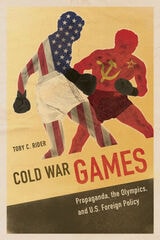
Drawing on newly declassified materials and archives, Toby C. Rider chronicles how the U.S. government used the Olympics to promote democracy and its own policy aims during the tense early phase of the Cold War. Rider shows how the government, though constrained by traditions against interference in the Games, eluded detection by cooperating with private groups, including secretly funded émigré organizations bent on liberating their home countries from Soviet control. At the same time, the United States utilized Olympic host cities as launching pads for hyping the American economic and political system. Behind the scenes, meanwhile, the government attempted clandestine manipulation of the International Olympic Committee. Rider also details the campaigns that sent propaganda materials around the globe as the United States mobilized culture in general, and sports in particular, to fight the communist threat.
Deeply researched and boldly argued, Cold War Games recovers an essential chapter in Olympic and postwar history.
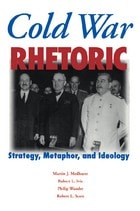
Cold War Rhetoric
Strategy, Metaphor, and IdeologyMartin J. Medhurst
Michigan State University Press, 1997
Cold War Rhetoric is the first book in over twenty years to bring a sustained rhetorical critique to bear on central texts of the Cold War. The rhetorical texts that are the subject of this book include speeches by Presidents Eisenhower and Kennedy, the Murrow- McCarthy confrontation on CBS, the speeches and writings of peace advocates, and the recurring theme of unAmericanism as it has been expressed in various media throughout the Cold War years. Each of the authors brings to his texts a particular approach to rhetorical criticism—strategic, metaphorical, or ideological. Each provides an introductory chapter on methodology that explains the assumptions and strengths of their particular approach.
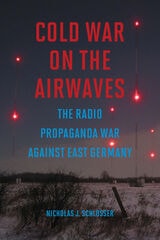
Cold War on the Airwaves
The Radio Propaganda War against East GermanyNicholas J. Schlosser
University of Illinois Press, 2015
Nicholas J. Schlosser draws on broadcast transcripts, internal memoranda, listener letters, and surveys by the U.S. Information Agency to profile RIAS. Its mission: to undermine the German Democratic Republic with propaganda that, ironically, gained in potency by obeying the rules of objective journalism. Throughout, Schlosser examines the friction inherent in such a contradictory project and propaganda's role in shaping political culture. He also portrays how RIAS's primarily German staff influenced its outlook and how the organization both competed against its rivals in the GDR and pushed communist officials to alter their methods in order to keep listeners.
From the occupation of Berlin through the airlift to the construction of the Berlin Wall, Cold War on the Airwaves offers an absorbing view of how public diplomacy played out at a flashpoint of East-West tension.
Cold Warriors
Manliness on Trial in the Rhetoric of the WestSuzanne Clark
Southern Illinois University Press, 2000
Cold Warriors: Manliness on Trial in the Rhetoric of the West returns to familiar cultural forces—the West, anticommunism, and manliness—to show how they combined to suppress dissent and dominate the unruliness of literature in the name of a national identity after World War II. Few realize how much the domination of a “white male” American literary canon was a product not of long history, but of the Cold War. Suzanne Clark describes here how the Cold War excluded women writers on several levels, together with others—African American, Native American, poor, men as well as women—who were ignored in the struggle over white male identity.
Clark first shows how defining national/individual/American identity in the Cold War involved a brand new configuration of cultural history. At the same time, it called upon the nostalgia for the old discourses of the West (the national manliness asserted by Theodore Roosevelt) to claim that there was and always had been only one real American identity.
By subverting the claims of a national identity, Clark finds, many male writers risked falling outside the boundaries not only of public rhetoric but also of the literary world: men as different from one another as the determinedly masculine Ernest Hemingway and the antiheroic storyteller of the everyday, Bernard Malamud. Equally vocal and contentious, Cold War women writers were unwilling to be silenced, as Clark demonstrates in her discussion of the work of Mari Sandoz and Ursula Le Guin.
The book concludes with a discussion of how the silencing of gender, race, and class in Cold War writing maintained its discipline until the eruptions of the sixties. By questioning the identity politics of manliness in the Cold War context of persecution and trial, Clark finds that the involvement of men in identity politics set the stage for our subsequent cultural history.
Collaborative Imagination
Earning Activism through Literacy EducationPaul Feigenbaum
Southern Illinois University Press, 2015
Processes of fighting unequal citizenship have historically prioritized literacy education, through which people envision universal first-class citizenship and devise practical methods for enacting this vision. In this important volume, literacy scholar Paul Feigenbaum explores how literacy education can facilitate activism in contemporary contexts in which underserved populations often remain consigned to second-class status despite official guarantees of equal citizenship. By conceiving of education as, in part, a process of understanding and grappling with adaptive and activist rhetorics, Feigenbaum explains, educators can direct people’s imaginations toward activism without running up against the conceptual problems so many scholars associate with critical pedagogy. Over time, this model of education expands people’s imaginations about what it means to be a good citizen, facilitates increased civic participation, and encourages collective destabilization of, rather than adaptation to, the structural inequalities of mainstream civic institutions. Feigenbaum offers detailed analyses of various locations and time periods inside, outside, and across the walls of formal education, including the Citizenship Schools and Freedom Schools rooted in the Civil Rights Movement of the 1950s and 1960s; the Algebra Project, a current practical-literacy network; and the Imagination Federation, a South Florida–based Earth-Literacy network. Considering both the history and the future of community literacy, Collaborative Imagination offers educators a powerful mechanism for promoting activism through their teaching and scholarship, while providing practical ideas for greater civic engagement among students.
Collateral Damage
The Influence of Political Rhetoric on the Incorporation of Second-Generation AmericansSean Richey
University of Michigan Press, 2023
Collateral Damage provides an overview of how political communication influences the process of incorporation with the broad society as well as its political parties. Sean Richey shows that how politicians talk about immigrants affects how their children perceive America and their feelings about the nation. These perceptions and feelings in turn greatly influence the children’s desire to incorporate into American political society. He also shows that regardless of a speaker’s intended outcome, what is said can still have a deleterious effect on incorporation desire, a communicative process that he terms “collateral damage.” Richey uses new experimental and survey evidence, as well as the rhetoric of Donald Trump as a test case, to examine how anti-immigration communication influences the incorporation of the children of immigrants.
Collecting, Ordering, Governing
Anthropology, Museums, and Liberal GovernmentTony Bennett, Fiona Cameron, Nelia Dias, Ben Dibley, Harrison Rodney, Ira Jacknis, and Conal McCarthy
Duke University Press, 2017
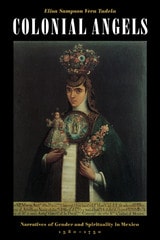
Colonial Angels
Narratives of Gender and Spirituality in Mexico, 1580-1750By Elisa Sampson Vera Tudela
University of Texas Press, 2000
Spain's attempt to establish a "New Spain" in Mexico never fully succeeded, for Spanish institutions and cultural practices inevitably mutated as they came in contact with indigenous American outlooks and ways of life. This original, interdisciplinary book explores how writing by and about colonial religious women participated in this transformation, as it illuminates the role that gender played in imposing the Spanish empire in Mexico.
The author argues that the New World context necessitated the creation of a new kind of writing. Drawing on previously unpublished writings by and about nuns in the convents of Mexico City, she investigates such topics as the relationship between hagiography and travel narratives, male visions of the feminine that emerge from the reworking of a nun's letters to her confessor into a hagiography, the discourse surrounding a convent's trial for heresy by the Inquisition, and the reports of Spanish priests who ministered to noble Indian women. This research rounds out colonial Mexican history by revealing how tensions between Spain and its colonies played out in the local, daily lives of women.
Colonizing Paradise
Landscape and Empire in the British West IndiesJefferson Dillman
University of Alabama Press, 2015
Explores how perceptions and depictions of the physical landscape both reflected and influenced the history of the British colonial Caribbean
In Colonizing Paradise, historian Jefferson Dillman charts the broad spectrum of sentiments that British citizens and travelers held regarding their colonial possessions in the West Indies. Myriad fine degrees of ambivalence separated extreme views of the region as an idyllic archipelago or a nest of Satanic entrapments. Dillman shows the manner in which these authentic or spontaneous depictions of the environment were shaped to form a narrative that undergirded Britain’s economic and political aims in the region.
Because British sentiments in the Caribbean located danger and evil not just in indigenous populations but in Spanish Catholics as well, Dillman’s work begins with the arrival of Spanish explorers and conquistadors. Colonizing Paradise spans the arrival of English ships and continues through the early nineteenth century and the colonial era. Dillman shows how colonial entrepreneurs, travelers, and settlers engaged in a disquieted dialogue with the landscape itself, a dialogue the examination of which sheds fresh light on the culture of the Anglophone colonial Caribbean.
Of particular note are the numerous mythical, metaphorical, and biblical lenses through which Caribbean landscapes were viewed, from early views of the Caribbean landscape as a New World paradise to later depictions of the landscape as a battleground between the forces of Christ and Satan. The ideal of an Edenic landscape persisted, but largely, Dillman argues, as one that needed to be wrested from the forces of darkness, principally through the work of colonization, planting, cataloguing, and a rational ordering of the environment.
Ultimately, although planters and their allies continued to promote pastoral and picturesque views of the Caribbean landscape, the goal of such narratives was to rationalize British rule as well as to mask and obscure emerging West Indian problems such as diseases, slavery, and rebellions. Colonizing Paradise offers much to readers interested in Caribbean, British, and colonial history.
Combative Politics
The Media and Public Perceptions of LawmakingMary Layton Atkinson
University of Chicago Press, 2017
By the time a bill is pushed through Congress or ultimately defeated, we’ve often been exposed to weeks, months—even years—of media coverage that underscores the unpopular process of policymaking, and Mary Layton Atkinson argues that this leads us to reject the bill itself. Contrary to many Americans’ understandings of the policymaking process, the best answer to a complex problem is rarely self-evident, and politicians must weigh many potential options, each with merits and drawbacks. As the public awaits a resolution, the news media tend to focus not on the substance of the debate but on descriptions of partisan combat. This coverage leads the public to believe everyone in Washington has lost sight of the problem altogether and is merely pursuing policies designed for individual political gain. Politicians in turn exacerbate the problem when they focus their objections to proposed policies on the lawmaking process, claiming, for example, that a bill is being pushed through Congress with maneuvers designed to limit minority party input. These negative portrayals become linked in many people’s minds with the policy itself, leading to backlash against bills that may otherwise be seen as widely beneficial. Atkinson argues that journalists and educators can make changes to help inoculate Americans against the idea that debate always signifies dysfunction in the government. Journalists should strive to better connect information about policy provisions to the problems they are designed to ameliorate. Educators should stress that although debate sometimes serves political interests, it also offers citizens a window onto the lawmaking process that can help them evaluate the work their government is doing.
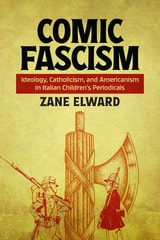
Comic Fascism
Ideology, Catholicism, and Americanism in Italian Children’s PeriodicalsZane Elward
The Ohio State University Press, 2025
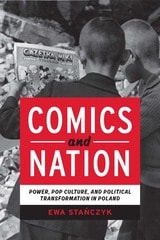
Comics and Nation
Power, Pop Culture, and Political Transformation in PolandEwa Stanczyk
The Ohio State University Press, 2022
Winner, BASEES George Blazyca Award in East European Studies
Comics and Nation offers a fresh perspective on the role of popular culture in the one-hundred-year history of the Polish state, from its foundation in 1918 to the present. Drawing on dozens of press articles, interviews, and readers’ letters, Ewa Stanczyk discusses how journalists, artists, and audiences used comics to probe the boundaries of national culture and scrutinize the established notions of Polishness. Critical moments of Poland’s political transformation ––the establishment of the interwar Polish Republic, the Cold War, the liberalization of the 1970s, the 1989 democratic transition, the turn to memory politics in the 2000s––have all been reflected in the history of Polish comics. Stanczyk offers new insights into how the production of homegrown comics and the influx of foreign works enabled commentators to express their fears, hopes, and disillusionment with political, economic, and cultural changes in Poland and beyond. At its core, Comics and Nation rethinks the impact of popular culture and transnational exchange on Polish nation building, citizenship formation, and the legitimation of power.
Coming Out Republican
A History of the Gay RightNeil J. Young
University of Chicago Press, 2024
One of the most maligned, misunderstood, and even mocked constituencies in American politics, gay Republicans regularly face condemnation from both the LGBTQ+ community and their own political party. Yet they’ve been active and influential for decades. Gay conservatives were instrumental, for example, in ending “Don’t Ask, Don’t Tell” and securing the legalization of same-sex marriage—but they also helped lay the groundwork for the rise of Donald Trump.
In Coming Out Republican, political historian and commentator Neil J. Young provides the first comprehensive history of the gay Right. From the 1950s up to the present day, Young excavates the multifarious origins, motivations, and evolutions of LGBTQ+ people who found their way to the institutions and networks of modern conservatism. Many on the gay Right have championed conservative values—like free markets, a strong national defense, and individual liberty—and believed that the Republican Party therefore offered LGBTQ+ people the best pathway to freedom. Meanwhile, that same party has actively and repeatedly demonized them. With his precise and provocative voice, Young details the complicated dynamics of being in—and yet never fully accepted into—the Republican Party.
Coming Out Republican provides striking insight into who LGBTQ+ conservatives are, what they want, and why many of them continue to align with a party whose rank and file largely seem to hate them. As the Republican Party renews its assaults on LGBTQ+ rights, understanding the significant history of the gay Right has never been more critical.
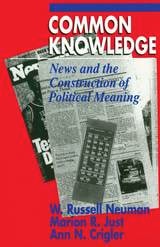
Common Knowledge
News and the Construction of Political MeaningW. Russell Neuman, Marion R. Just, and Ann N. Crigler
University of Chicago Press, 1992
For their study, the authors analyzed coverage of 150 television and newspaper stories on five prominent issues—drugs, AIDS, South African apartheid, the Strategic Defense Initiative, and the stock market crash of October 1987. They tested audience responses of more than 1,600 people, and conducted in-depth interviews with a select sample. What emerges is a surprisingly complex picture of people actively and critically interpreting the news, making sense of even the most abstract issues in terms of their own lives, and finding political meaning in a sophisticated interplay of message, medium, and firsthand experience.
At every turn, Common Knowledge refutes conventional wisdom. It shows that television is far more effective at raising the saliency of issues and promoting learning than is generally assumed; it also undermines the assumed causal connection between newspaper reading and higher levels of political knowledge. Finally, this book gives a deeply responsible and thoroughly fascinating account of how the news is conveyed to us, and how we in turn convey it to others, making meaning of at once so much and so little. For anyone who makes the news—or tries to make anything of it—Common Knowledge promises uncommon wisdom.
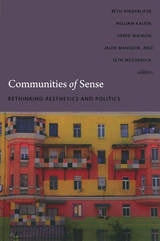
Communities of Sense
Rethinking Aesthetics and PoliticsBeth Hinderliter, William Kaizen, Vered Maimon, Jaleh Mansoor, and Seth McCormick, eds.
Duke University Press, 2009
The first of the collection’s three sections explicitly examines the links between aesthetics and social and political experience. Here a new essay by Rancière posits art as a key site where disagreement can be staged in order to produce new communities of sense. In the second section, contributors investigate how sense was constructed in the past by the European avant-garde and how it is mobilized in today’s global visual and political culture. Exploring the viability of various models of artistic and political critique in the context of globalization, the authors of the essays in the volume’s final section suggest a shift from identity politics and preconstituted collectivities toward processes of identification and disidentification. Topics discussed in the volume vary from digital architecture to a makeshift museum in a Paris suburb, and from romantic art theory in the wake of Hegel to the history of the group-subject in political art and performance since 1968. An interview with Étienne Balibar rounds out the collection.
Contributors. Emily Apter, Étienne Balibar, Carlos Basualdo, T. J. Demos, Rachel Haidu, Beth Hinderliter, David Joselit, William Kaizen, Ranjanna Khanna, Reinaldo Laddaga, Vered Maimon, Jaleh Mansoor, Reinhold Martin, Seth McCormick, Yates McKee, Alexander Potts, Jacques Rancière, Toni Ross
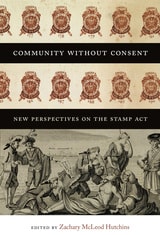
Community without Consent
New Perspectives on the Stamp ActEdited by Zachary McLeod Hutchins
Dartmouth College Press, 2016
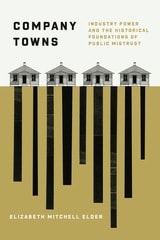
Company Towns
Industry Power and the Historical Foundations of Public MistrustElizabeth Mitchell Elder
University of Chicago Press, 2026
Reveals the deep, historical roots of public distrust in former mining areas in the US, shedding new light on the corrosive feedback loops that persist today.
In Company Towns, Elizabeth Mitchell Elder examines the long-lasting political legacies of mining-company dominance in the Midwest and Appalachia. While the economic consequences of deindustrialization are well-known, Elder shifts the focus to a more insidious problem: the political dysfunction that took root long before the mines shut down.
Drawing on historical and administrative data, Elder shows that the coal industry hindered the growth of local government capacity in the places where it was dominant. Mining companies also engaged in outright corruption to shape local governments, practices which local elites then carried forward. When mining companies withdrew, they left behind not just economic decline, but local governments ill-equipped to govern.
These patterns have had enduring consequences for public life. Elder shows how these historical experiences have fueled a broader cynicism toward government, in which citizens expect little from public institutions and doubt the usefulness of elections. Company Towns underscores the consequences of corporate dominance for state capacity, public opinion, and democratic accountability today.

Comparative Media Policy, Regulation and Governance in Europe
Unpacking the Policy CycleEdited by Leen d’Haenens, Helena Sousa, and Josef Trappel
Intellect Books, 2018
Comparative Media Systems
European and Global PerspectivesMiklós Sükösd
Central European University Press, 2010
Competing Responsibilities
The Ethics and Politics of Contemporary LifeSusanna Trnka and Catherine Trundle, editors
Duke University Press, 2017
Contributors
Barry D. Adam, Elizabeth Anne Davis, Filippa Lentzos, Jessica Robbins-Ruszkowski, Nikolas Rose, Rosalind Shaw, Cris Shore, Jessica M. Smith, Susanna Trnka, Catherine Trundle, Jarrett Zigon
Competitive Archaeology in Jordan
Narrating Identity from the Ottomans to the HashemitesBy Elena D. Corbett
University of Texas Press, 2015
An examination of archaeology in Jordan and Palestine, Competitive Archaeology in Jordan explores how antiquities have been used to build narratives and national identities. Tracing Jordanian history, and the importance of Jerusalem within that history, Corbett analyzes how both foreign and indigenous powers have engaged in a competition over ownership of antiquities and the power to craft history and geography based on archaeological artifacts. She begins with the Ottoman and British Empires—under whose rule the institutions and borders of modern Jordan began to take shape—asking how they used antiquities in varying ways to advance their imperial projects. Corbett continues through the Mandate era and the era of independence of an expanded Hashemite Kingdom, examining how the Hashemites and other factions, both within and beyond Jordan, have tried to define national identity by drawing upon antiquities.
Competitive Archaeology in Jordan traces a complex history through the lens of archaeology’s power as a modern science to create and give value to spaces, artifacts, peoples, narratives, and academic disciplines. It thus considers the role of archaeology in realizing Jordan’s modernity—drawing its map; delineating sacred and secular spaces; validating taxonomies of citizens; justifying legal frameworks and institutions of state; determining logos of the nation for display on stamps, currency, and in museums; and writing history. Framing Jordan’s history in this way, Corbett illustrates the manipulation of archaeology by governments, institutions, and individuals to craft narratives, draw borders, and create national identities.
Competitiveness and Death
Trade and Politics in Cars, Beef, and DrugsGary Winslett
University of Michigan Press, 2021
Gary Winslett builds on new trade theories to explain when and why businesses are most likely to lobby governments to reduce these regulatory trade barriers. He argues that businesses prevail when they can connect with broader concerns about national economic competitiveness. He examines how activist organizations overcome collective action problems and defend regulatory differences, arguing that they succeed when they can link their desire for barriers with preventing needless death. Competitiveness and Death provides a political companion to new trade theories in economics, questioning cleavage-based explanations of trade politics, demonstrating the underappreciated importance of activists, suggesting the limits of globalization, providing in-depth examination of previously ignored trade negotiations, qualifying the California Effect (the shift toward stricter regulatory standards), and showing the relative rarity of regulations used as disguised protectionism.
Composition and Cornel West
Notes toward a Deep DemocracyKeith Gilyard
Southern Illinois University Press, 2008
Composition and Cornel West: Notes toward a Deep Democracy identifies and explains key aspects of the work of Cornel West—the highly regarded scholar of religion, philosophy, and African American studies—as they relate to composition studies, focusing especially on three rhetorical strategies that West suggests we use in our questioning lives as scholars, teachers, students, and citizens.
In this study, author Keith Gilyard examines the strategies of Socratic Commitment (a relentless examination of received wisdom), Prophetic Witness (an abiding concern with justice and the plight of the oppressed), and Tragicomic Hope (a keep-on-pushing sensibility reflective of the African American freedom struggle). Together, these rhetorical strategies comprise an updated form of cultural criticism that West calls prophetic pragmatism.
This volume, which contains the only interview in which Cornel West directly addresses the field of composition,sketches the development of Cornel West’s theories of philosophy, political science, religion, and cultural studies and restates the link between Deweyan notions of critical intelligence and the notion of critical literacy developed by Ann Berthoff, Ira Shor, and Henry Giroux. Gilyard provides examples from the classroom to illustrate the possibilities of Socratic Commitment as part of composition pedagogy, shows the alignment of Prophetic Witness with traditional aims of critical composition, and in his chapter on Tragicomic Hope, addresses African American expressive culture with an emphasis on music and artists such as Curtis Mayfield, Marvin Gaye, Aretha Franklin, and Kanye West.
The first book to comprehensively connect the ideas of one of America's premier scholars of religion, philosophy and African American studies with composition theory and pedagogy, Composition and Cornel West will be valuable to scholars, teachers, and students interested in race, class, critical literacy, and the teaching of writing.
Composition in the Age of Austerity
Nancy Welch
Utah State University Press, 2016
In the face of the gradual saturation of US public education by the logics of neoliberalism, educators often find themselves at a loss to respond, let alone resist. Through state defunding and many other “reforms” fueled by austerity politics, a majority of educators are becoming casual labor in US universities while those who hang onto secure employment are pressed to act as self-supporting entrepreneurs or do more with less. Focusing on the discipline of writing studies, this collection addresses the sense of crisis that many educators experience in this age of austerity.
The chapters in this book chronicle how neoliberal political economy shapes writing assessments, curricula, teacher agency, program administration, and funding distribution. Contributors also focus on how neoliberal political economy dictates the direction of scholarship, because the economic and political agenda shaping the terms of work, the methods of delivery, and the ways of valuing and assessing writing also shape the primary concerns and directions of scholarship.
Composition in the Age of Austerity offers critical accounts of how the restructuring of higher education is shaping the daily realities of composition programs. The book documents the effects and implications of the current restructuring, examines how cherished rhetorical ideals actually leave the field unprepared to respond effectively to defunding and corporatizing trends, and establishes points of departure for collective response.
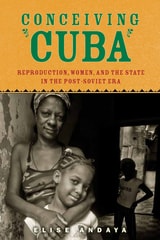
Conceiving Cuba
Reproduction, Women, and the State in the Post-Soviet EraAndaya, Elise
Rutgers University Press, 2014
Winner of the Adele E. Clarke Book Award from ReproNetwork
After Cuba’s 1959 revolution, the Castro government sought to instill a new social order. Hoping to achieve a new and egalitarian society, the state invested in policies designed to promote the well-being of women and children. Yet once the Soviet Union fell and Cuba’s economic troubles worsened, these programs began to collapse, with serious results for Cuban families.
Conceiving Cuba offers an intimate look at how, with the island’s political and economic future in question, reproduction has become the subject of heated public debates and agonizing private decisions. Drawing from several years of first-hand observations and interviews, anthropologist Elise Andaya takes us inside Cuba’s households and medical systems. Along the way, she introduces us to the women who wrestle with the difficult question of whether they can afford a child, as well as the doctors who, with only meager resources at their disposal, struggle to balance the needs of their patients with the mandates of the state.
Andaya’s groundbreaking research considers not only how socialist policies have profoundly affected the ways Cuban families imagine the future, but also how the current crisis in reproduction has deeply influenced ordinary Cubans’ views on socialism and the future of the revolution. Casting a sympathetic eye upon a troubled state, Conceiving Cuba gives new life to the notion that the personal is always political.