Results by title
1668 books match the query 'Popular culture' and 123 start with c
Class-Passing
Social Mobility in Film and Popular CultureGwendolyn Audrey Foster
Southern Illinois University Press, 2005
Oprah Winfrey, Donald Trump, Roseanne Barr, Martha Stewart, and Britney Spears typify class-passers—those who claim different socioeconomic classes as their own—asserts Gwendolyn Audrey Foster in Class-Passing: Social Mobility in Film and Popular Culture. According to new rules of social standing in American popular culture, class is no longer defined by wealth, birth, or education. Instead, today’s notion of class reflects a socially constructed and regulated series of performed acts and gestures rooted in the cult of celebrity.
In examining the quest for class mobility, Foster deftly traces class-passing through the landscape of popular films, reality television shows, advertisements, the Internet, and video games. She deconstructs the politics of celebrity, fashion, and conspicuous consumerism and analyzes class-passing as it relates to the American Dream, gender, and marriage.
Class-Passing draws on dozens of examples from popular culture, from old movie classics and contemporary films to print ads and cyberspace, to illustrate how flagrant displays of wealth that were once unacceptable under the old rules of behavior are now flaunted by class-passing celebrities. From the construction worker in Who Wants to Marry a Millionaire? to the privileged socialites Paris Hilton and Nicole Richie of The Simple Life, Foster explores the fantasy of contact between the classes. She also refers to television class-passers from The Apprentice, Queer Eye for the Straight Guy, and Survivor and notable class-passing achievers Warren Buffet, Bill Gates, and P. Diddy.
Class-Passing is a notable examination of the historical, social, and ideological shifts in expressions of class. The first serious book of its kind, Class-Passing is fresh, innovative, and invaluable for students and scholars of film, television, and popular culture.
Coca-Cola Socialism
Americanization of Yugoslav Culture in the SixtiesRadina Vucetic
Central European University Press, 2018
This book is about the Americanization of Yugoslav culture and everyday life during the nineteen-sixties. After falling out with the Eastern bloc, Tito turned to the United States for support and inspiration. In the political sphere the distance between the two countries was carefully maintained, yet in the realms of culture and consumption the Yugoslav regime was definitely much more receptive to the American model. For Titoist Yugoslavia this tactic turned out to be beneficial, stabilising the regime internally and providing an image of openness in foreign policy.
Coca-Cola Socialism addresses the link between cultural diplomacy, culture, consumer society and politics. Its main argument is that both culture and everyday life modelled on the American way were a major source of legitimacy for the Yugoslav Communist Party, and a powerful weapon for both USA and Yugoslavia in the Cold War battle for hearts and minds.
Radina Vučetić explores how the Party used American culture in order to promote its own values and what life in this socialist and capitalist hybrid system looked like for ordinary people who lived in a country with communist ideology in a capitalist wrapping. Her book offers a careful reevaluation of the limits of appropriating the American dream and questions both an uncritical celebration of Yugoslavia’s openness and an exaggerated depiction of its authoritarianism.
Collaborative Production in the Creative Industries
James Graham and Alessandro Gandini
University of Westminster Press, 2017
In recent years research into creative labour and cultural work has usually addressed the politics of production in these fields, but the sociotechnical and aesthetic dimensions of collaborative creative work have been somewhat overlooked.
This book aims to address this gap. Through case studies that range from TV showrunning to independent publishing, from the film industry to social media platforms such as Tumblr and Wattpad, this collection develops a critical understanding of the integral role collaboration plays in contemporary media and culture. It draws attention to diverse kinds of creative collaboration afforded via the intermediation of digital platforms and networked publics. It considers how these are incorporated into emergent market paradigms and investigates the complicated forms of subjectivity that develop as a consequence. But it also acknowledges historical continuities, not least in terms of the continued exploitation of ‘support personnel’ and of resulting artistic conflicts but also of alternative models that resist the precarious nature of contemporary cultural work.
Finally, this volume attempts to situate creative collaboration in broader social and economic contexts, where the experience and outcomes of such work have proved more problematic than the rich potential of their promise would lead us to expect.
The Editors: James Graham is Senior Lecturer in the Faculty of Arts and Creative Industries, Middlesex University, London. Alessandro Gandini is Lecturer in Digital Media Management and Innovation in the Department of Digital Humanities, Kings College, London.
Collective Effervescence
Edited by Sébastien Tutenges and Philip Smith
Temple University Press, 2026
The editors and contributors to Collective Effervescence make a deep dive into new waters. They investigate solo experiences, virtual collectivities, low-intensity effervescence, and negative outcomes. Through studies of drug ceremonies, occupational subcultures, bookshops, online activities, and much more, each chapter discovers and theorizes something previously unknown. Collective Effervescence finds new potentials in a familiar theoretical resource.
Contributors: Sarah H. Awad, Pierre Bouchat, Randall Collins, Silvia da Costa, Scott Draper, Lisa Flower, Romulo Lelis, Heather Margrsion, Sharon Mascall-Dare, Ashley Mears, Margit Anne Petersen, José J. Pizarro, Bernard Rimé, Dario Páez, David Sausdal, Daniel Smith, Femke Vandenberg, Brady Wagoner, David Wästerfors, Brad West, and the editors
Color of Privilege
Three Blasphemies on Race and FeminismAida Hurtado
University of Michigan Press, 1996
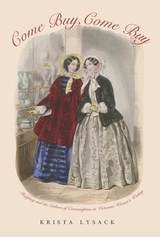
Come Buy, Come Buy
Shopping and the Culture of Consumption in Victorian Women’s WritingKrista Lysack
Ohio University Press, 2008
From the 1860s through the early twentieth century, Great Britain saw the rise of the department store and the institutionalization of a gendered sphere of consumption. Come Buy, Come Buy considers representations of the female shopper in British women’s writing and demonstrates how women’s shopping practices are materialized as forms of narrative, poetic, and cultural inscription, showing how women writers emphasize consumerism as productive of pleasure rather than the condition of seduction or loss. Krista Lysack examines works by Christina Rossetti, Mary Elizabeth Braddon, George Eliot, and Michael Field, as well as the suffragette newspaper Votes for Women, in order to challenge the dominant construction of Victorian femininity as characterized by self-renunciation and the regulation of appetite.
Come Buy, Come Buy considers not only literary works, but also a variety of archival sources (shopping guides, women’s fashion magazines, household management guides, newspapers, and advertisements) and cultural practices (department store shopping, shoplifting and kleptomania, domestic economy, and suffragette shopkeeping). With this wealth of sources, Lysack traces a genealogy of the woman shopper from dissident domestic spender to aesthetic connoisseur, from curious shop-gazer to political radical.
Comic Book Movies
Davis, Blair
Rutgers University Press, 2018
Film scholar Blair Davis also considers how the genre’s visual style is equally important as its weighty themes, and he details how advances in digital effects have allowed filmmakers to incorporate elements of comic book art in innovative ways. As he reveals, comic book movies have inspired just as many innovations to Hollywood’s business model, with film franchises and transmedia storytelling helping to ensure that the genre will continue its reign over popular culture for years to come.
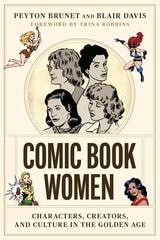
Comic Book Women
Characters, Creators, and Culture in the Golden AgeBy Peyton Brunet and Blair Davis; foreword by Trina Robbins
University of Texas Press, 2022
2023 Ray and Pat Browne Best Single Work by One or More Authors in Popular and American Culture, Popular and American Culture Association (PACA) / Popular Culture Association (PCA)
2023 Ray and Pat Browne Best Edited Reference/Primary Source Work in Popular Culture Award (Honorable Mention), Popular and American Culture Association (PACA) / Popular Culture Association (PCA)
2023 Peter C. Rollins Book Award, Southwest Texas Popular Culture and American Culture Associations (SWPACA)
A revisionist history of women's pivotal roles as creators of and characters in comic books.
The history of comics has centered almost exclusively on men. Comics historians largely describe the medium as one built by men telling tales about male protagonists, neglecting the many ways in which women fought for legitimacy on the page and in publishers’ studios. Despite this male-dominated focus, women played vital roles in the early history of comics. The story of how comic books were born and how they evolved changes dramatically when women like June Tarpé Mills and Lily Renée are placed at the center rather than at the margins of this history, and when characters such as the Black Cat, Patsy Walker, and Señorita Rio are analyzed.
Comic Book Women offers a feminist history of the golden age of comics, revising our understanding of how numerous genres emerged and upending narratives of how male auteurs built their careers. Considering issues of race, gender, and sexuality, the authors examine crime, horror, jungle, romance, science fiction, superhero, and Western comics to unpack the cultural and industrial consequences of how women were represented across a wide range of titles by publishers like DC, Timely, Fiction House, and others. This revisionist history reclaims the forgotten work done by women in the comics industry and reinserts female creators and characters into the canon of comics history.

Comic Crime
Edited by Earl F. Bargainnier
University of Wisconsin Press, 1987
The humor of Sherlock Holmes, Donald Westlake, Agatha Christie, Michael Innes, and Edmund Crispin are just a few of those discussed. A major point highlighted by this book is simply that wit, slapstick. laughter, and an anything-can-happen motif appear in a significant amount of fiction about crime.
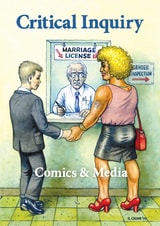
Comics & Media
A Special Issue of "Critical Inquiry"Edited by Hillary L. Chute and Patrick Jagoda
University of Chicago Press, 2014
The twenty-first century has seen the medium of comics reach unprecedented heights of critical acclaim and commercial success. Comics & Media reflects that, bringing together an amazing array of contributors--creators and critics alike--to discuss the state, future, and potential of the medium.
Loaded with full-color reproductions of work by such legends as R. Crumb, Art Spiegelman, Alison Bechdel, Chris Ware, Daniel Clowes, and Lynda Barry, the book addresses the place of comics in both a contemporary and historical context. Essays by such high-profile figures as Tom Gunning, N. Katherine Hayles, Patrick Jagoda, and W. J. T. Mitchell address a stunning range of topics, including the place of comics in the history of aesthetics, changes to popular art forms, digital humanities, and ongoing tensions between new and old media. The result is a substantial step forward for our understanding of what comics are and can be, and the growing place they hold in our culture.
Comics Studies
A GuidebookCharles Hatfield
Rutgers University Press, 2020
In the twenty-first century, the field of comics studies has exploded. Scholarship on graphic novels, comic books, comic strips, webcomics, manga, and all forms of comic art has grown at a dizzying pace, with new publications, institutions, and courses springing up everywhere. The field crosses disciplinary and cultural borders and brings together myriad traditions. Comics Studies: A Guidebook offers a rich but concise introduction to this multifaceted field, authored by leading experts in multiple disciplines. It opens diverse entryways to comics studies, including history, form, audiences, genre, and cultural, industrial, and economic contexts. An invaluable one-stop resource for veteran and new comics scholars alike, this guidebook represents the state of the art in contemporary comics scholarship.
Comics and Nation
Power, Pop Culture, and Political Transformation in PolandEwa Stanczyk
The Ohio State University Press, 2022
Winner, BASEES George Blazyca Award in East European Studies
Comics and Nation offers a fresh perspective on the role of popular culture in the one-hundred-year history of the Polish state, from its foundation in 1918 to the present. Drawing on dozens of press articles, interviews, and readers’ letters, Ewa Stanczyk discusses how journalists, artists, and audiences used comics to probe the boundaries of national culture and scrutinize the established notions of Polishness. Critical moments of Poland’s political transformation ––the establishment of the interwar Polish Republic, the Cold War, the liberalization of the 1970s, the 1989 democratic transition, the turn to memory politics in the 2000s––have all been reflected in the history of Polish comics. Stanczyk offers new insights into how the production of homegrown comics and the influx of foreign works enabled commentators to express their fears, hopes, and disillusionment with political, economic, and cultural changes in Poland and beyond. At its core, Comics and Nation rethinks the impact of popular culture and transnational exchange on Polish nation building, citizenship formation, and the legitimation of power.
Coming Out of War
Poetry, Grieving, and the Culture of the World WarsJanis P. Stout
University of Alabama Press, 2005
World War I is widely considered “the Great War” and World War II, “the Good War.” Janis Stout thinks of them as two parts of a whole that continues to engage historians and literary scholars searching for an understanding of both the actual war experiences and the modern culture of grief they embody. In Coming Out of War: Poetry, Grieving, and the Culture of the World Wars Stout argues that poetry, of all the arts, most fully captures and conveys those cultural responses.
While probing the work of such well known war poets as Rupert Brooke, Wilfred Owen, and Randall Jarrell, Stout also highlights the impact of the wars on lesser studied, but equally compelling, sources such as the music of Charles Ives and Cole Porter, Aaron Copland and Irving Berlin. She challenges the commonplace belief that war poetry came only from the battlefield and was written only by men by examining the wartime writings of women poets such as Rose Macaulay, Marianne Moore, Elizabeth Bishop, and Gwendolyn Brooks. She also challenges the assumption that World War II did not produce poetry of distinction by studying the work of John Ciardi, Karl Shapiro, Louis Simpson, Robert Frost, and Wallace Stevens. While emphasizing aesthetic continuity between the wars, Stout stresses that the poetry that emerged from each displays a greater variety than is usually recognized.
A final chapter considers Benjamin Britten’s War Requiem as a culmination and embodiment of the anti-war tradition in 20th-century poetry and music, and speculates on the reasons why, despite their abundance and eloquence, these expressions of grief and opposition to war have effected so little change.
Commerce in Color
Race, Consumer Culture, and American Literature, 1893-1933James C. Davis
University of Michigan Press, 2010
Commerce in Color exploresthe juncture of consumer culture and race by examining advertising, literary texts, mass culture, and public events in the United States from 1893 to 1933. James C. Davis takes up a remarkable range of subjects—including the crucial role publishers Boni and Liveright played in the marketing of Harlem Renaissance literature, Henry James’s critique of materialism in The American Scene, and the commodification of racialized popular culture in James Weldon Johnson’s The Autobiography of anEx-Colored Man—as he argues that racial thinking was central to the emergence of U.S. consumerism and, conversely, that an emerging consumer culture was a key element in the development of racial thinking and the consolidation of racial identity in America. By urging a reassessment of the familiar rubrics of the “culture of consumption” and the “culture of segregation,” Dawson poses new and provocative questions about American culture and social history.
Both an influential literary study and an absorbing historical read, Commerce in Color proves that—in America—advertising, publicity, and the development of the modern economy cannot be understood apart from the question of race.
“A welcome addition to existing scholarship, Davis’s study of the intersection of racial thinking and the emergence of consumer culture makes connections very few scholars have considered.”
—James Smethurst, University of Massachusetts
James C. Davis is Assistant Professor of English at Brooklyn College.Communication and Women's Friendships
Parallels and Intersections in Literature and LifeJanet Doubler Ward
University of Wisconsin Press, 1993

Concrete Encoded
Poetry, Design, and the Cybernetic Imaginary in BrazilNathaniel Wolfson
University of Texas Press, 2025
A study of concrete art and poetry, its implications, and influence in Brazil.
Concrete art and poetry burst onto Brazil’s cultural stage in the 1950s, while the country was embarking on a dizzying period of modernization. Bringing together key poets and visual artists alongside less recognized figures, Nathaniel Wolfson shows that concretism was hardly socially inert, as pundits have suggested. Rather, it presciently grappled with an emerging information age that would soon reorganize human relations globally.
Concrete Encoded describes a nascent cybernetic imaginary. Concretism has long been considered Brazil’s most global aesthetic movement. Wolfson traces new circles of international theorists and practitioners involved in critical technological thought. Wolfson argues that concrete poetry is the quintessential literary genre of the early information age. He shows that Brazilian poets, artists, and designers contested the military dictatorship’s technological authoritarianism and information-gathering operations. Vigorous experimentalists, their attention to form and semantics unveiled both the creative and nefarious possibilities of algorithmic writing. A highly original work, Concrete Encoded reckons with aesthetic responses from Brazil to an advancing capitalist and digital era.
Conjuring the Folk
Forms of Modernity in African AmericaDavid G. Nicholls
University of Michigan Press, 2000
In a series of revisionary readings, Nicholls studies how the "folk" is shaped by the ideology of form. He examines the presence of a spectral "folk" in Toomer's modernist pastiche, Cane. He explores how Hurston presents folklore as a contemporary language of resistance in her ethnography, Mules and Men. In Claude McKay's naturalistic romance, Banana Bottom, Nicholls discovers the figuration of an alternative modernity in the heroine's recovery of her lost "folk" identity. He unearths the individualist ethos of Booker T. Washington in two novels by George Wylie Henderson. And he reveals how Richard Wright's photo-documentary history, 12 Million BlackVoices, places the "folk" in a Marxian narrative of modernization toward class-consciousness.
A provocative rereading of the cultural politics of the Harlem Renaissance, Conjuring the Folk offers a new way of understanding literary responses to migration, modernization, and the concept of the "folk" itself.
David G. Nicholls is a post-doctoral fellow in the Center for the Study of Race, Politics, and Culture, University of Chicago.
Considering Watchmen
Poetics, Property, Politics: New edition with full color illustrationsHoberek, Andrew
Rutgers University Press, 2017
Demonstrating a keen eye for historical detail, Considering Watchmen gives readers a new appreciation of just how radical Moore and Gibbons’s blend of gritty realism and formal experimentation was back in 1986. The book also considers Watchmen’s place in the history of the comics industry, reading the graphic novel’s playful critique of superhero marketing alongside Alan Moore’s public statements about the rights to the franchise. Andrew Hoberek examines how Moore and Gibbons engaged with the emerging discourses of neoconservatism and neoliberal capitalism, ideologies that have only become more prominent in subsequent years.
Watchmen’s influences on the superhero comic and graphic novel are undeniable, but Hoberek reveals how it has also had profound effects on literature as a whole. He suggests that Watchmen not only proved that superhero comics could rise to the status of literature—it also helped to inspire a generation of writers who are redefining the boundaries of the literary, from Jonathan Lethem to Junot Díaz. Hoberek delivers insight and analysis worthy of satisfying serious readers of the genre while shedding new light on Watchmen as both an artistic accomplishment and a book of ideas.
Constructing Nationhood in Modern East Asia
Kai-wing Chow, Kevin M. Doak, and Poshek Fu, Editors
University of Michigan Press, 2001
This is an interdisciplinary study of the cultural politics of nationalism and national identities in modern East Asia. Combining theoretical insights with empirical research, it explores the cultural dimensions of nationhood and identity-making in China, Japan, Korea, Hong Kong, and Taiwan. The essays address issues ranging from the complex relations between popular culture and national consciousness to the representation of ethnic/racial identity and gendered discourse on nationalism. The cutting-edge research on the diverse forms of cultural preacceptance and the various ways in which this participates in the construction and projection of national and ethnic identities in East Asia illuminates several understudied issues in Asian studies, including the ambiguity of Hong Kong identity during World War II and the intricate politics of the post-war Taiwanese trial of collaboration.
Addressing a wide range of theoretical and historical issues regarding cultural dimensions of nationalism and national identities all over East Asia, these essays draw insights from such recent theories as cultural studies, postcolonial theories, and archival-researched cultural anthropology. The book will be important reading for students of Asian studies as well as for serious readers interested in issues of nationalism and culture.
Kai-wing Chow is Associate Professor of East Asian Languages and Cultures. Kevin Doak is Associate Professor of History. Poshek Fu is Associate Professor of History and Cinema Studies. All three teach at University of Illinois, Urbana-Champaign.
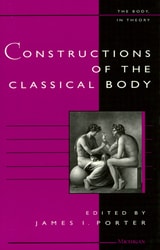
Constructions of the Classical Body
James I. Porter, Editor
University of Michigan Press, 2002
Classical scholarship has traditionally neglected the prominence of the body in antiquity. Constructions of the Classical Body theorizes that the study of antiquity is necessarily a study of the body, and that attention to this fact can lead to a much-needed shift in the way in which classical studies are approached today. This volume aims to reestablish the relevance of the problem of the body at the perimeters of several different kinds of inquiry, and, in this way, to help open up a field of possibilities for future study. The range covered by the essays in this volume is sweeping: from Corinthian vaseware to Athenian and Roman politics, poetry from Homer to Ovid, medical writers from the Hippocratic corpus to the diary of Aelius Aristides (second century c.e.), philosophy (Seneca, Porphyry), the Greek novel, Christian apocrypha, Ovid's medieval reception, and twentieth century film. This range is a consequence of the multidisciplinarity that any study of the body requires, and it attests to the particular richness of the body in classical antiquity and as an object for study today. The volume illustrates that body is located between traditional borders, not within them; the body dissolves traditional objects of study and joins areas usually kept apart. Retracing the fate of the body is thus a way of rendering antiquity truly strange again -- it allows us to see the past afresh, with open eyes. This volume includes essays by Carlin A. Barton, Anne Carson, Eric Downing, Catherine Edwards, Maud W. Gleason, John Henderson, Ralph Hexter, S. C. Humphreys, Helen King, Leslie Kurke, Robert Lamberton, David S. Potter, Amy Richlin, Giulia Sissa, Maria Wyke, and Froma I. Zeitlin, along with an introduction by James I. Porter. ". . . a superb collection, one that I know will be most welcome not only in the field of classical studies, but in the libraries of all those interested in the history and historicity of the body." --Page duBois, University of California, San Diego

Consumer Culture
Selected EssaysEdited by Gjoko Muratovski
Intellect Books, 2016
Consumers And Citizens
Globalization and Multicultural ConflictsNestor Garcia Canclini
University of Minnesota Press, 2001
An essential analysis of the ways consumerism and globalization intersect with political power.
In Consumers and Citizens, Néstor García Canclini, the best-known and most innovative cultural studies scholar in Latin America, maps the critical effects of urban sprawl and global media and commodity markets on citizens-and shows at the same time that the complex results mean not only a shrinkage of certain traditional rights (particularly those of the welfare or client state) but also new openings for expanding citizenship.
García Canclini focuses on the diverse ways in which democratic societies recognize markets of citizen opinions, however heterogeneous and dissonant, as in the fashion and entertainment industries. He shows how identity issues, brought to the fore by the aligning of citizenship and consumption, can no longer be understood strictly within the purview of territory or nation. Rather, the postmodern citizen-consumer inhabits a transterritorial and multilingual space, structured more along the lines of markets than states. Defining this space, García Canclini seeks to formulate a participatory and critical approach to consumption in which national culture, far from being extinguished, is reconstituted in transnational, cultural interactions.
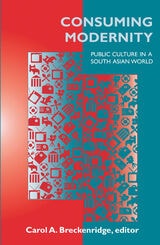
Consuming Modernity
Public Culture in a South Asian WorldCarol A. Breckenridge
University of Minnesota Press, 1995
Consuming Modernity illustrates that what is distinctive of any particular society is not the fact of its modernity, but rather its own unique debates about modernity. Behind the embattled arena of culture in India, for example, lie particular social and political interests such as the growing middle class; the entrepreneurs and commercial institutions; and the state.
The contributors address the roles of these various intertwined interests in the making of India's public culture, each examining different sites of consumption. The sites they explore include cinema, radio, cricket, restaurants, and tourism. Consuming Modernity also makes clear the differences among public, mass, and popular culture.Contributors include Arjun Appadurai, University of Chicago; Frank F. Conlon, University of Washington; Sara Dickey, Bowdoin College; Paul Greenough, University of Iowa; David Lelyveld, Columbia University; Barbara N. Ramusack, University of Cincinnati; Rosie Thomas, University of Westminster; and Phillip B. Zarrilli, University of Wisconsin, Madison.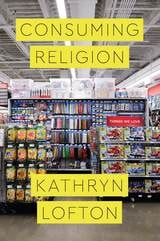
Consuming Religion
Kathryn Lofton
University of Chicago Press, 2017
What are you drawn to like, to watch, or even to binge? What are you free to consume, and what do you become through consumption? These questions of desire and value, Kathryn Lofton argues, are questions for the study of religion. In eleven essays exploring soap and office cubicles, Britney Spears and the Kardashians, corporate culture and Goldman Sachs, Lofton shows the conceptual levers of religion in thinking about social modes of encounter, use, and longing. Wherever we see people articulate their dreams of and for the world, wherever we see those dreams organized into protocols, images, manuals, and contracts, we glimpse what the word “religion” allows us to describe and understand.
With great style and analytical acumen, Lofton offers the ultimate guide to religion and consumption in our capitalizing times.
Consuming Religion
Kathryn Lofton
University of Chicago Press, 2017
What are you drawn to like, to watch, or even to binge? What are you free to consume, and what do you become through consumption? These questions of desire and value, Kathryn Lofton argues, are questions for the study of religion. In eleven essays exploring soap and office cubicles, Britney Spears and the Kardashians, corporate culture and Goldman Sachs, Lofton shows the conceptual levers of religion in thinking about social modes of encounter, use, and longing. Wherever we see people articulate their dreams of and for the world, wherever we see those dreams organized into protocols, images, manuals, and contracts, we glimpse what the word “religion” allows us to describe and understand.
With great style and analytical acumen, Lofton offers the ultimate guide to religion and consumption in our capitalizing times.
Consuming Russia
Popular Culture, Sex, and Society since GorbachevAdele Marie Barker, ed.
Duke University Press, 1999
The contributors examine how the people of Russia reconcile prerevolutionary elite culture—as well as the communist legacy—with the influx of popular influences from the West to build a society that no longer relies on a single dominant discourse and embraces the multiplicities of both public and private Russian life. Barker brings together Russian and American scholars from anthropology, history, literature, political science, sociology, and cultural studies. These experts fuse theoretical analysis with ethnographic research to analyze the rise of popular culture, covering topics as varied as post-Soviet rave culture, rock music, children and advertising, pyramid schemes, tattooing, pets, and spectator sports. They consider detective novels, anecdotes, issues of feminism and queer sexuality, nostalgia, the Russian cinema, and graffiti. Discussions of pornography, religious cults, and the deployment of Soviet ideological symbols as post-Soviet kitsch also help to demonstrate how the rebuilding of Russia’s political and economic infrastructure has been influenced by its citizens’ cultural production and consumption.
This volume will appeal to those engaged with post-Soviet studies, to anyone interested in the state of Russian society, and to readers more generally involved with the study of popular culture.
Contributors. Adele Marie Barker, Eliot Borenstein, Svetlana Boym, John Bushnell, Nancy Condee, Robert Edelman, Laurie Essig, Julia P. Friedman, Paul W. Goldschmidt, Judith Deutsch Kornblatt, Anna Krylova, Susan Larsen, Catharine Theimer Nepomnyaschy, Theresa Sabonis-Chafee, Tim Scholl, Adam Weiner, Alexei Yurchak, Elizabeth Kristofovich Zelensky
Containment Culture
American Narratives, Postmodernism, and the Atomic AgeAlan Nadel
Duke University Press, 1995
Examining a broad sweep of American culture, from the work of George Kennan to Playboy Magazine, from the movies of Doris Day and Walt Disney to those of Cecil B. DeMille and Alfred Hitchcock, from James Bond to Holden Caulfield, Nadel discloses the remarkable pervasiveness of the containment narrative. Drawing subtly on insights provided by contemporary theorists, including Baudrillard, Foucault, Jameson, Sedgwick, Certeau, and Hayden White, he situates the rhetoric of the Cold War within a gendered narrative powered by the unspoken potency of the atom. He then traces the breakdown of this discourse of containment through such events as the Bay of Pigs invasion and the Free Speech Movement at Berkeley, and ties its collapse to the onset of American postmodernism, typified by works such as Catch–22 and The Man Who Shot Liberty Valence.
An important work of cultural criticism, Containment Culture links atomic power with postmodernism and postwar politics, and shows how a multifarious national policy can become part of a nation’s cultural agenda and a source of meaning for its citizenry.
Contesting Cultural Rhetorics
Public Discourse and Education, 1890-1900Margaret J. Marshall
University of Michigan Press, 1995
Contesting Malayness
Malay Identity Across BoundariesEdited by Timothy P. Barnard
National University of Singapore Press, 2014
Continuities in Popular Culture
The Present in the Past and the Past in the Present and FutureEdited by Ray B. Brown and Ronald J. Ambrosetti
University of Wisconsin Press, 1993
Contract With The Skin
Masochism, Performance Art, and the 1970sKathy O'Dell
University of Minnesota Press, 1998
Places masochistic performance within a social and historical context.
Having yourself shot. Putting out fires with your bare hands and feet. Biting your own body and photographing the marks. Sewing your own mouth shut. These seemingly aberrant acts were committed by performance artists during the 1970s. Why would anyone do these things? What do these kinds of masochistic performances tell us about the social and historical context in which they occurred? Fascinating and accessibly written, Contract with the Skin addresses such questions through a reconsideration of these acts in relation to psychoanalytic and legal concepts of masochism.
O’Dell argues that the growth of masochistic performance during the 1970s must be seen in the context of society’s response to the Vietnam War and contemporaneous changes in theories of contract. She contends that the dynamic that exists between audience and performer during these masochistic acts relates to tensions resulting from ruptures in the social contract. Indeed, as the war in Vietnam waned, so did masochistic performance, only to reemerge in the 1980s in relation to the “war on AIDS” and the censorious “culture wars.”Focusing on 1970s performance artists Vito Acconci, Chris Burden, Gina Pane, and collaborators Marina Abramovi´c/Ulay as well as those with similar sensibilities from the late 1980s onward (Bob Flanagan, David Wojnarowicz, Simon Leung, Catherine Opie, Ron Athey, Lutz Bacher, and Robby Garfinkel), O’Dell provides photographic documentation of performances and quotations from interviews with many of the artists. Throughout, O’Dell asks what we can do about the institutionalized forms of masochism for which these performances are metaphors. Contract with the Skin is a provocative guide to this little-studied area, and offers new ways of thinking about performance art and artistic production.Cops and Constables
American and British Fictional PolicemenEdited by Earl F. Bargainnier and George N. Dove
University of Wisconsin Press, 1986

Cordially Yours, Brother Cadfael
Edited by Anne K. Kaler
University of Wisconsin Press, 1998
Why, essays ask, is a cloistered monk solving murders? How can an author combine a valid detective and an effective healer?
Corn Palaces and Butter Queens
A History of Crop Art and Dairy SculpturePamela H. Simpson
University of Minnesota Press, 2012
Teddy Roosevelt’s head sculpted from butter. The Liberty Bell replicated in oranges. The Sioux City Corn Palace of 1891 encased with corn, grains, and grasses and stretching for two city blocks—with a trolley line running down its center. Between 1870 and 1930, from county and state fairs to the world’s fairs, large exhibition buildings were covered with grains, fruits, and vegetables to declare in no uncertain terms the rich agricultural abundance of the United States. At the same fairs—but on a more intimate level—ice-cooled cases enticed fairgoers to marvel at an array of butter sculpture models including cows, buildings, flowers, and politicians, all proclaiming the rich bounty and unending promise held by the region.
Often viewed as mere humorous novelties—fun and folksy, but not worthy of serious consideration—these lively forms of American art are described by Pamela H. Simpson in a fascinating and comprehensive history. From the pioneering cereal architecture of Henry Worrall at the Philadelphia Centennial Exposition to the vast corn palaces displayed in Sioux City, Iowa, and elsewhere between 1877 and 1891, Simpson brings to life these dazzling large-scale displays in turn-of-the-century American fairs and festivals. She guides readers through the fascinating forms of crop art and butter sculpture, as they grew from state and regional fairs to a significant place at the major international exhibitions. The Minnesota State Fair’s Princess Kay of the Milky Way contest, Lillian Colton’s famed pictorial seed art, and the work of Iowa’s “butter cow lady,” Norma “Duffy” Lyon, are modern versions of this tradition.
Beautifully illustrated with a bounty of never-before-seen archival images, Corn Palaces and Butter Queens is an accessible history of one of America’s most unique and beguiling Midwestern art forms—an amusing and peculiar phenomenon that profoundly affected the way Americans saw themselves and their country’s potential during times of drought and great depression.
Corridors of Deceit
The World of John le CarréPeter Wolfe
University of Wisconsin Press, 1987
Peter Wolfe has produced an informative study of le Carré’s works, showing how le Carré’s five years in the Service (British Intelligence) helped him become a keen observer, social historian, and expert in bureaucratic politics. He has supplanted the technological flair marking much of today's spy fiction with moral complexity and psychological depth. He shows us what spies are like, how they feel about spying, and how spying affects their minds and hearts.
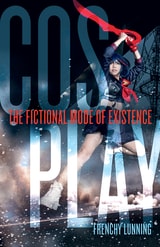
Cosplay
The Fictional Mode of ExistenceFrenchy Lunning
University of Minnesota Press, 2022
An exploration of cosplay and its relationship with the realms of its global fandom, performance, and the modes of fictional existence
Flourishing far beyond its Japanese roots, cosplay has become an international phenomenon with fervid fans who gather at enormous, worldwide conventions annually. Here, author Frenchy Lunning offers an intimate, sensational tour through cosplay’s past and present, as well as its global lure.
Through a culmination of years of personal research on cosplay, and growing out of Lunning’s wealth of scholarship, conference presentations, and cosplayer interviews, Cosplay is a unique and necessary examination of identity, performance, play, and otaku fandom and culture in relation to contemporary theories. With discussions covering construction, masquerades, and community through performance, Lunning presents cosplay as a dynamic and ever-evolving global practice. She combines the fascinating viewpoints of cosplayers with observational, in-depth research on cosplay history and practice, and a deep dive into critical theory involving the modes of fictional existence, in order to understand its global expansion.
Augmented with beautiful photographs, this is an engrossing, lively read that explores a complicated and often misunderstood history and meditates on how cosplay allows its participants to create and construct meaning and identity.
Cowboys and Caudillos
Frontier Ideology of the AmericasTom R. Sullivan
University of Wisconsin Press, 1990

Cozy Time
Resistance Through Comfort in Youth(ful) Media and Popular CultureEmily Midkiff
University of Iowa Press, 2027
Crafting America
Artists and Objects, 1940 to TodayJen Padgett
University of Arkansas Press, 2020
Craft is a diverse, democratic art form practiced by Americans of every gender, age, ethnicity, and class. Crafting America traces this expansive range of skilled making in a variety of forms, from ceramics and wood to performance costume and community-based practice. In exploring the intertwining of craft and American experience, this volume reveals how artists leverage their craft to realize the values of life, liberty, and the pursuit of happiness.
Accompanying an exhibition of the same title organized by Crystal Bridges Museum of American Art, Crafting America features contributions from scholars that illuminate craft’s relationship to ritual and memory, personal independence, abstraction, and Native American histories. The richly illustrated catalog section—with more than a hundred color images accompanied by lively commentary—presents a vivid picture of American craft over the past eight decades, offering fresh insights on the relationships between objects.
Building upon recent advances in craft scholarship and encouraging more inclusive narratives, Crafting America presents a bold statement on the vital role of craft within the broader context of American art and identity.
Crafting Mexico
Intellectuals, Artisans, and the State after the RevolutionRick A. López
Duke University Press, 2010
Craftsmanship and the Michigan Union Carpenter
Philip A. Korth
University of Wisconsin Press, 1991
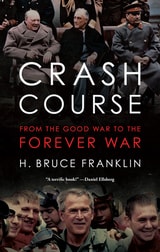
Crash Course
From the Good War to the Forever WarFranklin, H. Bruce
Rutgers University Press, 2024
Now, after fifty years as a renowned cultural historian, Franklin offers a set of hard-learned lessons about modern American history. Crash Course is essential reading for anyone who wonders how America ended up where it is today: with a deeply divided and disillusioned populace, led by a dysfunctional government, and mired in unwinnable wars. It also finds startling parallels between America’s foreign military exploits and the equally brutal tactics used on the home front to crush organized labor, antiwar, and civil rights movements.
More than just a memoir or a history book, Crash Course gives readers a unique firsthand look at the building of the American empire and the damage it has wrought. Shocking and gripping as any thriller, it exposes the endless deception of the American public, and reveals from inside how and why many millions of Americans have been struggling for decades against our own government in a fight for peace and justice.
Creating Ourselves
African Americans and Hispanic Americans on Popular Culture and Religious ExpressionAnthony B. Pinn and Benjamín Valentín, eds.
Duke University Press, 2009
Corresponding to a particular form of popular culture, each section features two essays, one by an African American scholar and one by a Latino/a scholar, as well as a short response by each scholar to the other’s essay. The essays and responses are lively, varied, and often personal. One contributor puts forth a “brown” theology of hip hop that celebrates hybridity, contradiction, and cultural miscegenation. Another analyzes the content of the message transmitted by African American evangelical preachers who have become popular sensations through television broadcasts, video distribution, and Internet promotions. The other essays include a theological reading of the Latina body, a consideration of the “authenticity” of representations of Jesus as white, a theological account of the popularity of telenovelas, and a reading of African American ideas of paradise in one of Toni Morrison’s novels. Creating Ourselves helps to make popular culture available as a resource for theology and religious studies and for facilitating meaningful discussions across racial and ethnic boundaries.
Contributors. Teresa Delgado, James H. Evans Jr., Joseph De León, Cheryl Kirk-Duggan, Angel F. Méndez Montoya, Alexander Nava, Anthony B. Pinn, Mayra Rivera, Suzanne E. Hoeferkamp Segovia, Benjamín Valentín, Jonathan L. Walton, Traci C. West, Nancy Lynne Westfield, Sheila F. Winborne
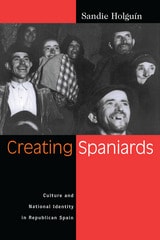
Creating Spaniards
Culture and National Identity in Republican SpainSandie Holguin
University of Wisconsin Press, 2002
Creating Spaniards is a cultural and intellectual history that explains the intersection of politics and culture, and the formation of a national identity, during Spain’s Second Republic and Civil War. It counters recent scholarship claiming that leaders of the Second Republic had no programs for "inventing traditions" to encourage a Spanish national identity.
Focusing on the Second Republic, 1931–1936, Sandie Holguín illustrates how various intellectuals and politicians of the Republican–Socialist coalition used theater, literature, and film to aid the construction of a unified Spanish culture and history. She uses memoirs, journals, newspapers, parliamentary debates, and archival sources in her examination of the impact that cultural reforms had on the transformation of one of Europe’s oldest states.
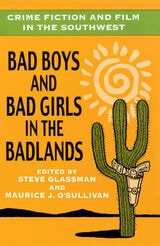
Crime Fiction and Film in the Southwest
Bad Boys and Bad Girls in the BadlandsEdited by Steve Glassman and Maurice O'Sullivan
University of Wisconsin Press, 2001
When Joe Leaphorn and Jim Chee, Tony Hillerman’s oddly matched tribal police officers, patrol the mesas and canyons of their Navajo reservation, they join a rich traditon of Southwestern detectives. In Crime Fiction and Film in the Southwest, a group of literary critics tracks the mystery and crime novel from the Painted Desert to Death Valley and Salt Lake City. In addition, the book includes the first comprehensive bibliography of mysteries set in the Southwest and a chapter on Southwest film noir from Humphrey Bogart’s tough hood in The Petrified Forest to Russell Crowe’s hard-nosed cop in L.A. Confidential.
Crime Uncovered
Private InvestigatorEdited by Alistair Rolls and Rachel Franks
Intellect Books, 2016
Assembling a cast of notable crime fiction experts, including Stephen Knight and Carolyn Beasley, the book covers characters from the whole world of international noir—Giorgio Scerbanenco’s Duca Lambert, Léo Malet’s Nestor Burma, and many more. Including essays on the genealogy and emergence of the protagonist in nineteenth-century fiction; interviews with crime writers Leigh Redhead, Nick Quantrill, and Fernando Lalana; and analyses of the transatlantic exchanges that helped to develop public perception of a literary icon, Crime Uncovered: Private Investigator will redefine what we think we know about the figure of the P. I.
Rolls and Franks have engaged here the tension between the popular and scholarly that is inherent in any critical examination of a literary type, along the way unraveling the mystery of the alluring, enigmatic private investigator. Crime Uncovered: Private Investigator will be a handy companion for any crime fiction fan.
Critical Analyses in English Renaissance Drama
A Bibliographic GuideBrownell Salomon
University of Wisconsin Press, 1979
This bibliographic guide directs the reader to a prize selection of the best modern, analytical studies of every play, anonymous play, masque, pageant, and "entertainment" written by more than two dozen contemporaries of Shakespeare in the years between 1580 and 1642. Together with Shakespeare's plays, these works comprise the most illustrious body of drama in the English language.
Critical Fandom
Representations of Race, Gender, and Sexuality in Fan FictionCara Marta Messina
University of Iowa Press, 2026
Critical Fandom positions fan authors as rhetoricians and fan fiction as an action. Every fan author navigates—implicitly or explicitly—the politics of their fandom, the media they love, their lived experiences, digital technologies, reader expectations, and a larger culture. To better understand critical fans, Cara Marta Messina analyzes Archive of Our Own tagging practices, fan fictions, and interviews from four different fandoms.
Fans of The Legend of Korra celebrate queer relationships while understanding representation is just the first step in the face of systemic homophobia. Game of Thrones fan authors challenge racism and heteronormativity in both the community and the show. In online forums for Black Panther, fans make space for sapphic romances and explore the humanity of Erik Killmonger, ultimately contending with harmful stereotypes of radical Black men. And the Our Flag Means Death fandom demonstrates how a show can flourish when it centers queerness, especially for trans fans. Even in these moments of joy, there’s conflict. Critical Fandom seeks to answer what comes next.

Critical Passions
Selected EssaysJean Franco
Duke University Press, 1999
A key participant in the major debates in Latin American studies—beginning with the “boom” period of the 1960s and continuing through debates on ideology and discourse, Marxism, mass culture, and postmodernism—Franco is recognized for her feminist critique of Latin American writing. While her principal books are all readily available, Franco’s several dozen articles are dispersed in a variety of periodicals in Latin America, Europe, and the United States. Although many of these essays are considered pioneering and classic, they have never before been collected in a single work. In this volume, Mary Louise Pratt and Kathleen Newman have organized the essays into four interrelated sections: feminism and the critique of authoritarianism, mass and popular culture, Latin American literature from the “boom” onward, and the cultural history of Mexico. As a group, these writings demonstrate Franco’s ability to reflect on and judge with equal seriousness all spheres of expression, whether subway graffiti, a fashion manual, or an avant-garde haiku. A bona fide fan of popular and mass media, Franco never allows her critiques to dissolve into the puritanical or reductive; instead, she finds ways to present and debate complex theoretical questions in direct and accessible language.
This volume will draw an extensive readership in Latin American, cultural, and women’s studies.

Critique of Exotica
Music, Politics and the Culture IndustryJohn Hutnyk
Pluto Press, 2000