Results by title
828 books match the query 'Study and teaching' and 80 start with c
Conversations with Interpreter Educators
Exploring Best PracticesChristine Monikowski
Gallaudet University Press, 2017
In Conversations with Interpreter Educators, Monikowski assembles a group of 17 professors in the field of sign language interpretation. Through individual interviews conducted via Skype, Monikowski engages them in informal conversations about their teaching experiences and the professional publications that have influenced their teaching philosophies. She guides each conversation by asking these experts to share a scholarly publication that they assign to their students. They discuss the merits of the text and its role in the classroom, which serves to highlight the varying goals each professor sets for students. The complexity of the interpreting task, self-reflection, critical thinking, linguistics, backchannel feedback, and cultural understanding are a sampling of topics explored in these exchanges. Engaging and accessible, Monikowski’s conversations offer evidence-based practices that will inform and inspire her fellow educators.

Copyright Conversations
Rights Literacy in a Digital WorldSara Benson
Assoc of College & Research Libraries, 2019

Core Tech Competencies for Librarians and Library Staff
American Library Association, 2009
Cosmopolitan English and Transliteracy
Xiaoye You
Southern Illinois University Press, 2016
Despite the vast number of multilingual speakers in the United States and the pervasive influence of globalization, writing studies in this country is still inextricably linked to a nationalistic, monolingual English ideology. In Cosmopolitan English and Transliteracy, Xiaoye You addresses this issue by proposing that writing studies programs adopt a cosmopolitan perspective. Emphasizing local and global forms of citizenship and identification, You merges a humanistic vision with the rigor of social science, arguing that linguistic and cultural differences can be explored to recover human connections normally severed by geographical and semiotic borders.
You examines several areas of writing affected by globalization. He then turns to the composition classroom, highlighting the challenges and possibilities of crossing cultural boundaries in academic discourse before introducing a pedagogy aimed at fostering American students’ translingual and transcultural sensibilities. Included is a model for training writing teachers in the context of globalization, which aims to help instructors gain practical knowledge about the needs and resources of multilingual writers through communication technologies and cross-cultural partnerships.
By introducing cosmopolitan perspectives into the composition classroom, You challenges traditional assumptions about language, identity, and literacy as they relate to writing studies. Innovative and provocative, Cosmopolitan English and Transliteracy charts a new way forward for writing programs, with a call to focus on global rather than national identity.
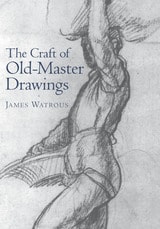
Craft of Old-Master Drawings
James Watrous
University of Wisconsin Press, 1967
A comprehensive study of the techniques of drawing, this is both a historical work, covering the period from the late Middle Ages to the present, and a useful manual for contemporary artists. It presents the old masters’ techniques by means of a thorough study of the historical and written evidence of the tools and materials used. The author also includes a series of workshop procedures he has developed with which the contemporary artist may produce the equivalents of the techniques of earlier draughtsmen. This book comprises a body of knowledge that is essential to students of art history, curators, collectors and artists, and is a significant addition to the literature on drawing.
In addition to his scholarly investigation of earlier practices, the author identifies materials and processes used by such important artists as Rembrandt, Van Gogh, Romney, Picasso, Michelangelo, Watteau, Holbein, Tiepolo, and Delacroix. For the artist interested in reproducing the effects achieved by these and many other acknowledged masters, there are full discussions and specific directions concerning the making of inks, styluses, reed and quill pens, fabricated chalks, and instructions for preparing grounds for metalpoint drawings. At every step, the discussion is supplemented with illustrations from laboratory experiments and from drawings by both old and contemporary artists. Of the more than sixty illustrations included, thirty-six are reproductions of master works, and among the others there are microphotographic enlargements of detail showing the differences in density and texture produced by various tools on different papers or grounds. Thus, as a collection of master drawings, the book is worthy of the art lover’s library; as a technical study, it is an indispensable aid to the art student and practicing artist.
Creating American Civilization
A Genealogy of American Literature as an Academic DisciplineDavid Shumway
University of Minnesota Press, 1994
“Shumway has written a penetrating and provocative account of the making of American civilization as an academic field.”
Gerald GraffUniversity of ChicagoDavid R. Shumway contends that American literature is the product of study - the deliberate invention of a discipline seeking to define the character and legitimate the existence of a specifically American civilization. He traces the various reconstitutions of American literature by examining the discipline’s practices and techniques, discourses and structures, paradigms and unstated assumptions.This genealogy begins around 1890, when American literature as defined by institutions outside the academy, such as magazines and publishing houses, acquired much of the ideology it would display in later phases, including sexism, racism, and class bias. Singular in its treatment of American literary study as a discipline rather than as criticism and in its insistence on the cultural and political work carried on by this discipline, Creating American Civilization will engage literary theorists and historians as well as individuals with an interest in American literature.
Creative Writing Pedagogies for the Twenty-First Century
Edited by Alexandria Peary and Tom C. Hunley
Southern Illinois University Press, 2015
Drawing primarily from the field of composition studies—a discipline rich with a wide range of established pedagogies—the contributors in this volume build on previous models to present fresh and inventive methods for the teaching of creative writing. Each chapter offers both a theoretical and a historical background for its respective pedagogical ideas, as well as practical applications for use in the classroom. This myriad of methods can be used either as a supplement to the customary workshop model or as stand-alone roadmaps to engage and reinvigorate the creative process for both students and teachers alike.
A fresh and inspiring collection of teaching methods, Creative Writing Pedagogies for the Twenty-First Century combines both conventional and cutting-edge techniques to expand the pedagogical possibilities in creative writing studies.
Critical Academic Writing and Multilingual Students
A. Suresh Canagarajah
University of Michigan Press, 2002
This volume facilitates teacher self-reflection and enables readers to better understand the motivations and pedagogical implications--especially for L2 writing--of a more openly pedagogical approach.
Critical Academic Writing and Multilingual Students explains what it means to commit to an academic pedagogy, in terms of form, self, content, and community--and what it can accomplish in the L2 writing classroom. It's a guide for writing teachers who wish to embark on a journey toward increased critical awareness of the role they play, or potentially could play, in the lives of their students.
Critical Approaches to Young Adult Literature
American Library Association, 2009
Critical Information Literacy Applications for All Libraries
Edited by Julie N. Hornick and Lauren Kehoe
American Library Association, 2025
- learn practical approaches for integrating CIL into instruction and praxis regardless of their level of experience;
- gain tools to better engage with the complexities of today's information landscape and empower their communities to do the same;
- be introduced to the theoretical frameworks of CIL through chapters that take a historical look at critical race theory in academic library instruction, CIL and feminist critique, and the intersection of queer pedagogy and CIL;
- discover in-depth profiles of programs happening in various library types, from algorithmic literacy and a targeted wiki-edit-a-thon event to an outreach initiative targeting groups historically excluded from post-secondary education;
- receive guidance on introducing CIL concepts to their peers and coworkers through professional development programs, such as introducing CIL practices into K-12 school culture, a CIL skills instruction program developed by public librarians to serve the everyday needs of information consumers, and a zine-making exercise for practicing reflection that embodies CIL; and
- find ready-to-use lesson plans and outlines, with suggestions on tailoring them to a variety of library types.
Critical Library Pedagogy Handbook Volume One
Essays and Workbooks ActivitiesNicole Pagowsky
Assoc of College & Research Libraries, 2016
Critical Library Pedagogy Handbook Volume Two
Lesson PlansNicole Pagowsky
Assoc of College & Research Libraries, 2016

Critical Studies in Art and Design Education
Edited by Richard Hickman
Intellect Books, 2005
Rod Taylor, who has done much to promote and develop critical studies in the UK, provides us with examples of classroom practice and gives us his more recent thoughts on fundamental issues – "universal themes" in art – and gives examples of how both primary and secondary schools might develop their teaching of art through attending to themes such as "identity," "myth," and "environments" to help "re-animate the practical curriculum."
Although some of the discussion in this book centres on or arises from the English National curriculum, the issues are more global, and relevant to anyone involved in developing or delivering art curricula in schools. An American perspective is given in papers by George Geahigan and Paul Duncum. Geahigan outlines an approach to teaching about visual form which begins with students' personal responses and is developed through structured instruction. In Duncum’s vision of ‘visual culture art education’ sites such as theme parks and shopping malls are the focus of students' critical attention in schools; Nick Stanley gives a lucid account of just such an enterprise, giving practical examples of ways to engage students with this particular form of visual pleasure.
This publication serves to highlight some of the more pressing issues of concern to art and design teachers in two aspects. Firstly it seeks to contextualise the development of critical studies, discussing its place in the general curriculum – possibly as a discrete subject – and secondly it examines different approaches to its teaching.
Critical Terms for the Study of Buddhism
Edited by Donald S. Lopez Jr.
University of Chicago Press, 2005
This volume provides a unique introduction to Buddhism by examining categories essential for a nuanced understanding of its traditions. Each of the fifteen essays here shows students how a fundamental term—from art to word—illuminates the practice of Buddhism, both in traditional Buddhist societies and in the realms of modernity. Apart from Buddha, the list of terms in this collection deliberately includes none that are intrinsic to the religion. Instead, the contributors explore terms that are important for many fields and that invite interdisciplinary reflection. Through incisive discussions of topics ranging from practice, power, and pedagogy to ritual, history, sex, and death, the authors offer new directions for the understanding of Buddhism, taking constructive and sometimes polemical positions in an effort both to demonstrate the shortcomings of assumptions about the religion and the potential power of revisionary approaches.
Following the tradition of Critical Terms for Religious Studies, this volume is not only an invaluable resource for the classroom but one that belongs on the short list of essential books for anyone seriously interested in Buddhism and Asian religions.
Cross-Language Relations in Composition
Edited by Bruce Horner, Min-Zhan Lu, and Paul Kei Matsuda
Southern Illinois University Press, 2010
Cross-Language Relations in Composition brings together the foremost scholars in the fields of composition, second language writing, education, and literacy studies to address the limitations of the tacit English-only policy prevalent in composition pedagogy and research and to suggest changes for the benefit of writing students and instructors throughout the United States. Recognizing the growing linguistic diversity of students and faculty, the ongoing changes in the English language as a result of globalization, and the increasingly blurred categories of native, foreign, and second language English speakers, editors Bruce Horner, Min-Zhan Lu, and Paul Kei Matsuda have compiled a groundbreaking anthology of essays that contest the dominance of English monolingualism in the study and teaching of composition and encourage the pursuit of approaches that embrace multilingualism and cross-language writing as the norm for teaching and research.
The nine chapters comprising part 1 of the collection focus on the origins of the “English only” bias dominating U.S. composition classes and present alternative methods of teaching and research that challenge this monolingualism. In part 2, nine composition teachers and scholars representing a variety of theoretical, institutional, and professional perspectives propose new, compelling, and concrete ways to understand and teach composition to students of a “global,” plural English, a language evolving in a multilingual world.
Drawing on recent theoretical work on genre, complexity, performance and identity, as well as postcolonialism, Cross-Language Relations in Composition offers a radically new approach to composition teaching and research, one that will prove invaluable to all who teach writing in today’s multilingual college classroom.
Crossing Unmarked Snow
Further Views on the Writer's VocationWilliam Stafford
University of Michigan Press, 1998
--William Stafford
A plain-spoken but eminently effective poet, the late William Stafford (1914-1993) has managed to shape part of the mainstream of American poetry by distancing himself from its trends and politics. Though his work has always inspired controversy, he was widely admired by students and poetry lovers as well as his own peers. His fascination with the process of writing joined with his love of the land and his faith in the teaching power of nature to produce a unique poetic voice in the last third of the twentieth century.
Crossing Unmarked Snow continues--in the tradition of Stafford's well-loved collections Writing the Australian Crawl and You Must Revise Your Life-- collecting prose and poetry on the writer's profession. The book includes reviews and reflections on poets from Theodore Roethke to Carolyn Forche, from May Sarton to Philip Levine; conversations on the making of poems; and a selection of Stafford's own poetry. The book also includes a section on the art of teaching, featuring interviews, writing exercises, and essays on the writer's vocation.
William Stafford authored more than thirty-five books of poetry and prose during his lifetime, including the highly acclaimed Writing the Australian Crawl: Views on the Writer's Vocation and You Must Revise Your Life.
Crossing the Yard
Thirty Years as a Prison VolunteerRichard Shelton
University of Arizona Press, 2007
Richard Shelton was a young English professor in 1970 when a convict named Charles Schmid—a serial killer dubbed the “Pied Piper of Tucson” in national magazines—shared his brooding verse. But for Shelton, the novelty of meeting a death-row monster became a thirty-year commitment to helping prisoners express themselves. Shelton began organizing creative writing workshops behind bars, and in this gritty memoir he offers up a chronicle of reaching out to forgotten men and women—and of creativity blossoming in a repressive environment. He tells of published students such as Paul Ashley, Greg Forker, Ken Lamberton, and Jimmy Santiago Baca who have made names for themselves through their writing instead of their crimes. Shelton also recounts the bittersweet triumph of seeing work published by men who later met with agonizing deaths, and the despair of seeing the creative strides of inmates broken by politically motivated transfers to private prisons. And his memoir bristles with hard-edged experiences, ranging from inside knowledge of prison breaks to a workshop conducted while a riot raged outside a barricaded door. Reflecting on his decision to tutor Schmid, Shelton sees that the choice “has led me through bloody tragedies and terrible disappointments to a better understanding of what it means to be human.”
Crossing the Yard is a rare story of professional fulfillment—and a testament to the transformative power of writing.
Cruel Auteurism
Affective Digital Mediations toward Film-Compositionbonnie lenore kyburz
University Press of Colorado, 2019
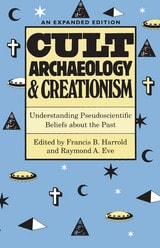
Cult Archaeology and Creationism
Understanding Pseudoscientific Beliefs about the PastFrancis B. Harrold
University of Iowa Press, 1995
UFOs and aliens, unexplained mysteries, religious cults, diffusion, creationism. We are all familiar with beliefs about human life that lie outside traditional scientific boundaries. Notions such as these are considered reasonable by vast numbers of us in the Western world, in our modern “technological” and “educated” cultures.
Understanding why this should be so and how we as a society might deal with these widespread pseudoscientific beliefs are the subjects at the heart of this study. The authors—specialists in anthropology, archaeology, sociology, psychology, and history—explore creationism, which claims that there is evidence to support a literal interpretation of the origins of the world and of humanity as narrated in the Book of Genesis, and cult archaeology, which encompasses a wide range of fantastic beliefs about our past.
Cult Archaeology and Creationism contains several essays on the history of pseudoscientific beliefs and their current manifestations as well as the results of a unique research project in which students at five campuses across the country were asked about their beliefs and about such background factors as their school experience and religious faith. This expanded edition also includes two new essays, one on Afrocentrism and another that views cult archaeology and creationism in the 1990s and beyond.
Cultivating Ecologies for Digital Media Work
The Case of English StudiesCatherine C. Braun
Southern Illinois University Press, 2014
Braun’s in-depth study documents English professors and the challenges they face in both career and classroom as they attempt to gain appropriate value for digital teaching and creation within their field, departments, and institutions. Braun proposes that to move English studies into the future, three main questions must be addressed. First, what counts as a text? How should we approach the reading of texts? Finally, how should we approach the production of texts? In addition to reconsidering the nature of texts in English studies, she calls for crucial changes in higher-education institutional procedures themselves, including new methods of evaluating digital scholarship on an even playing field with other forms of work during the processes for promotion and tenure.
With insightful expertise, Braun analyzes how the new age of digital scholarship not only complements the traditional values of the English studies discipline but also offers constructive challenges to old ideas about texts, methods, and knowledge production. Cultivating Ecologies for Digital Media Work is the first volume to offer specific examination of the digital shift’s impact on English studies and provides the scaffold upon which productive conversations about the future of the field and digital pedagogy can be built.
Cultural Capital
The Problem of Literary Canon FormationJohn Guillory
University of Chicago Press, 1993
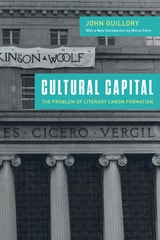
Cultural Capital
The Problem of Literary Canon FormationJohn Guillory
University of Chicago Press, 2023
Since its publication in 1993, John Guillory’s Cultural Capital has been a signal text for understanding the codification and uses of the literary canon. Cultural Capital reconsiders the social basis for aesthetic judgment and exposes the unequal distribution of symbolic and linguistic knowledge on which culture has long been based. Drawing from Pierre Bourdieu’s sociology, Guillory argues that canon formation must be understood less as a question of the representation of social groups and more as a question of the distribution of cultural capital in schools, which regulate access to literacy, to the practices of reading and writing.
Now, as the crisis of the canon has evolved into the so-called crisis of the humanities, Guillory’s groundbreaking, incisive work has never been more urgent. As scholar and critic Merve Emre writes in her introduction to this enlarged edition: “Exclusion, selection, reflection, representation—these are the terms on which the canon wars of the last century were fought, and the terms that continue to inform debates about, for instance, decolonizing the curriculum and the rhetoric of antiracist pedagogy.”
Cultural Citizenship
Cosmopolitanism, Consumerism, and Television in a Neoliberal AgeToby Miller
Temple University Press, 2006
Cultural Marxism in Postwar Britain
History, the New Left, and the Origins of Cultural StudiesDennis Dworkin
Duke University Press, 1997
Limited to neither a single discipline nor a particular intellectual figure, this book comprehensively views British cultural Marxism in terms of the dialogue between historians and the originators of cultural studies and in its relationship to the new left and feminist movements. From the contributions of Eric Hobsbawm, Christopher Hill, Rodney Hilton, Sheila Rowbotham, Catherine Hall, and E. P. Thompson to those of Perry Anderson, Barbara Taylor, Raymond Williams, Dick Hebdige, and Stuart Hall, Dworkin examines the debates over issues of culture and society, structure and agency, experience and ideology, and theory and practice. The rise, demise, and reorganization of journals such as The Reasoner, The New Reasoner, Universities and Left Review, New Left Review, Past and Present, are also part of the history told in this volume. In every instance, the focus of Dworkin’s attention is the intellectual work seen in its political context. Cultural Marxism in Postwar Britain captures the excitement and commitment that more than one generation of historians, literary critics, art historians, philosophers, and cultural theorists have felt about an unorthodox and critical tradition of Marxist theory.
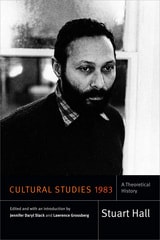
Cultural Studies 1983
A Theoretical HistoryStuart Hall
Duke University Press, 2016
Cultural Studies in the Future Tense
Lawrence Grossberg
Duke University Press, 2010
Cultural Studies in the Interregnum
Edited by Robert F. Carley, Anne Donlon, Beenash Jafri, Laura J. Kwak, Eero Laine, SAJ, and Chris Alen Sula
Temple University Press, 2025
Covering queer and feminist studies, critical disability studies, and critical race and ethnic studies, the essays in Cultural Studies in the Interregnum reflect on our shared political pasts and futures. Using examples ranging from media and literature to sex work, policing, and university systems, this exciting volume probes what cultural studies means in moments of social transformation.
Contributors include: Sean Johnson Andrews, C.M. Kaliko Baker, Mary Tuti Baker, James Bliss, Jorge E. Cuéllar, John R. Decker, Brian Dolber, Candace Fujikane, Evyn Lê Espiritu Gandhi, Chris Hall, Rachel Lim, Alexis Pauline Gumbs, Anna Karthika, Manu Karuka, Najwa Mayer, Kyle Mays, Andrew Ó Baoill, Yumi Pak, Therí A. Pickens, Sami Schalk, Leanne Betasamosake Simpson, Tia Trafford, and the editors
Culture Myths
Applying Second Language Research to Classroom TeachingAndrea DeCapua
University of Michigan Press, 2018
A goal of this book is to help readers strike a balance between minimizing cultural differences and assuming similarities across cultures on one hand, and exoticizing other cultures or accentuating surface differences on the other.
The myths about culture as it relates to the classroom that are explored in this book are:
- We are all human beings, so how different can we really be?
- The goal of education is to develop each individual’s potential.
- Focusing on conversational skills in the classroom is overrated.
- Not looking at the teacher shows disrespect.
- How something is said is not as important as what is said.
- Everyone knows what a good instructional environment is.
- By the time students get to middle or high school, they know how to be a student.
Culture and Content in French
Frameworks for Innovative CurriculaAurélie Chevant-Aksoy
Lever Press, 2022
Curators of the Buddha
The Study of Buddhism under ColonialismEdited by Donald S. Lopez Jr.
University of Chicago Press, 1995
After an overview of the origins of Buddhist studies in the early nineteenth century, the essays focus on important "curators of the Buddha," such as Aurel Stein, D. T. Suzuki, and Carl Jung, who, as they created and maintained the discipline, played a significant role in disseminating knowledge about Buddhism in the West. The essays bring to life many of the important but unexamined social, political, and cultural conditions that have shaped the course of Buddhist studies for more than a century—and have frequently distorted the understanding of a complex set of traditions. Contributors Charles Hallisey, Gustavo Benavides, Stanley Abe, Luis Gómez, Robert Sharf, and Donald Lopez challenge some of the most enduring ideas in Buddhist studies: that Zen Buddhism is, above all, an experience; that Tibetan Buddhism is polluted, or pristine; that the Buddha image is of Greek or Roman origin; that the classical text supersedes the vernacular, as the manuscript supersedes the informant; and many others.