Results by title
3258 books match the query 'Art' and 225 start with c

Color Harmonies
Augusto Garau
University of Chicago Press, 1993
Garau, a painter who teaches the psychology of form, pays particular attention to the way colors behave when organized in patterns. His theory of color combination addresses two principal compositional elements: the relations between figure and ground and the phenomenon of transparency.
Garau meticulously analyzes the use of color in paintings by masters such as Cézanne, Picasso, and Matisse to show how his theory applies to actual works of art. Containing many full-color examples, his introduction to the workings of color relations is of great practical use to art historians and critics, artists, interior decorators, fashion and set designers, and anyone who works with color to display information or convey emotions.
"In an area of the psychology of art where reliable guidance is still so hard to come by, [Garau's] well-supported contributions to the theory of color composition ought to be welcomed by practitioners and scholars alike."—from the Foreword by Rudolf Arnheim
Come Walk with Me
The Art of Dorris CurtisDorris Curtis
University of Arkansas Press, 2004
Comfort and Glory
Two Centuries of American Quilts from the Briscoe CenterBy Katherine Jean Adams
University of Texas Press, 2016
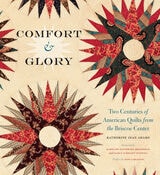
Quilts bear witness to the American experience. With a history that spans the early republic to the present day, this form of textile art can illuminate many areas of American life, such as immigration and settlement, the development of our nation’s textile industry, and the growth of mass media and marketing. In short, each quilt tells a story that is integral to America’s history.
Comfort and Glory introduces an outstanding collection of American quilts and quilt history documentation, the Winedale Quilt Collection at the Briscoe Center for American History at the University of Texas at Austin. This volume showcases 115 quilts—nearly one-quarter of the Winedale Collection—through stunning color photographs (including details) and essays about each quilt’s history and construction. The selections span more than two hundred years of American quiltmaking and represent a broad range of traditional styles and functions. Utility quilts, some worn or faded, join show quilts, needlework masterpieces, and “best” quilts saved for special occasions. Texas quilts, including those made in or brought to Texas during the nineteenth century, constitute a significant number of the selections. Color photographs of related documents and material culture objects from the Briscoe Center’s collections—quilting templates, a painted bride’s box, sheet music, a homespun dress, a brass sewing bird, and political ephemera, among them—enrich the stories of many of the quilts.
Comic Book Movies
Davis, Blair
Rutgers University Press, 2018
Film scholar Blair Davis also considers how the genre’s visual style is equally important as its weighty themes, and he details how advances in digital effects have allowed filmmakers to incorporate elements of comic book art in innovative ways. As he reveals, comic book movies have inspired just as many innovations to Hollywood’s business model, with film franchises and transmedia storytelling helping to ensure that the genre will continue its reign over popular culture for years to come.
Comics & Media
A Special Issue of "Critical Inquiry"Edited by Hillary L. Chute and Patrick Jagoda
University of Chicago Press, 2014
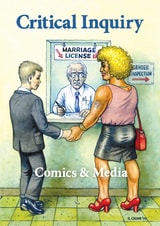
The twenty-first century has seen the medium of comics reach unprecedented heights of critical acclaim and commercial success. Comics & Media reflects that, bringing together an amazing array of contributors--creators and critics alike--to discuss the state, future, and potential of the medium.
Loaded with full-color reproductions of work by such legends as R. Crumb, Art Spiegelman, Alison Bechdel, Chris Ware, Daniel Clowes, and Lynda Barry, the book addresses the place of comics in both a contemporary and historical context. Essays by such high-profile figures as Tom Gunning, N. Katherine Hayles, Patrick Jagoda, and W. J. T. Mitchell address a stunning range of topics, including the place of comics in the history of aesthetics, changes to popular art forms, digital humanities, and ongoing tensions between new and old media. The result is a substantial step forward for our understanding of what comics are and can be, and the growing place they hold in our culture.
Comics Studies
A GuidebookCharles Hatfield
Rutgers University Press, 2020
In the twenty-first century, the field of comics studies has exploded. Scholarship on graphic novels, comic books, comic strips, webcomics, manga, and all forms of comic art has grown at a dizzying pace, with new publications, institutions, and courses springing up everywhere. The field crosses disciplinary and cultural borders and brings together myriad traditions. Comics Studies: A Guidebook offers a rich but concise introduction to this multifaceted field, authored by leading experts in multiple disciplines. It opens diverse entryways to comics studies, including history, form, audiences, genre, and cultural, industrial, and economic contexts. An invaluable one-stop resource for veteran and new comics scholars alike, this guidebook represents the state of the art in contemporary comics scholarship.
Commercial Visions
Science, Trade, and Visual Culture in the Dutch Golden AgeDániel Margócsy
University of Chicago Press, 2014
Margócsy introduces a number of natural historians, physicians, and curiosi in Amsterdam, London, St. Petersburg, and Paris who, in their efforts to boost their trade, developed modern taxonomy, invented color printing and anatomical preparation techniques, and contributed to philosophical debates on topics ranging from human anatomy to Newtonian optics. These scientific practitioners, including Frederik Ruysch and Albertus Seba, were out to do business: they produced and sold exotic curiosities, anatomical prints, preserved specimens, and atlases of natural history to customers all around the world. Margócsy reveals how their entrepreneurial rivalries transformed the scholarly world of the Republic of Letters into a competitive marketplace.
Margócsy’s highly readable and engaging book will be warmly welcomed by anyone interested in early modern science, global trade, art, and culture.
Communities of Sense
Rethinking Aesthetics and PoliticsBeth Hinderliter, William Kaizen, Vered Maimon, Jaleh Mansoor, and Seth McCormick, eds.
Duke University Press, 2009
The first of the collection’s three sections explicitly examines the links between aesthetics and social and political experience. Here a new essay by Rancière posits art as a key site where disagreement can be staged in order to produce new communities of sense. In the second section, contributors investigate how sense was constructed in the past by the European avant-garde and how it is mobilized in today’s global visual and political culture. Exploring the viability of various models of artistic and political critique in the context of globalization, the authors of the essays in the volume’s final section suggest a shift from identity politics and preconstituted collectivities toward processes of identification and disidentification. Topics discussed in the volume vary from digital architecture to a makeshift museum in a Paris suburb, and from romantic art theory in the wake of Hegel to the history of the group-subject in political art and performance since 1968. An interview with Étienne Balibar rounds out the collection.
Contributors. Emily Apter, Étienne Balibar, Carlos Basualdo, T. J. Demos, Rachel Haidu, Beth Hinderliter, David Joselit, William Kaizen, Ranjanna Khanna, Reinaldo Laddaga, Vered Maimon, Jaleh Mansoor, Reinhold Martin, Seth McCormick, Yates McKee, Alexander Potts, Jacques Rancière, Toni Ross
Communities of Style
Portable Luxury Arts, Identity, and Collective Memory in the Iron Age LevantMarian H. Feldman
University of Chicago Press, 2014
Marian H. Feldman brings her dual training as an art historian and an archaeologist to bear on the networks that were essential to the movement and trade of luxury goods—particularly ivories and metal works—and how they were also central to community formation. The interest in, and relationships to, these art objects, Feldman shows, led to wide-ranging interactions and transformations both within and between communities. Ultimately, she argues, the production and movement of luxury goods in the period demands a rethinking of our very geo-cultural conception of the Levant, as well as its influence beyond what have traditionally been thought of as its borders.
Compagnons de lutte
Avant-garde et critique d’art en Espagne pendant le franquismePaula Barreiro López
Diaphanes, 2023
Comparative Textual Media
Transforming the Humanities in the Postprint EraN. Katherine Hayles
University of Minnesota Press, 2013
For the past few hundred years, Western cultures have relied on print. When writing was accomplished by a quill pen, inkpot, and paper, it was easy to imagine that writing was nothing more than a means by which writers could transfer their thoughts to readers. The proliferation of technical media in the latter half of the twentieth century has revealed that the relationship between writer and reader is not so simple. From telegraphs and typewriters to wire recorders and a sweeping array of digital computing devices, the complexities of communications technology have made mediality a central concern of the twenty-first century.
Despite the attention given to the development of the media landscape, relatively little is being done in our academic institutions to adjust. In Comparative Textual Media, editors N. Katherine Hayles and Jessica Pressman bring together an impressive range of essays from leading scholars to address the issue, among them Matthew Kirschenbaum on archiving in the digital era, Patricia Crain on the connection between a child’s formation of self and the possession of a book, and Mark Marino exploring how to read a digital text not for content but for traces of its underlying code.
Primarily arguing for seeing print as a medium along with the scroll, electronic literature, and computer games, this volume examines the potential transformations if academic departments embraced a media framework. Ultimately, Comparative Textual Media offers new insights that allow us to understand more deeply the implications of the choices we, and our institutions, are making.
Contributors: Stephanie Boluk, Vassar College; Jessica Brantley, Yale U; Patricia Crain, NYU; Adriana de Souza e Silva, North Carolina State U; Johanna Drucker, UCLA; Thomas Fulton, Rutgers U; Lisa Gitelman, New York U; William A. Johnson, Duke U; Matthew G. Kirschenbaum, U of Maryland; Patrick LeMieux; Mark C. Marino, U of Southern California; Rita Raley, U of California, Santa Barbara; John David Zuern, U of Hawai‘i at Mānoa.
Compelling Visuality
The Work Of Art In And Out Of HistoryClaire Farago
University of Minnesota Press, 2003
Explores what we actually see, touch, and experience when looking at art
Typically, art history is an enterprise of recovery—of searching out the provenance, the original intentions, the physical setting, and historical conditions behind a work of art. The essays in Compelling Visuality address some of the other questions that are less frequently asked—and, in doing so, show how much is to be learned and gained by going beyond the traditional approaches of art history.
In particular, the contributors take up the commonly unexplored question of what is actually present in a work of art—what we see, touch, and experience when confronted with Renaissance or Baroque works that have survived the vicissitudes of time. International and interdisciplinary, this volume conducts readers into an ongoing discussion of the value and significance of personal response to works of art. Contributors: F. R. Ankersmit, U of Groningen; Mieke Bal, U of Amsterdam and Cornell U; Oskar Bätschmann, U of Bern; Georges Didi-Huberman, École des Hautes Études en Sciences Sociales, Paris; Michael Ann Holly, Clark Art Institute; Donald Preziosi, UCLA and Oxford U; Renée van de Vall, U of Maastricht.
Complex Identities
Jewish Consciousness and Modern ArtBaigell, Matthew
Rutgers University Press, 2001
Complex Identities is a joint effort by American and Israeli scholars who ask challenging questions about art as formed by society and ethnicity. Focusing on nineteenth– and twentieth–century European, American, and Israeli artists, the contributors delve into the many ways in which Jewish artists have responded to their Jewishness and to the societies in which they lived, and how these factors have influenced their art, their choice of subject matter, and presentation of their work.
The contributions reflect a broad range of contemporary art criticism drawn from the history of art, culture, and literature. By analyzing how Jewish experiences have depicted and shaped art, the collection begins to answer how art, in its turn, depicts and shapes Jewish experience. An introduction by the volume editors unifies the essays and gives a historical overview.

Computers and Art
Second EditionEdited by Stuart Mealing
Intellect Books, 2002
ConFiguring America
Iconic Figures, Visuality, and the American IdentityEdited by Klaus Rieser, Michael Fuchs, and Michael Phillips
Intellect Books, 2013
Concerning Consequences
Studies in Art, Destruction, and TraumaKristine Stiles
University of Chicago Press, 2016
The essays in this book focus primarily on performance art and photography. From war and environmental pollution to racism and sexual assault, Stiles analyzes the consequences of trauma as seen in the works of artists like Marina Abramovic, Pope.L, and Chris Burden. Assembling rich intellectual explorations on everything from Paleolithic paintings to the Bible’s patriarchal legacies to documentary images of nuclear explosions, Concerning Consequences explores how art can provide a distinctive means of understanding trauma and promote individual and collective healing.
Confidence Games
Money and Markets in a World without RedemptionMark C. Taylor
University of Chicago Press, 2004
In Confidence Games, Mark C. Taylor considers the implications of these developments for our digital and increasingly virtual economy. According to Taylor, money and markets do not exist in a vacuum but grow in a profoundly cultural medium, reflecting and in turn shaping their world. To understand the recent changes in our economy, it is not enough to analyze the impact of politics and technology—one must consider the influence of art, philosophy, and religion as well.
Bringing John Calvin, G. W. F. Hegel, and Adam Smith to Wall Street by way of Las Vegas, Taylor first explores the historical and psychological origins of money, the importance of religious beliefs and practices for the emergence of markets, and the unexpected role of religion and art in the classical understanding of economics. He then moves to an account of economic developments during the past four decades, exploring the dawn of our new information age, the growing virtuality of money and markets, and the complexity of the networks by which monetary value is now negotiated.
Returning full circle to a version of the market first proposed by Adam Smith when he used theology and aesthetics to rethink economics, Confidence Games closes with a plea for a conception of life that embraces uncertainty and insecurity as signs of the openness of the future. Like religion and economics, life is a confidence game in which the challenge is not to find redemption but to learn to live without it.
"Before the global credit system began its collapse in 2007, Mark Taylor had connected the dots between increasingly complex financial instruments and larger cultural forces. Anyone who wants to understand the disappearing foundation of our financial markets needs to read this book immediately."—Michael Lewitt, editor, The HCM Market Letter
Conflict Graffiti
From Revolution to GentrificationJohn Lennon
University of Chicago Press, 2021
Graffiti makes for messy politics. In film and television, it is often used to create a sense of danger or lawlessness. In bathroom stalls, it is the disembodied expression of gossip, lewdness, or confession. But it is also a resistive tool of protest, making visible the disparate voices and interests that come together to make a movement.
In Conflict Graffiti, John Lennon dives into the many permutations of graffiti in conflict zones—ranging from the protest graffiti of the Black Lives Matter movement in Ferguson and the Tahrir Square demonstrations in Egypt, to the tourist-attraction murals on the Israeli Separation Wall and the street art that has rebranded Detroit and post-Katrina New Orleans. Graffiti has played a crucial role in the revolutionary movements of these locales, but as the conflict subsides a new graffiti and street art scene emerges—often one that ushers in postconflict consumerism, gentrification, militarization, and anesthetized forgetting.
Graffiti has an unstable afterlife, fated to be added to, transformed, overlaid, photographed, reinterpreted, or painted over. But as Lennon concludes, when protest movements change and adapt, graffiti is also uniquely suited to shapeshift with them.
Conflict and Cultural Heritage
A Moral Analysis of the Challenges of Heritage ProtectionHelen Frowe
J. Paul Getty Trust, The, 2019
A number of writers and thinkers working on the problem of preserving the world’s most treasured monuments, sites, and objects today cite what Frowe and Matravers call extrinsic and intrinsic justifications for the protection of cultural heritage. These are arguments that maintain that protecting heritage will be a key means to achieve other important goals, like the prevention of genocide, or arguments that heritage deserves to be forcefully protected for its own sake. Frowe and Matravers deconstruct both types of justifications, demonstrating a lack of clear evidence for a causal relationship between the destruction of cultural heritage and atrocities like genocide and arguing that the defense of heritage must not be treated with the same weight or urgency, or according to the same international policies, as the defense of human lives.
By calling for expanded theory and empirical data and the consideration of morality in the crafting of international policy vis-à-vis cultural heritage protection, Frowe and Matravers present a thoughtful critique that enriches this important series and adds to the ongoing dialogue in the field.
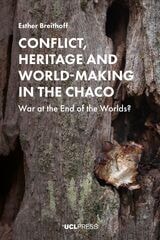
Conflict, Heritage and World-Making in the Chaco
War at the End of the Worlds?Esther Breithoff
University College London, 2020
Framing the study as an exploration of modern, industrialized warfare as a sort of “hyper object”, Breithoff shows how the material culture and heritage of modern conflict fuse together objects, people, and landscapes, connecting them physically and conceptually across vast, almost unimaginable distances and time periods. This book makes a major contribution to key debates in anthropology, archaeology, critical heritage, and material culture studies on the significance of conflict in understanding the Anthropocene, and the roles played by its persistent heritages in assembling worlds.
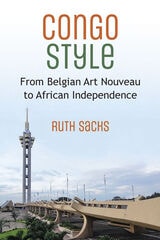
Congo Style
From Belgian Art Nouveau to African IndependenceRuth Sacks
University of Michigan Press, 2023
Congo Style presents a postcolonial approach to discussing the visual culture of two now-notorious regimes: King Leopold II’s Congo Colony and the state sites of Mobutu Sese Seko’s totalitarian Zaïre. Readers are brought into the living remains of sites once made up of ambitious modernist architecture and art in Kinshasa, Democratic Republic of the Congo. From the total artworks of Art Nouveau to the aggrandizing sites of post-independence Kinshasa, Congo Style investigates the experiential qualities of man-made environments intended to entertain, delight, seduce, and impress.
In her study of visual culture, Ruth Sacks sets out to reinstate the compelling wonder of nationalist architecture from Kinshasa’s post-independence era, such as the Tower of the Exchange (1974), Gécamines Tower (1977), and the artworks and exhibitions that accompanied them. While exploring post-independence nation-building, this book examines how the underlying ideology of Belgian Art Nouveau, a celebrated movement in Belgium, led to the dominating early colonial settler buildings of the ABC Hotels (circa 1908–13). Congo Style combines Sacks’s practice as a visual artist and her academic scholarship to provide an original study of early colonial and independence-era modernist sites in their African context.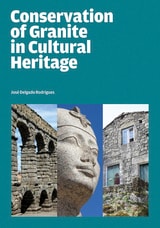
Conservation of Granite in Cultural Heritage
José Delgado Rodrigues
J. Paul Getty Trust, The, 2025
The field of stone conservation has long needed a holistic perspective that embraces the needs of conservation professionals and provides scientific support to enable them to better analyze preservation issues and implement efficient, long-lasting treatments. Conservation of Granite in Cultural Heritage offers such a perspective by bridging scholarly research on the available literature related to granite decay and best practices from conservators working in the field and laboratory.
First offering an overview of granitic rocks and their natural weathering, this volume then outlines the issues that arise when removing granite from quarries and incorporating it into what eventually becomes built heritage. Case studies are presented alongside guidelines for assessing conservation problems. This book will serve as a fundamental manual for students, conservation scientists, conservators, and restorers alike.
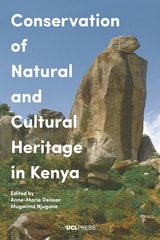
Conservation of Natural and Cultural Heritage in Kenya
Edited by Anne-Marie Deisser and Mugwima Njuguna
University College London, 2016
Conserving Active Matter
Edited by Peter N. Miller and Soon Kai Poh
Bard Graduate Center, 2022
This volume brings together the findings from a five-year research project that seeks to reimagine the relationship between conservation knowledge and the humanistic study of the material world. The project, “Cultures of Conservation,” was supported by the Andrew W. Mellon Foundation and included events, seminars, and an artist-in-residence.
The effort to conserve things amid change is part of the human struggle with the nature of matter. For as long as people have made things and kept things, they have also cared for and repaired them. Today, conservators use a variety of tools and categories developed over the last one hundred and fifty years to do this work, but in the coming decades, new kinds of materials and a new scale of change will pose unprecedented challenges. Looking ahead to this moment from the perspectives of history, philosophy, materials science, and anthropology, this volume explores new possibilities for both conservation and the humanities in the rethinking of active matter.
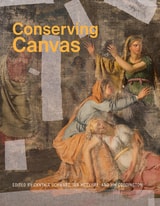
Conserving Canvas
Cynthia Schwarz
J. Paul Getty Trust, The, 2023
In 2019, Yale University, with the support of the Getty Foundation, held an international conference, where nearly four hundred attendees from more than twenty countries gathered to discuss a vital topic: how best to conserve paintings on canvas. It was the first major symposium on the subject since 1974, when wax-resin and glue-paste lining reigned as the predominant conservation techniques. Over the past fifty years, such methods, which were often destructive to artworks, have become less widely used in favor of more minimalist approaches to intervention. More recent decades have witnessed the reevaluation of traditional practices as well as focused research supporting significant new methodologies, procedures, and synthetic materials for the care and conservation of paintings on fabric supports.
Conserving Canvas compiles the proceedings of the conference, presenting a wide array of papers and posters that provide important global perspectives on the history, current state, and future needs of the field. Featuring an expansive glossary of terms that will be an invaluable resource for conservators, this publication promises to become a standard reference for the international conservation community.
The free online edition of this open-access publication is available at getty.edu/publications/conserving-canvas. Also available are free PDF and EPUB downloads of the book.

Conspiring Toward Utopia
Jersey Homesteads and the Jewish New DealDaniel S. Palmer
Rutgers University Press, 2027
During the 1930s, the United States government founded the Jersey Homesteads community (now known as Roosevelt, New Jersey) to help a group of pioneering Jewish immigrants create a new and ambitious cooperative experiment. Two hundred urban garment worker families moved from New York City to rural New Jersey to develop an intentional community with a focus and reliance upon both agriculture and craft. The community worked to unite the Jewish cooperative agricultural movement with the New Deal priorities of back-to-the-land rural resettlement. Notably, the town also embraced modernist aesthetics through homes designed by Louis Kahn and Alfred Kastner, and a public mural by Ben Shahn depicting the community’s creation.
This book tells the inspiring yet under-appreciated history of the town’s establishment, revealing its historical utopian commune precursors and detailing how such an unconventional project could only have been possible at its precise moment because of President Franklin D. Roosevelt’s progressive New Deal government support. The Jersey Homesteads project brought together the forces of community, identity, and art as a unified force for betterment in the brave new world of New Deal America. It is a story about a specific time and place with significant lessons for our understanding of American modernism and Jewish identity during the 1930s and beyond.

Constructed Situations
A New History of the Situationist InternationalFrances Stracey
Pluto Press, 2014
The Situationist International were a group of anti-authoritarian, highly cultured, revolutionary artists whose energy and enragement fundamentally shaped the revolutions of the late 1960’s, most famously in Paris in May ‘68. They took on their shoulders the history of the workers’ struggle, saw that it had been corrupted by authoritarianism and transformed it, with influences incorporating the avant-garde via Dada and Surrealism. They were not Marxologists, defenders of the faith. Marxism came back to life in their raging analyses, the use of the ‘spectacle’ and at the heart of the project was the idea of the constructed situation.
This book by Frances Stracey offers itself up as the ‘first historiography of constructed situations’. Within it are new insights into the movement, and with them, a sense of relevance to political situations and practice today. As an archivist, Stracey uncovered new documents which, amongst other things, revealed how the SI related to representations of sexuality; and is able to discuss whether they could be considered as feminists or not. She also looked at their famous motto ‘Never Work’ and again shows how alienated labour is even more relevant to us today.
Constructed Situations is not a history of celebrated personalities, or cultural influences, or political circumstances. It is instead an open door to one of the most influential art movements in modern history, and an invitation for us to reclaim inspiration from this ubiquitous movement.
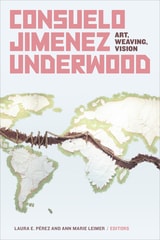
Consuelo Jimenez Underwood
Art, Weaving, VisionLaura E. Pérez and Ann Marie Leimer, editors
Duke University Press, 2021
Contributors. Constance Cortez, Karen Mary Davalos, Carmen Febles, M. Esther Fernández, Christine Laffer, Ann Marie Leimer, Amalia Mesa-Bains, Robert Milnes, Jenell Navarro, Laura E. Pérez, Marcos Pizarro, Verónica Reyes, Clara Román-Odio, Carol Sauvion, Cristina Serna, Emily Zaiden
Contemporary African Cinema
Olivier Barlet
Michigan State University Press, 2016
Drawing on more than 1,500 articles, reviews, and interviews written over the past fifteen years, Olivier Barlet identifies the critical questions brought about by the evolution of African cinema. In the process, he offers us a personal and passionate vision, making this book an indispensable sum of thought that challenges preconceived ideas and enriches an approach to cinema as a critical art.
Contemporary African Screen Worlds
Lindiwe Dovey, Añulika Agina, and Michael W. Thomas, editors
Duke University Press, 2025
Contributors. Moradewun Adejunmobi, Añulika Agina, Alexander Bud, Lindiwe Dovey, Femi Eromosele, Pier Paolo Frassinelli, Alexandra Grieve, Jonathan Haynes, Joe Jackson, Alessandro Jedlowski, Dennis-Brook Prince Lotsu, Alison MacAulay, Elastus Mambwe, Asteway M. Woldemichael, Nedine Moonsamy, Elizabeth Olayiwola, Temitayo Olofinlua, Rashida Resario, Estrella Sendra, Robin Steedman, Michael W. Thomas, Stefanie Van de Peer, Solomon Waliaula
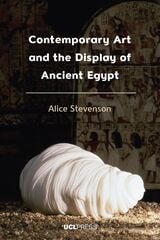
Contemporary Art and the Display of Ancient Egypt
Alice Stevenson
University College London, 2025
Contemporary art installations in Egyptian galleries are often framed as dialogues between past and present—but what if they are, instead, shaped by the museum itself? Contemporary Art and the Display of Ancient Egypt argues that both contemporary and ancient works are mediated through the structures and ideologies of the museum space. In this seminal work, Alice Stevenson examines how artists’ work influences museum discourse and public engagement with ancient artifacts.
Drawing on case studies from the British Museum, the Egyptian Museum in Turin, and the State Museum of Egyptian Art in Munich, this book assesses the motivations behind these interventions and their lasting impact. Through an evidence-based approach, Stevenson offers new insights into how curators, scholars, and artists can collaborate to create more meaningful and politically engaged museum experiences. Of particular interest to Egyptologists, museum professionals, and contemporary art scholars, this work redefines the role of artistic intervention in shaping our understanding of ancient cultures.
Contemporary Asian Art at Biennials
John Clark
National University of Singapore Press, 2025
How did contemporary Asian art move from the margins to the global stage, and what role did biennials play in shaping its trajectory? In this incisive study, renowned art historian John Clark unpacks the rise of biennials in Asia since the 1990s and depicts how these sprawling exhibitions have challenged and reinforced the forces of globalization. By examining key biennials in Australia, China, Japan, and Singapore, Clark exposes the tensions between national agendas, independent curatorial ambitions, and the neoliberal art economy that transformed once-radical movements into global spectacles. He explores how biennials create networks of artists and curators who simultaneously resist and reproduce the very systems they critique, shaping not just regional art scenes but the broader narrative of contemporary art itself.
As the euphoria surrounding global contemporary art fades, Clark’s deeply researched history offers a crucial reexamination of the structures that have defined Asian art on the world stage. Richly illustrated and rigorously argued, Contemporary Asian Art at Biennials is a valuable resource for scholars, curators, and those interested in the shifting dynamics of the art world.
Contemporary Black Women Filmmakers and the Art of Resistance
Christina N. Baker
The Ohio State University Press, 2018
Analyzing the cultural texts of filmmakers such as Ava DuVernay, Tanya Hamilton, Kasi Lemmons, Gina Prince-Bythewood, and Dee Rees—and including interviews she conducted with three of the filmmakers—Baker emphasizes the importance of applying an intersectional perspective that centers on the shared experiences of Black women and the role of film as a form of artistic expression and a tool of social resistance.
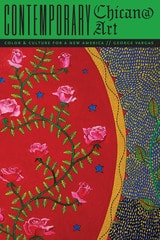
Contemporary Chican@ Art
Color and Culture for a New AmericaBy George Vargas
University of Texas Press, 2010
From its inception in the 1960s to its present form, contemporary Mexican American or Chicano art has developed as an art of identity, asserting the uniqueness of Chicanos and their dual Mexican and U.S. American cultural backgrounds. Because it emerged as a social phenomenon, however, many people outside the Chicano community have perceived Chicano art as merely protest art or social commentary, and Mexican American artists have been largely ignored in mainstream museums and absent in art history texts on American art. Yet more than ever before, Chicano art is diverse in medium, style, technique, and content—the cutting edge of a bold attempt to redefine and advance the American experience through new ideas of who we are as Americans and what American art is.
Contemporary Chican@ Art is a general introduction and guide to one of the most exciting and meaningful expressions in contemporary American art. Intended for the casual reader as well as for art history scholars and students, the book provides an overview of work created from the 1960s to the present. George Vargas follows the dramatic evolution of Chicano art within the broader context of American cultural history. He shows that while identity politics was and still is a prevailing force in Chicano expression, Chicano art has undergone a remarkable transformation, shifting from a strict Chicano perspective to a more universal one, while still remaining a people's art. In the concluding chapter, Vargas takes an in-depth look at selected Chicano artists who share their thoughts about the Chicano artistic enterprise and their own work.
Contemporary Chinese Art
Primary DocumentsWu Hung, editor
Duke University Press, 2010
Publication of the Museum of Modern Art
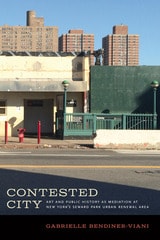
Contested City
Art and Public History as Mediation at New York's Seward Park Urban Renewal AreaGabrielle Bendiner-Viani
University of Iowa Press, 2018
2020 Brendan Gill Prize finalist
For forty years, as New York’s Lower East Side went from disinvested to gentrified, residents lived with a wound at the heart of the neighborhood, a wasteland of vacant lots known as the Seward Park Urban Renewal Area (SPURA). Most of the buildings on the fourteen-square-block area were condemned in 1967, displacing thousands of low-income people of color with the promise that they would soon return to new housing—housing that never came.
Over decades, efforts to keep out affordable housing sparked deep-rooted enmity and stalled development, making SPURA a dramatic study of failed urban renewal, as well as a microcosm epitomizing the greatest challenges faced by American cities since World War II.
Artist and urban scholar Gabrielle Bendiner-Viani was invited to enter this tense community to support a new approach to planning, which she accepted using collaboration, community organizing, public history, and public art. Having engaged her students at The New School in a multi-year collaboration with community activists, the exhibitions and guided tours of her Layered SPURA project provided crucial new opportunities for dialogue about the past, present, and future of the neighborhood.
Simultaneously revealing the incredible stories of community and activism at SPURA, and shedding light on the importance of collaborative creative public projects, Contested City bridges art, design, community activism, and urban history. This is a book for artists, planners, scholars, teachers, cultural institutions, and all those who seek to collaborate in new ways with communities.
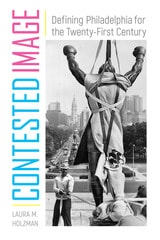
Contested Image
Defining Philadelphia for the Twenty-First CenturyLaura M. Holzman
Temple University Press, 2019
Thomas Eakins’ 1875 painting, The Gross Clinic, the Rocky Statue, andthe Barnes Foundation are all iconic in Philadelphia for different reasons. But around the year 2000, this painting, this sculpture, and this entire art collection, respectively, generated extended—and heated—controversies about the “appropriate” location for each item. Contested Image revisits the debates that surrounded these works of visual culture and how each item changed through acts of reception—through the ways that viewers looked at, talked about, and used these objects to define their city.
Laura Holzman investigates the negotiations and spirited debates that affected the city of Philadelphia’s identity and its public image. She considers how the region’s cultural resources reshaped the city’s reputation as well as delves into discussions about official efforts to boost local spirit. In tracking these “contested images,” Holzman illuminates the messy process of public envisioning of place and the ways in which public dialogue informs public meaning of both cities themselves and the objects of urban identity.
Contract With The Skin
Masochism, Performance Art, and the 1970sKathy O'Dell
University of Minnesota Press, 1998
Places masochistic performance within a social and historical context.
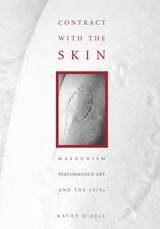
Having yourself shot. Putting out fires with your bare hands and feet. Biting your own body and photographing the marks. Sewing your own mouth shut. These seemingly aberrant acts were committed by performance artists during the 1970s. Why would anyone do these things? What do these kinds of masochistic performances tell us about the social and historical context in which they occurred? Fascinating and accessibly written, Contract with the Skin addresses such questions through a reconsideration of these acts in relation to psychoanalytic and legal concepts of masochism.
O’Dell argues that the growth of masochistic performance during the 1970s must be seen in the context of society’s response to the Vietnam War and contemporaneous changes in theories of contract. She contends that the dynamic that exists between audience and performer during these masochistic acts relates to tensions resulting from ruptures in the social contract. Indeed, as the war in Vietnam waned, so did masochistic performance, only to reemerge in the 1980s in relation to the “war on AIDS” and the censorious “culture wars.”Focusing on 1970s performance artists Vito Acconci, Chris Burden, Gina Pane, and collaborators Marina Abramovi´c/Ulay as well as those with similar sensibilities from the late 1980s onward (Bob Flanagan, David Wojnarowicz, Simon Leung, Catherine Opie, Ron Athey, Lutz Bacher, and Robby Garfinkel), O’Dell provides photographic documentation of performances and quotations from interviews with many of the artists. Throughout, O’Dell asks what we can do about the institutionalized forms of masochism for which these performances are metaphors. Contract with the Skin is a provocative guide to this little-studied area, and offers new ways of thinking about performance art and artistic production.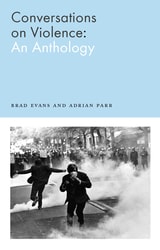
Conversations on Violence
An AnthologyBrad Evans
Pluto Press, 2021
Whether physical or metaphorical, institutional or interpersonal, violence is everywhere. A seemingly immutable fact of life, it is nonetheless rarely engaged with at the conceptual level. What does violence actually mean? And is it an inevitable part of the human condition?
Conversations on Violence brings together many of the world's leading critical scholars, artists, writers and cultural producers to provide a kaleidoscopic exploration of the concept of violence. Through in-depth interviews with thirty figures including Marina Abramovic, Kehinde Andrews and Simon Critchley, Brad Evans and Adrian Parr interrogate violence in all its manifestations, including its role in politics, art, gender discrimination and decolonisation.
Provocative, eye-opening and bracingly original, Conversations on Violence sheds light on a defining political and ethical concern of our age.
Conversations with Picasso
Brassaï
University of Chicago Press, 1999
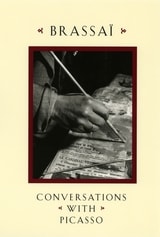
Conversations with Picasso offers a remarkable vision of both Picasso and the entire artistic and intellectual milieu of wartime Paris, a vision provided by the gifted photographer and prolific author who spent the early portion of the 1940s photographing Picasso's work. Brassaï carefully and affectionately records each of his meetings and appointments with the great artist, building along the way a work of remarkable depth, intimate perspective, and great importance to anyone who truly wishes to understand Picasso and his world.
Conversion to Modernism
The Early Work of Man RayFrancis M. Naumann
Rutgers University Press, 2003
Man Ray (1890–1976) has long been considered one of the most versatile and innovative artists of the twentieth century. As a painter, writer, sculptor, photographer, and filmmaker, he is best known for his intimate association with the French Surrealist group in Paris during the 1920s and 1930s, particularly for his highly inventive and unconventional photographic images. These remarkable accomplishments, however, have tended to overshadow the importance of his earlier work—significant not only for comprehending Man Ray’s future artistic development, but also for fleshing out our understanding of the visual arts in America during one of the most important and crucial phases of the evolution of modernism.
The book, and the exhibition for which this work will serve as the catalog, concentrate on Man Ray’s production from 1907 to 1917. Conversion to Modernism will be the first comprehensive, fully illustrated work to examine this artist’s seminal years. The show and the catalog begin with Man Ray’s high school years in Brooklyn, his studies at the Art Students League and the American Academy in New York, and the time he spent in life drawing classes at the more progressive Ferrer Center
From 1913 to 1915, Man Ray lived in a small artists’ colony in Grantwood, New Jersey. It was here, studying with Samuel Halpert (a former student of Matisse), that Man Ray began to become the artist we know today. The last section of the show and of the book include recently discovered photographs and other works that are influenced by a knowledge of the emergent Dada movement. Here is Man Ray in recognizable form just before he leaves the country for France in 1921.
This exhibit will first be on display at the Montclair Art Museum from January 26 through March 2003. It will then travel to museums in Athens, Georgia, Philadelphia, and Chicago.
Corn Palaces and Butter Queens
A History of Crop Art and Dairy SculpturePamela H. Simpson
University of Minnesota Press, 2012
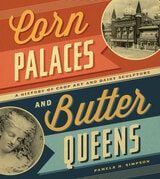
Teddy Roosevelt’s head sculpted from butter. The Liberty Bell replicated in oranges. The Sioux City Corn Palace of 1891 encased with corn, grains, and grasses and stretching for two city blocks—with a trolley line running down its center. Between 1870 and 1930, from county and state fairs to the world’s fairs, large exhibition buildings were covered with grains, fruits, and vegetables to declare in no uncertain terms the rich agricultural abundance of the United States. At the same fairs—but on a more intimate level—ice-cooled cases enticed fairgoers to marvel at an array of butter sculpture models including cows, buildings, flowers, and politicians, all proclaiming the rich bounty and unending promise held by the region.
Often viewed as mere humorous novelties—fun and folksy, but not worthy of serious consideration—these lively forms of American art are described by Pamela H. Simpson in a fascinating and comprehensive history. From the pioneering cereal architecture of Henry Worrall at the Philadelphia Centennial Exposition to the vast corn palaces displayed in Sioux City, Iowa, and elsewhere between 1877 and 1891, Simpson brings to life these dazzling large-scale displays in turn-of-the-century American fairs and festivals. She guides readers through the fascinating forms of crop art and butter sculpture, as they grew from state and regional fairs to a significant place at the major international exhibitions. The Minnesota State Fair’s Princess Kay of the Milky Way contest, Lillian Colton’s famed pictorial seed art, and the work of Iowa’s “butter cow lady,” Norma “Duffy” Lyon, are modern versions of this tradition.
Beautifully illustrated with a bounty of never-before-seen archival images, Corn Palaces and Butter Queens is an accessible history of one of America’s most unique and beguiling Midwestern art forms—an amusing and peculiar phenomenon that profoundly affected the way Americans saw themselves and their country’s potential during times of drought and great depression.
Corpus Vasorum Antiquorum, Fascicule 10
Athenian Red-Figure Column and Volute KratersDespoina Tsiafakis
J. Paul Getty Trust, The, 2019
This new fascicule of the CVA—the tenth issued by the J. Paul Getty Museum and the first ever to be published open access—presents a selection of Attic red-figure column and volute kraters ranging from 520 to 510 BCE through the early fourth century BCE. Among the works included are a significant dinoid volute krater and a volute krater with the Labors of Herakles that is attributed to the Kleophrades Painter.
The free online edition of this open-access catalogue is available at www.getty.edu/publications/cva10/. Also available are free PDF, EPUB, and Kindle/MOBI downloads of the book, CSV and JSON downloads of the object data, and JPG downloads of the catalogue images.
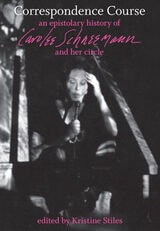
Correspondence Course
An Epistolary History of Carolee Schneemann and Her CircleKristine Stiles, ed.
Duke University Press, 2010
Kristine Stiles selected, edited, annotated, and wrote the introduction to the letters, assembling them so that readers can follow the development of Schneemann’s art, thought, and private and public relationships. The correspondence chronicles a history of energy and invention, joy and sorrow, and charged personal and artistic struggles. It sheds light on the internecine aesthetic politics and mundane activities that constitute the exasperating vicissitudes of making art, building an artistic reputation, and negotiating an industry as unpredictable and demanding as the art world in the mid- to late twentieth century.
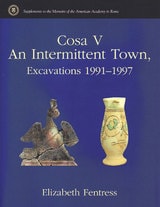
Cosa V
An Intermittent Town, Excavations 1991-1997Elizabeth Fentress
University of Michigan Press, 2003
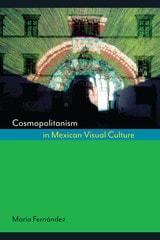
Cosmopolitanism in Mexican Visual Culture
By María Fernández
University of Texas Press, 2014
Since the colonial era, Mexican art has emerged from an ongoing process of negotiation between the local and the global, which frequently involves invention, synthesis, and transformation of diverse discursive and artistic traditions. In this pathfinding book, María Fernández uses the concept of cosmopolitanism to explore this important aspect of Mexican art, in which visual culture and power relations unite the local and the global, the national and the international, the universal and the particular. She argues that in Mexico, as in other colonized regions, colonization constructed power dynamics and forms of violence that persisted in the independent nation-state. Accordingly, Fernández presents not only the visual qualities of objects, but also the discourses, ideas, desires, and practices that are fundamental to the very existence of visual objects.
Fernández organizes episodes in the history of Mexican art and architecture, ranging from the seventeenth century to the end of the twentieth century, around the consistent but unacknowledged historical theme of cosmopolitanism, allowing readers to discern relationships among various historical periods and works that are new and yet simultaneously dependent on their predecessors. She uses case studies of art and architecture produced in response to government commissions to demonstrate that established visual forms and meanings in Mexican art reflect and inform desires, expectations, memories, and ways of being in the world—in short, that visual culture and cosmopolitanism are fundamental to processes of subjectification and identity.
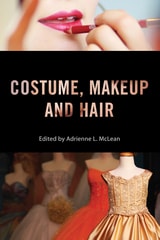
Costume, Makeup, and Hair
McLean, Adrienne L
Rutgers University Press, 2016
From the acclaimed Behind the Silver Screen series, Costume, Makeup, and Hair charts the development of these three crafts in the American film industry from the 1890s to the present. Each chapter examines a different era in film history, revealing how the arts of cinematic costume, makeup, and hair, have continually adapted to new conditions, making the transitions from stage to screen, from monochrome to color, and from analog to digital. Together, the book’s contributors give us a remarkable glimpse into how these crafts foster creative collaboration and improvisation, often fashioning striking looks and ingenious effects out of limited materials.
Costume, Makeup, and Hair not only considers these crafts in relation to a wide range of film genres, from sci-fi spectacles to period dramas, but also examines the role they have played in the larger marketplace for fashion and beauty products. Drawing on rare archival materials and lavish color illustrations, this volume provides readers with both a groundbreaking history of film industry labor and an appreciation of cinematic costume, makeup, and hairstyling as distinct art forms.
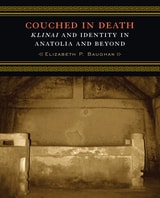
Couched in Death
Klinai and Identity in Anatolia and BeyondElizabeth P. Baughan
University of Wisconsin Press, 2013
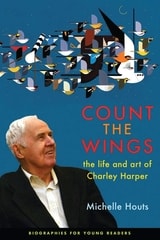
Count the Wings
The Life and Art of Charley HarperMichelle Houts
Ohio University Press, 2018
When you look at a bird, do you see feathers and a beak? Or do you see circles and triangles? Artist Charley Harper spent his life reducing subjects to their simplest forms, their basic lines and shapes. This resulted in what he called minimal realism and the style that would become easily recognized as Charley Harper’s. Art fans and nature lovers around the world fell in love with Harper’s paintings, which often featured bright colors and intriguing nature subjects.
Harper’s love of painting and drawing led him from the hills of West Virginia to the bombed-out villages of Europe, to the streets of New York City, and to the halls of the Art Academy of Cincinnati. How did the farm boy who didn’t know a single artist become one of America’s most recognized midcentury modern painters? The answer is simple. He did it by counting the wings.
Count the Wings is the first book for middle-grade readers about Harper’s life and work. Author Michelle Houts worked closely with the Harper estate to include full-color illustrations, plentiful supplemental materials, and discussion questions that will intrigue and engage young readers. Count the Wings is part of our acclaimed Biographies for Young Readers series, which brings smart, expertly researched books about often overlooked but exceptional individuals to school-age readers.
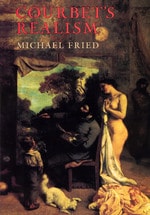
Courbet's Realism
Michael Fried
University of Chicago Press, 1990
Courbet's Realism is clearly a major contribution to the highly active field of Courbet studies. . . . But to contribute here and now is necessarily also to contribute to central debates about art history itself, and so the book is also—I hesitate to say 'more importantly,' because of the way object and method are woven together in it—a major contribution to current attempts to rethink the foundations and objects of art history. . . . It will not be an easy book to come to terms with; for all its engagement with contemporary literary theory and related developments, it is not an application of anything, and its deeply thought-through arguments will not fall easily in line with the emerging shapes of the various 'new art histories' that tap many of the same theoretical resources. At this moment, there may be nothing more valuable than such a work."—Stephen Melville, Art History