Results by title
3785 books match the query 'Poetry' and 202 start with c
Coda
Steven Seidenberg
Omnidawn, 2025
The nameless narrator of Coda attempts to trace the origins of linguistic and perceptual differentiation by experimenting with contemporary lyric and narrative forms. Moving between extravagant prosody and obsessive disquisition, Seidenberg’s poetry works to reconfigure conceptual imperatives found throughout philosophy and theology. With a focus on the structure of memory and the decadence of the body, Seidenberg describes the epistemological regress of desire, intention, knowledge, and discernment.
Seidenberg brings together the language and concerns of figures including Spinoza, Kant, Hegel, and Wittgenstein, alongside elements of raucous humor drawn from the tradition of Rabelais, Beckett, Lispector, and Sterne.
Code Name Puritan
Norman Holmes Pearson at the Nexus of Poetry, Espionage, and American PowerGreg Barnhisel
University of Chicago Press, 2024
Although his impact on twentieth-century American cultural life was profound, few people know the story of Norman Holmes Pearson. Pearson’s life embodied the Cold War alliances among US artists, scholars, and the national-security state that coalesced after World War II. As a Yale professor and editor, he helped legitimize the study of American culture and shaped the public’s understanding of literary modernism—significantly, the work of women poets such as Hilda Doolittle and Gertrude Stein. At the same time, as a spy, recruiter, and cultural diplomat, he connected the academy, the State Department, and even the CIA.
In Code Name Puritan, Greg Barnhisel maps Pearson’s life, from his childhood injury that led to a visible, permanent disability to his wartime counterespionage work neutralizing the Nazis’ spy network to his powerful role in the cultural and political heyday sometimes called the American Century. Written with clarity and informed by meticulous research, Barnhisel’s revelatory portrait of Pearson details how his unique experiences shaped his beliefs about the American character, from the Puritans onward.

Coffin Honey
Todd Davis
Michigan State University Press, 2022
Colcha
Aaron Abeyta
University Press of Colorado, 2001
Winner of a 2002 American Book Award
Winner of the 2002 Colorado Book Award in Poetry
"The natural voice at work in the poetry sings of one human life as if it were our own. I loved listening."
—Rita Kiefer, author of Nesting Doll
"This just may be one of the best books of poetry I have ever read. . . . This is the kind of writing that give poetry a good name."
—Mike Nobles, Tulsa World
"Abeyta's poetry amazingly captures this struggle with poems that are simultaneously tortured and thankful, celebratory and melancholy, earthly and ethereal. . . . Poet Abeyta beautifully captures the hardships of living in rural Colorado."
—Blue Sky Quarterly
"Abeyta writes about family, friends, and famous (and infamous) locals. His approach is intimate and daring while avoiding the self-absorbed, coffee-house clichés we fear. Yes, death plays a role in the connection of community and the land, but these poems are sly rather than dark, modulated rather than graphic, sweet rather than maudlin."
—Wayne Sheldrake, Colorado Central Magazine
In Colcha, Aaron Abeyta blends the contrasting rhythms of the English and Spanish languages, finding music in a simple yet memorable lyricism without losing the complexity and mystery of personal experience. His forty-two poems take the reader on a journey through a contemplative personal history that explores communal, political and societal issues as well as the individual experiences of family and friends. With his distinctive voice, Abeyta invites people of all cultures to enter his poems by exploring the essence of humanity as expressed by his particular Hispanic culture and heritage.
Marked by intimacy and deep sentiment, Colcha not only acquaints us with the land of Abeyta's people, but also reveals the individuals from his life and family history in the most colorful and delicate detail. We meet his abuelitos (grandparents) in poems such as "colcha" and "3515 Wyandot," and hear of their connection to the tierra and its seasons, their labor and its bounty presented both viscerally and lovingly. We also meet the nameless people: the rancheros and the herders and the farmers, the locals in their pick-up trucks, and the women who make the tortillas. Abeyta's reflections on the plight, loves, joys, failures, and exploitation of the common person in such poems as "cuando se secan las acequias," "untitled (verde)," and "cinco de mayo" belong to the literary heritage of such poets as Pablo Neruda, Federico Garcia Lorca, and Walt Whitman.
Colcha is not just for those who love poetry, but for all people who wish to be moved by the music of language and, while listening, perhaps to gain some personal insight into their own lives and cultural traditions.
Collected Poems
Donald Davie
University of Chicago Press, 1991
"Davie's voice—judgemental, ironic, epigrammatic, humorous, self-lacerating—speaks always with reference to an unhuman perpendicular standard that itself goes unquestioned. It is not a standard of Beauty or Truth; Davie is a poet of the third member of the Platonic triad, Justice."—Helen Vendler, The New Yorker
"[Davie's poems] are on the quiet side, often casual and musing in mood and tone; determined to resist large gestures of assent or denial. . .Donald Davie may just be the best English poet-critic of our time."—William Pritchard, The New Republic
"Donald Davie's Collected Poems does more than mark the culmination of one of the most distinguished careers in post-war British poetry; it is the autobiographical journey of a living poet at the height of his creative powers and the mastery of his craft. Davie is considered the most important and valuable contemporary link between poetry in England and America."—Sarah E. McNeil, Little Rock Free Press
Collected Poems
Thomas Bernhard
Seagull Books, 2017
Beloved Austrian writer Thomas Bernhard (1931–89) began his career in the early 1950s as a poet. Over the next decade, Bernhard wrote thousands of poems and published four volumes of intensely wrought and increasingly personal verse, with such titles as On Earth and in Hell, In Hora Mortis, and Under the Iron of the Moon. Bernhard’s early poetry, bearing the influence of Georg Trakl, begins with a deep connection to his Austrian homeland. As his poems saw publication and recognition, Bernhard seemed always on the verge of joining the ranks of Ingeborg Bachmann, Paul Celan, and other young post-war poets writing in German. During this time, however, his poems became increasingly more obsessive, filled with undulant self-pity, counterpointed by a defamatory, bardic voice utterly estranged from his country, all of which resulted in a magisterial work of anti-poetry—one that represents Bernhard’s own harrowing experience with his leitmotif of success and failure, which makes his fiction such a pleasure. There is much to be found in these pages for Bernhard fans of every stripe.

Collected Poems
Edwin Rolfe
University of Illinois Press, 1993
Lincoln Battalion, the Americans who volunteered to help defend the elected
Spanish government during its 1936-39 civil war. His career began in the
revolutionary Left in New York in the 1920s and continued into the 1950s,
when Rolfe wrote searing poetry attacking the McCarthy-era witch-hunts.
Collected Poems
Georg Trakl
Seagull Books, 2019
In a refreshing contrast to previous translated collections of Trakl’s work, James Reidel is mindful of how the poet himself wished to be read, emphasizing the order and content of the verses to achieve a musical effect. Trakl’s verses were also marked by allegiance to both the nineteenth and twentieth centuries, a fact which Reidel honors with impressive research into the historicity of the poet’s language.
Collected Poems gathers Trakl’s early, middle, and late work, ranging widely, from his haunting prose pieces to his darkly beautiful poems documenting the first bloody weeks of World War I on the Eastern Front.
Collected Poems
Rainer Brambach
Seagull Books, 2014
Marked by his disregard for material values, a profound engagement with the landscape of the Upper Rhine, and a lasting commitment to humanity, Brambach’s poems are direct, unadorned, and free of pomp or ideology. His quiet images conjure up landscapes, small rural scenes, and interiors of bars and cafes. Brambach was, above all, an observer whose poems provide insights of deceptive simplicity that form a poetic essence confirming the significance of this author’s voice. This collection of poems, masterfully translated by noted writer and poet Esther Kinsky, represents the first major English translation of a significant European poet.

Collected Poems 1953-1983
Lucien Stryk
Ohio University Press, 1985
Years of translating Zen poems and religious texts have helped give Stryk a special sense of the particular, a feel for those details which, because they are so much a part of our lives, seem to define us. Stryk’s poetry is neither an attempt to surpass these details nor an attempt to give them significance. It is an activity that exists among them, as ordinary — yet as important — as breath. Stryk’s poetic power rests in the sureness of plain speech and his insistence on a direct, sympathetic attention to the world we actually inhabit.
Collected Poems, a gathering of three decades of work, contains nearly all Stryk’s poems, including the best of his Zen translations and a book–length section of new poetry. This book is a revelation of the wonderful amid the familiar by a poet whose language and vision have found their maturity.
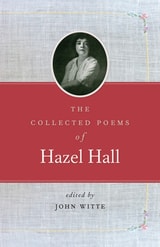
Collected Poems of Hazel Hall, The
Hazel Hall
Oregon State University Press, 2020
Confined to a wheelchair since childhood, Hall viewed life from the window of an upper room in her family’s house in Portland, Oregon. To better observe passersby on the sidewalk, she positioned a small mirror on her windowsill. Hall was an accomplished seamstress; her fine needlework helped to support the family and provided a vivid body of imagery for her precisely crafted, often gorgeously embellished poems.
Hall’s writings convey the dark undertones of the lives of working women in the early twentieth century, while bringing into focus her own private, reclusive life—her limited mobility, her isolation and loneliness, her gifts with needlework and words. In his updated introduction to this volume, John Witte examines Hall’s brief and brilliant career and highlights her remarkably modern sensibilities. In a new afterword, Anita Helle considers Hall’s work in an era when modes of literary historical recovery have been widened and expanded—and what that means in the afterlife of Hazel Hall.
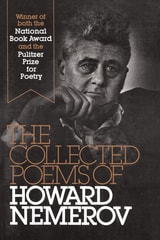
Collected Poems of Howard Nemerov
Howard Nemerov
University of Chicago Press, 1981
The Collected Poems of Howard Nemerov won both the National Book Award and the Pulitzer Prize in 1978.
"Howard Nemerov is a witty, urbane, thoughtful poet, grounded in the classics, a master of the craft. It is refreshing to read his work. . . . "—Minneapolis Tribune
"The world causes in Nemerov a mingled revulsion and love, and a hopeless hope is the most attractive quality in his poems, which slowly turn obverse to reverse, seeing the permanence of change, the vices of virtue, the evanescence of solidities and the errors of truth."—Helen Vendler, New York Times Book Review
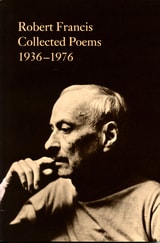
Collected Poems, 1936-1976
Robert Francis
University of Massachusetts Press, 1976
Gathered here in their entirety are the seven previous volumes of Robert Francis poetry—Stand with Me Here, Valhalla and Other Poems, The Sound I Listened For, The Face against the Glass, The Orb Weaver, Come Out into the Sun, and Like Ghosts of Eagles—together with a group of recent poems, many not previously published but “saved” to end this volume on a note of newness.
Because the original seven volumes are kept in chronological order, the reader can follow the author's journey from his quiet early work to poetry of greater color, warmth, vitality, vivacity, and sportiveness; and can note just when and where Francis' style becomes more and more diversified, with word-count, fragmented surface, and the celebration of words themselves.
The book is graced with eight wood engravings by Wang Hui-Ming.
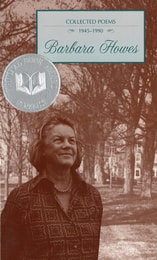
Collected Poems, 1945-1990
Barbara Howes
University of Arkansas Press, 1995
Finalist, 1995 National Book Award
This collection fills in a missing chapter in the history of American women’s poetry by bringing a significant voice back into print. Barbara Howes has perfected a personal style that had little to do with the fashionable currents of her time. Dana Gioia has said of her “[O]ne sees Howes very clearly as a woman writing in one of the oddest but most important traditions of American poetry. She stands with Marianne Moore, Elizabeth Bishop, and ultimately Emily Dickinson in a lineage of women writers passionately committed to the independence and singularity of the poetic imagination. Collected poems 1945-1990 contains the lifework of one of America’s irreplaceable poets.”
Forty years ago in The New Yorker Louise Bogan wrote: “Barbara Howes is the most accomplished women poet of the younger writing generation—one who has found her own voice, chosen her own material, and worked out her own form. Miss Howes is daring with language, but she is also accurate. Her originality stands in constant close reference to the material in hand, and although much of that material is fantastic or exotic, it is never so simply for its own sake.”
Drawing from seven previous books, this collection confirms and consolidates the reputation of Barbara Howes as a timeless poet whose fine voice and surprising insights will continue to delight all lovers of language.
Collected Poems, 1952–1999
Robert Mezey
University of Arkansas Press, 2000
Collected Poems
With Notes Toward the MemoirsDjuna Barnes; selected and edited by Phillip Herrring and Osias Stutman
University of Wisconsin Press, 2005
This groundbreaking edition compiles many of the late unpublished works of American writer Djuna Barnes (1892–1982). Because she published only seven poems and a play during the last forty years of her life, scholars believed Barnes wrote almost nothing during this period. But at the time of her death her apartment was filled with multiple drafts of unpublished poetry and notes toward her memoirs, both included here for the first time. Best known for her tragic lesbian novel Nightwood, Barnes has always been considered a crucial modernist. Her later poetry will only enhance this reputation as it shows her remarkable evolution from a competent young writer to a deeply intellectual poet in the metaphysical tradition. With the full force of her biting wit and dramatic flair, Barnes’s autobiographical notes describe the expatriate scene in Paris during the 1920s, including her interactions with James Joyce and Gertrude Stein and her intimate recollections of T. S. Eliot. These memoirs provide a rare opportunity to experience the intense personality of this complex and fascinating poet.
Collected Prose
James Wright
University of Michigan Press, 1983
Collected Prose
Robert Hayden
University of Michigan Press, 1984
Collected Shorter Poems
John Peck
Northwestern University Press, 2004
John Peck's poems draw on both modernist and traditional resources, quarrying in the large gaps among contemporary readers of poetry. This definitive collection makes available difficult-to-find works by a remarkable, thoroughly original American poet. Peck's poems continue to attract a discerning, loyal audience of readers up to the challenge of confronting his astonishing range and ambitions.
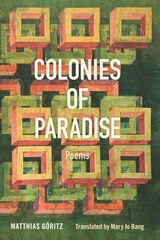
Colonies of Paradise
PoemsMatthias Göritz, translated from the German by Mary Jo Bang
Northwestern University Press, 2023
The first book of poetry by Matthias Göritz to be available in English, in a translation by a renowned writer
Very few books of poetry by contemporary German writers are available to English-speaking readers. In Colonies of Paradise, acclaimed poet and translator Mary Jo Bang introduces the poems of novelist, poet, and translator Matthias Göritz, one of the most exciting German writers publishing today. The poems in this book, which originally appeared in German under the title Loops, take the reader on a tour of Paris, Chicago, Hamburg, and Moscow as they explore childhood, travel, and the human experience. Unsettling our expectations about adulthood, the book permeates the quotidian with a disquieting strangeness that leads us deeper into our own lives and histories. Göritz’s sly humor, keen insight, and artistry are brought to the fore in Bang’s careful and innovative translation, allowing an English-language audience to enter fully the intricate interiority of Göritz’s work.
Columbarium
Susan Stewart
University of Chicago Press, 2003
In her long-awaited fourth book of poetry, Susan Stewart gives us a series of splendid, numinous poems about truths learned with the mind but set free through the senses. Modeled on the seventeenth-century practice of century forms, or books of one hundred pages, Columbarium expresses the bond between the living and the dead in voices of parent to child, lover to beloved, and mortal to the gods. The book arrives as a meditative gift from one of our most respected poet-critics.
Stewart frames her Columbarium with four poems paying homage to the elements-to their destructive and creative aspects and to their roles in the human and more than human worlds. Both nest and crypt, the book's center holds an alphabet of "shadow georgics," poems of instruction and doubt that link knowledge and the unconscious. Questions of mortality, of goodness and suffering, and of the fragility and power of memory animate these poems. In one poem an apple calls the narrator back from the dead to savor the echoes of its varieties in myth and literature. In another, the seeds of a pear tree reveal the essential unity that makes the diversity of existence possible.
Stewart's Columbarium is both a memorial to the dead and a testament to life.
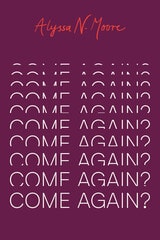
Come Again?
Alyssa N. Moore
University of Chicago Press, 2026
In this formally inventive debut collection, a speaker continuously shapeshifts through roles, forms, and characters.
Alyssa N. Moore’s Come Again? conjures a series of otherworldly scenarios in which reinvention becomes a form of resistance and a method to escape the snares of a modern existence to which we contribute but cannot control. Throughout these surreal and absurdist poems, an untethered consciousness is continuously reincarnated and dragged through various personae—including the Volunteer, the Eternal Counselor, the Streetcleaner, and the Architect—to find “what exactly to do with a willing body.” For example, in “The Volunteer,” a visual sequence, the book’s shapeshifting narrator is dropped into a formless expanse and expected to perform. As we move through the collection, the speaker’s perception morphs rapidly. From wage worker to computer programmer to sexbot to God, they collide over and over with the boundaries of the world. With each shift, the speaker guides us through a series of darkly comic set pieces that are, in turns, cinematic and slapstick as they seek a solid home base from which to “reject the emptiness that’s inherited.”
Moore’s facility with poetic form, use of image and text, and play between irony and sincerity make Come Again? a bold collection that defies the customary and conventional, instead forging new worlds of continual remaking.
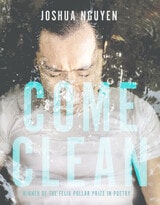
Come Clean
Joshua Nguyen
University of Wisconsin Press, 2021
Joshua Nguyen's sharp, songlike, and often experimental collection compartmentalizes past trauma—sexual and generational—through the quotidian. Poems aim to confront the speaker's past by physically, and mentally, cleaning up. Here, the Asian-American masculine interrogates the domestic space through the sensual and finds healing through family and in everyday rhythms: rinsing rice until the water runs clear, folding clean shirts, and attempts at re-creating an unwritten family recipe. Yet past wounds remain present like permanent marker under layers of paint or spilled fish sauce set into car upholstery. Infused with the Shinto-inspired organizing practices of KonMari and the catchy nihilism of Mitski's songs, the poems in Come Clean unpack, organize, and tidy up life's messy joys and hurtful chaos with intimacy, grace, and vulnerability.
No matter how smattered my insides,
I am relieved that I left my room tidy—
One less ugly sight.
I always wanted to die clean & pretty
while my dreams made music in the night.
—Excerpt from "Last Words"
Come, Take a Gentle Stab
Selected PoemsSalim Barakat
Seagull Books, 2021
Although Salim Barakat is one of the most renowned and respected contemporary writers in Arabic letters, he remains virtually unknown in the English-speaking world. This first collection of his poetry in English, representing every stage of his career, remedies that startling omission. Come, Take a Gentle Stab features selections from his most acclaimed works of poetry, including excerpts from his book-length poems, rendered into an English that captures the exultation of language for which he is famous.
A Kurdish-Syrian man, Barakat chose to write in Arabic, the language of cultural and political hegemony that has marginalized his people. Like Paul Celan, he mastered the language of the oppressor to such an extent that the course of the language itself has been compelled to bend to his will. Barakat pushes Arabic to a point just beyond its linguistic limits, stretching those limits. He resists coherence, but never destroys it, pulling back before the final blow. What results is a figurative abstraction of struggle, as alive as the struggle itself. And always beneath the surface of this roiling water one can glimpse the deep currents of ancient Kurdish culture.
Comfort Measures Only
New and Selected Poems, 1994–2016Rafael Campo
Duke University Press, 2018
Coming After
Essays on PoetryAlice Notley
University of Michigan Press, 2005
Notley explores the work of second-generation New York School poets and their allies: Ted Berrigan, Anne Waldman, Joanne Kyger, Ron Padgett, Lorenzo Thomas, and others. These essays and reviews are among the first to deal with a generation of poets notorious for their refusal to criticize and theorize, assuming the stance that "only the poems matter." The essays are characterized by Notley's strong, compelling voice, which transfixes the reader even in the midst of professional detail. Coming After revives the possibility of the readable book of criticism.
Coming Close
Forty Essays on Philip LevineMari L'Esperance and Tomas Morin
University of Iowa Press, 2013
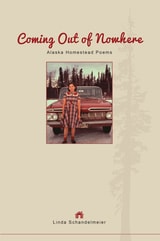
Coming Out of Nowhere
Alaska Homestead PoemsLinda Schandelmeier
University of Alaska Press, 2018
Homestead life is often romanticized as a valiant, resilient family persisting in the clean isolation of pristine wilderness, living off the land and depending only on each other. But there can be a darker side to this existence.
Linda Schandelmeier was raised on a family homestead six miles south of the fledgling town of Anchorage, Alaska in the 1950s and ’60s. But hers is not a typical homestead story. In this book, part poetic memoir and part historical document, a young girl comes of age in a family fractured by divorce and abuse. Schandelmeier does not shy away from these details of her family history, but she also recognizes her childhood as one that was unique and nurturing, and many of her poems celebrate homestead life. Her words hint at her way of surviving and even transcending the remoteness by suggesting a deeper level of human experience beyond the daily grind of homestead life; a place in which the trees and mountains are almost members of the family. These are poems grounded in the wilds that shimmer with a mythic quality. Schandelmeier’s vivid descriptions of homesteading will draw in readers from all types of lives.
Coming Out of War
Poetry, Grieving, and the Culture of the World WarsJanis P. Stout
University of Alabama Press, 2005
World War I is widely considered “the Great War” and World War II, “the Good War.” Janis Stout thinks of them as two parts of a whole that continues to engage historians and literary scholars searching for an understanding of both the actual war experiences and the modern culture of grief they embody. In Coming Out of War: Poetry, Grieving, and the Culture of the World Wars Stout argues that poetry, of all the arts, most fully captures and conveys those cultural responses.
While probing the work of such well known war poets as Rupert Brooke, Wilfred Owen, and Randall Jarrell, Stout also highlights the impact of the wars on lesser studied, but equally compelling, sources such as the music of Charles Ives and Cole Porter, Aaron Copland and Irving Berlin. She challenges the commonplace belief that war poetry came only from the battlefield and was written only by men by examining the wartime writings of women poets such as Rose Macaulay, Marianne Moore, Elizabeth Bishop, and Gwendolyn Brooks. She also challenges the assumption that World War II did not produce poetry of distinction by studying the work of John Ciardi, Karl Shapiro, Louis Simpson, Robert Frost, and Wallace Stevens. While emphasizing aesthetic continuity between the wars, Stout stresses that the poetry that emerged from each displays a greater variety than is usually recognized.
A final chapter considers Benjamin Britten’s War Requiem as a culmination and embodiment of the anti-war tradition in 20th-century poetry and music, and speculates on the reasons why, despite their abundance and eloquence, these expressions of grief and opposition to war have effected so little change.
Coming and Going
New and Selected PoemsJames McAuley
University of Arkansas Press, 1989
Coming to Light
American Women Poets in the Twentieth CenturyDiane Wood Middlebrook and Marilyn Yalom, Editors
University of Michigan Press, 1985

Commentary and Ideology
Dante in the RenaissanceDeborah Parker
Duke University Press, 1993
Parker begins by tracing the criticism of Dante commentaries from the nineteenth century to the present and then examines the tradition of commentary from the Middle Ages to the Renaissance. She shows how the civic, institutional, and social commitments of commentators shaped their response to the Comedy, and how commentators tried to use the poem as an authoritative source for various kinds of social legitimation. Parker discusses how different commentators dealt with a deeply political section of the poem: the damnation of Brutus and Cassius.
The scope and importance of Commentary and Ideology will command the attention of a broad group of scholars, including Italian specialists on Dante, late medievalists, students and professionals in early modern European literature, bibliographers, critical theorists, historians of literary criticism and theory, and cultural and intellectual historians.
Common Disaster
PoemsM. Cynthia Cheung
Acre Books, 2025
As a front-line physician, M. Cynthia Cheung started writing poetry during the worst days of the COVID-19 pandemic. Her remarkable debut collection, Common Disaster, chronicles these experiences. Confronting not just the coronavirus but also war crimes and the death of loved ones, Cheung shows us that the pandemic is only one of many disasters we hold in common. In poems that look to both the past and future, she takes a stand against the extinction of self and memory, challenging the violence of erasure.
The period covered by the book is geologic and vast. It examines present-day evidence of ancient human activity and natural history, including the Lascaux caves, asteroid craters, tar pits, and Viking ruins. The poems include ghazals, thoughtful free verse, and work that takes up the page in reframing classical Chinese oracular texts to situate the pain of a doctor in crisis.
As a physician-poet, Cheung asks us to see beyond the every day to the devastating truths about the human condition.
Companion Grasses
Brian Teare
Omnidawn, 2013
Company
Sam Ross
Four Way Books, 2019
Comparative Essays on the Poetry and Prose of John Donne and George Herbert
Combined LightsRussell M. Hillier
University of Delaware Press, 2022
Compass and Clock
PoemsDavid Sanders
Ohio University Press, 2016
The poems of Compass and Clock take their inspiration from the intersection of the natural world and the human, exploring the landscapes in which those intersections occur. Those landscapes range from David Sanders’s native midwestern countryside to the caves of Lascaux and an enchanted lake where relics of lost lives are washed ashore. Yet, the true source of the poems’ vitality is Sanders’s attention to the missed or misread moments, those times when the act fails, and the perceived clashes with the actual.
Here, the satisfying pairing of elegance and vulnerability invites the reader to tour those uncanny landscapes from which one returns irrevocably changed—refreshed, but wistful. In a review of his earlier limited-edition work, Time in Transit, the Hudson Review called David Sanders “a poet to watch.” With the Swallow Press publication of Compass and Clock, we have the realization of that promise.
Compass of the Dying
PoemsLaurence Lieberman
University of Arkansas Press, 1998
When Laurence Lieberman writes of Guyana or islands in the Dutch West Indies, he excavates, explores, even exhumes the essence of the place. In the flora and fauna, in the rural cafes and ruins of churches and crypts, in the taste of iguana soup and the look of light through stained glass, Lieberman unfolds an exquisite atlas of the senses.
The awe of encounter, the raw impact, beauty, and sometimes the brutality of both the surroundings and the people fuel this poetry. Whether he meets an iguana hunter, a bricklayer, a witness to the United States–led Grenada invasion, or a classical composer, Lieberman gives the reader a vivid combination of his own wit and surprising observations mingled with the speech of each character.
Folk tales, legends, and island myths play a great role in his newest work. In the eddies of a river in Guyana, Lieberman dares river demons. On the island of Aruba, he hears the chants and work songs of long-dead miners in an abandoned gold mine. He briefly loses himself when he stares into the mirror of a well once frequented by slaves on Bonaire.
Coupled with natural forces—floods, volcanic eruptions, constant rains—these folk tales and the stories of the islanders’ lives create a “wedding of sun and rain,” and a map to the troves of the Caribbean hidden beneath a rich and often violent history.
Compendium
A Collection of Thoughts on ProsodyDonald Justice
Omnidawn, 2017
Complete Poems
Claude Mckay. Edited and with an Introduction by William J. Maxwell.
University of Illinois Press, 2003
Containing more than three hundred poems, including nearly a hundred previously unpublished works, this unique collection showcases the intellectual range of Claude McKay (1889-1948), the Jamaican-born poet and novelist whose life and work were marked by restless travel and steadfast social protest. McKay's first poems were composed in rural Jamaican creole and launched his lifelong commitment to representing everyday black culture from the bottom up. Migrating to New York, he reinvigorated the English sonnet and helped spark the Harlem Renaissance with poems such as "If We Must Die." After coming under scrutiny for his communism, he traveled throughout Europe and North Africa for twelve years and returned to Harlem in 1934, having denounced Stalin's Soviet Union. By then, McKay's pristine "violent sonnets" were giving way to confessional lyrics informed by his newfound Catholicism.
McKay's verse eludes easy definition, yet this complete anthology, vividly introduced and carefully annotated by William J. Maxwell, acquaints readers with the full transnational evolution of a major voice in twentieth-century poetry.
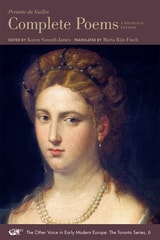
Complete Poems. A Bilingual Edition
Pernette du Guillet
Iter Press, 2010
This first complete English edition provides a fully-annotated bilingual text and a fresh perspective from which to appreciate the originality and beauty of this poetry.
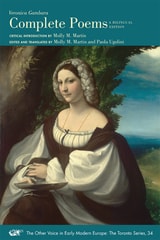
Complete Poems
A Bilingual EditionVeronica Gambara
Iter Press, 2014
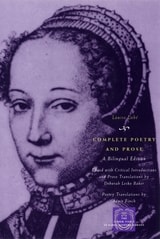
Complete Poetry and Prose
A Bilingual EditionLouise Labé
University of Chicago Press, 2006
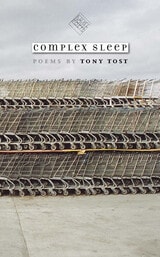
Complex Sleep
Tony Tost
University of Iowa Press, 2007
Complex Sleep, Tony Tost’s ambitious second book of poems, leaps upward with an astounding multiplicity of voices, utterances, and bursts. Each leap marks a sure and precise entry into a world of images, ideas, and sensations that is brand new—the true accomplishment of any poetic work.
The octet of poems that compose Complex Sleep comprises a complex organism, audacious in scope, swiping at meaning via language as fragmented music. Tost takes on the problem of physical shape, reorchestrates phrases according to the alphabet, and writes himself into the hypnagogic state between waking and dreaming. Informed by their own procedural constraints, these poems invent forms that tap the unconscious poetic, the very complexity embodied in sleep. All the while, Tost reforms utterance beyond the mere epistemology of much contemporary poetry.
Devising an innovative formalism rather than concerning itself with discovering the what, Complex Sleep is about discovering how to say what needs to be said. Skip the opera, this book performs.
Con las debidas licencias / With Leave and License
Poemas / PoemsLeda Schiavo
Swan Isle Press, 2000
Conceptualisms
The Anthology of Prose, Poetry, Visual, Found, E- & Hybrid Writing as Contemporary ArtEdited by Steve Tomasula
University of Alabama Press, 2022
A wide-ranging anthology of experimental writing—prose, poetry, and hybrid—from its most significant practitioners and innovators
A variety of names have been used to describe fiction, poetry, and hybrid writing that explore new forms and challenges mainstream traditions. Those phrases include experimental, conceptual, avant-garde, hybrid, surfiction, fusion, radical, slip-stream, avant-pop, postmodern, self-conscious, innovative, L=A=N=G=U=A=G=E writing, alternative, and anti- or new literature. Conceptualisms: The Anthology of Prose, Poetry, Visual, Found, E- & Hybrid Writing as Contemporary Art is the first major anthology of writing that offers readers an overview of this other tradition as it lives in the early decades of the 21st century.
Featuring over 100 pieces from more than 90 authors, this anthology offers a plethora of aesthetics and approaches to a wide variety subjects. Editor Steve Tomasula has gathered poems, prose, and hybrid pieces that all challenge our understanding of what literature means. Intended as a collection of the most exciting and bold literary work being made today, Tomasula has put a spotlight on the many possibilities available to writers and readers wishing for a glimpse of literature’s future.
Readers will recognize authors who have shaped contemporary writing, as among them Lydia Davis, Charles Bernstein, Jonathan Safran Foer, Shelley Jackson, Nathaniel Mackey, David Foster Wallace, and Claudia Rankine. Even seasoned readers will find authors, and responses to the canon, not yet encountered. Conceptualisms is a book of ideas for writers, teachers and scholars, as well as readers who wonder how many ways literature can live.
The text features headnotes to chapters on themes such as sound writing, electronic literature, found text, and other forms, offering accessible introductions for readers new to this work. An online companion presents statements about the work and biographies of the authors in addition to audio, video, and electronic writing that can’t be presented in print. Visit www.conceptualisms.info to read more.
Concerning the Angels
Rafael Alberti
Four Way Books, 2025
Concrete Encoded
Poetry, Design, and the Cybernetic Imaginary in BrazilNathaniel Wolfson
University of Texas Press, 2025
A study of concrete art and poetry, its implications, and influence in Brazil.
Concrete art and poetry burst onto Brazil’s cultural stage in the 1950s, while the country was embarking on a dizzying period of modernization. Bringing together key poets and visual artists alongside less recognized figures, Nathaniel Wolfson shows that concretism was hardly socially inert, as pundits have suggested. Rather, it presciently grappled with an emerging information age that would soon reorganize human relations globally.
Concrete Encoded describes a nascent cybernetic imaginary. Concretism has long been considered Brazil’s most global aesthetic movement. Wolfson traces new circles of international theorists and practitioners involved in critical technological thought. Wolfson argues that concrete poetry is the quintessential literary genre of the early information age. He shows that Brazilian poets, artists, and designers contested the military dictatorship’s technological authoritarianism and information-gathering operations. Vigorous experimentalists, their attention to form and semantics unveiled both the creative and nefarious possibilities of algorithmic writing. A highly original work, Concrete Encoded reckons with aesthetic responses from Brazil to an advancing capitalist and digital era.
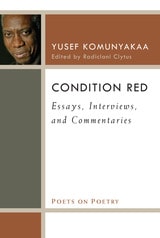
Condition Red
Essays, Interviews, and CommentariesYusef Komunyakaa; Edited by Radiclani Clytus
University of Michigan Press, 2017
Confession
Susan Hahn
University of Chicago Press, 1996
"Phoenix Poets is the most distinguished university press series going."—Alfred Corn
"Compressed, controlled, circumscribed by the artist's discipline, the poems in Susan Hahn's Confession do not spill over; each is like a steadily held cup containing its pain."—Alicia Ostriker
"Hahn's voice is unique and unforgettable . . . . Hahn's self-revelation is so startling, and her details so extraordinary, that she virtually detonates her poems with energy. . . . Plath, Ai, Sexton—Hahn brings to mind those vivid, violent poets, but her voice is clearly her own, strong and without either shrillness or shame."—Patricia Monaghan, Booklist
"In her third book of poems, Confession, Susan Hahn continues to refine her amazing capacity to disquiet, disgust and fascinate. This may not sound like a recommendation, but it is. . . . The precision of Hahn's language stands out even more clearly when compared to the looser, baggier free verse that dominates so much contemporary poetry."—Maureen McLane, Chicago Tribune