Results by title
8812 books match the query 'Political Science' and 698 start with c
City Scripts
Narratives of Postindustrial Urban FuturesEdited by Barbara Buchenau, Jens Martin Gurr, and Maria Sulimma
The Ohio State University Press, 2023
Storytelling shapes how we view our cities, legitimizing histories, future plans, and understandings of the urban. City Scripts responds to calls by literary theorists to engage a new kind of narrative analysis that recalibrates close reading and interpretation to the multiple ways in which narratives “do things”—how they intervene in the world and take action in everyday life. A multidisciplinary cast of contributors approaches this new way of looking at cities through the stories people tell about them, looking especially at political activism and urban planning, which depend on the invention of plausible stories of connectedness and of a redemptive future.
The stakes are especially high in cities where economic, ecological, and social futures are delimited by histories of large-scale extraction and racialized industrial labor. Contributors thus focus on cities in postindustrial areas of Germany and the United States, examining how narratives about cities become scripts and how these scripts produce real-life results. This approach highlights how uses of narrative and scripting appeal to stakeholders in urban change. These actors continually deploy narrative, media, and performance, with consequences for urban futures worldwide.
Contributors:
Lieven Ameel, Juliane Borosch, Barbara Buchenau, Florian Deckers, Barbara Eckstein, Kornelia Freitag, Walter Grünzweig, Randi Gunzenhäuser, Jens Martin Gurr, Elisabeth Haefs, Chris Katzenberg, Johannes Maria Krickl, Renee M. Moreno, Hanna Rodewald, Julia Sattler, Maria Sulimma, James A. Throgmorton, Michael Wala, Katharina Wood
City Trenches
Urban Politics and the Patterning of Class in the United StatesIra Katznelson
University of Chicago Press, 1982
City and Environment
Christopher G. Boone and Ali Modarres
Temple University Press, 2006
City and Regime in the American Republic
Stephen L. Elkin
University of Chicago Press, 1987
The present workings of American urban political institutions are, Elkin maintains, characterized by a close relationship between politicians and businessmen, a relationship that promotes neither political equality nor effective social problem-solving. Elkin pays particular attention to the issue of land-use in his analysis of these failures of popular control in traditional city politics. Urban political institutions, however, are not just instruments for the dispensing of valued outcomes or devices for social problem-solving—they help to form the citizenry. Our present institutions largely define citizens as interest group adversaries and do little to encourage them to focus on the commercial public interest of the city. Elkin concludes by proposing new institutional arrangements that would be better able to harness the self-interested behavior of individuals for the common good of a commercial republic.
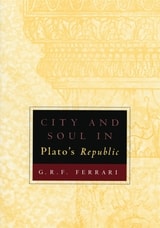
City and Soul in Plato's Republic
G. R. F. Ferrari
University of Chicago Press, 2005
In addition to acknowledging familiar themes in the interpretation of the Republic—the sincerity of its utopianism, the justice of the philosopher's return to the Cave—Ferrari provocatively engages secondary literature by Leo Strauss, Bernard Williams, and Jonathan Lear. With admirable clarity and insight, Ferrari conveys the relation between the city and the soul and the choice between tyranny and philosophy. City and Soul in Plato's Republic will be of value to students of classics, philosophy, and political theory alike.
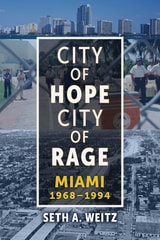
City of Hope, City of Rage
Miami, 1968–1994Weitz, Seth A.
University of Alabama Press, 2024
Examines Miami’s turbulent transformation from a segregated vacation destination to a global, multicultural metropolis
City of Hope, City of Rage gives a fascinating account of three turbulent and transformative decades in the history of Miami. Marked by mass immigration, racially motivated uprisings, economic inequity, rising crime, and social change, Miami’s history from 1968 to 1994 saw the city evolve rapidly from a predominantly white southern city and vacation spot into a global, Hispanic-majority metropolis with an international tourist base. And yet Miami remains highly segregated today.
Exploring beyond the clichés of the Magic City as a bastion of hope for immigrants, a fantasy of beaches and art deco architecture, or a hotbed of drugs and crime, historian Seth A. Weitz reveals the social, political, and cultural shifts that transformed the city. Utilizing archival research and personal stories to reveal the diverse experiences of Miami’s Black, Latinx, Jewish, and LGBTQ+ communities, Weitz explores the struggles for social justice, the rise of the drug trade, and the ongoing fight to mold Miami’s image.
A Miami native, Weitz challenges simplistic narratives about the city, revealing a place defined by hope, rage, and struggle for identity. Illuminating the way Miami is defined and who gets to define it, City of Hope, City of Rage offers a fresh perspective on this vibrant and complex city, making it a valuable resource for anyone interested in Miami’s unique history.
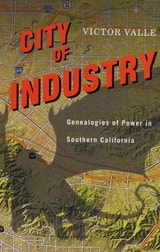
City of Industry
Genealogies of Power in Southern CaliforniaValle, Victor
Rutgers University Press, 2011
Valle investigated an untapped archive of Industry's built landscape, media coverage, and public records, including sealed FBI reports, to uncover a cascading series of scandals. A kaleidoscopic view of the corruption that resulted when local land owners, media barons, and railroads converged to build the city, this suspenseful narrative explores how new governmental technologies and engineering feats propelled the rationality of privatization using their property-owning servants as tools.
Valle's tale of corporate greed begins with the city's founder James M. Stafford and ends with present day corporate heir, Edward Roski Jr., the nation's biggest industrial developerùco-owner of the L.A. Staples Arena and possible future owner of California's next NFL franchise. Not to be forgotten in Valle's captivating story are Latino working class communities living within Los Angeles's distribution corridors, who suffer wealth disparities and exposure to air pollution as a result of diesel-burning trucks, trains, and container ships that bring global trade to their very doorsteps. They are among the many victims of City of Industry.
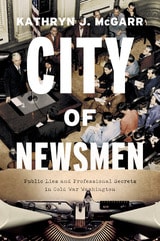
City of Newsmen
Public Lies and Professional Secrets in Cold War WashingtonKathryn J. McGarr
University of Chicago Press, 2022
Americans’ current trust in journalists is at a dismayingly low ebb, particularly on the subject of national and international politics. For some, it might be tempting to look back to the mid-twentieth century, when the nation’s press corps was a seemingly venerable and monolithic institution that conveyed the official line from Washington with nary a glint of anti-patriotic cynicism. As Kathryn McGarr’s City of Newsmen shows, however, the real story of what Cold War–era journalists did and how they did it wasn’t exactly the one you’d find in the morning papers.
City of Newsmen explores foreign policy journalism in Washington during and after World War II—a time supposedly defined by the press’s blind patriotism and groupthink. McGarr reveals, though, that DC reporters then were deeply cynical about government sources and their motives, but kept their doubts to themselves for professional, social, and ideological reasons. The alliance and rivalries among these reporters constituted a world of debts and loyalties: shared memories of harrowing wartime experiences, shared frustrations with government censorship and information programs, shared antagonisms, and shared mentors. McGarr ventures into the back hallways and private clubs of the 1940s and 1950s to show how white male reporters suppressed their skepticism to build one of the most powerful and enduring constructed realities in recent US history—the Washington Cold War consensus. Though by the 1960s, this set of reporters was seen as unduly complicit with the government—failing to openly critique the decisions and worldviews that led to disasters like the Vietnam War—McGarr shows how self-aware these reporters were as they negotiated for access, prominence, and, yes, the truth—even as they denied those things to their readers.

Civic Agriculture
Reconnecting Farm, Food, and CommunityThomas A. Lyson
University Press of New England, 2004
Civic Hopes and Political Realities
Immigrants, Community Organizations, and Political EngagementS. Karthick Ramakrishnan
Russell Sage Foundation, 2008
Civic Labors
Scholar Activism and Working-Class StudiesEdited by Dennis Deslippe, Eric Fure-Slocum, and John W. McKerley
University of Illinois Press, 2016
Civic Talk
Peers, Politics, and the Future of DemocracyAuthored by Casey A. Klofstad
Temple University Press, 2011
Does talking about civic issues encourage civic participation? In his innovative book, Civic Talk, Casey Klofstad shows that our discussions about politics and current events with our friends, colleagues, and relatives—"civic talk"—has the ability to turn thought into action—from voting to volunteering in civic organizations.
Klofstad’s path breaking research is the first to find evidence of a causal relationship between the casual chatting and civic participation. He employs survey information and focus groups consisting of randomly assigned college freshman roommates to show this behavior in action. Klofstad also illustrates how civic talk varies under different circumstances and how the effects can last years into the future. Based on these findings, Klofstad contends that social context plays a central role in maintaining the strength of democracy. This conclusion cuts against the grain of previous research, which primarily focuses on individual-level determinants of civic participation, and negates social-level explanations.
Civic War and the Corruption of the Citizen
Peter Alexander Meyers
University of Chicago Press, 2008
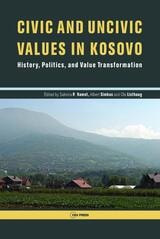
Civic and Uncivic Values in Kosovo
History, Politics, and Value TransformationSabrina P. Ramet
Central European University Press, 2015
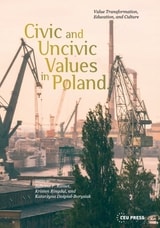
Civic and Uncivic Values in Poland
Value Transformation, Education, and CultureSabrina P. Ramet
Central European University Press, 2019
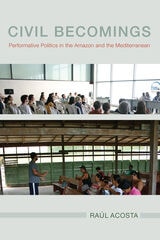
Civil Becomings
Performative Politics in the Amazon and the MediterraneanRaúl Acosta
University of Alabama Press, 2020
An anthropological approach to an emerging form of transnational political engagement by independent civil society organizations
Activism and advocacy have drawn academic interest as alternative ways of achieving collective ends outside established political institutions. However, there has been very little theoretical attention aimed at the interconnections between the two spheres. In Civil Becomings: Performative Politics in the Amazon and the Mediterranean, Raúl Acosta examines the manner in which progressive nongovernmental organizations (NGOs) and activists act in a more intermingled and processual way than scholars have previously acknowledged.
Acosta focuses on networks from the vantage point of two NGOs: one in Brazil that concentrated on environmental issues in the Amazon and another in Barcelona called the Mediterranean Social Forum. The focus of this research is not on organizational aspects of collaboration, but rather on the practices and contexts in which such cooperation occurs. Three major aspects of activist and advocacy networks are analyzed: their communicative characters, their collective performances of the political, and the negotiations they engage in between vernacular and cosmopolitan values.
This volume theorizes the cooperative actions of activist and advocacy networks as legitimating processes for the work of participating groups. In doing so, Acosta argues, they address the issues that justify a joint campaign or effort and also crucially underpin each participating collective as a worthy organization of civil society.
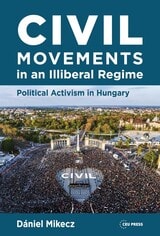
Civil Movements in an Illiberal Regime
Political Activism in HungaryDániel Mikecz
Central European University Press, 2023
Dániel Mikecz addresses in this study the tensions between oppositional civil society and party-political actors. As successive elections demonstrate the increasing confidence of the illiberal regime of Viktor Orbán, left and liberal parties of the opposition have faced a prolonged crisis in credibility. At the same time, the civil society has not been immobile, and bottom-up initiatives, social and political movements, and non-governmental organizations have gained momentum in the public sphere. The ruling power is also active in the extra-parliamentary political arena. Through national consultations, Peace Marches, and other means, Orbán’s governing Fidesz party has mobilized voters outside of election campaigns and has implemented a so-called movement governance. The study offers a vivid examination of this top-down or astroturf mobilization of the regime.
Mikecz identifies the different patterns of activism and creates a coherent typology. He describes in detail each kind of activism based on opinion surveys, protest surveys and content analysis. The categorization and comprehensive exploration of civil movements provide a deep understanding of the mechanisms of illiberal postcommunist regimes.
Civil Obedience
Complicity and Complacency in Chile since PinochetMichael J. Lazzara
University of Wisconsin Press, 2020
Michael J. Lazzara boldly argues that today's Chile is a product of both complicity and complacency. Combining historical analysis with deft literary, political, and cultural critique, he scrutinizes the post-Pinochet rationalizations made by politicians, artists, intellectuals, bystanders, former revolutionaries-turned-neoliberals, and common citizens. He looks beyond victims and perpetrators to unveil the ambiguous, ethically vexed realms of memory and experience that authoritarian regimes inevitably generate.
Civil Religion in Political Thought
Ronald Weed
Catholic University of America Press, 2010
Civil Rights in Bakersfield
Segregation and Multiracial Activism in the Central ValleyOliver A. Rosales
University of Texas Press, 2024
2024 Outstanding Book Award, National Association for Ethnic Studies
2025 Honorable Mention, Norris & Carol Hundley Award, Pacific Coast Branch of the American Historical Association
2025 The Ambassador Julian Nava Best Ethnic Studies Book, International Latino Book Awards
A multiracial history of civil rights coalitions beyond the farm worker movement in twentieth-century Bakersfield, California.
In Civil Rights in Bakersfield, Oliver Rosales uncovers the role of the multiracial west in shaping the course of US civil rights history. Focusing on Bakersfield, one of the few sizable cities within California’s Central Valley for much of the twentieth century in a region most commonly known as a bastion of political conservatism, oil, and industrial agriculture, Rosales documents how multiracial coalitions emerged to challenge histories of racial segregation and discrimination. He recounts how the region was home to both the historic farm worker movement, led by César Chávez, Dolores Huerta, and Larry Itliong, and also a robust multiracial civil rights movement beyond the fields. This multiracial push for civil rights reform included struggles for fair housing, school integration, public health, media representation, and greater political representation for Black and Brown communities. In expanding on this history of multiracial activism, Rosales further explores the challenges activists faced in community organizing and how the legacies of coalition building contribute to ongoing activist efforts in the Central Valley of today.
Civil Rights in the Texas Borderlands
Dr. Lawrence A. Nixon and Black ActivismWill Guzman
University of Illinois Press, 2016
Will Guzmán delves into Nixon's lifelong struggle against Jim Crow. Linking Nixon's activism to his independence from the white economy, support from the NAACP, and the man's own indefatigable courage, Guzmán also sheds light on Nixon's presence in symbolic and literal borderlands--as an educated professional in a time when few went to college, as an African American who made waves when most feared violent reprisal, and as someone living on the mythical American frontier as well as an international boundary.
A powerful addition to the literature on African Americans in the Southwest, Civil Rights in the Texas Borderlands explores seldom-studied corners of the Black past and the civil rights movement.
Civil Service Reform in Brazil
Principles Versus PracticeBy Lawrence S. Graham
University of Texas Press, 1968
In the 1930s, during the authoritarian government of Getúlio Vargas, the Brazilian civil service reform movement began. Thirty-five years later, the actual administrative practices of the country did not adequately reflect the philosophy underlying this movement, a philosophy drawn from the reform experience and public administration theories of the United States and Western Europe. This book examines why these ideas, when transplanted to another cultural setting, did not take root and, further, why they unexpectedly proved to be most applicable in Brazil during periods of autocratic rule.
These questions are highly relevant not only to Brazil, but equally to other developing countries struggling to create more effective national administrative systems. For this reason, and in order to evaluate the Brazilian reform experience within its total context (social, economic, and political), Lawrence S. Graham develops a broad conceptual framework. His focus is on the years between 1945 and 1964, a period which allowed a relatively free play of political forces but, ironically, produced a diminution in the success of the reform efforts when compared with the authoritarian governments which preceded and followed it. After a comparative consideration of the public administration theories behind the reform movement, Graham examines this period in terms of the political environment, the functions of political patronage, and the influences of a nascent national party. Finally, he juxtaposes the conditions and course of the Brazilian reform experience with those of the United States and Great Britain.
Graham’s study of the Brazilian example, which does not pass judgment on the prevailing public personnel system, reveals the importance of understanding the total cultural context within which administrative principles are put into practice. Such an approach, wider than generally held in the field of public administration, may prove to be the most vital factor in the future of the civil service in Brazil and several other countries facing the same problems.
Civil Society Elites
Field Studies from Cambodia and IndonesiaEdited by Astrid Norén-Nilsson, Amalinda Savirani, and Anders Uhlin
National University of Singapore Press, 2023
Civil Society and the Political Imagination in Africa
Critical PerspectivesEdited by John L. Comaroff and Jean Comaroff
University of Chicago Press, 1999
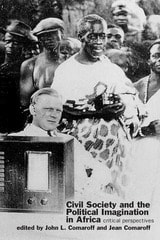
In a substantial introduction, anthropologists Jean and John Comaroff offer a critical theoretical analysis of the nature and deployment of the concept—and the current debates surrounding it. Building on this framework, the contributors investigate the "problem" of civil society across their regions of expertise, which cover the continent. Drawing creatively on one another's work, they examine the impact of colonial ideology, postcoloniality, and development practice on discourses of civility, the workings of everyday politics, the construction of new modes of selfhood, and the pursuit of moral community.
Incisive and original, the book shows how struggles over civil society in Africa reveal much about larger historical forces in the post-Cold War era. It also makes a strong case for the contribution of historical anthropology to contemporary discourses on the rise of a "new world order."
Civil Society, Philanthropy, and the Fate of the Commons
Bruce R. Sievers
University Press of New England, 2010
Civil War and State Formation
The Political Economy of War and Peace in LiberiaFelix Gerdes
Campus Verlag, 2013
Civil War, Civil Peace
Helen Yanacopulos
Ohio University Press, 2006
When a cease-fire is arranged, aid workers, military personnel, diplomats, and others pour in from the United States, Europe, and international agencies. Outside help is essential after a war, but too often, well-intentioned interveners do more harm than good. A half of civil wars have resumed after failed peace agreements.
Each war is different, and there can be no intervention handbook or best practices guide. Aimed at practitioners and policy makers, and essential reading for students of war, humanitarian intervention, peace building, and development, Civil War, Civil Peace provides a comprehensive examination of how interventions can be improved through a better understanding of the roots of war and of the grievances and interests that fueled the war.
Civil Wars and Foreign Powers
Outside Intervention in Intrastate ConflictPatrick M. Regan
University of Michigan Press, 2002
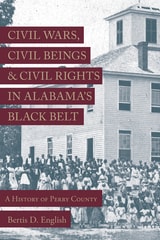
Civil Wars, Civil Beings, and Civil Rights in Alabama's Black Belt
A History of Perry CountyBertis D. English, Foreword by Wayne Flynt
University of Alabama Press, 2020
Reconstruction politics and race relations between freed blacks and the white establishment in Perry County, Alabama
In his fascinating, in-depth study, Bertis D. English analyzes why Perry County, situated in the heart of a violence-prone subregion of Alabama, enjoyed more peaceful race relations and less bloodshed than several neighboring counties. Choosing an atypical locality as central to his study, English raises questions about factors affecting ethnic disturbances in the Black Belt and elsewhere in Alabama. He also uses Perry County, which he deems an anomalous county, to caution against the tendency of some scholars to make sweeping generalizations about entire regions and subregions.
English contends Perry County was a relatively tranquil place with a set of extremely influential African American businessmen, clergy, politicians, and other leaders during Reconstruction. Together with egalitarian or opportunistic white citizens, they headed a successful campaign for black agency and biracial cooperation that few counties in Alabama matched. English also illustrates how a significant number of educational institutions, a high density of African American residents, and an unusually organized and informed African American population were essential factors in forming Perry County’s character. He likewise traces the development of religion in Perry, the nineteenth-century Baptist capital of Alabama, and the emergence of civil rights in Perry, an underemphasized center of activism during the twentieth century.
This well-researched and comprehensive volume illuminates Perry County’s history from the various perspectives of its black, interracial, and white inhabitants, amplifying their own voices in a novel way. The narrative includes rich personal details about ordinary and affluent people, both free and unfree, creating a distinctive resource that will be useful to scholars as well as a reference that will serve the needs of students and general readers.

Civil Wars, Civil Peace
An Introduction to Conflict ResolutionKumar Rupesinghe and Sanam Naraghi Anderlini
Pluto Press, 1998
Civilizing Money
Hume, his Monetary Project, and the Scottish EnlightenmentGeorge Caffentzis
Pluto Press, 2021
Taking the Scottish Enlightenment philosopher David Hume as its subject, this book breaks new ground in focusing its lens on a little-studied aspect of Hume’s thinking: his understanding of money.
George Caffentzis makes both an intervention in the field of monetary philosophy and into Marxian conceptions of the relation between philosophy and capitalist development. He vividly charts the ways in which Hume’s philosophy directly informed the project of ‘civilizing’ the people of the Scottish Highlands and pacifying the English proletariat in response to the revolts of both groups at the heart of the empire.
Built on careful historical and philosophical detective work, Civilizing Money offers a stimulating and radical political reading of the ways in which Hume’s fundamental philosophical claims performed concrete political functions.
Civilizing the Enemy
German Reconstruction and the Invention of the WestPatrick Thaddeus Jackson
University of Michigan Press, 2006
By examining German reconstruction under the Marshall Plan, author Patrick Jackson shows how the rhetorical invention of a West that included Germany was critical to the emergence of the postwar world order. Civilizing the Enemy convincingly describes how concepts are strategically shaped and given weight in modern international relations, by expertly dissecting the history of "the West" and demonstrating its puzzling persistence in the face of contradictory realities.
"By revisiting the early Cold War by means of some carefully conducted intellectual history, Patrick Jackson expertly dissects the post-1945 meanings of "the West" for Europe's emergent political imaginary. West German reconstruction, the foundation of NATO, and the idealizing of 'Western civilization' all appear in fascinating new light."
--Geoff Eley, University of Michigan
"Western civilization is not given but politically made. In this theoretically sophisticated and politically nuanced book, Patrick Jackson argues that Germany's reintegration into a Western community of nations was greatly facilitated by civilizational discourse. It established a compelling political logic that guided the victorious Allies in their occupation policy. This book is very topical as it engages critically very different, and less successful, contemporary theoretical constructions and political deployments of civilizational discourse."
--Peter J. Katzenstein, Cornell University
"What sets Patrick Jackson's book apart is his attention, on the one hand, to philosophical issues behind the kinds of theoretical claims he makes and, on the other hand, to the methodological implications that follow from those claims. Few scholars are willing and able to do both, and even fewer are as successful as he is in carrying it off. Patrick Jackson is a systematic thinker in a field where theory is all the rage but systematic thinking is in short supply."
--Nicholas Onuf, Florida International University
Patrick Thaddeus Jackson is Assistant Professor of International Relations in American University's School of International Service.
Claiming Impartiality
Peacebuilding Organizations as Actors in Multiple Fields of Global GovernanceAndrea Warnecke
University of Michigan Press, 2026
Drawing on and expanding a Bourdieusian field perspective, the book examines international organizations as actors in multiple fields of global governance. Using the case studies of Bosnia and Herzegovina and Timor-Leste, it traces the emergence and transformation of peacebuilding practices by leading international and bilateral organizations during the first two decades of the field’s existence. The organizational lens highlights the tensions that exist between the objectives of simultaneously acting as a peacebuilding organization and as a peacekeeping, humanitarian, or development organization whose practices are to varying degrees committed to observing the twin principles of impartiality and neutrality. By thinking through these sometimes contradictory roles, the book offers new insights into how these organizations sideline questions of political agency in favor of expanding their influence into related fields of global governance. Claiming Impartiality discusses the future of peacebuilding and explores avenues for addressing political challenges to peace itself.
Claiming Neighborhood
New Ways of Understanding Urban ChangeJohn Betancur
University of Illinois Press, 2016
As the authors show, a diverse collection of people including urban policy experts, elected officials, investors, resident leaders, institutions, community-based organizations, and many others compete to control how neighborhoods change and are characterized. Betancur and Smith argue that neighborhoods have become sites of consumption and spaces to be consumed. Discourse is used to add and subtract value from them. The romanticized image of "the neighborhood" exaggerates or obscures race and class struggles while celebrating diversity and income mixing. Scholars and policy makers must reexamine what sustains this image and the power effects produced in order to explain and govern urban space more equitably.
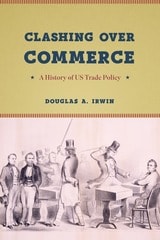
Clashing over Commerce
A History of US Trade PolicyDouglas A. Irwin
University of Chicago Press, 2017
Douglas A. Irwin’s Clashing over Commerce is the most authoritative and comprehensive history of US trade policy to date, offering a clear picture of the various economic and political forces that have shaped it. From the start, trade policy divided the nation—first when Thomas Jefferson declared an embargo on all foreign trade and then when South Carolina threatened to secede from the Union over excessive taxes on imports. The Civil War saw a shift toward protectionism, which then came under constant political attack. Then, controversy over the Smoot-Hawley tariff during the Great Depression led to a policy shift toward freer trade, involving trade agreements that eventually produced the World Trade Organization. Irwin makes sense of this turbulent history by showing how different economic interests tend to be grouped geographically, meaning that every proposed policy change found ready champions and opponents in Congress.
As the Trump administration considers making major changes to US trade policy, Irwin’s sweeping historical perspective helps illuminate the current debate. Deeply researched and rich with insight and detail, Clashing over Commerce provides valuable and enduring insights into US trade policy past and present.
Class
Andrea Cavalletti
Seagull Books, 2019
Class, by Andrea Cavalletti, is a striking montage of diverse materials—Marx and Jules Verne, Benjamin and Gabriel Tarde. In it, Cavalletti asks whether the untimely concept of class is once again thinkable. Faced with new pogroms and state racism, he challenges us to imagine a movement that would unsettle and eventually destroy the crowd.
Class And Its Others
J. K. Gibson-Graham
University of Minnesota Press, 2000
A surprising and innovative look at class that proposes new approaches to this important topic
While references to gender, race, and class are everywhere in social theory, class has not received the kind of theoretical and empirical attention accorded to gender and race. A welcome and much-needed corrective, this book offers a novel theoretical approach to class and an active practice of class analysis.
The authors offer new and compelling ways to look at class through examinations of such topics as sex work, the experiences of African American women as domestic laborers, and blue- and white-collar workers. Their work acknowledges that individuals may participate in various class relations at one moment or over time and that class identities are multiple and changing, interacting with other aspects of identity in contingent and unpredictable ways.
The essays in the book focus on class difference, class transformation and change, and on the intersection of class, race, gender, sexuality, and other dimensions of identity. They find class in seemingly unlikely places-in households, parent-child relationships, and self-employment-and locate class politics on the interpersonal level as well as at the level of enterprises, communities, and nations. Taken together, they will prompt a rethinking of class and class subjectivity that will expand social theory.
Contributors: Enid Arvidson, U of Texas, Arlington; Jenny Cameron, Monash U, Australia; Harriet Fraad; Janet Hotch; Susan Jahoda, U of Massachusetts, Amherst; Amitava Kumar, U of Florida; Cecilia Marie Rio; Jacquelyn Southern; Marjolein van der Veen.

Class Forces
Youth and Labor in the Making of the Egyptian Uprising of 2011Nada Matta
University of Michigan Press, 2027
Class Forces offers a new political economy explanation of the forces behind Egypt’s 2011 uprising. How did movements that had long struggled to challenge an authoritarian regime suddenly help generate a mass uprising capable of bringing down President Hosni Mubarak—and why did that uprising ultimately fail? Moving beyond explanations centered on economic grievances and political repression, the book shows how transformations in capitalism and changing class relations created new opportunities for labor, democratic, and youth movements to mobilize. It traces how the evolving relationship between business and the regime indirectly helped open political space and strengthen movements whose organizational capacities had remained limited.
Nada Matta argues that class dynamics were central to the extraordinary mass mobilization that filled Tahrir Square during the uprising. By focusing on class linkages rather than the more static concept of cross-class coalitions, Matta offers a dynamic account of class relations that also identifies the limits of associational capacities and durable cross-class alliances and helps explain why democratic forces failed to consolidate political gains after President Hosni Mubarak’s ouster. Class Forces illuminates the sources of movement power and vulnerability under contemporary capitalism for social movement practitioners.
Class Matters
Inequality and Exploitation in 21st-Century BritainCharles Umney
Pluto Press, 2018
Class Politics and the Creation of the American State
James Parisot
University of Michigan Press, 2026
Why does the American federal government seem to prioritize elite capitalist interests over those of other groups? Class Politics and the Creation of the American State draws on a wide range of sources—personal letters, official government documents, private notes, and newspaper articles—to reveal that the federal government was built to give the emerging capitalist elite a way to consolidate and institutionalize their power. Challenging both liberal and conservative interpretations about what the US Constitution means, this book tells a new story about how the American state took shape.
The framers of the Constitution constructed an image of the state, enshrined in the Constitution, that presented their power as universal: a system meant to serve all Americans equally. This image helped legitimize the new order, even if the rising capitalist class stood to benefit most of all. Since the United States of the late 1780s was not yet a fully capitalist society, the state that was built opened space for less capitalistically incorporated social classes, including some artisans and yeoman farmers, to have limited representation. Class Politics and the Creation of the American State shows how the structure of the early American state worked primarily to advance capitalist interests, while incorporating other groups enough to maintain a sense of broad representation and inclusion.
Class War?
What Americans Really Think about Economic InequalityBenjamin I. Page and Lawrence R. Jacobs
University of Chicago Press, 2009
Recent battles in Washington over how to fix America’s fiscal failures strengthened the widespread impression that economic issues sharply divide average citizens. Indeed, many commentators split Americans into two opposing groups: uncompromising supporters of unfettered free markets and advocates for government solutions to economic problems. But such dichotomies, Benjamin Page and Lawrence Jacobs contend, ring false. In Class War? they present compelling evidence that most Americans favor free enterprise and practical government programs to distribute wealth more equitably.
At every income level and in both major political parties, majorities embrace conservative egalitarianism—a philosophy that prizes individualism and self-reliance as well as public intervention to help Americans pursue these ideals on a level playing field. Drawing on hundreds of opinion studies spanning more than seventy years, including a new comprehensive survey, Page and Jacobs reveal that this worldview translates to broad support for policies aimed at narrowing the gap between rich and poor and creating genuine opportunity for all. They find, for example, that across economic, geographical, and ideological lines, most Americans support higher minimum wages, improved public education, wider access to universal health insurance coverage, and the use of tax dollars to fund these programs.
In this surprising and heartening assessment, Page and Jacobs provide our new administration with a popular mandate to combat the economic inequity that plagues our nation.
Class Warfare
Interviews with David BarsamianNoam Chomsky
Pluto Press, 2002
Classics of Social Choice
Iain McLean and Arnold Urken, Editors
University of Michigan Press, 1995
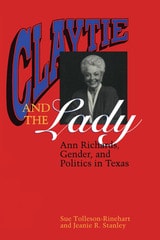
Claytie and the Lady
Ann Richards, Gender, and Politics in TexasBy Sue Tolleson-Rinehart and Jeanie R. Stanley
University of Texas Press, 1994
It was like a remake of The Cowboy and the Lady, except that this time they weren't friends. The 1990 Texas governor's race pitted Republican Clayton Williams, a politically conservative rancher and oil millionaire, against Democrat Ann Richards, an experienced progressive politician noted for her toughness and quick wit. Their differences offered voters a choice not only of policies and programs but also of stereotypes and myths of men's and women's proper roles.
Claytie and the Lady is the first in-depth look at how gender affected the 1990 governor's race. The authors' analysis reveals that Ann Richards' victory was a result of a unique combination of characteristics. She was simultaneously tough enough to convince voters that she could lead and feminine enough to put them at ease. At the same time, she remained committed to the progressive and women's issues that had won her the early support of feminists and progressives. The authors also show how Clayton Williams' appeal to the Texas cowboy myth backfired when he broke the cowboy code of chivalry to women.
The authors set their discussion within the historical context of twentieth-century Texas politics and the theoretical context of gender politics in order to pose a number of thought-provoking questions about the effects of women's participation in political life. Interviews with key players in the 1990 election, including Governor Ann Richards, add a lively and insightful counterpoint to the text.
Clean Air and Good Jobs
U.S. Labor and the Struggle for Climate JusticeTodd E. Vachon
Temple University Press, 2023
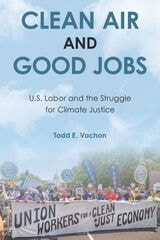
The labor–climate movement in the U.S. laid the groundwork for the Green New Deal by building a base within labor for supporting climate protection as a vehicle for good jobs. But as we confront the climate crisis and seek environmental justice, a “jobs vs. environment” discourse often pits workers against climate activists. How can we make a “just transition” moving away from fossil fuels, while also compensating for the human cost when jobs are lost or displaced?
In his timely book, Clean Air and Good Jobs, Todd Vachon examines the labor–climate movement and demonstrates what can be envisioned and accomplished when climate justice is on labor’s agenda and unions work together with other social movements to formulate bold solutions to the climate crisis. Vachon profiles the workers and union leaders who have been waging a slow, but steadily growing revolution within their unions to make labor as a whole an active and progressive champion for both workers and the environment.
Clean Air and Good Jobs examines the “movement within the movement” offering useful solutions to the dual crises of climate and inequality.
Cleansing the Nation
India, the Hindu Modern, and Mediations of GenderRaka Shome
Duke University Press, 2025
Clear It with Sid!
Sidney R. Yates and Fifty Years of Presidents, Pragmatism, and Public ServiceMichael C. Dorf and George Van Dusen
University of Illinois Press, 2022
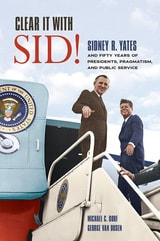
Michael C. Dorf and George Van Dusen draw on scores of interviews and unprecedented access to private papers to illuminate the life of an Illinois political icon. Wise, energetic, charismatic, petty, stubborn--Sid Yates presented a complicated character to constituents and colleagues alike. Yet his get-it-done approach to legislation allowed him to bridge partisan divides in the often-polarized House of Representatives. Following Yates from the campaign trail to the negotiating table to the House floor, Dorf and Van Dusen offer a rich portrait of a dealmaker extraordinaire and tireless patriot on a fifty-year journey through postwar American politics.
Clear Word and Third Sight
Folk Groundings and Diasporic Consciousness in African Caribbean WritingCatherine A. John
Duke University Press, 2003
Contesting popular discourses about what constitutes culture and maintaining that neglected strains in negritude discourse provide a crucial philosophical perspective on the connections between folk practices, cultural memory, and collective consciousness, John examines the diasporic principles in the work of the negritude writers Léon Damas, Aimé Césaire, and Léopold Senghor. She traces the manifestations and reworkings of their ideas in Afro-Caribbean writing from the eastern and French Caribbean, as well as the Caribbean diaspora in the United States. The authors she discusses include Jamaica Kincaid, Earl Lovelace, Simone Schwarz-Bart, Audre Lorde, Paule Marshall, and Edouard Glissant, among others. John argues that by incorporating what she calls folk groundings—such as poems, folktales, proverbs, and songs—into their work, Afro-Caribbean writers invoke a psychospiritual consciousness which combines old and new strategies for addressing the ongoing postcolonial struggle.
Cleavage Politics and the Populist Right
The New Cultural Conflict in Western EuropeAuthored by Simon Bornschier
Temple University Press, 2010
Over the last two decades, right-wing populist parties in Western Europe have gained sizable vote shares and power, much to the fascination and consternation of political observers. Meshing traditionalism and communitarian ideals, right-wing populist parties have come to represent a polar normative ideal to the New Left in Western Europe. In his dynamic study Cleavage Politics and the Populist Right, Simon Bornschier applies a cultural as well as political dimension to analyze the parties of both the right and left in six countries. He develops a theory that integrates the role of political conflict around both established cleavages and party strategies regarding new divisions to explain the varying fortunes of the populist right.
Climate Bridge
An International Perspective on How to Enact Climate Action at the Government Public InterfaceWolfram Höfer
Rutgers University Press, 2025