Results by title
8812 books match the query 'Political Science' and 698 start with c

Combating Jihadism
American Hegemony and Interstate Cooperation in the War on TerrorismBarak Mendelsohn
University of Chicago Press, 2009

Combating Teen Smoking
Research and Policy StrategiesPeter D. Jacobson, Paula M. Lantz, Kenneth E. Warner, Jeffrey Wasserman, Harold A. Pollack, and Alexis K. Ahlstrom
University of Michigan Press, 2001

Combating Terrorism
Strategies of Ten CountriesYonah Alexander, Editor
University of Michigan Press, 2002
All of the essays address the same set of questions to allow for cross-national comparison of strategies and an assessment of counterterrorism practices:
What is the governmental and public perception of the sources of terrorism? How successful have the policies of governments been in combating both domestic and international terrorism? What factors influence a government's willingness and ability to cooperate with other countries in combating terrorism? To what degree are the terrorist realities and the concerns of governments interconnected with global terrorism? To what degree are certain countries "natural hosts" of either terrorist groups or propensities that target Western or closely allied interests? To what degree are terrorist organizations mainly concerned about winning political participation in their target countries? Which counterterrorism strategies work, and which do not? What are the lessons of past experiences for future counterterrorism responses at the national, regional, and global levels?
The conclusion to the volume summarizes the lessons that may be learned from the experiences of the ten countries and discusses a list of best practices in counterterrorism.
This book will be of interest to policymakers, scholars, and other individuals with professional responsibilities in the area of terrorism and security studies. Written in clear, accessible prose, this book will also appeal to the general reader who is interested in gaining insight into the array of issues facing governments that endeavor to combat terrorism, and into the possible solutions to one of the foremost threats to world peace in our time.
Yonah Alexander is Professor and Director, Inter-University Center for Terrorism Studies; Senior Fellow and Director, International Center for Terrorism Studies, Potomac Institute for Policy Studies; and Co-Director, Inter-University Center for Legal Studies, International Law Institute.
Combative Politics
The Media and Public Perceptions of LawmakingMary Layton Atkinson
University of Chicago Press, 2017
By the time a bill is pushed through Congress or ultimately defeated, we’ve often been exposed to weeks, months—even years—of media coverage that underscores the unpopular process of policymaking, and Mary Layton Atkinson argues that this leads us to reject the bill itself. Contrary to many Americans’ understandings of the policymaking process, the best answer to a complex problem is rarely self-evident, and politicians must weigh many potential options, each with merits and drawbacks. As the public awaits a resolution, the news media tend to focus not on the substance of the debate but on descriptions of partisan combat. This coverage leads the public to believe everyone in Washington has lost sight of the problem altogether and is merely pursuing policies designed for individual political gain. Politicians in turn exacerbate the problem when they focus their objections to proposed policies on the lawmaking process, claiming, for example, that a bill is being pushed through Congress with maneuvers designed to limit minority party input. These negative portrayals become linked in many people’s minds with the policy itself, leading to backlash against bills that may otherwise be seen as widely beneficial. Atkinson argues that journalists and educators can make changes to help inoculate Americans against the idea that debate always signifies dysfunction in the government. Journalists should strive to better connect information about policy provisions to the problems they are designed to ameliorate. Educators should stress that although debate sometimes serves political interests, it also offers citizens a window onto the lawmaking process that can help them evaluate the work their government is doing.

Comic Fascism
Ideology, Catholicism, and Americanism in Italian Children’s PeriodicalsZane Elward
The Ohio State University Press, 2025

Coming Out Republican
A History of the Gay RightNeil J. Young
University of Chicago Press, 2024
One of the most maligned, misunderstood, and even mocked constituencies in American politics, gay Republicans regularly face condemnation from both the LGBTQ+ community and their own political party. Yet they’ve been active and influential for decades. Gay conservatives were instrumental, for example, in ending “Don’t Ask, Don’t Tell” and securing the legalization of same-sex marriage—but they also helped lay the groundwork for the rise of Donald Trump.
In Coming Out Republican, political historian and commentator Neil J. Young provides the first comprehensive history of the gay Right. From the 1950s up to the present day, Young excavates the multifarious origins, motivations, and evolutions of LGBTQ+ people who found their way to the institutions and networks of modern conservatism. Many on the gay Right have championed conservative values—like free markets, a strong national defense, and individual liberty—and believed that the Republican Party therefore offered LGBTQ+ people the best pathway to freedom. Meanwhile, that same party has actively and repeatedly demonized them. With his precise and provocative voice, Young details the complicated dynamics of being in—and yet never fully accepted into—the Republican Party.
Coming Out Republican provides striking insight into who LGBTQ+ conservatives are, what they want, and why many of them continue to align with a party whose rank and file largely seem to hate them. As the Republican Party renews its assaults on LGBTQ+ rights, understanding the significant history of the gay Right has never been more critical.

Coming Together
Singapore and the Idea of the EntrepotJeff Khoo
National University of Singapore Press, 2027
Explores the circumstances and elements that make for a successful Southeast Asian entrepôt.
What made modern Singapore and fifteenth-century Malacca so exceptional in their success in trade, and why did so many other attempts fail to coalesce? Coming Together recasts the founding of modern Singapore as the culmination of a long tradition of alliance-building within the “straits and peninsula,” that sliver of maritime Southeast Asia that connects the Indian Ocean with the China Seas. From abortive Franco-Siamese projects in the 1680s, through lonely failure at Poulo Condor and stubborn frustration on the Burmese “Eastern Coast,” to the persistent enterprise of Bugis and Malay rulers during the 1770s and 1780s, Coming Together follows an evolving cast of princes, captains, merchants, and missionaries drawn together by a powerful idea: that the trade of Asia could be concentrated at a single and wildly prosperous place.
Long-neglected French archival materials illuminate events long distorted by colonial historiography, revealing the entrepôt as a transcultural project sustained by tributary diplomacy, treaty-making, and the pragmatic exchange of protection for commercial privilege. The result is a fundamental reinterpretation of the origins of Penang and Singapore—and of the alliance-building that lies at the core of modern Singapore.

Coming of Political Age
American Schools and the Civic Development of Immigrant YouthRebecca M. Callahan
Russell Sage Foundation, 2013

Commager on Tocqueville
Henry Steele Commager
University of Missouri Press, 1993
Commager on Tocqueville is Henry Steele Commager's masterful interpretation of Alexis de Tocqueville's Democracy in America. Using Tocqueville's classic as a vehicle for discussing such contemporary issues as the environment, civil rights, and the military-industrial complex, Commager calls for a new vision of American leadership that trascends nationalism.
Committees and the Decline of Lawmaking in Congress
Jonathan Lewallen
University of Michigan Press, 2020
He finds that because party leaders have more control over the legislative agenda, committees have spent more of their time conducting oversight instead. Partisanship alone does not explain this trend; changes in institutional rules and practices that empowered party leaders have created more uncertainty for committees and contributed to a shift in their policy activities. The shift toward oversight at the committee level combined with party leader control over the voting agenda means that many members of Congress are effectively cut out of many of the institution’s policy decisions. At a time when many, including Congress itself, are considering changes to modernize the institution and keep up with a stronger executive branch, the findings here suggest that strengthening Congress will require more than running different candidates or providing additional resources.
Common Knowledge
News and the Construction of Political MeaningW. Russell Neuman, Marion R. Just, and Ann N. Crigler
University of Chicago Press, 1992
For their study, the authors analyzed coverage of 150 television and newspaper stories on five prominent issues—drugs, AIDS, South African apartheid, the Strategic Defense Initiative, and the stock market crash of October 1987. They tested audience responses of more than 1,600 people, and conducted in-depth interviews with a select sample. What emerges is a surprisingly complex picture of people actively and critically interpreting the news, making sense of even the most abstract issues in terms of their own lives, and finding political meaning in a sophisticated interplay of message, medium, and firsthand experience.
At every turn, Common Knowledge refutes conventional wisdom. It shows that television is far more effective at raising the saliency of issues and promoting learning than is generally assumed; it also undermines the assumed causal connection between newspaper reading and higher levels of political knowledge. Finally, this book gives a deeply responsible and thoroughly fascinating account of how the news is conveyed to us, and how we in turn convey it to others, making meaning of at once so much and so little. For anyone who makes the news—or tries to make anything of it—Common Knowledge promises uncommon wisdom.
Common Law Judging
Subjectivity, Impartiality, and the Making of LawDouglas E. Edlin
University of Michigan Press, 2016
In Common Law Judging, Douglas Edlin challenges these widely held assumptions by reorienting the entire discussion. Rather than analyze judging in terms of objectivity and truth, he argues that we should instead approach the role of a judge’s individual perspective in terms of intersubjectivity and validity. Drawing upon Kantian aesthetic theory as well as case law, legal theory, and constitutional theory, Edlin develops a new conceptual framework for the respective roles of the individual judge and of the judiciary as an institution, as well as the relationship between them, as integral parts of the broader legal and political community. Specifically, Edlin situates a judge’s subjective responses within a form of legal reasoning and reflective judgment that must be communicated to different audiences.
Edlin concludes that the individual values and perspectives of judges are indispensable both to their judgments in specific cases and to the independence of the courts. According to the common law tradition, judicial subjectivity is a virtue, not a vice.

Commoning with George Caffentzis and Silvia Federic
Camille Barbagallo, Nicholas Beuret and David Harvie
Pluto Press, 2019

Commons and Lords
A Short Anthropology of ParliamentEmma Crewe
Haus Publishing, 2015
Based on fieldwork within both Houses, this volume in the Haus Curiosities series provides a surprising twist in how relationships in each play out. The high social status of peers in the House of Lords gives the impression of hierarchy and, more specifically, patriarchy. In contrast, the House of Commons conjures impressions of equality and fairness between members. But actual observation reveals the opposite: while the House of Lords has an egalitarian and cooperative ethos that is also supportive of female members, the competitive and aggressive House of Commons is a far less comfortable place for women. Offering many surprises and secrets, this book exposes the sheer oddity of the British parliament system.
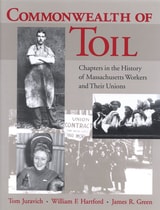
Commonwealth of Toil
Chapters in the History of Massachusetts Workers and Their UnionsThomas Juravich
University of Massachusetts Press, 1996
Over the past two centuries, Massachusetts workers have fought for many important advances that would later be enjoyed by other Americans. The right to organize, restrictions on work hours and child labor, and workers' compensation were all pioneered in the Commonwealth. From the 1825 strike of Boston carpenters for a ten-hour day to recent victories in hospitals and universities, Massachusetts workers and their unions have been in the forefront of the battle for dignity and justice.
This book tells their story. In eighteen chapters, beginning with the first industrial workers in the nation—the Lowell “mill girls”—the authors describe the struggles of working men and women to improve their lives. In the process, the book provides a valuable perspective on the development of the American labor movement.
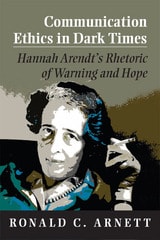
Communication Ethics in Dark Times
Hannah Arendt's Rhetoric of Warning and HopeRonald C. Arnett
Southern Illinois University Press, 2013
Renowned in the disciplines of political theory and philosophy, Hannah Arendt’s searing critiques of modernity continue to resonate in other fields of thought decades after she wrote them. In Communication Ethics in Dark Times: Hannah Arendt’s Rhetoric of Warning and Hope, author Ronald C. Arnett offers a groundbreaking examination of fifteen of Arendt’s major scholarly works, considering the German writer’s contributions to the areas of rhetoric and communication ethics for the first time.
Arnett focuses on Arendt’s use of the phrase “dark times” to describe the mistakes of modernity, defined by Arendt as the post-Enlightenment social conditions, discourses, and processes ruled by principles of efficiency, progress, and individual autonomy. These principles, Arendt argues, have led humanity down a path of folly, banality, and hubris. Throughout his interpretive evaluation, Arnett illuminates the implications of Arendt’s persistent metaphor of “dark times” and engages the question, How might communication ethics counter the tenets of dark times and their consequences? A compelling study of Hannah Arendt’s most noteworthy works and their connections to the fields of rhetoric and communication ethics, Communication Ethics in Dark Times provides an illuminating introduction for students and scholars of communication ethics and rhetoric, and a tool with which experts may discover new insights, connections, and applications to these fields.
Top Book Award for Philosophy of Communication Ethics by Communication Ethics Division of the National Communication Association, 2013
Communication and Capitalism
A Critical TheoryChristian Fuchs
University of Westminster Press, 2020
‘An authoritative analysis of the role of communication in contemporary capitalism and an important contribution to debates about the forms of domination and potentials for liberation in today’s capitalist society.’ — Professor Michael Hardt, Duke University, co-author of the tetralogy Empire, Commonwealth, Multitude, and Assembly
‘A comprehensive approach to understanding and transcending the deepening crisis of communicative capitalism. It is a major work of synthesis and essential reading for anyone wanting to know what critical analysis is and why we need it now more than ever.’ — Professor Graham Murdock, Emeritus Professor, University of Loughborough and co-editor of The Handbook of Political Economy of Communications
Communication and Capitalism outlines foundations of a critical theory of communication. Going beyond Jürgen Habermas’ theory of communicative action, Christian Fuchs outlines a communicative materialism that is a critical, dialectical, humanist approach to theorising communication in society and in capitalism. The book renews Marxist Humanism as a critical theory perspective on communication and society.
The author theorises communication and society by engaging with the dialectic, materialism, society, work, labour, technology, the means of communication as means of production, capitalism, class, the public sphere, alienation, ideology, nationalism, racism, authoritarianism, fascism, patriarchy, globalisation, the new imperialism, the commons, love, death, metaphysics, religion, critique, social and class struggles, praxis, and socialism.
Fuchs renews the engagement with the questions of what it means to be a human and a humanist today and what dangers humanity faces today.

Communication and Discourse Theory
Collected Works of the Brussels Discourse Theory GroupEdited by Leen Van Brussel, Nico Carpentier, and Benjamin De Cleen
Intellect Books, 2019
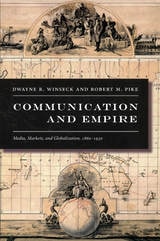
Communication and Empire
Media, Markets, and Globalization, 1860-1930Dwayne R. Winseck and Robert M. Pike
Duke University Press, 2007
Drawing on extensive research in corporate and government archives, Winseck and Pike illuminate the actions of companies and cartels during the late nineteenth century and early twentieth, in many different parts of the globe, including Africa, Asia, and Central and South America as well as Europe and North America. The complex history they relate shows how cable companies exploited or transcended national policies in the creation of the global cable network, how private corporations and government agencies interacted, and how individual reformers fought to eliminate cartels and harmonize the regulation of world communications. In Communication and Empire, the multinational conglomerates, regulations, and the politics of imperialism and anti-imperialism as well as the cries for reform of the late nineteenth century and early twentieth emerge as the obvious forerunners of today’s global media.
Communications in Turkey and the Ottoman Empire
A Critical HistoryBurçe Çelik
University of Illinois Press, 2023
The history of communications in the Ottoman Empire and Turkey contradicts the widespread belief that communications is a byproduct of modern capitalism and other Western forces. Burçe Çelik uses a decolonial perspective to analyze the historical commodification and militarization of communications and how it affected production and practice for oppressed populations like women, the working class, and ethnic and religious minorities. Moving from the mid-nineteenth century through today, Çelik places networks within the changing geopolitical landscape and the evolution of modern capitalism in relationship to struggles involving a range of social and political actors. Throughout, she challenges Anglo- and Eurocentric assumptions that see the non-West as an ahistorical imitation of, or aberration from, the development of Western communications.
Ambitious and comprehensive, Communications in Turkey and the Ottoman Empire merges political economy with social history to challenge Western-centered assumptions about the origins and development of modern communications.

Communism Day-to-Day
State Enterprises in East German SocietySandrine Kott
University of Michigan Press, 2014
First published in France in 2001 by Éditions Belin under the title Le communisme au quotidien, Sandrine Kott’s book examines how East German businesses and government carried out communist practices on a daily basis and how citizens and workers experienced the conditions created by the totalitarian state in their daily lives. Kott undertakes a social analysis of the Communist Party’s grasp on state enterprises and the limits of its power. She then analyzes the enterprises themselves and the social, generational, and gender tensions that had a profound impact on the lived experience of socialism. Finally, she considers the development and acceptance of a complex set of rituals and gift exchanges that masked latent conflicts while providing meaning to socialism’s role in ordinary life.
Communism in Mexico
A Study in Political FrustrationBy Karl M. Schmitt
University of Texas Press, 1965
The ease with which Cuba slipped into its relationship with Communism revived in the United States its recurring nightmare in which other Latin American countries, particularly Mexico, become satellites of Russia or Red China. But such an occurrence is most unlikely in Mexico, according to Karl Schmitt, former intelligence research analyst with the United States Department of State.
Communism in Mexico traces efforts during the early twentieth century to create a Soviet-style society in one of the largest and most strategically situated of the Latin American countries. Schmitt writes authoritatively of the Mexican Communist movement, tracing its development from an early and potentially powerful political-economic base to the increasingly fragmented and weakened collection of parties and front groups of the 1960s. He follows the various schisms and factional divisions to the mid-1950s, when the process of disintegration became most noticeable, and explores and analyzes in detail Communist attempts since then to establish unity among the many quarreling and frustrated groups of the now-splintered movement.
Three Communist parties in Mexico, a score of front groups, and numerous infiltration cells in non-Communist organizations such as student and labor groups, all recognize in a broad way a common and ultimate goal: the creation of a Soviet-style society. But their attempts at unity have consistently led only to further bickering and frustration. This period is subjected to a thorough study and analysis in an effort to understand and explain the Communists' lack of success. Schmitt presciently concludes that Communism's future in Mexico will be as cloudy as its past, and that the accelerating economy and improving social conditions there will serve to weaken the movement still further.

Communism, Religion, and Revolt in Banten in the Early Twentieth Century
Mis Sea#86Michael Williams
Ohio University Press, 1990
Twice in this century popular revolts against colonial rule have occured in the Banten district of West Java. These revolts, conducted largely under an Islamic leadership, also proclaimed themselves Communist. Islamic Communism is seemingly a paradox. This is especially the case when one considers that probably no religion has proved more resistant to Communist ideology than Islam.
Michael Williams here details the complicated history of the Bantenese revolts in the twentieth century and probes the ideological riddle of Islamic Communism. Modern history is replete with examples of regions with a long history of organizing themselves politically to resist intrusion on their territory, resources, and people. This book establishes that in Indonesia, the Bantenese were among the most practiced exponents of resistance.
Communism
A TLS CompanionEdited by Ferdinand Mount
University of Chicago Press, 1993
Contributors to this volume include Isaac Deutscher, Eric Hobsbawm, Richard Pipes, Hugh Seton-Watson, Robert Conquest, Geoffrey Hosking, C. M. Woodhouse, Max Hayward, Leszek Kolakowski, Timothy Garton Ash, and many others of equal distinction. The volume is arranged in four sections covering the period leading to the Russian Revolution, the post-Revolution era of Lenin, Trotsky, and Stalin; the Soviet Union from World War II to 1968; and the final period of disillusionment and collapse.
Communist Gourmet
The Curious Story of Food in the People’s Republic of BulgariaAlbena Shkodrova
Central European University Press, 2021
Communist Gourmet presents a lively, detailed account of how the communist regime in Bulgaria determined people’s everyday food experience between 1944 and 1989. It examines the daily routines of acquiring food, cooking it, and eating out at restaurants through the memories of Bulgarians and foreigners, during communism.
In looking back on a wide array of issues and events, Albena Shkodrova attempts to explain the paradoxes of daily existence. She reports human stories that are touching, sometimes dark, but often full of humor and anecdotes from nearly one hundred people: some of them are Bulgarians who were involved in the communist food industry, whether as consumers or employees, while others are visitors from the United States and Western Europe who report culinary highlights and disappointments. The author made use of the national press, officially published cookbooks, Communist Party documents, and other previously unstudied sources.
An appendix containing recipes of dishes typical of the period and an extensive set of archival photographs are special features of the volume.
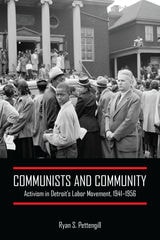
Communists and Community
Activism in Detroit's Labor Movement, 1941-1956Ryan S. Pettengill
Temple University Press, 2020
Communists and Community seeks to reframe the traditional chronology of the Communist Party in the United States as a means to better understand the change that occurred in community activism in the mid-twentieth century. Ryan Pettengill argues that Popular Front activism continued to flourish throughout the war years and into the postwar period. In Detroit, where there was a critical mass of heavy industry, Communist Party activists mobilized support for civil rights and affordable housing, brought attention to police brutality, sought protection for the foreign-born, and led a movement for world peace.
Communists and Community demonstrates that the Communist Party created a social space where activists became effective advocates for the socioeconomic betterment of a multiracial work force. Pettengill uses Detroit as a case study to examine how communist activists and their sympathizers maintained a community to enhance the quality of life for the city’s working class. He investigates the long-term effects of organized labor’s decision to force communists out of the unions and abandon community-based activism. Communists and Community recounts how leftists helped workers, people of color, and other under-represented groups became part of the mainstream citizenry in America.
Communists in Harlem during the Depression
Mark Naison
University of Illinois Press, 2004
Winner of the Ralph Bunche Award, American Political Science Association
No socialist organization has ever had a more profound effect on black life than the Communist Party did in Harlem during the Depression. Mark Naison describes how the party won the early endorsement of such people as Adam Clayton Powell Jr. and how its support of racial equality and integration impressed black intellectuals, including Richard Wright, Langston Hughes, and Paul Robeson.
This meticulously researched work, largely based on primary materials and interviews with leading black Communists from the 1930s, is the first to fully explore this provocative encounter between whites and blacks. It provides a detailed look at an exciting period of reform, as well as an intimate portrait of Harlem in the 1920s and 30s, at the high point of its influence and pride.
Communities In Economic Crisis
edited by John Gaventa, Barbara Ellen Smith and Alex Willingham
Temple University Press, 1990
Hard times are no stranger to the people of Appalachia and the South. Earlier books have documented the low wages of the textile industry, boom-and-bust cycles of coal mining, and debt peonage of Southern agriculture that have established a heritage of poverty that endures. This book is a unique collection of essays by people who are actively involved in the efforts to challenge economic injustice in these regions and to empower the residents to build democratic alternatives.
In the series Labor and Social Change, edited by Paula Rayman and Carmen Sirianni.
Communities and Law
Politics and Cultures of Legal IdentitiesGad Barzilai
University of Michigan Press, 2005
--Choice
"A remarkable achievement."
--Malcolm Feeley, University of California, Berkeley
"A rich, subtle, and wide-ranging analysis of the complex interaction between law and culture in Israeli society."
--Pnina Lahav, Boston University School of Law
"Barzilai makes a major contribution to thinking about state-society relations, pointing researchers to the plurality of communities harboring different sorts of legal identities, consciousness, and practices."
--Joel Migdal, University of Washington
Communities and Law examines the intersection of communities, cultures, and laws in public life, asking important questions about how nonruling communities confront the law in their efforts to achieve political goals.
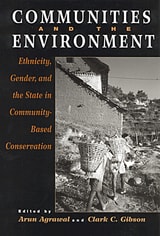
Communities and The Environment
Ethnicity, Gender, and the State in Community-Based ConservationAgrawal, Arun
Rutgers University Press, 2001
For years environmentalists thought natural resources could be best protected by national legislation. But the poor outcomes of this top-down policy have led conservation professionals today to regard local communities as the agents of conservation efforts. According to a recent survey, more than fifty countries report that they pursue partnerships with local communities in an effort to protect their forests. Despite the recent popularity of a community-based approach, the concept of community rarely receives the attention it should get from those concerned with resource management. This balanced volume redresses the situation, demonstrating both the promise and the potential dangers of community action.
Although the contributors advocate community-based conservation, they examine the record with a critical eye. They pay attention to the concrete political contexts in which communities emerge and operate. Understanding the nature of community requires understanding the internal politics of local regions and their relationship to external forces and actors. Especially critical are issues related to ethnicity, gender, and the state.
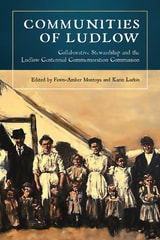
Communities of Ludlow
Collaborative Stewardship and the Ludlow Centennial Commemoration CommissionFawn-Amber Montoya
University Press of Colorado, 2021
The history of the Ludlow Massacre encompasses the stories of immigrant groups, women, the working-class, and people of color as much as the story of that tragedy, and the continued relevance of these issues creates a need for remembrance and discussion of how to make the events of the Ludlow Massacre available to contemporary society. The book outlines recent efforts to remember and commemorate this important historical event, documenting the unique collaborations in public scholarship and outreach among the diverse group of people involved in marking the 100-year anniversary of the Ludlow Massacre. The chapters relate the tales of the stewards of the Ludlow Massacre—the various communities that rallied together to keep this history alive and show its relevance, including lineal descendants, members of the United Mine Workers of America, historians, archaeologists, scholars, artists, interpreters, authors, playwrights, and politicians. The book also offers tips, strategies, and cautionary tales for practicing engaged public scholarship.
The history of the Ludlow Massacre has been told as a tragedy of striking miners in the West that occurred during a turbulent time in US labor relations, but it is so much more than that. Communities of Ludlow explores the intersections of public scholarship, advocacy, and personal experience, weaving these perspectives together with models for practicing public scholarship to illustrate the power of creating spaces for sharing ideas and information in an environment that encourages creativity, open dialogue, public outreach, political action, and alternative narratives.
Contributors: Robert Butero, Robin Henry, Michael Jacobson, Elizabeth Jameson, Linda Linville, Matthew Maher, Yolanda Romero
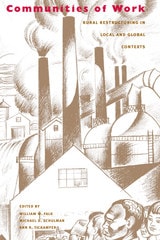
Communities of Work
Rural Restructuring in Local and Global ContextsWilliam W. Falk
Ohio University Press, 2003
The image of rural America portrayed in this illuminating study is one that is vibrant, regionally varied, and sometimes heroic. Communities of Work focuses on the ways in which rural people and places are affected by political, social, and economic forces far outside their control and how they sustain themselves and their communities in response.
Bringing together the two fundamental concepts of community—where the relationships and practices of daily life occur—and work, in which an elementary exchange occurs, Communities of Work bridges several fields of study. Presented here is the contextual and embedded nature of social relations and the complexity involved in understanding them. Through the use of multiple case studies, the authors apply diverse theories and methods in seeking an integrated outcome, one captured by “communities of work.”
Beginning with a description of the broad changes in work and economic activities across the United States, ranging from the Ohio River Valley to a western boomtown, the book shifts its focus to the interplay of work, family, and local networks in time and place. Activities range from fishing in the Mississippi Delta to farming and family life in the Midwest. The authors then highlight how rural people and places respond to extra-local, increasingly global forces in settings as diverse as rural South Carolina and Wisconsin.
A certain communitarian theme runs through Communities of Work. It is about people and communities not merely reacting, but instead responding in ways that reflect their local culture, while being cognizant of the larger world within which they live.

Communities of the Air
Radio Century, Radio CultureSusan Merrill Squier, ed.
Duke University Press, 2003
Drawing on the perspectives of literary and cultural studies, science studies and feminist theory, radio history, and the new field of radio studies, these essays consider the development of radio as technology: how it was modeled on the telephone, early conflicts between for-profit and public uses of radio, and amateur radio (HAMS), local programming, and low-power radio. Some pieces discuss how radio gives voice to different cultural groups, focusing on the BBC and poetry programming in the West Indies, black radio, the history of alternative radio since the 1970s, and science and contemporary arts programming. Others look at radio’s influence on gender (and gender’s influence on radio) through examinations of Queen Elizabeth’s broadcasts, Gracie Allen’s comedy, and programming geared toward women. Together the contributors demonstrate how attention to the variety of ways radio is used and understood reveals the dynamic emergence and transformation of communities within the larger society.
Contributors. Laurence A. Breiner, Bruce B. Campbell, Mary Desjardins, Lauren M. E. Goodlad, Nina Hunteman, Leah Lowe, Adrienne Munich, Kathleen Newman, Martin Spinelli, Susan Merrill Squier, Donald Ulin, Mark Williams, Steve Wurzler
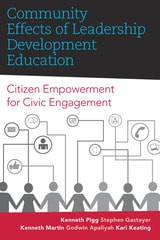
Community Effects of Leadership Development Education
Citizen Empowerment for Civic EngagementKenneth Pigg
West Virginia University Press, 2015
Community leadership development programs are designed to increase the capacity of citizens for civic engagement. These programs fill gaps in what people know about governance and the processes of governance, especially at the local level. The work of many in this field is a response to the recognition that in smaller, rural communities, disadvantaged neighborhoods, or disaster areas, the skills and aptitudes needed for citizens to be successful leaders are often missing or underdeveloped.
Community Effects of Leadership Development Education presents the results of a five-year study tracking community-level effects of community leadership development programs drawn from research conducted in Illinois, Minnesota, Missouri, South Carolina, Ohio, and West Virginia.
As the first book of its kind to seek answers to the question of whether or not the millions of dollars invested each year in community leadership development programs are valuable in the real world, this book challenges researchers, community organizers, and citizens to identify improved ways of demonstrating the link from program to implementation, as well as the way in which programs are conceived and designed.
This text also explores how leadership development programs relate to civic engagement, power and empowerment, and community change, and it demonstrates that community leadership development programs really do produce community change. At the same time, the findings of this study strongly support a relational view of community leadership, as opposed to other traditional leadership models used for program design.
To complement their findings, the authors have developed CENCE, a new model for community leadership development programs, which links leadership development efforts to community development by understanding how Civic Engagement, Networks, Commitment, and Empowerment work together to produce community viability.

Community Health Centers
A Movement and the People Who Made It HappenLefkowitz, Bonnie
Rutgers University Press, 2007
This book tells the story of one groundbreaking approach to medicine that attacks the problem by focusing on the wellness of whole neighborhoods. Since their creation during the 1960s, community health centers have served the needs of the poor in the tenements of New York, the colonias of Texas, the working class neighborhoods of Boston, and the dirt farms of the South. As products of the civil rights movement, the early centers provided not only primary and preventive care, but also social and environmental services, economic development, and empowerment.
Bonnie Lefkowitz-herself a veteran of community health administration-explores the program's unlikely transformation from a small and beleaguered demonstration effort to a network of close to a thousand modern health care organizations serving nearly 15 million people. In a series of personal accounts and interviews with national leaders and dozens of health care workers, patients, and activists in five communities across the United States, she shows how health centers have endured despite cynicism and inertia, the vagaries of politics, and ongoing discrimination.
Community Organizing and Community Building for Health and Social Equity, 4th edition
Meredith Minkler and Patricia Wakimoto
Rutgers University Press, 2022
Many of the book’s contributors are leaders in their academic fields, from public health and social work, to community psychology and urban and regional planning, and to social and political science. One author was the 44th president of the United States, himself a former community organizer in Chicago, who reflects on his earlier vocation and its importance. Other contributors are inspiring community leaders whose work on-the-ground and in partnership with us “outsiders” highlights both the power of collaboration, and the cultural humility and other skills required to do it well.
Throughout this book, and particularly in the case studies and examples shared, the role of context is critical, and never far from view. Included here most recently are the horrific and continuing toll of the COVID-19 pandemic, and a long overdue, yet still greatly circumscribed, “national reckoning with systemic racism,” in the aftermath of the brutal police killing of yet another unarmed Black person, and then another and another, seemingly without end. In many chapters, the authors highlight different facets of the Black Lives Matter movement that took on new life across the country and the world in response to these atrocities. In other chapters, the existential threat of climate change and grave threats to democracy also are underscored.
View the Table of Contents and introductory text for the supplementary instructor resources. (https://d3tto5i5w9ogdd.cloudfront.net/wp-content/uploads/2022/02/04143046/9781978832176_optimized_sampler.pdf)
Supplementary instructor resources are available on request: https://www.rutgersuniversitypress.org/communityorganizing
Community Organizing and Community Building for Health and Welfare
Edited by Meredith Minkler
Rutgers University Press, 2012
The third edition of Community Organizing and Community Building for Health and Welfare provides new and more established ways to approach community building and organizing, from collaborating with communities on assessment and issue selection to using the power of coalition building, media advocacy, and social media to enhance the effectiveness of such work.
With a strong emphasis on cultural relevance and humility, this collection offers a wealth of case studies in areas ranging from childhood obesity to immigrant worker rights to health care reform. A "tool kit" of appendixes includes guidelines for assessing coalition effectiveness, exercises for critical reflection on our own power and privilege, and training tools such as "policy bingo." From former organizer and now President Barack Obama to academics and professionals in the fields of public health, social work, urban planning, and community psychology, the book offers a comprehensive vision and on-the-ground examples of the many ways community building and organizing can help us address some of the most intractable health and social problems of our times.
Community Without Unity
A Politics of Derridian ExtravaganceWilliam Corlett
Duke University Press, 1989
Now available in paperback with a new preface by the author, this award-winning book breaks new ground by challenging traditional concepts of community in political theory. William Corlett brings the diverse (and sometimes contradictory) work of Foucault and Derrida to bear on the thought of Pocock, Burke, Lincoln, and McIntyre, among others, to move beyond the conventional dichotomy of "individual vs. community," arguing instead that community is best advanced within a politics of difference.
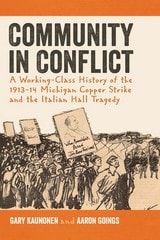
Community in Conflict
A Working-class History of the 1913-14 Michigan Copper Strike and the Italian Hall TragedyGary Kaunonen
Michigan State University Press, 2013
A mirror of great changes that were occurring on the national labor rights scene, the 1913–14 Michigan Copper Strike was a time of unprecedented social upheaval in Michigan’s Upper Peninsula. With organized labor taking an aggressive stance against the excesses of unfettered capitalism, the stage was set for a major struggle between labor and management. The Michigan Copper Strike received national attention and garnered the support of luminaries in organized labor like Mother Jones, John Mitchell, Clarence Darrow, and Charles Moyer. The hope of victory was overshadowed, however, by violent incidents like the shooting of striking workers and their family members, and the bitterness of a community divided. No other event came to symbolize or memorialize the strike more than the Italian Hall tragedy, in which dozens of workers and working-class children died. In Community in Conflict, the efforts of working people to gain a voice on the job and in their community through their unions, and the efforts of employers to crush those unions, take center stage. Previously untapped historical sources such as labor spy reports, union newspapers, coded messages, and artifacts shine new light on this epic, and ultimately tragic, period in American labor history.
Community without Consent
New Perspectives on the Stamp ActEdited by Zachary McLeod Hutchins
Dartmouth College Press, 2016

Community, Cosmopolitanism and the Problem of Human Commonality
Vered Amit and Nigel Rapport
Pluto Press, 2012
In this follow up to their widely read earlier volume, The Trouble with Community, Vered Amit and Nigel Rapport ask: 'Do notions of community remain central to our sense of who we are, in the dislocating context of globalization, or can we see beyond community closures to a human whole?'
This volume explores the variable nature of contemporary sociality. It focuses on the ethical, organizational and emotional claims and opportunities sought or fashioned for mobilizing and evading social collectivities in a world of mobile subjects. Here is an examination of the tensions and interactions between everyday forms of fluid fellowship, culturally normative claims to identity, and opportunities for realizing a universal humanity.
The book offers a new perspective on human commonality through a dialogue between two eminent anthropologists who come from distinct, but complementary positions.
Community-Centered Journalism
Engaging People, Exploring Solutions, and Building TrustAndrea Wenzel
University of Illinois Press, 2020
Andrea Wenzel models new practices of community-centered journalism that build trust across boundaries of politics, race, and class, and prioritize solutions while engaging the full range of local stakeholders. Informed by case studies from rural, suburban, and urban settings, Wenzel's blueprint reshapes journalism norms and creates vigorous storytelling networks between all parts of a community. Envisioning a portable, rather than scalable, process, Wenzel proposes a community-centered journalism that, once implemented, will strengthen lines of local communication, reinvigorate civic participation, and forge a trusting partnership between media and the people they cover.

Company Towns
Industry Power and the Historical Foundations of Public MistrustElizabeth Mitchell Elder
University of Chicago Press, 2026
Reveals the deep, historical roots of public distrust in former mining areas in the US, shedding new light on the corrosive feedback loops that persist today.
In Company Towns, Elizabeth Mitchell Elder examines the long-lasting political legacies of mining-company dominance in the Midwest and Appalachia. While the economic consequences of deindustrialization are well-known, Elder shifts the focus to a more insidious problem: the political dysfunction that took root long before the mines shut down.
Drawing on historical and administrative data, Elder shows that the coal industry hindered the growth of local government capacity in the places where it was dominant. Mining companies also engaged in outright corruption to shape local governments, practices which local elites then carried forward. When mining companies withdrew, they left behind not just economic decline, but local governments ill-equipped to govern.
These patterns have had enduring consequences for public life. Elder shows how these historical experiences have fueled a broader cynicism toward government, in which citizens expect little from public institutions and doubt the usefulness of elections. Company Towns underscores the consequences of corporate dominance for state capacity, public opinion, and democratic accountability today.

Comparative Law and Economics
Ugo Mattei
University of Michigan Press, 1998
Mattei shows how concepts from economics can be applied to the study of comparative law. He then applies the concepts to several significant problems in comparative law, including the history and sources of law, differences between civil and common law systems, and the reasons for legal change and the movement of law from one country to another. He looks at specific problems in property, contracts, and trust law. Finally he uses the insights he has developed to understand the issues involved in changing law in developing countries and in formerly socialist countries.
This book will be of interest to scholars of law, economics, and development, as well as those interested in transformation in formerly communist states.
Ugo Mattei is Alfred and Hanna Fromm Professor of International and Comparative Law, Hastings College of Law, University of California; and Professor of Civil Law, University of Trento.
Comparative Media Policy, Regulation and Governance in Europe
Unpacking the Policy CycleEdited by Leen d’Haenens, Helena Sousa, and Josef Trappel
Intellect Books, 2018

Comparative Media Systems
European and Global PerspectivesMiklós Sükösd
Central European University Press, 2010
Comparing Muslim Societies
Knowledge and the State in a World CivilizationJuan R. I. Cole, Editor
University of Michigan Press, 1992
Comparing Public Bureaucracies
Problems of Theory and MethodB. Guy Peters
University of Alabama Press, 1988
A foundational guide to understanding how bureaucracies differ—and why those differences matter.
The comparative study of public policy once promised to make major contributions to our understanding of government. Much of that promise now appears unfulfilled. What accounts for this decline in intellectual fortunes and change in intellectual fashion? Comparing Public Bureaucracies seeks to understand why. One of the principal answers is that there is no readily accepted and dependent variable that would allow comparative public administration to conform to the usual canons of social research. In contrast, comparative public policy has a ready-made dependent variable in public expenditure.
Peters discusses four possible dependent variables for comparative public administration. The first is personnel—the number and type of people who work for government. Second, the number and type of organizations that form government can suggest a great deal about the structure of government. Third, the behavior of members is obviously important for understanding what actually happens in government—such as the extents to which bureaucracies approximate the budget-maximizing behavior posited by economists. Ginally, the relative power of civil servants in the policymaking process is a major factor in institutional politics in contemporary industrial societies.
Compassion and Responsibility
Readings in the History of Social Welfare Policy in the United StatesFrank R. Breul and Steven J. Diner
University of Chicago Press, 1985
Competing Norms
State Regulations and Local Praxis in sub-Saharan AfricaEdited by Mamadou Diawara and Ute Röschenthaler
Campus Verlag, 2016