Results by title
8812 books match the query 'Political Science' and 698 start with c
Competing Principals
Committees, Parties, and the Organization of CongressForrest Maltzman
University of Michigan Press, 1997
Since Woodrow Wilson, political scientists have recognized the importance of congressional committees in the policy-making process. Congressional committees often determine what legislation will reach the floor of the House or Senate and what form that legislation will take. In spite of the broad consensus on the importance of congressional committees, there is little agreement on what explains committee action. Committees are alternately viewed as agents of the chamber, the party caucuses, or constituencies outside the institution. Each theory suggests a different distribution of power in the policy-making process. Forrest Maltzman argues that none of these models fully captures the role performed by congressional committees and that committee members attempt to balance the interests of the chamber, the party caucus, and outside constituencies. Over time, and with the changing importance of a committee's agenda to these groups, the responsiveness of members of committees will vary. Maltzman argues that the responsiveness of the committee to these groups is driven by changes in procedure, the strength of the party caucus, and the salience of a committee's agenda. Maltzman tests his theory against historical data. This book will appeal to social scientists interested in the study of Congress and legislative bodies, as well as those interested in studying the impact of institutional structure on the policy-making process. "This specialized study, of value to congressional scholars and partisan activists, enriches an understanding of the increasingly predictable patterns of committee variety." --Choice.
Competition and Cooperation
Conversations with Nobelists about Economics and Political ScienceJames Alt
Russell Sage Foundation, 1999

Competitive Elections in Developing Countires
Myron Weiner and Ergun Özbudun
Duke University Press, 1987
Competitiveness Matters
Industry and Economic Performance in the U.S.Candace Howes and Ajit Singh, Editors
University of Michigan Press, 2000
Competitiveness and Death
Trade and Politics in Cars, Beef, and DrugsGary Winslett
University of Michigan Press, 2021
Gary Winslett builds on new trade theories to explain when and why businesses are most likely to lobby governments to reduce these regulatory trade barriers. He argues that businesses prevail when they can connect with broader concerns about national economic competitiveness. He examines how activist organizations overcome collective action problems and defend regulatory differences, arguing that they succeed when they can link their desire for barriers with preventing needless death. Competitiveness and Death provides a political companion to new trade theories in economics, questioning cleavage-based explanations of trade politics, demonstrating the underappreciated importance of activists, suggesting the limits of globalization, providing in-depth examination of previously ignored trade negotiations, qualifying the California Effect (the shift toward stricter regulatory standards), and showing the relative rarity of regulations used as disguised protectionism.
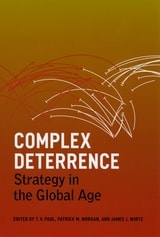
Complex Deterrence
Strategy in the Global AgeEdited by T. V. Paul, Patrick M. Morgan, and James J. Wirtz
University of Chicago Press, 2009
As the costs of a preemptive foreign policy in Iraq have become clear, strategies such as containment and deterrence have been gaining currency among policy makers. This comprehensive book offers an agenda for the contemporary practice of deterrence—especially as it applies to nuclear weapons—in an increasingly heterogeneous global and political setting.
Moving beyond the precepts of traditional deterrence theory, this groundbreaking volume offers insights for the use of deterrence in the modern world, where policy makers may encounter irrational actors, failed states, religious zeal, ambiguous power relationships, and other situations where the traditional rules of statecraft do not apply. A distinguished group of contributors here examines issues such as deterrence among the Great Powers; the problems of regional and nonstate actors; and actors armed with chemical, biological, and nuclear weapons. Complex Deterrence will be a valuable resource for anyone facing the considerable challenge of fostering security and peace in the twenty-first century.
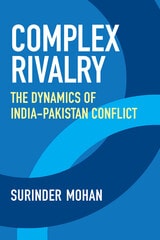
Complex Rivalry
The Dynamics of India-Pakistan ConflictSurinder Mohan
University of Michigan Press, 2022
While a substantial body of research explains how the conflict between India and Pakistan originated and developed over time, a systematic and multivariate inquiry cutting across different IR paradigms to understand this rivalry is rare or limited. Surinder Mohan contributes to the understanding of India and Pakistan’s rivalry by presenting a new type of framework, also known as complex rivalry model. This comprehensive model, by not limiting its theoretical tool-kit to any single paradigm, is unique in its approach and better positioned to debate and answer baffling questions that the single-paradigm-based studies address rather inadequately and in isolation.
This book, through an examination of fifty-seven militarized disputes between 1947 and 2021, explains the life cycle of India-Pakistan rivalry in four phases: initiation; development; maintenance; and a possible transformation/termination. Mohan delineates five specific conditions that evolved the subcontinental conflict into a complex rivalry: first, its survival in spite of the Bangladesh War and the end of the Cold War; second, its linkage with other rivalries; third, the inclusion of nuclear factor; fourth, the dyadic stability in the militarized disputes and hostility level despite changes in the regime type; and fifth, the dyad’s involvement in a multilayered conflict pattern. To break this deadlock and mitigate their longstanding differences, Mohan proposes that India and Pakistan must reframe their national priorities and political goals so that the new situation or combinations of conditions would assist their peace strategists to downgrade the dyadic hostility and implement risky policies to make headway to a promising transformation.
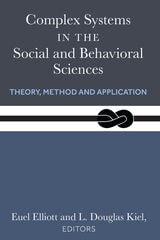
Complex Systems in the Social and Behavioral Sciences
Theory, Method and ApplicationEuel Elliott and L. Douglas Kiel, eds.
University of Michigan Press, 2021
Complexity Systems in the Social and Behavioral Sciences provides a sophisticated yet accessible account of complexity science or complex systems research. Phenomena in the behavioral, social, and hard sciences all exhibit certain important similarities consistent with complex systems. These include the concept of emergence, sensitivity to initial conditions, and interactions between agents in a system that yield unanticipated, nonlinear outcomes. The topics discussed range from the implications for artificial intelligence and computing to questions about how to model complex systems through agent-based modeling, to complex phenomena exhibited in international relations, and in organizational behavior. This volume will be an invaluable addition for both the general reader and the specialist, offering new insights into this fascinating area of research.

Complicated Lives
Girls, Parents, Drugs, and Juvenile JusticeLopez, Vera
Rutgers University Press, 2017
Complicated Lives focuses on the lives of sixty-five drug-using girls in the juvenile justice system (living in group homes, a residential treatment center, and a youth correctional facility) who grew up in families characterized by parental drug use, violence, and child maltreatment. Vera Lopez situates girls’ relationships with parents who fail to live up to idealized parenting norms and examines how these relationships change over time, and ultimately contribute to the girls’ future drug use and involvement in the justice system.
While Lopez’s subjects express concerns and doubt in their chances for success, Lopez provides an optimistic prescription for reform and improvement of the lives of these young women and presents a number of suggestions ranging from enhanced cultural competency training for all juvenile justice professionals to developing stronger collaborations between youth and adult serving systems and agencies.
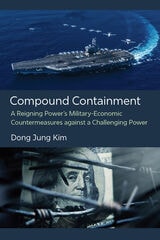
Compound Containment
A Reigning Power's Military-Economic Countermeasures against a Challenging PowerDong Jung Kim
University of Michigan Press, 2022
When does a reigning great power of the international system supplement military containment of a challenging power by restricting its economic exchanges with that state? Scholars of great power politics have traditionally focused on examining a reigning power’s military containment of a challenging power. In direct contrast, Compound Containment demonstrates that these conventional studies are flawed without a sound understanding of the multilayered aspects of containment strategy in great power politics. Since economic capacity and military power are intimately linked to one another, countering a challenging power requires addressing both economic and military dimensions. Nonetheless, this nexus of security and economy in a reigning power’s response to a challenging power cannot be explained by traditional theories that dominate research in international security. Author Dong Jung Kim fills a gap in the scholarship on great power competition by investigating when a reigning power will make its military containment of a challenging power “compound” by simultaneously employing restrictive economic measures. Its main theoretical claims are corroborated by an analysis of key historical cases of reigning power-challenging power competition. This book also offers policy prescriptions for the United States by examining whether the United States is in a position to complement military containment of China with restrictive economic measures.
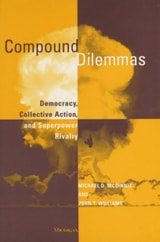
Compound Dilemmas
Democracy, Collective Action, and Superpower RivalryMichael Dean McGinnis and John T. Williams
University of Michigan Press, 2001
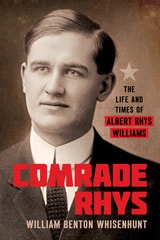
Comrade Rhys
The Life and Times of Albert Rhys WilliamsWilliam Benton Whisenhunt
University of Illinois Press, 2026
William Benton Whisenhunt draws on the largely untapped archive of Williams’s papers to provide a first-ever biography of the dedicated radical writer. Williams spent nearly ten years living and traveling in the USSR, where he observed the Soviet system and reported on it with unusual nuance in numerous books, articles, and speeches. Whisenhunt follows Williams from his early life as a lumberyard worker and preacher through his participation in the Revolution and his long career as a radical writer. Able to see socialism as flawed, Williams’s nonetheless defended it as an alternative to capitalism with such vigor that correspondents often addressed him as Comrade Rhys.
Astute and richly detailed, Comrade Rhys reveals the life and work of an overlooked radical thinker.

Comrade or Brother?
A History of the British Labour MovementMary Davis
Pluto Press, 2009
Critical and iconoclastic, Comrade or Brother? traces the history of the British Labour Movement from its beginnings at the onset of industrialisation through its development within a capitalist society, up to the end of the twentieth-century. Written by a leading activist in the labour movement, the book redresses the balance in much labour history writing. It examines the place of women and the influence of racism and sexism as well as providing a critical analysis of the rival ideologies which played a role in the uneven development of the labour movement.
Concept and Controversy
Sixty Years of Taking Ideas to MarketBy W. W. Rostow
University of Texas Press, 2003
A trusted advisor to Presidents Eisenhower, Kennedy, and Johnson and one of America's leading professors of economic history, W. W. Rostow has helped shape the intellectual debate and governmental policies on major economic, political, and military issues since World War II. In this thought-provoking memoir, he takes a retrospective look at eleven key policy problems with which he has been involved to show how ideas flow into concrete action and how actions taken or not taken in the short term actually determine the long run that we call "the future."
The issues that Rostow discusses are these:
- The use of air power in Europe in the 1940s
- Working toward a united Europe during the Cold War
- The death of Joseph Stalin and early attempts to end the Cold War
- Eisenhower's Open Skies policy
- The debate over foreign aid in the 1950s
- The economic revival of Korea
- Efforts to control inflation in the 1960s
- Waiting for democracy in China
- The Vietnam War and Southeast Asian policy
- U.S. urban problems in disadvantaged neighborhoods
- The challenges posed by declining population in the twenty-first century
In discussing how he and others have worked to meet these challenges, Rostow builds a compelling case for including long-term forces in the making of current policy. He concludes his memoir with provocative reflections on the twentieth and twenty-first centuries and on how individual actors shape history.
Concepts at Work
On the Linguistic Infrastructure of World PoliticsPiki Ish-Shalom, Editor
University of Michigan Press, 2021
Concepts are socially and linguistically constructed and used for multiple purposes, such as justifying war in the name of democracy; or, using the idea of democracy to resist Western intervention and influence. In this fascinating and novel edited collection, Piki Ish-Shalom and the contributors interrogate the “conceptions of concepts” in international relations. Using theoretical frameworks from Gramsci and Bourdieu, among others, the authors show that not interrogating the meaning of the language we use to talk about international relations obscures the way we understand (or portray) IR. The authors examine self-determination, winning in war, avoidance of war, military design and reform agenda, vagueness in political discourse, “blue economy,” friendship, and finally, the very idea of the “international community” itself. As the author asserts, Bourdieu’s sociology of field and Gramsci’s political theory, combined, “offer us a socio-political theory of relations of power and domination concealed by doxic knowledge and taken-for-granted rules, in which essential contested concepts and political-serving conceptions can and do play an important role.”
Concepts of International Relations, for Students and Other Smarties
Iver B. Neumann
University of Michigan Press, 2019
In a relaxed style, Neumann introduces the long-term historical emergence of concepts such as state (European), state (global), empire, nonstate agents, foreign policy, state system, nationalism, globalization, security, international society, great powers, diplomacy, war and peace, balance of power, international law, power and sovereignty, intervention, gender, and class. He demonstrates how such phenomena have been understood in different ways over time. First, the reader learns how the use of concepts is an integral part of politics. Second, the reader sees how social change has worked in the past, and is working now. Third, the book demonstrates how historical and social context matters in ongoing international relations.
Conceptualizing Capitalism
Institutions, Evolution, FutureGeoffrey M. Hodgson
University of Chicago Press, 2015
With Conceptualizing Capitalism, Geoffrey M. Hodgson offers readers a more precise conceptual framework. Drawing on a new theoretical approach called legal institutionalism, Hodgson establishes that the most important factor in the emergence of capitalism—but also among the most often overlooked—is the constitutive role of law and the state. While private property and markets are central to capitalism, they depend upon the development of an effective legal framework. Applying this legally grounded approach to the emergence of capitalism in eighteenth-century Europe, Hodgson identifies the key institutional developments that coincided with its rise. That analysis enables him to counter the widespread view that capitalism is a natural and inevitable outcome of human societies, showing instead that it is a relatively recent phenomenon, contingent upon a special form of state that protects private property and enforces contracts. After establishing the nature of capitalism, the book considers what this more precise conceptual framework can tell us about the possible future of capitalism in the twenty-first century, where some of the most important concerns are the effects of globalization, the continuing growth of inequality, and the challenges to America’s hegemony by China and others.
Concordance
Black Lawmaking in the U.S. Congress from Carter to ObamaKatherine Tate
University of Michigan Press, 2014
During the height of the civil rights movement, Blacks were among the most liberal Americans. Since the 1970s, however, increasing representation in national, state, and local government has brought about a more centrist outlook among Black political leaders.
Focusing on the Congressional Black Caucus (CBC), Katherine Tate studies the ways in which the nation’s most prominent group of Black legislators has developed politically. Organized in 1971, the CBC set out to increase the influence of Black legislators. Indeed, over the past four decades, they have made progress toward the goal of becoming recognized players within Congress. And yet, Tate argues, their incorporation is transforming their policy preferences. Since the Clinton Administration, CBC members—the majority of whom are Democrats—have been less willing to oppose openly congressional party leaders and both Republican and Democratic presidents. Tate documents this transformation with a statistical analysis of Black roll-call votes, using the important Poole-Rosenthal scores from 1977 to 2010. While growing partisanship has affected Congress as a whole, not just minority caucuses, Tate warns that incorporation may mute the independent voice of Black political leaders.
Concordance
Black Lawmaking in the U.S. Congress from Carter to ObamaKatherine Tate
University of Michigan Press, 2020
Focusing on the Congressional Black Caucus (CBC), Katherine Tate studies the ways in which the nation’s most prominent group of Black legislators has developed politically. Organized in 1971, the CBC set out to increase the influence of Black legislators. Indeed, over the past four decades, they have made progress toward the goal of becoming recognized players within Congress. And yet, Tate argues, their incorporation is transforming their policy preferences. Since the Clinton Administration, CBC members—the majority of whom are Democrats—have been less willing to oppose openly congressional party leaders and both Republican and Democratic presidents. Tate documents this transformation with a statistical analysis of Black roll-call votes, using the important Poole-Rosenthal scores from 1977 to 2010. While growing partisanship has affected Congress as a whole, not just minority caucuses, Tate warns that incorporation may mute the independent voice of Black political leaders.
Concrete Colonialism
Architecture, Urbanism, and the US Imperial Project in the PhilippinesDiana Jean S. Martinez
Duke University Press, 2025
Concrete Leviathan
The Interstate Highway System and State Building in Modern AmericaTeal Arcadi
University of Chicago Press, 2026
Offers an insightful new way to understand the construction and consequences of the US interstate highway system, expanding and revising the common story.
In Concrete Leviathan, historian Teal Arcadi denaturalizes the interstate highway system, interrogating the ideologies, fiscal mechanisms, and legal tools that led to the construction of a vast and permanent physical infrastructure—and then made it all but impossible to change course. Arcadi argues that the US interstate highway system was built by an unaccountable regime of law and political economy that systematically created and insulated structures of governance. The power of these administrative and physical structures has been such that even when people have mobilized to oppose or try to change them, their protests have tended only to reveal the extent and power of the infrastructural state.
At the same time, Concrete Leviathan shows how resistance to this infrastructure’s inequities generated new democratic ideas and practices, pointing toward more participatory structures of government and more equitable models of state building.

Condensing The Cold War
Reader’s Digest and American IdentityJoanne P. Sharp
University of Minnesota Press, 2000
Confederate Arkansas
The People and Policies of a Frontier State in WartimeMichael B. Dougan
University of Alabama Press, 1990
Confessions of a Presidential Speechwriter
Craig R. Smith
Michigan State University Press, 2014
Confidence Regained
Economics, Mrs. Thatcher, and the British VoterHelmut Norpoth
University of Michigan Press, 1992
Confident Pluralism
Surviving and Thriving through Deep DifferenceJohn D. Inazu
University of Chicago Press, 2016
In Confident Pluralism, John D. Inazu analyzes the current state of the country, orients the contemporary United States within its broader history, and explores the ways that Americans can—and must—strive to live together peaceably despite our deeply engrained differences. Pluralism is one of the founding creeds of the United States—yet America’s society and legal system continues to face deep, unsolved structural problems in dealing with differing cultural anxieties and differing viewpoints. Inazu not only argues that it is possible to cohabitate peacefully in this country, but also lays out realistic guidelines for our society and legal system to achieve the new American dream through civic practices that value toleration over protest, humility over defensiveness, and persuasion over coercion.
The paperback edition includes a new preface that addresses the election of Donald Trump, the decline in civic discourse after the election, the Nazi march in Charlottesville, and more, this new edition of Confident Pluralism is an essential clarion call during one of the most troubled times in US history. Inazu argues for institutions that can work to bring people together as well as political institutions that will defend the unprotected. Confident Pluralism offers a refreshing argument for how the legal system can protect peoples’ personal beliefs and differences and provides a path forward to a healthier future of tolerance, humility, and patience.
Confident Pluralism
Surviving and Thriving through Deep DifferenceJohn D. Inazu
University of Chicago Press, 2018
In Confident Pluralism, John D. Inazu analyzes the current state of the country, orients the contemporary United States within its broader history, and explores the ways that Americans can—and must—strive to live together peaceably despite our deeply engrained differences. Pluralism is one of the founding creeds of the United States—yet America’s society and legal system continues to face deep, unsolved structural problems in dealing with differing cultural anxieties and differing viewpoints. Inazu not only argues that it is possible to cohabitate peacefully in this country, but also lays out realistic guidelines for our society and legal system to achieve the new American dream through civic practices that value toleration over protest, humility over defensiveness, and persuasion over coercion.
With a new preface that addresses the election of Donald Trump, the decline in civic discourse after the election, the Nazi march in Charlottesville, and more, this new edition of Confident Pluralism is an essential clarion call during one of the most troubled times in US history. Inazu argues for institutions that can work to bring people together as well as political institutions that will defend the unprotected. Confident Pluralism offers a refreshing argument for how the legal system can protect peoples’ personal beliefs and differences and provides a path forward to a healthier future of tolerance, humility, and patience.
Confident Pluralism
Surviving and Thriving through Deep DifferenceJohn D. Inazu
University of Chicago Press, 2018
In the years since Donald Trump first announced his plans to run for president, the United States seems to become more dramatically polarized and divided with each passing month. There are seemingly irresolvable differences in the beliefs, values, and identities of citizens across the country that too often play out in our legal system in clashes on a range of topics such as the tensions between law enforcement and minority communities. How can we possibly argue for civic aspirations like tolerance, humility, and patience in our current moment?
In Confident Pluralism, John D. Inazu analyzes the current state of the country, orients the contemporary United States within its broader history, and explores the ways that Americans can—and must—strive to live together peaceably despite our deeply engrained differences. Pluralism is one of the founding creeds of the United States—yet America’s society and legal system continues to face deep, unsolved structural problems in dealing with differing cultural anxieties and differing viewpoints. Inazu not only argues that it is possible to cohabitate peacefully in this country, but also lays out realistic guidelines for our society and legal system to achieve the new American dream through civic practices that value toleration over protest, humility over defensiveness, and persuasion over coercion.
With a new preface that addresses the election of Donald Trump, the decline in civic discourse after the election, the Nazi march in Charlottesville, and more, this new edition of Confident Pluralism is an essential clarion call during one of the most troubled times in US history. Inazu argues for institutions that can work to bring people together as well as political institutions that will defend the unprotected. Confident Pluralism offers a refreshing argument for how the legal system can protect peoples’ personal beliefs and differences and provides a path forward to a healthier future of tolerance, humility, and patience.
Conflict Resolution in the Twenty-first Century
Principles, Methods, and ApproachesJacob Bercovitch and Richard Jackson
University of Michigan Press, 2009
Conflict Resolution in the Twenty-first Centuryis not only an essential introduction for students and scholars, it is a must-have guide for the men and women entrusted with creating stability and security in our changing world.
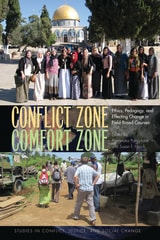
Conflict Zone, Comfort Zone
Ethics, Pedagogy, and Effecting Change in Field-Based CoursesAgnieszka Paczynska
Ohio University Press, 2019
By taking students out of their comfort zone, field-based courses—which are increasingly popular in secondary and postsecondary education—have the potential to be deep, transformative learning experiences. But what happens when the field in question is a site of active or recent conflict? In Conflict Zone, Comfort Zone, editors Agnieszka Paczyńska and Susan F. Hirsch highlight new approaches to field-based learning in conflict zones worldwide. As the contributors demonstrate, instructors must leave the comfort zone of traditional pedagogy to meet the challenges of field-based education.
Drawing on case studies in the United States and abroad, the contributors address the ethical considerations of learning in conflict zones, evaluate the effectiveness of various approaches to teaching these courses, and provide guidelines for effecting change. They also explore how the challenges of field-based classes are magnified in conflict and postconflict settings, and outline the dilemmas faced by those seeking to resolve those challenges. Finally, filling a crucial gap in existing literature, the contributors identify best practices that will assist aspiring instructors in developing successful field-based courses in conflict zones.
Contributors: Daniel R. Brunstetter, Alison Castel, Gina M. Cerasani, Alexander Cromwell, Maryam Z. Deloffre, Sandi DiMola, Leslie Dwyer, Eric Hartman, Pushpa Iyer, Allyson M. Lowe, Patricia A. Maulden, rj nickels, Anthony C. Ogden, Jennifer M. Ramos, Lisa E. Shaw, Daniel Wehrenfennig
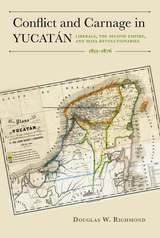
Conflict and Carnage in Yucatán
Liberals, the Second Empire, and Maya Revolutionaries, 1855–1876Douglas W. Richmond
University of Alabama Press, 2015
Synthesizing an extensive and heterogeneous range of sources, Douglas W. Richmond covers three tumultuous political upheavals of this period. First, Mexico’s fledgling republic attempted to impose a liberal ideology at odds with traditional Maya culture on Yucatán; then, the French-backed regime of Emperor Maximilian began to reform Yucatán; and, finally, the republican forces of Benito Juárez restored the liberal hegemony. Many issues spurred resistance to these liberal governments. Instillation of free trade policies, the suppression of civil rights, and persecution of the Roman Catholic Church mobilized white opposition to liberal governors. The Mayas fought the seizure of their communal properties. A long-standing desire for regional autonomy united virtually all Yucatecans. Richmond advances the thought-provoking argument that Yucatán both fared better under Maximilian’s Second Empire than under the liberal republic and would have thrived more had the Second Empire not collapsed.
The most violent and bloody manifestation of these broad conflicts was the Caste War (Guerra de Castas), the longest sustained peasant revolt in Latin American history. Where other scholars have advocated the simplistic position that the war was a Maya uprising designed to reestablish a mythical past civilization, Richmond’s sophisticated recounting of political developments from 1855 to 1876 restores nuance and complexity to this pivotal time in Yucatecan history.
Richmond’s Conflict and Carnage in Yucatán is a welcome addition to scholarship about Mexico and Yucatán as well as about state consolidation, empire, and regionalism.
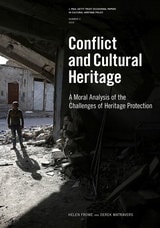
Conflict and Cultural Heritage
A Moral Analysis of the Challenges of Heritage ProtectionHelen Frowe
J. Paul Getty Trust, The, 2019
A number of writers and thinkers working on the problem of preserving the world’s most treasured monuments, sites, and objects today cite what Frowe and Matravers call extrinsic and intrinsic justifications for the protection of cultural heritage. These are arguments that maintain that protecting heritage will be a key means to achieve other important goals, like the prevention of genocide, or arguments that heritage deserves to be forcefully protected for its own sake. Frowe and Matravers deconstruct both types of justifications, demonstrating a lack of clear evidence for a causal relationship between the destruction of cultural heritage and atrocities like genocide and arguing that the defense of heritage must not be treated with the same weight or urgency, or according to the same international policies, as the defense of human lives.
By calling for expanded theory and empirical data and the consideration of morality in the crafting of international policy vis-à-vis cultural heritage protection, Frowe and Matravers present a thoughtful critique that enriches this important series and adds to the ongoing dialogue in the field.
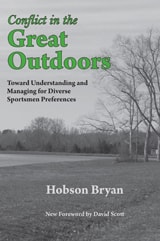
Conflict in the Great Outdoors
Toward Understanding and Managing for Diverse Sportsmen PreferencesHobson Bryan, Jr.
University of Alabama Press, 2008
Managing nature’s playground—where diversity meets design.
A major problem of outdoor recreation management addressed in Hobson Bryan’s Conflict in the Great Outdoors is the difficulty in identifying sportsmen subgroups having distinctive preferences and expectations as to the composition of the “quality” outdoor experience. Land-use managers and planners are faced with the problem of matching resources with more users having increasingly specific motivations. Bryan applies his theory of variations within a leisure activity by addressing what sportsmen do and why they do it in various activities such as mountain climbing, hunting, canoeing, skiing, and backpacking.
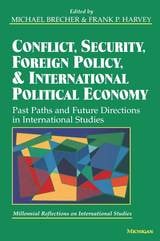
Conflict, Security, Foreign Policy, and International Political Economy
Past Paths and Future Directions in International StudiesMichael Brecher and Frank P. Harvey, editors
University of Michigan Press, 2009
No study of international relations is complete without consideration of foreign policy processes and an understanding of state security, conflict in global politics, and the relationship between the world economy and international behavior. Conflict, Security, Foreign Policy, and International Political Economy: Past Paths and Future Directions in International Studies consists of twelve original essays that point out the strengths and weaknesses of current approaches in these research areas as well as suggest agendas for future research.
See table of contents and excerpts.
Frank P. Harvey is Professor of Political Science and Director of the Centre for Foreign Policy Studies at Dalhousie University.
Michael Brecher is the R.B. Angus Professor of Political Science at McGill University and past president of the International Studies Association.
Millennial Reflections on International StudiesThis volume is part of the Millennial Reflections on International Studies project in which forty-five prominent scholars engage in self-critical, state-of-the-art reflection on international studies to stimulate debates about successes and failures and to address the larger questions of progress in the discipline.
Other paperbacks from this project:
Realism and Institutionalism in International Studies
Evaluating Methodology
Critical Perspectives in International Studies
The full collection of essays is available in the handbook Millennial Reflections on International Studies.
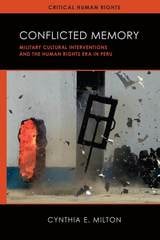
Conflicted Memory
Military Cultural Interventions and the Human Rights Era in PeruCynthia E. Milton
University of Wisconsin Press, 2018
Milton calls attention to fabrications of our post-truth era but goes further to deeply explore the ways members of the Peruvian military see their past, how they actively commemorate and curate it in the present, and why they do so. Her nuanced approach upends frameworks of memory studies that reduce military and ex-military to a predictable role of outright denial.
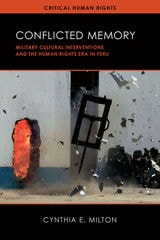
Conflicted Memory
Military Cultural Interventions and the Human Rights Era in PeruCynthia E. Milton
University of Wisconsin Press, 2020
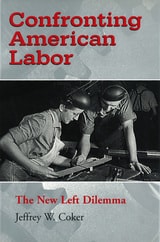
Confronting American Labor
The New Left DilemmaJeffrey W. Coker
University of Missouri Press, 2002
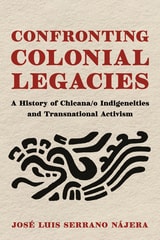
Confronting Colonial Legacies
A History of Chicana/o Indigeneities and Transnational ActivismJosé Luis Serrano Nájera
University of Arizona Press, 2026
This work offers a groundbreaking account of how Chicana/o activists have engaged in sustained efforts to reclaim Indigenous identity through political struggle, cultural expression, and transnational solidarity.
Author José Luis Serrano Nájera takes an in-depth look at the history of Chicana/o indigeneity, starting with the Chicana/o Movement of the 1960s and 1970s and through twenty-first century transnational activism and solidarity movements. Serrano Nájera reveals how claims to indigeneity were rooted in reciprocal relationships with Indigenous communities and driven by a shared commitment to decolonization. Through chapters on visual and performing arts, ceremony, education, and grassroots organizing, this book challenges reductive narratives of cultural appropriation and instead foregrounds the complex and historically grounded nature of Chicana/o indigeneity.
Drawing on extensive archival research, Serrano Nájera demonstrates how Chicana/o indigeneity has contributed to broader Indigenous rights movements, including efforts that culminated in the 2007 United Nations Declaration on the Rights of Indigenous Peoples. This work highlights the intercontinental dimensions of Chicana/o activism and offers a vital source for scholars and students in Chicana/o studies, Indigenous studies, ethnic studies, history, and political science. Confronting Colonial Legacies is a compelling call to rethink the politics of identity, sovereignty, and solidarity across the Americas.
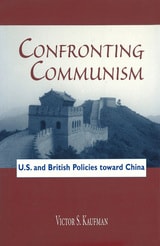
Confronting Communism
U.S. and British Policies toward ChinaVictor S. Kaufman
University of Missouri Press, 2001
In Confronting Communism, Victor S. Kaufman examines how the United States and Great Britain were able to overcome serious disagreements over their respective approaches toward Communist China. Providing new insight into the workings of alliance politics, specifically the politics of the Anglo- American alliance, the book covers the period from 1948—a year before China became an area of contention between London and Washington—through twenty years of division to the gradual resolution of Anglo-American divergences over the People's Republic of China beginning in the mid-1960s. It ends in 1972, the year of President Richard Nixon's historic visit to the People's Republic, and also the year that Kaufman sees as bringing an end to the Anglo-American differences over China.
Kaufman traces the intricate and subtle pressures each ally faced in determining how to approach Beijing. The British aspect is of particular interest because Britain viewed itself as being within "three circles": Western Europe, the Atlantic alliance, and the Commonwealth. Important as well to British policy with respect to China was the concern about being dragged into another Korean-style conflict. The impact of decisions on these "circles," as well as the fear of another war, appeared time and again in Britain's decision making.
Kaufman shows how the alliance avoided division over China largely because Britain did the majority of the compromising. Reliant upon the United States militarily and financially, most U.K. officials made concessions to their Washington counterparts. Readers of Confronting Communism will come away with a better understanding of alliance politics. They will learn that such decision making, for both Great Britain and the United States, was a highly complex process, one that posed serious challenges to the Anglo-American alliance. Despite those challenges, accord between London and Washington prevailed.

Confronting Leviathan
Mozambique Since IndependenceMargaret Hall
Ohio University Press, 1997
Confronting Leviathan describes Mozambique’s attempt to construct a socialist society in one African country on the back of an anti-colonial struggle for national independence. In explaining the failure of this effort the authors suggest reasons why the socialist vision of the ruling party, Frelimo, lacked resonance with Mozambican society. They also document in detail South Africa’s attempts to destabilize the country, even to the extent of sponsoring the Renamo insurgents. The dynamics of that insurgency and its roots in Mozambican society are examined as well as the process of negotiation that brought it to a close. Finally the authors analyze the more recent attempt to construct a liberal capitalist society in Mozambique. From their findings it appears that this may prove no easier than the construction of socialism.
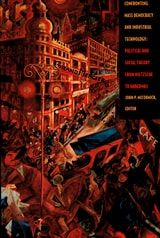
Confronting Mass Democracy and Industrial Technology
Political and Social Theory from Nietzsche to HabermasJohn P. McCormick, ed.
Duke University Press, 2002
Scholars representing the fields of political science, philosophy, history, law, literature, and cultural studies devote essays to the work of Nietzsche, Weber, Heidegger, Lukács, Schmitt, Marcuse, Adorno, and Habermas. They also discuss the writings of such figures as Brecht and Freud, who are not primarily thought of as political theorists, and explore the thought of Helmut Plessner and reformist theorists from East Germany who have been little studied in the English language. In the process of debating the nature and responsibilities of the modern state in an era of mass politics, unparalleled military technology, capacity for surveillance, and global media presence, the contributors question whether technology is best understood as an instrument of human design and collective control or as an autonomous entity that not only has a will and life of its own but one that forms the very fabric of modern humanity.
Contributors. Seyla Benhabib, Richard J. Bernstein, Peter C. Caldwell, Richard Dienst, David Dyzenhaus, Andrew Feenberg, Nancy S. Love, John P. McCormick, Jan-Werner Müller, Gia Pascarelli, William E. Scheuerman, Steven B. Smith, Tracy B. Strong, Richard Wolin
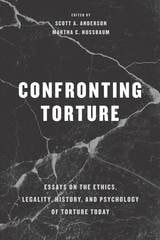
Confronting Torture
Essays on the Ethics, Legality, History, and Psychology of Torture TodayEdited by Scott A. Anderson and Martha C. Nussbaum
University of Chicago Press, 2018
Confronting Torture offers a multidisciplinary investigation of this wrenching topic. Editors Scott A. Anderson and Martha C. Nussbaum bring together a diversity of scholars to grapple with many of torture’s complexities, including: How should we understand the impetus to use torture? Why does torture stand out as a particularly heinous means of war-fighting? Are there any sound justifications for the use of torture? How does torture affect the societies that employ it? And how can we develop ethical or political bulwarks to prevent its use? The essays here resist the temptation to oversimplify torture, drawing together work from scholars in psychology, history, sociology, law, and philosophy, deepening and broadening our grasp of the subject. Now, more than ever, torture is something we must think about; this important book offers a diversity of timely, constructive responses on this resurgent and controversial subject.
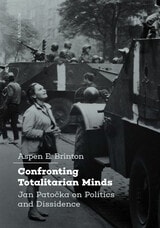
Confronting Totalitarian Minds
Jan Patocka on Politics and DissidenceAspen Brinton
Karolinum Press, 2020
Confronting Totalitarian Minds examines his legacy along with several contemporary applications of his ideas about dissidence, solidarity, and the human being’s existential confrontation with unjust politics. Aspen Briton puts Patočka’s ideas about dissidence, citizen mobilization, and civic responsibility in conversation with those of notable world historical figures like Mohandas Gandhi, expanding the current possibilities of comparative political theory. In adding a fresh voice to contemporary conversations on transcending injustice, Confronting Totalitarian Minds seeks to educate a wider audience about this philosopher’s continued relevance to political dissidents across the world.
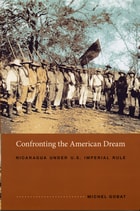
Confronting the American Dream
Nicaragua under U.S. Imperial RuleMichel Gobat
Duke University Press, 2005
Gobat focuses primarily on the reactions of the elites to Americanization, because the power and identity of these Nicaraguans were the most significantly affected by U.S. imperial rule. He describes their adoption of aspects of “the American way of life” in the mid–nineteenth century as strategic rather than wholesale. Chronicling the U.S. occupation of 1912–33, he argues that the anti-American turn of Nicaragua’s most Americanized oligarchs stemmed largely from the efforts of U.S. bankers, marines, and missionaries to spread their own version of the American dream. In part, the oligarchs’ reversal reflected their anguish over the 1920s rise of Protestantism, the “modern woman,” and other “vices of modernity” emanating from the United States. But it also responded to the unintended ways that U.S. modernization efforts enabled peasants to weaken landlord power. Gobat demonstrates that the U.S. occupation so profoundly affected Nicaragua that it helped engender the Sandino Rebellion of 1927–33, the Somoza dictatorship of 1936–79, and the Sandinista Revolution of 1979–90.
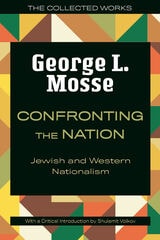
Confronting the Nation
Jewish and Western NationalismGeorge L. Mosse
University of Wisconsin Press, 2024
Mosse considers a broad range of topics, from Nazi book burnings to Americans’ search for unifying national symbols during the Great Depression, exploring how the development of particular modes of art, architecture, and mass movements served nationalist agendas by dictating who was included in the image of the nation. These essays retain their significance today in their examination of the cultural and social implications of contemporary nationalism. A new critical introduction by Shulamit Volkov, professor emerita of history at Tel Aviv University, situates Mosse’s analysis within its historiographical context.
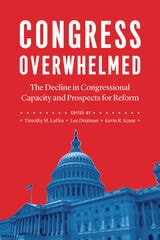
Congress Overwhelmed
The Decline in Congressional Capacity and Prospects for ReformEdited by Timothy M. LaPira, Lee Drutman, and Kevin R. Kosar
University of Chicago Press, 2020
The essays in Congress Overwhelmed assess Congress’s declining capacity and explore ways to upgrade it. Some provide broad historical scope. Others evaluate the current decay and investigate how Congress manages despite the obstacles. Collectively, they undertake the most comprehensive, sophisticated appraisal of congressional capacity to date, and they offer a new analytical frame for thinking about—and improving—our underperforming first branch of government.
Congress Versus the Supreme Court, 1957-1960
C. Herman Pritchett
University of Minnesota Press, 1961
Congress Versus the Supreme Court, 1957–1960 was first published in 1961. Minnesota Archive Editions uses digital technology to make long-unavailable books once again accessible, and are published unaltered from the original University of Minnesota Press editions.
This is an account of the effort made in the last two sessions of Congress to curb the Supreme Court because of certain liberal decisions of the Court, and an analysis of the reasons for the congressional failure. Many times in history Congress has objected to Court decisions and has tried to retaliate against the Court. The most recent period of difficulty traces back to the Court's school segregation decisions in 1954, but not until the Court took a liberal line in certain national security cases in 1956 and 1957 was an organized effort made in Congress to attack it. Professor Pritchett analyzes the specific decisions which aroused congressional concern and reviews the methods by which their reversal was sought. The failure of this effort to curb the Court is important to an understanding of the role of the Supreme Court in the American governmental system. This book is an expansion of the Guy Stanton Ford lectures given by Mr. Pritchett at the University of Minnesota.
Congress and the Constitution
Neal Devins and Keith E. Whittington, eds.
Duke University Press, 2005
Several contributors offer wide-ranging accounts of the workings of Congress. They look at lawmakers’ attitudes toward Congress’s role as a constitutional interpreter, the offices within Congress that help lawmakers learn about constitutional issues, Congress’s willingness to use its confirmation power to shape constitutional decisions by both the executive and the courts, and the frequency with which congressional committees take constitutional questions into account. Other contributors address congressional deliberation, paying particular attention to whether Congress’s constitutional interpretations are sound. Still others examine how Congress and the courts should respond to one another’s decisions, suggesting how the courts should evaluate Congress’s work and considering how lawmakers respond to Court decisions that strike down federal legislation. While some essayists are inclined to evaluate Congress’s constitutional interpretation positively, others argue that it could be improved and suggest institutional and procedural reforms toward that end. Whatever their conclusions, all of the essays underscore the pervasive and crucial role that Congress plays in shaping the meaning of the Constitution.
Contributors. David P. Currie, Neal Devins, William N. Eskridge Jr.. John Ferejohn, Louis Fisher, Elizabeth Garrett, Michael J. Gerhardt, Michael J. Klarman, Bruce G. Peabody, J. Mitchell Pickerill, Barbara Sinclair, Mark Tushnet, Adrian Vermeule, Keith E. Whittington, John C. Yoo
Congress and the Emergence of Sectionalism
From the Missouri Compromise to the Age of JacksonPaul Finkelman
Ohio University Press, 2008
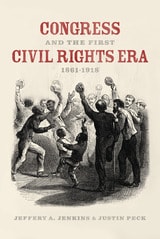
Congress and the First Civil Rights Era, 1861-1918
Jeffery A. Jenkins and Justin Peck
University of Chicago Press, 2021
The authors examine in detail how the Republican Party slowly withdrew its support for a meaningful civil rights agenda, as well as how Democrats and Republicans worked together to keep civil rights off the legislative agenda at various points. In doing so, Jenkins and Peck show how legal institutions can be used both to liberate and protect oppressed minorities and to assert the power of the white majority against those same minority groups.