Results by title
1563 books match the query 'African American & Black Studies' and 60 start with d
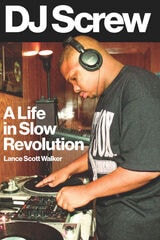
DJ Screw
A Life in Slow RevolutionLance Scott Walker
University of Texas Press, 2022
DJ Screw, a.k.a. Robert Earl Davis Jr., changed rap and hip-hop forever. In the 1990s, in a spare room of his Houston home, he developed a revolutionary mixing technique known as chopped and screwed. Spinning two copies of a record, Screw would “chop” in new rhythms, bring in local rappers to freestyle over the tracks, and slow the recording down on tape. Soon Houstonians were lining up to buy his cassettes—he could sell thousands in a single day. Fans drove around town blasting his music, a sound that came to define the city’s burgeoning and innovative rap culture. June 27 has become an unofficial city holiday, inspired by a legendary mix Screw made on that date.
Lance Scott Walker has interviewed nearly everyone who knew Screw, from childhood friends to collaborators to aficionados who evangelized Screw’s tapes—millions of which made their way around the globe—as well as the New York rap moguls who honored him. Walker brings these voices together with captivating details of Screw’s craft and his world. More than the story of one man, DJ Screw is a history of the Houston scene as it came of age, full of vibrant moments and characters. But none can top Screw himself, a pioneer whose mystique has only grown in the two decades since his death.
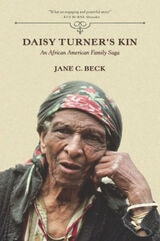
Daisy Turner's Kin
An African American Family SagaJane C. Beck
University of Illinois Press, 2015
In 1983, folklorist Jane Beck began a series of interviews with Turner, then one hundred years old and still relating four generations of oral history. Beck uses Turner's storytelling to build the Turner family saga, using at its foundation the oft-repeated touchstone stories at the heart of their experiences: the abduction into slavery of Turner's African ancestors; Daisy's father Alec Turner learning to read; his return as a soldier to his former plantation to kill his former overseer; and Daisy's childhood stand against racism. Other stories re-create enslavement and her father's life in Vermont--in short, the range of life events large and small, transmitted by means so alive as to include voice inflections. Beck, at the same time, weaves in historical research and offers a folklorist's perspective on oral history and the hazards--and uses--of memory.
Publication of this book is supported by grants from the Andrew W. Mellon Foundation and the L. J. and Mary C. Skaggs Folklore Fund.
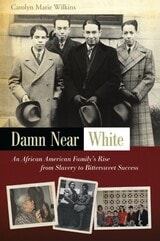
Damn Near White
An African American Family's Rise from Slavery to Bittersweet SuccessCarolyn Marie Wilkins
University of Missouri Press, 2010
Carolyn Wilkins grew up defending her racial identity. Because of her light complexion and wavy hair, she spent years struggling to convince others that she was black. Her family’s prominence set Carolyn’s experiences even further apart from those of the average African American. Her father and uncle were well-known lawyers who had graduated from Harvard Law School. Another uncle had been a child prodigy and protégé of Albert Einstein. And her grandfather had been America's first black assistant secretary of labor.
Carolyn's parents insisted she follow the color-conscious rituals of Chicago's elite black bourgeoisie—experiences Carolyn recalls as some of the most miserable of her entire life. Only in the company of her mischievous Aunt Marjory, a woman who refused to let the conventions of “proper” black society limit her, does Carolyn feel a true connection to her family's African American heritage.
When Aunt Marjory passes away, Carolyn inherits ten bulging scrapbooks filled with family history and memories. What she finds in these photo albums inspires her to discover the truth about her ancestors—a quest that will eventually involve years of research, thousands of miles of travel, and much soul-searching.
Carolyn learns that her great-grandfather John Bird Wilkins was born into slavery and went on to become a teacher, inventor, newspaperman, renegade Baptist minister, and a bigamist who abandoned five children. And when she discovers that her grandfather J. Ernest Wilkins may have been forced to resign from his labor department post by members of the Eisenhower administration, Carolyn must confront the bittersweet fruits of her family's generations-long quest for status and approval.
Damn Near White is an insider’s portrait of an unusual American family. Readers will be drawn into Carolyn’s journey as she struggles to redefine herself in light of the long-buried secrets she uncovers. Tackling issues of class, color, and caste, Wilkins reflects on the changes of African American life in U.S. history through her dedicated search to discover her family’s powerful story.
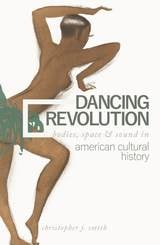
Dancing Revolution
Bodies, Space, and Sound in American Cultural HistoryChristopher J. Smith
University of Illinois Press, 2019
Dancing Revolution presents richly diverse case studies to illuminate these patterns of movement and influence in movement and sound in the history of American public life. Christopher J. Smith spans centuries, geographies, and cultural identities as he delves into a wide range of historical moments. These include the God-intoxicated public demonstrations of Shakers and Ghost Dancers in the First and Second Great Awakenings; creolized antebellum dance in cities from New Orleans to Bristol; the modernism and racial integration that imbued twentieth-century African American popular dance; the revolutionary connotations behind images of dance from Josephine Baker to the Marx Brothers; and public movement's contributions to hip hop, antihegemonic protest, and other contemporary transgressive communities’ physical expressions of dissent and solidarity.
Multidisciplinary and wide-ranging, Dancing Revolution examines how Americans turned the rhythms of history into the movement behind the movements.
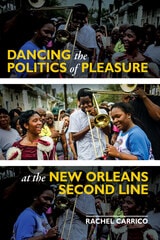
Dancing the Politics of Pleasure at the New Orleans Second Line
Rachel Carrico
University of Illinois Press, 2024
On many Sundays, Black New Orleanians dance through city streets in Second Lines. These processions invite would-be spectators to join in, grooving to an ambulatory brass band for several hours. Though an increasingly popular attraction for tourists, parading provides the second liners themselves with a potent public expression of Black resistance.
Rachel Carrico examines the parading bodies in motion as a form of negotiating and understanding power. Seeing pleasure as a bodily experience, Carrico reveals how second liners’ moves link joy and liberation, self and communal identities, play and dissent, and reclamations of place. As she shows, dancers’ choices allow them to access the pleasure of reclaiming self and city through motion and rhythm while expanding a sense of the possible in the present and for the future.
In-depth and empathetic, Dancing the Politics of Pleasure at the New Orleans Second Line blends analysis with a chorus of Black voices to reveal an indelible facet of Black culture in the Crescent City.

Dangerous Donations
Northern Philanthropy and Southern Black Education, 1902-1930Eric Anderson & Alfred A. Moss, Jr.
University of Missouri Press, 1999
Eric Anderson and Alfred A. Moss, Jr., offer a new examination of the impact of northern philanthropy on southern black education, giving special attention to the "Ogden movement," the General Education Board, the Rosenwald Fund, and the Episcopal American Church Institute for Negroes. Anderson and Moss present significant reinterpretations of key figures in African American education, including Booker T. Washington, William H. Baldwin, Jr., George Foster Peabody, and Thomas Jesse Jones.
Dangerous Donations explores both the great influence of the philanthropic foundations and the important limitations on their power. White racial radicals were suspicious that the northern agencies sought to undermine the southern system of race relations, "training negroes in the vain hope of social equality with whites." This criticism forced the philanthropists and their agents to move cautiously, seeking white southern cooperation whenever possible. Despite repeated compromises, northern philanthropists maintained a vision of race relations and black potential significantly different from that held by the South’s white majority.
Blacks challenged the foundations, expressing their own educational agendas in a variety of ways, including demands for black teachers, resistance to any distinctive racial curricula, and, in some cases, support for independent black schools. The millions of dollars in self-help philanthropy contributed by African Americans also indicated their refusal to give complete control of their schools to either the white South or distant philanthropists in the North.
No other scholars, according to Louis R. Harlan, "have examined the controversial role of philanthropy with the same coolness, analytical skill, and persistent search for the truth as Eric Anderson and Alfred Moss... [they] have made an outstanding contribution to the history of education for both races in the segregated South of 1900 to 1930."
Dangerous Frames
How Ideas about Race and Gender Shape Public OpinionNicholas J. G. Winter
University of Chicago Press, 2008
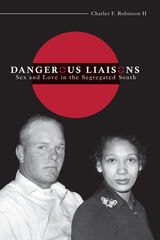
Dangerous Liaisons
Sex and Love in the Segregated SouthCharles F. Robinson II
University of Arkansas Press, 2003
In the tumultuous decades after the Civil War, as the southern white elite reclaimed power, “racial mixing” was the central concern of segregationists who strove to maintain “racial purity.” Segregation—and race itself—was based on the idea that interracial sex posed a biological threat to the white race. In this groundbreaking study, Charles Robinson examines how white southerners enforced anti-miscegenation laws. His findings challenge conventional wisdom, documenting a pattern of selective prosecution under which interracial domestic relationships were punished even more harshly than transient sexual encounters. Robinson shows that the real crime was to suggest that black and white individuals might be equals, a notion which undermined the legitimacy of the economic, political, and social structure of white male supremacy.
Robinson examines legal cases from across the South, considering both criminal prosecutions brought by states and civil disputes over marital and family assets. He also looks at U.S. Supreme Court decisions, debates in state legislatures, comments in the U.S. Congressional Record, and newspaper editorials. He not only shows the hardening of racial categories but assesses the attitudes of African Americans about anti-miscegenation laws and intermarriage. The epilogue concerns “The Demise of Anti-miscegenation Law” including the case of Richard and Mildred Loving.
Dangerous Liaisons vividly documents the regulation of intimacy and its fundamental role in the construction of race.
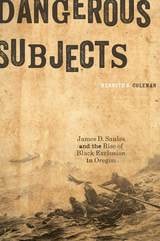
Dangerous Subjects
James D. Saules and the Rise of Black Exclusion in OregonKenneth R. Coleman
Oregon State University Press, 2017
In Oregon, Saules encountered a multiethnic population already transformed by colonialism—in particular, the fur industry and Protestant missionaries. Once the Oregon Trail emigrants began arriving in large numbers, in 1843, Saules had to adapt to a new reality in which Anglo-American settlers persistently sought to marginalize and exclude black residents from the region. Unlike Saules, who adapted and thrived in Oregon’s multiethnic milieu, the settler colonists sought to remake Oregon as a white man’s country. They used race as shorthand to determine which previous inhabitants would be included and which would be excluded. Saules inspired and later had to contend with a web of black exclusion laws designed to deny black people citizenship, mobility, and land.
In Dangerous Subjects, Kenneth Coleman sheds light on a neglected chapter in Oregon’s history. His book will be welcomed by scholars in the fields of western history and ethnic studies, as well as general readers interested in early Oregon and its history of racial exclusion.
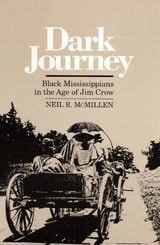
Dark Journey
Black Mississippians in the Age of Jim CrowNeil R. McMillen
University of Illinois Press, 1989
"Dark Journey is a superb piece of scholarship, a book that all students of southern and African-American history will find valuable and informative."--David J. Garrow, Georgia Historical Quarterly
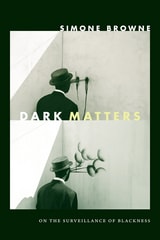
Dark Matters
On the Surveillance of BlacknessSimone Browne
Duke University Press, 2015
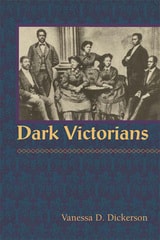
Dark Victorians
Vanessa D. Dickerson
University of Illinois Press, 2007
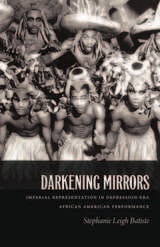
Darkening Mirrors
Imperial Representation in Depression-Era African American PerformanceStephanie Leigh Batiste
Duke University Press, 2012
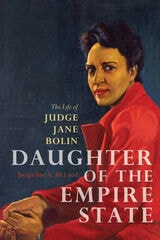
Daughter of the Empire State
The Life of Judge Jane BolinJacqueline A. McLeod
University of Illinois Press, 2016
Bolin was appointed to New York City's domestic relations court in 1939 for the first of four ten-year terms. When she retired in 1978, her career had extended well beyond the courtroom. Drawing on archival materials as well as a meeting with Bolin in 2002, historian Jacqueline A. McLeod reveals how Bolin parlayed her judicial position to impact significant reforms of the legal and social service system in New York.
Beginning with Bolin's childhood and educational experiences at Wellesley and Yale, Daughter of the Empire State chronicles Bolin's relatively quick rise through the ranks of a profession that routinely excluded both women and African Americans. Deftly situating Bolin's experiences within the history of black women lawyers and the historical context of high-achieving black New Englanders, McLeod offers a multi-layered analysis of black women's professionalization in a segregated America.
Linking Bolin's activist leanings and integrationist zeal to her involvement in the NAACP, McLeod analyzes Bolin's involvement at the local level as well as her tenure on the organization's national board of directors. An outspoken critic of the discriminatory practices of New York City's probation department and juvenile placement facilities, Bolin also co-founded, with Eleanor Roosevelt, the Wiltwyck School for boys in upstate New York and campaigned to transform the Domestic Relations Court with her judicial colleagues. McLeod's careful and highly readable account of these accomplishments inscribes Bolin onto the roster of important social reformers and early civil rights trailblazers.
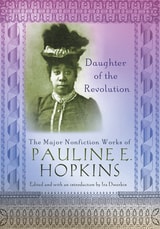
Daughter of the Revolution
The Major Nonfiction Works of Pauline HopkinsDworkin, Ira
Rutgers University Press, 2007
Pauline E. Hopkins (1859–1930) came to prominence in the early years of the twentieth century as an outspoken writer, editor, and critic. Frequently recognized for her first novel, Contending Forces, she is currently one of the most widely read and studied African American novelists from that period.
While nearly all of Hopkins’s fiction remains in print, there is very little of her nonfiction available. This reader brings together dozens of her hard-to-find essays, including longer nonfiction works such as Famous Men of the Negro Race and The Dark Races of the Twentieth Century, some of which are published here for the first time in their entirety.
Through these works, along with two juvenile essays from the 1870s, a personal letter, and two speeches, readers encounter a voice that is committed to constructing an international discourse on race, recovering the militant abolitionist tradition to combat Jim Crow, celebrating black political participation during and after the Reconstruction era, articulating the connections between race and labor, and insisting on equal rights for women. Hopkins’s writing will challenge contemporary scholars to rethink their understanding of black activism and modernity in the early twentieth century.

Death's Futurity
The Visual Life of Black PowerSampada Aranke
Duke University Press, 2023
Deathlife
Hip Hop and Thanatological Narrations of BlacknessAnthony B. Pinn
Duke University Press, 2024
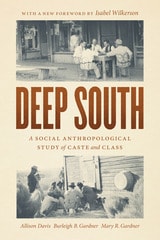
Deep South
A Social Anthropological Study of Caste and ClassAllison Davis, Burleigh B. Gardner, and Mary R. Gardner
University of Chicago Press, 2022
First published in 1941, Deep South is a landmark work of anthropology, documenting in startling and nuanced detail the everyday realities of American racism. Living undercover in Depression-era Mississippi—not revealing their scholarly project or even their association with one another—groundbreaking Black scholar Allison Davis and his White co-authors, Burleigh and Mary Gardner, delivered an unprecedented examination of how race shaped nearly every aspect of twentieth-century life in the United States. Their analysis notably revealed the importance of caste and class to Black and White worldviews, and they anatomized the many ways those views are constructed, solidified, and reinforced.
This reissue of the 1965 abridged edition, with a new foreword from Pulitzer Prize winner Isabel Wilkerson—who acknowledges the book’s profound importance to her own work—proves that Deep South remains as relevant as ever, a crucial work on the concept of caste and how it continues to inform the myriad varieties of American inequality.
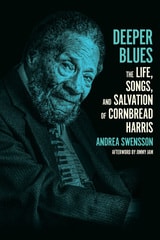
Deeper Blues
The Life, Songs, and Salvation of Cornbread HarrisAndrea Swensson
University of Minnesota Press, 2024
The emotional, epic story of James “Cornbread” Harris—a self-proclaimed “blessed dude” and one of Minneapolis’s most influential musicians
From the heart of the Minnesota blues comes the story of James “Cornbread” Harris Jr., the songwriter, pianist, and consummate bluesman whose seventy years making music helped to shape the Minneapolis Sound. “I am a blessed dude,” Cornbread tells Andrea Swensson, taking us along on his musical journey from a first “gig” entertaining his fellow soldiers during World War II to his subsequent years playing music for audiences across Minnesota. Following Cornbread’s extraordinary life story, Deeper Blues is a unique history of Minnesota music that evolves into a heartfelt tale of reconciliation and forgiveness, all to the tune of the legendary musician’s signature sound.
Cornbread’s career started in the 1950s, when he played with the Augie Garcia Quintet and cowrote their hit “Hi Ho Silver.” A tireless entertainer, he has been performing live ever since, influencing an entire generation of musicians credited with putting Minneapolis on the map in the 1980s—including his long-estranged son, Grammy-winning Rock and Roll Hall of Famer James “Jimmy Jam” Harris III. Going beyond the music, Deeper Blues turns toward family, atonement, and peace when Cornbread reunites with Jimmy Jam after a five-decade separation and they perform together on stage.
Through conversations with Cornbread, Jimmy Jam, and many others, Swensson reveals a story of perseverance and unfailing grace, a firsthand account of making music in the face of racism and segregation, and a hard-won acceptance of the personal sacrifices that are often required when dedicating one’s life to making music. As the man himself says, “All of my hardships ended up to be blessings.”
A rich mix of present-day anecdotes and historical vignettes, animated by voices from Cornbread’s life and the Twin Cities music scene, underscored by the bluesman’s original lyrics of heartache and hope, and featuring never-before-seen photographs of Cornbread and Jimmy Jam, Deeper Blues tells a singular story—one imprinted on the history, heart, and soul of the Minneapolis Sound.
Defending Diversity
Affirmative Action at the University of MichiganPatricia Gurin, Jeffrey S. Lehman, and Earl Lewis, with Eric L. Dey, Gerald Gurin, and Sylvia Hurtado
University of Michigan Press, 2004
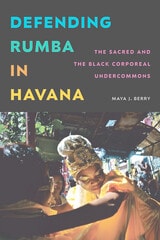
Defending Rumba in Havana
The Sacred and the Black Corporeal UndercommonsMaya J. Berry
Duke University Press, 2025
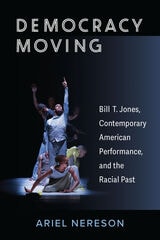
Democracy Moving
Bill T. Jones, Contemporary American Performance, and the Racial PastAriel Nereson
University of Michigan Press, 2022
The project addresses how different communities choose to commemorate historical figures, events, and places through art—whether performance, oratory, song, statuary, or portraiture—and in particular, Black US American counter-memorial practices that address histories of slavery. Advancing the theory of oscillation as Black aesthetic praxis, author Ariel Nereson celebrates Bill T. Jones as a public intellectual whose practice has contributed to the project of understanding America’s relationship to its troubled past. The book features materials from Bill T. Jones/Arnie Zane Company’s largely unexplored archive, interviews with artists, and photos that document this critical stage of Jones’s career as it explores how aesthetics, as ideas in action, can imagine more just and equitable social formations.
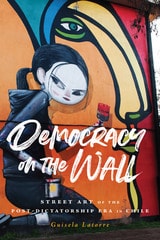
Democracy on the Wall
Street Art of the Post-Dictatorship Era in ChileGuisela Latorre
The Ohio State University Press, 2019
Exploring the resurgence and impact of the muralist brigades, women graffiti artists, the phenomenon of “open-sky museums,” and the transnational impact on the development of Chilean street art, Latorre argues that mural and graffiti artists are enacting a “visual democracy,” a form of artistic praxis that seeks to create alternative images to those produced by institutions of power. Keenly aware of Latin America’s colonial legacy and deeply flawed democratic processes, and distrustful of hegemonic discourses promoted by government and corporate media, the artists in Democracy on the Wall utilize graffiti and muralism as an alternative means of public communication, one that does not serve capitalist or nationalist interests. Latorre posits that through these urban interventions that combine creativity with social action, Chilean street artists formulate visions of what a true democracy looks like.
Democratic Discourses
The Radical Abolition Movement and Antebellum American LiteratureBennett, Michael
Rutgers University Press, 2005
Ever since the hallowed statement, "All men are created equal," was penned in the Declaration of Independence, it has become a historical tenet that freedom and equality were brought to American shores by the so-called Founding Fathers.
In this path-breaking study, Michael Bennett departs from tradition to argue that the democratic ideal of equality and the actual ways in which it has been practiced are grounded less in the fledgling government documents written by a handful of white men than in the actions and writings of the radical abolitionists of the nineteenth century. Bringing together key texts of both African American and European American authors, Democratic Discourses shows the important ways that abolitionist writing shaped a powerful counterculture within a slave-holding society. Bennett offers fresh new analysis through unusual pairings of authors, including Frederick Douglass with Henry David Thoreau, Frances Ellen Watkins Harper with Walt Whitman, and Margaret Fuller with Sojourner Truth. These rereadings avoid the tendency to view antebellum writing as a product primarily of either European American or African American influences and, instead, illustrate the interconnections of white and black literature in the creation and practice of democracy.
Drawing on discourses about race, the body, gender, economics, and aesthetics, this unique study encourages readers to reconsider the reality and roots of freedoms experienced in the United States today.
Demolition Means Progress
Flint, Michigan, and the Fate of the American MetropolisAndrew R. Highsmith
University of Chicago Press, 2015
In one of the most comprehensive works yet written on the history of inequality and metropolitan development in modern America, Andrew R. Highsmith uses the case of Flint to explain how the perennial quest for urban renewal—even more than white flight, corporate abandonment, and other forces—contributed to mass suburbanization, racial and economic division, deindustrialization, and political fragmentation. Challenging much of the conventional wisdom about structural inequality and the roots of the nation’s “urban crisis,” Demolition Means Progress shows in vivid detail how public policies and programs designed to revitalize the Flint area ultimately led to the hardening of social divisions.
Demonic Grounds
Black Women And The Cartographies Of StruggleKatherine McKittrick
University of Minnesota Press, 2006
Demonic Grounds moves between past and present, archives and fiction, theory and everyday, to focus on places negotiated by black women during and after the transatlantic slave trade. Specifically, the author addresses the geographic implications of slave auction blocks, Harriet Jacobs’s attic, black Canada and New France, as well as the conceptual spaces of feminism and Sylvia Wynter’s philosophies.
Central to McKittrick’s argument are the ways in which black women are not passive recipients of their surroundings and how a sense of place relates to the struggle against domination. Ultimately, McKittrick argues, these complex black geographies are alterable and may provide the opportunity for social and cultural change.
Katherine McKittrick is assistant professor of women’s studies at Queen’s University.
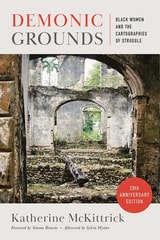
Demonic Grounds
Black Women and the Cartographies of Struggle (20th Anniversary Edition)Katherine McKittrick
University of Minnesota Press, 2026
The field-defining text for black geographies—now with a new foreword and afterword
The initial publication of Demonic Grounds in 2006 marked a watershed for the field of geography: revealing how human geographies are a result of racialized connections and black placemaking practices, this book opened the discipline to feminist, interdisciplinary, and black perspectives. Katherine McKittrick traces the geographies of black women across the diaspora, arguing that the spaces they inhabit are marked by legacies of violence and slavery while also being sites of unacknowledged political power. Making a forceful claim, she identifies rich opportunities within black geographies for social and cultural change and rebellion. With a new foreword by Simone Browne and comments from Sylvia Wynter on the original edition as an afterword, this twentieth-anniversary edition celebrates Demonic Grounds and its ongoing influence on twenty-first century geography.
Retail e-book files for this title are screen-reader friendly.
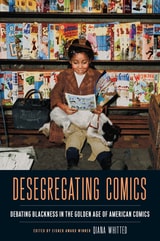
Desegregating Comics
Debating Blackness in the Golden Age of American ComicsQiana Whitted
Rutgers University Press, 2023
Shortlisted for the Best Academic / Scholarly Work Eisner Award
Honorable Mention for the Harry Shaw and Katrina Hazzard-Donald Award for Outstanding Work in African-American Popular Culture Studies from the Popular Culture Association
Some comics fans view the industry’s Golden Age (1930s-1950s) as a challenging time when it comes to representations of race, an era when the few Black characters appeared as brutal savages, devious witch doctors, or unintelligible minstrels. Yet the true portrait is more complex and reveals that even as caricatures predominated, some Golden Age comics creators offered more progressive and nuanced depictions of Black people.
Desegregating Comics assembles a team of leading scholars to explore how debates about the representation of Blackness shaped both the production and reception of Golden Age comics. Some essays showcase rare titles like Negro Romance and consider the formal innovations introduced by Black comics creators like Matt Baker and Alvin Hollingsworth, while others examine the treatment of race in the work of such canonical cartoonists as George Herriman and Will Eisner. The collection also investigates how Black fans read and loved comics, but implored publishers to stop including hurtful stereotypes. As this book shows, Golden Age comics artists, writers, editors, distributors, and readers engaged in heated negotiations over how Blackness should be portrayed, and the outcomes of those debates continue to shape popular culture today.
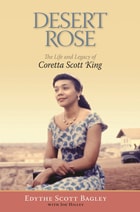
Desert Rose
The Life and Legacy of Coretta Scott KingEdythe Scott Bagley with Joe Hilley
University of Alabama Press, 2012
An intimate biography illuminating the life, leadership, and legacy of Coretta Scott King within the American Civil Rights Movement.
Coretta Scott King—noted author, human rights activist, and wife and partner of famed Civil Rights Movement leader Martin Luther King Jr.—grew up in the rural Alabama Black Belt with her older sister, Edythe Scott Bagley. Bagley chronicles the sisters’ early education together at the Crossroads School and later at the progressive Lincoln School in Marion. She describes Coretta’s burgeoning talent for singing and her devotion to musical studies, and the sisters’ experiences matriculating at Antioch College, an all-white college far from the rural South. Bagley provides vivid insights into Coretta’s early passion for racial and economic justice, which lead to her involvement in the Peace Movement and the National Association for the Advancement of Colored People.
As Coretta’s older sister, Edythe shared in almost all of Coretta’s many trials and tribulations. Desert Rose charts Coretta’s hesitance about her romance with Martin Luther King and the prospect of having to sacrifice her dream of a career in music to become a minister’s wife. Ultimately, Coretta chose to utilize her artistic gifts and singing voice for the Movement through the development and performance of Freedom Concerts. This book also charts Coretta’s own commitment and dedication, in the years that followed King’s death, to the causes of international civil rights, the antiapartheid movement, and the establishment of the King Center in Atlanta and the national King Holiday. Coretta’s devotion to activism, motherhood, and the movement led by her husband, and her courageous assumption of the legacy left in the wake of King’s untimely assassination, are wonderfully detailed in this intimate biography.
Desire and Disaster in New Orleans
Tourism, Race, and Historical MemoryLynnell L. Thomas
Duke University Press, 2014
Destructive Desires
Rhythm and Blues Culture and the Politics of Racial EqualityRobert J. Patterson
Rutgers University Press, 2019
Dethroning the Deceitful Pork Chop
Rethinking African American Foodways from Slavery to ObamaJennifer Jensen Wallach
University of Arkansas Press, 2015
2017 Association for the Study of Food and Society Award, best edited collection.
The fifteen essays collected in Dethroning the Deceitful Pork Chop utilize a wide variety of methodological perspectives to explore African American food expressions from slavery up through the present. The volume offers fresh insights into a growing field beginning to reach maturity. The contributors demonstrate that throughout time black people have used food practices as a means of overtly resisting white oppression—through techniques like poison, theft, deception, and magic—or more subtly as a way of asserting humanity and ingenuity, revealing both cultural continuity and improvisational finesse. Collectively, the authors complicate generalizations that conflate African American food culture with southern-derived soul food and challenge the tenacious hold that stereotypical black cooks like Aunt Jemima and the depersonalized Mammy have on the American imagination. They survey the abundant but still understudied archives of black food history and establish an ongoing research agenda that should animate American food culture scholarship for years to come.
Detroit Remains
Archaeology and Community Histories of Six Legendary PlacesKrysta Ryzewski
University of Alabama Press, 2021
WINNER OF THE UNIVERSITY OF MARY WASHINGTON CENTER FOR HISTORIC PRESERVATION BOOK PRIZE, THE JAMES DEETZ BOOK AWARD, AND THE JOAN GERO BOOK AWARD
An interdisciplinary study of urban archaeology, community heritage, and social justice in modern Detroit.
The city of Detroit has endured periods of unprecedented industrial growth, decline, and revitalization between the late nineteenth century and the present. In Detroit Remains: Archaeology and Community Histories of Six Legendary Places, Krysta Ryzewski presents six archaeological case studies of legendary Detroit institutions—Little Harry speakeasy, the Ransom Gillis house, the Blue Bird Inn, Gordon Park, the Grande Ballroom, and the Halleck Street log cabin—that trace the contours of the city’s underrepresented communities and their relationship to local currents of capitalism and social justice. Through a combination of rigorous historical archaeological research and narrative storytelling, Ryzewski deftly contextualizes the cases within the city’s current struggles, including recovery from bankruptcy, and future-oriented recovery efforts.
This is the first historical archaeology book focused on Detroit and one of the few to foreground the archaeology of the Great Migration era (ca. 1915–1970). The archaeological scholarship is rooted in collaborative, community-involved, and public-facing initiatives. The case studies examine how power is and has been exercised in Detroit’s communities over the past century: how it was stripped from the city’s twentieth- and twenty-first-century residents, but also how they acquired alternative sources of agency by establishing creative and illicit economies, most of which still operated within the city’s capitalist framework.
Throughout this book, connections run deep between archaeology, heritage, politics, historic preservation, and storytelling. Detroit Remains demonstrates how the city’s past, present, and future lie not in ruins but in the tangible archaeological traces of the everyday lives of Detroiters and their legacies.
Dialect and Dichotomy
Literary Representations of African American SpeechLisa Cohen Minnick
University of Alabama Press, 2007
Applies linguistics methods for a richer understanding of literary texts and spoken language.
Dialect and Dichotomy outlines the history of dialect writing in English and its influence on linguistic variation. It also surveys American dialect writing and its relationship to literary, linguistic, political, and cultural trends, with emphasis on African American voices in literature.
Furthermore, this book introduces and critiques canonical works in literary dialect analysis and covers recent, innovative applications of linguistic analysis of literature. Next, it proposes theoretical principles and specific methods that can be implemented in order to analyze literary dialect for either linguistic or literary purposes, or both. Finally, the proposed methods are applied in four original analyses of African American speech as represented in major works of fiction of the American South—Mark Twain's Adventures of Huckleberry Finn, Charles W. Chesnutt's The Conjure Woman, William Faulkner's The Sound and the Fury, and Zora Neale Hurston's Their Eyes Were Watching God.
Dialect and Dichotomy is designed to be accessible to audiences with a variety of linguistic and literary backgrounds. It is an ideal research resource and course text for students and scholars interested in areas including American, African American, and southern literature and culture; linguistic applications to literature; language in the African American community; ethnicity and representation; literary dialect analysis and/or computational linguistics; dialect writing as genre; and American English.
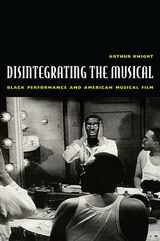
Disintegrating the Musical
Black Performance and American Musical FilmArthur Knight
Duke University Press, 2002
Arthur Knight focuses on American film’s classic sound era, when Hollywood studios made eight all-black-cast musicals—a focus on Afro-America unparalleled in any other genre. It was during this same period that the first black film stars—Paul Robeson, Louis Armstrong, Lena Horne, Harry Belafonte, Dorothy Dandridge—emerged, not coincidentally, from the ranks of musical performers. That these films made so much of the connection between African Americans and musicality was somewhat ironic, Knight points out, because they did so in a form (song) and a genre (the musical) celebrating American social integration, community, and the marriage of opposites—even as the films themselves were segregated and played before even more strictly segregated audiences.
Disintegrating the Musical covers territory both familiar—Show Boat, Stormy Weather, Porgy and Bess—and obscure—musical films by pioneer black director Oscar Micheaux, Lena Horne’s first film The Duke Is Tops, specialty numbers tucked into better-known features, and lost classics like the short Jammin’ the Blues. It considers the social and cultural contexts from which these films arose and how African American critics and audiences responded to them. Finally, Disintegrating the Musical shows how this history connects with the present practices of contemporary musical films like O Brother, Where Art Thou? and Bamboozled.
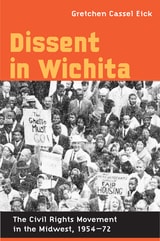
Dissent in Wichita
The Civil Rights Movement in the Midwest, 1954-72Gretchen Cassel Eick
University of Illinois Press, 2001
Winner of the Richard L. Wentworth Prize in American History, Byron Caldwell Smith Book Prize, and the William Rockhill Nelson Award
On a hot summer evening in 1958, a group of African American students in Wichita, Kansas, quietly entered Dockum's Drug Store and sat down at the whites-only lunch counter. This was the beginning of the first sustained, successful student sit-in of the modern civil rights movement, instigated in violation of the national NAACP's instructions.
Dissent in Wichita traces the contours of race relations and black activism in this unexpected locus of the civil rights movement. Based on interviews with more than eighty participants in and observers of Wichita's civil rights struggles, this powerful study hones in on the work of black and white local activists, setting their efforts in the context of anticommunism, FBI operations against black nationalists, and the civil rights policies of administrations from Eisenhower through Nixon.
Through her close study of events in Wichita, Eick reveals the civil rights movement as a national, not a southern, phenomenon. She focuses particularly on Chester I. Lewis, Jr., a key figure in the local as well as the national NAACP. Lewis initiated one of the earliest investigations of de facto school desegregation by the Department of Health, Education, and Welfare and successfully challenged employment discrimination in the nation's largest aircraft industries.
Dissent in Wichita offers a moving account of the efforts of Lewis, Vivian Parks, Anna Jane Michener, and other courageous individuals to fight segregation and discrimination in employment, public accommodations, housing, and schools. This volume also offers the first extended examination of the Young Turks, a radical movement to democratize and broaden the agenda of the NAACP for which Lewis provided critical leadership.
Through a close study of personalities and local politics in Wichita over two decades, Eick demonstrates how the tenor of black activism and white response changed as economic disparities increased and divisions within the black community intensified. Her analysis, enriched by the words and experiences of men and women who were there, offers new insights into the civil rights movement as a whole and into the complex interplay between local and national events.
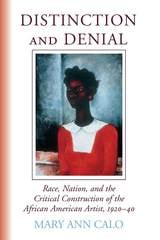
Distinction and Denial
Race, Nation, and the Critical Construction of the African American Artist, 1920-40Mary Ann Calo
University of Michigan Press, 2007
Distinctionand Denial challenges conventional theories of race and art by examining the role early twentieth-century art critics played in marginalizing African American artists. Mary Ann Calo dispels the myth of a unified African American artistic tradition through an engaging study of the germinal writing of Alain Locke and other significant critics of the era, who argued that African American artists were both a diverse group and a constituent element of America’s cultural center. By documenting the effects of the “Negro aesthetic” on African American artists working in the interwar years, Distinctionand Denial shows that black artistic production existed between the claims of a distinctly African American tradition and full inclusion into American modernist culture—never fully inside or outside the mainstream.
“A major contribution to the scholarship of African American artists in the inter-war period. With scrupulous research and probing analyses, Calo’s study enables scholars, students, and those interested in the Harlem Renaissance to grasp the intellectual debates, institutional support, and art world promotion that advanced an emerging cohort of African American artists.”
—Patricia Hills, Boston University
“A careful, thorough, historically grounded study that builds a new and significant argument challenging conventional histories of African American art. Sure to become indispensable to any scholarly discussion of American art or African American cultural studies.”
—Helen Langa, American University
Mary Ann Calo is Professor of Art History and Director of the Institute for the Creative and Performing Arts at Colgate University. She is author of Bernard Berenson and the Twentieth Century and editor of Critical Issues in American Art: A Book of Readings.
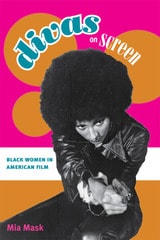
Divas on Screen
Black Women in American FilmMia Mask
University of Illinois Press, 2008
This insightful study places African American women's stardom in historical and industrial contexts by examining the star personae of five African American women: Dorothy Dandridge, Pam Grier, Whoopi Goldberg, Oprah Winfrey, and Halle Berry. Interpreting each woman's celebrity as predicated on a brand of charismatic authority, Mia Mask shows how these female stars have ultimately complicated the conventional discursive practices through which blackness and womanhood have been represented in commercial cinema, independent film, and network television.
Mask examines the function of these stars in seminal yet underanalyzed films. She considers Dandridge's status as a sexual commodity in films such as Tamango, revealing the contradictory discourses regarding race and sexuality in segregation-era American culture. Grier's feminist-camp performances in sexploitation pictures Women in Cages and The Big Doll House and her subsequent blaxploitation vehicles Coffy and Foxy Brown highlight a similar tension between representing African American women as both objectified stereotypes and powerful, self-defining icons. Mask reads Goldberg's transforming habits in Sister Act and The Associate as representative of her unruly comedic routines, while Winfrey's daily television performance as self-made, self-help guru echoes Horatio Alger narratives of success. Finally, Mask analyzes Berry's meteoric success by acknowledging the ways in which Dandridge's career made Berry's possible.
Dividing Lines
Municipal Politics and the Struggle for Civil Rights in Montgomery, Birmingham, and SelmaJ. Mills Thornton, III
University of Alabama Press, 2006
Presents the story of the civil rights movement from the perspective of community-municipal history at the grassroots level
Thornton demonstrates that the movement had powerful local sources in its three birth cities—Montgomery, Birmingham, and Selma. There, the arcane mechanisms of state and city governance and the missteps of municipal politicians and civic leaders—independent of emerging national trends in racial mores—led to the great swell of energy for change that became the civil rights movement.
Do Right by Me
Learning to Raise Black Children in White SpacesValerie I. Harrison and Kathryn Peach D'Angelo
Temple University Press, 2021
For decades, Katie D’Angelo and Valerie Harrison engaged in conversations about race and racism. However, when Katie and her husband, who are white, adopted Gabriel, a biracial child, Katie’s conversations with Val, who is black, were no longer theoretical and academic. The stakes grew from the two friends trying to understand each other’s perspectives to a mother navigating, with input from her friend, how to equip a child with the tools that will best serve him as he grows up in a white family.
Through lively and intimate back-and-forth exchanges, the authors share information, research, and resources that orient parents and other community members to the ways race and racism will affect a black child’s life—and despite that, how to raise and nurture healthy and happy children. These friendly dialogues about guarding a child’s confidence and nurturing positive racial identity form the basis for Do Right by Me. Harrison and D’Angelo share information on transracial adoption, understanding racism, developing a child’s positive racial identity, racial disparities in healthcare and education, and the violence of racism.
Do Right by Me also is a story about friendship and kindness, and how both can be effective in the fight for a more just and equitable society.
Doctrine and Race
African American Evangelicals and Fundamentalism between the WarsMary Beth Swetnam Mathews
University of Alabama Press, 2017
Doctrine and Race examines the history of African American Baptists and Methodists of the early twentieth century and their struggle for equality in the context of white Protestant fundamentalism.
By presenting African American Protestantism in the context of white Protestant fundamentalism, Doctrine and Race: African American Evangelicals and Fundamentalism between the Wars demonstrates that African American Protestants were acutely aware of the manner in which white Christianity operated and how they could use that knowledge to justify social change. Mary Beth Swetnam Mathews’s study scrutinizes how white fundamentalists wrote blacks out of their definition of fundamentalism and how blacks constructed a definition of Christianity that had, at its core, an intrinsic belief in racial equality. In doing so, this volume challenges the prevailing scholarly argument that fundamentalism was either a doctrinal debate or an antimodernist force. Instead, it was a constantly shifting set of priorities for different groups at different times.
A number of African American theologians and clergy identified with many of the doctrinal tenets of the fundamentalism of their white counterparts, but African Americans were excluded from full fellowship with the fundamentalists because of their race. Moreover, these scholars and pastors did not limit themselves to traditional evangelical doctrine but embraced progressive theological concepts, such as the Social Gospel, to help them achieve racial equality. Nonetheless, they identified other forward-looking theological views, such as modernism, as threats to “true” Christianity.
Mathews demonstrates that, although traditional portraits of “the black church” have provided the illusion of a singular unified organization, black evangelical leaders debated passionately among themselves as they sought to preserve select aspects of the culture around them while rejecting others. The picture that emerges from this research creates a richer, more profound understanding of African American denominations as they struggled to contend with a white American society that saw them as inferior.
Doctrine and Race melds American religious history and race studies in innovative and compelling ways, highlighting the remarkable and rich complexity that attended to the development of African American Protestant movements.
Doing Diversity in Higher Education
Faculty Leaders Share Challenges and StrategiesBrown-Glaude, Winnifred R
Rutgers University Press, 2008
The rich variety of colleges and universities included provides a wide array of models that faculty can draw upon to inspire institutional change.
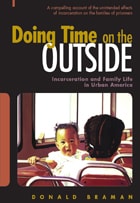
Doing Time on the Outside
Incarceration and Family Life in Urban AmericaDonald Braman
University of Michigan Press, 2004
-Katherine S. Newman
"Doing Time on the Outside brings to life in a compelling way the human drama, and tragedy, of our incarceration policies. Donald Braman documents the profound economic and social consequences of the American policy of massive imprisonment of young African American males. He shows us the link between the broad-scale policy changes of recent decades and the isolation and stigma that these bring to family members who have a loved one in prison. If we want to understand fully the impact of current criminal justice policies, this book should be required reading."
-Mark Mauer, Assistant Director, The Sentencing Project
"Through compelling stories and thoughtful analysis, this book describes how our nation's punishment policies have caused incalculable damage to the fabric of family and community life. Anyone concerned about the future of urban America should read this book."
-Jeremy Travis, The Urban Institute
In the tradition of Elijah Anderson's Code of the Street and Katherine Newman's No Shame in My Game, this startling new ethnography by Donald Braman uncovers the other side of the incarceration saga: the little-told story of the effects of imprisonment on the prisoners' families.
Since 1970 the incarceration rate in the United States has more than tripled, and in many cities-urban centers such as Washington, D.C.-it has increased over five-fold. Today, one out of every ten adult black men in the District is in prison and three out of every four can expect to spend some time behind bars. But the numbers don't reveal what it's like for the children, wives, and parents of prisoners, or the subtle and not-so-subtle effects mass incarceration is having on life in the inner city.
Author Donald Braman shows that those doing time on the inside are having a ripple effect on the outside-reaching deep into the family and community life of urban America. Braman gives us the personal stories of what happens to the families and communities that prisoners are taken from and return to. Carefully documenting the effects of incarceration on the material and emotional lives of families, this groundbreaking ethnography reveals how criminal justice policies are furthering rather than abating the problem of social disorder. Braman also delivers a number of genuinely new arguments.
Among these is the compelling assertion that incarceration is holding offenders unaccountable to victims, communities, and families. The author gives the first detailed account of incarceration's corrosive effect on social capital in the inner city and describes in poignant detail how the stigma of prison pits family and community members against one another. Drawing on a series of powerful family portraits supported by extensive empirical data, Braman shines a light on the darker side of a system that is failing the very families and communities it seeks to protect.
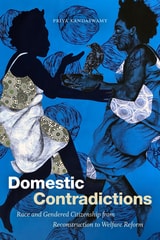
Domestic Contradictions
Race and Gendered Citizenship from Reconstruction to Welfare ReformPriya Kandaswamy
Duke University Press, 2021
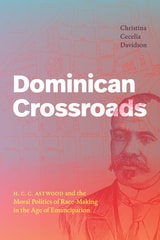
Dominican Crossroads
H. C. C. Astwood and the Moral Politics of Race-Making in the Age of EmancipationChristina Cecelia Davidson
Duke University Press, 2024
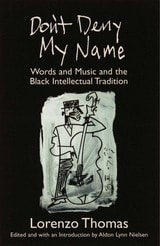
Don't Deny My Name
Words and Music and the Black Intellectual TraditionLorenzo Thomas; Edited and with an Introduction by Aldon Lynn Nielsen
University of Michigan Press, 2008
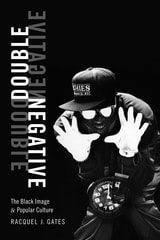
Double Negative
The Black Image and Popular CultureRacquel J. Gates
Duke University Press, 2018

Double Quartet, Volume I
Nathaniel Mackey
Duke University Press, 2027
Double Quartet, Volume II
Nathaniel Mackey
Duke University Press, 2027
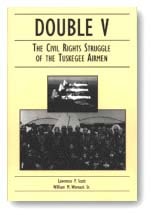
Double V
The Civil Rights Struggle of the Tuskegee AirmenLawrence P. Scott
Michigan State University Press, 1994
On April 12, 1945, the United States Army Air Force arrested 101 of its African American officers. They were charged with disobeying a direct order from a superior officer—a charge that could carry the death penalty upon conviction. They were accused of refusing to sign an order that would have placed them in segregated housing and recreational facilities. Their plight was virtually ignored by the press at the time, and books written about the subject did not detail the struggle these aviators underwent to win recognition of their civil rights.
The central theme of Double V is the promise held out to African American military personnel that service in World War II would deliver to them a double victory—a "double V"—over tyranny abroad and racial prejudice at home. The book's authors, Lawrence P. Scott and William M. Womack Sr., chronicle for the first time, in detail, one of America's most dramatic failures to deliver on that promise. In the course of their narrative, the authors demonstrate how the Tuskegee airmen suffered as second-class citizens while risking their lives to serve their country. Among the contributions made by this work is a detailed examination of how 101 Tuskegee airmen, by refusing to live in segregated quarters, triggered one of the most significant judicial proceedings in U.S. military history. Double V uses oral accounts and heretofore unused government documents to portray this little-known struggle by one of America's most celebrated flying units.
In addition to providing background material about African American aviators before World War II. the authors also demonstrate how the Tuskegee airmen's struggle foretold dilemmas faced by the civil rights movement in the second half of the 20th century. Double V is destined to become an important contribution in the rapidly growing body of civil rights literature.