1049 books match the query 'English, Irish, Scottish, Welsh' and 53 start with d

cover of D. H. Lawrence: An Unprofessional Study

D. H. Lawrence

An Unprofessional Study

Anaïs Nin

Ohio University Press, 1964

In 1932, two years after D. H. Lawrence’s death, a young woman wrote a book about him and presented it to a Paris publisher. She recorded the event in her diary: “It will not be published and out by tomorrow, which is what a writer would like when the book is hot out of the oven, when it is alive within oneself. He gave it to his assistant to revise.” The woman was Anaïs Nin.

Nin examined Lawrence’s poetry, novels, essays, and travel writing. She analyzed and explained the more important philosophical concepts contained in his writings, particularly the themes of love, death, and religion, as well as his attention to primitivism and to women. But what Anaïs Nin brought to the explication of Lawrence’s writing was an understanding of the fusion of imaginative, intuitive, and intellectual elements from which he drew his characters, themes, imagery and symbolism.
[more]
cover of D. H. Lawrence: The Croydon Years

D. H. Lawrence

The Croydon Years

By Helen Corke, introduction by Warren Roberts

University of Texas Press, 1965

Croydon, England, was the setting of the famous three-way friendship of D. H. Lawrence, Jessie Chambers, and Helen Corke, all of whom made literary records of their association, and all of whom appeared as characters in Lawrence novels. Perhaps the most objective of these records were Helen Corke’s, which became difficult to acquire. Their scarcity and their continuing usefulness were the stimulus for publication of this volume, which contains in four statements Helen Corke’s “major comment on Lawrence the man and Lawrence the artist.”

The “Portrait of D. H. Lawrence, 1909–1910,” a section from Corke’s unpublished autobiography, gives the reader glimpses into the earliest stages of the Lawrence-Corke friendship, when Lawrence worked to bring meaning back into Corke’s life after she had suffered a tragic loss. The “Portrait” tells of conversations before a log fire, German lessons, the reading of poetry, and sessions over Lawrence’s manuscript “Nethermere,” which the publishers renamed The White Peacock. In “Portrait,” Corke tells of working with Lawrence on revising the proofs of this book, of Lawrence’s encouragement of her own literary efforts, of their wandering together in the Kentish hill country, and of her first meeting with Jessie Chambers.

“Lawrence’s ‘Princess’” continues the narrative of the triple friendship, carrying it to its sad ending, but with the focus on Jessie Chambers. Perceptively and sympathetically written, it throws a clarifying light on the psychology of Lawrence and presents with literary charm another human being—Jessie, the Miriam of Sons and Lovers.

In combined narrative-critique method, Corke, in the essay “Concerning The White Peacock,” relates Lawrence’s problems in writing this novel and gives an analysis of its literary quality.

Lawrence and Apocalypse is cast in the form of a “deferred conversation” in which Lawrence and Corke discuss his philosophical ideas as presented in his Apocalypse. Although the book was written to present Lawrence’s ideas, its significance reposes equally in Corke’s reaction to his thought. As a succinct statement of Lawrence’s teachings about the nature of humanity, it has unique value.
[more]
cover of D. H. Lawrence: The Failure and the Triumph of Art

D. H. Lawrence

The Failure and the Triumph of Art

Eliseo Vivas

Northwestern University Press, 1960
In D. H. Lawrence, Eliseo Vivas examines the aesthetic triumphs and failures of Lawrence’s major works through a literary device that he coins “the constitutive symbol.” Understanding how Lawrence uses the constitutive symbol provides new insight into his world views. Vivas covers a wide range of Lawrence's work, including Aaron’s Rod, Kangaroo, The Plumed Serpent, Lady Chatterley’s Lover, Sons and Lovers, The Rainbow, and Women in Love.  Vivas was one of the first scholars to use psychological criticism to read Lawrence’s works; Vivas's and his particularly fresh reading of Lawrence’s novels continue to make this a significant literary-critical study.
[more]
cover of DECIPHERING RACE: WHITE ANXIETY, RACIAL CONFLICT, & THE TURN TO FICTION IN MID-VICTORIAN ENGLISH PROSE

DECIPHERING RACE

WHITE ANXIETY, RACIAL CONFLICT, & THE TURN TO FICTION IN MID-VICTORIAN ENGLISH PROSE

Laura Callanan

The Ohio State University Press, 2005

Deciphering Race engages with the complex and contested world of Victorian racial discourse. In the five central texts under consideration in this study—Harriet Martineau’s The Hour and the Man, Robert Knox’s The Races of Men, Charles Dickens and Wilkie Collins’s “The Perils of Certain English Prisoners,” the transcript of the inquiry into the Governor Eyre Controversy, and James Grant’s First Love and Last Love—a white English author or character turns to the aesthetic in order to assuage a sense of anxiety produced by a confrontation with racial otherness. White characters or narrators confront the limitations of preconceived ideologies or the interlacing of oppressions, and subsequently falter.

In this manner these narratives confront the complexity, indeterminacy, and irrationality of both racial difference and the systems put in place to understand that difference. Deciphering Race unpacks this narrative turn to the aesthetic in writings by white English individuals and thus reveals the instability at the heart of cultural understanding of race and racial tropes at mid-century. This series of readings will help to see how figurative structures, while providing a bridge between different cultures and epistemologies, also reinforce a distance that keeps groups separate. Only by disentangling these structures, by addressing and unpacking our assumptions and narratives about those different from ourselves, and by understanding our deep cultural anxiety and investment in these ways of talking about one another, can we begin to create the conditions for productive, local understanding between different cultures, races, and communities.
[more]
cover of DETECTING THE NATION: FICTIONS OF DETECTION AND THE IMPERIAL VENTURE

DETECTING THE NATION

FICTIONS OF DETECTION AND THE IMPERIAL VENTURE

Caroline Reitz

The Ohio State University Press, 2004
In Detecting the Nation, Reitz argues that detective fiction was essential both to public acceptance of the newly organized police force in early Victorian Britain and to acclimating the population to the larger venture of the British Empire. In doing so, Reitz challenges literary-historical assumptions that detective fiction is a minor domestic genre that reinforces a distinction between metropolitan center and imperial periphery. Rather, Reitz argues, nineteenth-century detective fiction helped transform the concept of an island kingdom to that of a sprawling empire; detective fiction placed imperialism at the center of English identity by recasting what had been the suspiciously un-English figure of the turn-of-the-century detective as the very embodiment of both English principles and imperial authority. She supports this claim through reading such masters of the genre as Godwin, Dickens, Collins, and Doyle in relation to narratives of crime and empire such as James Mill's History of British India, narratives about Thuggee, and selected writings of Kipling and Buchan. Detective fiction and writings more specifically related to the imperial project, such as political tracts and adventure stories, were inextricably interrelated during this time.
[more]
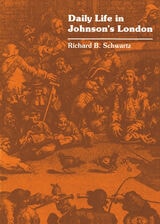
cover of Daily Life in Johnson's London

Daily Life in Johnson's London

Richard B. Schwartz

University of Wisconsin Press, 1983

"Rich in facts and anecdotes, this is the perfect introduction to 18th-century London and a wonderful companion for readers of Johnson and Boswell. . . . Schwartz starts with the sights, sound, and smells of the metropolis—a city of steeples, chimneys, coal smoke, and intolerable street noise—and surveys in succession Work and Money, Pastimes and Pleasures, Daily Routines and Domestic Life, Travel and Transportation, and Health and Hygiene and concludes with a gallery of street 'Londoners,' an independent and assertive lot, notably insolent to foreigners, especially those in French clothes."—Washington Post Book World

"Outstanding. . . . The author packs a remarkable quantity of detail into a small space, even including a discussion of price and wage figures that will be intelligible to Americans [today]. . . . His prose is lucid, graceful, lively. Generously illustrated, the book also includes an extensive bibliography."—Choice

"An excellent source for English Literature and history students studying this period or Samuel Johnson."—Booklist
[more]
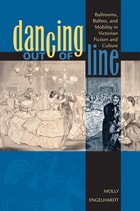
cover of Dancing out of Line: Ballrooms, Ballets, and Mobility in Victorian Fiction and Culture

Dancing out of Line

Ballrooms, Ballets, and Mobility in Victorian Fiction and Culture

Molly Engelhardt

Ohio University Press, 2009

Dancing out of Line transports readers back to the 1840s, when the craze for social and stage dancing forced Victorians into a complex relationship with the moving body in its most voluble, volatile form.

By partnering cultural discourses with representations of the dance and the dancer in novels such as Jane Eyre, Bleak House, and Daniel Deronda, Molly Engelhardt makes explicit many of the ironies underlying Victorian practices that up to this time have gone unnoticed in critical circles. She analyzes the role of the illustrious dance master, who created and disseminated the manners and moves expected of fashionable society, despite his position as a social outsider of nebulous origins. She describes how the daughters of the social elite were expected to “come out” to society in the ballroom, the most potent space in the cultural imagination for licentious behavior and temptation. These incongruities generated new, progressive ideas about the body, subjectivity, sexuality, and health.

Engelhardt challenges our assumptions about Victorian sensibilities and attitudes toward the sexual/social roles of men and women by bringing together historical voices from various fields to demonstrate the versatility of the dance, not only as a social practice but also as a forum for Victorians to engage in debate about the body and its pleasures and pathologies.
[more]
cover of Dangerous Children: On Seven Novels and a Story

Dangerous Children

On Seven Novels and a Story

Kenneth Gross

University of Chicago Press, 2022

Gross explores our complex fascination with uncanny children in works of fiction.
 
Ranging from Victorian to modern works—Lewis Carroll’s Alice in Wonderland, Carlo Collodi’s Pinocchio, Henry James’s What Maisie Knew, J. M. Barrie’s Peter and Wendy, Franz Kafka’s “The Cares of a Family Man,” Richard Hughes’s A High Wind in Jamaica, Elizabeth Bowen’s The Death of the Heart, and Vladimir Nabokov’s Lolita—Kenneth Gross’s book delves into stories that center around the figure of a strange and dangerous child.
 
Whether written for adults or child readers, or both at once, these stories all show us odd, even frightening visions of innocence. We see these children’s uncanny powers of speech, knowledge, and play, as well as their nonsense and violence. And, in the tales, these child-lives keep changing shape. These are children who are often endangered as much as dangerous, haunted as well as haunting. They speak for lost and unknown childhoods. In looking at these narratives, Gross traces the reader’s thrill of companionship with these unpredictable, often solitary creatures—children curious about the adult world, who while not accommodating its rules, fall into ever more troubling conversations with adult fears and desires. This book asks how such imaginary children, objects of wonder, challenge our ways of seeing the world, our measures of innocence and experience, and our understanding of time and memory.
 
[more]
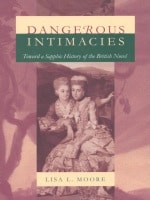
cover of Dangerous Intimacies: Toward a Sapphic History of the British Novel

Dangerous Intimacies

Toward a Sapphic History of the British Novel

Lisa L. Moore

Duke University Press, 1997

Refuting commonly held beliefs within women’s and lesbian history, feminist theory, and histories of the novel, Dangerous Intimacies challenges the idea that sex between women was unimaginable in British culture before the late nineteenth century. Lisa L. Moore argues that literary representations of female sexual agency—and in particular "sapphic" relationships between women—were central to eighteenth-century debates over English national identity. Moore shows how the novel’s representation of women’s "romantic friendships"—both platonic and sexual—were encoded within wider social concerns regarding race, nation, and colonialist ventures.
Moore demonstrates that intimacy between women was vividly imagined in the British eighteenth century as not only chaste and virtuous, but also insistently and inevitably sexual. She looks at instances of sapphism in such novels as Millenium Hall, Memoirs of a Woman of Pleasure, Belinda, and Emma and analyzes how the new literary form of the novel made the bourgeois heroine’s successful negotiation of female friendship central to the establishment of her virtue. Moore also examines representations of sapphism through the sweeping economic and political changes of the period and claims that middle-class readers’ identifications with the heroine’s virtue helped the novel’s bourgeois audience justify the violent bases of their new prosperity, including slavery, colonialism, and bloody national rivalry.
In revealing the struggle over sapphism at the heart of these novels of female friendship—and at the heart of England’s national identity—Moore shows how feminine sexual agency emerged as an important cultural force in post-Enlightenment England
[more]
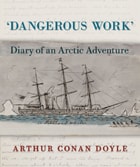
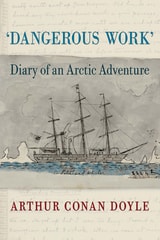
cover of Dangerous Work: Diary of an Arctic Adventure

Dangerous Work

Diary of an Arctic Adventure

Arthur Conan Doyle

University of Chicago Press, 2012

In 1880 a young medical student named Arthur Conan Doyle embarked upon the “first real outstanding adventure” of his life, taking a berth as ship’s surgeon on an Arctic whaler, the Hope. The voyage took him to unknown regions, showered him with dramatic and unexpected experiences, and plunged him into dangerous work on the ice floes of the Arctic seas. He tested himself, overcame the hardships, and, as he wrote later, “came of age at 80 degrees north latitude.”

Conan Doyle’s time in the Arctic provided powerful fuel for his growing ambitions as a writer. With a ghost story set in the Arctic wastes that he wrote shortly after his return, he established himself as a promising young writer. A subsequent magazine article laying out possible routes to the North Pole won him the respect of Arctic explorers. And he would call upon his shipboard experiences many times in the adventures of Sherlock Holmes, who was introduced in 1887’s A Study in Scarlet.
 
Out of sight for more than a century was a diary that Conan Doyle kept while aboard the whaler. Dangerous Work: Diary of an Arctic Adventure makes this account available for the first time in a beautiful facsimile edition that reproduces Conan Doyle’s notebook pages in his own elegant hand, accompanied by his copious illustrations. With humor and grace, Conan Doyle provides a vivid account of a long-vanished way of life at sea. His careful detailing of the experience of arctic whaling is equal parts fascinating and alarming, revealing the dark workings of the later days of the British whaling industry. In addition to the facsimile and annotated transcript of the diary, the volume contains photographs of the Hope, its captain, and a young Conan Doyle on deck with its officers; two nonfiction pieces by Doyle about his experiences; and two of his tales inspired by the journey.
 
To the end of his life, Conan Doyle would look back on this experience with awe: “You stand on the very brink of the unknown,” he declared, “and every duck that you shoot bears pebbles in its gizzard which come from a land which the maps know not. It was a strange and fascinating chapter of my life.” Only now can the legion of Conan Doyle fans read and enjoy that chapter.

A special limited, numbered edition of the clothbound book is also available. In addition, a text-only e-book edition is published as Dangerous Work: Diary of an Arctic Adventure, Text-only Edition.
[more]
cover of Dangerous Work: Diary of an Arctic Adventure, Text-only Edition

Dangerous Work

Diary of an Arctic Adventure, Text-only Edition

Arthur Conan Doyle

University of Chicago Press, 2012

This e-book features the complete text found in the print edition of Dangerous Work, without the illustrations or the facsimile reproductions of Conan Doyle's notebook pages.
In 1880 a young medical student named Arthur Conan Doyle embarked upon the “first real outstanding adventure” of his life, taking a berth as ship’s surgeon on an Arctic whaler, the Hope. The voyage took him to unknown regions, showered him with dramatic and unexpected experiences, and plunged him into dangerous work on the ice floes of the Arctic seas. He tested himself, overcame the hardships, and, as he wrote later, “came of age at 80 degrees north latitude.”
 
Conan Doyle’s time in the Arctic provided powerful fuel for his growing ambitions as a writer. With a ghost story set in the Arctic wastes that he wrote shortly after his return, he established himself as a promising young writer. A subsequent magazine article laying out possible routes to the North Pole won him the respect of Arctic explorers. And he would call upon his shipboard experiences many times in the adventures of Sherlock Holmes, who was introduced in 1887’s A Study in Scarlet.
 
Out of sight for more than a century was a diary that Conan Doyle kept while aboard the whaler. Dangerous Work: Diary of an Arctic Adventure makes this account available for the first time. With humor and grace, Conan Doyle provides a vivid account of a long-vanished way of life at sea. His careful detailing of the experience of arctic whaling is equal parts fascinating and alarming, revealing the dark workings of the later days of the British whaling industry. In addition to the transcript of the diary, the e-book contains two nonfiction pieces by Doyle about his experiences; and two of his tales inspired by the journey.
 
To the end of his life, Conan Doyle would look back on this experience with awe: “You stand on the very brink of the unknown,” he declared, “and every duck that you shoot bears pebbles in its gizzard which come from a land which the maps know not. It was a strange and fascinating chapter of my life.” Only now can the legion of Conan Doyle fans read and enjoy that chapter.
[more]
cover of Dante's Epistle to Cangrande

Dante's Epistle to Cangrande

Robert Hollander

University of Michigan Press, 1994

Dante's epistle to Can Grande de la Scala seemingly provides keys to the Divine Comedy; hence it has posed awkward problems for many students of the poet. On one hand, those who discount "authorial intention" are confronted with Dante's own reading of his poem, an apparently explicit statement of his intentions. On the other, the epistle offers information on how to interpret the poem's allegorical elements, which are at odds with modern sensibilities.

In Dante's Epistle to Cangrande Robert Hollander commandingly marshals new evidence to demonstrate that the epistle should be considered authentically Dantean. He further provides enlightening discussion of the nature of tragedy and comedy in the Divine Comedy. The author draws authoritatively on the extensive array of medieval and modern commentaries stored in electronic form by the Dartmouth Dante Project, of which he is the director.

Dante's Epistle to Cangrande makes a signal contribution to Dante studies. Naturally of interest to students of Dante's work, it will also be important reading for those concerned with literary critical questions such as authorial intent, programmatic statements, and allegorical interpretations of literature.
[more]
cover of Dark Smiles: Race and Desire in George Eliot

Dark Smiles

Race and Desire in George Eliot

Alicia Carroll

Ohio University Press, 2002

Although George Eliot has long been described as “the novelist of the Midlands,” she often brought the outer reaches of the empire home in her work. Dark Smiles: Race and Desire in George Eliot studies Eliot’s problematic, career-long interest in representing racial and ethnic Otherness.

Placing Eliot’s diverse and wide-ranging treatment of Otherness in its contemporary context, Alicia Carroll argues that Eliot both engages and resists traditional racial and ethnic representations of Otherness. Carroll finds that Eliot, like other women writers of her time, often appropriates narratives of Otherness to explore issues silenced in mainstream Victorian culture, particularly the problem of the desirous woman. But if Otherness in Eliot’s century was usually gendered as woman and constructed as the object of white male desire, Eliot often seeks to subvert that vision. Professor Carroll demonstrates Eliot’s tendency to “exoticize” images of girlhood, vocation, and maternity in order to critique and explore gendered subjectivities. Indeed, the disruptive presence of a racial or ethnic outsider often fractures Eliot’s narratives of community, creating a powerful critique of home culture.

The consistent reliance of Eliot’s work upon racial and ethnic Otherness as a mode of cultural critique is explored here for the first time in its entirety.
[more]
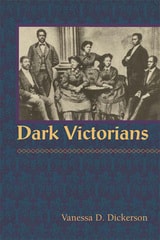
cover of Dark Victorians

Dark Victorians

Vanessa D. Dickerson

University of Illinois Press, 2007
Dark Victorians illuminates the cross-cultural influences between white Britons and black Americans during the Victorian age. In carefully analyzing literature and travel narratives by Ida B. Wells, Harriet Martineau, Charles Dickens, Frederick Douglass, Thomas Carlyle, W.E.B. Du Bois, and others, Vanessa D. Dickerson reveals the profound political, racial, and rhetorical exchanges between the groups. From the nineteenth-century black nationalist David Walker, who urged emigrating African Americans to turn to England, to the twentieth-century writer Maya Angelou, who recalls how those she knew in her childhood aspired to Victorian ideas of conduct, black Americans have consistently embraced Victorian England. At a time when scholars of black studies are exploring the relations between diasporic blacks, and postcolonialists are taking imperialism to task, Dickerson considers how Britons negotiated their support of African Americans with the controlling policies they used to govern a growing empire of often dark-skinned peoples, and how philanthropic and abolitionist Victorian discourses influenced black identity, prejudice, and racism in America.
[more]
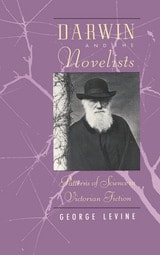
cover of Darwin and the Novelists: Patterns of Science in Victorian Fiction

Darwin and the Novelists

Patterns of Science in Victorian Fiction

George Levine

University of Chicago Press, 1991
Levine shows how Darwin's ideas affected nineteenth-century novelists—from Dickens and Trollope to Conrad. "Levine stands in our day as the premier critic and commentator on Victorian prose."—Frank M. Turner, Nineteenth-Century Literature. "Magnificently written, with a care and delicacy worthy of its subject."—Nina Auerbach, University of Pennsylvania
[more]
cover of Dead Fathers: The Logic of Transference in Modern Narrative

Dead Fathers

The Logic of Transference in Modern Narrative

Nina Schwartz

University of Michigan Press, 1994
Reading modernist literature through the lenses of feminist and psychoanalytic theory, Dead Fathers: The Logic of Transference in Modern Narrative examines the reproduction of passions and passionate conflicts—in individual behavior, in literary representations of such behavior, and in the critical responses to the literature.Through readings of four canonical modernist texts—Heart of Darkness, The Wings of the Dove, The Sun Also Rises, and A Room of One's Own—Nina Schwartz analyzes representations of rebellion against social forces. Arguing that modernist narratives frequently recuperate precisely those forms of authority they wish to undermine, Schwartz demonstrates that their representations of rebellion follow this pattern as well, promoting the very social forces they critique. This is an ever-widening circle, a pattern of repetition compulsion at the levels of character, textual authority, and literary criticism. The books tell stories of people locked into patterns they wish to escape, but the very depiction of entrapment reenacts the doublebind, as the oppressive forms of cultural authority are still the source of coherence in the text. The compulsion is further reproduced in the critical response to the books when readers repeat the structures, language, or concerns of the authors.It is this relation between reading and the desire for authority that Schwartz examines as an example of the psychological phenomenon of transference. Drawing on the work of Lacanian theorist Slavov Žižek to articulate a complex linkage of agency, authority, and desire in writing, this book examines how canonical modernist texts have functioned for readers as transferential objects, repositories of authoritative knowledge, and subjects that know and embody the truth of the modern.
[more]
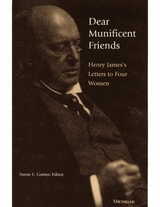
cover of Dear Munificent Friends: Henry James's Letters to Four Women

Dear Munificent Friends

Henry James's Letters to Four Women

Susan E. Gunter, Editor

University of Michigan Press, 2000
Henry James was not only a prolific novelist but also a prolific letter writer. This edition of 150 previously unpublished letters to four of his female contemporaries reveals James to be a warm, witty, and astute commentator on a world now lost. The James revealed in these engaging letters is a vital, clever, and lively man with an intense interest in affairs of his day. The letters present a delightful picture of Victorian-Edwardian culture, including health cures (Fletcherizing and going to health spas), literary scandals (he feared writer Edith Wharton would be destroyed by her mad husband Teddy), domestic affairs (the marriage market, child rearing, antiquing, decorating, and gardening), and historical events (the Civil War, Queen Victoria's funeral, England's great Coal Strike, the Dreyfus case, and World War I).Susan Gunter has selected and annotated correspondence between James and four women in his social milieu: Alice Howe Gibbens James, wife of William James; Mary Cadwalader Jones, wife of Frederic Rhinelander Jones (New York socialite and Edith Wharton's brother); Mary Frances Prothero, wife of Cambridge academic Sir George Prothero; and Lady Louisa Wolseley, wife of Viscount Garnet Wolseley, commander-in-chief of the British Forces. Of the 10,000 extant letters by James, over two-thirds of them have never been published. The selection presented here is designed to reveal the writer's human side, his humorous and warm views of Anglo-American life over a fifty-year span, as well as his intimate participation in nineteenth-century women's daily lives. Editor Susan Gunter has provided an introduction that offers a helpful historical overview of nineteenth-century women's roles, a biographical register of people mentioned in the letters, a chronology, and brief biographies of the four women correspondents. Readers interested in gender studies, biography, intellectual and cultural history, and literary history will find this book fascinating.
[more]
cover of Dearly Beloved Friends: Henry James's Letters to Younger Men

Dearly Beloved Friends

Henry James's Letters to Younger Men

Susan E. Gunter and Steven H. Jobe, Editors

University of Michigan Press, 2004
While the novelist Henry James never formed a permanent relationship with a single individual, in the last decades of his life he increasingly formed passionate attachments to younger men of diverse talents and traits. Dearly Beloved Friends collects carefully edited texts of an ample selection of the writer's personal and often intimate letters -- many of them long withheld from publication -- to four of those men: the sculptor Hendrik Andersen (1872-1940), the dilettante Dudley Jocelyn Persse (1873-1943), and the writers Howard Overing Sturgis (1855-1920) and Sir Hugh Walpole (1884-1941). These letters reveal the humourous, warm side of the literary "Master," and document as never before the depth and eroticism of his love for a number of his friends. Witty, poignant, and passionate, the letters reveal a man in full control of both his rhetoric and his relationships.
[more]
cover of Death Be Not Proud: The Art of Holy Attention

Death Be Not Proud

The Art of Holy Attention

David Marno

University of Chicago Press, 2016

The seventeenth-century French philosopher Nicolas Malebranche thought that philosophy could learn a valuable lesson from prayer, which teaches us how to attend, wait, and be open for what might happen next. Death Be Not Proud explores the precedents of Malebranche’s advice by reading John Donne’s poetic prayers in the context of what David Marno calls the “art of holy attention.”

If, in Malebranche’s view, attention is a hidden bond between religion and philosophy, devotional poetry is the area where this bond becomes visible. Marno shows that in works like “Death be not proud,” Donne’s most triumphant poem about the resurrection, the goal is to allow the poem’s speaker to experience a given doctrine as his own thought, as an idea occurring to him. But while the thought must feel like an unexpected event for the speaker, the poem itself is a careful preparation for it. And the key to this preparation is attention, the only state in which the speaker can perceive the doctrine as a cognitive gift. Along the way, Marno illuminates why attention is required in Christian devotion in the first place and uncovers a tradition of battling distraction that spans from ascetic thinkers and Church Fathers to Catholic spiritual exercises and Protestant prayer manuals.
[more]
cover of Death and the Pearl Maiden: Plague, Poetry, England

Death and the Pearl Maiden

Plague, Poetry, England

David K. Coley

The Ohio State University Press, 2019

The plague first arrived in the English port of Weymouth in the summer of 1348. Two years later, half of Britain was dead, but the Black Death was just beginning. In the decades to come, England would suffer recurring outbreaks, social and cultural upheaval, and violent demographic shifts. The pandemic was, by any measure, a massive cultural trauma; however, within the vernacular English literature of the fourteenth century, the response to the disease appears muted, particularly compared to contemporaneous descriptions emerging from mainland Europe.
Death and the Pearl Maiden: Plague, Poetry, England asks why one of the singular historical traumas of the later Middle Ages appears to be evoked so fleetingly in fourteenth-century Middle English poetry, a body of work as daring and socially engaged as any in English literary history. By focusing on under-recognized pestilential discourses in Pearl, Cleanness, Patience, and Sir Gawain and the Green Knight—the four poems uniquely preserved British Library MS Cotton Nero A.x —this study resists the idea that the Black Death had only a slight impact on medieval English literature, and it strives to account for the understated shape of England’s literary response to the plague and our contemporary understandings of it.
 
[more]
cover of Debating Rhetorical Narratology: On the Synthetic, Mimetic, and Thematic Aspects of Narrative

Debating Rhetorical Narratology

On the Synthetic, Mimetic, and Thematic Aspects of Narrative

Matthew Clark and James Phelan

The Ohio State University Press, 2020

In Debating Rhetorical Narratology:On the Synthetic, Mimetic, and Thematic Aspects of Narrative, Matthew Clark and James Phelan provide a model of lively, sharp, and good-natured scholarly exchange. Clark proposes “friendly amendments” to Phelan’s theorizing of the synthetic, mimetic, and thematic aspects of narrative, and Phelan responds, often by explaining why he finds Clark’s amendments less-than-friendly. Clark rounds off the debate by offering a brief rejoinder. Clark and Phelan consistently ground their theoretical arguments in their analyses of particular narratives, drawing on a corpus that ranges from Homer’s Iliad to Tobias Wolff’s In Pharaoh’s Army and includes, among many others, Jane Austen’s Emma, George Orwell’s 1984, and Toni Morrison’s Beloved.

Clark and Phelan’s deep dive into the synthetic, mimetic, and thematic leads them to explore many other aspects of narrative and narrative theory: style, audiences, the mimetic illusion, fictionality, and more. Their investigation also leads them into questions about rhetorical narratology’s relation to other projects in narrative theory, especially unnatural narratology, and, indeed, about how to assess the explanatory power of competing theories. Ultimately, their debate is compelling testimony about the power of both narrative theory and narrative itself.
[more]
cover of Deep Mapping the Literary Lake District: A Geographical Text Analysis

Deep Mapping the Literary Lake District

A Geographical Text Analysis

Joanna E. Taylor

Bucknell University Press, 2022
England’s famed Lake District—best known as the place of inspiration for the Wordsworths, Samuel Taylor Coleridge, and other Romantic-era writers—is the locus of this pioneering study, which implements and critiques a new approach to literary analysis in the digital age. Deploying innovative methods from literary studies, corpus linguistics, historical geography, and geographical information science, Deep Mapping the Literary Lake District combines close readings of a body of writing about the region from 1622-1900 with distant approaches to textual analysis. This path-breaking volume exemplifies interdisciplinarity, demonstrating how digital humanities methodologies and geospatial tools can enhance our appreciation of a region whose topography has been long recognized as fundamental to the shape of the poetry and prose produced within it.
[more]
cover of Defects: Engendering the Modern Body

Defects

Engendering the Modern Body

Helen Deutsch and Felicity Nussbaum, Editors

University of Michigan Press, 2000

Defects brings together essays on the emergence of the concept of monstrosity in the eighteenth century and the ways it paralleled the emergence of notions of sexual difference. Women, declared a mid-eighteenth-century vindication, have been regarded since Aristotle as deformed amphibious things, "neither more or less than Monsters" (Beauty's Triumph 1758). This alliance of monstrosity with misogyny, along with the definition of sexual difference as aberration, is the starting point for this volume's investigation of monstrosity's cultural work in the eighteenth century and its simultaneous mapping and troubling of the range of differences. This collection investigates the conceptual and geographical mapping of early modern and Enlightenment ideas of monstrosity onto a range of differences that contested established categories. The essays consider the representations and material dimensions of phenomena as diverse as femininity and disfigurement, the material imagination and monstrous birth, ugliness as an aesthetic category, deafness and theories of sign language, and the exotic, racialized deformed. Collectively, they demonstrate that the emergence of sexual difference is inextricably intertwined with the emergence of a category of the human that is imagined and deformed, monstrous, and ugly.
[more]
cover of Defoe's Britain

Defoe's Britain

jeremy black

St. Augustine's Press, 2023

The Weight of Words Series continues with Daniel Defoe, as historian Jeremy Black uses this writer to interpret Britain in the late 1600s, and likewise looks to the times to interpret the fiction. As seen in previous studies on Christie, Smollett, Fielding, and the Gothic novelists, Black tells the story of the story-teller, and presents the picture of British nationalism that "was the product, history, and record of struggle––collective and individual––as well as its defence. Defoe provides particular accounts of this struggle, both in foreign seas and lands, and at home. This struggle had a moral character that is difficult to capture today."
 
Defoe was an outsider, a man of many interests whom Black asserts evades too precise a portrait or coherent description of character and career. But he is a traveler, in the literal and imaginative senses, and in his engagement with life and its issues and willingness to associate with 'low-life' prefigures later literary giants like Smollett and Fielding. More than the establishment of genre, Defoe created the writer "whose business is observation." Black's account of this parcel of the British past is impeccable because it is in fact an account that the past, in Defoe, gives of itself. "As a writer, Defoe brought together a reality usually presented as, and endorsed by, history, with the imaginative focus of storytelling, and the direction of, variously, propaganda, analysis, and exemplary tale." 
[more]
cover of Democratic Education: The Complete Prose Works of Matthew Arnold

Democratic Education

The Complete Prose Works of Matthew Arnold

Matthew Arnold; Edited by R. H. Super

University of Michigan Press, 1962
An inspector of schools as well as a professor of poetry, Matthew Arnold was an educator in the true sense of the word. Watching democracy breed self-satisfied Philistines, he relized that not all the liberty and industry in the world would insure the rule of right reason. If we are to survive, he said, we must seize on the best and make it prevail. The fate of civilization depends on our schools. Unfailingly relevant, his essays on education include Democracy, The Popular Education of France, and A French Eton, as well as three essays discovered by the editor in the pages of the London Review and republished here for the first time. They form a crucial chapter in the history of education, setting forth the standards upon which Arnold's literary criticism was to be based and from which his political utterances were to come.
[more]
cover of Desiring Freedom: Counter-Imaginaries of Work, Sex, and Family After West Indian Emancipation

Desiring Freedom

Counter-Imaginaries of Work, Sex, and Family After West Indian Emancipation

Kaneesha Cherelle Parsard

University of Chicago Press, 2026

A groundbreaking account of concepts of freedom in West Indian literature and visual culture.

Desiring Freedom examines post-emancipation West Indian literature and visual culture to ask how they reimagine freedom. Ranging from emancipation in the 1830s to the arrival of independence in the 1960s, Kaneesha Cherelle Parsard analyzes a literary and visual repertoire through which West Indians and Britons cast doubt on wage labor and domesticity as freedom. Whereas freedom was traditionally conceived around narratives of the self-governing individual, Parsard unearths a diverse range of materials—fiction, poetry, painting, photography, imperial correspondence, social scientific discourse, and economic history—in which this plot breaks down, finding practices of freedom in hoarding, pleasure-seeking, hustling, and siphoning. 

Parsard focuses on conceptions of freedom in Trinidad, British Guiana, and Jamaica. Along the way, she shows how indentured Indian women’s jewelry reveals contradictions in imperial capital, studies the short fiction of a 1930s Trinidadian literary collective called the Beacon group to reveal how women find both profit and pleasure in their affairs, and offers a fascinating reading of C. L. R. James’s only novel, Minty Alley—including a little-known alternative ending. In a key methodological contribution, Parsard develops proposition as a critical tool, drawing on its many valences—a sexual advance, a contract before its signing, and, in philosophy, the act of saying “this is how things stand.” Parsard’s own propositions show that West Indian culture offers new ways of seeing the relationships among race, labor, capital, gender, and sexuality after emancipation.
[more]
cover of Devotions Upon Emergent Occasions: Together with Death's Duel

Devotions Upon Emergent Occasions

Together with Death's Duel

John Donne

University of Michigan Press, 1959

Devotions upon Emergent Occasions: Together with Death's Duel is a profound collection of meditations and sermons by John Donne that reflect on the human condition, mortality, and spirituality. Written during a severe illness in 1623, the Devotions are a series of reflections that combine Donne's experience of personal anguish with deep theological insights. He explores themes of suffering, divine intervention, and redemption. In addition, Death's Duel, often considered Donne's final sermon before his death, serves as a poignant and eloquent meditation on the inevitability of death and the promise of eternal life. Together, these writings offer readers a timeless contemplation of life, faith, and death.
[more]
cover of Dialogic Novels of Malcolm Bradbury and David Lodge

Dialogic Novels of Malcolm Bradbury and David Lodge

Robert A. Morace

Southern Illinois University Press, 1989

Morace analyzes the novels of Malcolm Bradbury and David Lodge together because they provide a dialogue of conflicting views, styles, and forms of the contemporary novel. This dialogue parallels the views of these two British novelists as critics.

Beginning as realists, as novelists of manners, as writers of campus novels, Bradbury and Lodge explore the possibilities and the limitations of realistic writing. Bradbury and Lodge, however, are not only heirs of English literary tradition. Both are also literary critics with a keen interest in recent critical theories. Morace shows us how the debate between Bradbury and Lodge over the nature and purpose of fiction and criticism has found its way into their novels. The realistic conflicts between civilian and military, English and American, pre- and post-Vatican II values gradually give way to an exploration of the semiotics behind such conflicts.

Morace finds Bradbury’s and Lodge’s works far more open-ended than the "doggedly indeterminate fictions" of many contemporary writers. Using Mikhail Bakhtin’s theory of dialogism, he identifies the ways in which language and values simultaneously compete with and support one another in their novels.

This first book-length study of Bradbury or Lodge deals with all of their novels, including Changing Places, How Far Can You Go?, and Small World by Lodge, as well as Bradbury’s The History of Man and Rates of Exchange.
[more]
cover of Diaphanous Bodies: Ability, Disability, and Modernist Irish Literature

Diaphanous Bodies

Ability, Disability, and Modernist Irish Literature

Jessica Colangelo

University of Michigan Press, 2021

Diaphanous Bodies: Ability, Disability, and Modernist Irish Literature examines ability, as a category of embodiment and embodied experience, and in the process opens up a new area of inquiry in the growing field of literary disability studies. It argues that the construction of ability arises through a process of exclusion and forgetting, in which the depiction of sensory information and epistemological judgment subtly (or sometimes un-subtly) elide the fact of embodied subjectivity. The result is what Colangelo calls “the myth of the diaphanous abled body,” a fiction that holds that an abled body is one which does not participate in or situate experience.  The diaphanous abled body underwrites the myth that abled and disabled constitute two distinct categories of being rather than points on a constantly shifting continuum.

In any system of marginalization, the dominant identity always sets itself up as epistemologically and experientially superior to whichever group it separates itself from. Indeed, the norm is always most powerful when it is understood as an empty category or a view from nowhere. Diaphanous Bodies explores the phantom body that underwrites the artificial dichotomy between abled and disabled upon which the representation of embodied experience depends.

[more]
cover of Dickens and Thackeray: Punishment and Forgiveness

Dickens and Thackeray

Punishment and Forgiveness

John Robert Reed

Ohio University Press, 1996

Attitudes toward punishment and forgiveness in English society of the nineteenth century came, for the most part, out of Christianity. In actual experience the ideal was not often met, but in the literature of the time the model was important. For novelists attempting to tell exciting and dramatic stories, violent and criminal activities played an important role, and, according to convention, had to be corrected through poetic justice or human punishment. Both Dickens’ and Thackeray’s novels subscribed to the ideal, but dealt with the dilemma it presented in slightly different ways.

At a time when a great deal of attention has been directed toward economic production and consumption as the bases for value, Reed’s well-documented study reviving moral belief as a legitimate concern for the analysis of nineteenth-century English texts is particularly illuminating.

[more]
cover of Dickens' Working Notes for His Novels

Dickens' Working Notes for His Novels

Charles Dickens

University of Chicago Press, 1987

This volume collects for the first time all of Charles Dickens' extant plans and notes for his novels. Dickens wrote his novels in segments during the course of serial publication. Beginning with Dombey and Son, the sixth novel, he wrote out plans for each segment as he went along, sketching future developments, querying himself about options, noting motifs, establishing recurrent images, working out chronologies, experimenting with names, and, in general, reminding himself of what he had done and what he should do next. Some notes survive from before Dombey and those for a few novels after that are incomplete or abbreviated, but for the most part the plan from Dombey on are full and complete. Each sheet of these notes is reproduced here in actual-size photographic facsimile and is transcribed on the facing page in typographic facsimile, a format that preserves Dickens' holographic nuances and at the same time allows for the instant decipherment of his often difficult hand. Included are his plans for The Old Curiosity Shop, Martin Chuzzlewit, Dombey and Son, David Copperfield, Bleak House, Hard Times, Little Dorrit, Great Expectations, Our Mutual Friend, and Edwin Drood. The volume also contains thirty-three full-page illustrations and a full-color frontispiece.

Harry Stone, an internationally recognized Dickens scholar, provides the reader with a full account of Dickens' methods of planning and working. In a comprehensive introduction and extensive notes, he uses Dickens' written plans to illuminate the thought and technique of the novels. He examines creative concerns, such as Dickens' process of naming and visualization, and technical matters, such as his use of various pen nibs, ink colors, and papers.

By making fully available and comprehensible Dickens' own cache of in-process plans, possibilities, and alternatives for shaping his novels, Dickens' Working Notes offers unparalleled insights into the novelist's art and into the nature of the creative imagination.
[more]
cover of Dickens's Forensic Realism: Truth, Bodies, Evidence

Dickens's Forensic Realism

Truth, Bodies, Evidence

Andrew Mangham

The Ohio State University Press, 2017

Dickens’s Forensic Realism: Truth, Bodies, Evidence by Andrew Mangham is one of the first studies to bring the medical humanities to bear on the work of Dickens. Turning to the field of forensic medicine (or medical jurisprudence), Mangham uncovers legal and medical contexts for Dickens’s ideas that result in new readings of novels, short stories, and journalism by this major Victorian author. Dickens’s Forensic Realism argues that the rich and unstable nature of truth and representation in Dickens owes much to the ideas and strategies of a forensic Victorian age, obsessed with questioning the relationship between clues and truths, evidences and answers.
                       
As Mangham shows, forensic medicine grew out of a perceived need to understand things with accuracy, leaning in part on the range of objectivities that inspired the inorganic sciences. At the same time, it had the burden of assisting the law in convicting the guilty and in exonerating the innocent. Practitioners of forensic medicine were uniquely mindful of unwanted variables such as human error and the vagaries of interpretation. In readings of Oliver Twist, Our Mutual Friend, Bleak House, The Pickwick Papers, Great Expectations, and Dickens’s early journalism, Mangham demonstrates that these questions about signification, perception, and reality are central to the stylistic complexities and playful tone often associated with Dickens. Moreover, the medico-legal context of Dickens’s fiction illuminates the richness and profundity, style and impact of Dicken’s narratives.
 
[more]
cover of Dickens's Hyperrealism

Dickens's Hyperrealism

John R. Reed

The Ohio State University Press, 2009

In Dickens’s Hyperrealism, John R. Reed examines certain features of Dickens’s style to demonstrate that the Inimitable consciously resisted what came to be known as realism in the genre of the novel. Dickens used some techniques associated with realism, such as description and metonymy, to subvert the purposes usually associated with it. Reed argues that Dickens used such devices as personification and present-tense narration, which are anathema to the realist approach. He asserts that Dickens preferred a heightened reality, not realism. And, unlike the realism which seeks to mask authorial control of how readers read his novels, Dickens wanted to demonstrate, first openly, and later in his career more subtly, his command over his narratives.
 
This book opens a new avenue for investigating Dickens’s mastery of his art and his awareness of its literary context. In addition, it reopens the whole issue of realism as a definition and examines the variety of genres that coexisted in the Victorian period.
[more]
cover of Dickens's London

Dickens's London

Peter Clark

Haus Publishing, 2012

Marking the 150th anniversary of Charles Dickens’s death, Dickens’s London leads us in the footsteps of the author through this beloved city. Few novelists have written so intimately about a place as Dickens wrote about London, and, from a young age, his near-photographic memory rendered his experiences there both significant and in constant focus. Virginia Woolf maintained that “we remodel our psychological geography when we read Dickens,” as he produces “characters who exist not in detail, not accurately or exactly, but abundantly in a cluster of wild yet extraordinarily revealing remarks.” The most enduring “character” Dickens was drawn back to throughout his novels was London itself, in all its aspects, from the coaching inns of his early years to the taverns and watermen of the Thames. These were the constant cityscapes of his life and work.

In five walks through central London, Peter Clark explores “The First Suburbs”—Camden Town, Chelsea, Greenwich, Hampstead, Highgate and Limehouse—as they feature in Dickens’s writing and illuminates the settings of Dickens’s life and his greatest works of journalism and fiction. Describing these storied spaces of today’s central London in intimate detail, Clark invites us to experience the city as it was known to Dickens and his characters. These walks take us through the locations and buildings that he interacted with and wrote about, creating an imaginative reconstruction of the Dickensian world that has been lost to time.
 
[more]
cover of Dickens, His Parables, and His Reader

Dickens, His Parables, and His Reader

Linda M. Lewis

University of Missouri Press, 2011
 
Charles Dickens once commented that in each of his Christmas stories there is “an express text preached on . . . always taken from the lips of Christ.” This preaching, Linda M. Lewis contends, does not end with his Christmas stories but extends throughout the body of his work. In Dickens, His Parables, and His Reader, Lewis examines parable and allegory in nine of Dickens’s novels as an entry into understanding the complexities of the relationship between Dickens and his reader.
Through the combination of rhetorical analysis of religious allegory and cohesive study of various New Testament parables upon which Dickens based the themes of his novels, Lewis provides new interpretations of the allegory in his novels while illuminating Dickens’s religious beliefs. Specifically, she alleges that Dickens saw himself as valued friend and moral teacher to lead his “dear reader” to religious truth.
Dickens’s personal gospel was that behavior is far more important than strict allegiance to any set of beliefs, and it is upon this foundation that we see allegory activated in Dickens’s characters. Oliver Twist and The Old Curiosity Shop exemplify the Victorian “cult of childhood” and blend two allegorical texts: Jesus’s Good Samaritan parable and John Bunyan’s ThePilgrim’s Progress. In Dombey and Son,Dickens chooses Jesus’s parable of the Wise and Foolish Builders. In the autobiographical David Copperfield, Dickens engages his reader through an Old Testament myth and a New Testament parable: the expulsion from Eden and the Prodigal Son, respectively.
Led by his belief in and desire to preach his social gospel and broad church Christianity, Dickens had no hesitation in manipulating biblical stories and sermons to suit his purposes. Bleak House is Dickens’s apocalyptic parable about the Day of Judgment, while Little Dorrit   echoes the line “Forgive us our debts as we forgive our debtors” from the Lord’s Prayer, illustrating through his characters that only through grace can all debt be erased. The allegory of the martyred savior is considered in Hard Times and A Tale of Two Cities. Dickens’s final completed novel, Our Mutual Friend, blends the parable of the Good and Faithful Servant with several versions of the Heir Claimant parable.
While some recent scholarship debunks the sincerity of Dickens’s religious belief, Lewis clearly demonstrates that Dickens’s novels challenge the reader to investigate and develop an understanding of New Testament doctrine. Dickens saw his relationship with his reader as a crucial part of his storytelling, and through his use and manipulation of allegory and parables, he hoped to influence the faith and morality of that reader.
[more]
cover of Difficult Rhythm: Music and the Word in E.M. Forster

Difficult Rhythm

Music and the Word in E.M. Forster

Michelle Fillion

University of Illinois Press, 2013
Difficult Rhythm examines E. M. Forster's irrepressible interest in music, providing plentiful examples of how the eminent British author's fiction resonates with music. Musicologist Michelle Fillion analyzes his critical writings, short stories, and novels, including A Room with a View, which alludes to Beethoven, Wagner, and Schumann, and Howards End, which explicitly alerts readers how fiction can adopt musical forms and ideas. This volume also includes, for the first time in print, Forster's notes on Beethoven's piano sonatas. Documenting his knowledge of music, his musical favorites and friends, and his attitudes toward various composers, performances, and competing musical theories, this engaging book traces the musical influences of luminaries such as Wagner, Beethoven, Tchaikovsky, and Britten on Forster's life and work.
[more]
cover of Directing Beckett

Directing Beckett

Lois Oppenheim

University of Michigan Press, 1997

In Directing Beckett, Lois Oppenheim presents interviews and essays with twenty-two prominent international directors of Samuel Beckett's work, many of whom worked closely with Beckett, assisting him with his productions or acting under his direction before directing his work themselves. Here they speak openly of their experiences of working with him, and comment on various productions that, in taking great liberties with his work, have raised a number of fascinating legal and aesthetic questions.
In exploring this key figure in the history of theater, Oppenheim's interviews--with such directors as JoAnne Akalaitis, Edward Albee, Herbert Blau, Joseph Chaikin, and Carey Perloff--also address many of the complexities of the director's role, such as the meaning of directorial integrity and fidelity to the playwright's vision--an issue of particular relevance to a playwright whose exactitude, with respect to stage directions, is well documented. Additional highlights include photographs from many of the productions; the unpublished text of a lecture by the late Alan Schneider, Beckett's most accomplished American director; and an interview with the late Roger Blin, the very first director of Beckett's work.
"Directing Beckett is a rare thing--a book both pleasant to read and useful to have . . . it is like listening to the ideal panel, everyone who should be there there and all at their articulate best." --Toby Silverman Zinman, Theatre Journal
"Anyone intending to direct or act in a work by Beckett, or to write about his work, must read this book." --Choice
Lois Oppenheim is Professor of French, Montclair State University
[more]
cover of Disowned by Memory: Wordsworth's Poetry of the 1790s

Disowned by Memory

Wordsworth's Poetry of the 1790s

David Bromwich

University of Chicago Press, 1998

Although we know him as one of the greatest English poets, William Wordsworth might not have become a poet at all without the experience of personal and historical catastrophe in his youth. In Disowned by Memory, David Bromwich connects the accidents of Wordsworth's life with the originality of his writing, showing how the poet's strong sympathy with the political idealism of the age and with the lives of the outcast and the dispossessed formed the deepest motive of his writings of the 1790s.

"This very Wordsworthian combination of apparently low subjects with extraordinary 'high argument' makes for very rewarding, though often challenging reading."—Kenneth R. Johnston, Washington Times

"Wordsworth emerges from this short and finely written book as even stranger than we had thought, and even more urgently our contemporary."—Grevel Lindop, Times Literary Supplement

"[Bromwich's] critical interpretations of the poetry itself offer readers unusual insights into Wordworth's life and work."—Library Journal

"An added benefit of this book is that it restores our faith that criticism can actually speak to our needs. Bromwich is a rigorous critic, but he is a general one whose insights are broadly applicable. It's an intellectual pleasure to rise to his complexities."—Vijay Seshadri, New York Times Book Review
[more]
cover of Disturbers of the Twentieth Century: Catholic Social Critics in Modern Britain

Disturbers of the Twentieth Century

Catholic Social Critics in Modern Britain

Adam Schwartz

Catholic University of America Press, 2026
Building on his acclaimed The Third Spring, Adam Schwartz presents a pioneering analysis of the social commentary of G. K. Chesterton, Graham Greene, Christopher Dawson, and David Jones. These four converts were exemplars of the Catholic literary revival as a “counter-politics” that provided a radical, supernaturalist alternative to predominant secularist social ideologies and systems from a distinctly Roman Catholic standpoint.  Disturbers of the Twentieth Century explores this facet of each writer’s work more thoroughly than earlier studies have done, and does so in comparison to his counterparts’ thought.  The Catholic literary revival hence emerges as a vital, yet largely neglected, voice in historical and sociological discussions of the relationship between religion and politics in the modern era. In the process, Schwartz uniquely situates these Catholic authors in broader heritages of British and Western protest thought dating to the Romantics, showing how their shared resistance to industrial technocracy (and its socio-political effects) and growing secularization was defined distinctively by Roman Catholicism.  The converts’ challenge was bolder than post-Reformation British Catholics had usually uttered in an often-hostile political culture.  Nonetheless this quartet’s criticism was always constructive, as they eschewed nostalgia and endeavored consciously to engage twentieth century society in its particular genres and discrete conditions to transform it into an “alternative modernity” governed by Roman Catholic principles. Schwartz therefore recasts understanding of movements like Chesterton’s distributism while elucidating originally other counterstatements, such as Dawson’s Christian corporatism, and deploying newly discovered and published material, including poetry and prose by Jones and letters and journalism by Greene.  Schwartz in turn interrogates misconstruals of the authors’ relationships to totalitarian ideologies, even as he confronts forthrightly controversial subjects such as antisemitism.  Disturbers of the Twentieth Century is thus an accurate, textured account of the “public doctrine” these trenchant Catholics proposed as the source of social renewal and cultural regeneration for a “century of bones.”
[more]
cover of Doctoring the Novel: Medicine and Quackery from Shelley to Doyle

Doctoring the Novel

Medicine and Quackery from Shelley to Doyle

Sylvia A. Pamboukian

Ohio University Press, 2012

If nineteenth-century Britain witnessed the rise of medical professionalism, it also witnessed rampant quackery. It is tempting to categorize historical practices as either orthodox or quack, but what did these terms really signify in medical and public circles at the time? How did they develop and evolve? What do they tell us about actual medical practices?

Doctoring the Novel explores the ways in which language constructs and stabilizes these slippery terms by examining medical quackery and orthodoxy in works such as Mary Shelley’s Frankenstein, Charles Dickens’s Bleak House and Little Dorrit, Charlotte Brontë’s Villette, Wilkie Collins’s Armadale, and Arthur Conan Doyle’s Stark Munro Letters. Contextualized in both medical and popular publishing, literary analysis reveals that even supposedly medico-scientific concepts such as orthodoxy and quackery evolve not in elite laboratories and bourgeois medical societies but in the rough-and-tumble of the public sphere, a view that acknowledges the considerable, and often underrated, influence of language on medical practices.
[more]
cover of Domestic Georgic: Labors of Preservation from Rabelais to Milton

Domestic Georgic

Labors of Preservation from Rabelais to Milton

Katie Kadue

University of Chicago Press, 2021

Inspired by Virgil’s Georgics, this study conceptualizes Renaissance poetry as a domestic labor.

When is literary production more menial than inspired, more like housework than heroics of the mind? In this revisionist study, Katie Kadue shows that some of the authors we credit with groundbreaking literary feats—including Michel de Montaigne and John Milton—conceived of their writing in surprisingly modest and domestic terms. In contrast to the monumental ambitions associated with the literature of the age, and picking up an undercurrent of Virgil’s Georgics, poetic labor of the Renaissance emerges here as often aligned with so-called women’s work. Kadue reveals how male authors’ engagements with a feminized georgic mode became central to their conceptions of what literature is and could be. This other georgic strain in literature shared the same primary concern as housekeeping: the necessity of constant, almost invisible labor to keep the things of the world intact. Domestic Georgic brings into focus a conception of literary—as well as scholarly and critical—labor not as a striving for originality and fame but as a form of maintenance work that aims at preserving individual and collective life.
[more]
cover of Domesticity, Imperialism, and Emigration in the Victorian Novel

Domesticity, Imperialism, and Emigration in the Victorian Novel

Diana C. Archibald

University of Missouri Press, 2002
During the nineteenth century, as millions of British citizens left for the New Worlds, hearth and home were physically moved from the heart of the empire to its very outskirts. In Domesticity, Imperialism, and Emigration in the Victorian Novel, Diana Archibald explores how such demographic shifts affected the ways in which Victorians both promoted and undermined the ideal of the domestic woman. Drawing upon works by Elizabeth Gaskell, Anthony Trollope, Samuel Butler, Charles Dickens, Charles Reade, and William Makepeace Thackeray, the author shows how the ideals of womanhood and home promoted by domestic ideology in many ways conflict with the argument in favor of immigration to imperial destinations. 
According to Coventry Patmore and John Ruskin, and some of their contemporaries, woman’s natural domain is the home, and a woman’s fulfillment lies at the hearthside. But would any hearth do as long as it was hallowed by the presence of a domestic goddess, or was this Victorian definition of home more discriminating? Although the ideal of the domestic woman was certainly affected by these mass movements, in many texts the definition of her becomes narrow and unattainable, for she must not only be an “angel,” but she must also be English and remain at home.
A rather predictable pattern emerges in almost every Victorian novel that encounters the New Worlds: if an English hero is destined for a happy ending, he either marries an English angel-wife and brings her with him to the New World or, more often, abandons thoughts of settling abroad and returns to England to marry and establish a home. This pattern seems to support the supposedly complementary ideologies of domesticity and imperialism. England, according to imperialist dogma, was the righteous center of a powerful empire whose mission was to “civilize” the rest of the world. The purpose of the domestic “angel” was to provide the moral center of a sacred space, and what is more sacred to such a scheme than English soil? A true “angel” should be English. Despite the mass migrations of the nineteenth century, home remains fundamentally English.
 The literary texts, however, reveal much ambivalence toward this domestic ideal. Often the colonial and native women were seen as foils for the English “angels” because they were much more interesting and attractive. At times, domestic and imperialist ideologies themselves conflicted. Female emigrants were desperately needed in the colonies; thus, a woman’s imperial duty was to leave England. Yet her womanly duty
told her to remain an untainted idol beside an English hearthside. The domestic ideal, then, because of its firm alliance with nationalism, seems to have been more in conflict with imperialistic ideology than heretofore supposed.
[more]
cover of Doris Lessing: The Alchemy of Survival

Doris Lessing

The Alchemy of Survival

Carey Kaplan

Ohio University Press, 1988

Long neglected by the academic world because of her rejection of belletristic values and resistance to convenient literary taxonomy, Doris Lessing has nonetheless built an international following of serious, dedicated readers. Acknowledging the difficulties posed by the multiple dimensions of Lessing’s work, Kaplan and Rose have gathered eleven essays that address her artistic, philosophical, political, and psychological complexity, and so provide a welcome introduction to the extraordinary depth and diversity of this important contemporary novelist.

Lessing has been described as an “alchemical” writer, in that her work is directed toward changing people’s lives and perceptions rather than simply recording experience. Accordingly, the contributors examine her various postures and tactics for the purpose of discovering how the alchemical elements inform her various personae. Frederick C. Stern discusses Lessing’s commitment to radical humanist thought, while Carey Kaplan examines how Lessing’s imperialist past has shaped her futuristic fiction. Elizabeth Abel offers a feminist interpretation of the pattern of brother-sister incest in Lessing’s work, showing how Lessing has established Antigone as a female alternative to the Oedipal myth of male incest. Particularly insightful is Eve Bertelsen’s report of her interview with Lessing, demonstrating how Lessing’s often evasive style of adversarial dialogue works in concert with her refusal to be conveniently pigeonholed by academic analysis.

For those readers new to her work, Doris Lessing: The Alchemy of Survival will serve as a useful introduction to Lessing’s concerns and techniques. Those who have long admired her writing will find in this collection new keys to understanding Lessing’s philosophical, political, and psychological complexity.
[more]
cover of Doris Lessing: The Poetics of Change

Doris Lessing

The Poetics of Change

Gayle Greene

University of Michigan Press, 1997

Doris Lessing has been a chronicler of our age for nearly half a century, and a study of her writing career does not yield easy generalizations. Difficult though she is to categorize, she is always concerned with change, with a search for "something new" against "the nightmare repetition" of history. The feminist quest she articulated in The Children of Violence and The Golden Notebook entered the culture with the force of a new myth: these books changed lives. The Golden Notebook--together with such works as The Second Sex and The Feminine Mystique--raised the consciousness of a generation of women readers and played a major part in making the second wave of feminism. It is the power of Lessing's novels to change people's lives, the effect she had raising the consciousness of a generation of women and the effect she continues to have on young readers, that is the subject of this book.

Gayle Greene employs an eclectic range of approaches (psychoanalytic, Marxist, biographical, historical, intertextual, formalist, feminist) to shed new light on Lessing's remarkable achievement. She sees Lessing as a feminist writer, not in offering strong female role models who climb top the top of existing social structures, but in envisioning, and indeed helping to bring about, a transformation of those structures. Lessing critiques Western values of individualism, competition, and materialism in terms similar to those developed by feminism; and, in getting us to view our culture from without, in teaching us to read cultural constructs as systems, her novels perform the deconstructing and demystifying work of feminism.
[more]
cover of Dorothy Dunnett’s Lymond Chronicles: The Enigma of Francis Crawford

Dorothy Dunnett’s Lymond Chronicles

The Enigma of Francis Crawford

Scott Richardson

University of Missouri Press, 2016
Since the first installment of Dunnett’s series was published in 1961, Francis Crawford of Lymond, the swashbuckling protagonist of the stories, has been captivating his fellow characters and readers alike. Instead of approaching the books primarily as historical fiction, Richardson, an enthusiastic admirer of the series, unravels the complexities of the main character by exploring his psychology, positioning the books within the genre of espionage, and examining Dunnett’s strategy of using games in her writing. Richardson’s insight and passion for his subject will inspire fans to revisit Dunnett’s series.

[more]
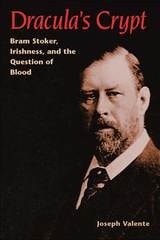
cover of Dracula's Crypt: Bram Stoker, Irishness, and the Question of Blood

Dracula's Crypt

Bram Stoker, Irishness, and the Question of Blood

Joseph Valente

University of Illinois Press, 2001

Dracula's Crypt unearths the Irish roots of Bram Stoker's gothic masterpiece, offering a fresh interpretation of the author's relationship to his novel and to the politics of blood that consumes its characters.
 
An ingenious reappraisal of a classic text, Dracula's Crypt presents Stoker's novel as a subtly ironic commentary on England's preoccupation with racial purity. Probing psychobiographical, political, and cultural elements of Stoker's background and milieu, Joseph Valente distinguishes Stoker's viewpoint from that of his virulently racist, hypermasculine vampire hunters, showing how the author's dual Anglo-Celtic heritage and uncertain status as an Irish parvenu among London's theatrical elite led him to espouse a progressive racial ideology at odds with the dominant Anglo-Saxon supremacism. In the light of Stoker's experience, the shabby-genteel Count Dracula can be seen as a doppelgänger, an ambiguous figure who is at once the blood-conscious landed aristocrat and the bloodthirsty foreign invader.
 
Stoker also confronts gender ideals and their implications, exposing the "inner vampire" in men like Jonathan Harker who dominate and absorb the women who become their wives. Ultimately, Valente argues, the novel celebrates a feminine heroism, personified by Mina Harker, that upholds an ethos of social connectivity against the prevailing obsession with blood as a vehicle of identity.
 
Revealing a profound and heretofore unrecognized ethical and political message, Dracula's Crypt maintains that the real threat delineated in Dracula is not racial degeneration but the destructive force of racialized anxiety itself. Stoker's novel emerges as a powerful critique of the very anxieties it has previously been taken to express: anxieties concerning the decline of the British empire, the deterioration of Anglo-Saxon culture, and the contamination of the Anglo-Saxon race.
 
[more]
cover of Drama in English From the Middle Ages to the Early Twentieth Century

Drama in English From the Middle Ages to the Early Twentieth Century

Christopher J. Wheatley

Catholic University of America Press, 2016
At a time when good editions of drama in English are prohibitively expensive and online texts are unedited and lack the apparatus necessary for students to understand and contextualize the plays, this anthology affordably illustrates every significant genre of drama in the English language from the late fourteenth century to the early twentieth century, with plays from England, Ireland, and the United States of America. The mystery and morality plays of the Middle Ages, Renaissance comedy, tragedy and meta-theater, Restoration and eighteenth-century comedy, tragedy, and ballad opera, nineteenth-century melodrama, and early twentieth century realism and naturalism are all presented with the introductions glossaries and notes suitable for a college level reader by an editor with a quarter of a century of experience teaching courses on the history of drama in English. The plays both reflect their times and critique them, while remaining stageable today. The Wakefield Master, The York Realist, Marlowe, Jonson, Dryden, Wycherley, Gay, Boucicault, Synge, and Shaw are some of the playwrights in this representative collection of plays that reveal both the popular appeal of the English-language theater and the dazzling dramatic artistry it embodied over a period of six centuries. Further the collection is in "old spelling" and is thus a useful sourcebook for those interested in the history of the English language.
[more]
cover of Drama, Play, and Game: English Festive Culture in the Medieval and Early Modern Period

Drama, Play, and Game

English Festive Culture in the Medieval and Early Modern Period

Lawrence M. Clopper

University of Chicago Press, 2001

How was it possible for drama, especially biblical representations, to appear in the Christian West given the church's condemnation of the theatrum of the ancient world?In a book with radical implications for the study of medieval literature, Lawrence Clopper resolves this perplexing question.

Drama, Play, and Game demonstrates that the theatrum repudiated by medieval clerics was not "theater" as we understand the term today. Clopper contends that critics have misrepresented Western stage history because they have assumed that theatrum designates a place where drama is performed. While theatrum was thought of as a site of spectacle during the Middle Ages, the term was more closely connected with immodest behavior and lurid forms of festive culture. Clerics were not opposed to liturgical representations in churches, but they strove ardently to suppress May games, ludi, festivals, and liturgical parodies. Medieval drama, then, stemmed from a more vernacular tradition than previously acknowledged-one developed by England's laity outside the boundaries of clerical rule.
[more]
cover of Dramatic Extracts in Seventeenth-Century English Manuscripts: Watching, Reading, Changing Plays

Dramatic Extracts in Seventeenth-Century English Manuscripts

Watching, Reading, Changing Plays

Laura Estill

University of Delaware Press, 2015

Throughout the seventeenth century, early modern play readers and playgoers copied dramatic extracts (selections from plays and masques) into their commonplace books, verse miscellanies, diaries, and songbooks. Dramatic Extracts in Seventeenth-Century English Manuscripts: Watching, Reading, Changing Plays is the first to examine these often overlooked texts, which reveal what early modern audiences and readers took, literally and figuratively, from plays. As this under-examined archival evidence shows, play readers and playgoers viewed plays as malleable and modular texts to be altered, appropriated, and, most importantly, used. These records provide information that is not available in other forms about the popularity and importance of early modern plays, the reasons plays appealed to their audiences, and the ideas in plays that most interested audiences.

Tracing the course of dramatic extracting from the earliest stages in the 1590s, through the prolific manuscript circulation at the universities, to the closure and reopening of the theatres, Estill gathers these microhistories to create a comprehensive overview of seventeenth-century dramatic extracts and the culture of extracting from plays. Dramatic Extracts in Seventeenth-Century English Manuscripts: Watching, Reading, Changing Plays explores new archival evidence (from John Milton’s signature to unpublished university plays) while also analyzing the popularity of perennial favorites such as Shakespeare’s The Tempest. The study of dramatic extracts is the study of particulars: particular readers, particular manuscripts, particular plays or masques, particular historic moments. As D. F. McKenzie puts it, “different readers [bring] the text to life in different ways.” By providing careful analyses of these rich source texts, this book shows how active play-viewing and play-reading (that is, extracting) ultimately led to changing the plays themselves, both through selecting and manipulating the extracts and positioning the plays in new contexts.


Published by University of Delaware Press. Distributed worldwide by Rutgers University Press.
 
[more]
cover of Drawing on the Victorians: The Palimpsest of Victorian and Neo-Victorian Graphic Texts

Drawing on the Victorians

The Palimpsest of Victorian and Neo-Victorian Graphic Texts

Anna Maria Jones

Ohio University Press, 2017

Late nineteenth-century Britain experienced an unprecedented explosion of visual print culture and a simultaneous rise in literacy across social classes. New printing technologies facilitated quick and cheap dissemination of images—illustrated books, periodicals, cartoons, comics, and ephemera—to a mass readership. This Victorian visual turn prefigured the present-day impact of the Internet on how images are produced and shared, both driving and reflecting the visual culture of its time.

From this starting point, Drawing on the Victorians sets out to explore the relationship between Victorian graphic texts and today’s steampunk, manga, and other neo-Victorian genres that emulate and reinterpret their predecessors. Neo-Victorianism is a flourishing worldwide phenomenon, but one whose relationship with the texts from which it takes its inspiration remains underexplored.

In this collection, scholars from literary studies, cultural studies, and art history consider contemporary works—Alan Moore’s League of Extraordinary Gentlemen, Moto Naoko’s Lady Victorian, and Edward Gorey’s Gashlycrumb Tinies, among others—alongside their antecedents, from Punch’s 1897 Jubilee issue to Alice in Wonderland and more. They build on previous work on neo-Victorianism to affirm that the past not only influences but converses with the present.

Contributors: Christine Ferguson, Kate Flint, Anna Maria Jones, Linda K. Hughes, Heidi Kaufman, Brian Maidment, Rebecca N. Mitchell, Jennifer Phegley, Monika Pietrzak-Franger, Peter W. Sinnema, Jessica Straley

[more]