Results by title
148 books match the query 'Evaluation' and 9 start with d
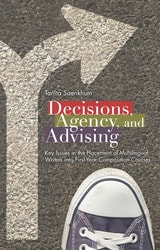
Decisions, Agency, and Advising
Key Issues in the Placement of Multilingual Writers into First-Year Composition CoursesTanita Saenkhum
Utah State University Press, 2016
Tanita Saenkhum follows eleven multilingual students who made their decisions about placement into first-year composition courses during one academic year at a large public university. She identifies the need for the process of making placement decisions to be understood more clearly, describes how to use that knowledge to improve placement practices for these students—particularly in advising—and offers hands-on recommendations for writing programs.
Decisions, Agency, and Advising is a significant contribution to the field and particularly valuable to writing program administrators, academic advisors, writing teachers, researchers investigating second language writing and writing program administration, composition and second language writing scholars, and graduate students.

Demonstrating Results
Using Outcome Measurement in Your LibraryRhea Joyce Rubin
American Library Association, 2006

Demystifying Online Instruction in Libraries
People, Process, and ToolsDominique Turnbow and Amanda Roth
American Library Association, 2019
The design of information literacy instruction and the building of it are two distinct skillsets and processes; yet all too often everything gets mashed together, creating needless confusion and stress. In this book Turnbow, an instructional designer, and Roth, an instructional technologist, suggest a better way to organize the work. They shed light on the people, processes, and resources required to create a sustainable portfolio of online instruction. With the goal of fostering conversations in your library about the most streamlined and effective ways to get the work done, they provide guidance on such topics as
- design and development processes, complete with “I.D. in Action” examples and sample design documents;
- thumbnail descriptions of ADDIE, SAM, and design thinking methods;
- creating learning objects;
- types of software tools and how to evaluate them;
- crafting the best documentation of your work for efficient maintenance and reuse;
- adapting assessment to your learning outcomes and purpose;
- when to design for performance support, an underutilized method in libraries; and
- starting points for those interested in developing instructional design and development skills.
Demystifying the instructional design and development process used to create online learning objects, this book will help you understand how instructional design principles and approaches can benefit your learners.
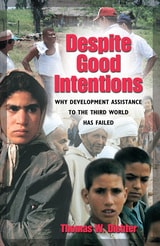
Despite Good Intentions
Why Development Assistance to the Third World Has FailedThomas W. Dichter
University of Massachusetts Press, 2003
For more than thirty-five years, Thomas W. Dichter has worked in the field of international development, managing and evaluating projects for nongovernmental organizations, directing a Peace Corps country program, and serving as a consultant for such agencies as USAID, UNDP, and the World Bank. On the basis of this extensive and varied experience, he has become an outspoken critic of what he terms the “international poverty alleviation industry.” He believes that efforts to reduce world poverty have been well-intentioned but largely ineffective. On the whole, the development industry has failed to serve the needs of the people it has sought to help.
To make his case, Dichter reviews the major trends in development assistance from the 1960s through the 1990s, illustrating his analysis with eighteen short stories based on his own experiences in the field. The analytic chapters are thus grounded in the daily life of development workers as described in the stories.
Dichter shows how development organizations have often become caught up in their own self-perpetuation and in public relations efforts designed to create an illusion of effectiveness. Tracing the evolution of the role of money (as opposed to ideas) in development assistance, he suggests how financial imperatives have reinforced the tendency to sponsor time-bound projects, creating a dependency among aid recipients. He also examines the rise of careerism and increased bureaucratization in the industry, arguing that assistance efforts have become disconnected from important lessons learned on the ground, and often lessons of world history.
In the end, Dichter calls for a more light-handed and artful approach to development assistance, with fewer agencies and experts involved. His stance is pragmatic, rather than ideological or political. What matters, he says, is what works, and the current practices of the development industry are simply not effective.
Discerning Experts
The Practices of Scientific Assessment for Environmental PolicyMichael Oppenheimer, Naomi Oreskes, Dale Jamieson, Keynyn Brysse, Jessica O’Reilly, Matthew Shindell, and Milena Wazeck
University of Chicago Press, 2019
Discerning Experts uncovers factors that can generate systematic bias and error, and recommends how the process can be improved. As the first study of the internal workings of large environmental assessments, this book reveals their strengths and weaknesses, and explains what assessments can—and cannot—be expected to contribute to public policy and the common good.
Doing Psychotherapy Effectively
Mona Sue Weissmark and Daniel A. Giacomo
University of Chicago Press, 1997
Mona Sue Weissmark and Daniel A. Giacomo offer a unique mode of evaluation that focuses not on a particular school of therapy but on the relationship between therapist and patient. Their approach, the "Harvard Psychotherapy Coding Method," begins with the assumption that good therapeutic relationships are far from intuitive. Successful relationships follow a pattern of behaviors that can be identified and quantified, as the authors demonstrate through clinical research and videotaped sessions of expert therapists. Likewise, positive changes in the patient, observed through client feedback and case studies, can be described operationally; they involve the process of overcoming feelings of detachment, helplessness, and rigidity and becoming more involved, effective, and adaptable.
Weissmark and Giacomo explain and ground these principles in the practice of psychotherapy, making Doing Psychotherapy Effectively an accessible and pragmatic work which will give readers a tool for measuring therapeutic effectiveness and further understanding human transformation. For the first time, successful therapy is described in a way that can be practiced and communicated.

Driving Simulators for the Evaluation of Human-Machine Interfaces in Assisted and Automated Vehicles
Toshio Ito
The Institution of Engineering and Technology, 2021
Dynamic Youth Services through Outcome-Based Planning and Evaluation
Eliza T. Dresang
American Library Association, 2006
Dynamic Youth Services through Outcome-Based Planning and Evaluation
Eliza T. Dresang
American Library Association, 2006