Results by title
130 books match the query 'Indonesia' and 4 start with d
Demanding Images
Democracy, Mediation, and the Image-Event in IndonesiaKaren Strassler
Duke University Press, 2019
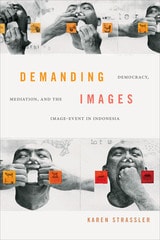
The end of authoritarian rule in 1998 ushered in an exhilarating but unsettled period of democratization in Indonesia. A more open political climate converged with a rapidly changing media landscape, yielding a vibrant and volatile public sphere within which Indonesians grappled with the possibilities and limits of democracy amid entrenched corruption, state violence, and rising forms of intolerance. In Demanding Images Karen Strassler theorizes image-events as political processes in which publicly circulating images become the material ground of struggles over the nation's past, present, and future. Considering photographs, posters, contemporary art, graffiti, selfies, memes, and other visual media, she argues that people increasingly engage with politics through acts of making, circulating, manipulating, and scrutinizing images. Demanding Images is both a closely observed account of Indonesia's turbulent democratic transition and a globally salient analysis of the work of images in the era of digital media and neoliberal democracy. Strassler reveals politics today to be an unruly enterprise profoundly shaped by the affective and evidentiary force of images.
[more]
Democracy, Electoral Systems, and Judicial Empowerment in Developing Countries
Vineeta Yadav and Bumba Mukherjee
University of Michigan Press, 2014
The power granted to the courts, both in a nation’s constitution and in practice, reveals much about the willingness of the legislative and executive branches to accept restraints on their own powers. For this reason, an independent judiciary is considered an indication of a nation’s level of democracy. Vineeta Yadav and Bumba Mukherjee use a data set covering 159 developing countries, along with comparative case studies of Brazil and Indonesia, to identify the political conditions under which de jure independence is established. They find that the willingness of political elites to grant the courts authority to review the actions of the other branches of government depends on the capacity of the legislature and expectations regarding the judiciary’s assertiveness.
Moving next to de facto independence, Yadav and Mukherjee bring together data from 103 democracies in the developing world, complemented by case studies of Brazil, India, and Indonesia. Honing in on the effects of electoral institutions, the authors find that, when faced with short time horizons, governments that operate in personal vote electoral systems are likely to increase de facto judicial independence whereas governments in party-centered systems are likely to reduce it.
[more]

Dictionary of Indonesian Islam
Mis Sea#94Howard M. Federspiel
Ohio University Press, 1994
Drawing from an extensive list of writings about Indonesian Islam that have appeared over the past fifteen years, Federspiel defines approximately 1,800 terms, phrases, historical figures, religious books, and place names that relate to Islam and gives their Arabic sources.
This dictionary will be indispensable to English–speaking students and researchers working in Indonesian or Southeast Asian studies. It will also be useful for scholars working in Bahasa Indonesian, reading texts written about Islam by Indonesian Muslims, as well as for Southeast Asia area scholars generally who are using sources in Western languages.
This dictionary will be indispensable to English–speaking students and researchers working in Indonesian or Southeast Asian studies. It will also be useful for scholars working in Bahasa Indonesian, reading texts written about Islam by Indonesian Muslims, as well as for Southeast Asia area scholars generally who are using sources in Western languages.
[more]

Dissociated Identities
Ethnicity, Religion, and Class in an Indonesian SocietyRita Smith Kipp
University of Michigan Press, 1996
Placing theories of ethnicity and religious pluralism in relation to theories of the state, Rita Smith Kipp in Dissociated Identities situates a particular Indonesian people, the Karo, in the modern world. What the state's policies on culture and religion mean to Karo women and men, who now live in cities throughout Indonesia as well as in their Sumatran homeland, becomes clear only by looking at the way Karo families and communities contend with religious pluralism, with the pull of tradition working against the wish to be "modern," and with the new wealth differences in their midst. Newly discrete facets of Karo selfhood -- ethnic, religious, and economic -- replicate in microcosm the political tensions of the nation-state, revealing both why the New Order has enjoyed great stability over almost three decades and the sources of disruption that may lie ahead.
[more]