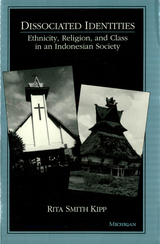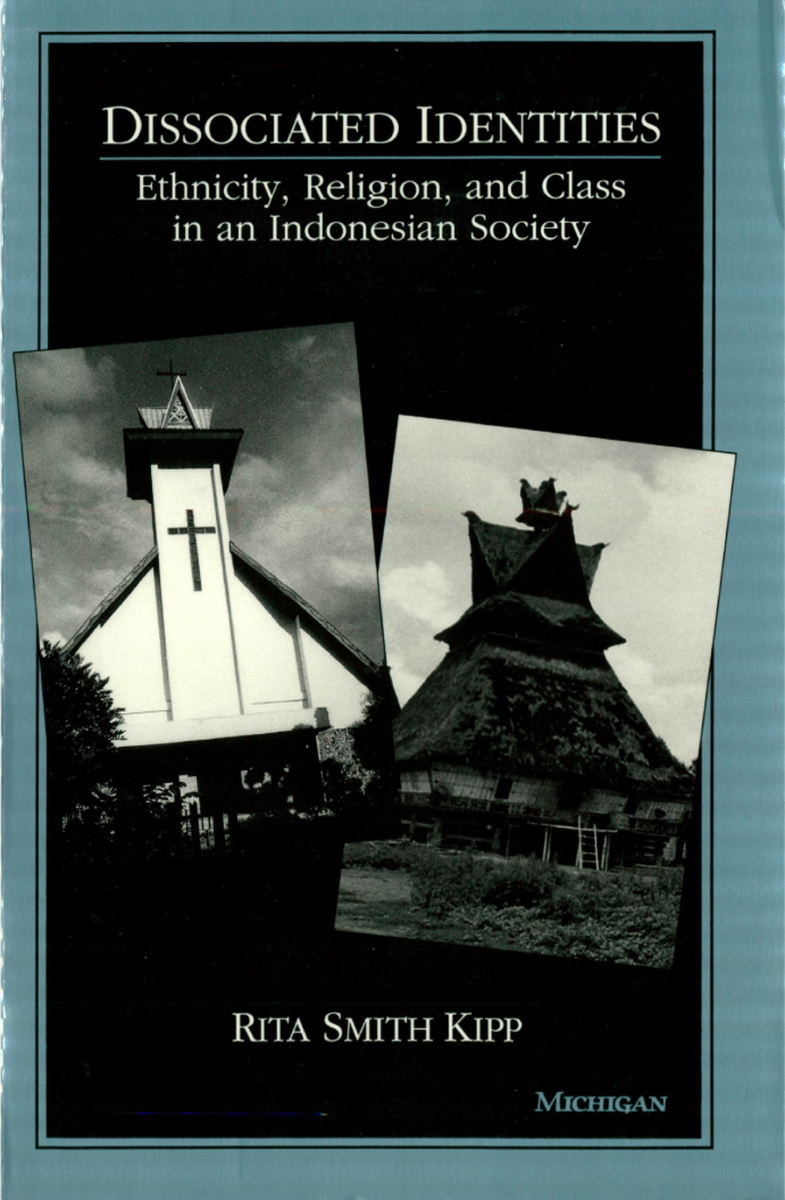
Dissociated Identities: Ethnicity, Religion, and Class in an Indonesian Society
University of Michigan Press, 1996
Cloth: 978-0-472-10412-3 | Paper: 978-0-472-08402-9 | eISBN: 978-0-472-22525-5 (standard)
Library of Congress Classification DS632.K3K56 1993
Dewey Decimal Classification 305.89922
Cloth: 978-0-472-10412-3 | Paper: 978-0-472-08402-9 | eISBN: 978-0-472-22525-5 (standard)
Library of Congress Classification DS632.K3K56 1993
Dewey Decimal Classification 305.89922
ABOUT THIS BOOK | AUTHOR BIOGRAPHY | REQUEST ACCESSIBLE FILE
ABOUT THIS BOOK
Placing theories of ethnicity and religious pluralism in relation to theories of the state, Rita Smith Kipp in Dissociated Identities situates a particular Indonesian people, the Karo, in the modern world. What the state's policies on culture and religion mean to Karo women and men, who now live in cities throughout Indonesia as well as in their Sumatran homeland, becomes clear only by looking at the way Karo families and communities contend with religious pluralism, with the pull of tradition working against the wish to be "modern," and with the new wealth differences in their midst. Newly discrete facets of Karo selfhood -- ethnic, religious, and economic -- replicate in microcosm the political tensions of the nation-state, revealing both why the New Order has enjoyed great stability over almost three decades and the sources of disruption that may lie ahead.
See other books on: Class | Ethnic identity | Ethnicity | Indonesia | Social classes
See other titles from University of Michigan Press