Results by title
8113 books match the query 'Literary Criticism' and 287 start with d
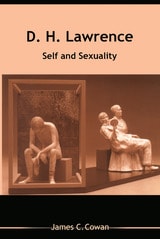
D H LAWRENCE
SELF AND SEXUALITYJames C. Cowan
The Ohio State University Press, 2003
D. H. Lawrence: Self and Sexuality is a psychoanalytic study of D. H. Lawrence’s life and writings. James Cowan relies most notably the methods of Heinz Kohut, psychoanalytic “self psychology,” and employs as well the object relation theories of D. W. Winnicott and others. This work also examines sexual issues in Lawrence’s work from a literary and critical perspective, employing authoritative medical and psychoanalytic sources in human sexuality. Lawrence’s work, which was early read in traditional Freudian terms, has only recently been considered from other psychoanalytic perspectives. In this self psychological study, Cowan provides a new and path-breaking analysis of Lawrence.
Turning to several problematic issues of sexuality in Lawrence, the author first discusses a number of Lawrence’s sexual fallacies, and personal and cultural issues. Cowan also considers contrasting idealized and negative presentations of Mellors and Sir Clifford Chatterley in Lady Chatterley’s Lover, and the theme of the “loss of desire” sequence of poems in Pansies.

D. H. Lawrence
An Unprofessional StudyAnaïs Nin
Ohio University Press, 1964
In 1932, two years after D. H. Lawrence’s death, a young woman wrote a book about him and presented it to a Paris publisher. She recorded the event in her diary: “It will not be published and out by tomorrow, which is what a writer would like when the book is hot out of the oven, when it is alive within oneself. He gave it to his assistant to revise.” The woman was Anaïs Nin.
Nin examined Lawrence’s poetry, novels, essays, and travel writing. She analyzed and explained the more important philosophical concepts contained in his writings, particularly the themes of love, death, and religion, as well as his attention to primitivism and to women. But what Anaïs Nin brought to the explication of Lawrence’s writing was an understanding of the fusion of imaginative, intuitive, and intellectual elements from which he drew his characters, themes, imagery and symbolism.
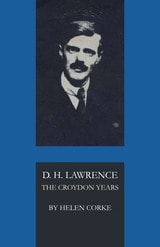
D. H. Lawrence
The Croydon YearsBy Helen Corke, introduction by Warren Roberts
University of Texas Press, 1965
Croydon, England, was the setting of the famous three-way friendship of D. H. Lawrence, Jessie Chambers, and Helen Corke, all of whom made literary records of their association, and all of whom appeared as characters in Lawrence novels. Perhaps the most objective of these records were Helen Corke’s, which became difficult to acquire. Their scarcity and their continuing usefulness were the stimulus for publication of this volume, which contains in four statements Helen Corke’s “major comment on Lawrence the man and Lawrence the artist.”
The “Portrait of D. H. Lawrence, 1909–1910,” a section from Corke’s unpublished autobiography, gives the reader glimpses into the earliest stages of the Lawrence-Corke friendship, when Lawrence worked to bring meaning back into Corke’s life after she had suffered a tragic loss. The “Portrait” tells of conversations before a log fire, German lessons, the reading of poetry, and sessions over Lawrence’s manuscript “Nethermere,” which the publishers renamed The White Peacock. In “Portrait,” Corke tells of working with Lawrence on revising the proofs of this book, of Lawrence’s encouragement of her own literary efforts, of their wandering together in the Kentish hill country, and of her first meeting with Jessie Chambers.
“Lawrence’s ‘Princess’” continues the narrative of the triple friendship, carrying it to its sad ending, but with the focus on Jessie Chambers. Perceptively and sympathetically written, it throws a clarifying light on the psychology of Lawrence and presents with literary charm another human being—Jessie, the Miriam of Sons and Lovers.
In combined narrative-critique method, Corke, in the essay “Concerning The White Peacock,” relates Lawrence’s problems in writing this novel and gives an analysis of its literary quality.
Lawrence and Apocalypse is cast in the form of a “deferred conversation” in which Lawrence and Corke discuss his philosophical ideas as presented in his Apocalypse. Although the book was written to present Lawrence’s ideas, its significance reposes equally in Corke’s reaction to his thought. As a succinct statement of Lawrence’s teachings about the nature of humanity, it has unique value.
D. H. Lawrence
The Failure and the Triumph of ArtEliseo Vivas
Northwestern University Press, 1960
DECIPHERING RACE
WHITE ANXIETY, RACIAL CONFLICT, & THE TURN TO FICTION IN MID-VICTORIAN ENGLISH PROSELaura Callanan
The Ohio State University Press, 2005
In this manner these narratives confront the complexity, indeterminacy, and irrationality of both racial difference and the systems put in place to understand that difference. Deciphering Race unpacks this narrative turn to the aesthetic in writings by white English individuals and thus reveals the instability at the heart of cultural understanding of race and racial tropes at mid-century. This series of readings will help to see how figurative structures, while providing a bridge between different cultures and epistemologies, also reinforce a distance that keeps groups separate. Only by disentangling these structures, by addressing and unpacking our assumptions and narratives about those different from ourselves, and by understanding our deep cultural anxiety and investment in these ways of talking about one another, can we begin to create the conditions for productive, local understanding between different cultures, races, and communities.
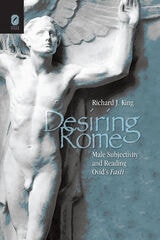
DESIRING ROME
Male Subjectivity and Reading Ovid’s FastiRichard J. King
The Ohio State University Press, 2006
Desiring Rome expands upon recent recognition of the Fasti’s centrality to early imperial politics by situating the poem’s “failure” within broader negotiations of identity between early imperial citizen-subjects and the cultural ideology of Roman manhood.
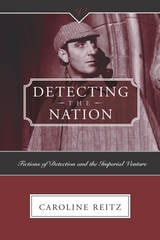
DETECTING THE NATION
FICTIONS OF DETECTION AND THE IMPERIAL VENTURECaroline Reitz
The Ohio State University Press, 2004

DR. FAUSTUS
ARCHETYPAL SUBTEXT AT THE MILLENNIUMPETER WERRES
West Virginia University Press, 1999
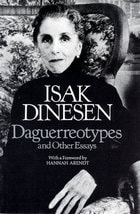
Daguerreotypes and Other Essays
Isak Dinesen
University of Chicago Press, 1979
"Through these daguerreotypes we begin to understand other periods, the renunciations of World War I, the purpose of houses and mansions, of ritual ceremonials, such as tatooing. We are given a fresh and vivid view of the women's movement . . . which urges that what our 'small society' needs beyond human beings who have demonstrated what they can do, is people who are. 'Indeed, our own time,' she wrote in 1953, 'can be said to need a revision from doing to being.' She demonstrated it in her own work and craft, with courage and with dignity. This collection is as real as a gallery of old daguerreotypes, moving and unfaded. The work, as Hannah Arendt says, of a wise woman."—Robert Kirsch, Los Angeles Times
"These essays . . . have the flavor of good conversation: humorous, easy, personal but not oppressive, the distillation of reading, thought, and experience. Their subjects are of surprisingly current interest. We need make no concessions to the past, need not set our watches back to 'historical.' Isak Dinesen was not a faddish thinker. . . . 'In history it is always the human element that has a chance for eternal life,' Dinesen remarks, and she gives these essays their chance."—Penelope Mesic, Chicago
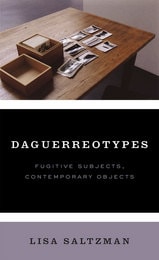
Daguerreotypes
Fugitive Subjects, Contemporary ObjectsLisa Saltzman
University of Chicago Press, 2015
By examining this idea of photography as articulated in literature, film, and the graphic novel, Daguerreotypes demonstrates how photography secures identity for figures with an otherwise unstable sense of self. Lisa Saltzman argues that in many modern works, the photograph asserts itself as a guarantor of identity, whether genuine or fabricated. From Roland Barthes’s Camera Lucida to Ridley Scott’s Blade Runner, W. G. Sebald’s Austerlitz to Alison Bechdel’s Fun Home—we find traces of photography’s “fugitive subjects” throughout contemporary culture. Ultimately, Daguerreotypes reveals how the photograph, at once personal memento and material witness, has inspired a range of modern artistic and critical practices.
Dahomean Narrative
A Cross-Cultural AnalysisMelville J. Herskovits and Frances S. Herskovits
Northwestern University Press, 1998
Published as a companion piece to Northwestern University Press's West African Folktales, Dahomean Narrative provides the basic texts of material collected in the field, and shows how they were collected, analyzed, and theorized in the anthropological and folklore disciplinary traditions of Herskovits's day. The result is a wide-ranging collection, culled from an entire narrative tradition, that remains unique among anthropological publications.
Daily Life in Johnson's London
Richard B. Schwartz
University of Wisconsin Press, 1983
"Outstanding. . . . The author packs a remarkable quantity of detail into a small space, even including a discussion of price and wage figures that will be intelligible to Americans [today]. . . . His prose is lucid, graceful, lively. Generously illustrated, the book also includes an extensive bibliography."—Choice
"An excellent source for English Literature and history students studying this period or Samuel Johnson."—Booklist
Daily Observations
Thoreau on the Days of the YearSteve Grant
University of Massachusetts Press, 2005
“How many a man has dated a new era in his life from the reading of a book,” wrote Henry David Thoreau in Walden. Today that book continues to provoke, inspire, and change lives all over the world, and each rereading is fresh and challenging. Yet as Thoreau's countless admirers know, there is more to the man than Walden. An engineer, poet, teacher, naturalist, lecturer, and political activist, he truly had multiple lives to lead, and each one speaks forcefully to us today.
Sponsored by the Thoreau Society, the brief, handsomely presented books in this series offer the thoughts of a great writer on a variety of topics, some that we readily associate with him, some that may be surprising. Each volume includes selections from his familiar published works as well as from less well known lectures, letters, and journal entries. The books include original engravings by renowned illustrator and book artist Barry Moser.

Dance Between Two Cultures
Latino Caribbean Literature Written in the United StatesWilliam Luis
Vanderbilt University Press, 1997
In this groundbreaking study, William Luis analyzes the most salient and representative narrative and poetic works of the newest literary movement to emerge in Spanish American and U.S. literatures. The book is divided into three sections, each focused on representative Puerto Rican American, Cuban American, and Dominican American authors. Luis traces the writers' origins and influences from the nineteenth century to the present, focusing especially on the contemporary works of Oscar Hijuelos, Julia Alvarez, Cristina Garcia, and Piri Thomas, among others. While engaging in close readings of the texts, Luis places them in a broader social, historical, political, and racial perspective to expose the tension between text and context.
As a group, Latino Caribbeans write an ethnic literature in English that is born of their struggle to forge an identity separate from both the influences of their parents' culture and those of the United States. For these writers, their parents' country of origin is a distant memory. They have developed a culture of resistance and a language that mediates between their parents' identity and the culture that they themselves live in.
Latino Caribbeans are engaged in a metaphorical dance with Anglo Americans as the dominant culture. Just as that dance represents a coming together of separate influences to make a unique art form, so do both Hispanic and North American cultures combine to bring a new literature into being. This new body of literature helps us to understand not only the adjustments Latino Caribbean cultures have had to make within the larger U.S. environment but also how the dominant culture has been affected by their presence.
Dance of Life
The Novels of Zakes Mda in Post-apartheid South AfricaGail Fincham
Ohio University Press, 2012
In recent years, the work of Zakes Mda—novelist, painter, composer, theater director and filmmaker—has attracted worldwide critical attention. Gail Fincham’s book examines the five novels Mda has written since South Africa’s transition to democracy: Ways of Dying (1995), The Heart of Redness (2000), The Madonna of Excelsior (2002), The Whale Caller (2005), and Cion (2007). Dance of Life explores how refigured identity is rooted in Mda’s strongly painterly imagination that creates changed spaces in memory and culture. Through a combination of magic realism, African orature, and intertextuality with the Western canon, Mda rejects dualistic thinking of the past and the present, the human and the nonhuman, the living and the dead, the rural and the urban. He imbues his fictional characters with the power to orchestrate a reconfigured subjectivity that is simultaneously political, social, and aesthetic.
Dancing Ghosts
Native American And Christian Syncretism In Mary Austin's WorkMark T. Hoyer
University of Nevada Press, 1998
A significant and innovative contribution to Austin studies. How did an Illinois Methodist homesteader in the West come to create one of the most significant cosmological syntheses in American literature? In this study, Hoyer draws on his own knowledge of biblical religion and Native American cultures to explore Austin's creation of the "mythology of the American continent" she so valued. Austin lived in and wrote about "the land of little rain," semiarid and arid parts of California and Nevada that were home to the Northern Paiute, Shoshone, Interior Chumash, and Yokut peoples. Hoyer makes new and provocative connections between Austin and spiritual figures like Wovoka, the prophet of the Ghost Dance religion, and writers like Zitkala-sa and Mourning Dove, and he provides a particularly fine reading of Cogowea.
Dancing at the Devil's Party
Essays on Poetry, Politics, and the EroticAlicia Suskin Ostriker
University of Michigan Press, 2000
In her work, Ostriker can be controversial, as when she attacks the academic establishment for rejecting the erotic dimension of poetry, or when she meditates on the significance of the black poet Lucille Clifton to herself as a reader, or when she argues that Allen Ginsberg's "Howl"--famous as the primary poem of the Beat Generation--is also a profoundly Jewish poem. Yet her writing is always lively and readable, free of academic jargon, inviting the reader to enjoy a wide range of poetic styles and experiences.
Ostriker's criticism, like her poetry, is both feminist and deeply humane. These essays on American poetry will appeal to students of poetry, scholars of American literature, and anyone who enjoys the work of the poets discussed in the book.
Alicia Ostriker is the author of nine books of poetry, including The Imaginary Lover, which won the William Carlos Williams Award and The Crack in Everything, which was a National Book award finalist in 1996, and which received the Paterson Prize in 1997 and the San Fransisco State Poetry Center Award in 1998. She is Distinguished Professor of English at Rutgers University.
Dancing out of Line
Ballrooms, Ballets, and Mobility in Victorian Fiction and CultureMolly Engelhardt
Ohio University Press, 2009
Dancing out of Line transports readers back to the 1840s, when the craze for social and stage dancing forced Victorians into a complex relationship with the moving body in its most voluble, volatile form.
By partnering cultural discourses with representations of the dance and the dancer in novels such as Jane Eyre, Bleak House, and Daniel Deronda, Molly Engelhardt makes explicit many of the ironies underlying Victorian practices that up to this time have gone unnoticed in critical circles. She analyzes the role of the illustrious dance master, who created and disseminated the manners and moves expected of fashionable society, despite his position as a social outsider of nebulous origins. She describes how the daughters of the social elite were expected to “come out” to society in the ballroom, the most potent space in the cultural imagination for licentious behavior and temptation. These incongruities generated new, progressive ideas about the body, subjectivity, sexuality, and health.
Engelhardt challenges our assumptions about Victorian sensibilities and attitudes toward the sexual/social roles of men and women by bringing together historical voices from various fields to demonstrate the versatility of the dance, not only as a social practice but also as a forum for Victorians to engage in debate about the body and its pleasures and pathologies.
Danger Zones
Homosexuality, National Identity, and Mexican CultureClaudia Schaefer
University of Arizona Press, 1996
Contents:
1. El diario de José Toledo: The Fantasies of a Middle-Class Bureaucrat
2. The Power of Subversive Imagination: Utopian Discourse in the Novels of Luis Zapata and José Rafael Calva
3. On the Cutting Edge: El jinete azul and the Aesthetics of the Abyss
4. Monobodies, Antibodies, and the Body Politic: Sara Levi Calderón’s Dos mujeres
5. Just Another Material Girl? La hermana secreta de Angélica María and the Seduction of the Popular
6. From "Infernal Realms of Delinquency" to Cozy Cabañas in Cuernavaca: José Joaquín Blanco’s Visions of Homosexuality
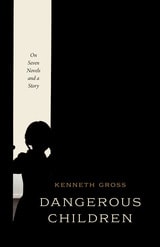
Dangerous Children
On Seven Novels and a StoryKenneth Gross
University of Chicago Press, 2022
Ranging from Victorian to modern works—Lewis Carroll’s Alice in Wonderland, Carlo Collodi’s Pinocchio, Henry James’s What Maisie Knew, J. M. Barrie’s Peter and Wendy, Franz Kafka’s “The Cares of a Family Man,” Richard Hughes’s A High Wind in Jamaica, Elizabeth Bowen’s The Death of the Heart, and Vladimir Nabokov’s Lolita—Kenneth Gross’s book delves into stories that center around the figure of a strange and dangerous child.
Whether written for adults or child readers, or both at once, these stories all show us odd, even frightening visions of innocence. We see these children’s uncanny powers of speech, knowledge, and play, as well as their nonsense and violence. And, in the tales, these child-lives keep changing shape. These are children who are often endangered as much as dangerous, haunted as well as haunting. They speak for lost and unknown childhoods. In looking at these narratives, Gross traces the reader’s thrill of companionship with these unpredictable, often solitary creatures—children curious about the adult world, who while not accommodating its rules, fall into ever more troubling conversations with adult fears and desires. This book asks how such imaginary children, objects of wonder, challenge our ways of seeing the world, our measures of innocence and experience, and our understanding of time and memory.
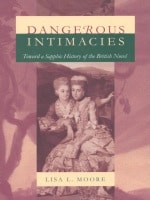
Dangerous Intimacies
Toward a Sapphic History of the British NovelLisa L. Moore
Duke University Press, 1997
Moore demonstrates that intimacy between women was vividly imagined in the British eighteenth century as not only chaste and virtuous, but also insistently and inevitably sexual. She looks at instances of sapphism in such novels as Millenium Hall, Memoirs of a Woman of Pleasure, Belinda, and Emma and analyzes how the new literary form of the novel made the bourgeois heroine’s successful negotiation of female friendship central to the establishment of her virtue. Moore also examines representations of sapphism through the sweeping economic and political changes of the period and claims that middle-class readers’ identifications with the heroine’s virtue helped the novel’s bourgeois audience justify the violent bases of their new prosperity, including slavery, colonialism, and bloody national rivalry.
In revealing the struggle over sapphism at the heart of these novels of female friendship—and at the heart of England’s national identity—Moore shows how feminine sexual agency emerged as an important cultural force in post-Enlightenment England

Daniil Kharms
Writing and the EventBy Branislav Jakovljevic
Northwestern University Press, 2009
The book follows Kharms’s development as a creative thinker, inquiring into the nature of Kharmsian nonsense, the ontological status of the OBERIU object, writing as performance, Kharms’s gestural language, his "language machines," and his ideas of order, number, infinity, and chance. Reading every paper trace (as well as extant memories) of Kharms’s activities as part of a large project of world creation, Branislav Jakovljevic situates him in a twentieth-century effort—exemplified by Kafka, Beckett, Artaud, Malevich, and Khelbnikov, among others—to go beyond an interpretation of meaning circumscribed by rational and logical thought. Examining texts that could conceivably be called "literary" as well as sketches, diagrams, hieroglyphs, photographs, and unclassifiable others, Jakovljevic’s study is the first to provide a properly broad perspective on this creative thinker’s farranging, far-reaching, and finally comprehensive achievement.
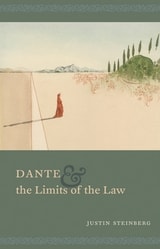
Dante and the Limits of the Law
Justin Steinberg
University of Chicago Press, 2013
Examining how Dante probes the limits of the law in this juridical otherworld, Steinberg argues that exceptions were vital to the medieval legal order and that Dante’s otherworld represents an ideal “system of exception.” In the real world, Dante saw this system as increasingly threatened by the dual crises of church and empire: the abuses and overreaching of the popes and the absence of an effective Holy Roman Emperor. Steinberg shows that Dante’s imagination of the afterlife seeks to address this gap between the universal validity of Roman law and the lack of a sovereign power to enforce it. Exploring the institutional role of disgrace, the entwined phenomena of judicial discretion and artistic freedom, medieval ideas about privilege and immunity, and the place of judgment in the poem, this cogently argued book brings to life Dante’s sense of justice.
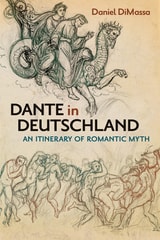
Dante in Deutschland
An Itinerary of Romantic MythDaniel DiMassa
Bucknell University Press, 2022
Dante's Aesthetics of Being
Warren Ginsberg
University of Michigan Press, 1999
Despite the absence of tracts about beauty and art, aesthetic issues did command the attention of people in the Middle Ages. Whenever poets or philosophers turned their thoughts to the order of the heavens, whenever they delighted in music or art, they contemplated how the pleasure they took in the artistry of the universe was related to the God who created it. For Dante, aesthetics was the discourse of being and could not be narrowly defined. The aesthetic became the domain in which he considered not only form and proportion, but questions of love, identity, and perfection of the self.
Warren Ginsberg expertly guides us through Dante's work. He distinguishes between early texts such as the Vita Nuova, in which the aesthetic offers only a form of knowledge between sensation and reason, and the Comedy, in which the aesthetic is transformed into a language of existence. Among other subjects, Dante's Aesthetics of Being treats poeticism, literary history, language theory, the relation of philosophy to poetry, and of course, aesthetics. Its readers will include not only experts in Dante and medievalists in general, but literary critics of all periods. Indeed, anyone interested in poetic theory, the philosophy of beauty, or interdisciplinary studies will profit from reading Ginsberg's thoughtful offering.
Warren Ginsberg is Professor of English, University at Albany, State University of New York. He is author of The Cast of Character: The Representation of Personality in Ancient and Medieval Literature and editor of two Middle English poems, Wynnere and Wastoure and The Parlement of the Thre Ages.
Dante's Epistle to Cangrande
Robert Hollander
University of Michigan Press, 1994
In Dante's Epistle to Cangrande Robert Hollander commandingly marshals new evidence to demonstrate that the epistle should be considered authentically Dantean. He further provides enlightening discussion of the nature of tragedy and comedy in the Divine Comedy. The author draws authoritatively on the extensive array of medieval and modern commentaries stored in electronic form by the Dartmouth Dante Project, of which he is the director.
Dante's Epistle to Cangrande makes a signal contribution to Dante studies. Naturally of interest to students of Dante's work, it will also be important reading for those concerned with literary critical questions such as authorial intent, programmatic statements, and allegorical interpretations of literature.
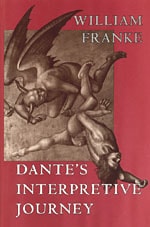
Dante's Interpretive Journey
William Franke
University of Chicago Press, 1996
Reading the poem through the lens of hermeneutical theory, Franke focuses particularly on Dante's address to the reader as the site of a disclosure of truth. The event of the poem for its reader becomes potentially an experience of truth both human and divine. While contemporary criticism has concentrated on the historical character of Dante's poem, often insisting on it as undermining the poem's claims to transcendence, Franke argues that precisely the poem's historicity forms the ground for its mediation of a religious revelation. Dante's dramatization, on an epic scale, of the act of interpretation itself participates in the self-manifestation of the Word in poetic form.
Dante's Interpretive Journey is an indispensable addition to the field of Dante studies and offers rich insights for philosophy and theology as well.
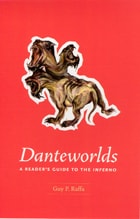
Danteworlds
A Reader's Guide to the InfernoGuy P. Raffa
University of Chicago Press, 2007
One of the greatest works of world literature, Dante Alighieri’s The Divine Comedy has, despite its enormous popularity and importance, often stymied readers with its multitudinous characters, references, and themes. But until now, students of the Inferno have lacked a suitable resource to guide their reading.
Welcome to Danteworlds, the first substantial guide to the Inferno in English. Guy P. Raffa takes readers on a geographic journey through Dante’s underworld circle by circle—from the Dark Wood down to the ninth circle of Hell—in much the same way Dante and Virgil proceed in their infernal descent. Each chapter—or “region”—of the book begins with a summary of the action, followed by detailed entries, significant verses, and useful study questions. The entries, based on a close examination of the poet’s biblical, classical, and medieval sources, help locate the characters and creatures Dante encounters and assist in decoding the poem’s vast array of references to religion, philosophy, history, politics, and other works of literature.
Written by an established Dante scholar and tested in the fire of extensive classroom experience, Danteworlds will be heralded by readers at all levels of expertise, from students and general readers to teachers and scholars.

Dante’s Craft
Studies in Language and StyleGlauco Cambon
University of Minnesota Press, 1969
Dante's Craft was first published in 1969. Minnesota Archive Editions uses digital technology to make long-unavailable books once again accessible, and are published unaltered from the original University of Minnesota Press editions.
In a series of nine essays, Professor Cambon discusses Dante's language and style and the influence of his poetry on later writers. The first section, a group of six essays, is devoted to the critical studies of Dante's own work. A second section consists of chapters devoted to Dante's influence on the eighteenth-century Italian philosopher Giambattista Vico, on certain American writers, chiefly Herman Melville, Nathaniel Hawthorne, Ezra Pound, and T.S. Eliot, and on the contemporary Italian poet Eugenio Montale.
The pertinence of Dante today is emphasized by Professor Cambon in his introduction to the volume. He writes: "Dante's viability for modern literature springs from the depth and latitude of his own probing into the tangled darkness and light of human existence; and, as some of the essays here collected attempt to show, I have come to believe that Dante can give invaluable clues to the reader of contemporary poetry, whether in its expression of derangement in a new Dark Wood or in its rare glimpses of felicity and wholeness."
Dante’s Volume from Alpha to Omega
Edited by Christiana Purdy Moudarres and Carol Chiodo
Arizona Center for Medieval and Renaissance Studies, 2020
Dark Conceit
The Making of AllegoryEdwin Honig
Northwestern University Press, 1959
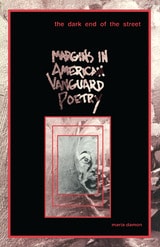
Dark End Of The Street
Margins in American Vanguard PoetryMaria Damon
University of Minnesota Press, 1993
Damon foregrounds a number of modern American poets work and lives in order to argue that the American avant-garde is located in the experimental literary works of social "outsiders." Discussed is the work of Black/Jewish surrealist street poet Bob Kaufman, Boston-Brahmin Robert Lowell and three teenaged women writing from a South Boston housing project, pre-Stonewall gay poets Jack Spicer and Robert Duncan, and Jewish lesbian-in-exile Gertrude Stein.
"An engaging and important book. Damon's sophisticated, theoretical approaches to American verse, coupled with her fresh, writerly style in The Dark End of The Street, put her on the forefront of American poetry's next generation of literary criticism." -American Literature"A work of art as well as a work of criticism. Addresses important questions about art and social life, about the margins and the center, and about oppression and suppression." -George Lipsitz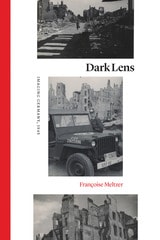
Dark Lens
Imaging Germany, 1945Françoise Meltzer
University of Chicago Press, 2019
The ruins of war have long held the power to stupefy and appall. Can such ruins ever be persuasively depicted and comprehended? Can images of ruins force us to identify with the suffering of the enemy and raise uncomfortable questions about forgiveness and revenge?
Françoise Meltzer explores these questions in Dark Lens, which uses the images of war ruins in Nazi Germany to investigate problems of aestheticization and the representation of catastrophe. Through texts that give accounts of bombed-out towns in Germany in the last years of the war, painters’ attempts to depict the destruction, and her own mother’s photographs taken in 1945, Meltzer asks if any medium offers a direct experience of war ruins for the viewer. Refreshingly accessible and deeply personal, Dark Lens is a compelling look at the role images play in constructing memory.
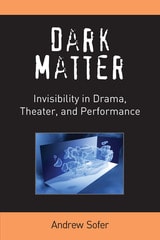
Dark Matter
Invisibility in Drama, Theater, and PerformanceAndrew Sofer
University of Michigan Press, 2013
Dark Mattermaps the invisible dimension of theater whose effects are felt everywhere in performance. Examining phenomena such as hallucination, offstage character, offstage action, sexuality, masking, technology, and trauma, Andrew Sofer engagingly illuminates the invisible in different periods of postclassical western theater and drama. He reveals how the invisible continually structures and focuses an audience’s theatrical experience, whether it’s black magic in Doctor Faustus, offstage sex in A Midsummer Night’s Dream, masked women in The Rover, self-consuming bodies in Suddenly Last Summer, or surveillance technology in The Archbishop’s Ceiling. Each discussion pinpoints new and striking facets of drama and performance that escape sight. Taken together, Sofer’s lively case studies illuminate how dark matter is woven into the very fabric of theatrical representation. Written in an accessible style and grounded in theater studies but interdisciplinary by design, Dark Matter will appeal to theater and performance scholars, literary critics, students, and theater practitioners, particularly playwrights and directors.
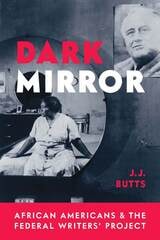
Dark Mirror
African Americans and the Federal Writers' ProjectJ. J. Butts
The Ohio State University Press, 2021
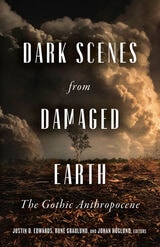
Dark Scenes from Damaged Earth
The Gothic AnthropoceneJustin D. Edwards
University of Minnesota Press, 2022
An urgent volume of essays engages the Gothic to advance important perspectives on our geological era
What can the Gothic teach us about our current geological era? More than just spooky, moonlit castles and morbid graveyards, the Gothic represents a vibrant, emergent perspective on the Anthropocene. In this volume, more than a dozen scholars move beyond longstanding perspectives on the Anthropocene—such as science fiction and apocalyptic narratives—to show that the Gothic offers a unique (and dark) interpretation of events like climate change, diminished ecosystems, and mass extinction.
Embracing pop cultural phenomena like True Detective, Jaws, and Twin Peaks, as well as topics from the New Weird and prehistoric shark fiction to ruin porn and the “monstroscene,” Dark Scenes from Damaged Earth demonstrates the continuing vitality of the Gothic while opening important new paths of inquiry. These essays map a genealogy of the Gothic while providing fresh perspectives on the ongoing climate chaos, the North/South divide, issues of racialization, dark ecology, questions surrounding environmental justice, and much more.
Contributors: Fred Botting, Kingston U; Timothy Clark, U of Durham; Rebecca Duncan, Linnaeus U; Michael Fuchs, U of Oldenburg, Germany; Esthie Hugo, U of Warwick; Dawn Keetley, Lehigh U; Laura R. Kremmel, South Dakota School of Mines and Technology; Timothy Morton, Rice U; Barry Murnane, U of Oxford; Jennifer Schell, U of Alaska Fairbanks; Lisa M. Vetere, Monmouth U; Sara Wasson, Lancaster U; Jeffrey Andrew Weinstock, Central Michigan U.
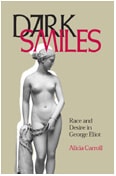
Dark Smiles
Race and Desire in George EliotAlicia Carroll
Ohio University Press, 2002
Although George Eliot has long been described as “the novelist of the Midlands,” she often brought the outer reaches of the empire home in her work. Dark Smiles: Race and Desire in George Eliot studies Eliot’s problematic, career-long interest in representing racial and ethnic Otherness.
Placing Eliot’s diverse and wide-ranging treatment of Otherness in its contemporary context, Alicia Carroll argues that Eliot both engages and resists traditional racial and ethnic representations of Otherness. Carroll finds that Eliot, like other women writers of her time, often appropriates narratives of Otherness to explore issues silenced in mainstream Victorian culture, particularly the problem of the desirous woman. But if Otherness in Eliot’s century was usually gendered as woman and constructed as the object of white male desire, Eliot often seeks to subvert that vision. Professor Carroll demonstrates Eliot’s tendency to “exoticize” images of girlhood, vocation, and maternity in order to critique and explore gendered subjectivities. Indeed, the disruptive presence of a racial or ethnic outsider often fractures Eliot’s narratives of community, creating a powerful critique of home culture.
The consistent reliance of Eliot’s work upon racial and ethnic Otherness as a mode of cultural critique is explored here for the first time in its entirety.
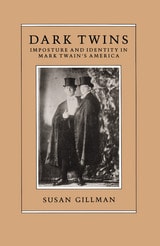
Dark Twins
Imposture and Identity in Mark Twain's AmericaSusan Gillman
University of Chicago Press, 1989
Gillman shows that laws regulating race classification, paternity, and rape cases underwrite Twain's critical exploration of racial and sexual difference in the writings of the 1890s and after, most strikingly in the little-known manuscripts that Gillman calls the "tales of transvestism." The "pseudoscience" of spiritualism and the "science" of psychology provide the cultural vocabularies essential to Twain's fantasy and science fiction writings of his last two decades. Twain stands forth finally as a representative man, not only a child of his culture, but also as one implicated in a continuing American anxiety about freedom, race, and identity.
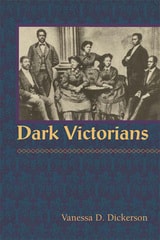
Dark Victorians
Vanessa D. Dickerson
University of Illinois Press, 2007
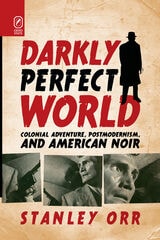
Darkly Perfect World
Colonial Adventure, Postmodernism, and American NoirStanley Orr
The Ohio State University Press, 2010
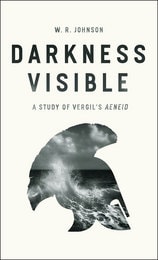
Darkness Visible
A Study of Vergil's "Aeneid"W. R. Johnson
University of Chicago Press, 1976
With an approach to the text that is both grounded in scholarship and intensely personal, and in a style both rhetorically elegant and passionate, Johnson offers readings of specific passages that are nuanced and suggestive as he focuses on the “somber and nourishing fictions” in Vergil’s poem. A timeless work of scholarship, Darkness Visible will enthrall classicists as well as students and scholars of the history of criticism—specifically the way in which politics influence modern readings of the classics—and of poetry and literature.

Darktown Strutters
A NovelWesley Brown
University of Massachusetts Press, 2000
Darwin and the Novelists
Patterns of Science in Victorian FictionGeorge Levine
University of Chicago Press, 1991
Darwin's Footprint
Cultural Perspectives on Evolution in Greece (1880–1930s)Maria Zarimis
Central European University Press, 2015
Darwin’s Footprint examines the impact of Darwinism in Greece, investigating how it has shaped Greece in terms of its cultural and intellectual history, and in particular its literature.
The book demonstrates that in the late 19th to early 20th centuries Darwinism and associated science strongly influenced celebrated Greek literary writers and other influential intellectuals, which fueled debate in various areas such as ‘man’s place in nature’, eugenics, the nature-nurture controversy, religion, as well as class, race and gender.
In addition, the study reveals that many of these individuals were also considering alternative approaches to these issues based on Darwinian and associated biological post-Darwinian ideas. Their concerns included the Greek “race” or nation, its culture, language and identity; also politics and gender equality.
Zarimis’s monograph devotes considerable space to Xenopoulos (1867-1951), notable novelist, journalist and playwright.
Dashiell Hammett and the Movies
Mooney, William H
Rutgers University Press, 2014
Daughter of the Revolution
The Major Nonfiction Works of Pauline HopkinsDworkin, Ira
Rutgers University Press, 2007
Pauline E. Hopkins (1859–1930) came to prominence in the early years of the twentieth century as an outspoken writer, editor, and critic. Frequently recognized for her first novel, Contending Forces, she is currently one of the most widely read and studied African American novelists from that period.
While nearly all of Hopkins’s fiction remains in print, there is very little of her nonfiction available. This reader brings together dozens of her hard-to-find essays, including longer nonfiction works such as Famous Men of the Negro Race and The Dark Races of the Twentieth Century, some of which are published here for the first time in their entirety.
Through these works, along with two juvenile essays from the 1870s, a personal letter, and two speeches, readers encounter a voice that is committed to constructing an international discourse on race, recovering the militant abolitionist tradition to combat Jim Crow, celebrating black political participation during and after the Reconstruction era, articulating the connections between race and labor, and insisting on equal rights for women. Hopkins’s writing will challenge contemporary scholars to rethink their understanding of black activism and modernity in the early twentieth century.
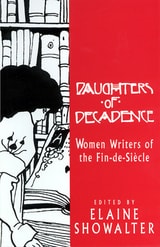
Daughters of Decadence
Women Writers of the Fin de SiecleShowalter, Elaine
Rutgers University Press, 1993

David Mamet in Conversation
Leslie Kane, Editor
University of Michigan Press, 2001
Contemporary playwright David Mamet's thought-provoking plays and screenplays such as Wag the Dog, Glengarry Glen Ross (for which he won the Pulitzer Prize), and Oleanna have enjoyed popular and critical success in the past two decades. Among the most prolific and provocative of writers, Mamet frequently draws emotional responses from both audiences and critics. Mamet in Conversation collects interviews with the playwright that offer readers insight into his life in the theater, his artistic vision, and the evolution of his craft. The interviews help followers of his work better understand the sensibilities that have informed his work in drama, film, and prose over a twenty-five-year career. The conversations collected here--several of which appear in print for the first time--allow a glimpse inside Mamet's creative process, and into the recurring motifs that drive his work. The range of topics is impressive and includes the celebratory purpose of theater, the responsibility of the playwright, writing for Hollywood, the seduction of fame, the search for truth and the merchandising of it, and the decay of culture. The interviews shed light on the personal as well: Mamet's return to Judaism, his appreciation of Midwestern virtues, his love of rural Vermont, the problems of embattled virtue, and the challenge of aging. The book includes transcripts of Mamet's engagingly candid broadcast interviews with Jim Lehrer and Charlie Rose of PBS, published here for the first time.
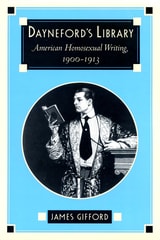
Dayneford's Library
American Homosexual Writing, 1900-1913James Gifford
University of Massachusetts Press, 1995
Dead Fathers
The Logic of Transference in Modern NarrativeNina Schwartz
University of Michigan Press, 1994