Results by title
914 books match the query 'Medieval' and 22 start with d
Daily Life in Portugal in the Late Middle Ages
A.H. de Oliviera Marques; Translated by S.S. Wyatt
University of Wisconsin Press, 1971
Dante and the Limits of the Law
Justin Steinberg
University of Chicago Press, 2013
Examining how Dante probes the limits of the law in this juridical otherworld, Steinberg argues that exceptions were vital to the medieval legal order and that Dante’s otherworld represents an ideal “system of exception.” In the real world, Dante saw this system as increasingly threatened by the dual crises of church and empire: the abuses and overreaching of the popes and the absence of an effective Holy Roman Emperor. Steinberg shows that Dante’s imagination of the afterlife seeks to address this gap between the universal validity of Roman law and the lack of a sovereign power to enforce it. Exploring the institutional role of disgrace, the entwined phenomena of judicial discretion and artistic freedom, medieval ideas about privilege and immunity, and the place of judgment in the poem, this cogently argued book brings to life Dante’s sense of justice.
Dante in Deutschland
An Itinerary of Romantic MythDaniel DiMassa
Bucknell University Press, 2022
Dante's Aesthetics of Being
Warren Ginsberg
University of Michigan Press, 1999
Despite the absence of tracts about beauty and art, aesthetic issues did command the attention of people in the Middle Ages. Whenever poets or philosophers turned their thoughts to the order of the heavens, whenever they delighted in music or art, they contemplated how the pleasure they took in the artistry of the universe was related to the God who created it. For Dante, aesthetics was the discourse of being and could not be narrowly defined. The aesthetic became the domain in which he considered not only form and proportion, but questions of love, identity, and perfection of the self.
Warren Ginsberg expertly guides us through Dante's work. He distinguishes between early texts such as the Vita Nuova, in which the aesthetic offers only a form of knowledge between sensation and reason, and the Comedy, in which the aesthetic is transformed into a language of existence. Among other subjects, Dante's Aesthetics of Being treats poeticism, literary history, language theory, the relation of philosophy to poetry, and of course, aesthetics. Its readers will include not only experts in Dante and medievalists in general, but literary critics of all periods. Indeed, anyone interested in poetic theory, the philosophy of beauty, or interdisciplinary studies will profit from reading Ginsberg's thoughtful offering.
Warren Ginsberg is Professor of English, University at Albany, State University of New York. He is author of The Cast of Character: The Representation of Personality in Ancient and Medieval Literature and editor of two Middle English poems, Wynnere and Wastoure and The Parlement of the Thre Ages.
Dante's Epistle to Cangrande
Robert Hollander
University of Michigan Press, 1994
In Dante's Epistle to Cangrande Robert Hollander commandingly marshals new evidence to demonstrate that the epistle should be considered authentically Dantean. He further provides enlightening discussion of the nature of tragedy and comedy in the Divine Comedy. The author draws authoritatively on the extensive array of medieval and modern commentaries stored in electronic form by the Dartmouth Dante Project, of which he is the director.
Dante's Epistle to Cangrande makes a signal contribution to Dante studies. Naturally of interest to students of Dante's work, it will also be important reading for those concerned with literary critical questions such as authorial intent, programmatic statements, and allegorical interpretations of literature.
Dante's Interpretive Journey
William Franke
University of Chicago Press, 1996
Reading the poem through the lens of hermeneutical theory, Franke focuses particularly on Dante's address to the reader as the site of a disclosure of truth. The event of the poem for its reader becomes potentially an experience of truth both human and divine. While contemporary criticism has concentrated on the historical character of Dante's poem, often insisting on it as undermining the poem's claims to transcendence, Franke argues that precisely the poem's historicity forms the ground for its mediation of a religious revelation. Dante's dramatization, on an epic scale, of the act of interpretation itself participates in the self-manifestation of the Word in poetic form.
Dante's Interpretive Journey is an indispensable addition to the field of Dante studies and offers rich insights for philosophy and theology as well.
Danteworlds
A Reader's Guide to the InfernoGuy P. Raffa
University of Chicago Press, 2007
One of the greatest works of world literature, Dante Alighieri’s The Divine Comedy has, despite its enormous popularity and importance, often stymied readers with its multitudinous characters, references, and themes. But until now, students of the Inferno have lacked a suitable resource to guide their reading.
Welcome to Danteworlds, the first substantial guide to the Inferno in English. Guy P. Raffa takes readers on a geographic journey through Dante’s underworld circle by circle—from the Dark Wood down to the ninth circle of Hell—in much the same way Dante and Virgil proceed in their infernal descent. Each chapter—or “region”—of the book begins with a summary of the action, followed by detailed entries, significant verses, and useful study questions. The entries, based on a close examination of the poet’s biblical, classical, and medieval sources, help locate the characters and creatures Dante encounters and assist in decoding the poem’s vast array of references to religion, philosophy, history, politics, and other works of literature.
Written by an established Dante scholar and tested in the fire of extensive classroom experience, Danteworlds will be heralded by readers at all levels of expertise, from students and general readers to teachers and scholars.
Dante’s Volume from Alpha to Omega
Edited by Christiana Purdy Moudarres and Carol Chiodo
Arizona Center for Medieval and Renaissance Studies, 2020
Death and Life in the Tenth Century
Eleanor Shipley Duckett
University of Michigan Press, 1989
Death and the Pearl Maiden
Plague, Poetry, EnglandDavid K. Coley
The Ohio State University Press, 2019
Death and the Pearl Maiden: Plague, Poetry, England asks why one of the singular historical traumas of the later Middle Ages appears to be evoked so fleetingly in fourteenth-century Middle English poetry, a body of work as daring and socially engaged as any in English literary history. By focusing on under-recognized pestilential discourses in Pearl, Cleanness, Patience, and Sir Gawain and the Green Knight—the four poems uniquely preserved British Library MS Cotton Nero A.x —this study resists the idea that the Black Death had only a slight impact on medieval English literature, and it strives to account for the understated shape of England’s literary response to the plague and our contemporary understandings of it.
Death by Drama and Other Medieval Urban Legends
Jody Enders
University of Chicago Press, 2002
Was a convicted criminal executed on stage during a beheading scene? Was an unfortunate actor driven insane while playing a madman? Did a theatrical enactment of a crucifixion result in a real one? Did an androgynous young man seduce a priest when portraying a female saint? Enders answers these and other questions while presenting a treasure trove of tales that have long seemed true but are actually medieval urban legends. On topics ranging through politics, religion, marriage, class, and law, these tales, Enders argues, do the cultural work of all urban legends: they disclose the hopes, fears, and anxieties of their tellers. Each one represents a medieval meditation created or dramatized by the theater with its power to blur the line between fiction and reality, engaging anyone who watches, performs, or is represented by it. Each one also raises pressing questions about the medieval and modern world on the eve of the Reformation, when Europe had never engaged more anxiously and fervently in the great debate about what was real, what was pretend, and what was pretense.
Written with elegance and flair, and meticulously researched, Death by Drama and Other Medieval Urban Legends will interest scholars of medieval and Renaissance literature, history, theater, performance studies, and anyone curious about urban legends.
Death in Babylon
Alexander the Great and Iberian Empire in the Muslim OrientVincent Barletta
University of Chicago Press, 2010
Though Alexander the Great lived more than seventeen centuries before the onset of Iberian expansion into Muslim Africa and Asia, he loomed large in the literature of late medieval and early modern Portugal and Spain. Exploring little-studied chronicles, chivalric romances, novels, travelogues, and crypto-Muslim texts, Vincent Barletta shows that the story of Alexander not only sowed the seeds of Iberian empire but foreshadowed the decline of Portuguese and Spanish influence in the centuries to come.
Death in Babylon depicts Alexander as a complex symbol of Western domination, immortality, dissolution, heroism, villainy, and death. But Barletta also shows that texts ostensibly celebrating the conqueror were haunted by failure. Examining literary and historical works in Aljamiado, Castilian, Catalan, Greek, Latin, and Portuguese, Death in Babylon develops a view of empire and modernity informed by the ethical metaphysics of French phenomenologist Emmanuel Levinas. A novel contribution to the literature of empire building, Death in Babylon provides a frame for the deep mortal anxiety that has infused and given shape to the spread of imperial Europe from its very beginning.
Deeds of the Saxons
Catholic University of America Press, 2014
Defining Dominion
The Discourses of Magic and Witchcraft in Early Modern France and GermanyGerhild Scholz Williams
University of Michigan Press, 1999
". . . Williams has done an exemplary job of analyzing the intersection of the discourses of magic (as related to women and witchcraft), discovery, and religious diversity/dissidence to explain how the confluence of these discourses eventually 'determined who occupied society's center and who was forced to move to, or remain at, its margins.' . . . Gerhild Scholz Williams is no dilettante grazing in the greener pastures of other disciplines. She has been laboring assiduously in these neighboring fields for years now, and it is breathtaking to see how all of her disparate projects have come together so elegantly articulated in this one volume." --Susan L. Cocalis, German Studies Review
Gerhild Scholz Williams is Professor of German and Comparative Literature, Washington University, St. Louis.
Defining Nature's Limits
The Roman Inquisition and the Boundaries of ScienceNeil Tarrant
University of Chicago Press, 2022
Neil Tarrant challenges conventional thinking by looking at the longer history of censorship, considering a five-hundred-year continuity of goals and methods stretching from the late eleventh century to well into the sixteenth.
Unlike earlier studies, Defining Nature’s Limits engages the history of both learned and popular magic. Tarrant explains how the church developed a program that sought to codify what was proper belief through confession, inquisition, and punishment and prosecuted what they considered superstition or heresy that stretched beyond the boundaries of religion. These efforts were continued by the Roman Inquisition, established in 1542. Although it was designed primarily to combat Protestantism, from the outset the new institution investigated both practitioners of “illicit” magic and inquiries into natural philosophy, delegitimizing certain practices and thus shaping the development of early modern science. Describing the dynamics of censorship that continued well into the post-Reformation era, Defining Nature's Limits is revisionist history that will interest scholars of the history science, the history of magic, and the history of the church alike.
Deprived of Sense and Intellect
Insanity, Possession, and Diagnosis in Medieval EuropeLeigh Ann Craig
University of Michigan Press, 2026
While medieval communities assigned these tensions to a malfunction of consciousness in a single person, medieval miracle texts also reveal how the function and malfunction of consciousness was named and classified. In studying these texts, Leigh Ann Craig explores the terminology and rhetoric used to diagnose a loss of mind as either from natural causes or as an effect of demonic predation, tracing the use of Latin vocabulary in medical compendia, law, and theology. Deprived of Sense and Intellect finds that since diagnoses were difficult and frequently subject to doubt, they varied based on regional cultures of disability in northern and southern Europe, the influences on the development of community consensus in Latin Europe in the Middle Ages, and assumptions based on gender, material evidence, and self-diagnosis.
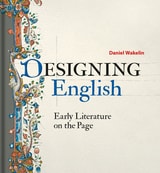
Designing English
Early Literature on the PageDaniel Wakelin
Bodleian Library Publishing, 2017
Working beyond the traditions established for Latin, scribes of English needed to be more inventive, using each book as an opportunity to redesign. Surveying eight centuries of graphic design in manuscripts and inscriptions, Designing English focuses on the craft, agency, and intentions of scribes, painters, and engravers from the Anglo-Saxon to the early Tudor periods. The book examines format, layout, and decoration, as well as bilingual manuscripts and oral recitations, weighing the balance of ingenuity and copying, imagination and practicality, behind early English book design. With over ninety illustrations, drawn especially from the holdings of the Bodleian Library, Designing English gives a comprehensive overview of English books and other material texts across the Middle Ages.
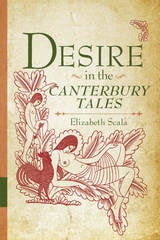
Desire in the Canterbury Tales
Elizabeth Scala
The Ohio State University Press, 2015
Desire in the Canterbury Tales coordinates the compulsions of desire with the act of misreading to define the driving force of Chaucer’s story collection. With Chaucer’s competitive pilgrimage as an important point of departure, this study examines the collection’s manner of generating stories out of division, difference, and contestation. It argues that Chaucer’s tales are produced as misreadings and misrecognitions of each other. Looking to the main predicate of the General Prologue’s famous opening sentence (“longen”) as well as the thematic concerns of a number of tale-tellers, and working with a theoretical model that exposes language as the product of such longing, Scala posits desire as the very subject of the Canterbury Tales and misrecognition as its productive effect. In chapters focusing on both the well-discussed tales of fragment 1 and the marriage group as well as the more recalcitrant religious stories, Desire in the Canterbury Tales offers a comprehensive means of accounting for Chaucer’s poem.
Development of Southern French and Catalan Society, 718-1050
By Archibald R. Lewis
University of Texas Press, 1965
Early in the eighth century, the current of the Muslim movement that inundated northern Spain crept over the Pyrenees to spread across a portion of the French Midi. From the north the tide of Carolingian conquest forced the Muslims back and took in these same southern French and northern Spanish provinces. During the same era the Vikings raided intermittently and with varying degrees of intensity along the seacoasts and up the inland waterways, sometimes controlling considerable areas for extended periods.
These raids and conquests inevitably affected the way of life of the people of southern France and Catalonia. Contemporary travelers and later scholars have noted that the feudal traditions and obligations that were so strong in the north seemed very weak or nonexistent in the south. They found that the land seemed to be held largely as allods, not as feudal fiefs; they saw that women held positions of surprising power, that throughout the area there was great emphasis on money, and that the traditions of Roman and Visigothic law still survived.
Although scholars have noted these differences, no one has made a comprehensive study of southern French and Catalan society as a whole. It is to fill this void that Archibald Lewis provides this volume. In a detailed and scholarly study, based largely upon original records and chronicles, he examines the familial, social, economic, governmental, military, and religious life of the area from 718 to 1050 A.D.
Lewis gives as comprehensive a picture as the records will permit of the society that existed in the early eighth century, describes and discusses the major changes which took place during the next three centuries, and analyzes their causes and effects. This study, which includes careful and detailed notes and an extensive bibliography, provides a reliable and long-needed reference tool.
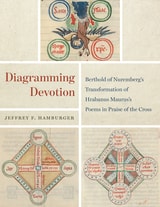
Diagramming Devotion
Berthold of Nuremberg’s Transformation of Hrabanus Maurus’s Poems in Praise of the CrossJeffrey F. Hamburger
University of Chicago Press, 2020
Digenis Akritas
The Two-Blood Border Lord—The Grottaferrata VersionDenison B. Hull
Ohio University Press, 1986
Before The Song of Roland, before El Cid, and centuries before today's fascination with warrior legends and frontier worlds, there was Digenis Akritas: the great epic of Byzantium and one of the earliest masterpieces of medieval Greek literature. Rooted in the turbulent borderlands between the Byzantine Empire and the Arab world, this remarkable poem brings to life a society where cultures met, clashed, and transformed one another. Based on traditions that emerged from the Byzantine eastern frontier and preserved in medieval manuscripts, Digenis Akritas remains the most celebrated surviving heroic epic of the Byzantine world.
At its center stands Basil, known as Digenis Akritas, the “two-blood border lord.” Born of a union between an Arab emir and a Byzantine noblewoman, he embodies the complex cultural landscape of the medieval eastern Mediterranean. Gifted with extraordinary strength and courage, Digenis grows into an unparalleled warrior, defending the empire's frontier against raiders, outlaws, and rival champions while forging his own legend along the banks of the Euphrates.
Blending action, romance, folklore, and faith, the poem follows Digenis through daring adventures, dramatic combats, encounters with marvels, and a passionate love story. Yet beyond its heroic exploits lies a vivid portrait of frontier life in the medieval Byzantine world, where Christian and Muslim, Greek and Arab, imperial power and local tradition intersected in unexpected ways. The result is an epic that is at once a thrilling tale of adventure and a window into a fascinating civilization.
This acclaimed English verse translation restores a foundational work of medieval literature for modern readers. Supported by scholarly commentary, a bibliography, and maps, it offers an accessible introduction to one of history's great heroic traditions and to the legendary figure who became the archetypal hero of Byzantine folklore.
Documents in Medieval Latin
John Thorley
University of Michigan Press, 1998
Documents in Medieval Latin will be useful to students of medieval history, literature, and philosophy and those interested in reading more about the Middle Ages. Thorley's cheerful approach, the lively and representative selections of tests, and the documentary and epigraphic focus will prove valuable for those wishing to explore these vital original sources.
John Thorley teaches medieval Latin at Lancaster University.