Results by title
970 books match the query 'Movements' and 30 start with d
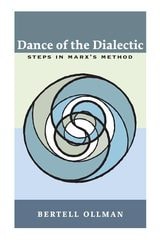
Dance of the Dialectic
STEPS IN MARX'S METHODBertell Ollman
University of Illinois Press, 2003
Marx made extremely creative use of dialectical method to analyze the origins, operation, and direction of capitalism. Unfortunately, his promised book on method was never written, so that readers wishing to understand and evaluate Marx's theories, or to revise or use them, have had to proceed without a clear grasp of the dialectic in which the theories are framed. The result has been more disagreement over "what Marx really meant" than over the writings of any other major thinker.
In putting Marx's philosophy of internal relations and his use of the process of abstraction--two little-studied aspects of dialectics--at the center of this account, Ollman provides a version of Marx's method that is at once systematic, scholarly, clear and eminently useful.
Ollman not only sheds important new light on what Marx really meant in his varied theoretical pronouncements, but in carefully laying out the steps in Marx's method makes it possible for a reader to put the dialectic to work in his or her own research. He also convincingly argues the case for why social scientists and humanists as well as philosophers should want to do so.

Dead Letters to Nietzsche, or the Necromantic Art of Reading Philosophy
Joanne Faulkner
Ohio University Press, 2010
Dead Letters to Nietzsche examines how writing shapes subjectivity through the example of Nietzsche’s reception by his readers, including Stanley Rosen, David Farrell Krell, Georges Bataille, Laurence Lampert, Pierre Klossowski, and Sarah Kofman. More precisely, Joanne Faulkner finds that the personal identification that these readers form with Nietzsche’s texts is an enactment of the kind of identity-formation described in Lacanian and Kleinian psychoanalysis. This investment of their subjectivity guides their understanding of Nietzsche’s project, the revaluation of values.
Not only does this work make a provocative contribution to Nietzsche scholarship, but it also opens in an original way broader philosophical questions about how readers come to be invested in a philosophical project and how such investment alters their subjectivity.
Dear Incomprehension
On American Speculative FictionStéphane Vanderhaeghe
University of Alabama Press, 2024
WINNER OF THE ELIZABETH AGEE PRIZE IN AMERICAN LITERARY STUDIES
A philosophical and formally inventive inquiry into the experimental terrains of American speculative fiction, where meaning emerges through ambiguity, rupture, and critical refusal.
Dear Incomprehension: On American Speculative Fiction is a thought-provoking exploration of the fascinating field of contemporary speculative fiction, a genre that transcends boundaries and encompasses science fiction, fabulist tales, modern fairy tales, and experimental narratives that challenge the very essence of storytelling and reading.
Written as a philosophical essay that mirrors the unorthodox nature of the texts it analyzes, Dear Incomprehension examines American works that defy traditional narrative devices such as plot, character, logic, and even legibility. Drawing on a number of philosophical theories, among them object-oriented ontology and speculative realism, Vanderhaeghe argues that these unconventional works resist the standard tools of criticism, demanding instead a novel perspective and approach.
An in-depth resource for scholars and students of contemporary literature, philosophy, and digital literary studies, Dear Incomprehension offers a fresh framework for analyzing experimental fiction and alternative modes of meaning-making. It is a must-read for those seeking to grasp the complexities and nuances of American experimental and speculative fiction.

Dearth
Deconstruction After Speculative Realism. Art and DwellingPhilippe Lynes
Northwestern University Press, 2026
Proposing new insight into the legacies of Derridean thought for contemporary philosophy
In Art and Dwelling, the second volume of his Dearth sequence, Philippe Lynes sheds new light on the most enduring offshoot of the speculative realist movement, object-oriented ontology. Through careful readings of Graham Harman and Timothy Morton, Lynes shows how Jacques Derrida’s seminars offer critical insights into the spacing and distancing that precede and exceed all human practices of art and dwelling, with a deep sensitivity to the ecological and ethico-political consequences that follow.
Dearth: Deconstruction After Speculative Realism argues that Derrida’s seminars on Martin Heidegger and Maurice Blanchot, La Chose (The Thing), anticipated many of the philosophical, literary, and aesthetic questions animating speculative realism today: an anti-anthropocentric critique of Kantian correlationism; an overcoming of the apocalyptic nihilism of extinction through a deeper, affirmative habituation to nothingness; and poignant reflections on the literary and poetic aspects of living and dying in impossible worlds. His is an anti-correlationist plea that resounds now more urgently than ever.

Dearth
Deconstruction After Speculative Realism. The Nothing and NothingnessPhilippe Lynes
Northwestern University Press, 2026
Proposing a radical reconceptualization of deconstruction and nothingness
The first of two volumes exploring Jacques Derrida’s prefiguration of speculative realism, The Nothing and Nothingness examines the transcendental naturalism of Ray Brassier and Iain Hamilton Grant and the speculative materialism of Quentin Meillassoux. Philippe Lynes proposes nothing less than a radical reconceptualization of deconstruction as a call to bear witness to nothingness: let the earth be the earth, let nature be nature, and leave them to their reality, secrecy, and withdrawal without us.
Dearth: Deconstruction After Speculative Realism argues that Derrida’s seminars on Martin Heidegger and Maurice Blanchot, La Chose (The Thing), anticipated many of the philosophical, literary, and aesthetic questions animating speculative realism today: an anti-anthropocentric critique of Kantian correlationism; an overcoming of the apocalyptic nihilism of extinction through a deeper, affirmative habituation to nothingness; and poignant reflections on the literary and poetic aspects of living and dying in impossible worlds. His is an anti-correlationist plea that resounds now more urgently than ever.

Decolonizing Science in Latin American Art
Joanna Page
University College London, 2021
Projects that bring the sciences into art are increasingly being exhibited in galleries and museums across the world. In a surge of publications on the subject, few have focused on regions beyond the Global North. This book assembles a new corpus of art-science projects by Latin American artists, ranging from big-budget collaborations with NASA and MIT to homegrown experiments in artists’ kitchens. Page shows how these artworks also “decolonize” science by resisting the exploitation of the natural world that has attended the creation of knowledge in western contexts. Instead, the artists featured in this volume emphasize the subjectivity and intelligence of other species, staging new forms of collaboration and co-creativity beyond the human. Establishing critical dialogues between Western science and indigenous thought, this book interrogates how artistic practices may communicate, extend, supplement, and challenge scientific ideas.
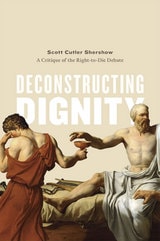
Deconstructing Dignity
A Critique of the Right-to-Die DebateScott Cutler Shershow
University of Chicago Press, 2013
Shershow examines texts from Cicero’s De Officiis to Kant’s Groundwork of the Metaphysics of Morals to court decisions and religious declarations. Through them he reveals how arguments both supporting and denying the right to die undermine their own unconditional concepts of human dignity and the sanctity of life with a hidden conditional logic, one often tied to practical economic concerns and the scarcity or unequal distribution of medical resources. He goes on to examine the exceptional case of self-sacrifice, closing with a vision of a society—one whose conditions we are far from meeting—in which the debate can finally be resolved. A sophisticated analysis of a heated topic, Deconstructing Dignity is also a masterful example of deconstructionist methods at work.

Deconstruction
An American InstitutionGregory Jones-Katz
University of Chicago Press, 2021
Deconstruction begins well before Jacques Derrida’s initial American presentation of his deconstructive work in a famed lecture at Johns Hopkins University in 1966 and continues through several decades of theoretic growth and tumult. While much of the subsequent story remains focused, inevitably, on Yale University and the personalities and curriculum that came to be lumped under the “Yale school” umbrella, Deconstruction makes clear how crucial feminism, queer theory, and gender studies also were to the lifeblood of this mode of thought. Ultimately, Jones-Katz shows that deconstruction in the United States—so often caricatured as a French infection—was truly an American phenomenon, rooted in our preexisting political and intellectual tensions, that eventually came to influence unexpected corners of scholarship, politics, and culture.
DeepAesthetics
Computational Experience in a Time of Machine LearningAnna Munster
Duke University Press, 2025

Deja Vu
Aberrations Of Cultural MemoryPeter Krapp
University of Minnesota Press, 2004
The pitfalls of cultural memory and forgetting, understood through the genealogy of the phenomenon called déjà vu
Referring to a past that never was, déjà vu shares a structure not only with fiction, but also with the ever more sophisticated effects of media technology. Tracing the term from the end of the nineteenth century, when it was first popularized in the pages of the Revue philosophique, Peter Krapp examines the genealogy and history of the singular and unrepeatable experience of déjà vu. This provocative book offers a refreshing counterpoint to the clichéd celebrations of cultural memory and forces us do a double take on the sanctimonious warnings against forgetting so common in our time.
Disturbances of cultural memory—screen memories, false recognitions, premonitions—disrupt the comfort zone of memorial culture: strictly speaking, déjà vu is neither a failure of memory nor a form of forgetting. Krapp’s analysis of such disturbances in literature, art, and mass media introduces, historicizes, and theorizes what it means to speak of an economy of attention or distraction. Reaching from the early psychoanalytic texts of Sigmund Freud to the plays of Heiner Müller, this exploration of the effects of déjà vu pivots around the work of Walter Benjamin and includes readings of kitsch and aura in Andy Warhol’s work, of cinematic violence and certain exaggerated claims about shooting and cutting, of the memorial character of architecture, and of the high expectations raised by the Internet.
Democratic Art
The New Deal's Influence on American CultureSharon Ann Musher
University of Chicago Press, 2015
In Democratic Art, Sharon Musher explores these questions and uses them as a springboard for an examination of the role art can and should play in contemporary society. Drawing on close readings of government-funded architecture, murals, plays, writing, and photographs, Democratic Art examines the New Deal’s diverse cultural initiatives and outlines five perspectives on art that were prominent at the time: art as grandeur, enrichment, weapon, experience, and subversion. Musher argues that those engaged in New Deal art were part of an explicitly cultural agenda that sought not just to create art but to democratize and Americanize it as well. By tracing a range of aesthetic visions that flourished during the 1930s, this highly original book outlines the successes, shortcomings, and lessons of the golden age of government funding for the arts.
Derrida and Differance
David Wood and Robert Bernasconi
Northwestern University Press, 1988
Derrida's Gift, Volume 16
Elizabeth Weed and Ellen Rooney, eds.
Duke University Press, 0
In bringing together major feminist critics whose work has been touched by the writings of Derrida, this issue both pays tribute to and reflects upon Derrida’s ideas. Among the essayists included, Jane Gallop considers Derrida’s writings on Levinas; Judith Butler reads Derrida’s final interview in Le Monde in 2004; Elizabeth Grosz signals Derrida as a rare philosopher for whom sexual difference was crucial; Gayatri Chakravorty Spivak explores the figure of the mother’s child in Derrida, focusing on the critique of reproductive heteronormativity and the question of agency in feminism; and Joan Wallach Scott argues for the importance of critique in the academy. The issue also includes an edited transcription of a vibrant discussion between feminist theorists and Derrida called “Women in the Beehive: A Seminar with Jacques Derrida,” which took place at Brown University’s Pembroke Center for Teaching and Research on Women in 1984.
Contributors. Fran Bartkowski, Anne-Emmanuelle Berger, Susan Bernstein, Judith Butler, Pheng Cheah, Drucilla Cornell, Jane Gallop, Elizabeth Grosz, Peggy Kamuf, Christie McDonald, Joan Wallach Scott, Gayatri Chakravorty Spivak

Destined for Liberty
The Human Person in the Philosophy of Karol Wojtyla/John Paul IIJaroslaw Kupczak, O.P.
Catholic University of America Press, 2000
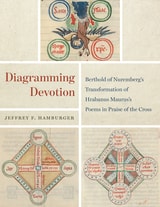
Diagramming Devotion
Berthold of Nuremberg’s Transformation of Hrabanus Maurus’s Poems in Praise of the CrossJeffrey F. Hamburger
University of Chicago Press, 2020
Dialectic and Dialogue
Plato's Practice of Philosophical InquiryFrancisco J. Gonzalez
Northwestern University Press, 1998

Dialogue on the Infinity of Love
Tullia d'Aragona
University of Chicago Press, 1997
Sexually liberated and financially independent, Tullia d'Aragona dared to argue that the only moral form of love between woman and man is one that recognizes both the sensual and the spiritual needs of humankind. Declaring sexual drives to be fundamentally irrepressible and blameless, she challenged the Platonic and religious orthodoxy of her time, which condemned all forms of sensual experience, denied the rationality of women, and relegated femininity to the realm of physicality and sin. Human beings, she argued, consist of body and soul, sense and intellect, and honorable love must be based on this real nature.
By exposing the intrinsic misogyny of prevailing theories of love, Aragona vindicates all women, proposing a morality of love that restores them to intellectual and sexual parity with men. Through Aragona's sharp reasoning, her sense of irony and humor, and her renowned linguistic skill, a rare picture unfolds of an intelligent and thoughtful woman fighting sixteenth-century stereotypes of women and sexuality.

Diary of a Philosophy Student
Volume 2, 1928-29Simone de Beauvoir; Translation by Barbara Klaw; Edited by Barbara Klaw, Sylvie Le Bon de Beauvoir, Margaret A. Simons, and Marybeth Timmermann
University of Illinois Press, 2021
Presented for the first time in translation, this fully annotated first volume of the Diary includes essays from Barbara Klaw and Margaret A. Simons that address its philosophical, historical, and literary significance. It remains an invaluable resource for tracing the development of Beauvoir’s independent thinking and her influence on philosophy, feminism, and the world.
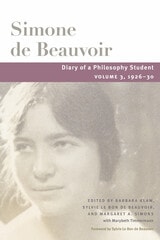
Diary of a Philosophy Student
Volume 3, 1926-30Simone de Beauvoir. Translation by Barbara Klaw. Edited by Barbara Klaw, Sylvie Le Bon de Beauvoir, and Margaret A. Simons with Marybeth Timmermann. Foreword by Sylvie Le Bon de Beauvoir
University of Illinois Press, 2024
In addition, the editors include a wealth of important supplementary material. Barbara Klaw provides a detailed consideration of the Diary’s role in the development of Beauvoir’s writing style by exploring her use of metanarrative and other literary techniques, part of a process of literary creation that saw Beauvoir use the notebooks to cultivate her talent. Margaret A. Simons’s essay places the assault by Sartre within an appraisal of Beauvoir’s complicated legacy for #MeToo while suggesting readers engage with the diary through the lens of trauma.

Dickey Chapelle Under Fire
Photographs by the First American Female War Correspondent Killed in ActionJohn Garofolo
Wisconsin Historical Society Press, 2026
Striking photographs and stories from more than two decades on the frontlines by a groundbreaking photojournalist—and the first female American war correspondent to be killed in action.
In 1941, twenty-two-year-old Georgette "Dickey" Chapelle sold her first photo essay to Look magazine. A year later, with World War II underway, she was photographing American soldiers in combat training in Panama. By the end of the war, she had captured the devastation at Iwo Jima and Okinawa, and in the ensuing decades, Dickey and her camera were on the scene at many of the world’s hotspots—from Cuba and the Dominican Republic to Algeria and Lebanon to Vietnam and Laos. Dickey Chapelle Under Fire exposes her remarkable story and shares over 150 stunning images from her extraordinary career as a photojournalist.
In the male-dominated world of war journalism, Chapelle fought to be taken seriously. She eventually earned the respect of many of her male colleagues and broke down barriers for future generations of female journalists. She embedded herself with military units on frontlines around the globe, capturing not only the horrors of war but also the camaraderie and everyday routines of service men and women.
Always one to follow the action, Chapelle traveled with Algerian rebels across the North African desert and with Fidel Castro through the jungles of Cuba. She spent two months in a Hungarian prison after being caught smuggling aid to refugees fleeing a Soviet invasion. Beginning in 1961, Chapelle set her lens and viewfinder on Southeast Asia, capturing the growing conflict there, until she was killed while on patrol with marines in Vietnam in April 1965—making her the first female American war correspondent to be killed in action.
For twenty-five years, Chapelle's photographs graced the pages of National Geographic, the National Observer, Life, and other major publications. Despite her tragic end, Chapelle’s tenacity, courage, and compassion shine throughout her work, highlighting the human impact of war while revealing the larger stories beyond the battlefield. Her legacy lives on through this powerful collection.
Discovering Existence with Husserl
Emmanuel Levinas
Northwestern University Press, 1997
In collecting almost all of Levinas's articles on Husserlian phenomenology, this volume gathers together a wealth of thoughtful exposition and interpretation by one of the most important European philosophers of the twentieth century. Levinas's thought is relevant to a broad variety of disciplines and concerns. This volume serves as a reliable introduction for the beginning student, as well as satisfying the expert's more demanding and critical desire for insight into the complexities of Levinas's thought.

Disorienting Phenomenology
Queer Space and Trans LifeEden Kinkaid
University of Minnesota Press, 2026
Rethinking space from the ground up through trans theory, philosophy, and radical possibility
Disorienting Phenomenology takes as its point of departure the trans mundane: entering a public restroom, moving through airport security, navigating professional spaces. These ordinary yet unsettling encounters become portals into urgent philosophical questions about space, embodiment, perception, power, and violence. Attending closely to how trans people experience everyday life, Eden Kinkaid shows that space is never neutral. It is felt, negotiated, and contested at the level of the body, shaping one’s capacities, safety, and sense of self.
Weaving together philosophy, queer and trans studies, geography, and personal narrative, Kinkaid develops an intersectional theory of space grounded in lived experience. They bring the foundational spatial theories of Henri Lefebvre together with critical phenomenologies of gender, race, and disability to demonstrate how systems of oppression are built into the environments we inhabit, configuring movement and constraining possibility for minoritized people. Bold and interdisciplinary, Disorienting Phenomenology offers vital conceptual tools for understanding—and transforming—the worlds we move through each day.
Retail e-book files for this title are screen-reader friendly.
Dissemination
Jacques Derrida
University of Chicago Press, 1981
Dissemination
Jacques Derrida
University of Chicago Press, 1981
Distracted
A Philosophy of Cars and PhonesRobert Rosenberger
University of Minnesota Press, 2024
Applying insights from philosophy and cognitive science to address the urgent issue of smartphone-induced distracted driving
Although the dangers of texting while driving are widely known, many people resist the idea that phone usage will impair their driving. And connectivity features in new cars have only made using technology behind the wheel more tempting. What will it take to change people’s minds and behavior? Robert Rosenberger contends that a better understanding of why this combination of technologies is so dangerous could effectively adjust both habits and laws.
Rosenberger brings together ideas from philosophy and cognitive science to leverage a postphenomenological perspective that reveals how our smartphones make us such bad drivers. Reviewing decades of empirical studies in cognitive science, he shows that we have developed habits of perception regarding our compulsive technology use—habits that may wrest our attention away from the road.
Distracted develops innovative concepts for understanding technology-related habits and the ways that our relationships to our devices influence how we perceive the world. In turn, these ideas can help drivers be more cognizant of the effect that smartphone usage has on their perceptions, better inform efforts to enact stricter regulations, and help us all to be more reflective about the technologies that shape our lives.
Domesticating Brown
Movements of Racial ImaginationChristopher B. Patterson
Duke University Press, 2026
Don't Act, Just Dance
The Metapolitics of Cold War CultureCatherine Gunther Kodat
Rutgers University Press, 2014

Dreamland of Humanists
Warburg, Cassirer, Panofsky, and the Hamburg SchoolEmily J. Levine
University of Chicago Press, 2013
In Dreamland of Humanists, Emily J. Levine considers not just these men, but the historical significance of the time and place where their ideas took form. Shedding light on the origins of their work on the Renaissance and the Enlightenment, Levine clarifies the social, political, and economic pressures faced by German-Jewish scholars on the periphery of Germany’s intellectual world. By examining the role that context plays in our analysis of ideas, Levine confirms that great ideas—like great intellectuals—must come from somewhere.

Duns Scotus on Time and Existence
John Duns Scotus
Catholic University of America Press, 2014
Dürer's Coats
Renaissance Men and Material Cultures of Social RecognitionUlinka Rublack
Central European University Press, 2025