Results by title
344 books match the query 'Nationalism' and 12 start with d
Dangerous Liaisons
Gender, Nation, and Postcolonial PerspectivesAnne Mcclintock
University of Minnesota Press, 1997

Daniel Webster and the Oratory of Civil Religion
Craig R. Smith
University of Missouri Press, 2005

Danish, But Not Lutheran
The Impact of Mormonism on Danish Cultural Identity, 1850–1920Julie K. Allen
University of Utah Press, 2017
The Danish-Mormon migration to Utah in the nineteenth century was, relative to population size, one of the largest European religious out-migrations in history. Hundreds of thousands of Americans can trace their ancestry to Danish Mormons, but few know about the social and cultural ramifications of their ancestors’ conversion to Mormonism. This book tells that exciting and complex story for the first time.
In 1849, after nearly a thousand years of state- controlled religion, Denmark’s first democratic constitution granted religious freedom. One year later, the arrival of three Mormon missionaries in Denmark and their rapid success at winning converts to their faith caused a crisis in Danish society over the existential question: "How could someone be Danish but not Lutheran?" Over the next half-century nearly thirty thousand Danes joined the LDS Church, more than eighteen thousand of whom emigrated to join their fellow Mormons in Utah. This volume explores the range of Danish public reactions to Mormonism over a seventy-year period—from theological concerns articulated by Søren and Peter Christian Kierkegaard in the 1850s to fear-mongering about polygamy and white slavery in silent films of the 1910s and 1920s—and looks at the personal histories of converts.
Honorable Mention for Best International Book from the Mormon History Association.

Deep Mexico, Silent Mexico
An Anthropology of NationalismClaudio Lomnitz
University of Minnesota Press, 2001
In Mexico, as elsewhere, the national space, that network of places where the people interact with state institutions, is constantly changing. How it does so, how it develops, is a historical process-a process that Claudio Lomnitz exposes and investigates in this book, which develops a distinct view of the cultural politics of nation building in Mexico. Lomnitz highlights the varied, evolving, and often conflicting efforts that have been made by Mexicans over the past two centuries to imagine, organize, represent, and know their country, its relations with the wider world, and its internal differences and inequalities. Firmly based on particulars and committed to the specificity of such thinking, this book also has broad implications for how a theoretically informed history can and should be done.
An exploration of Mexican national space by way of an analysis of nationalism, the public sphere, and knowledge production, Deep Mexico, Silent Mexico brings an original perspective to the dynamics of national cultural production on the periphery. Its blending of theoretical innovation, historical inquiry, and critical engagement provides a new model for the writing of history and anthropology in contemporary Mexico and beyond.
Public Worlds Series, volume 9

Democracy, Militarism, and Nationalism in Argentina, 1930–1966
An InterpretationBy Marvin Goldwert
University of Texas Press, 1972
Until 1930, Argentina was one of the great hopes for stable democracy in Latin America. Argentines themselves believed in the destiny of their nation to become the leading Latin American country in wealth, power, and culture. But the revolution of 1930 unleashed the scourges of modern militarism and chronic instability in the land. Between 1930 and 1966, the Argentine armed forces, or factions of the armed forces, overthrew the government five times.
For several decades, militarism was the central problem in Argentine political life. In this study, Marvin Goldwert interprets the rise, growth, and development of militarism in Argentina from 1930 to 1966. The tortuous course of Argentine militarism is explained through an integrating hypothesis. The army is viewed as a “power factor,” torn by a permanent dichotomy of values, which rendered it incapable of bringing modernization to Argentina. Caught between conflicting drives for social order and modernization, the army was an ambivalent force for change. First frustrated by incompetent politicians (1916–1943), the army was later driven by Colonel Juan D. Perón into an uneasy alliance with labor (1943–1955). Peronism initially represented the means by which army officers could have their cake—nationalistic modernization—and still eat it in peace, with the masses organized in captive unions tied to an authoritarian state.
After 1955, when Perón was overthrown, a deeply divided army struggled to contain the remnants of its own dictatorial creation. In 1966, the army, dedicated to staunch anti-Peronism, again seized the state and revived the dream of reconciling social order and modernization through military rule.
Although militarism has been a central problem in Argentine political life, it is also the fever that suggests deeper maladies in the body politic. Marvin Goldwert seeks to relate developments in the military to the larger political, social, and economic developments in Argentine history. The army and its factions are viewed as integral parts of the whole political spectrum during the period under study.
Demons and Development
The Struggle for Community in a Sri Lankan VillageJames Brow
University of Arizona Press, 1996
James Brow witnessed these possession trances and sorcery accusations as they occurred, enabling him to convey this richly textured story interweaving political factionalism and troubled spirits. Official projects of development have proceeded apace in Sri Lanka, but until now there have been few accounts of their tendency to tear apart the fabric of rural society. Demons and Development combines an engaging narrative of how development was experienced in one particular village with an original contribution to theories of hegemony, the social anthropology of South Asia, the ethnography of nationalism, and the sociology of development.
Diaspora Identities
Exile, Nationalism and Cosmopolitanism in Past and PresentEdited by Susanne Lachenicht and Kirsten Heinsohn
Campus Verlag, 2009
Historical work on the late nineteenth and early twentieth centuries suggests that as nation-states were solidifying throughout Western Europe, exiled groups tended to develop rival national identities—an occurrence that had been fairly uncommon in the two preceding centuries. Diaspora Identities draws on eight case studies, ranging from the early modern period through the twentieth century, to explore the interconnectedness of exile, nationalism, and cosmopolitanism as concepts, ideals, attitudes, and strategies among diasporic groups.
Dilemmas of Culture in African Schools
Youth, Nationalism, and the Transformation of KnowledgeCati Coe
University of Chicago Press, 2005
Coe identifies the state's limitations in teaching cultural knowledge and discusses how Ghanaians negotiate the tensions raised by the competing visions of modernity that nationalism and Christianity have created. She reveals how cultural curricula affect authority relations in local social organizations—between teachers and students, between Christians and national elite, and between children and elders—and raises several questions about educational processes, state-society relations, the production of knowledge, and the making of Ghana's citizenry.

Disappearing Acts
Spectacles of Gender and Nationalism in Argentina's "Dirty War"Diana Taylor
Duke University Press, 1997
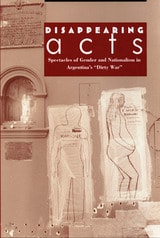
Taylor uses performance theory to explore how public spectacle both builds and dismantles a sense of national and gender identity. Here, nation is understood as a product of communal "imaginings" that are rehearsed, written, and staged—and spectacle is the desiring machine at work in those imaginings. Taylor argues that the founding scenario of Argentineness stages the struggle for national identity as a battle between men—fought on, over, and through the feminine body of the Motherland. She shows how the military’s representations of itself as the model of national authenticity established the parameters of the conflict in the 70s and 80s, feminized the enemy, and positioned the public—limiting its ability to respond. Those who challenged the dictatorship, from the Mothers of the Plaza de Mayo to progressive theater practitioners, found themselves in what Taylor describes as "bad scripts." Describing the images, myths, performances, and explanatory narratives that have informed Argentina’s national drama, Disappearing Acts offers a telling analysis of the aesthetics of violence and the disappearance of civil society during Argentina’s spectacle of terror.
Disappearing Acts
Spectacles of Gender and Nationalism in Argentina's "Dirty War"Diana Taylor
Duke University Press, 0
Taylor uses performance theory to explore how public spectacle both builds and dismantles a sense of national and gender identity. Here, nation is understood as a product of communal "imaginings" that are rehearsed, written, and staged—and spectacle is the desiring machine at work in those imaginings. Taylor argues that the founding scenario of Argentineness stages the struggle for national identity as a battle between men—fought on, over, and through the feminine body of the Motherland. She shows how the military’s representations of itself as the model of national authenticity established the parameters of the conflict in the 70s and 80s, feminized the enemy, and positioned the public—limiting its ability to respond. Those who challenged the dictatorship, from the Mothers of the Plaza de Mayo to progressive theater practitioners, found themselves in what Taylor describes as "bad scripts." Describing the images, myths, performances, and explanatory narratives that have informed Argentina’s national drama, Disappearing Acts offers a telling analysis of the aesthetics of violence and the disappearance of civil society during Argentina’s spectacle of terror.

Discourses of the Vanishing
Modernity, Phantasm, JapanMarilyn Ivy
University of Chicago Press, 1995
Ivy shows how a fascination with cultural margins accompanied the emergence of Japan as a modern nation-state. This fascination culminated in the early twentieth-century establishment of Japanese folklore studies and its attempts to record the spectral, sometimes violent, narratives of those margins. She then traces the obsession with the vanishing through a range of contemporary reconfigurations: efforts by remote communities to promote themselves as nostalgic sites of authenticity, storytelling practices as signs of premodern presence, mass travel campaigns, recallings of the dead by blind mediums, and itinerant, kabuki-inspired populist theater.

Divine Enterprise
Gurus and the Hindu Nationalist MovementLise McKean
University of Chicago Press, 1996
In this close look at the business of religion, McKean traces the ideological and organizational antecedents to the Hindu nationalist movement. The Indian state's increasing patronage of Hindu institutions makes competition for its support greater than ever. Using materials from guru's publications, the press, and extensive field research, McKean examines how participation by upper-caste ruling class groups in the Divine Life Society and other Hindu organizations further legitimates their own authority.
With a remarkable selection of photographs and advertisements showing icons of spirituality used to sell commodities from textiles to cement to comic books, McKean illustrates the pervasive presence of Hindu imagery in India's burgeoning market economy. She shows how gurus popularize Hindu nationalism through imagery such as the goddess, Mother India, and her martyred sons and daughters.