Results by title
3785 books match the query 'Poetry' and 128 start with d
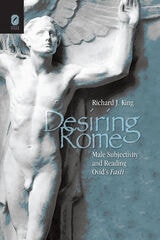
DESIRING ROME
Male Subjectivity and Reading Ovid’s FastiRichard J. King
The Ohio State University Press, 2006
Desiring Rome expands upon recent recognition of the Fasti’s centrality to early imperial politics by situating the poem’s “failure” within broader negotiations of identity between early imperial citizen-subjects and the cultural ideology of Roman manhood.

Daisy
PoemsRachel Feder
Northwestern University Press, 2025
A narrative-poetic retelling of The Great Gatsby from the perspective of a 1990s teen poet
Daisy: Poems is a captivating and imaginative take on The Great Gatsby that puts F. Scott Fitzgerald’s 1925 classic in the hands of a messy, ambitious, and possibly devious teen poet. From her privileged yet precarious perch in the roaring 1990s, Daisy navigates the expectations of her parents, boyfriend, and lover, alongside her own artistic ambitions, as she explores whether freedom is what she truly desires—and wonders if it’s even possible. Rachel Feder puts a new spin on beloved characters: Jay, longtime and secret lover; Nick, somewhat mysterious and always meddling cousin; and Jordyn, best friend and companion in doomed relationships. A meditation on juvenilia, constructions of femininity, the purity myth, and canonical literary silences, Daisy is told in sparse, evocative verse that pulsates with youthful passion and offers a new elegy for our lost American dreams.
Dance and Disappear
Laura Kasischke
University of Massachusetts Press, 2002
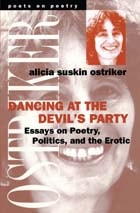
Dancing at the Devil's Party
Essays on Poetry, Politics, and the EroticAlicia Suskin Ostriker
University of Michigan Press, 2000
In her work, Ostriker can be controversial, as when she attacks the academic establishment for rejecting the erotic dimension of poetry, or when she meditates on the significance of the black poet Lucille Clifton to herself as a reader, or when she argues that Allen Ginsberg's "Howl"--famous as the primary poem of the Beat Generation--is also a profoundly Jewish poem. Yet her writing is always lively and readable, free of academic jargon, inviting the reader to enjoy a wide range of poetic styles and experiences.
Ostriker's criticism, like her poetry, is both feminist and deeply humane. These essays on American poetry will appeal to students of poetry, scholars of American literature, and anyone who enjoys the work of the poets discussed in the book.
Alicia Ostriker is the author of nine books of poetry, including The Imaginary Lover, which won the William Carlos Williams Award and The Crack in Everything, which was a National Book award finalist in 1996, and which received the Paterson Prize in 1997 and the San Fransisco State Poetry Center Award in 1998. She is Distinguished Professor of English at Rutgers University.
Dancing in Odessa
Ilya Kaminsky
Tupelo Press, 2004
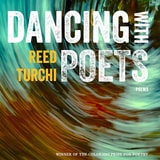
Dancing with Poets
Reed Turchi
University Press of Colorado, 2026
Reed Turchi’s debut collection, Dancing with Poets, explores what it means to make—and re-make—oneself amid a swirl of love, loss, and memory. In dive bars and art museums, baseball stadiums and blues clubs, Turchi summons his ghosts and invites them to sing their songs. A Grammy Award–winning musician as well as poet, Turchi is guided by finely honed rhythm and a singular sonic sensibility that coaxes music from poems that are narrative and lyric in turn. As a collection, Dancing with Poets remembers those the author has loved and lost, but avoids nostalgia, asking instead what futures may be built from grief and how love may grow on the other side of devastation. While the poems may swirl, their emotional truth remains crystalline: The characters, moments, and stories in each poem are infinitely recognizable—fantastic and quotidian in equal measure. Within these poems there are chicken tenders and high art, motorcycles and funerals—a familiar boyhood that happened to be spent surrounded by some of the finest American poets of the late twentieth century. In Dancing with Poets, Turchi invites his reader to join him—“to strut and spin” in grief and joy alike.
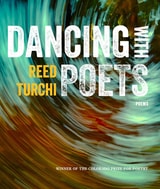
Dancing with Poets
Reed Turchi
University Press of Colorado, 2026
Reed Turchi’s debut collection, Dancing with Poets, explores what it means to make—and re-make—oneself amid a swirl of love, loss, and memory. In dive bars and art museums, baseball stadiums and blues clubs, Turchi summons his ghosts and invites them to sing their songs. A Grammy Award–winning musician as well as poet, Turchi is guided by finely honed rhythm and a singular sonic sensibility that coaxes music from poems that are narrative and lyric in turn. As a collection, Dancing with Poets remembers those the author has loved and lost, but avoids nostalgia, asking instead what futures may be built from grief and how love may grow on the other side of devastation. While the poems may swirl, their emotional truth remains crystalline: The characters, moments, and stories in each poem are infinitely recognizable—fantastic and quotidian in equal measure. Within these poems there are chicken tenders and high art, motorcycles and funerals—a familiar boyhood that happened to be spent surrounded by some of the finest American poets of the late twentieth century. In Dancing with Poets, Turchi invites his reader to join him—“to strut and spin” in grief and joy alike.
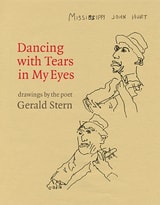
Dancing with Tears in My Eyes
Gerald Stern
University of Iowa Press, 2014
Long recognized as one of the most original poets in America, Stern is known for his tragi-comic, irascible vision that has been vividly rendered in hundreds of poems. All along, he has also been drafting these whimsical sketches. The Thurber-esque drawings represented here are daft, graphic expressions of Stern’s fearless and shameless sense of self.
In addition to expressing a forgiving and cavalier attitude toward aging, these saucy drawings, until now a well-kept secret of Stern’s creative life, capture something essential about his character. By turns profane and playfully romantic, they are another expression of the cutting wit and inimitable charm of Gerald Stern.

Dante's Interpretive Journey
William Franke
University of Chicago Press, 1996
Reading the poem through the lens of hermeneutical theory, Franke focuses particularly on Dante's address to the reader as the site of a disclosure of truth. The event of the poem for its reader becomes potentially an experience of truth both human and divine. While contemporary criticism has concentrated on the historical character of Dante's poem, often insisting on it as undermining the poem's claims to transcendence, Franke argues that precisely the poem's historicity forms the ground for its mediation of a religious revelation. Dante's dramatization, on an epic scale, of the act of interpretation itself participates in the self-manifestation of the Word in poetic form.
Dante's Interpretive Journey is an indispensable addition to the field of Dante studies and offers rich insights for philosophy and theology as well.

Dante’s Craft
Studies in Language and StyleGlauco Cambon
University of Minnesota Press, 1969
Dante's Craft was first published in 1969. Minnesota Archive Editions uses digital technology to make long-unavailable books once again accessible, and are published unaltered from the original University of Minnesota Press editions.
In a series of nine essays, Professor Cambon discusses Dante's language and style and the influence of his poetry on later writers. The first section, a group of six essays, is devoted to the critical studies of Dante's own work. A second section consists of chapters devoted to Dante's influence on the eighteenth-century Italian philosopher Giambattista Vico, on certain American writers, chiefly Herman Melville, Nathaniel Hawthorne, Ezra Pound, and T.S. Eliot, and on the contemporary Italian poet Eugenio Montale.
The pertinence of Dante today is emphasized by Professor Cambon in his introduction to the volume. He writes: "Dante's viability for modern literature springs from the depth and latitude of his own probing into the tangled darkness and light of human existence; and, as some of the essays here collected attempt to show, I have come to believe that Dante can give invaluable clues to the reader of contemporary poetry, whether in its expression of derangement in a new Dark Wood or in its rare glimpses of felicity and wholeness."
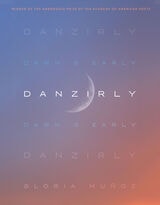
Danzirly
Gloria Muñoz
University of Arizona Press, 2021
Danzirly does not shy away from confronting traditional gender roles, religion, and anxieties surrounding climate change and the digital age. Gloria Muñoz addresses Latinx stereotypes and powerfully dismantles them in poetic form, juxtaposing the promised wonders of a life in America with the harsh realities that immigrants face as they build their lives and raise their families here. Winner of the Academy of American Poets’ Ambroggio Prize, this collection of poems is an unforgettable reckoning of the grief and beauty that pulses through twenty-first-century America.
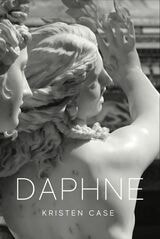
Daphne
Kristen Case
Tupelo Press, 2025
In dialogue with Wittgenstein's “On Certainty,” Ovid's Metamorphoses, Shakespeare's Hamlet, and Thomas Wyatt’s “Whoso List to Hunt,” among other works, Kristen Case's poems and lyric essays unearth the ways violence both disrupts and enables our ways of knowing—or approximating knowledge of—one another.
Dark Alphabet
Jennifer Maier
Southern Illinois University Press, 2006

Dark Braid
PoemsDara Yen Elerath
BkMk Press, 2020
Julie Suk Prize longlist
Through the use of imagination, fairy tale and persona Dark Braid bridges the universal and the personal by focusing on the body, problematic relationships, illness (both mental and physical) and feelings of being an outsider.
Dark End Of The Street
Margins in American Vanguard PoetryMaria Damon
University of Minnesota Press, 1993
Damon foregrounds a number of modern American poets work and lives in order to argue that the American avant-garde is located in the experimental literary works of social "outsiders." Discussed is the work of Black/Jewish surrealist street poet Bob Kaufman, Boston-Brahmin Robert Lowell and three teenaged women writing from a South Boston housing project, pre-Stonewall gay poets Jack Spicer and Robert Duncan, and Jewish lesbian-in-exile Gertrude Stein.
"An engaging and important book. Damon's sophisticated, theoretical approaches to American verse, coupled with her fresh, writerly style in The Dark End of The Street, put her on the forefront of American poetry's next generation of literary criticism." -American Literature"A work of art as well as a work of criticism. Addresses important questions about art and social life, about the margins and the center, and about oppression and suppression." -George Lipsitz
Dark Legs and Silk Kisses
The Beatitudes of the SpinnersAngela Jackson
Northwestern University Press, 1993
Angela Jackson brings her remarkable linguistic and poetic gifts to the articulation of African-American experience. The recurrent motif of the spider, which she presents as both creator and predator, demonstrates her deliberate reshaping of myth in the context of contemporary human experience. Informed by African-American speech and poetic traditions, yet uniquely her own, these poems display Jackson's stylistic grace, her exuberance and vitality of spirit, and her emotional sensitivity and psychological insight.
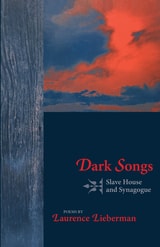
Dark Songs
Slave House and SynagogueLaurence Lieberman
University of Arkansas Press, 1996
Laurence Lieberman writes poems that successfully utilize techniques from every possible form of literature—including histories, travelogues, short stories, and epics. All the while, his lines maintain a deft balance of lyrical intensity, clear, methodical description, and the pure dialect of the characters living his poetry.
In Dark Songs: Slave House and Synagogue, Lieberman creates a narrative mosaic of the eastern Caribbean islands, ranging from St. Eustatius in the eighteenth century to the island of Grenada after the United States–led invasion in 1983. When he writes of African slaves, British governors, Dutch Jews, island guerillas, fallen Swiss nobility, and piratelike charter captains, the wealth of his details, the force, and often the truth behind his stories allow us to witness the whole human saga of the Caribbean.
With humor, absolute candor, and relentless observation, Lieberman has, as reviewer Samuel Maio says, “given is a new form of fiction in his poetry. He has created a singular art.”
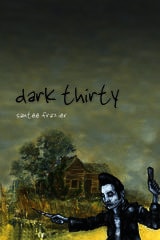
Dark Thirty
Santee Frazier
University of Arizona Press, 2009
Dark Thirty takes us on a loosely autobiographical trip through Cherokee country, the backwoods towns and the big cities, giving us clear-eyed portraits of Native people surviving contemporary America. In Frazier’s world, there is no romanticizing of Native American life. Here cops knock on the door of a low-rent apartment after a neighbor has been stabbed. Here a poem’s narrator recalls firing a .38 pistol—“barrel glowing like oil in a gutter-puddle”—for the first time. Here a young man catches a Greyhound bus to Flagstaff after his ex-girlfriend tells him he has fathered a child. Yet even in the midst of violence and despair there is time for the beauty of the world to shine through: “The Cutlass rattling out / the last fumes of gas, engine stops, / the night dimly lit by the moon / hung over the treetops; / owls calling each other from / hilltop to valley bend.”
Like viewing photographs that repel us even as they draw us in, we are pulled into these poems. We’re compelled to turn the page and read the next poem. And the next. And each poem rewards us with a world freshly seen and remade for us of sound and image and voice.
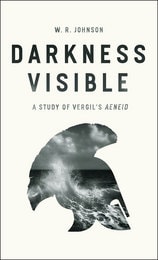
Darkness Visible
A Study of Vergil's "Aeneid"W. R. Johnson
University of Chicago Press, 1976
With an approach to the text that is both grounded in scholarship and intensely personal, and in a style both rhetorically elegant and passionate, Johnson offers readings of specific passages that are nuanced and suggestive as he focuses on the “somber and nourishing fictions” in Vergil’s poem. A timeless work of scholarship, Darkness Visible will enthrall classicists as well as students and scholars of the history of criticism—specifically the way in which politics influence modern readings of the classics—and of poetry and literature.

Darktown Follies
Amaud Johnson
Tupelo Press, 2013
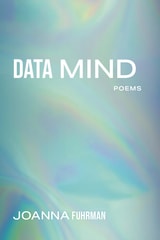
Data Mind
PoemsJoanna Fuhrman
Northwestern University Press, 2025
Wrestling with the experience of living online as a non-digital native
Joanna Fuhrman didn’t grow up online. Her generation entered the digital age as adults, with optimism about the possibilities it would bring for community building. In the alien landscape of the internet, they indeed found moments of joy and connection, but they also watched in anguish as what had been sold as a utopian space instead magnified the anti-democratic demons of necrocapitalism. In this darkly comic and surreal collection, Fuhrman lets herself fall into the internet wormhole of these conflicting realities. With titles ranging from “You Won’t Believe How Your Favorite Childhood Star Looks Now” to “We’ll Burn That Algorithm When We Get to It,” the feminist prose poems in Data Mind remix the tropes of digital life with the puckishness and embodied urgency for which Fuhrman is celebrated.
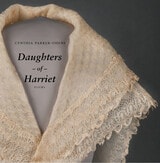
Daughters of Harriet
Cynthia Parker-Ohene
University Press of Colorado, 2022
Finalist, 2022 Foreword INDIES for Poetry
Finalist, 2022 Golden Poppy Award for Poetry
Finalist, 2022 San Francisco/Nomadic Literary Award for Poetry
Drawing inspiration from the life of Harriet Tubman, Cynthia Parker-Ohene’s poetic narratives follow a historical arc of consciousness of Black folks: mislaid in potters’ fields and catalogued with other misbegotten souls, now unsettled as the unknown Black denominator. Who loved them? Who turned them away? Who dismembered their souls? In death, they are the institutionalized marked Black bodies assigned to parcels, scourged beneath plastic sheets identified as a number among Harriets as black, marked bodies. These poems speak to how the warehousing of enslaved and somewhat free beings belies their humanity through past performances in reformatories, workhouses, and hospitals for the negro insane. To whom did their Black lives belong? How are Black grrls socialized within the family to be out in the world? What is the beingness of Black women? How have the Harriets—the descended daughters of Harriet Tubman—confronted issues of caste and multiple oppressions? These poems give voice to the unspeakable, the unreachable, the multiple Black selves waiting to become.
Day of the Border Guards
PoemsKatherine E. Young
University of Arkansas Press, 2014
Daybook 1918
Early FragmentsJ. V. Foix, Edited and translated by Lawrence Venuti
Northwestern University Press, 2019
Winner of the Global Humanities Prize
Daybook 1918: Early Fragments is the first substantial selection in English from the prose poetry of the major Catalan writer J. V. Foix. The core of Lawrence Venuti’s edition is forty-five prose poems from the beginning of Foix’s career, supplemented by additional poems in prose and verse, prose fictions, and essays that immerse the reader in the heady cultural ferment of early twentieth-century Catalonia.
Deeply committed to the European avant-gardes, Foix explored experimental poetics in the service of Catalan nationalism as Catalonia itself carried out its notable experiments with autonomous government on the eve of Franco’s dictatorship. Foix was particularly attracted to the revolutionary energy of French surrealism, and he endows Catalan life and landscapes with a dreamlike quality while staging a series of unsettling encounters with the femme fatale Gertrudis.
In translations praised as both fluid and resonant, Venuti plumbs the expressive capabilities of English to evoke the profound impact that the Catalan texts had on their first readers. Daybook 1918: Early Fragments establishes Foix as a key figure in international modernism.
Days of Our Lives
Joan Aleshire
Four Way Books, 2019
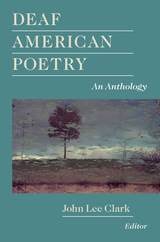
Deaf American Poetry
An AnthologyJohn Lee Clark
Gallaudet University Press, 2009
“The Deaf poet is no oxymoron,” declares editor John Lee Clark in his introduction to Deaf American Poetry: An Anthology. The 95 poems by 35 Deaf American poets in this volume more than confirm his point. From James Nack’s early metered narrative poem “The Minstrel Boy” to the free association of Kristi Merriweather’s contemporary “It Was His Movin’ Hands Be Tellin’ Me,” these Deaf poets display mastery of all forms prevalent during the past two centuries. Beyond that, E. Lynn Jacobowitz’s “In Memoriam: Stephen Michael Ryan” exemplifies a form unique to Deaf American poets, the transliteration of verse originally created in American Sign Language.
This anthology showcases for the first time the best works of Deaf poets throughout the nation’s history — John R. Burnet, Laura C. Redden, George M. Teegarden, Agatha Tiegel Hanson, Loy E. Golladay, Robert F. Panara, Mervin D. Garretson, Clayton Valli, Willy Conley, Raymond Luczak, Christopher Jon Heuer, Pamela Wright-Meinhardt, and many others. Each of their poems reflects the sensibilities of their times, and the progression of their work marks the changes that deaf Americans have witnessed through the years. In “The Mute’s Lament,” John Carlin mourns the wonderful things that he cannot hear, and looks forward to heaven where “replete with purest joys/My ears shall be unsealed, and I shall hear.” In sharp contrast, Mary Toles Peet, who benefitted from being taught by Deaf teachers, wrote “Thoughts on Music” with an entirely different attitude. She concludes her account of the purported beauty of music with the realization that “the music of my inward ear/Brings joy far more intense.”
Clark tracks these subtle shifts in awareness through telling, brief biographies of each poet. By doing so, he reveals in Deaf American Poetry how “the work of Deaf poets serves as a prism through which Deaf people can know themselves better and through which the rest of the world can see life in a new light.”
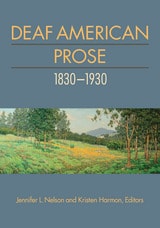
Deaf American Prose, 1830-1930
Jennifer L. Nelson
Gallaudet University Press, 2013
This new anthology showcases the work of Deaf writers during a critical formative period in their history. From 1830 to 1930, these writers conveyed their impressions in autobiographies, travel narratives, romances, non-fiction short stories, editorials, descriptive pieces, and other forms of prose. The quick, often evocative snapshots and observations featured here, many explicitly addressing deafness and sign language, reflect their urgency to record Deaf American life at this pivotal time. Using sensory details, dialogue, characterization, narrative movement, and creative prose, these writers emphasized the capabilities of Deaf people to counter events that threatened their way of life.
The volume opens with “The Orphan Mute,” a sentimental description of the misfortune of deaf people written by John Robertson Burnet in 1835. Less than 50 years later, James Denison, the only Deaf delegate at the 1880 Convention of Instructors of the Deaf in Milan, published his “impressions” that questioned the majority’s passage of a strict oralism agenda. In 1908, Thomas Flowers wrote “I was a little human plant,” a paean to education without irony despite the concurrent policy banning African Americans from attending Gallaudet College. These and a host of other Deaf writers—Laurent Clerc, Kate Farlow, Edmund Booth, Laura Redden Searing, Freda W. Bauman, Vera Gammon, Isaac H. Benedict, James Nack, John Carlin, Joseph Mount and many more—reveal the vitality and resilience of Deaf writers in an era of wrenching change.
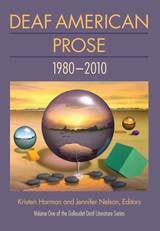
Deaf American Prose, 1980–2010
Kristen C. Harmon
Gallaudet University Press, 2012
In Deaf life, the personal narrative holds sway because most Deaf individuals recall their formative years as solitary struggles to understand and to be understood. Few deaf people in the past related their stories in written form, relying instead on a different kind of “oral” tradition, that of American Sign Language. During the last several decades, however, a burgeoning bilingual deaf experience has ignited an explosion of Deaf writing that has pushed the potential of ASL-influenced English to extraordinary creative heights. Deaf American Prose: 1980–2010 presents a diverse cross-section of stories, essays, memoirs, and novel excerpts by a remarkable cadre of Deaf writers that mines this rich, bilingual environment.
The works in Deaf American Prose frame the Deaf narrative in myriad forms: Tom Willard sends up hearing patronization in his wicked satire “What Exactly Am I Supposed to Overcome?” Terry Galloway injects humor in “Words,” her take on the identity issues of being hard of hearing rather than deaf or hearing. Other contributors relate familiar stories about familiar trials, such as Tonya Stremlau’s account of raising twins, and Joseph Santini’s short story of the impact on Deaf and hearing in-laws of the death of a son. The conflicts are well-known and heartfelt, but with wrinkles directly derived from the Deaf perspective.
Several of the contributors expand the Deaf affect through ASL glosses and visual/spatial elements. Sara Stallard emulates ASL on paper through its syntax and glosses, and by eliminating English elements, a technique used in dialogue by Kristen Ringman and others. Deaf American Prose features the work of other well-known contemporary Deaf writers, including co-editor Kristen Harmon, Christopher Jon Heuer, Raymond Luczak, and Willy Conley. The rising Deaf writers presented here further distinguish the first volume in this new series by thinking in terms of what they can bring to English, not what English can bring to them.

Dear All,
Maggie Anderson
Four Way Books, 2017
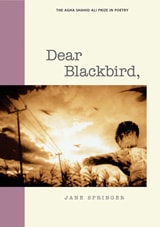
Dear Blackbird,
Jane Springer
University of Utah Press, 2007
Dear Blackbird, is the 2006 prize-winning volume selected by this year's judge, J. D. McClatchy, editor of The Yale Review.
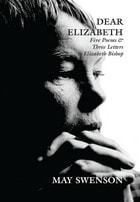
Dear Elizabeth
May Swenson
Utah State University Press, 2000

Dear Friend
Rainer Maria Rilke and Paula Modersohn-BeckerEric Torgersen
Northwestern University Press, 2000

Dear John, Dear Coltrane
PoemsMichael S. Harper
University of Illinois Press, 1985
unflinching record of a man alive in his time. When he is at his best,
in both his public and his private voice, he creates a language humming
with emotion and ennobled by a deeply felt human dignity."
-- Virginia Quarterly Review
". . . one of the finest poets of our time."
-- San Francisco Examiner & Chronicle
Stephen Henderson Award, African American Literature and Culture Society (AALCS), 2013. Author is recipient of the Frost Medal for Lifetime Achievement, Poetry Society of America, 2008.
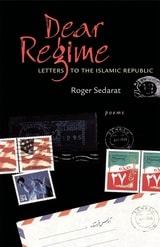
Dear Regime
Letters to the Islamic RepublicRoger Sedarat
Ohio University Press, 2007
In his provocative, brave, and sometimes brutal first book of poems, Roger Sedarat directly addresses the possibility of political change in a nation that some in America consider part of “the axis of evil.” Iranianon his father’s side, Sedarat explores the effects of the Islamic Revolution of 1979—including censorship, execution, and pending war—on the country as well as on his understanding of his own origins. Written in a style that is as sure-footed as it is experimental, Dear Regime: Letters to the Islamic Republic confronts the past and current injustices of the Iranian government while retaining a sense of respect and admiration for the country itself. Woven into this collection are the author’s vividdescriptions of the landscape as well as the people of Iran. Throughout, Sedarat exhibits a keen appreciation for the literary tradition of Iran, and inmaking it new, attempts to preserve the culture of a country he still claims as his own.
Thigh
With honesty of homemade butter,
paddle-churned cream (eshta in Arabic,
ecstasy foaming to the brim), a woman
river-bathes, sheet of oil-black hair breaking
in rapids, cut lemon scintillating
olive skin free of tree-stumped chador, skirts
within skirts, peal of her bell-body rung
muffled in Iran heat—a splash of white.
The rhythm of pumice scraping her feet,
sandbar against warm current, frothy cape
a bee-bubbled hive, honeyed trace curling
to her bare knees, thick transparent lather.
At a Tehran bazaar endless gold-stores
could never return me anywhere pure.
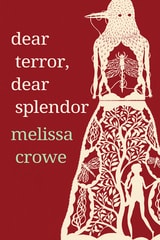
Dear Terror, Dear Splendor
Melissa Crowe
University of Wisconsin Press, 2019
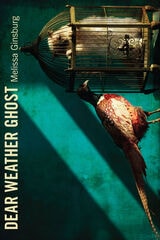
Dear Weather Ghost
Melissa Ginsburg
Four Way Books, 2013

Dears, Beloveds
Kevin Phan
University Press of Colorado, 2020
Death and the Pearl Maiden
Plague, Poetry, EnglandDavid K. Coley
The Ohio State University Press, 2019
Death and the Pearl Maiden: Plague, Poetry, England asks why one of the singular historical traumas of the later Middle Ages appears to be evoked so fleetingly in fourteenth-century Middle English poetry, a body of work as daring and socially engaged as any in English literary history. By focusing on under-recognized pestilential discourses in Pearl, Cleanness, Patience, and Sir Gawain and the Green Knight—the four poems uniquely preserved British Library MS Cotton Nero A.x —this study resists the idea that the Black Death had only a slight impact on medieval English literature, and it strives to account for the understated shape of England’s literary response to the plague and our contemporary understandings of it.
Death of a Ventriloquist
Gibson Fay-LeBlanc
University of North Texas Press, 2012
Death to the Death of Poetry
Essays, Reviews, Notes, InterviewsDonald Hall
University of Michigan Press, 1994
Donald Hall believes that American poetry, at the present moment, thrives both in quality and in leadership. In his latest collection of essays, reviews, and interviews, Hall counters the increasingly publicized view that poetry has an ever-diminishing importance in contemporary American culture. He resents the endlessly repeated cliché that finds poetry unpopular and losing popularity. Thus: Death to the Death of Poetry.
Throughout the pages of this latest offering in the Poets on Poetry series, Hall returns again and again to the theme of poetry's health, and offers essays praising contemporary poets, who serve as examples of poetry's thriving condition. In addition, Death to the Death of Poetry collects interviews in which Hall discusses the work of poetry--revisions, standards, the psychology and sociology of the poet's life.
The collection will be warmly received by Donald Hall's large readership, enhanced in 1993 by publication of two exemplary volumes: The Museum of Clear Ideas, his eleventh book of poetry; and his essay Life Work, which brought him both new and returning readers.
Death's Homeland
Dragan Dragojlovic
Northwestern University Press, 2008
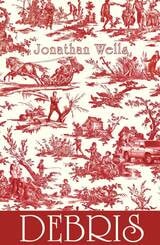
Debris
Jonathan Wells
Four Way Books, 2021
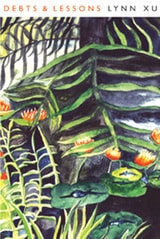
Debts & Lessons
Lynn Xu
Omnidawn, 2013
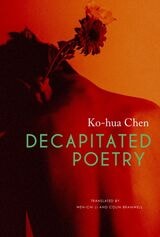
Decapitated Poetry
Ko-Hua Chen
Seagull Books, 2023
Ko-hua Chen’s Decapitated Poetry was the first explicitly queer book of poems published in Taiwan and remains a foundational work in Taiwanese poetry. Decades after it first appeared in 1995, this collection retains the capacity to shock, appall, and jolt readers into recognizing homosexuality as its own specific category of being. Behind Chen’s depictions of the disjunctive realities of queer erotic life, a formidable and uncompromising poetic intelligence can be seen at play. Alongside the erotic, satirical offerings from Decapitated Poetry, this volume includes selections from Chen’s remarkable sci-fi sequences that offer further transcorporeal meditations on forbidden queer love. Excoriating, heretical, tender, and always alive to the transgressive potential of language, this exhilarating volume from Seagull’s Pride List is the perfect introduction to one of Taiwanese poetry’s most daring voices.

Decolonial Topophilia
Nature, Place, and History in Puerto Rican PoetryVíctor Figueroa
Bucknell University Press, 2026
Decolonial Topophilia: Nature, Place, and History in Puerto Rican Poetry examines how four major poets—Luis Lloréns Torres, Luis Palés Matos, Juan Antonio Corretjer, and Julia de Burgos—address the ecological and human consequences of colonial domination in early twentieth-century Puerto Rico. Their poetry raises questions about the capitalist transformation of land through monocultures like sugarcane, the reduction of nature to exploitable resources, and the ties between attachment to place and nationalism. In tracing these connections, this pathbreaking book reveals how poetic visions of place can challenge colonial histories and imagine more reciprocal ways of inhabiting the world.
Published by Bucknell University Press. Distributed worldwide by Rutgers University Press.
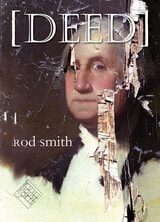
Deed
Rod Smith
University of Iowa Press, 2007
A deed is a governmental conveyance, a power asserted by the written, for, as William Carlos Williams wrote to Robert Creeley: “the government can never be more than the government of the words.” The question of ownership, of the words with which we define ourselves and each other, and of whose and what claims are legitimate is much at issue in Rod Smith’s Deed, a lyric, ambitious, rebellious work thoroughly grounded in the New American tradition of poets such as John Ashbery, Allen Ginsberg, and Charles Olson.
At the entrance to this collection stands an abode in the form of a long poem, “The Good House,” a comfortable, at times soothingly humorous place that is also a site of conflict. In “The Spider Poems,” the mythic spider, the maker of the alphabet, is a ?gure of fun and revelation. The third section of the book presents a series of shorter poems chosen for their stylistic variety. Deed ends with a nod to two masters, as Smith turns Jack Spicer’s “Homage to Creeley” into a double homage with “Homage to Homage to Creeley.” The gesture of choosing what one brings into one’s house, what one decides to love, closes the book.
Deed is about making as bequeathing, as celebration, and as impatience for the true democracy that is always yet to arrive. There is still joy inside and out, and by giving usDeed Rod Smith has captured that joy. In so doing he tells us where we as a people, a politik, and a poetic are going.

Defensible Space/if a crow—
Ian Lockaby
Omnidawn, 2024
Considering how we might detox from old languages, systems, and modes of life, Ian Lockaby’s poems seek out new forms of interconnectivity and possibility, finding the energy of emerging worlds along the edges of ruins. This collection poses questions of how to thrive in aftermaths, suggesting that attempts at absolute knowledge are less powerful than an embrace of the unknown. Throughout these poems, Lockaby uses crows as a model for dynamic adaption and creative entanglement with the world and with language, finding “defensible space” for new lyrical syntax amid shifts and desolation: “Everywhere a burning root system. Everywhere, a root fire crowing off the splayed tail feathers of a crow.”
Defensible Space/if a crow—looks towards a reintroduction of fire into wilds and wilds into our lives, taking the unknown of an “if” as the base from where we can build life.
Defensible Space/if a crow– won Omnidawn’s 2022 Poetry Chapbook contest, selected by Ruth Ellen Kocher.
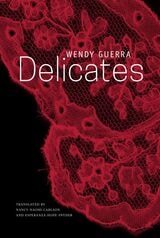
Delicates
Wendy Guerra
Seagull Books, 2023
Imbued with a sensuality reminiscent of the work of Anaïs Nin, Wendy Guerra’s Delicates takes readers on an exhilarating journey through the cities of love, where women leave their bodies “in the showers of men,” marking their territory “like animals in heat,” their panties “saturated with sand and a sidereal isolating odor.” Guerra’s shocking metaphors and images invite us to enter her gallery of striking and provoking poems where we witness a flight through the air from a thirty-fourth-story window and a woman’s pilgrimage to the salt flats “to taste the pink in stones” on her lover’s behalf. Guerra’s relationship with her native Cuba—much like her relationships with men—is complex and multilayered. Her work confronts the realities of a political system that doesn’t celebrate artistic freedom. Here we have a new way of looking at a woman, an artist, a country, and the colonizers of that country. In these music-infused poems, Guerra shares with us her hard-won truths.
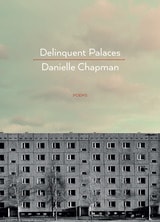
Delinquent Palaces
PoemsDanielle Chapman
Northwestern University Press, 2015
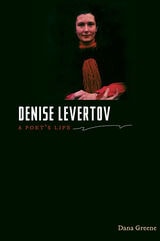
Denise Levertov
A Poet's LifeDana Greene
University of Illinois Press, 2014
Kenneth Rexroth called Denise Levertov (1923–1997) "the most subtly skillful poet of her generation, the most profound, . . . and the most moving." Author of twenty-four volumes of poetry, four books of essays, and several translations, Levertov became a lauded and honored poet. Born in England, she published her first book of poems at age twenty-three, but it was not until she married and came to the United States in 1948 that she found her poetic voice, helped by the likes of William Carlos Williams, Robert Duncan, and Robert Creeley. Shortly before her death in 1997, the woman who claimed no country as home was nominated to be America's poet laureate.
Levertov was the quintessential romantic. She wanted to live vividly, intensely, passionately, and on a grand scale. She wanted the persistence of Cézanne and the depth and generosity of Rilke. Once she acclimated herself to America, the dreamy lyric poetry of her early years gave way to the joy and wonder of ordinary life. By the late 1960s and early 1970s, however, her poems began to engage the issues of her times. Vehement and strident, her poetry of protest was both acclaimed and criticized. The end of both the Vietnam War and her marriage left her mentally fatigued and emotionally fragile, but gradually, over the span of a decade, she emerged with new energy. The crystalline and luminous poetry of her last years stands as final witness to a lifetime of searching for the mystery embedded in life itself. Through all the vagaries of life and art, her response was that of a "primary wonder."
In this illuminating biography, Dana Greene examines Levertov's interviews, essays, and self-revelatory poetry to discern the conflict and torment she both endured and created in her attempts to deal with her own psyche, her relationships with family, friends, lovers, colleagues, and the times in which she lived. Denise Levertov: A Poet's Life is the first complete biography of Levertov, a woman who claimed she did not want a biography, insisting that it was her work that she hoped would endure. And yet she confessed that her poetry in its various forms--lyric, political, natural, and religious--derived from her life experience. Although a substantial body of criticism has established Levertov as a major poet of the later twentieth century, this volume represents the first attempt to set her poetry within the framework of her often tumultuous life.