Results by title
355 books match the query 'Political and social views' and 14 start with d
Daniel Webster and the Oratory of Civil Religion
Craig R. Smith
University of Missouri Press, 2005
Dark Victorians
Vanessa D. Dickerson
University of Illinois Press, 2007
Darwin's Sacred Cause
Race, Slavery and the Quest for Human OriginsAdrian Desmond and James Moore
University of Chicago Press, 2011
There has always been a mystery surrounding Darwin: How did this quiet, respectable gentleman come to beget one of the most radical ideas in the history of human thought? It is difficult to overstate what Darwin was risking in publishing his theory of evolution. So it must have been something very powerful—a moral fire, as Desmond and Moore put it—that helped propel him. That moral fire, they argue, was a passionate hatred of slavery.
In opposition to the apologists for slavery who argued that blacks and whites had originated as separate species, Darwin believed the races belonged to the same human family. Slavery was a “sin,” and abolishing it became his “sacred cause.” By extending the abolitionists’ idea of human brotherhood to all life, Darwin developed our modern view of evolution.
Drawing on a wealth of fresh manuscripts, family letters, diaries, and even ships’ logs, Desmond and Moore argue that only by acknowledging Darwin’s abolitionist heritage can we fully understand the development of his groundbreaking ideas.
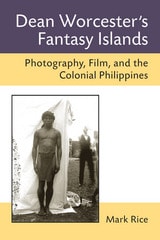
Dean Worcester's Fantasy Islands
Photography, Film, and the Colonial PhilippinesMark Rice
University of Michigan Press, 2014
Dean Worcester’s Fantasy Islands brings to life one of the most significant (but under examined) figures in the history of U.S. colonialism in the Philippines. Upon the outbreak of the Spanish-American War, Worcester, a scientist who had traveled twice to the Philippines on zoological expeditions, established himself as one of America’s leading experts on the Philippines. Over a fourteen-year career as a member of the U.S. colonial regime, Worcester devoted much of his time and energy to traveling among and photographing non-Christian minority groups in the Philippines. He amassed an archive of several thousand photographs taken by him or by government photographers. Worcester deployed those photographs in books, magazine articles, and lectures to promote his belief that the United States should maintain control of the Philippines for decades to come. While many historians have examined American colonial photography in the Philippines, this book is the first lengthy treatment of Worcester’s role in shaping American perceptions of the Philippines in the early twentieth century.
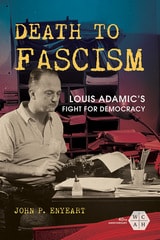
Death to Fascism
Louis Adamic's Fight for DemocracyJohn P. Enyeart
University of Illinois Press, 2019
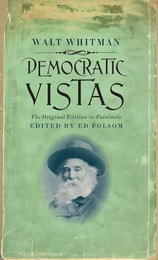
Democratic Vistas
The Original Edition in FacsimileWhitman, Walt
University of Iowa Press, 2010
Written in the aftermath of the American Civil War during the ferment of national Reconstruction, Walt Whitman’s Democratic Vistas remains one of the most penetrating analyses of democracy ever written. Diagnosing democracy’s failures as well as laying out its vast possibilities, Whitman offers an unflinching assessment of the ongoing social experiment known as the United States. Now available for the first time in a facsimile of the original 1870–1871 edition, with an introduction and annotations by noted Whitman scholar Ed Folsom that illuminate the essay’s historical and cultural context, this searing analysis of American culture offers readers today the opportunity to argue with Whitman over the nature of democracy and the future of the nation.
Living in Washington, D.C., where Congress granted male African Americans the right to vote nearly five years before the fifteenth amendment extended that right across the nation, and working for the office charged with enforcing the new civil rights amendments to the Constitution, Whitman was at the volatile center of his nation’s massive attempt to reconstruct and redefine itself after the tumultuous years of civil war. In the enduring cultural document that Democratic Vistas has become, the great poet of democracy analyzes the role that literature plays in the development of a culture, the inevitable tensions between the “democratic individual” and the “democratic nationality,” and the corrosive effects of materialism on the democratic spirit.
His own conflicting racial biases notwithstanding, Whitman in Democratic Vistas offers his most eloquent and extended articulation of the beckoning American democratic future. At a time when the nation has elected a president whom Whitman could never have imagined, his controversial and provocative book is a timely reminder of those occasions when we experience the expansion of America’s democratic dream.
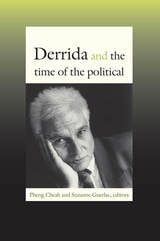
Derrida and the Time of the Political
Pheng Cheah and Suzanne Guerlac, eds.
Duke University Press, 2009
The volume opens with a substantial introduction in which Pheng Cheah and Suzanne Guerlac survey Derrida’s entire corpus and position his later work in relation to it. The remaining essays address the concerns that arise out of Derrida’s analysis of politics and the conditions of the political, such as the meaning and scope of democracy, the limits of sovereignty, the relationship between the ethical and the political, the nature of responsibility, the possibility for committed political action, the implications of deconstructive thought for non-Western politics, and the future of nationalism in an era of globalization and declining state sovereignty. The collection is framed by original contributions from Hélène Cixous and Judith Butler.
Contributors. Étienne Balibar, Geoffrey Bennington, Wendy Brown, Judith Butler, Pheng Cheah, Hélène Cixous, Rodolphe Gasché, Suzanne Guerlac, Marcel Hénaff, Martin Jay, Anne Norton, Jacques Rancière, Soraya Tlatli, Satoshi Ukai
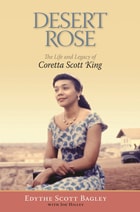
Desert Rose
The Life and Legacy of Coretta Scott KingEdythe Scott Bagley with Joe Hilley
University of Alabama Press, 2012
An intimate biography illuminating the life, leadership, and legacy of Coretta Scott King within the American Civil Rights Movement.
Coretta Scott King—noted author, human rights activist, and wife and partner of famed Civil Rights Movement leader Martin Luther King Jr.—grew up in the rural Alabama Black Belt with her older sister, Edythe Scott Bagley. Bagley chronicles the sisters’ early education together at the Crossroads School and later at the progressive Lincoln School in Marion. She describes Coretta’s burgeoning talent for singing and her devotion to musical studies, and the sisters’ experiences matriculating at Antioch College, an all-white college far from the rural South. Bagley provides vivid insights into Coretta’s early passion for racial and economic justice, which lead to her involvement in the Peace Movement and the National Association for the Advancement of Colored People.
As Coretta’s older sister, Edythe shared in almost all of Coretta’s many trials and tribulations. Desert Rose charts Coretta’s hesitance about her romance with Martin Luther King and the prospect of having to sacrifice her dream of a career in music to become a minister’s wife. Ultimately, Coretta chose to utilize her artistic gifts and singing voice for the Movement through the development and performance of Freedom Concerts. This book also charts Coretta’s own commitment and dedication, in the years that followed King’s death, to the causes of international civil rights, the antiapartheid movement, and the establishment of the King Center in Atlanta and the national King Holiday. Coretta’s devotion to activism, motherhood, and the movement led by her husband, and her courageous assumption of the legacy left in the wake of King’s untimely assassination, are wonderfully detailed in this intimate biography.
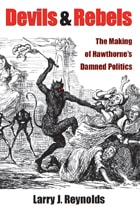
Devils and Rebels
The Making of Hawthorne's Damned PoliticsLarry J. Reynolds
University of Michigan Press, 2010
"An outstanding combination of literary interpretation and cultural and historical context that will be an important addition to the critical literature on Hawthorne."
---Nina Baym, University of Illinois
"It is difficult to imagine a more timely book than Devils and Rebels. Examining the role of the public intellectual and writer during a time of political conflict and war, Reynolds takes up his charges with great precision and historical finesse. What particularly distinguishes this book is its attention to the ways in which one of this country's most important authors struggled to resist the waves of political extremism and patriotic hysteria that swept around him."
---Jeffrey Steele, University of Wisconsin—Madison
Widely condemned even in his own time, Nathaniel Hawthorne's views on abolitionism and slavery are today frequently characterized by scholars as morally reprehensible. Devils and Rebels explores the historical and biographical record to reveal striking evidence of the author's true political values---values grounded in pacifism and resistant to the kind of binary thinking that could lead to violence and war.
The book offers fresh readings of not only Hawthorne's four major romances but also some of his less familiar works like "Legends of the Province House," The Whole History of Grandfather's Chair, Journal of an African Cruiser, The Life of Franklin Pierce, and "Septimius Felton." Reynolds argues that Hawthorne---whether in his politics or his art---drew upon racialized imagery from America's past revolution and war on witchcraft to create a politics of quiet imagination, alert to the ways in which New England righteousness could become totalitarian by imposing its narrow view of the world on others.
Meticulously researched and cogently argued, this groundbreaking work demonstrates the need to examine perspectives and values from beyond the New England region when studying the literary history of the American Renaissance and illuminates the difficulties faced by public intellectuals during times of political strife---an issue as relevant today as it was some one hundred and fifty years ago.
Larry J. Reynolds is Thomas Franklin Mayo Professor of Liberal Arts and Professor of English at Texas A&M University. His previous books include A Historical Guide to Nathaniel Hawthorne, National Imaginaries, American Identities: The Cultural Work of American Iconography, and European Revolutions and the American Literary Renaissance as well as an edition of the European writings of Margaret Fuller.
Distributions of the Sensible
Rancière, between Aesthetics and PoliticsEdited by Scott Durham and Dilip Gaonkar With an afterword by Jacques Rancière
Northwestern University Press, 2019
Jacques Rancière’s work is increasingly central to several debates across the humanities. Distributions of the Sensible confronts a question at the heart of his thought: How should we conceive the relationship between the “politics of aesthetics” and the “aesthetics of politics”? Specifically, the book explores the implications of Rancière’s rethinking of the relationship of aesthetic to political democracy from a wide range of critical perspectives.
Distributions of the Sensible contains original essays by leading scholars on topics such as Rancière’s relation to political theory, critical theory, philosophical aesthetics, and film. The book concludes with a new essay by Rancière himself that reconsiders the practice of theory between aesthetics and politics.
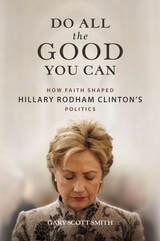
Do All the Good You Can
How Faith Shaped Hillary Rodham Clinton’s PoliticsGary Scott Smith
University of Illinois Press, 2023
Methodism in the public and private lives of the politician
After more than forty contentious years in the public eye, Hillary Rodham Clinton is one of the best-known political figures in the nation. Yet the strong religious faith at the heart of her politics and personal life often remains confounding, if not mysterious, to longtime observers. Even many of her admirers would be surprised to hear Clinton state that her Methodist outlook has “been a huge part of who I am and how I have seen the world, and what I believe in, and what I have tried to do in my life.”
Gary Scott Smith’s biography of Clinton’s journey in faith begins with her Methodist upbringing in Park Ridge, Illinois, where she faithfully attended worship services, Sunday school, and youth group meetings. Like many mainline Protestants, Clinton’s spiritual commitment developed gradually throughout childhood, while her combination of missionary zeal and impressive personal talents has informed her career from the time of her pro bono work at Yale on behalf of children to the present.
Her Methodist faith has been very important to many of Clinton’s high-profile endeavors and in helping her cope with the prominent travails brought on by two presidential campaigns, never-ending conservative rancor, and her husband’s infidelity. Smith’s account examines Clinton’s faith in the context of work ranging from her 1990s pursuit of healthcare reform to a “Hillary doctrine” of foreign policy focused on her longtime goal of providing basic human rights for children and women--a project she saw as essential to United States security. The result is an enlightening reconsideration of an extraordinary political figure who has defied private doubts and public controversy to live by John Wesley’s dictum: “Do all the good you can, by all the means you can, in all the ways you can, in all the places you can, at all the times you can, to all the people you can, as long as ever you can.”

Dreaming Revolution
Transgression in the Development of American RomanceScott Bradfield
University of Iowa Press, 1993
Dreaming Revolution usefully employs current critical theory to address how the European novel of class revolt was transformed into the American novel of imperial expansion. Bradfield shows that early American romantic fiction—including works by William Godwin, Charles Brockden Brown, James Fenimore Cooper, and Edgar Allan Poe—can and should be considered as part of a genre too often limited to the nineteenth-century European novel. In a spirited discussion of the works from these four authors, Bradfield argues that Americans take the class dynamics of the European psychological novel and apply them to the American landscape, reimagining psychological spaces as geographical ones.
Dreiser and Veblen, Saboteurs of the Status Quo
Clare Virginia Eby
University of Missouri Press, 1999
In this important interdisciplinary study, Clare Eby argues that the writings of Theodore Dreiser and Thorstein Veblen form a neglected chapter in the history of United States cultural criticism that is especially relevant today.
This study leaves behind the narrow frameworks through which most of Veblen's and Dreiser's writings have been interpreted, covering a wide range of both authors' major and minor works. Moving beyond Veblen's The Theory of the Leisure Class and Dreiser's Sister Carrie, Eby shows how the two writers, as saboteurs of the status quo, anticipated many preoccupations of cultural critics today: the cultural role of the intellectual, the relationship of science to society, the place of consumption in modern life, and the intersection of class, gender, and power.
Eby uses cultural criticism as a unifying concept that shows how Veblen fuses satire, sociology, economics, history, psychology, anthropology, political science, and philosophy; and how Dreiser connects fiction, travelogue, literary manifesto, occasional essay, autobiography, biography, and philosophy. By reading Veblen through Dreiser, and Dreiser through Veblen, Eby illustrates the striking parallels between their works, demonstrating how literature and social science can merge in cultural criticism.
Although Dreiser's interest in the natural and social sciences has often been noted, this study provides the only extended analysis of how his works actually resemble, and strive to become, critically informed social science. Similarly, despite the singularity of Veblen's rhetoric, the centrality of literary devices to his works has never been systematically examined. By placing the works of Veblen and Dreiser into dialogue, this study contributes significantly to the recent attempts to bring together the concerns of literary analysts and social scientists.
Dreiser and Veblen, Saboteurs of the Status Quo makes an important contribution not only to Dreiser and Veblen studies but also to cultural criticism itself.
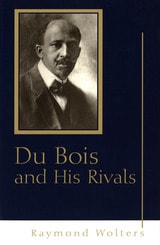
Du Bois and His Rivals
Raymond Wolters
University of Missouri Press, 2002
In Du Bois and His Rivals, Raymond Wolters provides a distinctive biography of this great pioneer of the American civil rights movement. Readers are able to follow the outline of Du Bois’s life, but the book’s main emphasis is on discrete scenes in his life, especially the controversies that pitted Du Bois against his principal black rivals. He challenged Booker T. Washington because he could not abide Washington’s conciliatory approach toward powerful whites. At the same time, Du Bois’s pluralism led him to oppose the leading separatists and integrationists of his day. He berated Marcus Garvey for giving up on America and urging blacks to pursue a separate destiny. He also rejected Walter White’s insistence that integration was the best way to promote the advancement of black people.
Du Bois felt that American blacks should be full-fledged Americans, with all the rights of other American citizens. However, he believed that they should also preserve and develop enough racial distinctiveness to enable them to maintain and foster a sense of racial identity, community, and pride. Du Bois and His Rivals shows that Du Bois stood for much more than protest against racial oppression. He was also committed to pluralism, and his pluralism emphasized the importance of traditional standards and of internal cooperation within the black community. Anyone interested in the civil rights movement, black history, or the history of the United States during the early twentieth century will find this book valuable.