Results by title
857 books match the query 'Schools' and 40 start with d
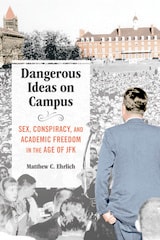
Dangerous Ideas on Campus
Sex, Conspiracy, and Academic Freedom in the Age of JFKMatthew C. Ehrlich
University of Illinois Press, 2021
In 1960, University of Illinois professor Leo Koch wrote a public letter condoning premarital sex. He was fired. Four years later, a professor named Revilo Oliver made white supremacist remarks and claimed there was a massive communist conspiracy. He kept his job.
Matthew Ehrlich revisits the Koch and Oliver cases to look at free speech, the legacy of the 1960s, and debates over sex and politics on campus. The different treatment of the two men marked a fundamental shift in the understanding of academic freedom. Their cases also embodied the stark divide over beliefs and values--a divide that remains today. Ehrlich delves into the issues behind these academic controversies and places the events in the context of a time rarely associated with dissent, but in fact a harbinger of the social and political upheavals to come.
An enlightening and entertaining history, Dangerous Ideas on Campus illuminates how the university became a battleground for debating America's hot-button issues.
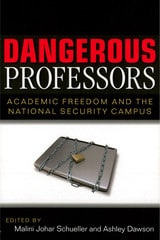
Dangerous Professors
Academic Freedom and the National Security CampusMalini Johar Schueller and Ashley Dawson, Editors
University of Michigan Press, 2009

Deaf Children in China
Alison Callaway
Gallaudet University Press, 1999
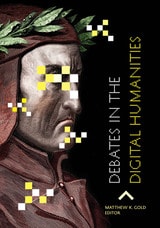
Debates in the Digital Humanities
Matthew K. Gold
University of Minnesota Press, 2012
Encompassing new technologies, research methods, and opportunities for collaborative scholarship and open-source peer review, as well as innovative ways of sharing knowledge and teaching, the digital humanities promises to transform the liberal arts—and perhaps the university itself. Indeed, at a time when many academic institutions are facing austerity budgets, digital humanities programs have been able to hire new faculty, establish new centers and initiatives, and attract multimillion-dollar grants.
Clearly the digital humanities has reached a significant moment in its brief history. But what sort of moment is it? Debates in the Digital Humanities brings together leading figures in the field to explore its theories, methods, and practices and to clarify its multiple possibilities and tensions. From defining what a digital humanist is and determining whether the field has (or needs) theoretical grounding, to discussions of coding as scholarship and trends in data-driven research, this cutting-edge volume delineates the current state of the digital humanities and envisions potential futures and challenges. At the same time, several essays aim pointed critiques at the field for its lack of attention to race, gender, class, and sexuality; the inadequate level of diversity among its practitioners; its absence of political commitment; and its preference for research over teaching.
Together, the essays in Debates in the Digital Humanities—which will be published both as a printed book and later as an ongoing, open-access website—suggest that the digital humanities is uniquely positioned to contribute to the revival of the humanities and academic life.
Contributors: Bryan Alexander, National Institute for Technology in Liberal Education; Rafael Alvarado, U of Virginia; Jamie “Skye” Bianco, U of Pittsburgh; Ian Bogost, Georgia Institute of Technology; Stephen Brier, CUNY Graduate Center; Daniel J. Cohen, George Mason U; Cathy N. Davidson, Duke U; Rebecca Frost Davis, National Institute for Technology in Liberal Education; Johanna Drucker, U of California, Los Angeles; Amy E. Earhart, Texas A&M U; Charlie Edwards; Kathleen Fitzpatrick, Pomona College; Julia Flanders, Brown U; Neil Fraistat, U of Maryland; Paul Fyfe, Florida State U; Michael Gavin, Rice U; David Greetham, CUNY Graduate Center; Jim Groom, U of Mary Washington; Gary Hall, Coventry U, UK; Mills Kelly, George Mason U; Matthew Kirschenbaum, U of Maryland; Alan Liu, U of California, Santa Barbara; Elizabeth Losh, U of California, San Diego; Lev Manovich, U of California, San Diego; Willard McCarty, King’s College London; Tara McPherson, U of Southern California; Bethany Nowviskie, U of Virginia; Trevor Owens, Library of Congress; William Pannapacker, Hope College; Dave Parry, U of Texas at Dallas; Stephen Ramsay, U of Nebraska, Lincoln; Alexander Reid, SUNY at Buffalo; Geoffrey Rockwell, Canadian Institute for Research Computing in the Arts; Mark L. Sample, George Mason U; Tom Scheinfeldt, George Mason U; Kathleen Marie Smith; Lisa Spiro, National Institute for Technology in Liberal Education; Patrik Svensson, Umeå U; Luke Waltzer, Baruch College; Matthew Wilkens, U of Notre Dame; George H. Williams, U of South Carolina Upstate; Michael Witmore, Folger Shakespeare Library.
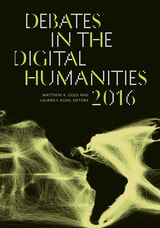
Debates in the Digital Humanities 2016
Matthew K. Gold
University of Minnesota Press, 2016
Pairing full-length scholarly essays with shorter pieces drawn from scholarly blogs and conference presentations, as well as commissioned interviews and position statements, Debates in the Digital Humanities 2016 reveals a dynamic view of a field in negotiation with its identity, methods, and reach. Pieces in the book explore how DH can and must change in response to social justice movements and events like #Ferguson; how DH alters and is altered by community college classrooms; and how scholars applying DH approaches to feminist studies, queer studies, and black studies might reframe the commitments of DH analysts. Numerous contributors examine the movement of interdisciplinary DH work into areas such as history, art history, and archaeology, and a special forum on large-scale text mining brings together position statements on a fast-growing area of DH research. In the multivalent aspects of its arguments, progressing across a range of platforms and environments, Debates in the Digital Humanities 2016 offers a vision of DH as an expanded field—new possibilities, differently structured.
Published simultaneously in print, e-book, and interactive webtext formats, each DH annual will be a book-length publication highlighting the particular debates that have shaped the discipline in a given year. By identifying key issues as they unfold, and by providing a hybrid model of open-access publication, these volumes and the Debates in the Digital Humanities series will articulate the present contours of the field and help forge its future.
Contributors: Moya Bailey, Northeastern U; Fiona Barnett; Matthew Battles, Harvard U; Jeffrey M. Binder; Zach Blas, U of London; Cameron Blevins, Rutgers U; Sheila A. Brennan, George Mason U; Timothy Burke, Swarthmore College; Rachel Sagner Buurma, Swarthmore College; Micha Cárdenas, U of Washington–Bothell; Wendy Hui Kyong Chun, Brown U; Tanya E. Clement, U of Texas–Austin; Anne Cong-Huyen, Whittier College; Ryan Cordell, Northeastern U; Tressie McMillan Cottom, Virginia Commonwealth U; Amy E. Earhart, Texas A&M U; Domenico Fiormonte, U of Roma Tre; Paul Fyfe, North Carolina State U; Jacob Gaboury, Stony Brook U; Kim Gallon, Purdue U; Alex Gil, Columbia U; Brian Greenspan, Carleton U; Richard Grusin, U of Wisconsin, Milwaukee; Michael Hancher, U of Minnesota; Molly O’Hagan Hardy; David L. Hoover, New York U; Wendy F. Hsu; Patrick Jagoda, U of Chicago; Jessica Marie Johnson, Michigan State U; Steven E. Jones, Loyola U; Margaret Linley, Simon Fraser U; Alan Liu, U of California, Santa Barbara; Elizabeth Losh, U of California, San Diego; Alexis Lothian, U of Maryland; Michael Maizels, Wellesley College; Mark C. Marino, U of Southern California; Anne B. McGrail, Lane Community College; Bethany Nowviskie, U of Virginia; Julianne Nyhan, U College London; Amanda Phillips, U of California, Davis; Miriam Posner, U of California, Los Angeles; Rita Raley, U of California, Santa Barbara; Stephen Ramsay, U of Nebraska–Lincoln; Margaret Rhee, U of Oregon; Lisa Marie Rhody, Graduate Center, CUNY; Roopika Risam, Salem State U; Stephen Robertson, George Mason U; Mark Sample, Davidson College; Jentery Sayers, U of Victoria; Benjamin M. Schmidt, Northeastern U; Scott Selisker, U of Arizona; Jonathan Senchyne, U of Wisconsin, Madison; Andrew Stauffer, U of Virginia; Joanna Swafford, SUNY New Paltz; Toniesha L. Taylor, Prairie View A&M U; Dennis Tenen; Melissa Terras, U College London; Anna Tione; Ted Underwood, U of Illinois, Urbana–Champaign; Ethan Watrall, Michigan State U; Jacqueline Wernimont, Arizona State U; Laura Wexler, Yale U; Hong-An Wu, U of Illinois, Urbana–Champaign.
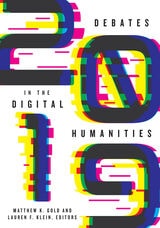
Debates in the Digital Humanities 2019
Matthew K. Gold
University of Minnesota Press, 2019
The latest installment of a digital humanities bellwether
Contending with recent developments like the shocking 2016 U.S. Presidential election, the radical transformation of the social web, and passionate debates about the future of data in higher education, Debates in the Digital Humanities 2019 brings together a broad array of important, thought-provoking perspectives on the field’s many sides. With a wide range of subjects including gender-based assumptions made by algorithms, the place of the digital humanities within art history, data-based methods for exhuming forgotten histories, video games, three-dimensional printing, and decolonial work, this book assembles a who’s who of the field in more than thirty impactful essays.
Contributors: Rafael Alvarado, U of Virginia; Taylor Arnold, U of Richmond; James Baker, U of Sussex; Kathi Inman Berens, Portland State U; David M. Berry, U of Sussex; Claire Bishop, The Graduate Center, CUNY; James Coltrain, U of Nebraska–Lincoln; Crunk Feminist Collective; Johanna Drucker, U of California–Los Angeles; Jennifer Edmond, Trinity College; Marta Effinger-Crichlow, New York City College of Technology–CUNY; M. Beatrice Fazi, U of Sussex; Kevin L. Ferguson, Queens College–CUNY; Curtis Fletcher, U of Southern California; Neil Fraistat, U of Maryland; Radhika Gajjala, Bowling Green State U; Michael Gavin, U of South Carolina; Andrew Goldstone, Rutgers U; Andrew Gomez, U of Puget Sound; Elyse Graham, Stony Brook U; Brian Greenspan, Carleton U; John Hunter, Bucknell U; Steven J. Jackson, Cornell U; Collin Jennings, Miami U; Lauren Kersey, Saint Louis U; Kari Kraus, U of Maryland; Seth Long, U of Nebraska, Kearney; Laura Mandell, Texas A&M U; Rachel Mann, U of South Carolina; Jason Mittell, Middlebury College; Lincoln A. Mullen, George Mason U; Trevor Muñoz, U of Maryland; Safiya Umoja Noble, U of Southern California; Jack Norton, Normandale Community College; Bethany Nowviskie, U of Virginia; Élika Ortega, Northeastern U; Marisa Parham, Amherst College; Jussi Parikka, U of Southampton; Kyle Parry, U of California, Santa Cruz; Brad Pasanek, U of Virginia; Stephen Ramsay, U of Nebraska–Lincoln; Matt Ratto, U of Toronto; Katie Rawson, U of Pennsylvania; Ben Roberts, U of Sussex; David S. Roh, U of Utah; Mark Sample, Davidson College; Moacir P. de Sá Pereira, New York U; Tim Sherratt, U of Canberra; Bobby L. Smiley, Vanderbilt U; Lauren Tilton, U of Richmond; Ted Underwood, U of Illinois, Urbana-Champaign; Megan Ward, Oregon State U; Claire Warwick, Durham U; Alban Webb, U of Sussex; Adrian S. Wisnicki, U of Nebraska–Lincoln.
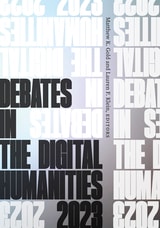
Debates in the Digital Humanities 2023
Matthew K. Gold
University of Minnesota Press, 2023
A cutting-edge view of the digital humanities at a time of global pandemic, catastrophe, and uncertainty
Where do the digital humanities stand in 2023? Debates in the Digital Humanities 2023 presents a state-of-the-field vision of digital humanities amid rising social, political, economic, and environmental crises; a global pandemic; and the deepening of austerity regimes in U.S. higher education. Providing a look not just at where DH stands but also where it is going, this fourth volume in the Debates in the Digital Humanities series features both established scholars and emerging voices pushing the field’s boundaries, asking thorny questions, and providing space for practitioners to bring to the fore their research and their hopes for future directions in the field. Carrying forward the themes of political and social engagement present in the series throughout, it includes crucial contributions to the field—from a vital forum centered on the voices of Black women scholars, manifestos from feminist and Latinx perspectives on data and DH, and a consideration of Indigenous data and artificial intelligence, to essays that range across topics such as the relation of DH to critical race theory, capital, and accessibility.
Contributors: Harmony Bench, Ohio State U; Christina Boyles, Michigan State U; Megan R. Brett, George Mason U; Michelle Lee Brown, Washington State U; Patrick J. Burns, New York U; Kent K. Chang, U of California, Berkeley; Rico Devara Chapman, Clark Atlanta U; Marika Cifor, U of Washington; María Eugenia Cotera, U of Texas; T. L. Cowan, U of Toronto; Marlene L. Daut, U of Virginia; Quinn Dombrowski, Stanford U; Kate Elswit, U of London; Nishani Frazier, U of Kansas; Kim Gallon, Brown U; Patricia Garcia, U of Michigan; Lorena Gauthereau, U of Houston; Masoud Ghorbaninejad, University of Victoria; Abraham Gibson, U of Texas at San Antonio; Nathan P. Gibson, Ludwig-Maximilians-Universität, Munich; Kaiama L. Glover, Barnard College; Hilary N. Green, Davidson College; Jo Guldi, Southern Methodist U; Matthew N. Hannah, Purdue U Libraries; Jeanelle Horcasitas, DigitalOcean; Christy Hyman, Mississippi State U; Arun Jacob, U of Toronto; Jessica Marie Johnson, Johns Hopkins U and Harvard U; Martha S. Jones, Johns Hopkins U; Annette K. Joseph-Gabriel, Duke U; Mills Kelly, George Mason U; Spencer D. C. Keralis, Digital Frontiers; Zoe LeBlanc, U of Illinois at Urbana-Champaign; Jason Edward Lewis, Concordia U; James Malazita, Rensselaer Polytechnic Institute; Alison Martin, Dartmouth College; Linda García Merchant, U of Houston Libraries; Rafia Mirza, Southern Methodist U; Mame-Fatou Niang, Carnegie Mellon U; Jessica Marie Otis, George Mason U; Marisa Parham, U of Maryland; Andrew Boyles Petersen, Michigan State U Libraries; Emily Pugh, Getty Research Institute; Olivia Quintanilla, UC Santa Barbara; Jasmine Rault, U of Toronto Scarborough; Anastasia Salter, U of Central Florida; Maura Seale, U of Michigan; Celeste Tường Vy Sharpe, Normandale Community College; Astrid J. Smith, Stanford U Libraries; Maboula Soumahoro, U of Tours; Mel Stanfill, U of Central Florida; Tonia Sutherland, U of Hawaiʻi at Mānoa; Gabriela Baeza Ventura, U of Houston; Carolina Villarroel, U of Houston; Melanie Walsh, U of Washington; Hēmi Whaanga, U of Waikato; Bridget Whearty, Binghamton U; Jeri Wieringa, U of Alabama; David Joseph Wrisley, NYU Abu Dhabi.
Cover alt text: A text-based cover with the main title repeating right-side up and upside down. The leftmost iteration appears in black ink; all others are white.
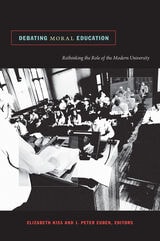
Debating Moral Education
Rethinking the Role of the Modern UniversityElizabeth Kiss and J. Peter Euben, eds.
Duke University Press, 2009
Editors Elizabeth Kiss and J. Peter Euben survey the history of ethics in higher education, then engage with provocative recent writings by Stanley Fish in which he argues that universities should not be involved in moral education. Stanley Hauerwas responds, offering a theological perspective on the university’s purpose. Contributors look at the place of politics in moral education; suggest that increasingly diverse, multicultural student bodies are resources for the teaching of ethics; and show how the debate over civic education in public grade-schools provides valuable lessons for higher education. Others reflect on the virtues and character traits that a moral education should foster in students—such as honesty, tolerance, and integrity—and the ways that ethical training formally and informally happens on campuses today, from the classroom to the basketball court. Debating Moral Education is a critical contribution to the ongoing discussion of the role and evolution of ethics education in the modern liberal arts university.
Contributors. Lawrence Blum, Romand Coles, J. Peter Euben, Stanley Fish, Michael Allen Gillespie, Ruth W. Grant, Stanley Hauerwas, David A. Hoekema, Elizabeth Kiss, Patchen Markell, Susan Jane McWilliams, Wilson Carey McWilliams, J. Donald Moon, James Bernard Murphy, Noah Pickus, Julie A. Reuben, George Shulman, Elizabeth V. Spelman

Deconstruction
An American InstitutionGregory Jones-Katz
University of Chicago Press, 2021
Deconstruction begins well before Jacques Derrida’s initial American presentation of his deconstructive work in a famed lecture at Johns Hopkins University in 1966 and continues through several decades of theoretic growth and tumult. While much of the subsequent story remains focused, inevitably, on Yale University and the personalities and curriculum that came to be lumped under the “Yale school” umbrella, Deconstruction makes clear how crucial feminism, queer theory, and gender studies also were to the lifeblood of this mode of thought. Ultimately, Jones-Katz shows that deconstruction in the United States—so often caricatured as a French infection—was truly an American phenomenon, rooted in our preexisting political and intellectual tensions, that eventually came to influence unexpected corners of scholarship, politics, and culture.
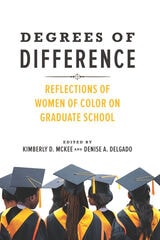
Degrees of Difference
Reflections of Women of Color on Graduate SchoolEdited by Kimberly D. McKee and Denise A. Delgado
University of Illinois Press, 2020
In Degrees of Difference, women of color from diverse backgrounds give frank, unapologetic accounts of their battles—both internal and external—to navigate grad school and fulfill their ambitions. At the same time, the authors offer strategies for surviving the grind via stories of their own hard-won successes with self-care, building supportive communities, finding like-minded mentors, and resisting racism and unsupportive faculty and colleagues.
Contributors: Aeriel A. Ashlee, Denise A. Delgado, Nwadiogo I. Ejiogu, Delia Fernández, Regina Emily Idoate, Karen J. Leong, Kimberly D. McKee, Délice Mugabo, Carrie Sampson, Arianna Taboada, Jenny Heijun Wills, and Soha Youssef

Degrees of Risk
Navigating Insecurity and Inequality in Public Higher EducationBlake R. Silver
University of Chicago Press, 2024
Institutions of higher education are often described as “ivory towers,” places of privilege where students exist in a “campus bubble,” insulated from the trials of the outside world. These metaphors reveal a widespread belief that college provides young people with stability and keeps insecurity at bay. But for many students, that’s simply not the case.
Degrees of Risk reveals how insecurity permeates every facet of college life for students at public universities. Sociologist Blake Silver dissects how these institutions play a direct role in perpetuating uncertainty, instability, individualism, and anxiety about the future. Silver examined interviews with more than one hundred students who described the risks that surrounded every decision: which major to choose, whether to take online classes, and how to find funding. He expertly identified the ways the college experience played out differently for students from different backgrounds. For students from financially secure families with knowledge of how college works, all the choices and flexibility of college felt like an adventure or a wealth of opportunities. But for many others, especially low-income, first-generation students, their personal and family circumstances meant that that flexibility felt like murkiness and precarity. In addition, he discovered that students managed insecurity in very different ways, intensifying inequality at the intersections of socioeconomic status, race, gender, and other sociodemographic dimensions. Drawing from these firsthand accounts, Degrees of Risk presents a model for a better university, one that fosters success and confidence for a diverse range of students.
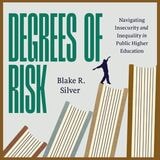
Degrees of Risk
Navigating Insecurity and Inequality in Public Higher EducationBlake R. Silver
University of Chicago Press, 2024
An ethnographic analysis of how insecurity is at the heart of contemporary higher education.
Institutions of higher education are often described as “ivory towers,” places of privilege where students exist in a “campus bubble,” insulated from the trials of the outside world. These metaphors reveal a widespread belief that college provides young people with stability and keeps insecurity at bay. But for many students, that’s simply not the case.
Degrees of Risk reveals how insecurity permeates every facet of college life for students at public universities. Sociologist Blake Silver dissects how these institutions play a direct role in perpetuating uncertainty, instability, individualism, and anxiety about the future. Silver examined interviews with more than one hundred students who described the risks that surrounded every decision: which major to choose, whether to take online classes, and how to find funding. He expertly identified the ways the college experience played out differently for students from different backgrounds. For students from financially secure families with knowledge of how college works, all the choices and flexibility of college felt like an adventure or a wealth of opportunities. But for many others, especially low-income, first-generation students, their personal and family circumstances meant that that flexibility felt like murkiness and precarity. In addition, he discovered that students managed insecurity in very different ways, intensifying inequality at the intersections of socioeconomic status, race, gender, and other sociodemographic dimensions. Drawing from these firsthand accounts, Degrees of Risk presents a model for a better university, one that fosters success and confidence for a diverse range of students.
Democracy and Higher Education
Traditions and Stories of Civic EngagementScott J. Peters
Michigan State University Press, 2010
How are we to understand the nature and value of higher education's public purposes, mission, and work in a democratic society? How do-and how should-academic professionals contribute to and participate in civic life in their practices as scholars, scientists, and educators?
Democracy and Higher Education addresses these questions by combining an examination of several normative traditions of civic engagement in American higher education with the presentation and interpretation of a dozen oral history profiles of contemporary practitioners. In his analysis of these profiles, Scott Peters reveals and interprets a democratic-minded civic professionalism that includes and interweaves expert, social critic, responsive service, and proactive leadership roles.
Democracy and Higher Education contributes to a new line of research on the critically important task of strengthening and defending higher education's positive roles in and for a democratic society.
Democracy's Education
Public Work, Citizenship, and the Future of Colleges and UniversitiesHarry C. Boyte
Vanderbilt University Press, 2015
Democracy's Education grows from the American Commonwealth Partnership, a year-long project to revitalize the democratic narrative of higher education that began with an invitation to Harry Boyte from the White House to put together a coalition aimed at strengthening higher education as a public good. The project was launched at the beginning of 2012 to mark the 150th anniversary of the Morrill Act, which created land grant colleges.
Beginning with an essay by Harry C. Boyte, "Reinventing Citizenship as Public Work," which challenges educators and their partners to claim their power to shape the story of higher education and the civic careers of students, the collection brings world-famous scholars, senior government officials, and university presidents together with faculty, students, staff, community organizers, and intellectuals from across the United States and South Africa and Japan. Contributors describe many constructive responses to change already taking place in different kinds of institutions, and present cutting-edge ideas like "civic science," "civic studies," "citizen professionalism," and "citizen alumni." Authors detail practical approaches to making change, from new faculty and student roles to changes in curriculum and student life and strategies for everyday citizen empowerment. Overall, the work develops a democratic story of education urgently needed to address today's challenges, from climate change to growing inequality.
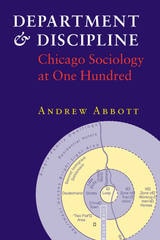
Department and Discipline
Chicago Sociology at One HundredAndrew Abbott
University of Chicago Press, 1999
Abbott analyzes the shifts in social scientific inquiry and discloses the intellectual rivalry and faculty politics that characterized different stages of the Chicago School. Along the way, he traces the rich history of the discipline's main journal, the American Journal of Sociology.
Embedded in this analysis of the school and its practices is a broader theoretical argument, which Abbott uses to redefine social objects as a sequence of interconnected events rather than as fixed entities. Abbott's theories grow directly out of the Chicago School's insistence that social life be located in time and place, a tradition that has been at the heart of the school since its founding one hundred years ago.
Desi Land
Teen Culture, Class, and Success in Silicon ValleyShalini Shankar
Duke University Press, 2008
Whether discussing instant messaging or arranged marriages, Desi bling or the pressures of the model minority myth, Shankar foregrounds the teens’ voices, perspectives, and stories. She investigates how Desi teens interact with dialogue and songs from Bollywood films as well as how they use their heritage language in ways that inform local meanings of ethnicity while they also connect to a broader South Asian diasporic consciousness. She analyzes how teens negotiate rules about dating and reconcile them with their longer-term desire to become adult members of their communities. In Desi Land Shankar not only shows how Desi teens of different socioeconomic backgrounds are differently able to succeed in Silicon Valley schools and economies but also how such variance affects meanings of race, class, and community for South Asian Americans.
Designed to Fail
Why Racial Equity in School Funding Is So Hard to AchieveRoseann Liu
University of Chicago Press, 2024
For people who care about urban school districts like Philadelphia’s, addressing the challenges that these schools face often boils down to the need for more money. But why are urban districts that serve Black and Brown students still so perennially underfunded compared to majority-white ones? Why is racial equity in school funding so hard to achieve?
In Designed to Fail, Roseann Liu provides an inside look at the Pennsylvania state legislature and campaigns for fair funding to show how those responsible for the distribution of school funding work to maintain the privileges of majority-white school districts. Liu analyzes how colorblind policies, political structures, and the maintenance of the status quo by people in power perpetuate wide and deepening racial disparities in education funding. Taking a lesson from community organizers fighting for a racially equitable school funding system, Liu’s work is a bold call to address structural racism at the root and organize from a place of abundant justice.
Developing Faculty in Liberal Arts Colleges
Aligning Individual Needs and Organizational GoalsBaker, Vicki L.
Rutgers University Press, 2017
Drawing on research conducted at the thirteen institutions of the Great Lakes Colleges Association, Vicki L. Baker, Laura Gail Lunsford, and Meghan J. Pifer propose a compelling Alignment Framework for Faculty Development in Liberal Arts Colleges to show how these colleges succeed—or sometimes fail—in providing their faculties with the right support to be successful.
Developmental Programming for Infants and Young Children
Volume 1. Assessment and ApplicationD. Sue Schafer and Martha S. Moersch, Editors
University of Michigan Press, 1981
Developmental Programming for Infants and Young Children: Volume 1 provides detailed instructions for the use of Volume 2: Early Intervention Developmental Profile, including administration and evaluation techniques, scoring and interpretation of results, validity and reliability of findings, and complete item descriptions. To be used with children functioning in the 0-to-36-month developmental age range. Volume 1 includes the scoring sheet (Volume 2).
Developmental Programming for Infants and Young Children has proven to be an invaluable tool for teachers, therapists, and other professionals who assess and facilitate the development of children functioning primarily in the 0-to-60 month range. The authors address six areas of development: perceptual/fine motor, cognition, language, social/emotional, self-care, and gross motor. Volumes 1, 2, and 3 are designed for use with children functioning in the 0-to-36-month developmental age range, while Volumes 4 and 5 extend assessment and programming guidelines to 5-year (preschool) levels.
Carefully designed and tested by the University of Michigan's Institute for the Study of Mental Retardation and Related Disabilities, all volumes bridge the gap between assessment and program implementation.
Developmental Programming for Infants and Young Children
Volume 3. Stimulation ActivitiesD. Sue Schafer and Martha S. Moersch, Editors
University of Michigan Press, 1981
Developmental Programming for Infants and Young Children: Volume 3 provides a reservoir of ideas for carrying out planned program objectives. Each developmental area contains sequenced develop mental behaviors that would be expected in a normal child, with adaptations for specific handicapping conditions noted. This volume describes ways to handle, stimulate, and interact with a young child functioning in the developmental age range 0-to-36 months. It can be used by parents for at-home activities.
This volume is available as a set in combination with Volumes 1 and 2.
Developmental Programming for Infants and Young Children has proven to be an invaluable tool for teachers, therapists, and other professionals who assess and facilitate the development of children functioning primarily in the 0-to-60 month range. The authors address six areas of development: perceptual/fine motor, cognition, language, social/emotional, self-care, and gross motor. Volumes 1, 2, and 3 are designed for use with children functioning in the 0-to-36-month developmental age range, while Volumes 4 and 5 extend assessment and programming guidelines to 5-year (preschool) levels.
Carefully designed and tested by the University of Michigan's Institute for the Study of Mental Retardation and Related Disabilities, all volumes bridge the gap between assessment and program implementation.

Dictators and the Higher Education Dilemma
State Power and the University in Modern IranSaeid Golkar
Rutgers University Press, 0
Dictators and the Higher Education Dilemma explores a powerful contradiction at the heart of modern authoritarian regimes: While universities are essential for producing skilled labor and projecting national progress, they also cultivate critical thinkers who can challenge state power. Drawing on Iran’s modern history, from the Pahlavi monarchy to the Islamic Republic, Saeid Golkar shows how dictators use universities not only to train technocrats and showcase development but also as tools for shaping ideology, suppressing dissent, and co-opting academics. In authoritarian systems, education becomes a double-edged sword, essential for growth yet dangerous when it empowers independent thought. Golkar reveals how regimes manipulate admissions, censor curricula, and reward loyalty to create compliant intellectuals and loyal elites. Blending personal experience with rich historical and political analysis, this book exposes the tactics used to turn universities into instruments of social control. It speaks to a growing trend worldwide, offering vital insights into the clash between authoritarian power and academic freedom from Iran to China, Russia, and beyond.
Digital Divisions
How Schools Create Inequality in the Tech EraMatthew H. Rafalow
University of Chicago Press, 2020
While teachers praise affluent White students for being “innovative” when they bring preexisting and sometimes disruptive tech skills into their classrooms, less affluent students of color do not receive such recognition for the same behavior. Digital skills exhibited by middle class, Asian American students render them “hackers,” while the creative digital skills of working-class, Latinx students are either ignored or earn them labels troublemakers. Rafalow finds in his study of three California middle schools that students of all backgrounds use digital technology with sophistication and creativity, but only the teachers in the school serving predominantly White, affluent students help translate the digital skills students develop through their digital play into educational capital. Digital Divisions provides an in-depth look at how teachers operate as gatekeepers for students’ potential, reacting differently according to the race and class of their student body. As a result, Rafalow shows us that the digital divide is much more than a matter of access: it’s about how schools perceive the value of digital technology and then use them day-to-day.
Digital Futures of Graduate Study in the Humanities
Gabriel Hankins
University of Minnesota Press, 2024
A resource for planning, reimagining, and participating in the digital transformation of graduate study in the humanities
How are the humanities adapting to the rise of digital technologies, and what are some of the tried and tested ways that postsecondary institutions are proving the importance of humanities training at the graduate level? Bringing together a diverse group of scholars and students, Digital Futures of Graduate Study in the Humanities invites a reimagining of current models of graduate education to address ongoing challenges to the humanities and to create sustainable and humane pedagogies, classes, and institutions.
The essays cover a wide range of topics, including the skills required to learn and practice digital methods, the resources needed to support students and faculty in this enterprise, the lack of meaningful credit for undertaking this time-intensive work, and the diminished employment possibilities within academia for graduate students who emerge with these skills. Mapping the broad terrain through which to address and intervene in these particular issues and beyond, this book offers deep insights into the digital futures of graduate studies in the humanities.
Contributors: Maria José Afanador-Llach, U de los Andes, Bogotá; Maria K. Alberto, U of Utah; Agnieszka Backman; Travis M. Bartley, CUNY Graduate Center; Peggy Bockwinkel, U Stuttgart; Alison Booth, U of Virginia; Donna Alfano Bussell, U of Illinois Springfield; Joshua Casmir Catalano, Clemson U; Laura Crossley, George Mason U; Quinn Dombrowski, Stanford U; Stuart Dunn, King’s College London; Jennifer Edmond, Trinity College Dublin; Natalia Ermolaev, Princeton U; Laura Estill, St. Francis Xavier U; Malte Gäckle-Heckelen; Vicky Garnett, Trinity College Dublin; Daniel Gorman Jr., U of Rochester; Sabrina T. Grimberg, Stanford U; Tena L. Helton, U of Illinois Springfield; Jeanelle Horcasitas; Melissa A. Hosek, Stanford U; Hoyeol Kim; Brady Krien, U of Iowa; Benjamin Charles Germain Lee, U of Washington; Pamela E. Mack, Clemson U; Meredith Martin, Princeton U; Germán Camilo Martínez Peñaloza, U de los Andes, Bogotá; E. L. Meszaros, Brown U; Sara Mohr, Hamilton College; Sethunya Mokoko, U of Virginia; Rebecca Munson; Erin Francisco Opalich; Olivia Quintanilla, MiraCosta College; Cecily Raynor, McGill U; Amanda E. Regan, Clemson U; Heather Richards-Rissetto, U of Nebraska–Lincoln; Jacob D. Richter, George Washington U; Stephen Robertson, George Mason U; Katina L. Rogers; Claus-Michael Schlesinger, Humboldt U Berlin; Douglas Seefeldt, Clemson U; Kayla Shipp, Yale Digital Humanities Lab; Serenity Sutherland, SUNY Oswego; Toma Tasovac, Belgrade Center for Digital Humanities; Hannah Taylor, Duke U; Manfred Thaller, U of Cologne; Madeline Ullrich, U of Rochester; Ted Underwood, U of Illinois Urbana-Champaign; Gabriel Viehhauser, U Stuttgart; Brandon Walsh, U of Virginia Library; Sean Weidman, Lycoming College; Alex Wermer-Colan, Temple U; Adrian S. Wisnicki, U of Nebraska–Lincoln; Alexander J. Zawacki, U Göttingen.
Retail e-book files for this title are screen-reader friendly with images accompanied by short alt text and/or extended descriptions.
Digital Me
Trans Students Exploring Future Possible Selves OnlineZ Nicolazzo
Rutgers University Press, 2023
Digital Sound Studies
Mary Caton Lingold, Darren Mueller, and Whitney Trettien, editors
Duke University Press, 2018
Contributors. Myron M. Beasley, Regina N. Bradley, Steph Ceraso, Tanya Clement, Rebecca Dowd Geoffroy-Schwinden, W. F. Umi Hsu, Michael J. Kramer, Mary Caton Lingold, Darren Mueller, Richard Cullen Rath, Liana M. Silva, Jonathan Sterne, Jennifer Stoever, Jonathan W. Stone, Joanna Swafford, Aaron Trammell, Whitney Trettien
Disability Services in Higher Education
An Insider's GuideKirsten T. Behling, Eileen H. Bellemore, Lisa B. Bibeau, Andrew S. Cioffi, and Bridget A. McNamee
Temple University Press, 2023
This volume provides an overview of the responsibilities of a Disabilities Service professional through an examination of relevant literature, laws and regulatory language, case law, and narrative on established practices. It also offers resources that current professionals can modify for use in their day-to-day practice immediately. The authors explore the complexities of accessibility, paying careful attention to the nuances of disability evaluation, accommodation decisions, management of a disability service office, advocating for resources and collaboration within and outside of higher education institutions.
This practitioner-friendly book will help newcomers and seasoned professionals explore and evaluate best practices in the field through questions, examples, and functional job aids available for immediate use.
Disciplining Feminism
From Social Activism to Academic DiscourseEllen Messer-Davidow
Duke University Press, 2002
Working within a firm theoretical framework and drawing on years of both personal involvement and fieldwork in and outside of academe, Messer-Davidow traces the metamorphosis of a once insurgent project in three steps. After illustrating how early feminists meshed their activism with institutional processes to gain footholds on campuses and in disciplinary associations, she turns to the relay between institutionalization and intellectualization, examining the way feminist studies coalesced into an academic field beginning in the mid-1970s. Without denying the successes of this feminist passage into the established system of higher learning, Messer-Davidow nonetheless insists that the process of institutionalization itself necessarily alters all new entrants—no matter how radical. Her final chapters look to the future of feminism in an increasingly conservative environment and to the possibilities for social change in general.
Disciplining Feminism’s interdisciplinary scope and cross-sector analysis will attract a broad range of readers interested in women’s studies, American higher education, and the dynamics of social transformation.
Discord And Direction
The Postmodern Writing Program Administratoredited by Sharon James McGee & Carolyn Handa
Utah State University Press, 2005
Postmodernism's central moves include questioning hierarchy, valuing paratactic associations, and rejecting grand narratives, and the work of a Writing Program Administrator, most days, includes those moves as well. The argument of this collection is that the cultural and intellectual legacies of postmodernism impinge, significantly and daily, on the practice of the Writing Program Administrator. WPAs work in spaces where they must assume responsibility for a multifaceted program, a diverse curriculum, instructors with varying pedagogies and technological expertise—and where they must position their program in relation to a university with its own conflicted mission, and a state with its unpredictable views of accountability and assessment.
The collection further argues that postmodernism offers a useful lens through which to understand the work of WPAs and to examine the discordant cultural and institutional issues that shape their work. Each chapter tackles a problem local to its author's writing program or experience as a WPA, and each responds to existing discord in creative ways that move toward rebuilding and redirection.
It is a given that accepting the role of WPA will land you squarely in the bind between modernism and postmodernism: while composition studies as a field arguably still reflects a modernist ethos, the WPA must grapple daily with postmodern habits of thought and ways of being. The effort to live in this role may or may not mean that a WPA will adopt a postmodern stance; it does mean, however, that being a WPA requires dealing with the postmodern.
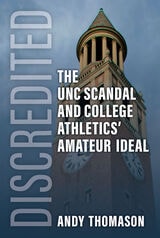
Discredited
The UNC Scandal and College Athletics' Amateur IdealAndy Thomason
University of Michigan Press, 2021
In 2009, the University of North Carolina at Chapel Hill was on top of the world.
Consistently named one of the top universities in the country, it had welcomed a new phenom of a chancellor who promised to lead the public Ivy into the future. In the all-important athletic realm, the Tar Heels were the Coca-Cola of athletic brands. Resting upon the legacy of legendary basketball coach Dean Smith, UNC had carved out a reputation of excellence paired with squeaky-clean adherence to the rules. Supporters had a name for that irresistible ethos: the Carolina Way. The Tar Heels were climbing even higher. That year, they won their fifth national championship in men's basketball and looked poised to climb the ranks in football under a new, high-powered coach.
But within just a few years, it all came crashing down.
The Tar Heels' success, it turned out, was based on a foundation of deceit. Athletes were flocking to a slate of fake classes that advisers deftly used to keep them eligible to play. That revelation and others metastasized into one of the most damaging scandals ever to visit an American college. In Discredited, journalist Andy Thomason provides a gripping and authoritative retelling of the scandal through the eyes of four of its key participants: the secretary who presided over the fake classes, the professor who directed players toward them, the literacy specialist turned whistleblower who sought to expose the system, and the chancellor who found his career suddenly on the line. The heart-stopping narrative reveals the toll of a college's investment in major sports, and the amateurism myth upon which it is based. Based on dozens of original interviews and thousands of pages of documents, Discredited demonstrates just how far a university will go to preserve the athletic status quo: tolerating tarnished careers, ruined reputations, and years of scathing media criticism—all for a shot at competitive glory.
Divergent Paths to College
Race, Class, and Inequality in High SchoolsHolland, Megan M
Rutgers University Press, 2019
Diversifying STEM
Multidisciplinary Perspectives on Race and GenderEbony O. McGee
Rutgers University Press, 2020
Research frequently neglects the important ways that race and gender intersect within the complex structural dynamics of STEM. Diversifying STEM fills this void, bringing together a wide array of perspectives and the voices of a number of multidisciplinary scholars. The essays cover three main areas: the widely-held ideology that science and mathematics are “value-free,” which promotes pedagogies of colorblindness in the classroom as well as an avoidance of discussions around using mathematics and science to promote social justice; how male and female students of color experience the intersection of racist and sexist structures that lead to general underrepresentation and marginalization; and recognizing that although there are no quick fixes, there exists evidence-based research suggesting concrete ways of doing a better job of including individuals of color in STEM. As a whole this volume will allow practitioners, teachers, students, faculty, and professionals to reimagine STEM across a variety of educational paradigms, perspectives, and disciplines, which is critical in finding solutions that broaden the participation of historically underrepresented groups within the STEM disciplines.
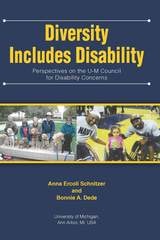
Diversity Includes Disability
Perspectives on the U-M Council for Disability ConcernsAnna Ercoli Schnitzer and Bonnie A. Dede
Michigan Publishing Services, 2018
The Council has changed and enlarged its membership from its origins as a small, low-key group consisting primarily of faculty and staff engaged in the disability arena, to an organization that encompasses a diverse, cross-campus and local community membership, with an extensive mailing list, as well. The achievements of the Council over the years and the goals that it envisions for the future, we hope, will serve as a template for other institutions.
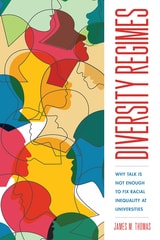
Diversity Regimes
Why Talk Is Not Enough to Fix Racial Inequality at UniversitiesJames M. Thomas
Rutgers University Press, 2020
As a major, public flagship university in the American South, so-called “Diversity University” has struggled to define its commitments to diversity and inclusion, and to put those commitments into practice. In Diversity Regimes, sociologist James M. Thomas draws on more than two years of ethnographic fieldwork at DU to illustrate the conflicts and contingencies between a core set of actors at DU over what diversity is and how it should be accomplished. Thomas’s analysis of this dynamic process uncovers what he calls “diversity regimes”: a complex combination of meanings, practices, and actions that work to institutionalize commitments to diversity, but in doing so obscure, entrench, and even magnify existing racial inequalities. Thomas’s concept of diversity regimes, and his focus on how they are organized and unfold in real time, provides new insights into the social organization of multicultural principles and practices.
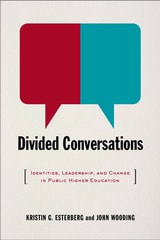
Divided Conversations
Identities, Leadership, and Change in Public Higher EducationKristin G. Esterberg
Vanderbilt University Press, 2013
Many faculty believe that one of their own who becomes an administrator has gone over to "the dark side." One provost recalled going for a beer with a faculty colleague and hearing the colleague complain about the latest memo "from the administration." He had to remind his friend of many years that he was the author of the offending document. Now he was "the administration." He realized that former colleagues now appeared in his office wearing suits and ties and referring to him by his title rather than his first name.
The disciplines serve as the tribes into which individual scholars are organized; the discipline is where a faculty member finds his community and identity. Administrators, on the other hand, identify with each other in trying to get the tribes to work together. Though most administrators came from the faculty ranks, their career paths take a different shape, especially in terms of mobility to another institution. It's not surprising that the two groups talk past each other.
A chapter is devoted to chairs of departments, who occupy an interesting middle ground. To their faculty, they can come across as a nurturing parent or a petty bureaucrat. The authors recommend training for chairs and administrative internships offered by the American Council on Education and other organizations.
The men and women on the campuses of the public universities described in the book make clear the challenges that universities face in terms of budgets, legislative politics, collective bargaining, rankings, and control of academic programs. If public institutions are truly to serve a public purpose, faculty and administrators must find ways to engage each other in shared conversation and management and find ways of engaging the university with the community.
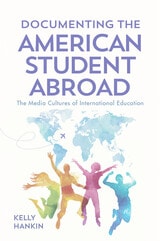
Documenting the American Student Abroad
The Media Cultures of International EducationKelly Hankin
Rutgers University Press, 2021
In Documenting the American Student Abroad, Kelly Hankin explores the documentary media cultures that shape these beliefs, drawing our attention to the broad range of stakeholders and documentary modes involved in defining the core values and practices of study abroad. From study abroad video contests and a F.B.I. produced docudrama about student espionage to reality television inspired educational documentaries and docudramas about Amanda Knox, Hankin shows how the institutional values of "global citizenship," "intercultural communication," and "cultural immersion" emerge in contradictory ways through their representation.
By bringing study abroad and media studies into conversation with one another, Documenting the American Student Abroad: The Media Cultures of International Education offers a much needed humanist contribution to the field of international education, as well as a unique approach to the growing scholarship on the intersection of media and institutions. As study abroad practitioners and students increase their engagement with moving images and digital environments, the insights of media scholars are essential for helping the field understand how the mediation of study abroad rhetoric shapes rather than reflects the field's central institutional ideals
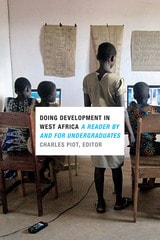
Doing Development in West Africa
A Reader by and for UndergraduatesCharles Piot
Duke University Press, 2016
Doing Diversity in Higher Education
Faculty Leaders Share Challenges and StrategiesBrown-Glaude, Winnifred R
Rutgers University Press, 2008
The rich variety of colleges and universities included provides a wide array of models that faculty can draw upon to inspire institutional change.
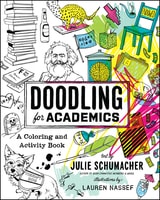
Doodling for Academics
A Coloring and Activity BookJulie Schumacher
University of Chicago Press, 2017
But those in the trenches of academe are well acquainted with the professoriate’s dark underside: the hierarchies and pseudo-political power plays, the peculiar colleagues, the over-parented students, the stacks of essays that need to be graded ASAP.
No one understands this world better than novelist Julie Schumacher, who here provides a bitingly funny distraction designed to help you survive life in higher education without losing your mind. Sardonic yet shrewdly insightful, Doodling for Academics offers the perfect cognitive relief for the thousands of faculty and grad students whose mentors and loved ones failed to steer them toward more reasonable or lucrative fields.
Through forty pages of original illustrations and activities—from coloring to paper dolls to mad libs—this book traces the arc of a typical day on campus. Get a peek inside the enigma of the student brain. Imagine a utopian faculty meeting. Navigate the red tape maze of university administration. With the help of hilarious illustrations by Lauren Nassef, Schumacher infuses the world of campus greens and university quads with cutting wit, immersing you deep into the weirdly creative challenges of university life. Offering a satirical interactive experience for scholars, the combination of humor and activities in this book will bring academia into entertaining relief, making it the perfect gift for your colleagues, advisors, or newly minted graduates.
During the Dissertation
A Textual Mentor for Doctoral Students in the Process of WritingChristine Pearson Casanave
University of Michigan Press, 2020
This volume is a sequel to Casanave’s popular Before the Dissertation. Like that volume, this book is designed as a companion for doctoral dissertation writers of qualitative or mixed methods work in fields related to language education. It could also benefit those writing master’s theses and those writing in other social science fields. It is meant to be consulted once the writing has begun—once students have settled on a topic, designed the project, or collected the data—because this is the time when they are analyzing, drafting, revising, polishing, and probably fretting, deleting, reconstructing, and even losing sleep. Also, like its predecessor, it is not designed to teach anyone how to write a dissertation as there are plenty of those available elsewhere.
For most doctoral students, writing will happen at different stages of the project. Strategies for timing of these kinds of writing differ across students, and also across supervisors and advisers. If dissertation writers do not know by the time they start writing which strategies and issues pertain to them, this book can help them craft some approaches to suit their own personalities, preferred practices, and individual goals and visions, as well as help them figure out how dissertation writing might fit into the real-life intrusions of work and family.
Issues covered in the book are: starting to write, envisioning the project as a whole, relationships with supervisors, perfectionism and other maladies, health, low- and high-IQ days, loneliness and isolation, distractions and interruptions, revising, and knowing when to stop.

dear elia
Letters from the Asian American AbyssMimi Khúc
Duke University Press, 2024