Results by title
2194 books match the query 'Women's Studies' and 97 start with d
DES Daughters, Embodied Knowledge, and the Transformation of Women's Health Politics in the Late Twentieth Century
Susan E. Bell
Temple University Press, 2009
In DES Daughters, Susan Bell recounts the experiences of this generation of “victims.” In moving, heartfelt narratives, she presents the voices of those women who developed cancer, those who were cancer-free but have concerns about becoming pregnant, and those who suffered other medical and/or reproductive difficulties.
Bell examines the hierarchy of knowledge and power of scientists, doctors, and daughters, tracing the emergence of a feminist health movement. The “embodied knowledge” of these DES daughters prompted them to become advocates and form a social movement that challenged reproductive medical knowledge specifically, but also the politics of women’s health in general. Bell’s important book chronicles the history and future of these grassroots activists born out of illness, suffering, and uncertainty.

Dames in the Driver's Seat
Rereading Film NoirBy Jans B. Wager
University of Texas Press, 2005
With its focus on dangerous, determined femmes fatales, hardboiled detectives, and crimes that almost-but-never-quite succeed, film noir has long been popular with moviegoers and film critics alike. Film noir was a staple of classical Hollywood filmmaking during the years 1941-1958 and has enjoyed a resurgence in popularity since the 1990s. Dames in the Driver's Seat offers new views of both classical-era and contemporary noirs through the lenses of gender, class, and race. Jans Wager analyzes how changes in film noir's representation of women's and men's roles, class status, and racial identities mirror changes in a culture that is now often referred to as postmodern and postfeminist.
Following introductory chapters that establish the theoretical basis of her arguments, Wager engages in close readings of the classic noirs The Killers, Out of the Past, and Kiss Me Deadly and the contemporary noirs L. A. Confidential, Mulholland Falls, Fight Club, Twilight, Fargo, and Jackie Brown. Wager divides recent films into retro-noirs (made in the present, but set in the 1940s and 1950s) and neo-noirs (made and set in the present but referring to classic noir narratively or stylistically). Going beyond previous studies of noir, her perceptive readings of these films reveal that retro-noirs fulfill a reactionary social function, looking back nostalgically to outdated gender roles and racial relations, while neo-noirs often offer more revisionary representations of women, though not necessarily of people of color.

Damsels and Divas
European Stardom in Silent HollywoodAgata Frymus
Rutgers University Press, 2020
Damsels and Divas investigates the meanings of Europeanness in Hollywood during the 1920s by charting professional trajectories of three movie stars: Pola Negri, Vilma Bánky and Jetta Goudal. It combines the investigation of American fan magazines with the analysis of studio documents, and the examination of the narratives of their films, to develop a thorough understanding of the ways in which Negri, Bánky and Goudal were understood within the realm of their contemporary American culture. This discussion places their star personae in the context of whiteness, femininity and Americanization. Every age has its heroines, and they reveal a lot about prevailing attitudes towards women in their respective eras. In the United States, where the stories of rags-to-riches were especially potent, stars could offer models of successful cultural integration.
Dance Floor Democracy
The Social Geography of Memory at the Hollywood CanteenSherrie Tucker
Duke University Press, 2014
Dance and the Hollywood Latina
Race, Sex, and StardomOvalle, Priscilla P
Rutgers University Press, 2011
Introducing the concepts of "inbetween-ness" and "racial mobility" to further illuminate how racialized sexuality and the dancing female body operate in film, Priscilla Peña Ovalle focuses on the careers of Dolores Del Rio, Rita Hayworth, Carmen Miranda, Rita Moreno, and Jennifer Lopez. Dance and the Hollywood Latina helps readers better understand how the United States grapples with race, gender, and sexuality through dancing bodies on screen.

Dancing across the Page
Narrative and Embodied Ways of KnowingKaren Barbour
Intellect Books, 2011
An innovative exploration of understanding through dance, Dancing across the Page draws on the frameworks of phenomenology, feminism, and postmodernism to offer readers an understanding of performance studies that is grounded in personal narrative and lived experience. Through accounts of contemporary dance making, improvisation, and dance education, Karen Barbour explores a diversity of themes, including power; activism; and cultural, gendered, and personal identity. An intimate yet rigorous investigation of creativity in dance, Dancing across the Page emphasizes embodied knowledge and imagination as a basis for creative action in the world.

Dancing at the Devil's Party
Essays on Poetry, Politics, and the EroticAlicia Suskin Ostriker
University of Michigan Press, 2000
In her work, Ostriker can be controversial, as when she attacks the academic establishment for rejecting the erotic dimension of poetry, or when she meditates on the significance of the black poet Lucille Clifton to herself as a reader, or when she argues that Allen Ginsberg's "Howl"--famous as the primary poem of the Beat Generation--is also a profoundly Jewish poem. Yet her writing is always lively and readable, free of academic jargon, inviting the reader to enjoy a wide range of poetic styles and experiences.
Ostriker's criticism, like her poetry, is both feminist and deeply humane. These essays on American poetry will appeal to students of poetry, scholars of American literature, and anyone who enjoys the work of the poets discussed in the book.
Alicia Ostriker is the author of nine books of poetry, including The Imaginary Lover, which won the William Carlos Williams Award and The Crack in Everything, which was a National Book award finalist in 1996, and which received the Paterson Prize in 1997 and the San Fransisco State Poetry Center Award in 1998. She is Distinguished Professor of English at Rutgers University.
Dancing for Their Lives
The Pursuit of Meaningful Aging in Urban ChinaClaudia Huang
Rutgers University Press, 2025

Dangerous Dames
Women and Representation in Film Noir and the Weimar Street FilmJans B. Wager
Ohio University Press, 1999
Both film noir and the Weimar street film hold a continuing fascination for film spectators and film theorists alike. The female characters, especially the alluring femmes fatales, remain a focus for critical and popular attention. In the tradition of such attention, Dangerous Dames focuses on the femme fatale and her antithesis, the femme attrapée.
Unlike most theorists, Jans Wager examines these archetypes from the perspective of the female spectator and rejects the persistence of vision that allows a reading of these female characters only as representations of unstable postwar masculinity. Professor Wager suggests that the woman in the audience has always seen and understood these characters as representations of a complex aspect of her existence.
Dangerous Dames looks at the Weimar street films The Street, Variety, Asphalt, and M and the film noir movies The Maltese Falcon, Gun Crazy, and The Big Heat. This book opens the doors to spectators and theorists alike, suggesting cinematic pleasures outside the bounds of accepted readings and beyond the narrow categorization of film noir and the Weimar street film as masculine forms.

Dangerous Frames
How Ideas about Race and Gender Shape Public OpinionNicholas J. G. Winter
University of Chicago Press, 2008

Daring to Care
American Nursing and Second-Wave FeminismSusan Gelfand Malka
University of Illinois Press, 2007

Dark Continent Of Our Bodies
Black Feminism & Politics Of RespectabilityE. Frances White
Temple University Press, 2001
White's powerful introduction draws on oral narratives from her own family history to illuminate the nature of narrative, both what is said and what is left unsaid. She then sets the historical stage with a helpful history of the inception and development of black feminism and a critique of major black feminist writings. In the three chapters that follow, she addresses the obstacles black feminism has already surmounted and must continue to traverse. Confronting what White calls "the politics of respectability," these chapters move the reader from simplistic views of race and gender in the nineteenth century through black nationalism and the radical movements of the sixties, and their relationship to feminist thought, to the linkages between race, gender, and sexuality in the works of such giants as Toni Morrison and James Baldwin. No one who finishes Dark Continent of Our Bodies will look at race and gender in the same way again.

Dark Designs and Visual Culture
Michele Wallace
Duke University Press, 2004
Beginning with a new introduction in which Wallace reflects on her life and career, this volume includes other autobiographical essays; articles focused on popular culture, the arts, and literary theory; and explorations of issues in black visual culture. Wallace discusses growing up in Harlem; how she dealt with the media attention and criticism she received for Black Macho and the Myth of the Superwoman, which was published when she was just twenty-seven years old; and her relationship with her family, especially her mother, the well-known artist Faith Ringgold. The many articles devoted to black visual culture range from the historical tragedy of the Hottentot Venus, an African woman displayed as a curiosity in nineteenth-century Europe, to films that sexualize the black body—such as Watermelon Woman, Gone with the Wind, and Paris Is Burning. Whether writing about the Anita Hill–Clarence Thomas hearings, rap music, the Million Man March, Toshi Reagon, multiculturalism, Marlon Riggs, or a nativity play in Bedford Stuyvesant, Wallace is a bold, incisive critic. Dark Designs and Visual Culture brings the scope of her career and thought into sharp focus.

Daughters of Decadence
Women Writers of the Fin de SiecleShowalter, Elaine
Rutgers University Press, 1993
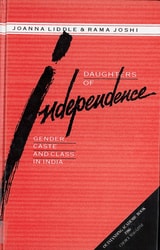
Daughters of Independence
Joanna Liddle
Rutgers University Press, 1989
For thousands of years Indian women have had a cultural tradition of resisting male domination. At the same time, the control of female sexuality has always been central to social hierarchies in India. Women are constrained in both class and caste hierarchies, to help distinguish the men at the top of the hierarchy from men at the bottom, where women are less constrained. In class society the seclusion of women allowed men to have sexual control over women and to retain the property that was transferred in marriage.
In contemporary India, professional women have had success entering the professions as the social groups to which they belong move increasingly to class rather than caste structures. But men continue to control the type of education they receive and the type of employment open to them, and to participate in the sexual harassment of women in the workplace. The concept that women are inferior to men--a concept that is not part of the Indian cultural heritage--is growing. In a sense, working professional women strengthen male control. The class structure is no more egalitarian than the caste structure, as oppression simply takes other forms.

Daughters of Suburbia
Growing Up White, Middle Class, and FemaleEdited by Lorraine Delia Kenny
Rutgers University Press, 2000
In order to move beyond characterizations of "the normal" (a loaded term that can obscure much of what actually defines this culture), Kenny highlights both the experiences of the middle-school students and the stories of three notoriously "bad" white middle-class teenage girls: Amy Fischer, the "Pistol-Packing Long Island Lolita," Cheryl Pierson, who hired a classmate to murder her father, and Emily Heinrichs, a former white supremacist and a teen mom. Arguing that middle-class whiteness thrives on its invisibility--on not being recognized as a cultural phenomenon--Kenny suggests that what the media identify as aberrant, as well as what they choose not to represent, are the keys to identifying the unspoken assumptions that constitute middle-class whiteness as a cultural norm. Daughters of Suburbia makes the familiar strange and gives substance to an otherwise intangible social position. Lorraine Kenny is the Public Education Coordinator for the American Civil Liberties Union's Reproductive Freedom Project. She has taught anthropology at Sarah Lawrence College.

Daughters of Time
Women in the Western TraditionMary Kinnear
University of Michigan Press, 1982

Daughters, Fathers, and the Novel
The Sentimental Romance of HeterosexualityLynda Zwinger
University of Wisconsin Press, 1991
Daughters, Fathers, and the Novel is a provocative study of the father-daughter story—a neglected dimension of the family romance. It has important implications for the history of the novel, for our understanding of key texts in that history, and for theories concerning the representation of gender, family relations, and heterosexuality in Western culture.
In the English and American novel, argues Lynda Zwinger, “the good woman” . . . is a father’s daughter, . . . constructed to the very particular specifications of an omnipresent and unvoiced paternal desire.” Zwinger supports her case with an analysis of both “high-brow” and “low-brow” novels and with ingenious textual analyses of five novels: Clarissa Harlowe, Dombey and Son, Little Women, The Golden Bowl, and The Story of O.
In the dominant discourse of Anglo-American culture, the father’s daughter provides the cornerstone for the patriarchal edifice of domesticity and the alibi for patriarchal desire. Zwinger’s analysis of the sexual politics embodied in the figure of this sentimental daughter raises compelling critical and cultural issues. Zwinger shows how different readings of Clarissa’s story form a sentimental composite that makes her available in perpetuity to heterosexual desire. Dombey and Son illuminates the erotic dimension of the sentimental, the titillation always inherent in the spectacle of virtue in distress. Zwinger’s analysis of Little Women in the context of Louisa May Alcott’s own life-text focuses upon the problems of a daughter trying to write the filial romance. The Golden Bowl deploys the daughter of sentiment as a “cover story” for a feminine version of the Oedipal story, founded on the daughter who can’t say yes, but doesn’t say no. The Story of O reveals the pornographic dimension in romantic and sentimental love.
In her conclusion, Zwinger offers an overview of the nineteenth-century novel, asking what difference it makes when the writer is a daughter. She shows how the daughter’s family romance pictures the father as inadequate, ironically requiring the sentimental daughter as a patriarchal prop. She develops a useful concept of hysteria and argues that generic “disorder” and hysterical “intrusions” mark the family romance novels of Jane Austen, Emily and Charlotte Brontë, and George Eliot. And finally, she makes the case that the daughter’s choice to stay home is not necessarily an act of simple complicity, for by staying home she comes as close as she can to disrupting the father-daughter romance.
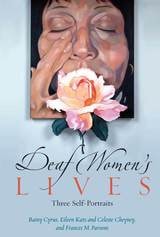
Deaf Women's Lives
Three Self-PortraitsBainy Cyrus
Gallaudet University Press, 2005
Three deaf women with widely varying stories share their experiences in this unique collection, revealing the vast differences in the circumstances of their lives, but also striking similarities. In Bainy Cyrus’s All Eyes, she vividly describes her life as a young child who was taught using the oral method at the Clarke School for the Deaf in Northampton, MA. Her account of the methods used (for example, repeating the same word over and over again, as many as 35 times), animates the extraordinary amount of work performed by deaf children to learn to read and speak. Cyrus also relates the importance of her lifelong friendships with two girls she met at Clarke, and how the different paths that they took influenced her as an adult.
Eileen Katz’s story, as told to Celeste Cheyney, offers a glimpse into a deaf girl’s life a generation before Cyrus. In Making Sense of It All: The Battle of Britain Through a Jewish Deaf Girl’s Eyes, Katz juxtaposes the gradual learning of the words who, what, where, and why with the confusing events of 1938 to 1941. As she and her fellow students grasped the meanings of these questions, they also realized the threat from the Nazi air attacks upon England. Katz also understood the compound jeopardy that she and her classmates faced by being both deaf and Jewish.
In contrast to the predominantly oral orientation of Cyrus and Katz, Frances M. Parsons writes of a year-long journey overseas in 1976 to lecture about Total Communication. Parsons traveled to Iran, India, Ceylon, Thailand, Malaysia, Singapore, Hong Kong, Taipei, the Philippines, Australia, and seven countries in Africa to teach administrators, teachers, and deaf students to communicate using sign, speechreading, writing, and any other means available. Her harrowing and fascinating anecdotes detail visits to ministries of education, schools, hospitals, clinics, palaces, hovels for the poorest of the poor, and all kinds of residential homes and apartments. Taken together, her travels testify to the aptness of her title I Dared!
The combined effect of these three Deaf women’s stories, despite the variation in their experiences, reveals the common thread that weaves through the lives of all deaf individuals.

Dear Dr. Menninger
Women's Voices from the ThirtiesHoward J. Faulkner and Virginia D. Pruitt, eds.
University of Missouri Press, 1997
In 1930 Dr. Karl A. Menninger, one of America's most distinguished psychiatrists, was asked by the editor of Ladies' Home Journal to write a monthly column that would address mental health issues and answer questions from readers. The result was the widely popular column "Mental Hygiene in the Home," which ran for eighteen months at a time when the American public was just beginning to popularize the idea of mental hygiene and psychotherapy.
Of the thousands of letters Dr. Menninger received, only a small number were printed in the Journal. However, he wrote personal responses to all of them, over two thousand of which have been preserved. For this book, Howard J. Faulkner and Virginia D. Pruitt have selected more than eighty exchanges that provide intimate glimpses into the personal lives of women from across the country.
Most notable in this fascinating collection is the precision and clarity of the women's voices, as well as Dr. Menninger's incisive, analytical, and elegantly phrased replies. The topics that were of major concern to these women included their own sexuality, cheating husbands, problem children, and interfering in-lawsþin other words, the same issues that many women still face today. Although Dr. Menninger's advice may sometimes be questionable by modern standards, these letters provide a useful look at the social assumptions of the 1930s.
Included in the book is an excellent introduction by the editors that traces America's affection for advice columns, chronicles Dr. Menninger's life and work, and provides an overview of the development of psychotherapy. Entertaining as well as informative, these letters not only offer a valuable reflection of women's issues during the Depression era but also invite comparison and contrast with contemporary problems, attitudes, and values.

Dear Helen
Wartime Letters from a Londoner to Her American Pen PalEdited by Russell M. Jones & John H. Swanson
University of Missouri Press, 2009

Dear Munificent Friends
Henry James's Letters to Four WomenSusan E. Gunter, Editor
University of Michigan Press, 2000
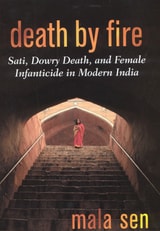
Death by Fire
Sati, Dowry Death, and Female Infanticide in Modern IndiaSen, Mala
Rutgers University Press, 2002
The Indian village of Deorala in Rajasthan, the northwestern Indian state that borders Pakistan, is neither remote nor feudal in the strictest sense. A tarmac road links the population of 10,000 to neighboring villages and towns, there is running water and electricity, and the villagers have had television for more than twenty years. On September 4, 1987, Deorala found itself in the center of a furor that awoke age-old conflicts in Indian society. Before a crowd of several thousand people, mostly men, a young woman dressed in her bridal finery was burned alive on her husband’s funeral pyre. The apparent revival of an ancient tradition opened old wounds in Indian society and focused world attention on the status and treatment of women in modern India.
The ancient practice of sati — the self-immolation of a woman on her husband’s funeral pyre — was outlawed by the British administration in India in 1829, and sati was widely believed to have died out. The fate of 18-year-old Roop Kanwar changed that perception. Mala Sen explores the reality of life and death for women in modern India in a study that is both illuminating and terrifying. The book is part journey through the India that the author knows and loves, and part exploration of the enigma that India still remains in the minds of many. Starting with Kanwar, Sen enters the worlds of three women: a goddess, a burned bride, and a woman accused of killing her daughter, and shows how, in this society in which ancient and modern apparently co-exist comfortably, there is increasingly cause for real alarm. She creates an image of a state in which political turmoil is constantly at the surface, and in which the role of women is constantly being redefined.

Debate of the Romance of the Rose
Christine de Pizan
University of Chicago Press, 2010
In 1401, Christine de Pizan (1365–1430?), one of the most renowned and prolific woman writers of the Middle Ages, wrote a letter to the provost of Lille criticizing the highly popular and widely read Romance of the Rose for its blatant and unwarranted misogynistic depictions of women. The debate that ensued, over not only the merits of the treatise but also of the place of women in society, started Europe on the long path to gender parity. Pizan’s criticism sparked a continent-wide discussion of issues that is still alive today in disputes about art and morality, especially the civic responsibility of a writer or artist for the works he or she produces.
In Debate of the “Romance of the Rose,” David Hult collects, along with the debate documents themselves, letters, sermons, and excerpts from other works of Pizan, including one from City of Ladies—her major defense of women and their rights—that give context to this debate. Here, Pizan’s supporters and detractors are heard alongside her own formidable, protofeminist voice. The resulting volume affords a rare look at the way people read and thought about literature in the period immediately preceding the era of print.

Debating Women's Equality
Toward a Feminist Theory of Law from a European PerspectiveGerhard, Ute
Rutgers University Press, 2001
Ute Gerhard places women's rights at the center of legal philosophy and sees the struggle for equality as a driving force in the history of law. Focusing on Europe and taking the course of German feminism and law as primary examples, she incorporates the various social contexts in which questions of equality and gender difference have been raised into an analysis that challenges misconceptions about the principle of equality itself.
Gerhard reviews the history of women's movements in the nineteenth and twentieth centuries and traces the historical development of claims to gender equality as well as obstacles to these claims. Critically exploring the influence of philosophers such as Rousseau, Fichte, and Kant, Gerhard concludes that women need to be recognized as both equal and different-that claims to equality do not simply eliminate difference, but also articulate it. Mindful of the social and political contexts surrounding equality arguments, Gerhard probes three legal issues: women's rights in the public sphere, especially the right to vote; women's legal capacities in private law, or the legal doctrine of so-called gender tutelage; and women's human rights, a prominent concern in the current international women's movement.
Debating Women
Gender, Education, and Spaces for Argument, 1835-1945Carly S. Woods
Michigan State University Press, 2018

Debt to Society
Accounting for Life under CapitalismMiranda Joseph
University of Minnesota Press, 2014
It is commonplace to say that criminals pay their debt to society by spending time in prison, but what is a “debt to society”? How is crime understood as a debt? How has time become the equivalent for crime? And how does criminal debt relate to the kind of debt held by consumers and university students?
In Debt to Society, Miranda Joseph explores modes of accounting as they are used to create, sustain, or transform social relations. Envisioning accounting broadly to include financial accounting, managerial accounting of costs and performance, and the calculation of “debts to society” owed by criminals, Joseph argues that accounting technologies have a powerful effect on social dynamics by attributing credits and debts. From sovereign bonds and securitized credit card debt to student debt and mortgages, there is no doubt that debt and accounting structure our lives.
Exploring central components of neoliberalism (and neoliberalism in crisis) from incarceration to personal finance and university management, Debt to Society exposes the uneven distribution of accountability within our society. Joseph demonstrates how ubiquitous the forces of accounting have become in shaping all aspects of our lives, proposing that we appropriate accounting and offer alternative accounts to turn the present toward a more widely shared well-being.
Declamation on the Nobility and Preeminence of the Female Sex
Henricus Cornelius Agrippa
University of Chicago Press, 1996
Rather than directly refuting prevailing wisdom, Agrippa uses women's superiority as a rhetorical device and overturns the misogynistic interpretations of the female body in Greek medicine, in the Bible, in Roman and canon law, in theology and moral philosophy, and in politics. He raised the question of why women were excluded and provided answers based not on sex but on social conditioning, education, and the prejudices of their more powerful oppressors. His declamation, disseminated through the printing press, illustrated the power of that new medium, soon to be used to generate a larger reformation of religion.

Decoding Abortion Rhetoric
Communicating Social ChangeCeleste Michelle Condit
University of Illinois Press, 1990
Defining Girlhood in India
A Transnational History of Sexual Maturity LawsAshwini Tambe
University of Illinois Press, 2019

Degrees of Difference
Reflections of Women of Color on Graduate SchoolEdited by Kimberly D. McKee and Denise A. Delgado
University of Illinois Press, 2020
In Degrees of Difference, women of color from diverse backgrounds give frank, unapologetic accounts of their battles—both internal and external—to navigate grad school and fulfill their ambitions. At the same time, the authors offer strategies for surviving the grind via stories of their own hard-won successes with self-care, building supportive communities, finding like-minded mentors, and resisting racism and unsupportive faculty and colleagues.
Contributors: Aeriel A. Ashlee, Denise A. Delgado, Nwadiogo I. Ejiogu, Delia Fernández, Regina Emily Idoate, Karen J. Leong, Kimberly D. McKee, Délice Mugabo, Carrie Sampson, Arianna Taboada, Jenny Heijun Wills, and Soha Youssef
Degrees of Difficulty
How Women's Gymnastics Rose to Prominence and Fell from GraceGeorgia Cervin
University of Illinois Press, 2021
Electrifying athletes like Olga Korbut and Nadia Comăneci helped make women’s artistic gymnastics one of the most popular events in the Olympic Games. But the transition of gymnastics from a women’s sport to a girl’s sport in the 1970s also laid the foundation for a system of emotional, physical, and sexual abuse of gymnasts around the world. Georgia Cervin offers a unique history of women's gymnastics, examining how the high-stakes diplomatic rivalry of the Cold War created a breeding ground for exploitation. Yet, a surprising spirit of international collaboration arose to decide the social values and image of femininity demonstrated by the sport. Cervin also charts the changes in style, equipment, training, and participants that transformed the sport, as explosive athleticism replaced balletic grace and gymnastics dominance shifted from East to West.
Sweeping and revelatory, Degrees of Difficulty tells a story of international friction, unexpected cooperation, and the legacy of abuse and betrayal created by the win-at-all-cost attitudes of the Cold War.

Dehexing Sex
Russian Womanhood During and After GlasnostHelena Goscilo
University of Michigan Press, 1996

Delivering Health
Midwifery and Development in MexicoLydia Z. Dixon
Vanderbilt University Press, 2020
Maternal health outcomes are a key focus of global health initiatives. In Delivering Health, author Lydia Z. Dixon uncovers the ways such outcomes have been shaped by broader historical, political, and social factors in Mexico, through the perspectives of those who are at the front lines fighting for change: midwives.
Midwives have long been marginalized in Mexico as remnants of the country's precolonial past, yet Dixon shows how they are now strategically positioning themselves as agents of modernity and development. Midwifery education programs have popped up across Mexico, each with their own critique of the health care system and vision for how midwifery can help. Delivering Health ethnographically examines three such schools with very different educational approaches and professional goals. From San Miguel de Allende to Oaxaca to Michoacán and points between, Dixon takes us into the classrooms, clinics, and conferences where questions of what it means to provide good reproductive health care are being taught, challenged, and implemented. Through interviews, observational data, and even student artwork, we are shown how underlying inequality manifests in poor care for many Mexican women. The midwives in this book argue that they can improve care while also addressing this inequality. Ultimately, Delivering Health asks us to consider the possibility that marginalized actors like midwives may hold the solution to widespread concerns in health.

Demanding Child Care
Women's Activism and the Politics of Welfare, 1940-1971Natalie M. Fousekis
University of Illinois Press, 2013
During World War II, as women stepped in to fill jobs vacated by men in the armed services, the federal government established public child care centers in local communities for the first time. When the government announced plans to withdraw funding and terminate its child care services at the end of the war, women in California protested and lobbied to keep their centers open, even as these services rapidly vanished in other states.
Analyzing the informal networks of cross-class and cross-race reformers, policymakers, and educators, Demanding Child Care: Women's Activism and the Politics of Welfare, 1940–1971 traces the rapidly changing alliances among these groups. During the early stages of the childcare movement, feminists, Communists, and labor activists banded together, only to have these alliances dissolve by the 1950s as the movement welcomed new leadership composed of working-class mothers and early childhood educators. In the 1960s, when federal policymakers earmarked child care funds for children of women on welfare and children described as culturally deprived, it expanded child care services available to these groups but eventually eliminated public child care for the working poor.
Deftly exploring the possibilities for partnership as well as the limitations among these key parties, Fousekis helps to explain the barriers to a publically funded comprehensive child care program in the United States.

Demanding Justice and Security
Indigenous Women and Legal Pluralities in Latin AmericaSieder, Rachel
Rutgers University Press, 2017
Featuring chapters on Bolivia, Colombia, Ecuador, Guatemala, and Mexico, the contributors to Demanding Justice and Security include both leading researchers and community activists. From Kichwa women in Ecuador lobbying for the inclusion of specific clauses in the national constitution that guarantee their rights to equality and protection within indigenous community law, to Me’phaa women from Guerrero, Mexico, battling to secure justice within the Inter-American Court of Human Rights for violations committed in the context of militarizing their home state, this book is a must-have for anyone who wants to understand the struggle of indigenous women in Latin America.

Democracy on the Wall
Street Art of the Post-Dictatorship Era in ChileGuisela Latorre
The Ohio State University Press, 2019
Exploring the resurgence and impact of the muralist brigades, women graffiti artists, the phenomenon of “open-sky museums,” and the transnational impact on the development of Chilean street art, Latorre argues that mural and graffiti artists are enacting a “visual democracy,” a form of artistic praxis that seeks to create alternative images to those produced by institutions of power. Keenly aware of Latin America’s colonial legacy and deeply flawed democratic processes, and distrustful of hegemonic discourses promoted by government and corporate media, the artists in Democracy on the Wall utilize graffiti and muralism as an alternative means of public communication, one that does not serve capitalist or nationalist interests. Latorre posits that through these urban interventions that combine creativity with social action, Chilean street artists formulate visions of what a true democracy looks like.

Demonic Grounds
Black Women And The Cartographies Of StruggleKatherine McKittrick
University of Minnesota Press, 2006
Demonic Grounds moves between past and present, archives and fiction, theory and everyday, to focus on places negotiated by black women during and after the transatlantic slave trade. Specifically, the author addresses the geographic implications of slave auction blocks, Harriet Jacobs’s attic, black Canada and New France, as well as the conceptual spaces of feminism and Sylvia Wynter’s philosophies.
Central to McKittrick’s argument are the ways in which black women are not passive recipients of their surroundings and how a sense of place relates to the struggle against domination. Ultimately, McKittrick argues, these complex black geographies are alterable and may provide the opportunity for social and cultural change.
Katherine McKittrick is assistant professor of women’s studies at Queen’s University.

Denise Levertov
Selected CriticismEdited with an Introduction by Albert Gelpi
University of Michigan Press, 1993

Deregulating Desire
Flight Attendant Activism, Family Politics, and Workplace JusticeRyan Patrick Murphy
Temple University Press, 2016
In 1975, National Airlines was shut down for 127 days when flight attendants went on strike to protest long hours and low pay. Activists at National and many other U.S. airlines sought to win political power and material resources for people who live beyond the boundary of the traditional family. In Deregulating Desire, Ryan Patrick Murphy, a former flight attendant himself, chronicles the efforts of single women, unmarried parents, lesbians and gay men, as well as same-sex couples to make the airline industry a crucible for social change in the decades after 1970.
Murphy situates the flight attendant union movement in the history of debates about family and work. Each chapter offers an economic and a cultural analysis to show how the workplace has been the primary venue to enact feminist and LGBTQ politics.
From the political economic consequences of activism to the dynamics that facilitated the rise of what Murphy calls the “family values economy” to the Airline Deregulation Act of 1978, Deregulating Desire emphasizes the enduring importance of social justice for flight attendants in the twenty-first century.
Deserving Desire
Women's Stories of Sexual EvolutionMontemurro, Beth
Rutgers University Press, 2015

Designing the Teenage Girl
The Debut of a Popular CharacterMary Celeste Kearney
University of Texas Press, 2026
Explores the forgotten first wave of American teen-girl entertainment from the late 1920s through the early 1950s.
During the mid-twentieth century, American entertainment featuring teenage girls blossomed. From short stories to plays, films, comics, radio programs, and television shows, writers and other creative professionals developed a new character type that helped to define midcentury girlhood and teen culture. Designing the Teenage Girl uncovers the largely forgotten first wave of US teen-girl entertainment, tracing its emergence in the 1920s through a thirty-year production cycle that spanned all sectors of American popular culture.
Beginning with short stories such as Sally Benson’s Junior Miss and following their adaptations, Kearney reveals how teen-girl narratives circulated across industries. Drawing on archival research and analysis of visual, narrative, and sound design, Kearney situates these texts within the identity politics of the period. While midcentury teen-girl entertainment privileged white, middle-class femininity, it also contained alternative visions of girlhood that complicated heteronormative and patriarchal expectations. This study reframes the origins of teen-girl entertainment and demonstrates how its aesthetic strategies and industrial practices continue to shape representations of girlhood today.

Desired States
Sex, Gender, and Political Culture in ChileLessie Jo Frazier
Rutgers University Press, 2020

Development Detoothed
Ugandan Girls and the Making and Unmaking of a Global NGO CampaignErin V. Moore
University of Chicago Press, 0
An in-depth examination and critique of girls’ empowerment campaigns in Uganda.
In Kampala, Uganda’s capital and largest city, to “detooth” is to take a man’s money with promises of sex and intimacy. In this highly engaging book, anthropologist Erin V. Moore uses detoothing as a metaphor to capture the ways that many in Uganda, where unemployment rates are staggering, get access to resources from prosperous international NGOs.
Based on over a decade of ethnographic research in Uganda, Canada, Ethiopia, Tanzania, the United Kingdom, the United States, and at the United Nations, Development Detoothed focuses on the world’s largest campaign to “empower” adolescent girls in the global south, which aimed to reach hundreds of millions of girls. Moore follows the campaign’s money and messages around the world, through what she calls the “development supply chain,” from NGO headquarters to staff training workshops, UN offices, government agencies, and community-based organizations.
From this uniquely multisited perspective, she explains how billions of aid dollars earmarked for girls ended up in the hands of men who ran these organizations. Rather than merely document ironic outcomes, however, Moore shows how people inventively navigated the development industry’s many injustices, arguing that as young Ugandan women pull development’s “teeth” they effectively challenge broader ideas about power, money, and masculinity.

Deviant and Useful Citizens
The Cultural Production of the Female Body in Eighteenth-Century PeruMariselle Melendez
Vanderbilt University Press, 2011
The book focuses on the different ways male authorities, as well as female subjects, conceived the female body as deeply connected to notions of what constituted a useful or deviant citizen within the Viceroyalty. Using eighteenth-century legal documents, illustrated chronicles, religious texts, and newspapers, Meléndez explores in depth the representation of the female body in periods of political, economic, and religious transformation to determine how it was conceived within certain contexts.
Deviant and Useful Citizens presents a highly complex society that relied on representations of utility and productivity to understand the female body, as it reveals the surprisingly large stake that colonial authorities had in defining the status of women during a crucial time in South American history.
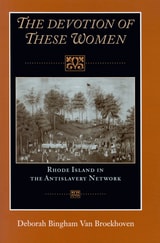
Devotion of These Women
Rhode Island in the Antislavery NetworkDeborah B. Van Broekhoven
University of Massachusetts Press, 2009
Despite the efforts of these groups, by 1842 the antislavery movement in Rhode Island was nearly moribund, the unified hopes of earlier years having fallen victim to political wrangling. A year later the largest auxiliary in the state, the Providence Antislavery Society, turned its funds over to Amarancy Paine, who in concert with other women not only revived the abolitionist movement in the state but kept it running for another ten years.
This detailed study explores how and why women like Paine emerged from the background to resuscitate and lead the antislavery cause in Rhode Island. It suggests that women more than men were accustomed to working behind the scenes, informally and without much public recognition.
The crumbling of the male-centered organization revealed a previously invisible female-based structure of personal ties on which leaders were able to build the Rhode Island State Anti-Slavery Society. Because these informal ties crossed traditional racial, geographic, and gender-role boundaries, they were often tenuous and fragile. Nevertheless, by developing this network among themselves and then extending it to national leaders, a few dedicated women managed to continue a program of antislavery petitioning, meetings, and literature circulation.
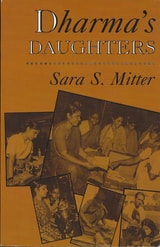
Dharma's Daughters
Contemporary Indian Women and Hindu CultureMitter, Sara S
Rutgers University Press, 1991
Women in India today are faced with a major conflict: how to adjust to rapid modernization and industrialization without abandoning traditional roles and customs. One of the assets of Hinduism has been its ability to incorporate seemingly unorthodox ideas, not fight against them. Contemporary Indian women today are trying to reconcile innovation with tradition as they assert that women are significant participants in the economy, that crimes against women should be investigated and prosecuted, and that a woman can divorce her husband. This is no easy task in light of the highly structured nature of Indian society. It is both hierarchical and patriarchal. Regardless of a family's economic position, women in the family are considered inferior. It is the woman's job, first and foremost, to be loyal to her husband and to be a good mother to her children.
Dharma's Daughters is divided into three sections. The first introduces us to women who live and work in Bombay, where the population is dense and the housing is inadequate. We meet manual laborers, members of construction crews, and illiterate domestic workers who live in shanties. Mitter paints a vivid picture of the harried lives of these women. In the second section Mitter describes Hindu mythology and the traditions that form the basis for women's lives. In the final section, Mitter tells of the increasing mobilization and resistance of Indian women since the 1970s.
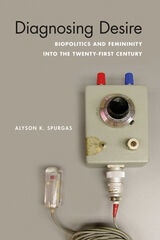
Diagnosing Desire
Biopolitics and Femininity into the Twenty-First CenturyAlyson K. Spurgas
The Ohio State University Press, 2020
In Diagnosing Desire: Biopolitics and Femininity into the Twenty-First Century, Alyson K. Spurgas examines the “new science of female sexuality” from a critical, sociological perspective, considering how today’s feminist-identified sex researchers study and manage women with low desire. Diagnosing Desire investigates experimental sex research that measures the disconnect between subjective and genital female arousal, contemporary psychiatric diagnoses for low female desire, new models for understanding women’s sexual response, and cutting-edge treatments for low desire in women—including from the realms of mindfulness and alternative healing.
Spurgas makes the case that, together, all of these technologies create a “feminized responsive desire framework” for understanding women’s sexuality, and that this, in fact, produces women’s sexuality as a complex problem to be solved. The biggest problem, Spurgas argues, is that gendered and sexualized trauma—including as it is produced within technoscientific medicine itself—is too often ignored in contemporary renderings. Through incisive textual analysis and in-depth qualitative research based on interviews with women with low desire, Spurgas argues for a more radical and communal form of care for feminized—and traumatized—populations, in opposition to biopolitical mandates to individualize and neoliberalize forms of self-care. Ultimately, this is a book not just about a specific diagnosis or dysfunction but about the material-discursive regimes that produce and regulate femininity.

Dialogue on the Infinity of Love
Tullia d'Aragona
University of Chicago Press, 1997
Sexually liberated and financially independent, Tullia d'Aragona dared to argue that the only moral form of love between woman and man is one that recognizes both the sensual and the spiritual needs of humankind. Declaring sexual drives to be fundamentally irrepressible and blameless, she challenged the Platonic and religious orthodoxy of her time, which condemned all forms of sensual experience, denied the rationality of women, and relegated femininity to the realm of physicality and sin. Human beings, she argued, consist of body and soul, sense and intellect, and honorable love must be based on this real nature.
By exposing the intrinsic misogyny of prevailing theories of love, Aragona vindicates all women, proposing a morality of love that restores them to intellectual and sexual parity with men. Through Aragona's sharp reasoning, her sense of irony and humor, and her renowned linguistic skill, a rare picture unfolds of an intelligent and thoughtful woman fighting sixteenth-century stereotypes of women and sexuality.

Dialogues and Addresses
Madame de Maintenon
University of Chicago Press, 2004
Denounced by her contemporaries as a political schemer and religious fanatic, Maintenon has long been criticized as an opponent of gender equality. The writings in this volume faithfully reflect Maintenon's respect for social hierarchy and her stoic call for women to accept the duties of their state in life. But the writings also echo Maintenon's more feminist concerns: the need to redefine the virtues in the light of women's experience, the importance of naming the constraints on women's freedom, and the urgent need to remedy the scandalous neglect of the education of women.
In her writings as well as in her own model school at Saint-Cyr, Maintenon embodies the demand for educational reform as the key to the empowerment of women at the dawn of modernity.