Results by title
18284 books match the query 'United States' and 684 start with d
Dissent from the Homeland
Essays After September 11, Volume 101Stanley Hauerwas and Frank Lentricchia, eds.
Duke University Press, 0
Addressing such questions as why the Middle East harbors a deep-seated hatred for the U.S., the contributors refuse to settle for the easy answers preferred by the mass media. "Thoughts in the Presence of Fear" urges Americans away from the pitfall of national self-righteousness toward an active peaceableness—an alert, informed, practiced state of being—deeply contrary to both passivity and war. Another essay argues that the U.S. drive to win the Cold War made the nation more like its enemies, leading the government to support ruthless anti-Communist tyrants such as Mobutu, Suharto, and Pinochet. "Groundzeroland" offers a sharp commentary on the power of American consumer culture to absorb the devastation and loss of life by transforming the attack sites into patriotic tourist attractions. James Nachtwey’s photo essay provides a visual document of the devastation of the attacks.
Contributors. Michael Baxter, Jean Baudrillard, Robert Bellah, Daniel Berrigan, Wendell Berry, Vincent Cornell, Stanley Hauerwas, Fredric Jameson, Frank Lentricchia, Catherine Lutz, Jody McAuliffe, John Milbank, James Nachtwey, Peter Ochs, Anne Rosalind Slifkin, Rowan Williams, Susan Willis, Slavoj Zizek
For more information about SAQ, please visit http://www.dukeupress.edu/saq/
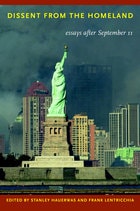
Dissent from the Homeland
Essays after September 11Stanley Hauerwas and Frank Lentricchia, eds.
Duke University Press, 2003
Whether illuminating the narratives that have been used to legitimate the war on terror, reflecting on the power of American consumer culture to transform the attack sites into patriotic tourist attractions, or insisting that to be a Christian is to be a pacifist, these essays refuse easy answers. They consider why the Middle East harbors a deep-seated hatred for the United States. They argue that the U.S. drive to win the cold war made the nation more like its enemies, leading the government to support ruthless anti-Communist tyrants such as Mobutu, Suharto, and Pinochet. They urge Americans away from the pitfall of national self-righteousness toward an active peaceableness—an alert, informed, practiced state of being—deeply contrary to both passivity and war. Above all, the essays assembled in Dissent from the Homeland are a powerful entreaty for thought, analysis, and understanding. Originally published as a special issue of the journal South Atlantic Quarterly, Dissent from the Homeland has been expanded to include new essays as well as a new introduction and postscript.
Contributors. Srinivas Aravamudan, Michael J. Baxter, Jean Baudrillard, Robert N. Bellah, Daniel Berrigan, Wendell Berry, Vincent J. Cornell, David James Duncan, Stanley Hauerwas, Fredric Jameson, Frank Lentricchia, Catherine Lutz, Jody McAuliffe, John Milbank, Peter Ochs, Donald E. Pease, Anne R. Slifkin, Rowan Williams, Susan Willis, Slavoj Zizek
Dissent in American Religion
Revised EditionEdwin Scott Gaustad
University of Chicago Press, 2006
This new edition, which reinaugurates the Chicago History of American Religion series under the new editorship of John Corrigan, features new commentary by Gaustad and Corrigan on the past thirty years of American religious history and the importance of understanding dissent in American religion today.
“This is an important and erudite work which shows the originality and scope which scholarship can bring to human experience.” —Los Angeles Times
“We shall understand the religious past and present better for reading Gaustad’s brief, well-written, helpful book.” —Commonweal
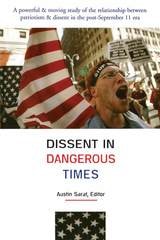
Dissent in Dangerous Times
Austin Sarat, Editor
University of Michigan Press, 2004
While dissent has played a central role in our national history and in the American cultural imagination, it is usually dangerous to those who practice it, and always unpalatable to its targets. War does not encourage the tolerance of opposition at home any more than it does on the front: if the War on Terror is to be a permanent war, then the consequences for American political freedoms cannot be overestimated.
"Dissent in Dangerous Times examines the nature of political repression in liberal societies, and the political and legal implications of living in an environment of fear. This profound, incisive, at times even moving volume calls upon readers to think about, and beyond, September 11, reminding us of both the fragility and enduring power of freedom."
--Nadine Strossen, President, American Civil Liberties Union, and Professor of Law, New York Law School.
Contributors to this volume
Lauren Berlant
Wendy Brown
David Cole
Hugh Gusterson
Nancy L. Rosenblum
Austin Sarat
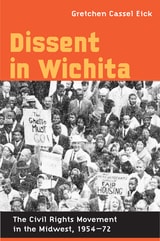
Dissent in Wichita
The Civil Rights Movement in the Midwest, 1954-72Gretchen Cassel Eick
University of Illinois Press, 2001
Winner of the Richard L. Wentworth Prize in American History, Byron Caldwell Smith Book Prize, and the William Rockhill Nelson Award
On a hot summer evening in 1958, a group of African American students in Wichita, Kansas, quietly entered Dockum's Drug Store and sat down at the whites-only lunch counter. This was the beginning of the first sustained, successful student sit-in of the modern civil rights movement, instigated in violation of the national NAACP's instructions.
Dissent in Wichita traces the contours of race relations and black activism in this unexpected locus of the civil rights movement. Based on interviews with more than eighty participants in and observers of Wichita's civil rights struggles, this powerful study hones in on the work of black and white local activists, setting their efforts in the context of anticommunism, FBI operations against black nationalists, and the civil rights policies of administrations from Eisenhower through Nixon.
Through her close study of events in Wichita, Eick reveals the civil rights movement as a national, not a southern, phenomenon. She focuses particularly on Chester I. Lewis, Jr., a key figure in the local as well as the national NAACP. Lewis initiated one of the earliest investigations of de facto school desegregation by the Department of Health, Education, and Welfare and successfully challenged employment discrimination in the nation's largest aircraft industries.
Dissent in Wichita offers a moving account of the efforts of Lewis, Vivian Parks, Anna Jane Michener, and other courageous individuals to fight segregation and discrimination in employment, public accommodations, housing, and schools. This volume also offers the first extended examination of the Young Turks, a radical movement to democratize and broaden the agenda of the NAACP for which Lewis provided critical leadership.
Through a close study of personalities and local politics in Wichita over two decades, Eick demonstrates how the tenor of black activism and white response changed as economic disparities increased and divisions within the black community intensified. Her analysis, enriched by the words and experiences of men and women who were there, offers new insights into the civil rights movement as a whole and into the complex interplay between local and national events.

Dissonant Divas in Chicana Music
The Limits of La OndaDeborah R. Vargas
University of Minnesota Press, 2012
Musical sound has been central to heteromasculinist productions of nation and homeland, whether Chicano, Tejano, Texan, Mexican, or American. If this assertion holds true, as Deborah R. Vargas suggests, then what are we to make of those singers and musicians whose representations of gender and sexuality are irreconcilable with canonical Chicano/Tejano music or what Vargas refers to as “la onda”? These are the “dissonant divas” Vargas discusses, performers who stimulate our listening for alternative borderlands imaginaries that are inaudible within the limits of “la onda.”
Dissonant Divas in Chicana Music focuses on the Texan monument of the Alamo and its association with Rosita Fernandez; Tejano corrido folklore and its musical antithesis in Chelo Silva; the female accordion-playing bodies of Ventura Alonza and Eva Ybarra as incompatible with the instrumental labor of conjunto music; geography as national border, explored through the multiple national music scales negotiated by Eva Garza; and racialized gender, viewed through Selena’s integration of black diasporic musical sound. Vargas offers a feminist analysis of these figures’ contributions by advancing a notion of musical dissonance—a dissonance that recognizes the complexity of gender, sexuality, and power within Chicana/o culture.
Incorporating ethnographic fieldwork, oral history, and archival research, Vargas’s study demonstrates how these singers work together to explode the limits of Texan, Chicano, Tejano, Mexican, and American identities.
Dissonant Voices
Race, Jazz, and Innovative Poetics in Midcentury AmericaJoseph Pizza
University of Iowa Press, 2023
Distancing English
A Chapter in the History of the InexpressiblePage Richards
The Ohio State University Press, 2009
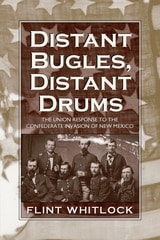
Distant Bugles, Distant Drums
The Union Response to the Confederate Invasion of New MexicoFlint Whitlock
University Press of Colorado, 2006
Drawing on previously overlooked diaries, letters, and contemporary newspaper accounts, military historian Flint Whitlock brings the Civil War in the West to life. Distant Bugles, Distant Drums details the battles of 1,000 Coloradans against 3,000 Confederate soldiers in New Mexico and offers vivid portraits of the leaders and soldiers involved - men whose strengths and flaws would shape the fate of the nation.
On their way to Colorado in search of gold and silver for the Confederacy's dwindling coffers, Texan Confederates won a series of engagements along the Rio Grande. Hastily assembled troops that had marched to meet them from Colorado finally turned them back in an epic conflict at Gloriéta Pass.
Miners, farmers, and peacetime officers turned themselves overnight into soldiers to keep the Confederacy from capturing the West's mines, shaping the outcome of the Civil War. Distant Bugles, Distant Drums tells their story. Southwest Book Award Winner from the Border Regional Library Association

Distant Corners
American Soccer's History of Missed Opportunities and Lost CausesDavid Wangerin
Temple University Press, 2014
In Distant Corners, his follow-up to Soccer in a Football World, David Wangerin details several of the people, places, and events that shaped American soccer history. Despite its struggle for popular acceptance, soccer in the United States has a rich history. Wangerin profiles Tom Cahill, the almost-forgotten "father of American soccer," and writes passionately about the 1979 North American Soccer League season, the high-water mark of the game in the twentieth century.
Wangerin shows how the American appetite for soccer has ebbed and grown over the years, chronicling the game at the college and professional levels and describing the city of St. Louis's unique historic attachment to the sport. Wangerin believes that the time is ripe for American fans to look into their own history and recognize the surprisingly deep connection their country has to soccer.

Distant Islands
The Japanese American Community in New York City, 1876-1930sDaniel H. Inouye
University Press of Colorado, 2018
The New York Japanese American community was a composite of several micro communities divided along status, class, geographic, and religious lines. Using a wealth of primary sources—oral histories, memoirs, newspapers, government documents, photographs, and more—Daniel H. Inouye tells the stories of the business and professional elites, mid-sized merchants, small business owners, working-class families, menial laborers, and students that made up these communities. The book presents new knowledge about the history of Japanese immigrants in the United States and makes a novel and persuasive argument about the primacy of class and status stratification and relatively weak ethnic cohesion and solidarity in New York City, compared to the pervading understanding of nikkei on the West Coast. While a few prior studies have identified social stratification in other nikkei communities, this book presents the first full exploration of the subject and additionally draws parallels to divisions in German American communities.
Distant Islands is a unique and nuanced historical account of an American ethnic community that reveals the common humanity of pioneering Japanese New Yorkers despite diverse socioeconomic backgrounds and life stories. It will be of interest to general readers, students, and scholars interested in Asian American studies, immigration and ethnic studies, sociology, and history.
Winner- Honorable Mention, 2018 Immigration and Ethnic History Society First Book Award

Distant Parents
Climo, Jacob
Rutgers University Press, 1992
The adult children he interviewed live at least 200 miles from their parents. In most ways they are similar to the millions of other professionals whose careers have led them to move away from their parents. We hear their voices, as they speak frankly about the advantages, pains, and challenges of separation.
Climo considers distant relationships to be different from other relationships and to be a growing social problem. Distant living complicates communications by shaping and restricting both phone calls and visits. His description of the typical phone call and typical seasonal visit, with their patterns and limitations, will sound familiar to many of us. In addition to affecting communications, distance affects memories of past parent-child relationships in ways that influence present relationships. Memories, which take on great weight, tend to determine current behavior. Most seriously, distance limits the kinds of assistance children can provide when their parents become ill, resulting in frustration, anger, guilt, and a sense of powerlessness.
Climo urges us to be more aware of distant living as a growing social problem. The percentage of children who move away from their parents will continue to increase. Once adult children acknowledge the challenges distance creates, they can learn to develop better communications and to deal with their feelings of ambivalence.
Distant Reading
Performance, Readership, and Consumption in Contemporary PoetryPeter Middleton
University of Alabama Press, 2005
A dynamic account of the history, practice, and theory of poetry as performance.
Distant Reading considers poetry as performance, offers new insights into its popularity, and proposes a new history of its origins. It also explores related issues concerning the reception of poetry, the impact of the computer on how we read poetry, the persistence of the letter "I" in poems by avant-garde poets, the strangeness of the line-break as a demand on the reader's attention, and the idea of the reader as consumer. These themes are connected by a historically contextualized and theoretically sophisticated discussion of contemporary American and British poets continuing to work in the modernist tradition.
The introductory essay establishes a new methodology that transforms close reading into what Middleton calls "distant reading," interpretive reading that acknowledges the distances that texts travel from their point of composition to readers in other geographical and historical locations. It indicates that poetic innovation is often driven by a desire on the part of the poet to make this distance do cultural work in the meanings that the poem generates.
Ultimately, Distant Reading treats poetry as a cultural practice that is always situated within specific sites of performance—recited on stage, displayed in magazines, laid out on a page, scrolled on the computer screen—rather than as a transcendent cloud of meaning tethered only to its words.
Distinction and Denial
Race, Nation, and the Critical Construction of the African American Artist, 1920-40Mary Ann Calo
University of Michigan Press, 2007
Distinctionand Denial challenges conventional theories of race and art by examining the role early twentieth-century art critics played in marginalizing African American artists. Mary Ann Calo dispels the myth of a unified African American artistic tradition through an engaging study of the germinal writing of Alain Locke and other significant critics of the era, who argued that African American artists were both a diverse group and a constituent element of America’s cultural center. By documenting the effects of the “Negro aesthetic” on African American artists working in the interwar years, Distinctionand Denial shows that black artistic production existed between the claims of a distinctly African American tradition and full inclusion into American modernist culture—never fully inside or outside the mainstream.
“A major contribution to the scholarship of African American artists in the inter-war period. With scrupulous research and probing analyses, Calo’s study enables scholars, students, and those interested in the Harlem Renaissance to grasp the intellectual debates, institutional support, and art world promotion that advanced an emerging cohort of African American artists.”
—Patricia Hills, Boston University
“A careful, thorough, historically grounded study that builds a new and significant argument challenging conventional histories of African American art. Sure to become indispensable to any scholarly discussion of American art or African American cultural studies.”
—Helen Langa, American University
Mary Ann Calo is Professor of Art History and Director of the Institute for the Creative and Performing Arts at Colgate University. She is author of Bernard Berenson and the Twentieth Century and editor of Critical Issues in American Art: A Book of Readings.
Distinguishing Disability
Parents, Privilege, and Special EducationColin Ong-Dean
University of Chicago Press, 2009
Students in special education programs can have widely divergent experiences. For some, special education amounts to a dumping ground where schools unload their problem students, while for others, it provides access to services and accommodations that drastically improve chances of succeeding in school and beyond. Distinguishing Disability argues that this inequity in treatment is directly linked to the disparity in resources possessed by the students’ parents.
Since the mid-1970s, federal law has empowered parents of public school children to intervene in virtually every aspect of the decision making involved in special education. However, Colin Ong-Dean reveals that this power is generally available only to those parents with the money, educational background, and confidence needed to make effective claims about their children’s disabilities and related needs. Ong-Dean documents this class divide by examining a wealth of evidence, including historic rates of learning disability diagnosis, court decisions, and advice literature for parents of disabled children. In an era of expanding special education enrollment, Distinguishing Disability is a timely analysis of the way this expansion has created new kinds of inequality.
Distinguishing the Righteous from the Roguish
The Arkansas Supreme Court, 1836–1874J.W. Looney
University of Arkansas Press, 2016
During the period from 1836 to 1874, the legal system in the new state of Arkansas developed amid huge social change. While the legislature could, and did, determine what issues were considered of importance to the populace, the Arkansas Supreme Court determined the efficacy of legislation in cases involving land titles, banks, transportation, slavery, family law, property, debt, contract, criminal law, and procedure.
Distinguishing the Righteous from the Roguish examines the court’s decisions in this era and shows how Arkansas, as a rural slave-holding state, did not follow the transformational patterns typical of some other states during the nineteenth century. Rather than using the law to promote broad economic growth and encourage social change, the Arkansas court attempted to accommodate the interests of the elite class by preserving the institution of slavery. The ideology of paternalism is reflected in the decisions of the court, and Looney shows how social and political stability—an emphasis on preserving the status quo of the so-called “righteous”—came at the expense of broader economic development.
Distorted Mirrors
Americans and Their Relations with Russia and China in the Twentieth CenturyDonald E. Davis & Eugene P. Trani
University of Missouri Press, 2009
Distorting the Law
Politics, Media, and the Litigation CrisisWilliam Haltom and Michael McCann
University of Chicago Press, 2004
Scholars have argued for years that this common view of the depraved ruin of our civil legal system is a myth, but their research and statistics rarely make the news. William Haltom and Michael McCann here persuasively show how popularized distorted understandings of tort litigation (or tort tales) have been perpetuated by the mass media and reform proponents. Distorting the Law lays bare how media coverage has sensationalized lawsuits and sympathetically portrayed corporate interests, supporting big business and reinforcing negative stereotypes of law practices.
Based on extensive interviews, nearly two decades of newspaper coverage, and in-depth studies of the McDonald's coffee case and tobacco litigation, Distorting the Law offers a compelling analysis of the presumed litigation crisis, the campaign for tort law reform, and the crucial role the media play in this process.

Distracted by Alabama
Tangled Threads of Natural History, Local History, and FolkloreJames Seay Brown Jr.
University of Alabama Press, 2022
Where rivers, railroads, and redhorse fish tell the story of Alabama’s soul.
A gateway to Alabama for the omnivorous mind, Distracted by Alabama is a collection of twelve captivating essays about Alabama and the South by Samford University writer and scholar Jim Brown, a former president of the Alabama Folklife Association.
During his decades living and teaching in Alabama, Brown followed his curiosity down myriad pathways about Alabama and the region, including the state’s majestic landscape, plants and animals found nowhere else, history, and rich folkways. In the tapestry of Alabama culture, Brown traces the threads of Native American, African slave, and European settler influences, woven over the centuries into novel patterns that surprise and fascinate.
Writing in the voice of a learned companion, Brown reveals insights and stories about unforgettable facets of Alabama culture, such as Sacred Harp singers and African American railroad callers, the use of handmade snares and stationary fishtraps to catch river redhorse and freshwater drum, white oak basketmaking and herbal medicine traditions, the evolution of the single-pen log cabin into the impressive two-story I-house, and a wealth of other engrossing stories.
An instant classic, Distracted by Alabama is a keepsake that readers who love, visit, or are curious about Alabama and Southern culture will return to again and again.
Disturbing the Universe
Power and Repression in Adolescent LiteratureRoberta S. Trites
University of Iowa Press, 2004
The Young Adult novel is ordinarily characterized as a coming-of-age story, in which the narrative revolves around the individual growth and maturation of a character, but Roberta Trites expands this notion by chronicling the dynamics of power and repression that weave their way through YA books. Characters in these novels must learn to negotiate the levels of power that exist in the myriad social institutions within which they function, including family, church, government, and school.
Trites argues that the development of the genre over the past thirty years is an outgrowth of postmodernism, since YA novels are, by definition, texts that interrogate the social construction of individuals. Drawing on such nineteenth-century precursors as Little Women and Adventures of Huckleberry Finn, Disturbing the Universe demonstrates how important it is to employ poststructuralist methodologies in analyzing adolescent literature, both in critical studies and in the classroom. Among the twentieth-century authors discussed are Blume, Hamilton, Hinton, Le Guin, L'Engle, and Zindel.
Trites' work has applications for a broad range of readers, including scholars of children's literature and theorists of post-modernity as well as librarians and secondary-school teachers.
Disturbing the Universe: Power and Repression in Adolescent Literature by Roberta Seelinger Trites is the winner of the 2002 Children's Literature Association's Book Award. The award is given annually in order to promote and recognize outstanding contributions to children's literature, history, scholarship, and criticisim; it is one of the highest academic honors that can accrue to an author of children's literary criticism.
Disunion Among Ourselves
The Perilous Politics of the American RevolutionEli Merritt
University of Missouri Press, 2025
Winner of the 2024 Society of the Cincinnati Prize from the American Revolution Institute
Winner of the 2023 American Revolution Round Table of Philadelphia book award
In this eye-opening account, Eli Merritt reveals the deep political divisions that almost tore the Union apart during the American Revolution. So fractious were the founders’ political fights that they feared the War of Independence might end in disunion and civil war.
Instead of disbanding into separate regional confederacies, the founders managed to unite for the sake of liberty and self-preservation. In so doing, they succeeded in holding the young nation together. To achieve this, they forged grueling compromises, including Declaration of Independence in 1776, the Mississippi-Fisheries Compromise of 1779, and the ratification of the Articles of Confederation in 1781.
In addition to bringing new insights to the history of the American Revolution, Disunion Among Ourselves has inevitable resonances with our present era of political hyperpolarization and serves as a touchstone for contemporary politics, reminding us that the founders overcame far tougher times than our own through commitment to ethical constitutional democracy and compromise.

Divas on Screen
Black Women in American FilmMia Mask
University of Illinois Press, 2008
This insightful study places African American women's stardom in historical and industrial contexts by examining the star personae of five African American women: Dorothy Dandridge, Pam Grier, Whoopi Goldberg, Oprah Winfrey, and Halle Berry. Interpreting each woman's celebrity as predicated on a brand of charismatic authority, Mia Mask shows how these female stars have ultimately complicated the conventional discursive practices through which blackness and womanhood have been represented in commercial cinema, independent film, and network television.
Mask examines the function of these stars in seminal yet underanalyzed films. She considers Dandridge's status as a sexual commodity in films such as Tamango, revealing the contradictory discourses regarding race and sexuality in segregation-era American culture. Grier's feminist-camp performances in sexploitation pictures Women in Cages and The Big Doll House and her subsequent blaxploitation vehicles Coffy and Foxy Brown highlight a similar tension between representing African American women as both objectified stereotypes and powerful, self-defining icons. Mask reads Goldberg's transforming habits in Sister Act and The Associate as representative of her unruly comedic routines, while Winfrey's daily television performance as self-made, self-help guru echoes Horatio Alger narratives of success. Finally, Mask analyzes Berry's meteoric success by acknowledging the ways in which Dandridge's career made Berry's possible.
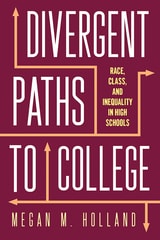
Divergent Paths to College
Race, Class, and Inequality in High SchoolsHolland, Megan M
Rutgers University Press, 2019
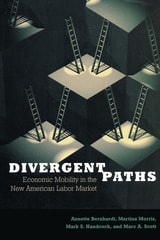
Divergent Paths
Economic Mobility in the New American Labor MarketAnnette Bernhardt
Russell Sage Foundation, 2001
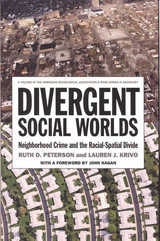
Divergent Social Worlds
Neighborhood Crime and the Racial-Spatial DivideRuth D. Peterson
Russell Sage Foundation, 2010
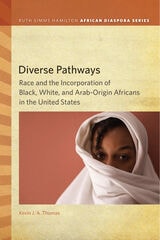
Diverse Pathways
Race and the Incorporation of Black, White, and Arab-Origin Africans in the United StatesKevin J. A. Thomas
Michigan State University Press, 2014
Diverse by Design
Literacy Education within Multicultural InstitutionsChristopher Schroeder
Utah State University Press, 2011
Diversity, despite what we say, disturbs us. In the U.S., we debate linguistic rights, the need for an official language, and educational policies for language minority students. On the one hand, we believe in the rights of individuals, including (at least in the academy) the right to one’s own language. On the other hand, we sponsor a single common language, monolingual and standard, for full participation and communication in both the academy and in U.S. society.
In Diverse by Design, Christopher Schroeder reports on an institutional case study conducted at an officially designated Hispanic-Serving Institution. He gives particular attention to a cohort of Latino students in a special admissions program, to document their experience of a program designed to help students surmount the “obstacle” that ethnolinguistic diversity is perceived to be.
Ultimately, Schroeder argues for reframing multilingualism and multiculturalism, not as obstacles, but as intellectual resources to exploit. While diversity might disturb us, we can overcome its challenges by a more expansive sense of social identity. In an increasingly globalized society, literacy ideologies are ever more critical to educational equity, and to human lives.
Diversity Regimes
Why Talk Is Not Enough to Fix Racial Inequality at UniversitiesJames M. Thomas
Rutgers University Press, 2020
As a major, public flagship university in the American South, so-called “Diversity University” has struggled to define its commitments to diversity and inclusion, and to put those commitments into practice. In Diversity Regimes, sociologist James M. Thomas draws on more than two years of ethnographic fieldwork at DU to illustrate the conflicts and contingencies between a core set of actors at DU over what diversity is and how it should be accomplished. Thomas’s analysis of this dynamic process uncovers what he calls “diversity regimes”: a complex combination of meanings, practices, and actions that work to institutionalize commitments to diversity, but in doing so obscure, entrench, and even magnify existing racial inequalities. Thomas’s concept of diversity regimes, and his focus on how they are organized and unfold in real time, provides new insights into the social organization of multicultural principles and practices.
Diversity and Disparities
America Enters a New CenturyJohn Logan is professor of sociology and director of the Research Initiative on Spatial Structures in the Social Sciences at Brown University and editor of Diversity and Disparities: America Enters a New Century.
Russell Sage Foundation, 2014

Diversity in Youth Literature
Opening Doors through ReadingJamie Campbell Naidoo
American Library Association, 2013
Diversity's Child
People of Color and the Politics of IdentityEfrén O. Pérez
University of Chicago Press, 2021
For decades now, pundits and political scientists have been pointing to a major demographic change that’s underway in the United States. Demographers project that whites will become a minority of the US population and that minority groups will jointly comprise a majority before 2050.
Diversity’s Child appraises the political ramifications of this change. Efrén O. Pérez deftly argues that America’s changing demographics are forging a new identity for many as people of color—that unifies the political outlook of assorted minority groups. Drawing on opinion surveys of multiple minority groups, social science experiments with minority adults, content analyses of newspapers and congressional archives, and in-depth interviews with minority individuals, Pérez makes two key points. First, a person of color's identity does exist, and we can reliably measure it, as well as distinguish it from other identities that minorities hold. Second, across a wide swath of circumstances, identifying as a person of color profoundly shapes how minorities view themselves and their political system. Diversity’s Child is a vital and engaging look at America’s identity politics as well as at how people of color think about racial disparities and how politics can best solve them.
Diversity, Equity, and Inclusion in Action
Planning, Leadership, and ProgrammingChristine Bombaro
American Library Association, 2020
All too often, in a hurried attempt to “catch up,” diversity training can create division among staff or place undue burdens on a handful of employees. Instead, academic libraries need approaches to diversity, equity, and inclusion (DEI) that position these priorities as ongoing institutional and professional goals. This book’s model programs will help academic libraries do exactly that, sharing a variety of initiatives that possess clear goals, demonstrable outcomes, and reproducible strategies. Librarians, administrators, and directors will all benefit from the programs detailed inside, which include such topics as
- a university library’s community of practice for interactions and learning around DEI;
- cultural competency training to create more welcoming instruction spaces;
- student workshops on literature searches that mitigate bias;
- overcoming the historic tendency to marginalize LGBTQ+ representation in archives;
- a curriculum and design workshop that moved from discussing social values to embedding them in actions;
- the founding of a library-led LGBT club for students at a rural community college;
- a liberal arts college’s retention-boosting program for first-generation students;
- tailoring a collection and library services to the unique needs of student veterans; and
- a framework for moving from diversity to equity and inclusion, toward a goal of social justice.
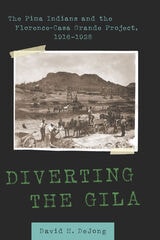
Diverting the Gila
The Pima Indians and the Florence-Casa Grande Project, 1916–1928David H. DeJong
University of Arizona Press, 2021
Diverting the Gila explores the complex web of tension, distrust, and political maneuvering to divide and divert the scarce waters of the Gila River. Residents of Florence, Casa Grande, and the Pima Reservation fought for vital access to water rights. Into this political foray stepped Arizona’s freshman congressman Carl Hayden, who not only united the farming communities but also used Pima water deprivation to the advantage of Florence-Casa Grande and Upper Gila Valley growers. The result was the federal Florence-Casa Grande Project that, as legislated, was intended to benefit Pima growers on the Gila River Indian Reservation first and foremost. As was often the case in the West, well-heeled, nontribal political interests manipulated the laws at the expense of the Indigenous community.
Diverting the Gila is the sequel to David H. DeJong’s 2009 Stealing the Gila, and it continues to tell the story of the forerunner to the San Carlos Irrigation Project and the Gila River Indian Community’s struggle to regain access to their water.
Divide & Conquer
Race, Gangs, Identity, and ConflictRobert D. Weide
Temple University Press, 2022
Hyper-criminalization and the normalization of violence was an integral aspect of Robert Weide’s formative years growing up in Los Angeles in the 1980s and 1990s, where Sureño, Crip, and Blood gangs maintained a precarious coexistence, often punctuated by racialized gang violence. His insider status informs Divide & Conquer, which considers how the capitalist economy, the race concept, and nationalist ideology have made gang members the instruments of their own oppression, resulting in racialized sectarian conflicts spanning generations between African American and Latino gangs in Los Angeles and California’s prisons.
While gang members may fail to appreciate the deeper historical and conceptual foundations of these conflicts, they rarely credit naked bigotry as the root cause. As Weide asserts, they divide themselves according to inherited groupist identities, thereby turning them against one another in protracted blood feuds across gang lines and racial lines.
Weide explores both the historical foundations and the conceptual and cultural boundaries and biases that divide gang members across racial lines, detailing case studies of specific racialized gang conflicts between Sureño, Crip, and Blood gangs. Weide employs mixed-methods research, having spent nearly a decade on ethnographic fieldwork and conducted over one hundred formal interviews with gang members and gang enforcement officers concerning taboo subjects like prison and gang politics, and transracial gang membership.
Divide & Conquer concludes with encouraging developments in recent years, as gang members themselves, on their own volition, have intervened to build solidarity and bring racialized gang conflicts between them to an end.
Divided Bodies
Lyme Disease, Contested Illness, and Evidence-Based MedicineAbigail A. Dumes
Duke University Press, 2020
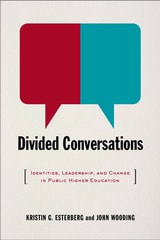
Divided Conversations
Identities, Leadership, and Change in Public Higher EducationKristin G. Esterberg
Vanderbilt University Press, 2013
Many faculty believe that one of their own who becomes an administrator has gone over to "the dark side." One provost recalled going for a beer with a faculty colleague and hearing the colleague complain about the latest memo "from the administration." He had to remind his friend of many years that he was the author of the offending document. Now he was "the administration." He realized that former colleagues now appeared in his office wearing suits and ties and referring to him by his title rather than his first name.
The disciplines serve as the tribes into which individual scholars are organized; the discipline is where a faculty member finds his community and identity. Administrators, on the other hand, identify with each other in trying to get the tribes to work together. Though most administrators came from the faculty ranks, their career paths take a different shape, especially in terms of mobility to another institution. It's not surprising that the two groups talk past each other.
A chapter is devoted to chairs of departments, who occupy an interesting middle ground. To their faculty, they can come across as a nurturing parent or a petty bureaucrat. The authors recommend training for chairs and administrative internships offered by the American Council on Education and other organizations.
The men and women on the campuses of the public universities described in the book make clear the challenges that universities face in terms of budgets, legislative politics, collective bargaining, rankings, and control of academic programs. If public institutions are truly to serve a public purpose, faculty and administrators must find ways to engage each other in shared conversation and management and find ways of engaging the university with the community.
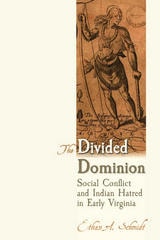
Divided Dominion
Social Conflict and Indian Hatred in Early VirginiaEthan A. Schmidt
University Press of Colorado, 2014
Myriad internal and external factors drove Virginians to interpret their disputes with one another increasingly along class lines. The decades-long tripartite struggle among elite whites, non-elite whites, and Native Americans resulted in the development of mutually beneficial economic and political relationships between elites and Native Americans. When these relationships culminated in the granting of rights—equal to those of non-elite white colonists—to Native Americans, the elites crossed a line and non-elite anger boiled over. A call for the annihilation of all Indians in Virginia united different non-elite white factions and molded them in widespread social rebellion.
The Divided Dominion places Indian policy at the heart of Bacon's Rebellion, revealing the complex mix of social, cultural, and racial forces that collided in Virginia in 1676. This new analysis will interest students and scholars of colonial and Native American history.
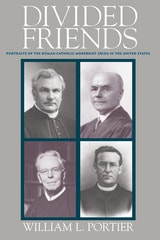
Divided Friends
William L. Portier
Catholic University of America Press, 2013
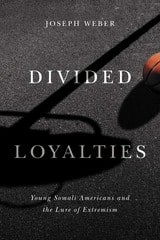
Divided Loyalties
Young Somali Americans and the Lure of ExtremismJoseph Weber
Michigan State University Press, 2020
Divided Parties, Strong Leaders
Ruth Bloch Rubin
University of Chicago Press, 2025
Drawing on nearly a century of legislative history, this careful account invites readers to think anew about when, why, and how leaders of divided parties wield power in Congress.
For decades, legislative scholars have viewed party divisions as critical constraints on congressional leadership. The more a party’s rank and file disagree with one another, the weaker their leaders are predicted to be; as member preferences converge, leader power is thought to increase.
In a powerful corrective to this prevailing view, Ruth Bloch Rubin argues that party divisions are not inherently limiting. Divided Parties, Strong Leaders highlights and examines variation in how members of party factions choose to work together. She shows that leaders of divided parties are well positioned to overcome, and even draw strength from, their divided ranks when the collaborative efforts of their coalitions’ competing factions are evenly matched. By contrast, their capacity to get what they want is more limited when one faction has out-collaborated its competition. Presenting detailed case studies of some of the most storied leaders of the postwar Congress, including Speakers Sam Rayburn and Nancy Pelosi, Bloch Rubin analyzes the factional configuration each leader encountered and explains why it mattered for their exercise of power.
Divided Power
The Presidency, Congress, and the Formation of American Foreign PolicyDonald R. Kelley
University of Arkansas Press, 2005
Divided Waters
Bridging the U.S.-Mexico BorderHelen Ingram, Nancy K. Laney, and David M. Gillilan
University of Arizona Press, 1995
Divided We Stand
Watertown, Massachusetts, 1630-1680Roger Thompson
University of Massachusetts Press, 2001
Thompson describes Watertown's early government, its relations with Native Americans and neighboring communities, its religious and economic affairs, and the day-to-day experiences of its people. Conflict occurred over a wide variety of issues: land allocation, administrative accountability, religious orthodoxy and exclusivity, generational and gender differences, livestock and fencing, haves and have-nots.
Thompson brings these disputes to life through a series of vivid case studies drawn from the unpublished Middlesex County Court Records. Among others, we meet John Sawin, who despite his best efforts at subterfuge was convicted of stealing and selling a neighbor's horse; Susanna Woodward, whose pregnancy resulted in a fiercely contested paternity case; and Edward Sanders, whose punishment for child abuse was both a whipping and a ruling that when in public he must "wear a rope round his neck openly to be seen hanging down two feet."
Throughout the book, the same themes reappear: continuity and change, the persistent conflicts of the first two generations, and the countervailing forces of communal cohesion.
Divided by Color
Racial Politics and Democratic IdealsDonald R. Kinder and Lynn M. Sanders
University of Chicago Press, 1996
Divided by Color supplies the reasons for this division, asserting that racial resentment continues to exist. Despite a parade of recent books optimistically touting the demise of racial hostility in the United States, the authors marshal a wealth of the most current and comprehensive evidence available to prove their case. Kinder and Sanders reveal that racial resentment remains the most powerful determinant of white opinion on such racially charged issues as welfare, affirmative action, school desegregation, and the plight of the inner city.
But more than a comprehensive description of American views on race, Divided by Color seeks to explain just why black and white Americans believe what they do. Kinder and Sanders analyze the critical factors that shape people's opinion on race-related issues, uncovering the relative importance of self-interest, group identity, ideological principles, as well as racial animosity. Finally, the authors explore how the racial divide has insinuated itself into the presidential election process and examine the role of political elites in framing racial issues for ordinary citizens.
The most accurate and thorough analysis of American attitudes toward race and racial policies undertaken in decades, Divided by Color is destined to become a landmark work on race in America.
Dividing the Land
Early American Beginnings of Our Private Property MosaicEdward T. Price
University of Chicago Press, 1995
In this unprecedented study, Edward T. Price covers most areas of the United States in which the initial division of land was controlled by colonial governments—the original thirteen colonies, and Maine, Vermont, Kentucky, West Virginia, Tennessee, Louisiana, and Texas. By examining different land policies and the irregular pattern of property that resulted from them, Price chronicles the many ways colonies managed land to promote settlement, develop agriculture, defend frontiers, and attract investment. His analysis reveals as much about land planning techiniques carried to America from Europe as innovations spurred by the unique circumstances of the new world.
Price’s analysis draws on his thorough survey of property records from the first land plans in Virginia in 1607 to empresario grants in Texas in the 1820s. This breadth of data allows him to identify regional differences in allocating land, assess the impact of land planning by historical figures like William Penn of Pennsylvania and Lord Baltimore of Maryland, and trace changes in patterns of land division and ownership through transfers of power among Britain, the Netherlands, France, Spain, Mexico, and the Republic of Texas.
Dividing the Union
Jesse Burgess Thomas and the Making of the Missouri CompromiseMatthew W. Hall
Southern Illinois University Press, 2015
In 1820 the Missouri controversy erupted over the issue of slavery in the newly acquired lands of the Louisiana Purchase. It fell to Jesse Burgess Thomas (1777–1853), a junior U.S. senator from the new state of Illinois, to handle the delicate negotiations that led to the Missouri Compromise. Thomas’s maturity, good judgment, and restraint helped pull the country back from the brink of disunion and created a compromise that held for thirty-four years. In Dividing the Union, Matthew W. Hall examines the legal issues underlying the controversy and the legislative history of the Missouri Compromise while focusing on the aspects of Thomas’s life and character that gave him such influence. The first in-depth biography of Thomas, Hall’s work demonstrates how the legislative battle over the Compromise reflected the underlying nuances of the larger struggle over slavery.
The text of the Missouri Compromise originated from the Northwest Ordinance. Article VI of the Ordinance purported to prohibit slavery in the Northwest Territory, but paradoxically, a provision that assured property rights in another article was used to protect slavery. People in some parts of the Northwest sought to circumvent Article VI by formulating indenture laws and various state constitutional provisions addressing slavery. Pro- and antislavery activists eventually developed quite different interpretations of the relevant language in these documents, making negotiations over slavery in the new territory extremely complicated.
As Hall demonstrates, Thomas was perfectly situated geographically, politically, and ideologically to navigate the Missouri controversy. He was the first speaker of the Indiana Territorial General Assembly, one of the first territorial judges in the Illinois Territory, and the president of the Illinois State Constitutional Convention in 1818. Because the drive for statehood in Illinois was strong, the convention managed to skirt the divisive issue of slavery, due in large part to Thomas’s efforts. That he was never required to clearly articulate his own views on slavery allowed Thomas to maintain a degree of neutrality, and his varied political career gave him the experience necessary to craft a compromise.
Thomas’s final version of the Compromise included shrewdly worded ambiguities that supported opposing interests in the matter of slavery. These ambiguities secured the passage of the Compromise and its endurance until the Kansas-Nebraska Act of 1854. By weaving Thomas’s life story into the history of the Missouri Compromise, Hall offers new insight into both a pivotal piece of legislation and an important, previously overlooked figure in nineteenth-century American politics.
Divine Days
A NovelLeon Forrest; Foreword by Kenneth W. Warren, Preface by Zachary Price
Northwestern University Press, 2023
“I have an awful memory for faces, but an excellent one for voices,” muses Joubert Jones, the aspiring playwright at the center of Divine Days. A kaleidoscopic whorl of characters, language, music, and Black experience, this saga follows Jones for one week in 1966 as he pursues the lore and legends of fictional Forest County, a place resembling Chicago’s South Side. Joubert is a veteran, recently returned to the city, who works for his aunt Eloise’s newspaper and pours drinks at her Night Light Lounge. He wants to write a play about Sugar-Groove, a drifter, “eternal wunderkind,” and local folk hero who seems to have passed away. Sugar-Groove’s disappearance recalls the subject of one of Joubert’s earlier writing attempts—W. A. D. Ford, a protean, diabolical preacher who led a religious sect known as “Divine Days.” Joubert takes notes as he learns about both tricksters, trying to understand their significance.
Divine Days introduces readers to a score of indelible characters: Imani, Joubert’s girlfriend, an artist and social worker searching for her lost siblings and struggling to reconcile middle class life with her values and Black identity; Eloise, who raised Joubert and whose influence is at odds with his writerly ambitions; (Oscar) Williemain, a local barber, storyteller, and founder of the Royal Rites and Righteous Ramblings Club; and the Night Light’s many patrons. With a structure inspired by James Joyce and jazz, Leon Forrest folds references to African American literature and cinema, Shakespeare, the Bible, and classical mythology into a heady quest that embraces life in all its tumult and adventure.
This edition brings Forrest’s masterpiece back into print, incorporating hundreds of editorial changes that the author had requested from W. W. Norton, but were not made for their editions in 1993 and 1994. Much of the inventory from the original printing of the book by Another Chicago Press in 1992 had been destroyed in a disastrous warehouse fire.
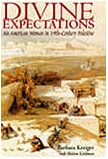
Divine Expectations
An American Woman In Nineteenth-Century PalestineBarbara Kreiger
Ohio University Press, 1999
Barbara Kreiger’s intriguing narrative presents the account of Clorinda Minor, a charismatic American Christian woman whose belief in the Second Coming prompted her to leave a comfortable life in Philadelphia in 1851 and take up agriculture in Palestine.
After her disappointment in a failed prophecy that the End of Days would take place in October 1844, Mrs. Minor determined that the Holy Land was not yet adequately prepared for such an event and decided that it would be her mission to teach the poverty-stricken Jews of Palestine to work the soil. In this very American story, Mrs. Minor, like so many other pioneers of her day, looked to the land as her future.
Even as her mission was distinctly religious, her daily efforts were in the social realm. And although her work brought Jews and Arabs together, and her small farm was a unique settlement where Christians, Muslims, and Jews labored alongside one another, the events detailed in Divine Expectations had dramatic and tragic diplomatic and international repercussions.
With the deft touch of a novelist, Barbara Kreiger weaves the little-known story of Clorinda Minor into the larger context of the region and its history, presenting it in its charming eccentricity and its gripping reality.
Divine Meets Digital
Tech Workers and Religion in the U.S. and ChinaDi Di
Rutgers University Press, 2026
What role does religion play in the tech industry? Based on nearly one hundred interviews, Divine Meets Digital uncovers the ways tech workers engage with religion and make sense of their work through religious and spiritual worldviews. While most identify as nonreligious, they are far from antireligious. Instead, they navigate competing religious and nonreligious views, often distinguishing between what they see as the controversial elements of religion—such as belief in the supernatural in China and its politicized and dogmatic aspects in the United States—and its more noncontroversial aspects. In doing so, they justify their religious engagement by embracing religion's noncontroversial elements while distancing themselves from its controversial features. This book offers a powerful new lens for understanding one of the most influential industries of our time, inviting readers to better understand the people who live and work at the intersection between science, religion, and technology.
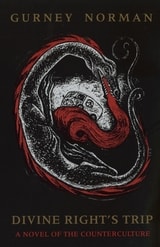
Divine Right's Trip
A Novel of the CountercultureGurney Norman
Ohio University Press, 1990
This first Gnomon Press edition was published in 1990.
Divine Right’s Trip is a countercultural classic that captures the spirit of the 1960s and early 1970s. The novel follows Divine Right (D. R.) Davenport, a restless young man on a journey of self-discovery, as he embarks on a cross-country road trip in his beloved but unreliable old Volkswagen bus, Urge. Accompanied at times by his free-spirited girlfriend, Estelle, D. R. embarks on an odyssey that takes him through communes, small towns, and encounters with eccentric characters, each offering insights into D. R.’s own struggles with identity, freedom, and belonging.
Originally published as a serial in the Last Whole Earth Catalog in 1971, Divine Right’s Trip is both a road novel and a coming-of-age story, reflecting the era’s tensions between individualism and community, rebellion and responsibility. Gurney Norman’s writing is infused with humor, sharp social observation, and a deep appreciation for the landscapes and people of Appalachia, where D. R. ultimately finds himself confronting his roots.
A defining work of Appalachian literature and the countercultural movement, Divine Right’sTrip remains a thought-provoking exploration of personal growth, societal change, and the search for meaning in an ever-shifting world.