Results by title
18284 books match the query 'United States' and 684 start with d
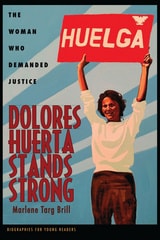
Dolores Huerta Stands Strong
The Woman Who Demanded JusticeMarlene Targ Brill
Ohio University Press, 2018
Selected as a Bank Street College of Education Best Children’s Book of the Year for 2018 (Category: Twelve–Fourteen)
“A biography for the times … An excellent read for anyone hoping to believe one person can make a difference.” —Kirkus (starred review)
“This well-told, age-appropriate account of a vital and essential activist deserves a place in all middle grade collections.” —School Library Journal (starred review)
Today, we know Dolores Huerta as the cofounder, with Cesar Chavez, of the National Farmworkers Association, which later became the United Farm Workers of America. We know her as a tireless advocate for the rights of farmworkers, Mexican American immigrants, women, and LGBTQ populations. And we know her as the recipient of the Presidential Medal of Freedom from Barack Obama in 2012.
Before all that, though, Huerta was a child in the farming community of Stockton, California, and then a teenager whose teachers underestimated her because she was Chicana. When she became a teacher herself, she witnessed her students coming to school shoeless and hungry. Many took days off from school to work in the farm fields to help feed their families. What could she do to help them? A young mother at the time, Huerta quit her teaching job to organize their parents. That began her journey to educate a nation about who produces our food and the conditions under which they work.
Dolores Huerta Stands Strong follows Huerta’s life from the mining communities of the Southwest where her father toiled, to the vineyards and fields of California, and across the country to the present day. As she worked for fair treatment for others, Dolores earned the nation’s highest honors. More important, she found her voice.
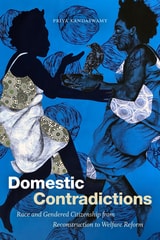
Domestic Contradictions
Race and Gendered Citizenship from Reconstruction to Welfare ReformPriya Kandaswamy
Duke University Press, 2021
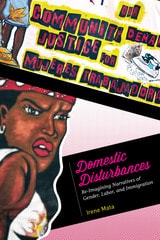
Domestic Disturbances
Re-Imagining Narratives of Gender, Labor, and ImmigrationBy Irene Mata
University of Texas Press, 2014
The issue of immigration is one of the most hotly debated topics in the national arena, with everyone from right-wing pundits like Sarah Palin to alternative rockers like Zack de la Rocha offering their opinion. The traditional immigrant narrative that gained popularity in the nineteenth and twentieth centuries continues to be used today in describing the process of the “Americanization” of immigrants. Yet rather than acting as an accurate representation of immigrant experiences, this common narrative of the “American Dream” attempts to ideologically contain those experiences within a story line that promotes the idea of achieving success through hard work and perseverance.
In Domestic Disturbances, Irene Mata dispels the myth of the “shining city on the hill” and reveals the central truth of hidden exploitation that underlies the great majority of Chicana/Latina immigrant stories. Influenced by the works of Latina cultural producers and the growing interdisciplinary field of scholarship on gender, immigration, and labor, Domestic Disturbances suggests a new framework for looking at these immigrant and migrant stories, not as a continuation of a literary tradition, but instead as a specific Latina genealogy of immigrant narratives that more closely engage with the contemporary conditions of immigration. Through examination of multiple genres including film, theatre, and art, as well as current civil rights movements such as the mobilization around the DREAM Act, Mata illustrates the prevalence of the immigrant narrative in popular culture and the oppositional possibilities of alternative stories.

Domestic Frontiers
Gender, Reform, and American Interventions in the Ottoman Balkans and the Near EastBarbara Reeves-Ellington
University of Massachusetts Press, 2013
During the nineteenth and early twentieth centuries, American Protestant missionaries attempted to export their religious beliefs and cultural ideals to the Ottoman Empire. Seeking to attract Orthodox Christians and even Muslims to their faith, they promoted the paradigm of the “Christian home” as the foundation of national progress. Yet the missionaries' efforts not only failed to win many converts but also produced some unexpected results.
Drawing on a broad range of sources—Ottoman, Bulgarian, Russian, French, and English—Barbara Reeves-Ellington tracks the transnational history of this little-known episode of American cultural expansion. She shows how issues of gender and race influenced the missionaries' efforts as well as the complex responses of Ottoman subjects to American intrusions into their everyday lives. Women missionaries—married and single—employed the language of Christian domesticity and female moral authority to challenge the male-dominated hierarchy of missionary society and to forge bonds of feminist internationalism. At the same time, Orthodox Christians adapted the missionaries' ideology to their own purposes in developing a new strain of nationalism that undermined Ottoman efforts to stem growing sectarianism within their empire. By the beginning of the twentieth century, as some missionaries began to promote international understanding rather than Protestantism, they also paved the way for future expansion of American political and commercial interests.
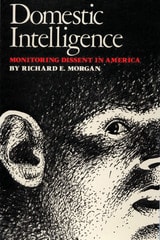
Domestic Intelligence
Monitoring Dissent in AmericaBy Richard E. Morgan
University of Texas Press, 1980
The 1970s revealed a number of infamous and sometimes illegal practices used by federal law enforcement agencies to monitor political dissent in the United States. In the aftermath of Watergate the revelation of serious abuses created distrust of virtually all domestic intelligence operations and led to vigorous efforts at reform.
Richard E. Morgan emphasizes the importance of guarding against an overreaction to the disclosures of the mid-1970s. While acknowledging the need for many of the recent reforms that seek to establish accountability, guarantee privacy, and protect dissent, he cautions against limitations on domestic intelligence gathering that could seriously hamper government's ability to prevent crime, particularly terrorism.
Domestic Intelligence has several major objectives: to trace the way in which government agencies became involved with domestic intelligence gathering; to review the controversies and abuses associated with these agencies, especially the FBI, the CIA, and the NSA; to discuss the constitutionality of domestic intelligence collection; to review intelligence reforms adopted; and to suggest additional reforms.
This volume is concerned with the tension between the need to protect privacy and political dissent and the need for the government to protect the community. Morgan concludes that intelligence operations aimed at anticipating criminal activity are necessary in a complex, highly vulnerable society, and that these operations can be conducted responsibly with proper guidelines and oversight mechanisms.
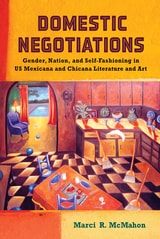
Domestic Negotiations
Gender, Nation, and Self-Fashioning in US Mexicana and Chicana Literature and ArtMcMahon, Marci R
Rutgers University Press, 2013
This interdisciplinary study explores how US Mexicana and Chicana authors and artists across different historical periods and regions use domestic space to actively claim their own histories. Through “negotiation”—a concept that accounts for artistic practices outside the duality of resistance/accommodation—and “self-fashioning,” Marci R. McMahon demonstrates how the very sites of domesticity are used to engage the many political and recurring debates about race, gender, and immigration affecting Mexicanas and Chicanas from the early twentieth century to today.
Domestic Negotiations covers a range of archival sources and cultural productions, including the self-fashioning of the “chili queens” of San Antonio, Texas, Jovita González’s romance novel Caballero, the home economics career and cookbooks of Fabiola Cabeza de Baca, Sandra Cisneros’s “purple house controversy” and her acclaimed text The House on Mango Street, Patssi Valdez’s self-fashioning and performance of domestic space in Asco and as a solo artist, Diane Rodríguez’s performance of domesticity in Hollywood television and direction of domestic roles in theater, and Alma López’s digital prints of domestic labor in Los Angeles. With intimate close readings, McMahon shows how Mexicanas and Chicanas shape domestic space to construct identities outside of gendered, racialized, and xenophobic rhetoric.

Domestic Tyranny
The Making of American Social Policy against Family Violence from Colonial Times to the PresentElizabeth Pleck
University of Illinois Press, 2004
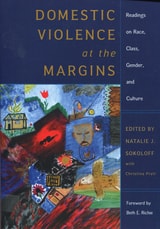
Domestic Violence at the Margins
Readings on Race, Class, Gender, and CultureSokoloff, Natalie J.
Rutgers University Press, 2005
"An exciting and powerful collection that eloquently critiques some of the current thinking in domestic violence and raises key concerns for advocates and scholars working in the area."—Sujata Warrier, president, board of directors, Manavi: An organization for South Asian women
"Sokoloff has assembled an impressive array of authors who challenge us to ‘think outside of our contemporary domestic violence box.’"—Angela M. Moore Parmley, chief, violence and victimization research division, National Institute of Justice
This groundbreaking anthology reorients the field of domestic violence research by bringing long-overdue attention to the structural forms of oppression in communities marginalized by race, ethnicity, religion, sexuality, or social class.
Reprints of the most influential recent work in the field as well as more than a dozen newly commissioned essays explore theoretical issues, current research, service provision, and activism among Latinos, African Americans, Asian Americans, Jewish Americans, and lesbians. The volume rejects simplistic analyses of the role of culture in domestic violence by elucidating the support systems available to battered women within different cultures, while at the same time addressing the distinct problems generated by that culture. Together, the essays pose a compelling challenge to stereotypical images of battered women that are racist, homophobic, and xenophobic.
The most up-to-date and comprehensive picture of domestic violence available, this anthology is an essential text for courses in sociology, criminology, social work, and women’s studies. Beyond the classroom, it provides critical information and resources for professionals working in domestic violence services, advocacy, social work, and law enforcement.
Domesticity And Dirt
Housewives and Domestic Servants in the United States, 1920-1945Phyllis Palmer
Temple University Press, 1991
In the era after Suffrage, white middle-class housewives abandoned moves toward paid work for themselves, embraced domestic life, and felt entitled to servants. In Domesticity and Dirt, Phyllis Palmer examines the cultural norms that led such women to take on the ornamental and emotional elements of the job while relegating the hard physical work and demeaning service tasks to servants—mainly women of color. Using novels, films, magazine articles, home economics texts, and government-funded domestic training course manuals, the author details cultural expectations about middle-class homelife.
Palmer describes how government-funded education programs encouraged the divisions of labor and identity and undercut domestic workers’ organized efforts during the 1930s to win inclusion in New Deal programs regulating labor conditions. Aided by less powerful black civil rights groups, without the assistance of trade unions or women’s clubs, domestics failed to win legal protections and the legal authority and self-respect these brought to covered workers. The author also reveals how middle- class women responded ambivalently to the call to aid women workers when labor reforms threatened their domestic arrangements.
Throughout her study, Palmer questions why white middle-class women looked to new technology and domestic help to deal with cultural demands upon "the perfect housewife" rather than expecting their husbands to help. When the supply of servants declined during the 1950s, middle-class housewives were left isolated with lots of housework. Although they rapidly followed their servants into paid work outside the home, they remain responsible for housework and child care.
In the series Women in the Political Economy, edited by Ronnie J. Steinberg.

Domesticity, Imperialism, and Emigration in the Victorian Novel
Diana C. Archibald
University of Missouri Press, 2002

Dominant Powers and Subordinate States
The United States in Latin America and the Soviet Union in Eastern EuropeJan F. Triska, ed.
Duke University Press, 1986

Dominguez Escalante Journal
Their Expedition Through Colorado Utah Az & N Mex 1776Ted J. Warner
University of Utah Press, 1995
Translated by Fray Angelico Chavez, Edited by Ted J. Warner
Western History
The chronicle of Fray Francisco Atanasio Domínguez and Fray Silvestre Vélez de Escalante’s most remarkable 1776 expedition through the Rocky Mountains, the eastern Great Basin, and the Colorado Plateau to inventory new lands for the Spanish crown and to find a route from Santa Fe to Monterey, California.
Escalante’s journal wonderfully describes every detail of the rugged and scenic country through which they journeyed, along the qualities and customs of its inhabitants. Working as far north as present-day Provo, Utah, the expedition finally returned south. An approaching severe winter and mishaps among the maze of the Grand Canyon forced the party to return to Santa Fe by way of the Hopi pueblos.
This journal provides a fascinating account of over a thousand miles of wilderness exploration.

Dominican Crossroads
H. C. C. Astwood and the Moral Politics of Race-Making in the Age of EmancipationChristina Cecelia Davidson
Duke University Press, 2024

Dominoes and Other Stories from the Puerto Rican
Jack Agüeros
Northwestern University Press, 1995
These stories convey hard, sometimes brutal, often bittersweet, experiences, but throughout Agüeros writes with artistry and unyielding compassion. Richly detailed, wry, and matter-of-fact, Dominoes and Other Stories from the Puerto Rican is an important achievement by an accomplished American writer.
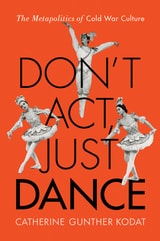
Don't Act, Just Dance
The Metapolitics of Cold War CultureCatherine Gunther Kodat
Rutgers University Press, 2014

Don't Call Me Inspirational
A Disabled Feminist Talks BackHarilyn Rousso
Temple University Press, 2013
For psychotherapist, painter, feminist, filmmaker, writer, and disability activist Harilyn Rousso, hearing well-intentioned people tell her, "You're so inspirational!" is patronizing, not complimentary.
In her empowering and at times confrontational memoir, Don't Call Me Inspirational, Rousso, who has cerebral palsy, describes overcoming the prejudice against disability--not overcoming disability. She addresses the often absurd and ignorant attitudes of strangers, friends, and family.Rousso also examines her own prejudice toward her disabled body, and portrays the healing effects of intimacy and creativity, as well as her involvement with the disability rights community. She intimately reveals herself with honesty and humor and measures her personal growth as she goes from "passing" to embracing and claiming her disability as a source of pride, positive identity, and rebellion.
A collage of images about her life, rather than a formal portrait, Don't Call Me Inspirational celebrates Rousso's wise, witty, productive, outrageous life, disability and all.

Don't Give Up the Ship!
Myths of the War of 1812Donald R. Hickey
University of Illinois Press, 2006
No longer willing to accept naval blockades, the impressment of American seamen, and seizures of American ships and cargos, the United States declared war on Great Britain. The aim was to frighten Britain into concessions and, if that failed, to bring the war to a swift conclusion with a quick strike at Canada. But the British refused to cave in to American demands, the Canadian campaign ended in disaster, and the U.S. government had to flee Washington, D.C., when it was invaded and burned by a British army.
By all objective measures, the War of 1812 was a debacle for the young republic, and yet it was celebrated as a great military triumph. The American people believed they had won the war and expelled the invader. Oliver H. Perry became a military hero, Francis Scott Key composed what became the national anthem and commenced a national reverence for the flag, and the U.S.S. Constitution, "Old Ironsides," became a symbol of American invincibility. Every aspect of the war, from its causes to its conclusion, was refashioned to heighten the successes, obscure the mistakes, and blur embarrassing distinctions, long before there were mass media or public relations officers in the Pentagon.
In this entertaining and meticulously researched book by America's leading authority on the War of 1812, Donald R. Hickey dispels the many misconcep-tions that distort our view of America's second war with Great Britain. Embracing military, naval, political, economic, and diplomatic analyses, Hickey looks carefully at how the war was fought between 1812 and 1815, and how it was remembered thereafter. Was the original declaration of war a bluff? What were the real roles of Canadian traitor Joseph Willcocks, Mohawk leader John Norton, pirate Jean Laffite, and American naval hero Lucy Baker? Who killed the Shawnee chief Tecumseh and who shot the British general Isaac Brock? Who actually won the war, and what is its lasting legacy? Hickey peels away fantasies and embellishments to explore why cer-tain myths gained currency and how they contributed to the way that the United States and Canada view themselves and each other.

Don't Give Your Heart to a Rambler
My Life with Jimmy Martin, the King of BluegrassBarbara Stephens
University of Illinois Press, 2017
Barbara bore his children and took on a crucial job as his booking agent when the agent he was using failed to obtain show dates for the group. Female booking agents were non-existent at that time but she persevered and went on to become the first female booking agent on Music Row. She also endured years of physical and emotional abuse at Martin's hands. With courage and candor, Barbara tells of the suffering and traces the hard-won personal growth she found inside motherhood and her work. Her vivid account of Martin's explosive personality and torment over his exclusion from the Grand Ole Opry fill in the missing details on a career renowned for being stormy. Barbara also shares her own journey, one of good humor and proud achievements, and filled with fond and funny recollections of the music legends and ordinary people she met, befriended, and represented along the way.
Straightforward and honest, Don't Give your Heart to a Rambler is a woman's story of the world of bluegrass and one of its most colorful, conflicted artists.

Don't Kill in Our Names
Families of Murder Victims Speak Out against the Death PenaltyKing, Rachel
Rutgers University Press, 2003
Could you forgive the murderer of your husband? Your mother? Your son?
Families of murder victims are often ardent and very public supporters of the death penalty. But the people whose stories appear in this book have chosen instead to forgive their loved ones’ murderers, and many have developed personal relationships with the killers and have even worked to save their lives. They have formed a nationwide group, Murder Victims’ Families for Reconciliation (MVFR), to oppose the death penalty.
MVFR members are often treated as either saints or lunatics, but the truth is that they are neither. They are ordinary people who have responded to an extraordinary and devastating tragedy with courage and faith, choosing reconciliation over retribution, healing over hatred. Believing that the death penalty is a form of social violence that only repeats and perpetuates the violence that claimed their loved one’s lives, they hold out the hope of redemption even for those who have committed the most hideous crimes.
Weaving third-person narrative with wrenching first-hand accounts, King presents the stories of ten MVFR members. Each is a heartrending tale of grief, soul searching, and of the challenge to choose forgiveness instead of revenge. These stories, which King sets in the context of the national discussion over the death penalty debate and restorative versus retributive justice, will appeal not only to those who oppose the death penalty, but also to those who strive to understand how people can forgive the seemingly unforgivable.
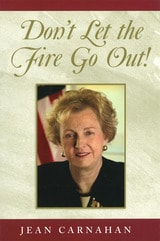
Don't Let the Fire Go Out!
Jean Carnahan
University of Missouri Press, 2004
Don't
A Reader's Guide to the Military's Anti-Gay PolicyJanet E. Halley
Duke University Press, 1999
Not so, reveals Halley. In order to work through the steps by which the new law was ultimately drafted, she opens with a close reading of the 1986 Supreme Court sodomy case which served as the legal and rhetorical model for the policy revisions made in 1993. Halley also describes how the Clinton administration’s attempts to offer Congress an opportunity to regulate conduct—and not status—were flatly rejected and not included in the final statute. Using cultural and critical theory seldom applied to explain the law, Halley argues that, far from providing privacy and an assurance that servicemembers' careers will be ruined only if they engage in illegal conduct, the rule activates a culture of minute surveillance in which every member must strictly avoid using any gesture in an ever-evolving lexicon of “conduct that manifests a propensity.” In other words, not only homosexuals but all military personnel are placed in danger by the new policy. After challenging previous pro-gay arguments against the policy that have failed to expose its most devious and dangerous elements, Halley ends with a persuasive discussion about how it is both unconstitutional and, politically, an act of sustained bad faith.
This knowledgeable and eye-opening analysis of one of the most important public policy debates of the 1990s will interest legal scholars, policymakers, activists, military historians and personnel, as well as citizens concerned about issues of discrimination.

Donald Barthelme
An ExhibitionJerome Klinkowitz
Duke University Press, 1991
Klinkowitz argues that the central piece in the Barthelme canon, and the key to his artistic method, is his widely acknowledged masterpiece, The Dead Father. In turning to this pivotal work, as well as to Barthelme’s short stories and other novels, Klinkowitz explores the way in which Barthelme reinvented the tools of narration, characterization, and thematics at a time when fictive techniques were largely believed to be exhausted.
Klinkowitz, who was one of the first scholars to study Barthelme’s work and became its definitive bibliographer, situates Barthelme’s life and work within a broad spectrum of influences and affinities. A consideration of developments in painting and sculpture, for example, as well as those of contemporaneous fiction, contribute to Klinkowitz’s analysis. This astute reading will provide great insight for readers, writers, and critics of contemporary American fiction seeking explanations and justifications of Barthelme’s critical importance in the literature of our times.

Done in a Day
Telex from the Fall of SaigonElisa Tamarkin
University of Chicago Press, 2026
Named one of Lit Hub's most anticipated books of the year.
A searing reflection on the last day of the Vietnam War and the beginning of the end of foreign reporting in the nation’s daily newspapers.
Done in a Day turns on a single event: the April 30, 1975, departure of the last helicopter evacuating civilians from the rooftop of the US embassy in Saigon. Elisa Tamarkin’s interest in that helicopter begins with the fact that her stepfather, the Saigon bureau chief for the Chicago Daily News, was on it—the last American correspondent to leave Saigon as it fell. His report was filed from a naval ship on the South China Sea at a time when no other telexes were going through.
Now, more than fifty years later, Tamarkin offers a social and cultural autopsy of that moment, based in personal history but vividly unfolding amid the vast documentation of America’s obvious defeat, which never seemed to register even as it got out, in the writings of journalists and essayists, in the backchannel cables between US ambassador Graham Martin and Henry Kissinger, in congressional hearings, and in photographs of the war’s end. The story is also set against the imminent disappearance of war coverage in city newspapers—and of the newspapers themselves—once proud, in the words of the Chicago Daily News, of bringing readers the “literature of the day” that was “done in a day.”
Done in a Day braids history, criticism, and memoir to tell the paired stories of Saigon’s liberation and the demise of the news. The result is a haunting essay about all that ended in a day—and about what it means to recognize and to write about endings even as we live through them.

Donut Dolly
An American Red Cross Girl's War in VietnamJoann Puffer Kotcher
University of North Texas Press, 2011

Don’t Kill Your Baby
Public Health and the Decline of Breastfeeding in the Nineteenth and Twentieth CenturiesJacqueline H. Wolf
The Ohio State University Press, 2001

Door County Outdoors
A Guide to the Best Hiking, Biking, Paddling, Beaches, and Natural PlacesMagill Weber
University of Wisconsin Press, 2011
A picturesque peninsula with 298 miles of Lake Michigan shoreline, state parks, forests, and cozy inns, Door County is one of the Midwest’s prime tourist attractions. Magill Weber explores the many recreational opportunities available to visitors, including secret spots known only to locals and longtime seasonal residents. Wisconsin native Janet Mrazek contributes 125 detailed and easy-to-follow maps. With suggestions of more than 150 scenic hikes, biking and paddling routes, end-of-the-road beaches, lighthouses, and wildlife-watching sites, and descriptions of the local flora and fauna, Door County Outdoors is the ultimate guide for active travelers and nature enthusiasts.

Door County's Emerald Treasure
A History of Peninsula State ParkWilliam H. Tishler
University of Wisconsin Press, 2006
With its magnificent forests, bluffs, and shoreline and its breathtaking views of Green Bay and Lake Michigan, Door County’s Peninsula State Park is one of the Midwest’s most popular attractions. Established in 1909, it was Wisconsin’s second state park and a key to pioneering efforts to build a state park system that would be the envy of the nation.
Door County’s Emerald Treasure explores the rich history of the park land, from its importance to Native Americans and early European settlers through the twentieth century. Bill Tishler engagingly relates the role of conservationists and progressives in establishing the state park, its growing popularity for tourism and recreation, and efforts to protect the park’s resources from a variety of threats. Tishler also tells a larger story of Americans’ intimate relationship with the land around them and the challenge to create accessible public spaces that preserve the natural environment.

Dopers in Uniform
The Hidden World of Police on SteroidsBy John Hoberman
University of Texas Press, 2017
The recorded use of deadly force against unarmed suspects and sustained protest from the Black Lives Matter movement, among others, have ignited a national debate about excessive violence in American policing. Missing from the debate, however, is any discussion of a factor that is almost certainly contributing to the violence—the use of anabolic steroids by police officers. Mounting evidence from a wide range of credible sources suggests that many cops are abusing testosterone and its synthetic derivatives. This drug use is illegal and encourages a “steroidal” policing style based on aggressive behaviors and hulking physiques that diminishes public trust in law enforcement.
Dopers in Uniform offers the first assessment of the dimensions and consequences of the felony use of anabolic steroids in major urban police departments. Marshalling an array of evidence, John Hoberman refutes the frequent claim that police steroid use is limited to a few “bad apples,” explains how the “Blue Wall of Silence” stymies the collection of data, and introduces readers to the broader marketplace for androgenic drugs. He then turns his attention to the people and organizations at the heart of police culture: the police chiefs who often see scandals involving steroid use as a distraction from dealing with more dramatic forms of misconduct and the police unions that fight against steroid testing by claiming an officer’s “right to privacy” is of greater importance. Hoberman’s findings clearly demonstrate the crucial need to analyze and expose the police steroid culture for the purpose of formulating a public policy to deal with its dysfunctional effects.
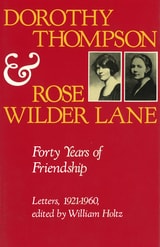
Dorothy Thompson and Rose Wilder Lane
Forty Years of Friendship, Letters, 1921-1960Edited by William Holtz
University of Missouri Press, 1991
The friendship between Dorothy Thompson and Rose Wilder Lane began in 1920 in the publicity office of the American Red Cross in Paris and continued until Thompson’s death in 1961. Although both women are today remembered primarily for their connections with others —Thompson as the wife of Sinclair Lewis, and Lane as the daughter of Laura Ingalls Wilder, author of the “Little House” books —each was remarkable in her own right.
Both women had a vital engagement with life that led them in fearless pursuit of experience. In 1939, Thompson appeared on the cover of Time, which judged her second only to Eleanor Roosevelt among influential women of the day. Typical of Lane were her travels through the mountains of Albania, the deserts of Syria, and Soviet Georgia in the 1920s and her visit as a journalist to Vietnam in 1965 at the age of seventy-eight.
The correspondence of these two talented and articulate women reveals their personal concerns, social ideas, and political/economic philosophies and how they changed over time. Their letters tell the story of the first generation of women to come of age during the twentieth century, as they tried to cope with problems that women still face today. Along with the letters themselves, Holtz has included annotations and footnotes that provide biographical information, as well as explaining personal and topical references.

Dos X
Disability and Racial Dysphoria in Latinx and Filipinx CultureSony Coráñez Bolton
University of Texas Press, 2025
An examination of the interconnectedness of brown-racialized people across multiple identities, told through case studies of television, literature, and writing.
As a Filipinx immigrant to the United States, Sony Coráñez Bolton has frequently been mistaken as Mexican. Dos X theorizes such misrecognition. What does it mean to exist in this liminal state, which Coráñez Bolton dubs the “racial uncanny”? What generative possibilities emerge from the presumed interchangeability of Latinx and Filipinx bodies—and from the in-betweenness of brownness as such?
Dos X tracks misrecognition through cultural products like the TV series Undone, Brian Ascalon Roley’s American Son, and the nonfiction work of Jose Antonio Vargas. Misrecognition, Coráñez Bolton argues, produces moments of uncanniness in which subjects experience dysphoric attachments to identities that aren’t supposed to be theirs. In the context of racial capitalism, racial dysphoria is a disability because it undermines certainty about what one’s body is and therefore what role one is meant to play as a laborer. But racial dysphoria can also be revealing. Coráñez Bolton identifies vast potential in this supposed disability, which compels its “sufferers” to confront their shared position within the social, political, and economic organization of capital’s empire, opening new avenues for liberatory solidarity.

Double Duty in the Civil War
The Letters of Sailor and Soldier Edward W. BaconEdited by George S. Burkhardt
Southern Illinois University Press, 2009
In 1861 at the age of eighteen, Edward Woolsey Bacon, a Yale student and son of well-known abolitionist minister Leonard Bacon, left his home in New Haven, Connecticut, to fight for the United States. Over the next four years Bacon served in both the Union navy and army, which gave him a sweeping view of the Civil War. His postings included being a captain’s clerk on the USS Iroquois, a hospital clerk in his hometown, a captain in the 29th Connecticut Infantry (Colored), and a major in the 117th U.S. Colored Infantry, and he described these experiences in vibrant letters to his friends and family. Historian George S. Burkhardt has compiled these letters, as well as Bacon’s diary in the impressive Double Duty in the Civil War: The Letters of Sailor and Soldier Edward W. Bacon.
Bacon tells of hunting Confederate commerce raiders on the high seas, enduring the tedium of blockade duty, and taking part in riverine warfare on the Mississippi. He recalls sweating in South Carolina as an infantry officer during drill and picket duty, suffering constant danger in the battlefield trenches of Virginia, marching victoriously on fallen Richmond, and tolerating the boredom of occupation duty in Texas.
His highly entertaining letters shed new light on naval affairs and reveal a close-knit family life. The narrative of his duty with black troops is especially valuable, since few first-hand accounts from white officers of the U.S. Colored Troops exist. Furthermore, his beliefs about race, slavery, and the Union cause were unconventional for the time and stand in contrast to those held by many of his contemporaries.
Double Duty in the Civil War is filled with lively descriptions of the men Bacon met and the events he experienced. With Burkhardt’s careful editing and useful annotations, Bacon’s letters and diary excerpts give rare insight into areas of the Civil War that have been neglected because of a lack of available sources. Given the scarcity of eyewitness testimonies to navy life and life in African American regiments, this book is a rarity indeed.

Double Jeopardy
Adolescent Offenders with Mental DisordersThomas Grisso
University of Chicago Press, 2004
Double Jeopardy considers the newest data on the nature of youths' mental disorders—their relationships to delinquency, the values and limits of methods to treat them, and the common patterns of adolescent offending. That information is used to chart a rational course for fulfilling the juvenile justice system's duty—as a custodian of children in need of health care, as a legal system promoting fairness in youth adjudication, and as a protector of public safety—to respond to delinquent youths' mental disorders. Moreover, Double Jeopardy provides a scientific yet practical foundation for lawmakers, judges, attorneys, and mental health care professionals, as well as researchers who must fill the knowledge gaps that limit the juvenile justice system's abilities to meet youths' mental health needs.

Double V
The Civil Rights Struggle of the Tuskegee AirmenLawrence P. Scott
Michigan State University Press, 1994
On April 12, 1945, the United States Army Air Force arrested 101 of its African American officers. They were charged with disobeying a direct order from a superior officer—a charge that could carry the death penalty upon conviction. They were accused of refusing to sign an order that would have placed them in segregated housing and recreational facilities. Their plight was virtually ignored by the press at the time, and books written about the subject did not detail the struggle these aviators underwent to win recognition of their civil rights.
The central theme of Double V is the promise held out to African American military personnel that service in World War II would deliver to them a double victory—a "double V"—over tyranny abroad and racial prejudice at home. The book's authors, Lawrence P. Scott and William M. Womack Sr., chronicle for the first time, in detail, one of America's most dramatic failures to deliver on that promise. In the course of their narrative, the authors demonstrate how the Tuskegee airmen suffered as second-class citizens while risking their lives to serve their country. Among the contributions made by this work is a detailed examination of how 101 Tuskegee airmen, by refusing to live in segregated quarters, triggered one of the most significant judicial proceedings in U.S. military history. Double V uses oral accounts and heretofore unused government documents to portray this little-known struggle by one of America's most celebrated flying units.
In addition to providing background material about African American aviators before World War II. the authors also demonstrate how the Tuskegee airmen's struggle foretold dilemmas faced by the civil rights movement in the second half of the 20th century. Double V is destined to become an important contribution in the rapidly growing body of civil rights literature.

Double-Consciousness/Double Bind
Theoretical Issues in Twentieth-Century Black LiteratureSandra Adell
University of Illinois Press, 1994

Douglass in His Own Time
A Biographical Chronicle of His Life, Drawn from Recollections, Interviews, and Memoirs by Family, Friends, and AssociatesJohn Ernest
University of Iowa Press, 2014
As valuable as these writings are in illuminating the man, the story Douglass told in 1845 has become rather too easy to tell, obscuring as much as it reveals. Less a living presence than an inspiring tale, Frederick Douglass remains relatively unknown even to many of those who celebrate his achievements. Douglass in His Own Time offers an introduction to Douglass the man by those who knew him. The book includes a broad range of writings, some intended for public viewing and some private correspondence, all of which contend with the force of Douglass’s tremendous power over the written and spoken word, his amazing presence before crowds, his ability to improvise, to entertain, to instruct, to inspire—indeed, to change lives through his eloquent appeals to righteous self-awareness and social justice. In approaching Douglass through the biographical sketches, memoirs, letters, editorials, and other articles about him, readers will encounter the complexity of a life lived on a very public stage, the story of an extraordinary black man in an insistently white world.

Down Ballot
How a Local Campaign Became a National Referendum on AbortionPatrick Wohl
University of Illinois Press, 2024
In 1990, a suburban Chicago race for the Republican Party nomination for state representative unexpectedly became a national proxy battle over abortion in the United States. But the hard-fought primary also illustrated the overlooked importance of down-ballot contests in America’s culture wars. Patrick Wohl offers the dramatic account of a rollercoaster campaign that, after attracting political celebrities and a media circus, came down to thirty-one votes, a coin toss to determine the winner, and a recount fight that set a precedent for how to count dimpled chads. As the story unfolds, Wohl provides a rare nuts-and-bolts look at an election for state office from its first days through the Illinois Supreme Court decision that decided the winner--and set the stage for a decisive 1992 rematch.
A compelling political page-turner, Down Ballot takes readers behind the scenes of a legendary Illinois election.

Down The Jersey Shore
Russell Roberts and Rich Youmans
Rutgers University Press, 1993
Summer visitors and year-round residents alike are sure to discover Jersey Shore lore that captures their fancy in this entertaining account of the people, places, and events that have shaped New Jersey’s famous shoreline.
From ghost stories and the comic misadventures of the early Miss America Pageant to the dynamics of the changing coastline and poignant portraits of traditional crafts workers, Russell Roberts and Rich Youmans have chronicled the fascinating history and heritage of the New Jersey Shore. In this book you’ll meet the luminaries who’ve frequented the Shore—from President Ulysses Grant strolling through Long Branch to Grace Kelly learning to surf at Ocean City. You’ll find out why the boardwalk was invented, and also why early ones were removable. Join the authors as they pay tribute to the Shore’s forgotten inventors, including Simon Lake, who some consider the true father of the modern submarine. Relive the Jersey Shore’s role in wartime and learn the story of the mysterious Nazi submarine sunken off of Point Pleasant Beach. Read about Lucy the Margate Elephant, as a well as her two long-gone “cousins.”
Discover all this and more as Roberts and Youmans explore the vast uncharted heritage of the New Jersey Shore.
Down and Out in America
The Origins of HomelessnessPeter H. Rossi
University of Chicago Press, 1990

Down and Out in the New Economy
How People Find (or Don’t Find) Work TodayIlana Gershon
University of Chicago Press, 2017
Finding a job used to be simple. Now . . . well, it’s complicated. In today’s economy, you can’t just be an employee looking to get hired—you have to market yourself as a business, one that can help another business achieve its goals.
That’s a radical transformation in how we think about work and employment, says Ilana Gershon. And with Down and Out in the New Economy, she digs deep into that change and what it means, not just for job seekers, but for businesses and our very culture. In telling this story, Gershon covers all parts of the employment spectrum: she interviews hiring managers about how they assess candidates; attends personal branding seminars; talks with managers at companies around the United States to suss out regional differences—like how Silicon Valley firms look askance at the lengthier employment tenures of applicants from the Midwest. And she finds that not everything has changed: though the technological trappings may be glitzier, in a lot of cases, who you know remains more important than what you know.
Rich in the voices of people deeply involved with all parts of the employment process, Down and Out in the New Economy offers a snapshot of the quest for work today—and a pointed analysis of its larger meaning.
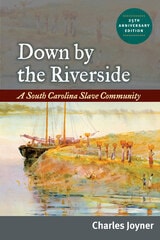
Down by the Riverside
A South Carolina Slave CommunityCharles Joyner
University of Illinois Press, 2009
Joyner recovers an entire lost society and way of life from the letters, diaries, and memoirs of the plantation whites and their guests, from quantitative analysis of census and probate records, and above all from the folklore and oral history of the enslaved Americans. His classic reconstruction of daily life in All Saints Parish is an inspiring testimony to the ingenuity and solidarity of a people.
This anniversary edition of Joyner's landmark study includes a new introduction in which the author recounts his process of writing the book, reflects on its critical and popular reception, and surveys the past three decades of scholarship on the history of enslaved people in the United States.
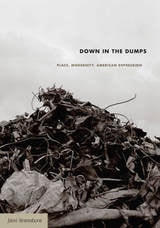
Down in the Dumps
Place, Modernity, American DepressionJani Scandura
Duke University Press, 2007
An interpretive bricolage that draws on an unlikely archive of 1930s detritus—office memos, scribbled manuscripts, scrapbooks, ruined photographs, newspaper clippings, glass eyes, incinerated stage sets, pulp novels, and junk washed ashore—Down in the Dumps escorts its readers through Reno’s divorce factory of the 1930s, where couples from across the United States came to quickly dissolve matrimonial bonds; Key West’s multilingual salvage economy and its status as the island that became the center of an ideological tug-of-war between the American New Deal government and a politically fraught Caribbean; post-Renaissance Harlem, in the process of memorializing, remembering, grieving, and rewriting a modernity that had already passed; and Studio-era Hollywood, Nathanael West’s “dump of dreams,” in which the introduction of sound in film and shifts in art direction began to transform how Americans understood place-making and even being itself. A coda on Alcatraz and the Pentagon brings the book into the present, exploring how American Depression comes to bear on post-9/11 America.
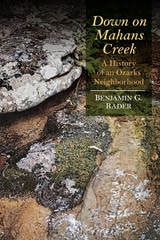
Down on Mahans Creek
A History of an Ozarks NeighborhoodBenjamin G. Rader
University of Arkansas Press, 2017
In Down on Mahans Creek, Benjamin Rader provides a fascinating look at a neighborhood in the Missouri Ozarks from the early nineteenth to the mid-twentieth century. He explores the many ways in which Mahans Creek, though remote, was never completely isolated or self-sufficient. The residents were deeply affected by the Civil War, and the arrival of the railroad and the timber boom in the 1890s propelled the community into modern times, creating a more fast-paced and consumer-oriented way of life and a new moral sensibility. During the Great Depression the creek’s residents returned to some of the older values for survival. After World War II, modern technology changed their lives again, causing a movement away from the countryside and to the nearby small towns.
Down on Mahans Creek tells the dynamic story of this distinctive neighborhood navigating the push and pull of the old and new ways of life.

Down on the Killing Floor
Black and White Workers in Chicago's Packinghouses, 1904-54Rick Halpern
University of Illinois Press, 1997

Down the River
or Practical Lessons Under The Code DuelloGeorge W Hooper
University of Alabama Press, 2007
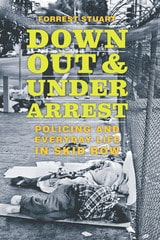
Down, Out, and Under Arrest
Policing and Everyday Life in Skid RowForrest Stuart
University of Chicago Press, 2016
Juliette, a woman he met during that time, has been stopped by police well over one hundred times, arrested upward of sixty times, and has given up more than a year of her life serving week-long jail sentences. Her most common crime? Simply sitting on the sidewalk—an arrestable offense in LA.
Why? What purpose did those arrests serve, for society or for Juliette? How did we reach a point where we’ve cut support for our poorest citizens, yet are spending ever more on policing and prisons? That’s the complicated, maddening story that Stuart tells in Down, Out and Under Arrest, a close-up look at the hows and whys of policing poverty in the contemporary United States. What emerges from Stuart’s years of fieldwork—not only with Skid Row residents, but with the police charged with managing them—is a tragedy built on mistakes and misplaced priorities more than on heroes and villains. He reveals a situation where a lot of people on both sides of this issue are genuinely trying to do the right thing, yet often come up short. Sometimes, in ways that do serious harm.
At a time when distrust between police and the residents of disadvantaged neighborhoods has never been higher, Stuart’s book helps us see where we’ve gone wrong, and what steps we could take to begin to change the lives of our poorest citizens—and ultimately our society itself—for the better.

Downed by Friendly Fire
Black Girls, White Girls, and Suburban SchoolingSignithia Fordham
University of Minnesota Press, 2016
Most Americans would never willingly revisit their high school experiences; the nation’s school systems reflect the broader society’s hierarchical emphasis on race, class, and gender. While schools purport to provide equal opportunities for all students, this rarely happens in actuality—particularly for girls.
In Downed by Friendly Fire, Signithia Fordham unmasks and examines female-centered bullying in schools, arguing that it is essential to unmask female aggression, bullying, and competition, all of which directly relate to the structural violence embedded in the racialized and gendered social order. For two and a half years, Fordham conducted field research at “Underground Railroad High School,” a suburban high school in upstate New York. Through a series of composite student profiles, she examines the girls’ relationships to academic achievement, social competition, and aggression toward one another. Fordham argues that girls academically “compete to lose,” which only perpetuates their subordination through the misrecognition of their own competitive behaviors. She goes further to expand the meaning of violence to include what is seen as normal, including suffering, humiliation, and social and economic abuse.
Using the concept “symbolic violence,” Fordham theorizes the psychological and social damage suffered especially by black girls in schools. The five narratives in Downed by Friendly Fire ultimately highlight the pain and suffering this violence produces as well as the ways in which it promotes inequality, exclusion, and marginalization among girls.
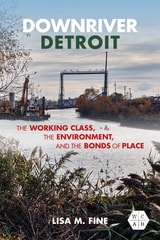
Downriver Detroit
The Working Class, the Environment, and the Bonds of PlaceLisa M. Fine
University of Illinois Press, 2026
Lisa M. Fine examines important moments in the ongoing efforts of the area’s citizens to create a humane and habitable environment. Her analysis shows how people preserved wetlands and the river by working through sportsmen’s organizations, appealing to state agencies, and forming grassroots movements. Fueled by enduring connections to place, local unions fought a proposed nuclear power plant in the 1950s. Years later, steel workers facing the steamroller of deindustrialization tried to preserve their communities by purchasing their own company. The ties that bind gave a unique character to activism in the Downriver region, challenging stereotypes of working-class attitudes toward the environment.
A creative merger of labor and environmental history, Downriver Detroit shows that working people have a right to live in and protect the places they love.

Downriver
Into the Future of Water in the WestHeather Hansman
University of Chicago Press, 2019
The Green River, the most significant tributary of the Colorado River, runs 730 miles from the glaciers of Wyoming to the desert canyons of Utah. Over its course, it meanders through ranches, cities, national parks, endangered fish habitats, and some of the most significant natural gas fields in the country, as it provides water for 33 million people. Stopped up by dams, slaked off by irrigation, and dried up by cities, the Green is crucial, overused, and at-risk, now more than ever.
Fights over the river’s water, and what’s going to happen to it in the future, are longstanding, intractable, and only getting worse as the West gets hotter and drier and more people depend on the river with each passing year. As a former raft guide and an environmental reporter, Heather Hansman knew these fights were happening, but she felt driven to see them from a different perspective—from the river itself. So she set out on a journey, in a one-person inflatable pack raft, to paddle the river from source to confluence and see what the experience might teach her. Mixing lyrical accounts of quiet paddling through breathtaking beauty with nights spent camping solo and lively discussions with farmers, city officials, and other people met along the way, Downriver is the story of that journey, a foray into the present—and future—of water in the West.
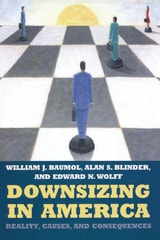
Downsizing in America
Reality, Causes, and ConsequencesWilliam J. Baumol
Russell Sage Foundation, 2003
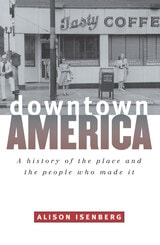
Downtown America
A History of the Place and the People Who Made ItAlison Isenberg
University of Chicago Press, 2005
Downtown America cuts beneath the archetypal story of downtown's rise and fall and offers a dynamic new story of urban development in the United States. Moving beyond conventional narratives, Alison Isenberg shows that downtown's trajectory was not dictated by inevitable free market forces or natural life-and-death cycles. Instead, it was the product of human actors—the contested creation of retailers, developers, government leaders, architects, and planners, as well as political activists, consumers, civic clubs, real estate appraisers, even postcard artists. Throughout the twentieth century, conflicts over downtown's mundane conditions—what it should look like and who should walk its streets—pointed to fundamental disagreements over American values.
Isenberg reveals how the innovative efforts of these participants infused Main Street with its resonant symbolism, while still accounting for pervasive uncertainty and fears of decline. Readers of this work will find anything but a story of inevitability. Even some of the downtown's darkest moments—the Great Depression's collapse in land values, the rioting and looting of the 1960s, or abandonment and vacancy during the 1970s—illuminate how core cultural values have animated and intertwined with economic investment to reinvent the physical form and social experiences of urban commerce. Downtown America—its empty stores, revitalized marketplaces, and romanticized past—will never look quite the same again.
A book that does away with our most clichéd approaches to urban studies, Downtown America will appeal to readers interested in the history of the United States and the mythology surrounding its most cherished institutions.
A Choice Oustanding Academic Title.
Winner of the 2005 Ellis W. Hawley Prize from the Organization of American Historians.
Winner of the 2005 Lewis Mumford Prize for Best Book in American
Planning History.
Winner of the 2005 Historic Preservation Book Price from the University of Mary Washington Center for Historic Preservation.
Named 2005 Honor Book from the New Jersey Council for the Humanities.