4743 books match the query 'Religion' and 145 start with d

cover of Deus: The Fall of Pompeii and the Rise of Christianity

Deus

The Fall of Pompeii and the Rise of Christianity

Gabriel Zuchtriegel

University of Chicago Press, 2027

Amid the city’s ruins, the director of the Pompeii Archaeological Park seeks signs of profound religious and cultural transformation to come. 

Recent excavations in Pompeii have unearthed stunning discoveries and a new understanding of how people really lived, revealing a city simmering with tension in an age of great upheaval. From the author of The Buried City comes a riveting account of religious and ritual engagement in and around Pompeii at the time of its destruction in 79 CE, a moment when Christianity was just beginning to gain footing in the Roman world.

Drawing on ancient artifacts and the latest findings from Pompeii, Gabriel Zuchtriegel, director of the Pompeii Archaeological Park, considers how such a momentous transformation might have come to pass. Each chapter takes a different deity as its starting point, exploring the place of the ancient gods in the life of the city and its people. Inviting readers behind the scenes to experience discoveries through the eyes of the excavation team, Zuchtriegel shares insights about Pompeii’s red-light district, where archaeologists have found graffiti that may refer to Christians; excavations in several of the city’s sanctuaries and in nearby Longola, a Bronze and Early Iron Age precursor of Pompeii; a top-secret dig in the House of the Thiasus that has yielded wall paintings as provocative as those of the famous Villa of the Mysteries; and much more. With intimate detail, this book brings to life a raw and often brutal society, capturing beauty and humanity in places both expected and surprising.

[more]
cover of Deuteronomy-Kings as Emerging Authoritative Books: A Conversation

Deuteronomy-Kings as Emerging Authoritative Books

A Conversation

Diana V. Edelman

SBL Press, 2014

Explore how the past came to address the present and the future and why it became important for emerging Jewish identity.

Experts explore the themes and topics that made Deuteronomy and the Former Prophets appealing to ancient readers leading ultimately to those texts becoming authoritative for Persian and Hellenistic readers. This unique collection of essays focuses on what larger impact these texts might have had on primary and secondary audiences as part of emerging Torah. Contributors include Klaus-Peter Adam, Yairah Amit, Thomas M. Bolin, Philip R. Davies, Serge Frolov, Susanne Gilmayr-Bucher, E. Axel Knauf, Christoph Levin, James R. Linville, and Thomas Römer, and Diana V. Edelman.

Features:

  • Essays focused on why texts became authoritative instead of when they were written or their historicity
  • Two scholars examine each book providing a range of views
  • Coverage of the socio-religious function of emerging Torah in the Persian and early Hellenistic periods
[more]
cover of Development in Spirit: Religious Transformation and Everyday Politics in Vietnam’s Highlands

Development in Spirit

Religious Transformation and Everyday Politics in Vietnam’s Highlands

Seb Rumsby

University of Wisconsin Press, 2023

As state economic policies promote integration under a single logic of modernist development, many impoverished groups remain on the margins. Development in Spirit explores the practices employed by communities on the fringes of such nation-building projects. Using an everyday political economy lens, Seb Rumsby demonstrates how seemingly powerless actors actively engage with larger forces, shaping their experience of development in ways that are underexamined but have far-reaching consequences. 

Following state-led market reforms in the 1980s, Vietnam experienced stunning economic transformation. But for the Hmong communities of the country’s north and central highlands, the benefits proved elusive. Instead, the Hmong people have pursued their own alternative paths to development. Rumsby shows how mass conversion to Christianity led to a case of “unplanned development” that put the Hmong on a trajectory of simultaneous integration into the market economy and resistance to state authority. 

Many of the strategies community members employ are tied to the Christianization of everyday life. Religious actors play complex and often contradictory roles in facilitating networks of exchange, challenging or enforcing gender norms, promoting communalism and enforcing discipline, and shaping local ideas about progress. They are influenced by national and transnational religious networks, especially US-produced radio broadcasts by Hmong American Christians and local converts.

This compelling account provides fresh theoretical and empirical insights into the interplay of religion, neoliberal development, and marketization across the world. 
[more]
cover of Devotion in Motion: Pilgrimage in Modern Mexico

Devotion in Motion

Pilgrimage in Modern Mexico

Edward Wright-Ríos

University of Chicago Press, 2025

A study of contemporary pilgrimage through the elastic history of a shrine in Oaxaca, Mexico.
 
For many, pilgrimage conjures ideas about ancient traditions and somber journeys of self-discovery—an escape from modern life. In Devotion in Motion, Edward Wright-Ríos argues that we misunderstand pilgrimage (past and present) if we ignore its dynamic relationship with the rhythms of daily life and community.

Through the story of a centuries-old, ever-changing Catholic shrine to Our Lady of Juquila in Oaxaca, Mexico, Wright-Ríos reveals how tradition, innovation, marketing, and devotion coexist and interact in pilgrimage. Devotees, he shows, are not dissuaded by the embeddedness of the sacred site in the complexities, hierarchies, or conflicts of their lives. In fact, the truckers, accountants, and health-care workers we meet in this book actively seek new resources (including social media) to aid and share their devotion. Part microhistory, part ethnography, Devotion in Motion is a celebration of pilgrimage as a living experience in every generation.
[more]
cover of Devotion: Three Inquiries in Religion, Literature, and Political Imagination

Devotion

Three Inquiries in Religion, Literature, and Political Imagination

Constance M. Furey, Sarah Hammerschlag, and Amy Hollywood

University of Chicago Press, 2021

Three scholars of religion explore literature and the literary as sites of critical transformation.

We are living in a time of radical uncertainty, faced with serious political, ecological, economic, epidemiological, and social problems. Scholars of religion Constance M. Furey, Sarah Hammerschlag, and Amy Hollywood come together in this volume with a shared conviction that what and how we read opens new ways of imagining our political futures and our lives.

Each essay in this book suggests different ways to characterize the object of devotion and the stance of the devout subject before it. Furey writes about devotion in terms of vivification, energy, and artifice; Hammerschlag in terms of commentary, mimicry, and fetishism; and Hollywood in terms of anarchy, antinomianism, and atopia. They are interested in literature not as providing models for ethical, political, or religious life, but as creating the site in which the possible—and the impossible—transport the reader, enabling new forms of thought, habits of mind, and ways of life. Ranging from German theologian Martin Luther to French-Jewish philosopher Sarah Kofman to American poet Susan Howe, this volume is not just a reflection on forms of devotion and their critical and creative import but also a powerful enactment of devotion itself.
[more]
cover of Devotional Activism: Public Religion, Innovation and Culture in the Nineteenth-Century

Devotional Activism

Public Religion, Innovation and Culture in the Nineteenth-Century

Richard Schaefer

St. Augustine's Press, 2023

Modern history has not been neutral in telling the story of religion. Since it presumes the centrality of human motives and machinations as the one and only means of explicating the unfolding of ‘events’, it has helped set the terms for what counts as a viable motive and what does not, and this is evident in the systematic unmasking of religion as only really ever about ‘something else’. By distilling more substantive/primary economic, political or other kinds of motives from the detritus of ‘religion’, the latter is thus consigned to the past as the primitive husk of more substantive and rational ways of thinking and acting. As a set of historical case studies, the essays collected here forgo that tendency, and suggest different possibilities for conceptualizing the fate of religion in the modern world. They chart a different course, one of faith and self-assertion.

The essays take up a variety of episodes from modern European and American history and explore, from various angles, three interrelated themes: 'public religion', and the role of Catholicism as a determined critic of modernity; religion as an impetus for innovation; and the tendency to reduce religion to culture.
[more]
cover of Devotions Upon Emergent Occasions: Together with Death's Duel

Devotions Upon Emergent Occasions

Together with Death's Duel

John Donne

University of Michigan Press, 1959
Devotions upon Emergent Occasions: Together with Death's Duel is a profound collection of meditations and sermons by John Donne that reflect on the human condition, mortality, and spirituality. Written during a severe illness in 1623, the Devotions are a series of reflections that combine Donne's experience of personal anguish with deep theological insights. He explores themes of suffering, divine intervention, and redemption. In addition, Death's Duel, often considered Donne's final sermon before his death, serves as a poignant and eloquent meditation on the inevitability of death and the promise of eternal life. Together, these writings offer readers a timeless contemplation of life, faith, and death.
[more]
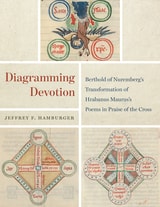
cover of Diagramming Devotion: Berthold of Nuremberg’s Transformation of Hrabanus Maurus’s Poems in Praise of the Cross

Diagramming Devotion

Berthold of Nuremberg’s Transformation of Hrabanus Maurus’s Poems in Praise of the Cross

Jeffrey F. Hamburger

University of Chicago Press, 2020
During the European Middle Ages, diagrams provided a critical tool of analysis in cosmological and theological debates. In addition to drawing relationships among diverse areas of human knowledge and experience, diagrams themselves generated such knowledge in the first place. In Diagramming Devotion, Jeffrey F. Hamburger examines two monumental works that are diagrammatic to their core: a famous set of picture poems of unrivaled complexity by the Carolingian monk Hrabanus Maurus, devoted to the praise of the cross, and a virtually unknown commentary on Hrabanus’s work composed almost five hundred years later by the Dominican friar Berthold of Nuremberg. Berthold’s profusely illustrated elaboration of Hrabnus translated his predecessor’s poems into a series of almost one hundred diagrams. By examining Berthold of Nuremberg’s transformation of a Carolingian classic, Hamburger brings modern and medieval visual culture into dialogue, traces important changes in medieval visual culture, and introduces new ways of thinking about diagrams as an enduring visual and conceptual model.
[more]
cover of Dialogue against the Jews

Dialogue against the Jews

Petrus Alfonsi

Catholic University of America Press, 2006
Never before translated into English, this work presents to the reader perhaps the most important source for an intensifying medieval Christian-Jewish debate.
[more]
cover of Dialogue with Trypho (Selections from the Fathers of the Church, Volume 3)

Dialogue with Trypho (Selections from the Fathers of the Church, Volume 3)

Saint Justin Martyr

Catholic University of America Press, 2003
No description available
[more]
cover of Dialogues

Dialogues

Saint Gregory the Great

Catholic University of America Press, 1959

No description available
[more]
cover of Dickens, His Parables, and His Reader

Dickens, His Parables, and His Reader

Linda M. Lewis

University of Missouri Press, 2011
 
Charles Dickens once commented that in each of his Christmas stories there is “an express text preached on . . . always taken from the lips of Christ.” This preaching, Linda M. Lewis contends, does not end with his Christmas stories but extends throughout the body of his work. In Dickens, His Parables, and His Reader, Lewis examines parable and allegory in nine of Dickens’s novels as an entry into understanding the complexities of the relationship between Dickens and his reader.
Through the combination of rhetorical analysis of religious allegory and cohesive study of various New Testament parables upon which Dickens based the themes of his novels, Lewis provides new interpretations of the allegory in his novels while illuminating Dickens’s religious beliefs. Specifically, she alleges that Dickens saw himself as valued friend and moral teacher to lead his “dear reader” to religious truth.
Dickens’s personal gospel was that behavior is far more important than strict allegiance to any set of beliefs, and it is upon this foundation that we see allegory activated in Dickens’s characters. Oliver Twist and The Old Curiosity Shop exemplify the Victorian “cult of childhood” and blend two allegorical texts: Jesus’s Good Samaritan parable and John Bunyan’s ThePilgrim’s Progress. In Dombey and Son,Dickens chooses Jesus’s parable of the Wise and Foolish Builders. In the autobiographical David Copperfield, Dickens engages his reader through an Old Testament myth and a New Testament parable: the expulsion from Eden and the Prodigal Son, respectively.
Led by his belief in and desire to preach his social gospel and broad church Christianity, Dickens had no hesitation in manipulating biblical stories and sermons to suit his purposes. Bleak House is Dickens’s apocalyptic parable about the Day of Judgment, while Little Dorrit   echoes the line “Forgive us our debts as we forgive our debtors” from the Lord’s Prayer, illustrating through his characters that only through grace can all debt be erased. The allegory of the martyred savior is considered in Hard Times and A Tale of Two Cities. Dickens’s final completed novel, Our Mutual Friend, blends the parable of the Good and Faithful Servant with several versions of the Heir Claimant parable.
While some recent scholarship debunks the sincerity of Dickens’s religious belief, Lewis clearly demonstrates that Dickens’s novels challenge the reader to investigate and develop an understanding of New Testament doctrine. Dickens saw his relationship with his reader as a crucial part of his storytelling, and through his use and manipulation of allegory and parables, he hoped to influence the faith and morality of that reader.
[more]
cover of Dictates of Conscience: From Mormon High Priest to My New Life as a Woman

Dictates of Conscience

From Mormon High Priest to My New Life as a Woman

Laurie Lee Hall

Signature Books, 2024

Laurie Lee Hall’s growing-up years were defined by the conflict between her physical condition as a boy and her inherent identity as a girl. Unable to explain or resolve her gender dysphoria, she committed to living her adult life as a male. She joined the Church of Jesus Christ of Latter-day Saints, eventually becoming chief architect of its temples and an ecclesiastical leader. In her church and community, rigid adherence to gender roles is not only the norm, but the defining issue of a faith that doctrinally declares one’s gender as an “eternal identity.” Against this traditional backdrop, Hall finally received spiritual confirmation and personally accepted that she was transgender and always had been. In this remarkable memoir, Laurie Lee details how she risked everything to live true to her long-suppressed gender identity.

Through the power of lived experience, Laurie Lee’s story affirms the reality of gender identity and the strength and joy of self-acceptance.
[more]
cover of Dictates of Conscience: From Mormon High Priest to My New Life as a Woman

Dictates of Conscience

From Mormon High Priest to My New Life as a Woman

Laurie Lee Hall

Signature Books, 2026

Laurie Lee Hall’s growing-up years were defined by the conflict between her physical condition as a boy and her inherent identity as a girl. Unable to explain or resolve her gender dysphoria, she committed to living her adult life as a male. She joined the Church of Jesus Christ of Latter-day Saints, eventually becoming chief architect of its temples and an ecclesiastical leader. In her church and community, rigid adherence to gender roles is not only the norm, but the defining issue of a faith that doctrinally declares one’s gender as an “eternal identity.” Against this traditional backdrop, Hall finally received spiritual confirmation and personally accepted that she was transgender and always had been. In this remarkable memoir, Laurie Lee details how she risked everything to live true to her long-suppressed gender identity.

Through the power of lived experience, Laurie Lee’s story affirms the reality of gender identity and the strength and joy of self-acceptance.

[more]
cover of Dictionary of Indonesian Islam: Mis Sea#94

Dictionary of Indonesian Islam

Mis Sea#94

Howard M. Federspiel

Ohio University Press, 1994

Drawing from an extensive list of writings about Indonesian Islam that have appeared over the past fifteen years, Federspiel defines approximately 1,800 terms, phrases, historical figures, religious books, and place names that relate to Islam and gives their Arabic sources.

This dictionary will be indispensable to English–speaking students and researchers working in Indonesian or Southeast Asian studies. It will also be useful for scholars working in Bahasa Indonesian, reading texts written about Islam by Indonesian Muslims, as well as for Southeast Asia area scholars generally who are using sources in Western languages.
[more]
cover of Did the Greeks Believe in Their Myths?: An Essay on the Constitutive Imagination

Did the Greeks Believe in Their Myths?

An Essay on the Constitutive Imagination

Paul Veyne

University of Chicago Press, 1988

A groundbreaking, innovative exploration of what the ancient Greeks really believed

Did the Greeks believe in their mythology? This question implies other difficult ones concerning the meaning of belief. While knowing that Theseus never slew the Minotaur, the Greeks were still capable of believing in the existence of Theseus, of crafting a genealogy for him and assigning him a place in history. This apparently contradictory process, the application of reason to myth, prompts legendary archaeologist Paul Veyne’s meditation on the nature of “truth.” Beginning with the example of the Greeks’ attitude toward their myths, Veyne argues that truth is not found, but created, as is history. His discussion reveals the historical quality of the imagination and its role in the constitution of a cultural tradition.
[more]
cover of Didymus the Blind and His Circle in Late-Antique Alexandria: Virtue and Narrative in Biblical Scholarship

Didymus the Blind and His Circle in Late-Antique Alexandria

Virtue and Narrative in Biblical Scholarship

Richard A. Layton

University of Illinois Press, 2004

This is the first comprehensive study in the English language of the commentaries of Didymus the Blind, who was revered as the foremost Christian scholar of the fourth century and an influential spiritual director of ascetics.
 
The writings of Didymus were censored and destroyed due to his posthumous condemnation for heresy. This study recovers the uncensored voice of Didymus through the commentaries among the Tura papyri, a massive set of documents discovered in an Egyptian quarry in 1941.
 
This neglected corpus offers an unprecedented glimpse into the internal workings of a Christian philosophical academy in the most vibrant and tumultuous cultural center of late antiquity. By exploring the social context of Christian instruction in the competitive environment of fourth-century Alexandria, Richard A. Layton elucidates the political implications of biblical interpretation.
 
Through detailed analysis of the commentaries on Psalms, Job, and Genesis, the author charts a profound tectonic shift in moral imagination as classical ethical vocabulary becomes indissolubly bound to biblical narrative. Attending to the complex interactions of political competition and intellectual inquiry, this study makes a unique contribution to the cultural history of late antiquity.
 
[more]
cover of Didymus the Blind and the Alexandrian Christian Reception of Philo

Didymus the Blind and the Alexandrian Christian Reception of Philo

Justin M. Rogers

SBL Press, 2017

Explore the Jewish traditions preserved in the commentaries of a largely neglected Alexandrian Christian exegete

Justin M. Rogers surveys commentaries on Genesis, Job, Psalms, Ecclesiastes, and Zechariah by Didymus the Blind (ca. 313–398 CE), who was regarded by his students as one of the greatest Christian exegetes of the fourth century. Rogers highlights Didymus’s Jewish sources, zeroing in on traditions of Philo of Alexandria, whose treatises were directly accessible to Didymus while he was authoring his exegetical works. Philonic material in Didymus is covered by extensive commentary, demonstrating that Philo was among the principle sources for the exegetical works of Didymus the Blind. Rogers also explores the mediating influence of the Alexandrian Christian tradition, focusing especially on the roles of Clement and Origen.

Features

  • Fresh insights into the Alexandrian Christian reception of Philo
  • A thorough discussion of Didymus’s exegetical method, particularly in the Commentary on Genesis
  • Examination of the use and importance of Jewish and Christian sources in Late Antique Christian commentaries
[more]
cover of Differing Visions: DISSENTERS IN MORMON HISTORY

Differing Visions

DISSENTERS IN MORMON HISTORY

Edited by Roger D. Launius and Linda Thatcher: Foreword by Leonard J. Arrington

University of Illinois Press, 1994

This exciting volume uses closeup looks at nineteen Mormon dissenters to focus on the variety of religious sentiment within the Mormon church and to explore how it has encouraged divergent ideas from the early 1800s through modern times.
"An absolute necessity for anyone interested in the history/direction of the Latter Day Saint Movement." -- Gerald John Kloss, Latter Day Saint History
"Well done. . . . Respectful and professional." -- Lynn D. Wardle, BYU Studies
"Makes a valuable contribution to our improved understanding of the rich heritage and faith of Mormonism." -- Milan D. Smith Jr., Sunstone
"An important and thought-provoking book." -- Lola Van Wagenen, Utah Historical Quarterly
"A splendid collection. . . . Essential reading for anyone interested even slightly in the Restoration movement." -- Paul Shupe, The John Whitmer Historical Association Journal
[more]
cover of Digital Samaritans: Rhetorical Delivery and Engagement in the Digital Humanities

Digital Samaritans

Rhetorical Delivery and Engagement in the Digital Humanities

Jim Ridolfo

University of Michigan Press, 2015
Digital Samaritans explores rhetorical delivery and cultural sovereignty in the digital humanities. The exigence for the book is rooted in a practical digital humanities project based on the digitization of manuscripts in diaspora for the Samaritan community, the smallest religious/ethnic group of 770 Samaritans split between Mount Gerizim in the Palestinian Authority and in Holon, Israel. Based on interviews with members of the Samaritan community and archival research, Digital Samaritans explores what some Samaritans want from their diaspora of manuscripts, and how their rhetorical goals and objectives relate to the contemporary existential and rhetorical situation of the Samaritans as a living, breathing people. 
 
How does the circulation of Samaritan manuscripts, especially in digital environments, relate to their rhetorical circumstances and future goals and objectives to communicate their unique cultural history and religious identity to their neighbors and the world? Digital Samaritans takes up these questions and more as it presents a case for collaboration and engaged scholarship situated at the intersection of rhetorical studies and the digital humanities.
 
[more]
cover of Dimensions Of Forgiveness: A Research Approach

Dimensions Of Forgiveness

A Research Approach

Everett L. Worthington

Templeton Press, 1999

The scientific study of forgiveness is a new approach to an age-old problem. For thousands of years, people have practiced forgiveness within religious systems. Now, the field of scholarly research of forgiveness reveals the beneficial aspects of the process.

p>Contributors include Elliot Dorff and Martin Marty discussing religious interpretations, followed by social implications explained by Kenneth Pargament and Mark Rye. Roy Baumeister, Julie Exline, and Kristin Sommer present the victim's point of view. Other contributors focusing on the forgiveness research are: Everett Worthington, Robert Enright, Catherine Coyle, Carl Thoresen, Frederic Luskin, and Alex Harris. An annotated bibliography by Michael McCullough, Julie Exline, and Roy Baumeister, covers the empirical literature on the subject. Lewis Smedes concludes with the four steps necessary for forgiveness: moving from estrangement to forgiveness to reconciliation to hope.
[more]
cover of Dimensions of Faith: A Mormon Studies Reader

Dimensions of Faith

A Mormon Studies Reader

Stephen C. Taysom

Signature Books, 2011

 In the brief time between when the alarm clock rings and the start of the day, we usually cherish those few extra moments of warmth in the sheets. However, soon enough we’re happy to be up and about, exploring the world around us. Similarly with religious studies, we may cling to the comforts of the past—what we find familiar in our faith—but then curiosity and conscience pull us to new revelations and sources of knowledge.

In these seventeen articles on things Mormon—prominent people, religious experience, memory, media, literature, and investigative theory—there is an obvious respect for the past and simultaneous desire to get to the bottom of things, to test the boundaries of knowledge. For instance, Jonathan Stapley and Kristine Wright look at the history of ritual healing within Mormonism, including the use of magic handkerchiefs and blessings performed by women. Matthew Bowman’s essay on “A Mormon Bigfoot” looks at the story retold in Sunday school and elsewhere about an early Church apostle who saw the biblical Cain. Brian Stuy examines Church President Wilford Woodruff’s account of the American founding fathers reaching from beyond the grave—a summons the prophet responded favorably to—requesting temple baptisms on their behalf. Unknown to Woodruff, this ordinance had been performed the year before. And Kathleen Flake looks at how the First Vision and other founding narratives were not emphasized in the Church until the twentieth century.

Other contributors include Gary James Bergera, Martha Bradley, Newell Bringhurst, Samuel Brown, Claudia Bushman, Brian Cannon, Douglas Davies, Rebecca de Schweinitz, Lawrence Foster, Reinhold Hill, and Jacob Olmstead.
[more]
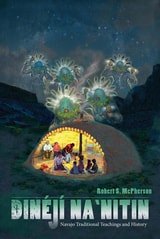
cover of Dinéjí Na`nitin: Navajo Traditional Teachings and History

Dinéjí Na`nitin

Navajo Traditional Teachings and History

Robert S. McPherson

University Press of Colorado, 2012

Traditional teachings derived from stories and practices passed through generations lie at the core of a well-balanced Navajo life. These teachings are based on a very different perspective of the physical and spiritual world than that found in general American culture. Dinéjí Na`nitin is an introduction to traditional Navajo teachings and history for a non-Navajo audience, providing a glimpse into this unfamiliar domain and illuminating the power and experience of the Navajo worldview.

Historian Robert McPherson discusses basic Navajo concepts such as divination, good and evil, prophecy, and metaphorical thought, as well as these topics' relevance in daily life, making these far-ranging ideas accessible to the contemporary reader. He also considers the toll of cultural loss on modern Navajo culture as many traditional values and institutions are confronted by those of dominant society. Using both historical and modern examples, he shows how cultural change has shifted established views and practices and illustrates the challenge younger generations face in maintaining the beliefs and customs their parents and grandparents have shared over generations.

This intimate look at Navajo values and customs will appeal not only to students and scholars of Native American studies, ethnic studies, and anthropology but to any reader interested in Navajo culture or changing traditional lifeways.
[more]
cover of Dionysus, Christ, and the Death of God, Volume 1: The Great Mediations of the Classical World

Dionysus, Christ, and the Death of God, Volume 1

The Great Mediations of the Classical World

Giuseppe Fornari

Michigan State University Press, 2020
This magisterial reflection on the history and destiny of the West compares Greco-Roman civilization and the Judeo-Christian tradition in order to understand what both unites and divides them. Mediation, understood as a collective, symbolic experience, gives society unity and meaning, putting human beings in contact with a universal object known as the world or reality. But unity has a price: the very force that enables peaceful coexistence also makes us prone to conflict. As a result, in order to find a common point of convergence—of at-one-ment—someone must be sacrificed. Sacrifice, then, is the historical pillar of mediation. It was endorsed in a cosmic-religious sense in antiquity and rejected for ethical reasons in modernity, where the Judeo-Christian tradition plays an intermediate role in condemning sacrificial violence as such, while accepting sacrifice as a voluntary act offered to save other human beings. Today, as we face the collapse of all shared mediations, this intermediating solution offers a way out of our moral and cultural plight.
[more]
cover of Dionysus, Christ, and the Death of God, Volume 2: Christianity and Modernity

Dionysus, Christ, and the Death of God, Volume 2

Christianity and Modernity

Giuseppe Fornari

Michigan State University Press, 2020
This magisterial reflection on the history and destiny of the West compares Greco-Roman civilization and the Judeo-Christian tradition in order to understand what both unites and divides them. Mediation, understood as a collective, symbolic experience, gives society unity and meaning, putting human beings in contact with a universal object known as the world or reality. But unity has a price: the very force that enables peaceful coexistence also makes us prone to conflict. As a result, in order to find a common point of convergence—of at-one-ment—someone must be sacrificed. Sacrifice, then, is the historical pillar of mediation. It was endorsed in a cosmic-religious sense in antiquity and rejected for ethical reasons in modernity, where the Judeo-Christian tradition plays an intermediate role in condemning sacrificial violence as such, while accepting sacrifice as a voluntary act offered to save other human beings. Today, as we face the collapse of all shared mediations, this intermediating solution offers a way out of our moral and cultural plight.
[more]
cover of Directions for Mormon Studies in the Twenty-First Century

Directions for Mormon Studies in the Twenty-First Century

Edited by Patrick Q. Mason

University of Utah Press, 2016

A new and exciting era in Mormon studies has emerged from a confluence of factors: an academy more attuned to the significance of religion, the increased public prominence of Mormons and Mormonism, and an increasing number of scholars applying ever-more sophisticated methods to the study of Mormonism. Directions for Mormon Studies in the Twenty-First Century captures this fruitful time by bringing together some of the most influential voices across the generations of Mormon studies. Neither a survey of the field nor a mere recapitulation of dominant themes, this volume charts out areas for exploration and modes of inquiry that reflect the maturation of the field and help set the agenda for the next generation of Mormon studies scholarship.

In previously unpublished essays, the volume’s distinguished authors offer new insights on a number of essential themes: a (re)assessment of twentieth-century Mormonism; the dynamic interplay of Mormonism’s American roots with its international expansion and encounter with global diversity; the ways Mormonism has shaped and been shaped by modern theories and discourses of race; new modes of thinking about the individual Mormon subject; and reflections on theory and method in Mormon studies. These essays display Mormon studies in its emergent interdisciplinarity, with contributions from religious studies, history, economics, literary criticism, sociology, and anthropology. Simultaneously erudite and accessible, the collection will help readers ask new questions and discover new answers.
[more]
cover of Dirshuni: Contemporary Women’s Midrash

Dirshuni

Contemporary Women’s Midrash

Edited by Tamar Biala

Brandeis University Press, 2022

A unique compilation of contemporary women’s midrashim.
 
Dirshuni: Contemporary Women’s Midrash, is the first-ever English edition of a historic collection of midrashim composed by Israeli women, which has been long-anticipated by multiple American audiences, including synagogues, rabbinical seminaries, adult learning programs, Jewish educators, and scholars of gender and religion. Using the classical forms developed by the ancient rabbis, the contributors express their religious and moral thought and experience through innovative interpretations of scripture. The women writers, from all denominations and beyond, of all political stripes and ethnic backgrounds, contribute their Torah to fill the missing half of the sacred Jewish bookshelf. This book reflects dramatic changes in the agency of women in the world of religious writings. The volume features a comprehensive introduction to Midrash for the uninitiated reader by the distinguished scholar Tamar Kadari and extensive annotation and commentary by Tamar Biala.
 
[more]
cover of Disability Rights and Religious Liberty in Education: The Story behind Zobrest v. Catalina Foothills School District

Disability Rights and Religious Liberty in Education

The Story behind Zobrest v. Catalina Foothills School District

Bruce J. Dierenfield and David A. Gerber

University of Illinois Press, 2020

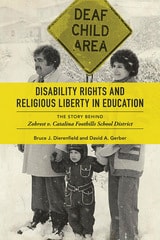
In 1988, Sandi and Larry Zobrest sued a suburban Tucson, Arizona, school district that had denied their hearing-impaired son a taxpayer-funded interpreter in his Roman Catholic high school. The Catalina Foothills School District argued that providing a public resource for a private, religious school created an unlawful crossover between church and state. The Zobrests, however, claimed that the district had infringed on both their First Amendment right to freedom of religion and the Individuals with Disabilities Education Act (IDEA).

Bruce J. Dierenfield and David A. Gerber use the Zobrests' story to examine the complex history and jurisprudence of disability accommodation and educational mainstreaming. They look at the family's effort to acquire educational resources for their son starting in early childhood and the choices the Zobrests made to prepare him for life in the hearing world rather than the deaf community. Dierenfield and Gerber also analyze the thorny church-state issues and legal controversies that informed the case, its journey to the U.S. Supreme Court, and the impact of the high court's ruling on the course of disability accommodation and religious liberty.
[more]
cover of Disarming Manhood: Roots of Ethical Resistance

Disarming Manhood

Roots of Ethical Resistance

David A.J. Richards

Ohio University Press, 2005
Masculine codes of honor and dominance often are expressed in acts of violence, including war and terrorism. In Disarming Manhood: Roots of Ethical Resistance, David A.J. Richards examines the lives of five famous men—great leaders and crusaders—who actively resisted violence and presented their causes with more humane alternatives.Richards argues that Winston Churchill, William Lloyd Garrison, Mohandas Gandhi, Martin Luther King, and Leo Tolstoy shared a psychology whose nonviolent roots were deeply influenced by a loving, maternalistic ethos deeply influenced by the teachings of Jesus of Nazareth. Drawing upon psychology, history, political theory, and literature, Richards threads a connection between these leaders and the maternal figures who profoundly shaped their responses to conflict. Their lives and work underscore how the outlook of maternal care givers and women enables some men to resist the violent responses characteristic of traditional manhood. The voice of nonviolent masculinity has empowered important democratic movements of ethical transformation, including civil disobedience in South Africa, India, and the United States. Disarming Manhood demonstrates that as Churchill, Garrison, Gandhi, King, and Tolstoy carried out their various missions they were galvanized by teachings whose ethical foundations rejected unjust violence and favored peaceful alternatives. Accessibly written and free of jargon, Disarming Manhood's exploration of human nature and maternal bonds will interest a wide audience as it furthers the understanding of human nature itself and contributes to the fields of developmental psychology and feminist scholarship.
[more]
cover of Disciplinary, Moral, and Ascetical Works

Disciplinary, Moral, and Ascetical Works

Catholic University of America Press, 1959
No description available
[more]
cover of Discourse Markers in Early Koine Greek: Cognitive-Functional Analysis and LXX Translation Technique

Discourse Markers in Early Koine Greek

Cognitive-Functional Analysis and LXX Translation Technique

Christopher J. Fresch

SBL Press, 2023

Using a cognitive-functional linguistic framework and cross-linguistic research on discourse markers, Christopher J. Fresch investigates the use of five discourse markers in the documentary papyri of the third to first centuries BCE and the Greek translations of the Hebrew Bible. Through this analysis, Fresch proposes linguistically grounded descriptions for how each discourse marker uniquely functions to guide readers in how they process and comprehend the text. Based on these descriptions, he examines the instances of these discourse markers in the Greek translation of the Minor Prophets and how the translator used them to render the Hebrew text. Fresch presents a picture of a translator who selected discourse markers based on their own understanding of the structure, flow, and meaning of the underlying Hebrew text. Their use attests to a translator who was contextually aware and who desired to produce a translation in idiomatic Koine.
[more]
cover of Discourse on the State and Grandeurs of Jesus: The Ineffable Union of the Diety with Humanity

Discourse on the State and Grandeurs of Jesus

The Ineffable Union of the Diety with Humanity

Pierre de Bérulle

Catholic University of America Press, 2023
Pierre de Bérulle (1575–1629) is one of the foremost personalities of early modern Catholicism. As the founder of the “French school” of spirituality, he has exercised a profound influence on the Church from the seventeenth century to the present day. Until now, however, very little of Bérulle’s writings have been available in English. This volume provides the first complete English translation of his best-known work, first printed in Paris in 1623 and titled Discourses on the State and Grandeurs of Jesus, by the Ineffable Union of the Deity with Humanity, and the Submission and Servitude that Is Due Him and His Most Holy Mother in Response to This Wondrous State. Composed in his maturity, this work expresses Bérulle’s theology of the Man-God, whose self-emptying has enabled us to become “capable” of God. In contrast to other spiritual writers who taught that mystical union with God follows the extinction of all sensory and conceptual awareness and all activity of willing, Bérulle’s focus is on the faithful soul’s participation in what he calls Jesus’ “states,” or inner dispositions. The state that Bérulle describes and honors supremely in this text is Jesus’ state of self-emptying in the mystery of the Incarnation. In the hypostatic union, our humanity in Christ is lifted up to heaven, and Christ is the first fruit of humanity-made-divine, the “firstborn among many brothers.” Through him we become children of God by adoption, participants in God’s divine being. This is an outstanding translation, conveying not only the meaning but also the beauty and rhetorical features of the original. The Discourses will repay reading as a poignant source of personal devotion, a primary text of the Catholic Reformation, and a classic of spiritual theology.
[more]
cover of Discourses against Judaizing Christians

Discourses against Judaizing Christians

Saint John Chrysostom

Catholic University of America Press, 1979
No description available
[more]
cover of Discourses of Empire: The Gospel of Mark from a Postcolonial Perspective

Discourses of Empire

The Gospel of Mark from a Postcolonial Perspective

Hans Leander

SBL Press, 2013

This inventive work explores Mark’s Gospel within the contexts of the empires of Rome and Europe. In a unique dual analysis, the book highlights how empire is not only part of the past but also of a present colonial heritage. The book first outlines postcolonial criticism and discusses the challenges it poses for biblical scholarship, then scrutinizes the complex ways with which nineteenth-century commentaries on Mark’s Gospel interplayed with the formation of European colonial identities. It examines the stance of Mark’s Gospel vis-à-vis the Roman Empire and analyzes the manner in which the fibers of empire within Mark are interwoven, reproduced, negotiated, modified and subverted. Finally, it offers synthesizing suggestions for bringing Mark beyond a colonial heritage. The book’s candid use of postcolonial criticism illustrates how a contemporary perspective can illuminate and shed new light on an ancient text in its imperial setting.
[more]
cover of Discovering the Laws of Life

Discovering the Laws of Life

Sir John Templeton

Templeton Press, 2009

“Truly a legend in our time, John Templeton understands that the real measure of a person's success in life is not a financial accomplishment but moral integrity and inner character.” —Billy Graham
“This book belongs to the list of seminal publications of the twentieth century. How grateful the world will be that John Templeton has shared his secret openly, forthrightly, packed with integrity and healing powers.” —Robert Schuller
 
[more]
cover of Disembodied Souls: The Nefesh in Israel and Kindred Spirits in the Ancient Near East, with an

Disembodied Souls

The Nefesh in Israel and Kindred Spirits in the Ancient Near East, with an

Richard C. Steiner

SBL Press, 2015

A reevaluation of the concept of the soul based on the latest evidence

Biblical scholars have long claimed that the Israelites “could not conceive of a disembodied nefesh [soul].” Steiner rejects that claim based on a broad spectrum of textual, linguistic, archaeological, and anthropological evidence spanning the millennia from prehistoric times to the present. The biblical evidence includes a prophecy of Ezekiel condemning women who pretend to trap the wandering souls of sleeping people. The extrabiblical evidence suggests that a belief in the existence of disembodied souls was part of the common religious heritage of the peoples of the ancient Near East.

Features

  • A re-examination of the evidence for and against disembodied souls in the Hebrew Bible
  • A new look at the nature and behavior of disembodied souls in the Hebrew Bible
  • A new study of the meaning and sociolinguistic background of the Katumuwa inscription

[more]
cover of Disenchanted Lives: Apostasy and Ex-Mormonism among the Latter-day Saints

Disenchanted Lives

Apostasy and Ex-Mormonism among the Latter-day Saints

Brooks, E. Marshall

Rutgers University Press, 2018

The Church of Jesus Christ of Latter-day Saints (LDS or Mormons), often heralded as the fastest growing religion in American history, is facing a crisis of apostasy. Rather than strengthening their faith, the study of church history and scriptures by many members pushes them away from Mormonism and into a growing community of secular ex-Mormons. In Disenchanted Lives, E. Marshall Brooks provides an intimate, in-depth ethnography of religious disenchantment among ex-Mormons in Utah. Showing that former church members were once deeply embedded in their religious life, Brooks argues that disenchantment unfolds as a struggle to overcome the spiritual, social, and ideological devotion ex-Mormons had to the religious community and not out of a lack of dedication as prominently portrayed in religious and scholarly writing on apostasy.  
[more]
cover of Disfiguring: Art, Architecture, Religion

Disfiguring

Art, Architecture, Religion

Mark C. Taylor

University of Chicago Press, 1992
Disfiguring is the first sustained interpretation of the deep but often hidden links among twentieth-century art, architecture, and religion. While many of the greatest modern painters and architects have insisted on the spiritual significance of their work, historians of modern art and architecture have largely avoided questions of religion. Likewise, contemporary philosophers and theologians have, for the most part, ignored visual arts. Taylor presents a carefully structured and subtly nuanced analysis of the religious presuppositions that inform recent artistic theory and practice—and, in doing so, recasts the cultural landscape of our era.
[more]
cover of Dismembering the Whole: Composition and Purpose of Judges 19-21

Dismembering the Whole

Composition and Purpose of Judges 19-21

Cynthia Edenburg

SBL Press, 2016

A fresh literary analysis of political polemic in the Bible

The Book of Judges ends with a bizarre narrative of sex and violence that starts with a domestic tiff and ends with the decimation of a tribe that is restored by means of abduction and rape. Cynthia Edenburg applies a fresh literary analysis, recent understandings of historical linguistics, and historical geography in her exploration of the origin of the anti-Benjamin polemic found in Judges 19–21, the growth and provenance of the book of Judges, and the shape of the Deuteronomistic History. Her study exposes how Judges 19–21 function as political polemic reflecting not the pre-monarchic period but instead the historical realities of the settlement of Benjamin during the Babylonian and Persian period.

Features:

  • Methodological discussions that open each chapter
  • Charts and tables
  • Engagement with current research produced by scholars from around the world
[more]
cover of Dispatches from the Front: Theological Engagements with the Secular

Dispatches from the Front

Theological Engagements with the Secular

Stanley Hauerwas

Duke University Press, 1994

God knows it is hard to make God boring, Stanley Hauerwas writes, but American Christians, aided and abetted by theologians, have accomplished that feat. Whatever might be said about Hauerwas—and there is plenty—no one has ever accused him of being boring, and in this book he delivers another jolt to all those who think that Christian theology is a matter of indifference to our secular society.
At once Christian theology and social criticism, this book aims to show that the two cannot be separated. In this spirit, Hauerwas mounts a forceful attack on current sentimentalities about the significance of democracy, the importance of the family, and compassion, which appears here as a literally fatal virtue. In this time of the decline of religious knowledge, when knowing a little about a religion tends to do more harm than good, Hauerwas offers direction to those who would make Christian discourse both useful and truthful. Animated by a deep commitment, his essays exhibit the difference that Christian theology can make in the shaping of lives and the world.
[more]
cover of Dispelling Fantasies: Authors of Color Reimagine a Genre

Dispelling Fantasies

Authors of Color Reimagine a Genre

Joy Sanchez-Taylor

The Ohio State University Press, 2025

In Dispelling Fantasies, Joy Sanchez-Taylor examines how authors of color, such as R. F. Kuang, N. K. Jemisin, Nnedi Okorafor, Tomi Adeyemi, Tasha Suri, Aiden Thomas, Nghi Vo, and Marlon James, among others, offer critical counterpoints to the history of white-dominated, Eurocentric fantasy. The traditional fantasy that these authors are writing against reinforces Christian virtues and colonial, white supremacist structures; Sanchez-Taylor argues that its racial tropes are tied to a history of colonization and Christian missionary practices, with popular fantasy narratives often depicting Indigenous groups as primitive, deviant peoples in need of salvation. Such representations are based on a Western binary of rational versus magical and are influenced by tenets of Christianity, ultimately contributing to depictions of “the dark fantastic” or fantasy worlds where dark and othered characters are implicitly portrayed as evil and irredeemable. Organized around four Christian ideals that appear frequently in Western fantasy texts—virtue, envy, patriarchy, and salvation—Dispelling Fantasies demonstrates how non-Eurocentric fantasy worlds offer alternative versions of morality, race, gender, and sexuality and make space for authors to move away from hierarchical, binary systems of good and evil.
[more]
cover of Displacing Christian Origins: Philosophy, Secularity, and the New Testament

Displacing Christian Origins

Philosophy, Secularity, and the New Testament

Ward Blanton

University of Chicago Press, 2007

Recent critical theory is curiously preoccupied with the metaphors and ideas of early Christianity, especially the religion of Paul. The haunting of secular thought by the very religion it seeks to overcome may seem surprising at first, but Ward Blanton argues that this recent return by theorists to the resources of early Christianity has precedent in modern and ostensibly secularizing philosophy, from Kant to Heidegger.

Displacing Christian Origins traces the current critical engagement of Agamben, Derrida, and Žižek, among others, back into nineteenth- and early-twentieth-century philosophers of early Christianity. By comparing these crucial moments in the modern history of philosophy with exemplars of modern biblical scholarship—David Friedrich Strauss, Adolf Deissmann, and Albert Schweitzer—Blanton offers a new way for critical theory to construe the relationship between the modern past and the biblical traditions to which we seem to be drawn once again.

An innovative contribution to the intellectual history of biblical exegesis, Displacing Christian Origins will promote informed and fruitful debate between religion and philosophy. 
[more]
cover of Disquiet in the Land: Cultural Conflict in American Mennonite Communities

Disquiet in the Land

Cultural Conflict in American Mennonite Communities

Kniss, Fred

Rutgers University Press, 1997

Mennonites have long referred to themselves as "The Quiet in the Land," but their actual historical experience has been marked by internal disquiet and contention over religious values and cultural practice. As Fred Kniss argues in his impressive study of Mennonite history, the story of this sectarian pacifist group is a story of conflict. How can we understand the ironic phenomenon of Mennonite conflict? How do ideas and symbols-both those of the American mainstream and those that are specifically Mennonite-influence the emergence and course of this conflict? What is the relationship betweenintra-Mennonite conflict and the changing historical context in which Mennonites are situated?

Through a rigorous analysis of a century of disputes over dress codes, congregational authority, and religious practice, Kniss offers the tools both to understand conflict within a specific religious group and to answer larger questions about culture, ideology, and social and historical change.
[more]
cover of Dissent in American Religion: Revised Edition

Dissent in American Religion

Revised Edition

Edwin Scott Gaustad

University of Chicago Press, 2006

Dissent in American Religion, originally published in 1973, was the first book to present religious dissent in the United States as a pervasive but hidden and often-ignored stream in American life. The first volume in the Chicago History of American Religion series, it reviewed the history of our nation’s longest dissenting tradition—a tradition older and richer in the realm of religion than in any other facet of national life. Indeed, Edwin Scott Gaustad argued that religious dissent was essential to the character of the American religious experience and stood in profound disagreement with society’s orthodox values and beliefs.

This new edition, which reinaugurates the Chicago History of American Religion series under the new editorship of John Corrigan, features new commentary by Gaustad and Corrigan on the past thirty years of American religious history and the importance of understanding dissent in American religion today.

“This is an important and erudite work which shows the originality and scope which scholarship can bring to human experience.” —Los Angeles Times

“We shall understand the religious past and present better for reading Gaustad’s brief, well-written, helpful book.” —Commonweal
[more]
cover of Dissociated Identities: Ethnicity, Religion, and Class in an Indonesian Society

Dissociated Identities

Ethnicity, Religion, and Class in an Indonesian Society

Rita Smith Kipp

University of Michigan Press, 1996

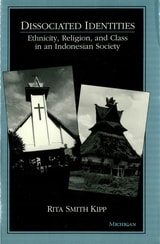
Placing theories of ethnicity and religious pluralism in relation to theories of the state, Rita Smith Kipp in Dissociated Identities situates a particular Indonesian people, the Karo, in the modern world. What the state's policies on culture and religion mean to Karo women and men, who now live in cities throughout Indonesia as well as in their Sumatran homeland, becomes clear only by looking at the way Karo families and communities contend with religious pluralism, with the pull of tradition working against the wish to be "modern," and with the new wealth differences in their midst. Newly discrete facets of Karo selfhood -- ethnic, religious, and economic -- replicate in microcosm the political tensions of the nation-state, revealing both why the New Order has enjoyed great stability over almost three decades and the sources of disruption that may lie ahead.
[more]
cover of Distant Islands: The Japanese American Community in New York City, 1876-1930s

Distant Islands

The Japanese American Community in New York City, 1876-1930s

Daniel H. Inouye

University Press of Colorado, 2018

Distant Islands is a modern narrative history of the Japanese American community in New York City between America's centennial year and the Great Depression of the 1930s. Often overshadowed in historical literature by the Japanese diaspora on the West Coast, this community, which dates back to the 1870s, has its own fascinating history.
 
The New York Japanese American community was a composite of several micro communities divided along status, class, geographic, and religious lines. Using a wealth of primary sources—oral histories, memoirs, newspapers, government documents, photographs, and more—Daniel H. Inouye tells the stories of the business and professional elites, mid-sized merchants, small business owners, working-class families, menial laborers, and students that made up these communities. The book presents new knowledge about the history of Japanese immigrants in the United States and makes a novel and persuasive argument about the primacy of class and status stratification and relatively weak ethnic cohesion and solidarity in New York City, compared to the pervading understanding of nikkei on the West Coast. While a few prior studies have identified social stratification in other nikkei communities, this book presents the first full exploration of the subject and additionally draws parallels to divisions in German American communities.
 
Distant Islands is a unique and nuanced historical account of an American ethnic community that reveals the common humanity of pioneering Japanese New Yorkers despite diverse socioeconomic backgrounds and life stories. It will be of interest to general readers, students, and scholars interested in Asian American studies, immigration and ethnic studies, sociology, and history.

Winner- Honorable Mention, 2018 Immigration and Ethnic History Society First Book Award
[more]
cover of Disturbers of the Twentieth Century: Catholic Social Critics in Modern Britain

Disturbers of the Twentieth Century

Catholic Social Critics in Modern Britain

Adam Schwartz

Catholic University of America Press, 2026
Building on his acclaimed The Third Spring, Adam Schwartz presents a pioneering analysis of the social commentary of G. K. Chesterton, Graham Greene, Christopher Dawson, and David Jones. These four converts were exemplars of the Catholic literary revival as a “counter-politics” that provided a radical, supernaturalist alternative to predominant secularist social ideologies and systems from a distinctly Roman Catholic standpoint.  Disturbers of the Twentieth Century explores this facet of each writer’s work more thoroughly than earlier studies have done, and does so in comparison to his counterparts’ thought.  The Catholic literary revival hence emerges as a vital, yet largely neglected, voice in historical and sociological discussions of the relationship between religion and politics in the modern era. In the process, Schwartz uniquely situates these Catholic authors in broader heritages of British and Western protest thought dating to the Romantics, showing how their shared resistance to industrial technocracy (and its socio-political effects) and growing secularization was defined distinctively by Roman Catholicism.  The converts’ challenge was bolder than post-Reformation British Catholics had usually uttered in an often-hostile political culture.  Nonetheless this quartet’s criticism was always constructive, as they eschewed nostalgia and endeavored consciously to engage twentieth century society in its particular genres and discrete conditions to transform it into an “alternative modernity” governed by Roman Catholic principles. Schwartz therefore recasts understanding of movements like Chesterton’s distributism while elucidating originally other counterstatements, such as Dawson’s Christian corporatism, and deploying newly discovered and published material, including poetry and prose by Jones and letters and journalism by Greene.  Schwartz in turn interrogates misconstruals of the authors’ relationships to totalitarian ideologies, even as he confronts forthrightly controversial subjects such as antisemitism.  Disturbers of the Twentieth Century is thus an accurate, textured account of the “public doctrine” these trenchant Catholics proposed as the source of social renewal and cultural regeneration for a “century of bones.”
[more]
cover of Disturbing Revelation: Leo Strauss, Eric Voegelin, and the Bible

Disturbing Revelation

Leo Strauss, Eric Voegelin, and the Bible

John J. Ranieri

University of Missouri Press, 2009
Political philosophers Leo Strauss and Eric Voegelin share an abiding interest in the Judeo-Christian tradition. In Disturbing Revelation, the first book to focus on their treatment of the Bible, John Ranieri explores how they draw on its texts in their philosophies and shows what these considerations say about whether the combination of religion and politics leads to violence or can prevent it.
            In addressing fundamental questions of reason and revelation, Ranieri focuses not on Strauss’s treatment of Judaism or Voegelin’s of Christianity, but rather on the place of the Bible in their thought. He first examines the differences between their methodological approaches and attitudes toward the Bible and biblical criticism—rather than their attitudes toward religion or questions of faith—and then explores in depth their interpretations of the biblical message and its contribution to the modern world.
Ranieri shows how both men recognized that biblical texts must be seriously engaged in order for us to understand our contemporary situation—but that their appreciation of the Bible is marked by deep ambivalence concerning its vision of life and its influence on the political sphere. He brings their thought into conversation with that of René Girard, whose writings on violence and religion shed light on the problems that arise when biblical insights take root in a culture, and also offers fresh insight into Strauss’s elusive writings, such as his indebtedness to Nietzsche.
            Disturbing Revelation reveals how Strauss and Voegelin viewed the applicability of biblical texts to what they considered the crisis of modernity without belaboring questions of their own personal faith. It is a clearly written exposition that reflects a rich understanding of the work of these thinkers and is as provocative as it is informative, not only for students of the two men but also for anyone interested in the relationship between philosophy and religious belief.
[more]
cover of Divas in the Convent: Nuns, Music, and Defiance in Seventeenth-Century Italy

Divas in the Convent

Nuns, Music, and Defiance in Seventeenth-Century Italy

Craig A. Monson

University of Chicago Press, 2012
When eight-year-old Lucrezia Orsina Vizzana (1590–1662) entered one of the preeminent convents in Bologna in 1598, she had no idea what cloistered life had in store for her. Thanks to clandestine instruction from a local maestro di cappella—and despite the church hierarchy’s vehement opposition to all convent music—Vizzana became the star of the convent, composing works so thoroughly modern and expressive that a recent critic described them as “historical treasures.” But at the very moment when Vizzana’s works appeared in 1623—she would be the only Bolognese nun ever to publish her music—extraordinary troubles beset her and her fellow nuns, as episcopal authorities arrived to investigate anonymous allegations of sisterly improprieties with male members of their order.
           
Craig A. Monson retells the story of Vizzana and the nuns of Santa Cristina to elucidate the role that music played in the lives of these cloistered women. Gifted singers, instrumentalists, and composers, these nuns used music not only to forge links with the community beyond convent walls, but also to challenge and circumvent ecclesiastical authority. Monson explains how the sisters of Santa Cristina—refusing to accept what the church hierarchy called God’s will and what the nuns perceived as a besmirching of their honor—fought back with words and music, and when these proved futile, with bricks, roof tiles, and stones. These women defied one Bolognese archbishop after another, cardinals in Rome, and even the pope himself, until threats of excommunication and abandonment by their families brought them to their knees twenty-five years later. By then, Santa Cristina’s imaginative but frail composer literally had been driven mad by the conflict.
           
Monson’s fascinating narrative relies heavily on the words of its various protagonists, on both sides of the cloister wall, who emerge vividly as imaginative, independent-minded, and not always sympathetic figures. In restoring the musically gifted Lucrezia Orsina Vizzana to history, Monson introduces readers to the full range of captivating characters who played their parts in seventeenth-century convent life.
 
[more]
cover of Divergent Paths of the Restoration: An Encyclopedia of the Smith–Rigdon Movement

Divergent Paths of the Restoration

An Encyclopedia of the Smith–Rigdon Movement

Steven L. Shields

Signature Books, 2021

When Joseph Smith founded the Church of Christ in 1830, he declared it to be God’s restoration of true Christianity, the Kingdom of God on earth. Although he foresaw opposition to such bold claims, he could not fathom that time and unforeseen circumstances would help to spawn hundreds of off-shoots and competing denominations—all claiming their origins in a movement born and sustained originally by Smith and Sidney Rigdon. Many of these groups have endured and boast multiple congregations of believers in many countries; others came and went quickly and have long since been forgotten. Some have survived but have only appealed to a handful of believers. Steven L Shields has for decades chronicled the various origins and paths of all known Restoration movements. This fifth edition of his encyclopedic study, offered as an ebook, includes recent groups born as internet communities. That so many groups and individuals have been unsatisfied with the more mainstream Mormon churches, yet cling to tenets of the Smith–Rigdon movement, speaks to the strengths of the restoration concept and the naïve view that one denomination can successfully meet all the needs of believers. 
[more]