Results by title
18284 books match the query 'United States' and 684 start with d
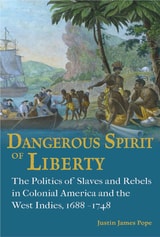
Dangerous Spirit of Liberty
The Politics of Slaves and Rebels in Early America and the West Indies, 1688-1748Justin James Pope
University of Missouri Press, 2024
Dangerous Spirit of Liberty's distinguishing feature is its focus on the role of communication in the development of a rebellious early eighteenth-century Atlantic. Most historians of slavery have presupposed that slave unrest was confined to small locales in the first half of the eighteenth century. In fact, slaves found ways to share news across provinces to great effect. Benefiting from research in the archives of Great Britain, Spain, Barbados, Bermuda, Jamaica, Antigua, the U.S. Virgin Islands, and the mainland United States, the book reveals new evidence of slave communication networks and shows how people of African ancestry shared rumors of emancipation and rebellion in this period. Slaves laboring in colonial commerce and working aboard ships helped foster an increasingly restive Black community. Banished slaves, convicted conspirators accused of plotting insurrection, carried their experiences with them in exile to neighboring colonies. By reconstructing the path of news, the book reveals rumors and reports that particularly resonated among slaves in the early eighteenth century.
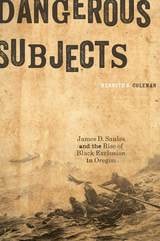
Dangerous Subjects
James D. Saules and the Rise of Black Exclusion in OregonKenneth R. Coleman
Oregon State University Press, 2017
In Oregon, Saules encountered a multiethnic population already transformed by colonialism—in particular, the fur industry and Protestant missionaries. Once the Oregon Trail emigrants began arriving in large numbers, in 1843, Saules had to adapt to a new reality in which Anglo-American settlers persistently sought to marginalize and exclude black residents from the region. Unlike Saules, who adapted and thrived in Oregon’s multiethnic milieu, the settler colonists sought to remake Oregon as a white man’s country. They used race as shorthand to determine which previous inhabitants would be included and which would be excluded. Saules inspired and later had to contend with a web of black exclusion laws designed to deny black people citizenship, mobility, and land.
In Dangerous Subjects, Kenneth Coleman sheds light on a neglected chapter in Oregon’s history. His book will be welcomed by scholars in the fields of western history and ethnic studies, as well as general readers interested in early Oregon and its history of racial exclusion.
Dangerous Writing
Understanding the Political Economy of CompositionTony Scott
Utah State University Press, 2009
Since the 1980s and the “social turn” in composition studies and other disciplines, scholars in this field have conceived writing in college as explicitly embedded in socio-rhetorical situations beyond the classroom. From this conviction develops a commitment to teach writing with an emphasis on analyzing the social and political dimensions of rhetoric.
Ironically, though a leftist himself, Tony Scott’s analysis finds the academic left complicit with the forces in American culture that tend, in his view, to compromise education. By focusing on the structures of labor and of institutions that enforce those structures, Scott finds teachers and administrators are too easily swept along with the inertia of a hyper-commodified society in which students---especially working class students---are often positioned as commodities, themselves. Dangerous Writing, then, is a critique of the field as much as it is a critique of capitalism. Ultimately, Scott’s eye is on the institution and its structures, and it is these that he finds most in need of transformation.
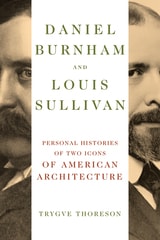
Daniel Burnham and Louis Sullivan
Personal Histories of Two Icons of American ArchitectureTrygve Thoreson
University of Illinois Press, 2026
An engaging piece of nonfiction storytelling, Daniel Burnham and Louis Sullivan reveals new facets of the architects’ personal, intellectual, and artistic lives.
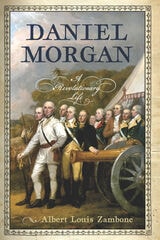
Daniel Morgan
A Revolutionary LifeAlbert Louis Zambone
Westholme Publishing, 2018
On January 17, 1781, at Cowpens, South Carolina, the notorious British cavalry officer Banastre Tarleton and his legion had been destroyed along with the cream of Lord Cornwallis’s troops. The man who planned and executed this stunning American victory was Daniel Morgan. Once a barely literate backcountry laborer, Morgan now stood at the pinnacle of American martial success. Born in New Jersey in 1736, he left home at seventeen and found himself in Virginia’s Shenandoah Valley. There he worked in mills and as a teamster, and was recruited for Braddock’s disastrous expedition to take Fort Duquesne from the French in 1755. When George Washington called for troops to join him at the siege of Boston in 1775, Morgan organized a select group of riflemen and headed north. From that moment on, Morgan’s presence made an immediate impact on the battlefield and on his superiors. Washington soon recognized Morgan’s leadership and tactical abilities. When Morgan’s troops blocked the British retreat at Saratoga in 1777, ensuring an American victory, he received accolades from across the colonies.
In Daniel Morgan: A Revolutionary Life, the first biography of this iconic figure in forty years, historian Albert Louis Zambone presents Morgan as the quintessential American everyman, who rose through his own dogged determination from poverty and obscurity to become one of the great battlefield commanders in American history. Using social history and other advances in the discipline that had not been available to earlier biographers, the author provides an engrossing portrait of this storied personality of America’s founding era—a common man in uncommon times.
Daniel Shays's Honorable Rebellion
An American StoryDaniel Bullen
Westholme Publishing, 2024
Daniel Shays’s Honorable Rebellion: An American Story by Daniel Bullen tells the history of the crisis from the protesters’ perspective. Through five months of nonviolent protests, the farmers kept courts throughout Massachusetts from hearing foreclosures, facing down threats from the government, which escalated to the point that Governor James Bowdoin ultimately sent an army to arrest them. Even so, the people won reforms in an electoral landslide.
Thomas Jefferson called these protests an honorable rebellion, and hoped that Americans would never let twenty years pass without such a campaign, to rein in powerful interests. This riveting and meticulously researched narrative shows that Shays and his fellow protesters were hardly a dangerous rabble, but rather a proud people who banded together peaceably, risking their lives for justice in a quintessentially American story.
Daniel Webster and the Oratory of Civil Religion
Craig R. Smith
University of Missouri Press, 2005

Daniel Webster, “The Completest Man”
Documents from The Papers of Daniel WebsterEdited by Kenneth E. Shewmaker and Daniel Webster
Brandeis University Press, 1993
Danny Litwhiler
Living the Baseball DreamDaniel Litwhiler
Temple University Press, 2006
Dardanelle and the Bottoms
Environment, Agriculture, and Economy in an Arkansas River Community, 1819-1970Mildred D. Gleason
University of Arkansas Press, 2017
A reciprocal relationship between the town and the Bottoms formed the economic backbone on which the area’s well-being was balanced. The country people came to town on Saturdays to buy their groceries and supplies, to shop and take in a movie or visit the pool halls or barbershops. Merchants relied heavily on this country trade and had a long history of extending credit, keeping prices reasonable, and offering respect and appreciation to their customers.
This interdependence, stable for decades, began to unravel in the late 1940s with changes in farming, particularly the cotton industry. In Dardanelle and the Bottoms, Mildred Diane Gleason explores this complex rural/town dichotomy, revealing and analyzing key components of each area, including aspects of race, education, the cotton economy and its demise, the devastation of floods and droughts, leisure, crime, and the impact of the Great Depression.
Dare the School Build a New Social Order?
George S. Counts. Preface by Wayne J. Urban
Southern Illinois University Press, 1978
George S. Counts was amajor figure in American education for almost fifty years. Republication of this early (1932) work draws special attention to Counts’s role as a social and political activist. Three particular themes make the book noteworthy because of their importance in Counts’s plan for change as well as for their continuing contemporary importance: (1)Counts’s criticism of child-centered progressives; (2) the role Counts assigns to teachers in achieving educational and social reform; and (3) Counts’s idea for the reform of the American economy.
Darger's Resources
Michael Moon
Duke University Press, 2012
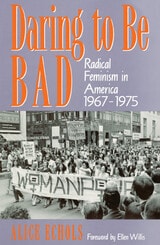
Daring To Be Bad
Radical Feminism in America 1967-1975Alice Echols
University of Minnesota Press, 1989
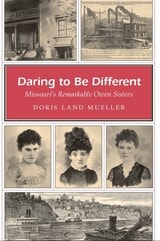
Daring to Be Different
Missouri's Remarkable Owen SistersDoris Land Mueller
University of Missouri Press, 2010
In the 1800s, American women were largely restricted to the private sphere. Most had no choice but to spend their lives in the home, marrying in their teens and living only as wives, mothers, and pillars of domesticity. Even as the women’s movement came along midcentury, it focused more on gaining legal and political rights for women than on expanding their career opportunities. So in that time period, in which the options and expectations for women’s professional lives were so limited, it is remarkable that three sisters born in the 1850s, the Owen daughters of Missouri, all achieved success and appreciation in their careers.

Daring to Care
American Nursing and Second-Wave FeminismSusan Gelfand Malka
University of Illinois Press, 2007
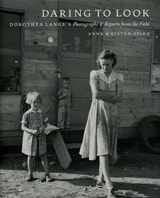
Daring to Look
Dorothea Lange's Photographs and Reports from the FieldAnne Whiston Spirn
University of Chicago Press, 2009
Daring to Look presents never-before-published photos and captions from Dorothea Lange’s fieldwork in California, the Pacific Northwest, and North Carolina during 1939. Lange’s images of squatter camps, benighted farmers, and stark landscapes are stunning, and her captions—which range from simple explanations of settings to historical notes and biographical sketches—add unexpected depth, bringing her subjects and their struggles unforgettably to life, often in their own words.
When Lange was dismissed from the Farm Security Administration at the end of 1939, these photos and field notes were consigned to archives, where they languished, rarely seen. With Daring to Look, Anne Whiston Spirn not only returns them to the public eye, but sets them in the context of Lange’s pioneering life, work, and struggle for critical recognition—firmly placing Lange in her rightful position at the forefront of American photography.
“A thoughtful and meticulously researched account of Lange’s career. . . . Spirn, a photographer herself, traces Lange’s path, visiting her locations and subjects in a fascinating series of ‘then and now’ shots.”—Publishers Weekly
“Dorothea Lange has long been regarded as one of the most brilliant photographic witnesses we have ever had to the peoples and landscapes of America, but until now no one has fully appreciated the richness with which she wove images together with words to convey her insights about this nation. We are lucky indeed that Anne Whiston Spirn, herself a gifted photographer and writer, has now recovered Lange’s field notes and woven them into a rich tapestry of texts and images to help us reflect anew on Lange’s extraordinary body of work.”—William Cronon, author of Nature’s Metropolis

Dark Borders
Film Noir and American CitizenshipJonathan Auerbach
Duke University Press, 2011
Dark Carnival
The Secret World of Tod Browning, Hollywood’s Master of the MacabreDavid J. Skal
University of Minnesota Press, 2025
The definitive biography of Hollywood horror legend Tod Browning—now revised and expanded with new material
One of the most original and unsettling filmmakers of all time, Tod Browning (1880–1962) began his career buried alive in a carnival sideshow and saw his Hollywood reputation crash with the box office disaster–turned–cult classic Freaks. Penetrating the secret world of “the Edgar Allan Poe of the cinema,” Dark Carnival excavates the story of this complicated, fiercely private man. In this newly revised and expanded edition of their biography first published in 1995, David J. Skal and Elias Savada researched Browning’s recently unearthed scrapbooks and photography archives to add further nuance and depth to their previous portrait of this enigmatic artist.
Skal and Savada chronicle Browning’s turn-of-the-century flight from an eccentric Louisville family into the realm of carnivals and vaudeville, his disastrous first marriage, his rapid climb to riches in the burgeoning silent film industry, and the alcoholism that would plague him throughout his life. They offer a close look at Browning’s legendary collaborations with Lon Chaney and Bela Lugosi as well as the studio politics that brought his remarkable run to an inglorious conclusion. With a revised prologue, epilogue, filmography, and new text and illustrations throughout, Dark Carnival is an unparalleled account of a singular filmmaker and an illuminating depiction of the evolution of horror and the early film industry.
Dark Continent Of Our Bodies
Black Feminism & Politics Of RespectabilityE. Frances White
Temple University Press, 2001
White's powerful introduction draws on oral narratives from her own family history to illuminate the nature of narrative, both what is said and what is left unsaid. She then sets the historical stage with a helpful history of the inception and development of black feminism and a critique of major black feminist writings. In the three chapters that follow, she addresses the obstacles black feminism has already surmounted and must continue to traverse. Confronting what White calls "the politics of respectability," these chapters move the reader from simplistic views of race and gender in the nineteenth century through black nationalism and the radical movements of the sixties, and their relationship to feminist thought, to the linkages between race, gender, and sexuality in the works of such giants as Toni Morrison and James Baldwin. No one who finishes Dark Continent of Our Bodies will look at race and gender in the same way again.
Dark Days in the Newsroom
McCarthyism Aimed at the PressEdward Alwood
Temple University Press, 2007
Dark Days in the Newsroom traces how journalists became radicalized during the Depression era, only to become targets of Senator Joseph McCarthy and like-minded anti-Communist crusaders during the 1950s. Edward Alwood, a former news correspondent describes this remarkable story of conflict, principle, and personal sacrifice with noticeable élan. He shows how McCarthy's minions pried inside newsrooms thought to be sacrosanct under the First Amendment, and details how journalists mounted a heroic defense of freedom of the press while others secretly enlisted in the government's anti-communist crusade.
Relying on previously undisclosed documents from FBI files, along with personal interviews, Alwood provides a richly informed commentary on one of the most significant moments in the history of American journalism. Arguing that the experiences of the McCarthy years profoundly influenced the practice of journalism, he shows how many of the issues faced by journalists in the 1950s prefigure today's conflicts over the right of journalists to protect their sources.
Dark December
The Full Account of the Battle of the BulgeRobert E. Merriam
Westholme Publishing, 2011
One of the Most Important Histories of the Greatest Battle on the Western Front in World War II
“Dark December occupies a distinguished place among war books. Every paragraph is based upon evidence, not flimsy wartime rumors. Technical enough for the professional, accurate enough for the historian (in fact, it is history of the best), it is lucid and understandable for the general reader.”—New York Herald Tribune
“If other veterans of the Army’s historical division can maintain Mr. Merriam’s high standard of stimulating, critical and painstaking work, we will be fortunate. Dark December can be heartily recommended to anyone faintly interested in the war.”—New York Times
“The book explodes a number of myths which have been winning their improper way into general belief.” —Arthur Schlesinger, Jr., Booklist
The massive German counteroffensive through Belgium’s Ardennes forest in December 1944 took the American and British armies by surprise and changed the outcome of the war. With whole divisions destroyed and decimated, the American army scrambled to contain the German threat, while also trying to determine how such an attack had gone undetected. The Americans succeeded in winning the month-long battle, commonly known as the Battle of the Bulge, through the tenacity of several pockets of troops, notably those in the Belgian town of Bastogne, and the remarkable rapid movement of Patton’s Third Army to seal the breech in the American lines. The battle stalled the British and American advances and lengthened the war with the result that the Soviet Union was able to make greater gains in Europe than previously anticipated. Dark December is a thorough and engrossing examination of the Battle of the Bulge by a historian who had the opportunity to prepare notes as the battle was occurring and consult classified American as well as German records. Notably, the book contains unique and critical information, including details gleaned from interviews conducted by the author with commanding officers on both sides, some of which are the only reports gathered from these sources. Originally published in 1947, this the first paperback edition with the complete original text and maps.
Dark Designs and Visual Culture
Michele Wallace
Duke University Press, 2004
Beginning with a new introduction in which Wallace reflects on her life and career, this volume includes other autobiographical essays; articles focused on popular culture, the arts, and literary theory; and explorations of issues in black visual culture. Wallace discusses growing up in Harlem; how she dealt with the media attention and criticism she received for Black Macho and the Myth of the Superwoman, which was published when she was just twenty-seven years old; and her relationship with her family, especially her mother, the well-known artist Faith Ringgold. The many articles devoted to black visual culture range from the historical tragedy of the Hottentot Venus, an African woman displayed as a curiosity in nineteenth-century Europe, to films that sexualize the black body—such as Watermelon Woman, Gone with the Wind, and Paris Is Burning. Whether writing about the Anita Hill–Clarence Thomas hearings, rap music, the Million Man March, Toshi Reagon, multiculturalism, Marlon Riggs, or a nativity play in Bedford Stuyvesant, Wallace is a bold, incisive critic. Dark Designs and Visual Culture brings the scope of her career and thought into sharp focus.
Dark Directions
Romero, Craven, Carpenter, and the Modern Horror FilmKendall R. Phillips
Southern Illinois University Press, 2012
A Nightmare on Elm Street. Halloween. Night of the Living Dead. These films have been indelibly stamped on moviegoers’ psyches and are now considered seminal works of horror. Guiding readers along the twisted paths between audience, auteur, and cultural history, author Kendall R. Phillips reveals the macabre visions of these films’ directors in Dark Directions: Romero, Craven, Carpenter, and the Modern Horror Film.
Phillips begins by analyzing the works of George Romero, focusing on how the body is used cinematically to reflect the duality between society and chaos, concluding that the unconstrained bodies of the Living Dead films act as a critical intervention into social norms. Phillips then explores the shadowy worlds of director Wes Craven. In his study of the films The Serpent and the Rainbow, Deadly Friend, Swamp Thing, Red Eye, and Shocker, Phillips reveals Craven’s vision of technology as inherently dangerous in its ability to cross the gossamer thresholds of the gothic. Finally, the volume traverses the desolate frontiers of iconic director John Carpenter. Through an exploration of such works as Halloween, The Fog, and In the Mouth of Madness, Phillips delves into the director’s representations of boundaries—and the haunting consequences for those who cross them.
The first volume ever to address these three artists together, Dark Directions is a spine-tingling and thought-provoking study of the horror genre. In analyzing the individual works of Romero, Craven, and Carpenter, Phillips illuminates some of the darkest minds in horror cinema.

Dark End Of The Street
Margins in American Vanguard PoetryMaria Damon
University of Minnesota Press, 1993
Damon foregrounds a number of modern American poets work and lives in order to argue that the American avant-garde is located in the experimental literary works of social "outsiders." Discussed is the work of Black/Jewish surrealist street poet Bob Kaufman, Boston-Brahmin Robert Lowell and three teenaged women writing from a South Boston housing project, pre-Stonewall gay poets Jack Spicer and Robert Duncan, and Jewish lesbian-in-exile Gertrude Stein.
"An engaging and important book. Damon's sophisticated, theoretical approaches to American verse, coupled with her fresh, writerly style in The Dark End of The Street, put her on the forefront of American poetry's next generation of literary criticism." -American Literature"A work of art as well as a work of criticism. Addresses important questions about art and social life, about the margins and the center, and about oppression and suppression." -George Lipsitz
Dark Governance
Illegal Organizations and State PowerJavier Auyero
University of Chicago Press, 2027
A revelatory account of the ways covert, nefarious relationships between state officials and criminal groups shape daily life for all.
Far too often, the line between legal and illegal action is crossed by actors and organizations on both sides of the law. From the old Chicago Machine getting rich off criminal activity to Mexican drug cartels placing politicians in office, these relationships between criminals and the government coordinate forms of power in ways that affect where people live, what opportunities they can pursue, how they spend money, and how they treat one another. In Dark Governance, sociologist Javier Auyero describes how this kind of governance works and what it means for civic life.
Auyero analyzes instances of dark governance, including gangs in Ecuador and paramilitaries in Colombia who exert territorial control through violent specialists and government actors. He then turns to the less-studied case of the “colectivos” in Venezuela to show the scope of political work clandestine connections can achieve by thwarting grassroots organizations. In El Salvador and Honduras, the ties between gang members on the one hand, and politicians and elected officials on the other, serve to illustrate the impact dark governance has on urban spatial arrangements and on electoral campaigns. Dark Governance also offers an in-depth study of police-trafficker collusion in Argentina, which allows Auyero to identify the ways covert connections between state actors and drug traffickers operate in marginalized communities, affecting interpersonal violence. In addition to these examples in Latin America, Auyero also shares case studies in the United States and China. Dark governance can be seen in US organizations that patrol the borders and assert their control over migrants through their illicit connections with state authorities. In China, land expropriation and development projects are sometimes delayed when some households refuse to leave their properties. Enter the thugs-for-hire frequently contracted by local governments across the country to coerce residents into complying with government orders.
Demonstrating the very real effects of dark governance, Auyero argues that though the organizations involved in these dark arrangements differ, their collaboration results in a singular effect: the ability to control populations. But when these relationships come out of the shadows, collective action can bring them down.
Dark Matters
On the Surveillance of BlacknessSimone Browne
Duke University Press, 2015
Dark Mirror
African Americans and the Federal Writers' ProjectJ. J. Butts
The Ohio State University Press, 2021
Dark Twins
Imposture and Identity in Mark Twain's AmericaSusan Gillman
University of Chicago Press, 1989
Gillman shows that laws regulating race classification, paternity, and rape cases underwrite Twain's critical exploration of racial and sexual difference in the writings of the 1890s and after, most strikingly in the little-known manuscripts that Gillman calls the "tales of transvestism." The "pseudoscience" of spiritualism and the "science" of psychology provide the cultural vocabularies essential to Twain's fantasy and science fiction writings of his last two decades. Twain stands forth finally as a representative man, not only a child of his culture, but also as one implicated in a continuing American anxiety about freedom, race, and identity.
Dark Victorians
Vanessa D. Dickerson
University of Illinois Press, 2007

Dark Victory
The United States and Global PovertyWalden Bello
Pluto Press, 1999
Dark Voices
W. E. B. Du Bois and American Thought, 1888-1903Shamoon Zamir
University of Chicago Press, 1995
Bringing to light materials from the Du Bois archives that have not been discussed before, Shamoon Zamir explores Du Bois's deep engagement with American and European philosophy and social science. He examines the impact on Du Bois of his studies at Harvard with William James and George Santayana, and shows how the experience of post-Reconstruction racism moved Du Bois from metaphysical speculation to the more instrumentalist knowledge of history and the new discipline of sociology, as well as toward the very different kind of understanding embodied in the literary imagination. Providing a new and detailed reading of The Souls of Black Folk in comparison with Hegel's Phenomenology of Mind, Zamir challenges accounts that place Du Bois alongside Emerson and James, or characterize him as a Hegelian idealist. This reading also explores Du Bois's relationship to African American folk culture, and shows how Du Bois was able to dramatize the collapse of many of his hopes for racial justice and liberation.
The first book to place The Souls of Black Folk in its intellectual context, Dark Voices is a case study of African American literary development in relation to the broader currents of European and American thought.
Dark Voyage
An American Privateer's War on Britain's African Slave TradeChristian M. McBurney
Westholme Publishing, 2026
One privateer was given an extraordinary task: to sail across the Atlantic to attack British slave trading posts and ships on the coast of West Africa. Based on a little-known contemporary primary source, The Journal of the Good Ship Marlborough, the story of this remarkable voyage is told here for the first time and will have a major impact on our understanding of the Atlantic slave trade and the American Revolution. The voyage of the Marlborough was the brainchild of John Brown, a prominent Rhode Island merchant—and an investor in two slave trading voyages himself. The motivation was not altruistic. The officers and crew of the Marlborough wanted to advance the cause of independence from Britain through harming Britain’s economy, but they also desired to enrich themselves by selling the plunder they captured—including enslaved Africans.
The work of the Marlborough and other American privateers was so disruptive that it led to an unintended consequence: virtually halting the British slave trade. British slave merchants, alarmed at losing money from their ships being captured, invested in many fewer slave voyages. As a result tens of thousands of Africans were not forced onto slave ships, transported to the New World, and consigned to a lifetime of slavery or an early death.
In Dark Voyage: An American Privateer’s War on Britain’s African Slave Trade, veteran researcher and writer Christian McBurney recreates the harrowing voyage of the Marlborough, while placing it in the context of Atlantic World slavery. In Africa, Marlborough’s officers come across an array of African and European slave traders willing to assist them in attacking the British. This book is also the first study to detail the many captures American privateers made of British slave ships during the Revolutionary War.
Dark and Bloody Ground
The American Revolution Along the Southern FrontierRichard D. Blackmon
Westholme Publishing, 2012
The American Revolution marked a dramatic change in the struggle for land along the southern frontier. In the colonial era, American Indian leaders and British offi cials attempted to accommodate the westward expansion of Anglo-Americans through land cessions designed to have the least impact on Indian societies. The region remained generally peaceful, but with the onset of the Revolution, the British no longer exercised sole authority to curb the settlements appearing within territory claimed by the Creeks, Shawnee, and most importantly, the Cherokee. Whether it was to escape the economic uncertainty of the east, the rigors of the confl ict, or the depredations of troops and militias on both sides, settlers fl ooded west. Under these conditions, the war in the south took on a savage character as Indians, Loyalists, and Whigs all desperately fought to defend their communities and maintain control of their own destinies. Taking advantage of the political turmoil in the east, the Cherokee Nation launched a coordinated offensive in 1776 against illegal frontier settlements. The Whigs responded with a series of expeditions from each of the Southern colonies that razed Cherokee towns and their food supplies. All the while, both British and Whig leaders walked a fi ne line: If the Indians attacked settlers without distinguishing between Loyalists and Whigs, those groups could unite and thwart both British and Indian interests; if the Indians attacked the western frontier with Loyalist and British support, the Whigs would face a two-front war—an event that ended up happening.
In Dark and Bloody Ground: The American Revolution Along the Southern Frontier, Richard Blackmon uses a wealth of primary source material to recount the confl ict between American Indians and Anglo-Americans in the colonial South during one of the most turbulent periods of North American history. He explains the complex points of contact in Georgia, Kentucky, North Carolina, South Carolina, Tennessee, and Virginia between native groups and settlers, while revealing the political gamesmanship between rival British and Whig traders and offi cials to secure Indian loyalty. The author also explains the critical role of the southern frontier to the American victory, a victory achieved long after the decision at Yorktown. Before the war, clashes between Cherokee and Shawnee hunters in Kentucky had become so commonplace that it was known as a “dark and bloody ground.” With the rise in Anglo-American settlements there, led by Daniel Boone and others, the dark and bloody ground became a metaphor for the entire struggle for the Southern frontier.
Darkly Perfect World
Colonial Adventure, Postmodernism, and American NoirStanley Orr
The Ohio State University Press, 2010
Dartmouth Veterans
Vietnam PerspectivesEdited by Phillip C. Schaefer
Brandeis University Press, 2014
Das Arkansas Echo
A Year in the Life of Germans in the Nineteenth-Century SouthKathleen Condray
University of Arkansas Press, 2020
“Das Arkansas Echo”: A Year in the Life of Germans in the Nineteenth-Century South examines topics the newspaper covered during its inaugural year. Kathleen Condray illuminates the newspaper’s crusade against Prohibition, its advocacy for the protection of German schools and the German language, and its promotion of immigration. We also learn about aspects of daily living, including food preparation and preservation, religion, recreation, the role of women in the family and society, health and wellness, and practical housekeeping. And we see how the paper assisted German speakers in navigating civic life outside their immigrant community, including the racial tensions of the post-Reconstruction South.
“Das Arkansas Echo”: A Year in the Life of Germans in the Nineteenth-Century South offers a fresh perspective on the German speakers who settled in a modernizing Arkansas. Mining a valuable newspaper archive, Condray sheds light on how these immigrants navigated their new identity as southern Americans.
Dash of Pepper!
The Depression, The Hobo, and the 1931 World SeriesJustin Wingerter
University of Missouri Press, 2027
Dash of Pepper!: The Depression, The Hobo, and the 1931 World Series is the first book about the 1931 World Series and its unlikely star, Johnnie Leonard Roosevelt “Pepper” Martin. Born in Oklahoma in 1904, Martin grew up in poverty, performing farm labor with his family and attending school only sporadically (he was eventually expelled for his lack of shoes). Local sandlots served as his introduction to baseball, bringing him into an unpretentious world of hand-me-down leather, battered balls bursting at the seams, and boyhood. He was immediately hooked.
Martin spent his adolescence working a variety of odd jobs and playing for even odder baseball teams before making a living as a player for the East Texas League beginning in 1925, the owner of which sold him to the St. Louis Cardinals later that year. Martin played for the Cardinals’ minor league affiliates for the next two years, all while continuing his boyhood habit of “hoboing” freight trains to travel to games. Promoted to the major leagues in 1927, Martin was sent back down to the minors two years later, making his return to the Big Leagues in 1931 and soon thereafter emerging as the star of that year’s World Series. Historians still credit Martin, with his .500 batting average, 4 doubles, 1 home run, and 5 RBIs, for the Cardinals’ taking the championship.
Author Justin Wingerter documents the words of reporters from every state who told of a Depression-weary nation enthralled by the self-described hobo with endless hustle — “Don’t say Pepper, say STAR,” wrote The St. Louis Star (a play on its motto, “Don’t say ‘paper,’ say STAR”) after the Cardinals’ Game Three win. As Wingerter argues, Martin became a symbol of the forgotten man at a time when his fellow Americans needed a hero. His performance in the 1931 Series was followed obsessively by farmers, businesspeople, industrial workers, and even inmates, all of whom found in Martin a source of solace in a time of widespread misery. As one sportswriter opined in Waterloo, Iowa, “The Pepper Martins have a way of making us forget it all.”
In Dash of Pepper!, Wingerter explores the 1931 World Series in the context of the era’s national mood, populating the book’s pages with a host of colorful characters reaching far beyond Martin: One-Eyed Connelly, the famed gatecrasher who eventually met his match; the masked assailants of the St. Louis Milk War, a violent labor action that shared the city’s frontpages with the Series; banking regulators rushing to save deposits at Philadelphia’s Franklin Trust, and more.
With Dash of Pepper!, Wingerter makes an original contribution to the field, its focus on American society making it particularly valuable to lovers of United States history in addition to baseball fans.
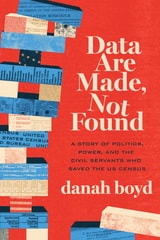
Data Are Made, Not Found
A Story of Politics, Power, and the Civil Servants Who Saved the US Censusdanah boyd
University of Chicago Press, 2026
An eye-opening story of the people who make the census, the United States’ largest and most consequential dataset, and the growing threats to their crucial work.
By many measures, the US census is the government’s largest non-wartime operation, and one of the world’s oldest and biggest data-making endeavors. The 2020 census required more than a decade of planning and technical work—not to mention managing nearly a quarter of a million temporary workers simultaneously—to collect data about the American public. That data was then processed to count each of 331,449,281 residents once—and only once—and in the right place. The operation is also one of the country’s most consequential. Census data determine how political power and federal funding are allocated. Census data make politics, and consequently, politics make census data. In this urgent book, danah boyd explores what it took for the Census Bureau to make the 2020 census, amidst a global pandemic and natural disasters, and while navigating political forces that constrained the budget, micro-managed the schedule, and attacked statisticians’ methods.
With rare insider access to the Census Bureau, boyd observed and interviewed hundreds of government civil servants who made the 2020 census. By documenting the perspectives of government workers, Data Are Made, Not Found provides a rare glimpse into what it takes to make democracy’s data. Each chapter reveals a different challenge—ranging from the last-minute fights about a citizenship question to the not-so-helpful help of well-intended stakeholders to avoid undercounts—and shows how civil servants responded to each problem, controversy, and hurdle. Boyd shows how many of the challenges that the Census Bureau faced in 2020 resulted from decades of political operatives, data users, and various stakeholders playing what boyd calls “Jenga politics,” weakening the administrative state for short-term political gains by removing support and adding more requirements.
Civil servants saved the 2020 census, but future censuses—and other data-making efforts related to elections, health, and the economy—are precarious. Boyd’s message is clear and compelling: protecting democracy means protecting the people and institutions that produce this data.
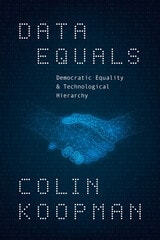
Data Equals
Democratic Equality and Technological HierarchyColin Koopman
University of Chicago Press, 2025
When we gave algorithms power over our world, we hoped that the apparent neutrality of machine thinking would create a more egalitarian age. Yet we are more divided than ever, staring down threats to democracy itself. In Data Equals, Colin Koopman argues that data technologies fail us so often because we built them around a deficient notion of equality.
It is not enough, Koopman explains, that algorithms engage everyone’s data with the same measuring stick. The data themselves are all too often structured in ways that obscure and exacerbate stratifying distinctions. Koopman contends that we must also work to ensure that those people subject to computational assessment enter data systems on equal terms. Part philosophical argument, part practical guide (replete with case studies from education technology), Data Equals offers novel methods for realizing democratic equality in a digital age.
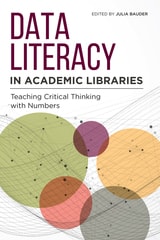
Data Literacy in Academic Libraries
Teaching Critical Thinking with NumbersJulia Bauder
American Library Association, 2021
We live in a data-driven world, much of it processed and served up by increasingly complex algorithms, and evaluating its quality requires its own skillset. As a component of information literacy, it's crucial that students learn how to think critically about statistics, data, and related visualizations. Here, Bauder and her fellow contributors show how librarians are helping students to access, interpret, critically assess, manage, handle, and ethically use data. Offering readers a roadmap for effectively teaching data literacy at the undergraduate level, this volume explores such topics as
- the potential for large-scale library/faculty partnerships to incorporate data literacy instruction across the undergraduate curriculum;
- how the principles of the ACRL Framework for Information Literacy for Higher Education can help to situate data literacy within a broader information literacy context;
- a report on the expectations of classroom faculty concerning their students’ data literacy skills;
- various ways that librarians can partner with faculty;
- case studies of two initiatives spearheaded by Purdue University Libraries and University of Houston Libraries that support faculty as they integrate more work with data into their courses;
- Barnard College’s Empirical Reasoning Center, which provides workshops and walk-in consultations to more than a thousand students annually;
- how a one-shot session using the PolicyMap data mapping tool can be used to teach students from many different disciplines;
- diving into quantitative data to determine the truth or falsity of potential “fake news” claims; and
- a for-credit, librarian-taught course on information dissemination and the ethical use of information.
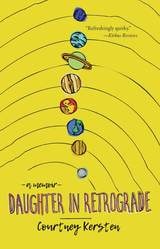
Daughter in Retrograde
A MemoirCourtney Kersten
University of Wisconsin Press, 2021
Daughter of the Empire State
The Life of Judge Jane BolinJacqueline A. McLeod
University of Illinois Press, 2016
Bolin was appointed to New York City's domestic relations court in 1939 for the first of four ten-year terms. When she retired in 1978, her career had extended well beyond the courtroom. Drawing on archival materials as well as a meeting with Bolin in 2002, historian Jacqueline A. McLeod reveals how Bolin parlayed her judicial position to impact significant reforms of the legal and social service system in New York.
Beginning with Bolin's childhood and educational experiences at Wellesley and Yale, Daughter of the Empire State chronicles Bolin's relatively quick rise through the ranks of a profession that routinely excluded both women and African Americans. Deftly situating Bolin's experiences within the history of black women lawyers and the historical context of high-achieving black New Englanders, McLeod offers a multi-layered analysis of black women's professionalization in a segregated America.
Linking Bolin's activist leanings and integrationist zeal to her involvement in the NAACP, McLeod analyzes Bolin's involvement at the local level as well as her tenure on the organization's national board of directors. An outspoken critic of the discriminatory practices of New York City's probation department and juvenile placement facilities, Bolin also co-founded, with Eleanor Roosevelt, the Wiltwyck School for boys in upstate New York and campaigned to transform the Domestic Relations Court with her judicial colleagues. McLeod's careful and highly readable account of these accomplishments inscribes Bolin onto the roster of important social reformers and early civil rights trailblazers.
Daughter of the Revolution
The Major Nonfiction Works of Pauline HopkinsDworkin, Ira
Rutgers University Press, 2007
Pauline E. Hopkins (1859–1930) came to prominence in the early years of the twentieth century as an outspoken writer, editor, and critic. Frequently recognized for her first novel, Contending Forces, she is currently one of the most widely read and studied African American novelists from that period.
While nearly all of Hopkins’s fiction remains in print, there is very little of her nonfiction available. This reader brings together dozens of her hard-to-find essays, including longer nonfiction works such as Famous Men of the Negro Race and The Dark Races of the Twentieth Century, some of which are published here for the first time in their entirety.
Through these works, along with two juvenile essays from the 1870s, a personal letter, and two speeches, readers encounter a voice that is committed to constructing an international discourse on race, recovering the militant abolitionist tradition to combat Jim Crow, celebrating black political participation during and after the Reconstruction era, articulating the connections between race and labor, and insisting on equal rights for women. Hopkins’s writing will challenge contemporary scholars to rethink their understanding of black activism and modernity in the early twentieth century.
Dave Rust
A Life in the CanyonsFrederick H Swanson
University of Utah Press, 2008
In the fall of 1897, Dave Rust, a young placer miner from Caineville, Utah, looked up from his sluice box on the Colorado River and gazed at the brilliant sandstone cliffs of Glen Canyon. He wasn’t finding much gold, but he knew that this landscape abounded in scenic beauty and that people would pay good money to see it. A quarter century later, he would fulfill his dream of taking adventurous travelers through this stunning canyon in his little canvas-covered canoes. By that time he had amassed a comprehensive knowledge of the geologic wonders of the Colorado Plateau province of Utah and Arizona, and each summer he led month-long pack trips through a mind-boggling variety of cliffs, mesas, mountaintop overlooks, and hidden desert canyons.
David D. Rust (1874–1963) grew up in south-central Utah, and as a young man he worked a variety of jobs. But the canyon country always called to him, and for more than three decades he was the premier backcountry outfitter and guide in southern Utah. He felt that travel was more than a pastime—it was a chance to enrich one’s mind, and he showed the way to achieve a deep understanding of the Colorado Plateau’s fabulous landforms.
Winner of the Evans Biography Award, the Utah State History Association's Best Utah History Book Award, the Mormon History Association Turner-Bergera Best Biography Award, the Utah State Division of History Francis Armstrong Madsen Best Utah History Book Award, and the Utah Book Award in Nonfiction.
David Davis, Abraham Lincoln's Favorite Judge
Raymond J. McKoski
University of Illinois Press, 2025
One of Abraham Lincoln’s staunchest and most effective allies, Judge David Davis masterminded the floor fight that gave Lincoln the presidential nomination at the 1860 Republican National Convention. This history-changing event emerged from a long friendship between the two men. It also altered the course of Davis’s career, as Lincoln named him to the U.S. Supreme Court in 1862.
Raymond J. McKoski offers a biography of Davis’s public life, his impact on the presidency and judiciary, and his personal, professional, and political relationships with Lincoln. Davis lent his vast network of connections, organizational and leadership abilities, and personal persuasiveness to help Lincoln’s political rise. When Davis became a judge, he honed an ability to hear each case with complete impartiality, a practice that endeared him to Lincoln but one day put him at odds with the president over important Civil War–era rulings. McKoski details these cases while providing an in-depth account of Davis’s role in Lincoln’s two unsuccessful campaigns for U.S. Senate and the fateful run for the presidency.
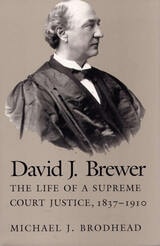
David J Brewer
The Life of a Supreme Court Justice, 1837-1910Michael J. Brodhead
Southern Illinois University Press, 1994
This is the first biography of David J. Brewer, an Associate Justice of the United States Supreme Court from 1889 to 1910.
Prior to rising to the nation’s highest tribunal, Brewer served as a county probate judge, a state district judge, a Kansas State Supreme Court justice, and a federal circuit court judge. He was known not only for his long tenure on the Supreme Court but also for his numerous off-the-bench statements as an orator and writer.
Many of Brewer’s judicial opinions and nonjudicial utterances created controversy, particularly when he confronted the reform issues of his day. The court, then presided over by Chief Justice Melville W. Fuller, has been seen as reactionary, determined to infuse the law with social Darwinism and laissez-faire ideology. Yet, contrary to this assessment of the Fuller Court as a whole, Brewer accepted most of his generation’s reform goals. He championed many forms of social legislation, the regulation of business, the rights of women and minorities, the support of charities, educational reform, and world peace.
Michael J. Brodhead contends that until recently historians have carelessly and inaccurately created a false image of Brewer, partly by citing a small sample of his opinions and public statements as representative of his alleged conservatism. They have also assumed that the disputable decisions of Brewer and his contemporaries were based on ideological predilections and that precedent and recognized legal principles played no role.
During his term, Brewer was the author of such notable court opinions as In re Debs, Muller v. Oregon, and Kansas v. Colorado. He supported property rights, admired honest entrepreneurial activity, and opposed the concentration of power in any form. Brewer favored the individual in all instances, whether that individual was the initiator of a great economic enterprise or a farmer struggling to extend agriculture into the western plains.
Dawn at Mineral King Valley
The Sierra Club, the Disney Company, and the Rise of Environmental LawDaniel P. Selmi
University of Chicago Press, 2022
In our current age of climate change–induced panic, it’s hard to imagine a time when private groups were not actively enforcing environmental protection laws in the courts. It wasn’t until 1972, however, that a David and Goliath–esque Supreme Court showdown involving the Sierra Club and Disney set a revolutionary legal precedent for the era of environmental activism we live in today.
Set against the backdrop of the environmental movement that swept the country in the late 1960s and early 1970s, Dawn at Mineral King Valley tells the surprising story of how the US Forest Service, the Disney company, and the Sierra Club each struggled to adapt to the new, rapidly changing political landscape of environmental consciousness in postwar America. Proposed in 1965 and approved by the federal government in 1969, Disney’s vast development plan would have irreversibly altered the practically untouched Mineral King Valley, a magnificently beautiful alpine area in the Sierra Nevada mountains. At first, the plan met with unanimous approval from elected officials, government administrators, and the press—it seemed inevitable that this expanse of wild natural land would be radically changed and turned over to a private corporation. Then the scrappy Sierra Club forcefully pushed back with a lawsuit that ultimately propelled the modern environmental era by allowing interest groups to bring litigation against environmentally destructive projects.
An expert on environmental law and appellate advocacy, Daniel P. Selmi uses his authoritative narrative voice to recount the complete history of this revolutionary legal battle and the ramifications that continue today, almost 50 years later.
Dawn of Industrial Agriculture in Iowa
Anthropology, Literature, and HistoryE. Paul Durrenberger
University Press of Colorado, 2021
Durrenberger tells the story that Corey aimed to record and preserve of the industrialization of Iowa’s agriculture and the death of its family farms. He analyzes Corey’s regionalist focus on Iowa farming and regionalism’s contemporaneous association in Europe with rising fascism. He explores Corey’s adoption of naturalism, evident in his resistance to heroes and villains, to plot structure and resolution, and to moral judgment, as well as his ethnographic tendency to focus on groups rather than individuals.
An unusual and wide-ranging study, The Dawn of Industrial Agriculture in Iowa offers important insight into the relationships among fiction, individual lives, and anthropological practice, as well as into a pivotal period in American history.
Dawn's Light Woman & Nicolas Franchomme
Marriage and Law in the Illinois CountryCarl J. Ekberg and Sharon K. Person
Southern Illinois University Press, 2022
Native women’s marital rights and roles in colonial Illinois society
Kaskaskia, Illinois, once the state’s capital, torn from the state by flood waters, and now largely forgotten, was once the home to a couple who helped transform the region in the 1720s from a frontier village to a civil society. In the heart of France’s North American empire, the village was a community of French-Canadian fur traders and Kaskaskia Indians who not only lived together but often intermarried. These Indigenous and French intermarriages were central to colonial Illinois society, and the coupling of Marguerite 8assecam8c8e (Dawn’s Light Woman) and Nicolas Franchomme, in particular, was critical to expanding the jurisdiction of French law.
While the story of Marguerite and Nicolas is unknown today, it is the story of how French customary law (Coutume de Paris) governed colonial marriage, how mixed Indian-French marriages stood at the very core of early colonial Illinois society, and how Illinois Indian women benefited, socially and legally, from being married to French men. All of this came about due to a lawsuit in which Nicolas successfully argued that his wife had legal claim to her first husband’s estate—a legal decision that created a precedent for society in the Illinois Country.
Within this narrative of a married couple and their legal fight—based on original French manuscripts and supported by the comprehensively annotated 1726 Illinois census—is also the story of the village of Kaskaskia during the 1720s, of the war between Fox Indians and French settlers, with their Indian allies, in Illinois, and of how the spread of plow agriculture dramatically transformed the Illinois Country’s economy from largely fur trade–based to expansively agricultural.
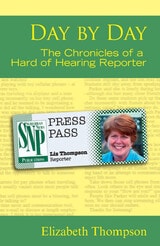
Day by Day
The Chronicles of a Hard of Hearing ReporterElizabeth Thompson
Gallaudet University Press, 2008
The Seventh Volume in the Deaf Lives Series
Elizabeth Thompson’s hearing loss was detected when she was in elementary school, and her hearing continued to deteriorate until she became completely deaf. Like many other hard of hearing and late-deafened individuals, her hearing loss complicated the general challenges of life. She struggled through school, worked as a secretary, married, had a daughter, and then found herself living as a single mother. She remarried, and soon after learned that she had contracted Multiple Sclerosis (MS). Despite these hurdles, Thompson always expressed her determination to enjoy the best life had to offer. Her astonishing exuberance might have gone unnoticed if she hadn’t accepted a new position as a reporter/columnist in 1998 for the Suburban News Publications (SNP). Day by Day: The Chronicles of a Hard of Hearing Reporter presents a marvelous blend of her experiences and best SNP columns that illustrate how she crafted her remarkable outlook.
In her columns, Thompson presented how she handled her hearing loss as a personal guide for readers. She used every stratagem available to function full-throttle – hearing aids, FM systems, lights for alarms, TTYs, even training her dog Snert. She also gently counseled readers on how to treat deaf and hard of hearing people with practical consideration and respect. Her pursuit of a fully realized life enabled her to do what she loved most, to meet and write about inspiring persons, many of whom are profiled in her memoir. Thompson eventually underwent cochlear implantation that restored 95% of her hearing, an exalting moment for her. Yet, Day by Day celebrates the entire arc of her life, a wonderful testament to her joyous resilience.