Results by title
28164 books match the query 'History' and 908 start with d
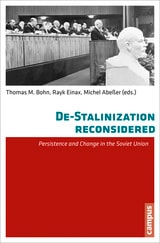
De-Stalinisation Reconsidered
Persistence and Change in the Soviet UnionEdited by Thomas M. Bohn, Rayk Einax, and Michel Abeßer
Campus Verlag, 2014
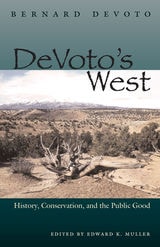
DeVoto’s West
History, Conservation, and the Public GoodBernard DeVoto
Ohio University Press, 2005
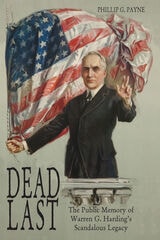
Dead Last
The Public Memory of Warren G. Harding’s Scandalous LegacyPhillip G. Payne
Ohio University Press, 2008
If George Washington and Abraham Lincoln are the saints in America’s civil religion, then the twenty-ninth president, Warren G. Harding, is our sinner. Prior to the Nixon administration, the Harding scandals were the most infamous of the twentieth century. Harding is consistently judged a failure, ranking dead last among his peers.
By examining the public memory of Harding, Phillip G. Payne offers the first significant reinterpretation of his presidency in a generation. Rather than repeating the old stories, Payne examines the contexts and continued meaning of the Harding scandals for various constituencies. Payne explores such topics as Harding’s importance as a midwestern small-town booster, his rumored black ancestry, the role of various biographers in shaping his early image, the tension between public memory and academic history, and, finally, his status as an icon of presidential failure in contemporary political debates. Harding was a popular president and was widely mourned when he died in office in 1923; but with his death began the construction of his public memory and his fall from political grace.
In Dead Last, Payne explores how Harding’s name became synonymous with corruption, cronyism, and incompetence and how it is used to this day as an example of what a president should not be.
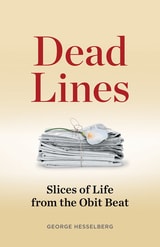
Dead Lines
Slices of Life from the Obit BeatGeorge Hesselberg
Wisconsin Historical Society Press, 2021
In more than forty years at the Wisconsin State Journal, Hesselberg frequently found himself writing about fatal accidents, crime investigations, and the deaths of the wealthy, famous, or notorious. But he was most drawn to the curious, the unknown, and the unsung—the deaths that normally wouldn’t make much of a splash, if any mention at all, in the news columns of a daily paper.
Digging deeper, he uncovered the extraordinary among the ordinary, memorializing the lives of a sword designer, a radio villain, a pioneering female detective, a homeless woman who spoke fluent French, a beloved classroom tarantula, and many more. Their stories are alternately amusing, sad, surprising, and profound. Together they speak to a shared human experience and inspire us to see the people around us with new eyes, valuing the lives while they are still being lived.
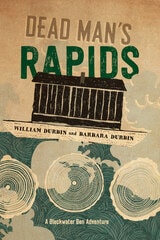
Dead Man's Rapids
William Durbin
University of Minnesota Press, 2018
When 13-year-old Ben Ward left school to work with his Pa in a logging camp, a winter of peeling potatoes and setting tables wasn’t the adventure he had in mind. Still, come spring, he signs up for the log drive with his friend Nevers, wishing the head cook on the wanigan (the floating cook shack) could be someone other than his crabby Pa. Fate, with a wink, complies, and Pa quits—only to be replaced by someone far worse: Pete Sardman, aka Old Sard, a cantankerous character complete with a greasy apron, an eye patch, one deaf ear, and plenty to say.
Luckily, there’s also the rest of the crew—a colorful, sometimes outrageous company of men. Together Ben and Nevers endure freezing weather, dangerous rapids, logjams, storms and floods, and a number of gripping tall tales, along the way learning about logging on the river and a whole lot more about life.
Taking up where Blackwater Ben left off, Dead Man’s Rapids returns to the north woods of Minnesota in the late nineteenth century, and with warmth, humor, and attention to historical detail engages readers both young and old.
Dead Sea Scrolls, Revise and Repeat
New Methods and PerspectivesCarmen Palmer
SBL Press, 2020
A reexamination of the people and movements associated with Qumran, their outlook on the world, and what bound them together
Dead Sea Scrolls, Revise and Repeat examines the identity of the Qumran movement by reassessing former conclusions and bringing new methodologies to the study of the Dead Sea Scrolls. The collection as a whole addresses questions of identity as they relate to law, language, and literary formation; considerations of time and space; and demarcations of the body. The thirteen essays in this volume reassess the categorization of rule texts, the reuse of scripture, the significance of angelic fellowship, the varieties of calendrical use, and celibacy within the Qumran movement. Contributors consider identity in the Dead Sea Scrolls from new interdisciplinary perspectives, including spatial theory, legal theory, historical linguistics, ethnicity theory, cognitive literary theory, monster theory, and masculinity theory.
Features
- Essays that draw on new theoretical frameworks and recent advances in Qumran studies
- A tribute to the late Peter Flint, whose scholarship helped to shape Qumran studies

Dead Towns of Alabama
W. Stuart Harris
University of Alabama Press, 2001
Rediscover Alabama's long-vanished towns, forts, settlements, and former state capitals that time left behind.
Dead Towns of Alabama is not merely a series of obituaries for dead towns. Instead, it brings back to life 83 Indian towns, 77 fort sites, and 112 colonial, territorial, and state towns. W. Stuart Harris conjures up a wealth of fascinating images from Alabama's rich and colorful past--images of life as the Indians lived it, of colonial life in the wilderness, of Spanish explorers and French exiles, of danger and romance, of riverboats and railroads, of plantations and gold mines, of stagecoaches and ferries. Overall, it presents a thoroughly absorbing panorama of Alabama's early history.
Here we learn about two former capitals--St. Stephens and Cahaba--that have deteriorated to mouldering ruins now. We learn about once thriving communities--county seats, river landings and crossings, trading posts, junctions, and other settlements--that time has forgotten. Absent from most maps, these sites come alive again in Harris's fascinating account, filled anew with the bustling activity of their former inhabitants.
First published in 1977, Dead Towns of Alabama is a unique guidebook to every region of the state. It is an invaluable resource for historians, students, tourists, and anyone interested in exploring Alabama's interesting historical and cultural past.

Dead in Their Tracks
Crossing America’s Desert Borderlands in the New EraJohn Annerino
University of Arizona Press, 2009
During the Sonoran Desert’s glorious and brutal summer season Annerino, a photojournalist, author, and explorer, watched four border crossers step off a bus and nonchalantly head into the American no-man’s land. On assignment for Newsweek, Annerino did more than just watch on that blistering August day. He joined them on their ultramarathon, life-or-death quest to find work to feed their families, amid temperatures so hot your parched throat burns from breathing and drinking water is the ultimate treasure.
As their water dwindled and the heat punished them, Annerino and the desperate men continued marching fifty miles in twenty-four hours and managed to survive their harrowing journey across the deadliest migrant trail in North America, El Camino del Diablo, “The Road of the Devil.” Driven by the mounting death toll, John returned again and again to the sun-scorched despoblado (uninhabited lands)—where hidden bighorn sheep water tanks glowed like diamonds—to document the lives, struggles, and heartbreaking remains of those who continue to disappear and perish in a region that’s claimed the lives of more than 9,700 men, women, and children.
Following the historic paths of indigenous Hia Ced O’odham (People of the Sand), Spanish missionary explorer Padre Eusebio Francisco Kino, and California-bound Forty-Niners, Annerino’s journeys on foot, crisscrossed the alluring yet treacherous desert trails of the El Camino del Diablo, Hohokam shell trail, and O’odham salt trails where hundreds of gambusinos (Mexican miners) and Euro-American pioneers succumbed during the 1850s.
As the migrants kept coming, the deaths kept mounting, and Annerino kept returning. He crossed celebrated Sonoran Desert sanctuaries—Organ Pipe Cactus National Monument, a UNESCO Biosphere Reserve, Cabeza Prieta National Wildlife Refuge, Barry M. Goldwater Range, sacred ancestral lands of the Tohono O’odham—that had become lost horizons, killing grounds, graveyards, and deadly smuggling corridors that also claimed the lives of National Park rangers and Border Patrol agents. John Annerino’s mission was to save someone, anyone, everyone—when he could find them.
Dead in Their Tracks is the saga of a merciless despoblado in the Great Southwest, of desperate yet hopeful migrants and refugees who keep staggering north. It is the story of ranchers, locals, and Border Patrol trackers who’ve saved countless lives, and heavily armed smugglers who haunt an inhospitable, if beautiful, wilderness that remains off the radar for journalists and news organizations that dare not set foot in the American desert waiting to welcome them on its terms.

Dead in the Water
Global Lessons from the World Bank's Model Hydropower Project in LaosEdited by Bruce Shoemaker and William Robichaud; foreword by Yos Santasombat; afterword by Philip Hirsch
University of Wisconsin Press, 2019
In the 2000s, as the World Bank was reeling from revelations of past hydropower failures, it nonetheless promoted the enormous Nam Theun 2 project. NT2, the Bank believed, offered a new, wiser model of dam development that would alleviate poverty, protect the environment, engage locally affected people in a transparent fashion, and stimulate political transformation. This was a tall order. For the first time, this book shows in detail why, despite assertions of success from the World Bank and other agencies involved in the project, the dam's true story has been one of substantial loss for affected villagers and the regional environment. Nam Theun 2 is an important case study that illustrates much broader problems of global development policy.

Deadline
200 Years of Violence Against Journalists in the United StatesElizabeth Atwood
University of Missouri Press, 2025
To help us understand these attacks, Atwood presents a framework for categorizing them, built on John Nerone’s studies on assaults on American media workers. Atwood categorizes attacks against journalists as attacks against individuals, ideas, and media institutions, and undertaken to suppress reporting on certain topics and in the context of wars and other international or conflicts. Crucially, Deadline utilizes this framework to offer possible solutions to the issue of violence against journalists.
Atwood was inspired to explore the pressing issue of violence against American journalists after the tragic death of one of her colleagues at the Baltimore Sun, Rob Hiaasen, in the Capital Gazette shooting in 2018. Throughout, she demonstrates that distrust of the media and violence against the press in the United States are hardly new developments. Her work examines how intimidation, violence, and censorship have, in fact, been used against the American press since both its and the nation’s founding.
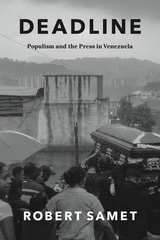
Deadline
Populism and the Press in VenezuelaRobert Samet
University of Chicago Press, 2019
In Deadline, anthropologist Robert Samet answers this question by focusing on the relationship between populism, the press, and what he calls “the will to security.” Drawing on nearly a decade of ethnographic research alongside journalists on the Caracas crime beat, he shows how the media shaped the politics of security from the ground up. Paradoxically, Venezuela’s punitive turn was not the product of dictatorship, but rather an outgrowth of practices and institutions normally associated with democracy. Samet reckons with this apparent contradiction by exploring the circulation of extralegal denuncias (accusations) by crime journalists, editors, sources, and audiences. Denuncias are a form of public shaming or exposé that channels popular anger against the powers that be. By showing how denuncias mobilize dissent, Deadline weaves a much larger tale about the relationship between the press, popular outrage, and the politics of security in the twenty-first century.
Deadly Dust
Silicosis and the On-Going Struggle to Protect Workers' HealthDavid Rosner and Gerald Markowitz
University of Michigan Press, 2006

Deadly Excitements
Shadows PhantomsRobert Sampson
University of Wisconsin Press, 1989
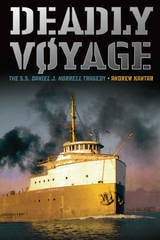
Deadly Voyage
The S.S. Daniel J. Morrell TragedyAndrew Kantar
Michigan State University Press, 2009
This is the harrowing story of one of the worst shipwrecks in Great Lakes history. In the early morning hours of November 29, 1966, the S.S. Daniel J. Morrell was caught in a deadly storm on Lake Huron. Waves higher than the ship crested over it, and winds exceeding sixty miles per hour whipped at its hull, splitting the 603-foot freighter into two giant pieces. Amazingly, after the bow went down, the stern blindly powered itself through the stormy seas for another five miles! Twenty-eight men drowned in the icy waters of Lake Huron, but one sailor—26-year-old Dennis Hale—miraculously survived the treacherous storm. Wearing only boxer shorts, a lifejacket, and a pea coat, Hale clung to a life raft in near-freezing temperatures for 38 hours until he was rescued late in the afternoon of the following day. Three of his fellow crewmates died in his raft.
In Deadly Voyage, Andrew Kantar recounts this tale of tragedy and triumph on Lake Huron. Informed by meticulous research and the eyewitness details provided by Hale, and illustrated with photographs from the Coast Guard search and rescue operation, Kantar depicts one of the most tragic shipwrecks in Great Lakes history.

Deaf Empowerment
Emergence, Struggle, and RhetoricKathy Jankowski
Gallaudet University Press, 1997
Central to Deaf Empowerment is the struggle between the dominant hearing society and Deaf people over the best means of communication, with the educational setting as the constant battleground. This evocative work first tracks the history of interaction between these two factions, highlighting the speaking majority’s desire to compel Deaf people to conform to “the human sciences” conventionality by learning speech. Then, it sharply focuses on the development of the Deaf social movement's ideology to seek general recognition of sign language as a valid cultural variation. Also, the influence of social movements of the 60s and 70s is examined in relation to the changing context and perception of the Deaf movement, as well as to its rhetorical refinement.
Deaf Empowerment delineates the apex of effective Deaf rhetoric in describing the success of the Deaf President Now! protest at Gallaudet University in 1988, its aftermath, and ensuing strategies. It concludes with an assessment of the goal of a multicultural society and offers suggestions for community building through a new humanitarianism. Scholars of social movements and Deaf studies will find it to be a uniquely provocative addition to their libraries and classrooms.
Deaf Heritage
A Narrative History of Deaf AmericaJack R. Gannon
Gallaudet University Press, 2012
Now, Jack R. Gannon’s original groundbreaking volume on Deaf history and culture is available once again. In Deaf Heritage: A Narrative History of Deaf America, Gannon brought together for the first time the story of the Deaf experience in America from a Deaf perspective. Recognizing the need to document the multifaceted history of this unique minority with its distinctive visual culture, he painstakingly gathered as much material as he could on Deaf American life. The result is a 17-chapter montage of artifacts and information that forms an utterly fascinating record from the early nineteenth century to the time of its original publication in 1981.
Deaf Heritage tracks the development of the Deaf community both chronologically and by significant subjects. The initial chapter treats the critical topics of early attempts at deaf education, the impact of Deaf and Black deaf teachers, the establishment of schools for the deaf, and the founding of Gallaudet College. Individual chapters cover the 1880s through the 1970s, mixing milestones such as the birth of the National Association of the Deaf and the work of important figures, Deaf and hearing, with anecdotes about day-to-day deaf life. Other chapters single out important facets of Deaf culture: American Sign Language, Deaf Sports, Deaf artists, Deaf humor, and Deaf publications. The overall effect of this remarkable record, replete with archival photographs, tables, and lists of Deaf people’s accomplishments, reveals the growth of a vibrant legacy singular in American history.

Deaf History Unveiled
Interpretations from the New ScholarshipJohn Vickrey Van Cleve
Gallaudet University Press, 1999
Other studies track societal paternalism toward deaf people in Italy, Hungary, and the United States. Adding to its intrigue, the new research in this milestone study provides evidence for previously uncredited self-determination of Deaf people in establishing education, employment, and social structures common throughout the Northern Hemisphere. Historians, teachers, and students alike will prize Deaf History Unveiled as a singular collection of insights that will change historical perspectives on the Deaf experience worldwide.

Deaf History and Culture in Spain
A Reader of Primary DocumentsBenjamin Fraser
Gallaudet University Press, 2009
In this landmark reader, Benjamin Fraser offers in five parts 44 Spanish documents dating from 1417 to the present, translated for the first time to trace the turbulent history of Deaf culture in Spain. Part I: The Birth of Oralism and Deafness as Metaphor illustrates the predominant impression of deafness as isolation, exemplified by Teresa de Cartagena writings in 1455-60 about deafness as an island. Part II: The Return to Deaf Education highlights writers who wished to restore “the Spanish ‘Art’” of educating deaf students. Lorenzo Hervás y Panduro wrote The Spanish School of Deafmutes, or Method of Teaching Them to Write and Speak the Spanish Language in 1795. Yet, Madrid’s Royal School for Deaf-Mutes, which opened in 1805, taught deaf students using methodical signs adopted from France’s Abbé de l’Epée.
Readings in Part III :The Contemporary Deaf Experience reveal considerations from the 1970s to the ‘90s of Deaf culture and linguistics similar to those in the United States, typified by the works of Inés Polo and Félix-Jesús Pinedo Peydró. The fourth part, The Recognition of Deaf Language and Culture, marks the expansion of academic research in Spain. María Angeles Rodríguez González spearheaded Spanish Sign Language (LSE) linguistics in 1992 with her publication Sign Language. The final part, A Selection of Deaf Poetry, concludes these documents with verse in Spanish spoken dialects rather than LSE, indicating that the evolution of the Deaf experience in Spain continues on its own path today.

Deaf Identity and Social Images in Nineteenth-Century France
Anne T. Quartararo
Gallaudet University Press, 2008
Since the French Revolution in1789, Deaf French people have struggled to preserve their cultural heritage, to win full civil rights, and to gain access to society through their sign language. Anne T. Quartararo depicts this struggle in her new book Deaf Identity and Social Images in Nineteenth-Century France. In it, she portrays the genesis of the French Deaf community, examines its identity as a minority culture, and analyzes how deaf people developed their cultural heritage, a deaf patrimonie that has been historically connected to the preservation of French sign language.
Quartararo begins by describing how Abbé de l’Epée promoted the education of deaf students with sign language, an approach supported by the French revolutionary government, which formally established the Paris Deaf Institute in 1791. In the early part of the nineteenth century, the school’s hearing director, Roch-Ambroise-Auguste Bébian, advocated the use of sign language even while the institute’s physician Dr. Jean-Marc-Gaspard Itard worked to discredit signing.
In this meticulous study, Quartararo details the many variations in deaf education from 1830 to1930. She describes the banquet movement in the 1830s led by Ferdinand Berthier, Alponse Lenoir, and Claudius Forestier, which celebrated sign language and fostered the deaf association known as the Société Centrale. Quartararo also recounts how hearing educators at the Milan Congress in 1880 universally adopted oralism as the way to defeat deafness, and prohibited sign language in deaf schools. French deaf people refused to submit to this attack upon their cultural heritage, however, and an explosion of social activity among deaf people between 1880 and 1900 created a host of active deaf groups in all corners of the country. Deaf Identity and Social Images paints a unique, rich tapestry of the resilience of French deaf people in defending their culture through the most trying century in their history.
Deaf People in Hitler's Europe
Donna F. Ryan
Gallaudet University Press, 2002
Inspired by the conference “Deaf People in Hitler’s Europe, 1933–1945,” hosted jointly by Gallaudet University and the United States Holocaust Memorial Museum in 1998, this extraordinary collection, organized into three parts, integrates key presentations and important postconference research.
Henry Friedlander begins “Part I: Racial Hygiene” by analyzing the assault on deaf people and people with disabilities as an integral element in the Nazi attempt to implement their theories of racial hygiene. Robert Proctor documents the role of medical professionals in deciding who should be sterilized or forbidden to marry, and whom the Nazi authorities would murder. In an essay written especially for this volume, Patricia Heberer details how Nazi manipulation of eugenics theory and practice facilitated the justification for the murder of those considered socially undesirable.
“Part II: The German Experience” commences with Jochen Muhs’s interviews of deaf Berliners who lived under Nazi rule, both those who suffered abuse and those who, as members of the Nazi Party, persecuted others, especially deaf Jews. John S. Schuchman describes the remarkable 1932 film Misjudged People, which so successfully portrayed the German deaf community as a vibrant contributor to society that the Nazis banned its showing when they came to power. Horst Biesold’s contribution confirms the complicity of teachers who denounced their own students, labeling them hereditarily deaf and thus exposing them to compulsory sterilization. The section also includes the reprint of a chilling 1934 article entitled “The Place of the School for the Deaf in the New Reich,” in which author Kurt Lietz rued the expense of educating deaf students, who could not become soldiers or bear “healthy children.”
In “Part III: The Jewish Deaf Experience,” John S. Schuchman discusses the plight of deaf Jews in Hungary. His historical analysis is complemented by a chapter containing excerpts from the testimony of six deaf Jewish survivors who describe their personal ordeals. Peter Black’s reflections on the need for more research conclude this vital study of a little-known chapter of the Holocaust.
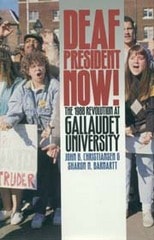
Deaf President Now!
The 1988 Revolution at Gallaudet UniversityJohn B. Christiansen
Gallaudet University Press, 1995
Deaf President Now! reveals the groundswell leading up to the history-making week in 1988 when the students at Gallaudet University seized the campus and closed it down until their demands were met. To research this probing study, the authors interviewed in-depth more than 50 of the principal players.
This telling book reveals the critical role played by a little-known group called the "Ducks," a tight-knit band of six alumni determined to see a deaf president at Gallaudet. Deaf President Now! details how they urged the student leaders to ultimate success, including an analysis of the reasons for their achievement in light of the failure of many other student movements. This fascinating study also scrutinizes the lasting effects of this remarkable episode in "the civil rights movement of the deaf." Deaf President Now! tells the full story of the insurrection at Gallaudet University, an exciting study of how deaf people won social change for themselves and all disabled people everywhere through a peaceful revolution.

Deaf Sport
The Impact of Sports within the Deaf CommunityDavid A. Stewart
Gallaudet University Press, 1991
Deaf Sport describes the full ramifications of athletics for Deaf people, from the meaning of individual participation to the cultural bonding resulting from their organization. Deaf Sport profiles noted deaf sports figures and the differences particular to Deaf sports, such as the use of sign language for score keeping, officiating, and other communication.
This important book analyzes the governing and business aspects of Deaf sport, both local deaf groups and the American Athletic Association of the Deaf and the World Games for the Deaf. It shows the positive psychological and educational impact of Deaf sport, and how it serves to socialize further the geographically dispersed members of the Deaf community.

Dealmaking Detroit
Two Essays About White Privilege, Private Gain, and Public LossJamon Jordan and Craig Regester, with an introduction by Stephen M. Ward
Disobedience Press, 2027
Who profits from Detroit’s “reinvention”?
In two incisive essays, historian Jamon Jordan and lecturer and labor activist Craig Regester dismantle the facile, corporate narratives surrounding Detroit’s past, present, and future.
Jordan reveals how racial hierarchy has consistently shaped the making and unmaking of the city. He traces a direct line from 19th-century laws requiring “negroes” to pay $500 just to exist in Michigan, through generations of White managers overseeing Black auto workers, to mid-century “redevelopment” plans that displaced and demolished thousands of homes and 350 businesses in Black neighborhoods—and into the present day, where a banner celebrates White capitalist saviors for rescuing Detroit from failure.
Building on this trajectory, Regester scrutinizes the upcoming University of Michigan Center for Innovation in Detroit, a foregone conclusion and joint venture between a public university and a pair of billionaires. Though funded with $100 million in taxpayer dollars, neither the university, the state, nor the developers seriously considered community visions for how the center should serve Detroiters. Regester exposes how the avarice and technocentric whims of the ultra-rich increasingly compromise the public service missions of major research universitie
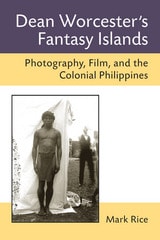
Dean Worcester's Fantasy Islands
Photography, Film, and the Colonial PhilippinesMark Rice
University of Michigan Press, 2014
Dean Worcester’s Fantasy Islands brings to life one of the most significant (but under examined) figures in the history of U.S. colonialism in the Philippines. Upon the outbreak of the Spanish-American War, Worcester, a scientist who had traveled twice to the Philippines on zoological expeditions, established himself as one of America’s leading experts on the Philippines. Over a fourteen-year career as a member of the U.S. colonial regime, Worcester devoted much of his time and energy to traveling among and photographing non-Christian minority groups in the Philippines. He amassed an archive of several thousand photographs taken by him or by government photographers. Worcester deployed those photographs in books, magazine articles, and lectures to promote his belief that the United States should maintain control of the Philippines for decades to come. While many historians have examined American colonial photography in the Philippines, this book is the first lengthy treatment of Worcester’s role in shaping American perceptions of the Philippines in the early twentieth century.

Dear Charles Dickens, Love, South LA
Literature, Place, and BelongingJacqueline Jean Barrios
University of Iowa Press, 2026
Jacqueline Jean Barrios confronts the cultural challenges that big canonical books pose to new generations of readers. Instead of erasing the differences between Dickens’s implied audiences and his current ones, Barrios demonstrates how youth can serve as the visionaries who bridge the gap. By placing literature in everyday surroundings, students at any school and in any location can learn from the embodied and the poetic and even question the universalism that masks unexamined reverence for the Western canon.
Dear Delia
The Civil War Letters of Captain Henry F. Young, Seventh Wisconsin InfantryHenry F. Young, edited by Micheal J. Larson and John David Smith
University of Wisconsin Press, 2019

Dear Denise
Letters to the Sister I Never KnewLisa McNair
University of Alabama Press, 2022
Poignant, honest, and heartfelt letters to a sister who perished in the 16th Street Baptist Church bombing.
Lisa McNair was born in 1964, one year after her older sister, Denise, was murdered in the bombing of the 16th Street Baptist Church in Birmingham, Alabama. Dear Denise is a collection of forty letters from Lisa addressed to the sister she never knew, but in whose shadow of sacrifice and lost youth she was raised. These letters offer an intimate look into the life of a family touched by one of the most heinous tragedies of the Civil Rights Movement.
Written in a genuine, accessible, familiar, and easy-to-read voice, Lisa’s letters apprise her late sister of all that has come to pass in the years since her death. Lisa considers her own challenges and accomplishments as a student in remarkably different—and very racially complex—schools; the birth of their baby sister, Kim; their father’s election to the Alabama legislature; her evolving sense of faith and place, and sometimes lack thereof, within the Black church; her college experiences; and her own sense of self as she’s matured into adulthood. She reveals some of the family’s difficulties and health challenges, and shares some of their joys and celebrations.
The letters are accompanied by 29 black-and-white photographs, most of them from the McNair family collection, many of them taken by her father, a professional photographer who documented the Civil Rights Movement in Alabama both before and after Denise’s murder. An unswervingly candid, gentle, and nuanced book, Dear Denise is a testament to one singular life lived bravely and truthfully (if sometimes confusedly or awkwardly), during decades of bewildering social change and in the shadow of one life never fully lived.
Dear Helen
Wartime Letters from a Londoner to Her American Pen PalEdited by Russell M. Jones & John H. Swanson
University of Missouri Press, 2009

Dear Mr. Lincoln
Letters to the PresidentEdited by Harold Holzer
Southern Illinois University Press, 2006
During the Civil War, Americans felt themselves to be on intimate terms with their commander in chief, sending President Abraham Lincoln between two hundred and five hundred pieces of mail every day—letters that expressed the concerns, aspirations, grievances, and obsessions of the nation. Ranging from weighty political tomes to greetings accompanying homespun gifts, the letters reflect the pulse of the country in a time of upheaval. This illuminating collection includes straightforward correspondence from ordinary Americans requesting autographs and favors as well as pleas from the influential, such as the anguished open letter from New York Tribune publisher Horace Greeley imploring Lincoln to end his “remiss” policy of caution on emancipation. This new paperback edition, featuring twenty-two illustrations, portrays a president clearly eager to review and respond to the advice, criticism, and requests of the nation’s citizens.

Death Underground
The Centralia and West Frankfort Mine DisastersRobert E. Hartley and David Kenney
Southern Illinois University Press, 2006
Death Underground: The Centralia and West Frankfort Mine Disasters examines two of the most devastating coal mine disasters in United States history since 1928. In two southern Illinois towns only forty miles apart, explosions killed 111 men at the Centralia No. 5 mine in 1947 and 119 men at the New Orient No. 2 mine in West Frankfort in 1951. Robert E. Hartley and David Kenney explain the causes of the accidents, identify who was to blame, and detail the emotional impact the disasters had on the survivors, their families, and their communities.
Politics at the highest level of Illinois government played a critical role in the conditions that led to the accidents. Hartley and Kenney address how safety was compromised when inspection reports were widely ignored by state mining officials and mine company supervisors. Highlighted is the role of Driscoll Scanlan, a state inspector at Centralia, who warned of an impending disaster but whose political enemies shifted the blame to him, ruining his career. Hartley and Kenney also detail the New Orient No. 2 mine explosion, the attempts at rescue, and the resulting political spin circulated by labor, management, and the state bureaucracy. They outline the investigation, the subsequent hearings, and the efforts in Congress to legislate greater mine safety.
Hartley and Kenney include interviews with the survivors, a summary of the investigative records, and an analysis of the causes of both mine accidents. They place responsibility for the disasters on individual mine owners, labor unions, and state officials, providing new interpretations not previously presented in the literature. Augmented by twenty-nine illustrations, the volume also covers the history, culture, and ethnic pluralism of coal mining in Illinois and the United States.
Death Valley National Park
A HistoryHal Rothman
University of Nevada Press, 2013
This history begins with a discussion of the physical setting, its geography and geology, and descriptions of the Timbisha, the first peoples to inhabit this tough and dangerous landscape. In the 19th-century and early 20th century, new arrivals came to exploit the mineral resources in the region and develop permanent agricultural and resort settlements. Although Death Valley was established as a National Monument in 1933, fear of the harsh desert precluded widespread acceptance by both the visiting public and its own administrative agency. As a result, Death Valley lacked both support and resources. This volume details the many debates over the park’s size, conflicts between miners, farmers, the military, and wilderness advocates, the treatment of the Timbisha, and the impact of tourists on its cultural and natural resources.
In time, Death Valley came to be seen as one of the great natural wonders of the United States, and was elevated to full national park status in 1994. The history of Death Valley National Park embodies the many tensions confronting American environmentalism.
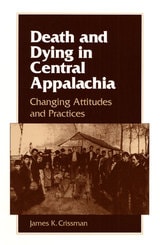
Death and Dying in Central Appalachia
Changing Attitudes and PracticesJames K. Crissman
University of Illinois Press, 1994
Written for both scholarly and general audiences, the book contains sections on the death watch, body preparation, selection or construction of a coffin or casket, digging the grave by hand, the wake, the funeral, and other topics. Crissman then demonstrates how technology and the encroachment of American society have turned these vital traditions into the disappearing practices of the past.

Death and Dying in Colonial Spanish America
Edited by Martina Will de Chaparro and Miruna Achim
University of Arizona Press, 2011
The variety of sources uncovered in the authors’ original archival research suggests the wide diversity of topics and approaches they employ: Nahua annals, Spanish chronicles, Inquisition case records, documents on land disputes, sermons, images, and death registers. Geographically, the range of research focuses on the viceroyalties of New Spain, Peru, and New Granada.
The resulting records—both documentary and archaeological—offer us a variety of vantage points from which to view each of these cultural groups as they came into contact with others. Much less tied to modern national boundaries or old imperial ones, the many facets of the new historical research exploring the topic of death demonstrate that no attitudes or practices can be considered either “Western” or universal.
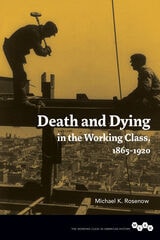
Death and Dying in the Working Class, 1865-1920
Michael K. Rosenow
University of Illinois Press, 2015
Drawing from an eclectic array of sources ranging from Andrew Carnegie to grave markers in Chicago's potter's field, Rosenow portrays the complex political, social, and cultural relationships that fueled the United States' industrial ascent. The result is an undertaking that adds emotional depth to existing history while challenging our understanding of modes of cultural transmission.

Death and Life in the Big Red One
A Soldier’s World War II Journey from North Africa to GermanyJoseph P. Olexa
University of North Texas Press, 2023

Death and Life in the Tenth Century
Eleanor Shipley Duckett
University of Michigan Press, 1989
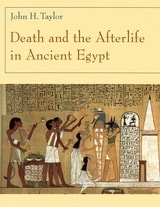
Death and the Afterlife in Ancient Egypt
John H. Taylor
University of Chicago Press, 2001
The author describes in detail the numerous provisions made for the dead and the intricate rituals carried out on their behalf. He considers embalming, coffins and sarcophagi, shabti figures, magic and ritual, and amulets and papyri, as well as the mummification of sacred animals, which were buried by the millions in vast labyrinthine catacombs.
The text also reflects recent developments in the interpretation of Egyptian burial practices, and incorporates the results of much new scientific research. Newly acquired information derives from a range of sophisticated applications, such as the use of noninvasive imaging techniques to look inside the wrappings of a mummy, and the chemical analysis of materials used in the embalming process. Authoritative, concise, and lucidly written, Death and the Afterlife in Ancient Egypt illuminates aspects of this complex, vibrant culture that still perplex us more than 3,000 years later.
Death and the Dervish
Mesa Selimovic
Northwestern University Press, 1996
Hugely successful when published in the 1960s, Death and the Dervish is an enduring classic made into a feature length film in 1974.
Death at Cross Plains
An Alabama Reconstruction TragedyGene L. Howard with a foreword by Gary B. Mills
University of Alabama Press, 1984
Reconstruction in the South is a much studied and yet little understood period in the region’s history. In many areas it was marked by such violence as to have been guerrilla warfare in all but name. Death at Cross Plains is the gripping story of one local incident that illuminates the aftermath of the Civil War throughout the region.

Death by Drama and Other Medieval Urban Legends
Jody Enders
University of Chicago Press, 2002
Was a convicted criminal executed on stage during a beheading scene? Was an unfortunate actor driven insane while playing a madman? Did a theatrical enactment of a crucifixion result in a real one? Did an androgynous young man seduce a priest when portraying a female saint? Enders answers these and other questions while presenting a treasure trove of tales that have long seemed true but are actually medieval urban legends. On topics ranging through politics, religion, marriage, class, and law, these tales, Enders argues, do the cultural work of all urban legends: they disclose the hopes, fears, and anxieties of their tellers. Each one represents a medieval meditation created or dramatized by the theater with its power to blur the line between fiction and reality, engaging anyone who watches, performs, or is represented by it. Each one also raises pressing questions about the medieval and modern world on the eve of the Reformation, when Europe had never engaged more anxiously and fervently in the great debate about what was real, what was pretend, and what was pretense.
Written with elegance and flair, and meticulously researched, Death by Drama and Other Medieval Urban Legends will interest scholars of medieval and Renaissance literature, history, theater, performance studies, and anyone curious about urban legends.

Death by Philosophy
The Biographical Tradition in the Life and Death of the Archaic Philosophers Empedocles, Heraclitus, and DemocritusAva Chitwood
University of Michigan Press, 2004
How does one die by philosophy? In Diogenes Laertius, philosophers jump into volcanoes, bury themselves in dung, get eaten by dogs, hang themselves, drown, and vanish into thin air -- sometimes all in a single lifetime. But what happens when we look beyond the fantastic and absurd to examine the particular ways that the philosophers' lives and deaths are recounted?
Ava Chitwood's reexamination of Diogenes Laertius's philosophical biographies opens a new window on the intellectual culture and context in which the work of philosophers like Empedocles, Heraclitus, and Democritus was read, received, and transmitted. Chitwood's analysis also suggests a methodology for understanding the interplay between biography and philosophy and for evaluating biographical sources.
While Chitwood's approach combines the disciplines of classical philology and philosophy, Death by Philosophy is not intended solely for the specialist. This investigation offers the modern reader a fascinating, fresh, and entertaining view of the ancient literary and philosophical world.
Ava Chitwood is Assistant Professor of Classics, at the University of South Florida.

Death in Babylon
Alexander the Great and Iberian Empire in the Muslim OrientVincent Barletta
University of Chicago Press, 2010
Though Alexander the Great lived more than seventeen centuries before the onset of Iberian expansion into Muslim Africa and Asia, he loomed large in the literature of late medieval and early modern Portugal and Spain. Exploring little-studied chronicles, chivalric romances, novels, travelogues, and crypto-Muslim texts, Vincent Barletta shows that the story of Alexander not only sowed the seeds of Iberian empire but foreshadowed the decline of Portuguese and Spanish influence in the centuries to come.
Death in Babylon depicts Alexander as a complex symbol of Western domination, immortality, dissolution, heroism, villainy, and death. But Barletta also shows that texts ostensibly celebrating the conqueror were haunted by failure. Examining literary and historical works in Aljamiado, Castilian, Catalan, Greek, Latin, and Portuguese, Death in Babylon develops a view of empire and modernity informed by the ethical metaphysics of French phenomenologist Emmanuel Levinas. A novel contribution to the literature of empire building, Death in Babylon provides a frame for the deep mortal anxiety that has infused and given shape to the spread of imperial Europe from its very beginning.

Death in England
An Illustrated HistoryEdited by Peter C. Jupp and Clare Gittings
Rutgers University Press, 2000
Death in England provides the first ever social history of death-from the earliest times to Diana, Princess of Wales. As we discard the taboos surrounding death, this book charts the fascinating story of how people have coped with this fundamental aspect of their daily lives.
Peter C. Jupp and Clare Gittings reveal how attitudes, practices, and beliefs about death have undergone constant change, as well as how, why, and at what ages people died. Examining how death touches all aspects of society, they cover topics such as plagues and violence; wills and deathbeds; funerals and memorials; and beliefs and bereavement. This wide-ranging analysis is lavishly illustrated with photographs and drawings, their diversity reflecting the breadth of issues and periods covered.
The contributors are all specialists in their own fields, including archaeology, history, and sociology. The ten chapters cover: earliest times to the Bronze Age; the Iron and Roman Ages; the Early Middle Ages; from the advent of Purgatory to the Black Death; the Later Middle Ages and the Reformation; from Elizabeth I to the Civil War; the "Age of Decency"; the Enlightenment; the Victorian era; and the twentieth century.
With the pervasive depiction of death through the media and the ensuing public awareness of this topic, Death in England will be of interest not only to the general reader but also to students of archaeology, art, history, medicine, and sociology.

Death of Dignity
Angola's Civil WarVictoria Brittain
Pluto Press, 1998
Death of Somoza
Claribel Alegría & Darwin Flakoll
Northwestern University Press, 1996
Death of a Confederate Colonel
Civil War Stories and a NovellaPat Carr
University of Arkansas Press, 2007
Death of a Gunfighter
The Quest for Jack Slade, the West's Most Elusive LegendDan Rottenberg
Westholme Publishing, 2008
The True Story of One of America’s Most Enigmatic and Tragic Heroes
Awarded Best Western History Book of 2008 by the Wild West History Association
"A superb biography"—Foreword Reviews
"An ambitious, well-written effort to restore a Wild West desperado to history.... Readers will surely remember Jack Slade from henceforth. A treat for Western history buffs and fans of true crime."—Kirkus Reviews
"An enjoyable read, and it is also a heroic effort."—Wall Street Journal
"Every bit the page-turner as Roughing It, with one added advantage—Rottenberg's book approaches the truth."—Wild West magazine
"Now and then a book of Western history comes along that captures an era and clears up many a mystery; Death of a Gunfighter is such a book."—Colorado Central magazine
In 1859, as the United States careened toward civil war, Washington's only northern link with America's richest state, California, was a stagecoach line operating between Missouri and the Pacific. Yet the stage line was plagued by graft, outlaws, and hostile Indians. At this critical moment, the company enlisted a former wagon train captain and Mexican War veteran to clean up its most dangerous division. Over the next three years, Joseph Alfred "Jack" Slade exceeded his employers' wildest dreams, capturing bandits and horse thieves and driving away gangs; he even shot to death a disruptive employee. He kept the stagecoaches and the U.S. Mail running, and helped launch the Pony Express, all of which kept California in the Union—and without California's gold, the Union would have failed to finance its cause. Across the Great Plains he became known as "The Law West of Kearny."
Slade's legend grew when he was shot multiple times and left for dead, only to survive and exact revenge on his would-be killer. But once Slade had restored the peace, leaving him without challenges, his life descended into an alcoholic Dr. Jekyll and Mr. Hyde nightmare, transforming him from a courageous leader, charming gentleman, and devoted husband into a vicious, quick-triggered ruffian—a purported outlaw —who finally lost his life at the hands of vigilantes.
Since Slade's death in 1864, persistent myths and stories have defied the efforts of writers and historians, including Mark Twain, to capture the real Jack Slade. Despite his notoriety, the pieces of Slade's fascinating life—including his marriage to the beautiful Maria Virginia—have remained scattered and hidden. He was never photographed and left almost no personal writings, not even a letter. In Death of a Gunfighter: The Quest for Jack Slade, the West's Most Elusive Legend, journalist Dan Rottenberg assembles years of research to reveal the true story of Jack Slade, one of America's greatest tragic heroes.
Death of a Nation
American Culture and the End of ExceptionalismDavid W. Noble
University of Minnesota Press, 2002
A trenchant examination of epic shifts in American thought by a major scholar in the field.
In the 1940s, American thought experienced a cataclysmic paradigm shift. Before then, national ideology was shaped by American exceptionalism and bourgeois nationalism: elites saw themselves as the children of a homogeneous nation standing outside the history and culture of the Old World. This view repressed the cultures of those who did not fit the elite vision: people of color, Catholics, Jews, and immigrants. David W. Noble, a preeminent figure in American studies, inherited this ideology. However, like many who entered the field in the 1940s, he rejected the ideals of his intellectual predecessors and sought a new, multicultural, postnational scholarship. Throughout his career, Noble has examined this rupture in American intellectual life. In Death of a Nation, he presents the culmination of decades of thought in a sweeping treatise on the shaping of contemporary American studies and an eloquent summation of his distinguished career.
Exploring the roots of American exceptionalism, Noble demonstrates that it was a doomed ideology. Capitalists who believed in a bounded nationalism also depended on a boundless, international marketplace. This contradiction was inherently unstable, and the belief in a unified national landscape exploded in World War II. The rupture provided an opening for alternative narratives as class, ethnicity, race, and region were reclaimed as part of the nation’s history. Noble traces the effects of this shift among scholars and artists, and shows how even today they struggle to imagine an alternative postnational narrative and seek the meaning of local and national cultures in an increasingly transnational world. While Noble illustrates the challenges that the paradigm shift created, he also suggests solutions that will help scholars avoid romanticized and reductive approaches toward the study of American culture in the future.
Death of the Moguls
The End of Classical HollywoodWheeler Winston Dixon
Rutgers University Press, 2012
Death of the Moguls is a detailed assessment of the last days of the “rulers of film.” Wheeler Winston Dixon examines the careers of such moguls as Harry Cohn at Columbia, Louis B. Mayer at MGM, Jack L. Warner at Warner Brothers, Adolph Zukor at Paramount, and Herbert J. Yates at Republic in the dying days of their once-mighty empires. He asserts that the sheer force of personality and business acumen displayed by these moguls made the studios successful; their deaths or departures hastened the studios’ collapse. Almost none had a plan for leadership succession; they simply couldn't imagine a world in which they didn’t reign supreme.
Covering 20th Century-Fox, Selznick International Pictures, Metro-Goldwyn-Mayer, Paramount Pictures, RKO Radio Pictures, Warner Brothers, Universal Pictures, Republic Pictures, Monogram Pictures and Columbia Pictures, Dixon briefly introduces the studios and their respective bosses in the late 1940s, just before the collapse, then chronicles the last productions from the studios and their eventual demise in the late 1950s and early 1960s. He details such game-changing factors as the de Havilland decision, which made actors free agents; the Consent Decree, which forced the studios to get rid of their theaters; how the moguls dealt with their collapsing empires in the television era; and the end of the conventional studio assembly line, where producers had rosters of directors, writers, and actors under their command.
Complemented by rare, behind-the-scenes stills, Death of the Moguls is a compelling narrative of the end of the studio system at each of the Hollywood majors as television, the de Havilland decision, and the Consent Decree forced studios to slash payrolls, make the shift to color, 3D, and CinemaScope in desperate last-ditch efforts to save their kingdoms. The aftermath for some was the final switch to television production and, in some cases, the distribution of independent film.
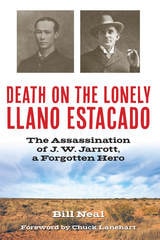
Death on the Lonely Llano Estacado
The Assassination of J. W. Jarrott, a Forgotten HeroBill Neal
University of North Texas Press, 2017