Results by title
8113 books match the query 'Literary Criticism' and 287 start with d
Disturbing Attachments
Genet, Modern Pederasty, and Queer HistoryKadji Amin
Duke University Press, 2017
Disturbing Indians
The Archaeology of Southern FictionAnnette Trefzer
University of Alabama Press, 2007
How Faulkner, Welty, Lytle, and Gordon reimagined and reconstructed the Native American past in their work.
In this book, Annette Trefzer argues that not only have Native Americans played an active role in the construction of the South’s cultural landscape—despite a history of colonization, dispossession, and removal aimed at rendering them invisible—but that their under-examined presence in southern literature also provides a crucial avenue for a post-regional understanding of the American South. William Faulkner, Eudora Welty, Andrew Lytle, and Caroline Gordon created works about the Spanish conquest of the New World, the Cherokee frontier during the Revolution, the expansion into the Mississippi Territory, and the slaveholding societies of the American southeast. They wrote 100 years after the forceful removal of Native Americans from the southeast but consistently returned to the idea of an "Indian frontier," each articulating a different vision and discourse about Native Americans—wholesome and pure in the vision of some, symptomatic of hybridity and universality for others.
Trefzer contends that these writers engage in a double discourse about the region and nation: fabricating regional identity by invoking the South’s "native" heritage and pointing to issues of national guilt, colonization, westward expansion, and imperialism in a period that saw the US sphere of influence widen dramatically. In both cases, the "Indian" signifies regional and national self-definitions and contributes to the shaping of cultural, racial, and national "others." Trefzer employs the idea of archeology in two senses: quite literally the excavation of artifacts in the South during the New Deal administration of the 1930s (a surfacing of material culture to which each writer responded) and archeology as a method for exploring texts she addresses (literary digs into the textual strata of America’s literature and its cultural history).
Disturbing the Universe
Power and Repression in Adolescent LiteratureRoberta S. Trites
University of Iowa Press, 2004
The Young Adult novel is ordinarily characterized as a coming-of-age story, in which the narrative revolves around the individual growth and maturation of a character, but Roberta Trites expands this notion by chronicling the dynamics of power and repression that weave their way through YA books. Characters in these novels must learn to negotiate the levels of power that exist in the myriad social institutions within which they function, including family, church, government, and school.
Trites argues that the development of the genre over the past thirty years is an outgrowth of postmodernism, since YA novels are, by definition, texts that interrogate the social construction of individuals. Drawing on such nineteenth-century precursors as Little Women and Adventures of Huckleberry Finn, Disturbing the Universe demonstrates how important it is to employ poststructuralist methodologies in analyzing adolescent literature, both in critical studies and in the classroom. Among the twentieth-century authors discussed are Blume, Hamilton, Hinton, Le Guin, L'Engle, and Zindel.
Trites' work has applications for a broad range of readers, including scholars of children's literature and theorists of post-modernity as well as librarians and secondary-school teachers.
Disturbing the Universe: Power and Repression in Adolescent Literature by Roberta Seelinger Trites is the winner of the 2002 Children's Literature Association's Book Award. The award is given annually in order to promote and recognize outstanding contributions to children's literature, history, scholarship, and criticisim; it is one of the highest academic honors that can accrue to an author of children's literary criticism.
Divergent Trajectories
Interviews with Innovative Fiction WritersFlore Chevaillier
The Ohio State University Press, 2017
Including interviews with R. M. Berry, Debra Di Blasi, Percival Everett, Thalia Field, Renee Gladman, Bhanu Kapil, Lance Olsen, Michael Martone, Carole Maso, Joseph McElroy, Christina Milletti, Alan Singer, and Steve Tomasula, Divergent Trajectories provides a framework that allows innovative authors to discuss in some depth their works, backgrounds, formal research, thematic preferences, genre treatment, aesthetic philosophies, dominant linguistic expressions, cultural trends, and the literary canon. Through an examination of these concepts, writers ask what “traditional” and “innovative” writing is, and most of all, what fiction is today.
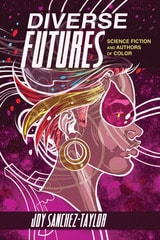
Diverse Futures
Science Fiction and Authors of ColorJoy Sanchez-Taylor
The Ohio State University Press, 2021

Diversity
Gender, Color, and CulturePhilomena Essed
University of Massachusetts Press, 1996
Essed examines these problems in a series of interrelated essays, urging us throughout the book to create a society in which diversity is accepted, encouraged, and made central to everyday life.
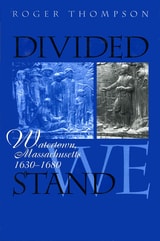
Divided We Stand
Watertown, Massachusetts, 1630-1680Roger Thompson
University of Massachusetts Press, 2001
Thompson describes Watertown's early government, its relations with Native Americans and neighboring communities, its religious and economic affairs, and the day-to-day experiences of its people. Conflict occurred over a wide variety of issues: land allocation, administrative accountability, religious orthodoxy and exclusivity, generational and gender differences, livestock and fencing, haves and have-nots.
Thompson brings these disputes to life through a series of vivid case studies drawn from the unpublished Middlesex County Court Records. Among others, we meet John Sawin, who despite his best efforts at subterfuge was convicted of stealing and selling a neighbor's horse; Susanna Woodward, whose pregnancy resulted in a fiercely contested paternity case; and Edward Sanders, whose punishment for child abuse was both a whipping and a ruling that when in public he must "wear a rope round his neck openly to be seen hanging down two feet."
Throughout the book, the same themes reappear: continuity and change, the persistent conflicts of the first two generations, and the countervailing forces of communal cohesion.
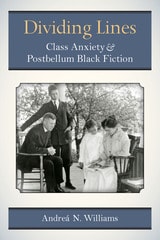
Dividing Lines
Class Anxiety and Postbellum Black FictionAndreá N. Williams
University of Michigan Press, 2013
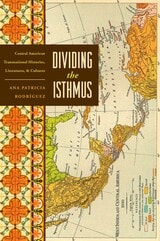
Dividing the Isthmus
Central American Transnational Histories, Literatures, and CulturesBy Ana Patricia Rodríguez
University of Texas Press, 2009
In 1899, the United Fruit Company (UFCO) was officially incorporated in Boston, Massachusetts, beginning an era of economic, diplomatic, and military interventions in Central America. This event marked the inception of the struggle for economic, political, and cultural autonomy in Central America as well as an era of homegrown inequities, injustices, and impunities to which Central Americans have responded in creative and critical ways. This juncture also set the conditions for the creation of the Transisthmus—a material, cultural, and symbolic site of vast intersections of people, products, and narratives.
Taking 1899 as her point of departure, Ana Patricia Rodríguez offers a comprehensive, comparative, and meticulously researched book covering more than one hundred years, between 1899 and 2007, of modern cultural and literary production and modern empire-building in Central America. She examines the grand narratives of (anti)imperialism, revolution, subalternity, globalization, impunity, transnational migration, and diaspora, as well as other discursive, historical, and material configurations of the region beyond its geophysical and political confines.
Focusing in particular on how the material productions and symbolic tropes of cacao, coffee, indigo, bananas, canals, waste, and transmigrant labor have shaped the transisthmian cultural and literary imaginaries, Rodríguez develops new methodological approaches for studying cultural production in Central America and its diasporas.
Monumental in scope and relentlessly impassioned, this work offers new critical readings of Central American narratives and contributes to the growing field of Central American studies.
Do the Americas Have a Common Literature?
Gustavo Pérez Firmat, ed.
Duke University Press, 1990
The essays here place the literature of the Americas in a hemispheric context by drawing on approaches derived from various schools of contemporary critical thought—Marxism, feminism, culture studies, semiotics, reception aesthetics, and poststructuralism. As part of their search for a distinctly New World literary idiom, the contributors engage not only the major North American and Spanish American writers, but also such “marginal” or “minor” literatures as Chicano, African American, Brazilian, and Québecois. In identifying areas of agreement and confluence, this work lays the groundwork for finding historical, ideological, and cultural homogeneity in the imaginative writing of the Americas.
Contributors. Lois Parkinson Zamora, David T. Haberly, José David Saldívar, Antonio Benítez-Rojo, José Piedra, Doris Sommer, Enrico Mario Santí, Eduardo González, John Irwin, Wendy B. Faris, René Prieto, Jonathan Monroe, Gustavo Pérez Firmat

Dockside Reading
Hydrocolonialism and the Custom HouseIsabel Hofmeyr
Duke University Press, 2022
Doctoring the Novel
Medicine and Quackery from Shelley to DoyleSylvia A. Pamboukian
Ohio University Press, 2012
Doctoring the Novel explores the ways in which language constructs and stabilizes these slippery terms by examining medical quackery and orthodoxy in works such as Mary Shelley’s Frankenstein, Charles Dickens’s Bleak House and Little Dorrit, Charlotte Brontë’s Villette, Wilkie Collins’s Armadale, and Arthur Conan Doyle’s Stark Munro Letters. Contextualized in both medical and popular publishing, literary analysis reveals that even supposedly medico-scientific concepts such as orthodoxy and quackery evolve not in elite laboratories and bourgeois medical societies but in the rough-and-tumble of the public sphere, a view that acknowledges the considerable, and often underrated, influence of language on medical practices.
Doctors in the Making
Memoirs and Medical EducationSuzanne Poirier
University of Iowa Press, 2009
Through close readings of these accounts, Poirier draws attention to the complex nature of power in medicine, the rewards and hazards of professional and interpersonal relationships in all aspects of physicians’ lives, and the benefits to and threats from the vulnerability that medical students and residents experience.
Although most students emerge from medical education as well-trained, well-prepared professionals, few of them will claim that they survived the process unscathed. The authors of these accounts document—for better or for worse—the ways in which they have been changed. Based on their stories, Poirier recommends that medical education should make room for the central importance of personal relationships, the profound sense of isolation and powerlessness that can threaten the wellbeing of patients and physicians alike, and the physical and moral vulnerability that are part of every physician’s life.
Document Raj
Writing and Scribes in Early Colonial South IndiaBhavani Raman
University of Chicago Press, 2012
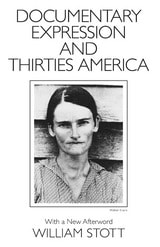
Documentary Expression and Thirties America
William Stott
University of Chicago Press, 1986
"[Scott] might be called the Aristotle of documentary. No one before him has so comprehensively surveyed the achievement of the 1930s, suggesting what should be admired, what condemned, and why; no one else has so persuasively furnished an aesthetic for judging the form."—Times Literary Supplement
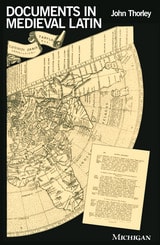
Documents in Medieval Latin
John Thorley
University of Michigan Press, 1998
Documents in Medieval Latin will be useful to students of medieval history, literature, and philosophy and those interested in reading more about the Middle Ages. Thorley's cheerful approach, the lively and representative selections of tests, and the documentary and epigraphic focus will prove valuable for those wishing to explore these vital original sources.
John Thorley teaches medieval Latin at Lancaster University.
Documents of American Realism and Naturalism
Donald Pizer
Southern Illinois University Press, 1998
Donald Pizer presents the major critical discussions of American realism and naturalism from the beginnings of the movement in the 1870s to the present. He includes the most often cited discussions ranging from William Dean Howells, Henry James, and Frank Norris in the late nineteenth century to those by V. L. Parrington, Malcolm Cowley, and Lionel Trilling in the early twentieth century. To provide the full context for the effort to interpret the nature and significance of realism and naturalism during the periods when the movements were live issues on the critical scene, however, he also includes many uncollected essays. His selections since World War II reflect the major recent tendencies in academic criticism of the movements.
Through introductions to each of the three sections, Pizer provides background, delineating the underlying issues motivating attempts to attack, defend, or describe American realism and naturalism. In particular, Pizer attempts to reveal the close ties between criticism of the two movements and significant cultural concerns of the period in which the criticism appeared. Before each selection, Pizer provides a brief biographical note and establishes the cultural milieu in which the essay was originally published. He closes his anthology with a bibliography of twentieth-century academic criticism of American realism and naturalism.
Doing What Comes Naturally
Change, Rhetoric, and the Practice of Theory in Literary & Legal StudiesStanley Fish
Duke University Press, 1989

Domestic Broils
Shakers, Antebellum Marriage, and the Narratives of Mary and Joseph DyerElizabeth De Wolfe
University of Massachusetts Press, 2010
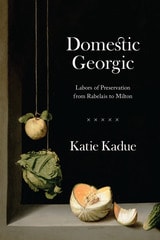
Domestic Georgic
Labors of Preservation from Rabelais to MiltonKatie Kadue
University of Chicago Press, 2021
When is literary production more menial than inspired, more like housework than heroics of the mind? In this revisionist study, Katie Kadue shows that some of the authors we credit with groundbreaking literary feats—including Michel de Montaigne and John Milton—conceived of their writing in surprisingly modest and domestic terms. In contrast to the monumental ambitions associated with the literature of the age, and picking up an undercurrent of Virgil’s Georgics, poetic labor of the Renaissance emerges here as often aligned with so-called women’s work. Kadue reveals how male authors’ engagements with a feminized georgic mode became central to their conceptions of what literature is and could be. This other georgic strain in literature shared the same primary concern as housekeeping: the necessity of constant, almost invisible labor to keep the things of the world intact. Domestic Georgic brings into focus a conception of literary—as well as scholarly and critical—labor not as a striving for originality and fame but as a form of maintenance work that aims at preserving individual and collective life.
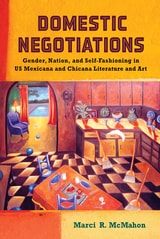
Domestic Negotiations
Gender, Nation, and Self-Fashioning in US Mexicana and Chicana Literature and ArtMcMahon, Marci R
Rutgers University Press, 2013
This interdisciplinary study explores how US Mexicana and Chicana authors and artists across different historical periods and regions use domestic space to actively claim their own histories. Through “negotiation”—a concept that accounts for artistic practices outside the duality of resistance/accommodation—and “self-fashioning,” Marci R. McMahon demonstrates how the very sites of domesticity are used to engage the many political and recurring debates about race, gender, and immigration affecting Mexicanas and Chicanas from the early twentieth century to today.
Domestic Negotiations covers a range of archival sources and cultural productions, including the self-fashioning of the “chili queens” of San Antonio, Texas, Jovita González’s romance novel Caballero, the home economics career and cookbooks of Fabiola Cabeza de Baca, Sandra Cisneros’s “purple house controversy” and her acclaimed text The House on Mango Street, Patssi Valdez’s self-fashioning and performance of domestic space in Asco and as a solo artist, Diane Rodríguez’s performance of domesticity in Hollywood television and direction of domestic roles in theater, and Alma López’s digital prints of domestic labor in Los Angeles. With intimate close readings, McMahon shows how Mexicanas and Chicanas shape domestic space to construct identities outside of gendered, racialized, and xenophobic rhetoric.
Domesticating Empire
Enlightenment in Spanish AmericaKaren Stolley
Vanderbilt University Press, 2013
Through the work of five authors--Jose de Oviedo y Banos, Juan Ignacio Molina, Felix de Azara, Catalina de Jesus Herrera, and Felix de Arrate--Domesticating Empire explores the Ibero-American Enlightenment as a project that reflects both key Enlightenment concerns and the particular preoccupations of Bourbon Spain and its territories in the Americas. At a crucial moment in Spain's imperial trajectory, these authors domesticate topics central to empire--conquest, Indians, nature, God, and gold--by making them familiar and utilitarian. As a result, their works later proved resistant to overarching schemes of Latin American literary history and have been largely forgotten. Nevertheless, eighteenth-century Ibero-American writing complicates narratives about both the Enlightenment and Latin American cultural identity.
Domestications
American Empire, Literary Culture, and the Postcolonial LensHosam Aboul-Ela
Northwestern University Press, 2018
Domestications traces a genealogy of American global engagement with the Global South since World War II. Hosam Aboul-Ela reads American writers contrapuntally against intellectuals from the Global South in their common—yet ideologically divergent—concerns with hegemony, world domination, and uneven development. Using Edward Said’s Culture and Imperialism as a model, Aboul-Ela explores the nature of U.S. imperialism’s relationship to literary culture through an exploration of five key terms from the postcolonial bibliography: novel, idea, perspective, gender, and space.
Within this framework the book examines juxtapositions including that of Paul Bowles’s Morocco with North African intellectuals’ critique of Orientalism, the global treatment of Vietnamese liberation movements with the American narrative of personal trauma in the novels of Tim O’Brien and Hollywood film, and the war on terror’s philosophical idealism with Korean and post-Arab nationalist materialist archival fiction.
Domestications departs from other recent studies of world literature in its emphases not only on U.S. imperialism but also on intellectuals working in the Global South and writing in languages other than English and French. Although rooted in comparative literature, its readings address issues of key concern to scholars in American studies, postcolonial studies, literary theory, and Middle Eastern studies.
Domesticity, Imperialism, and Emigration in the Victorian Novel
Diana C. Archibald
University of Missouri Press, 2002
Don Isaac Abravanel
An Intellectual BiographyCedric Cohen-Skalli
Brandeis University Press, 2020
Don Isaac Abravanel (1437–1508) was one of the great inventors of Jewish modernity. A merchant, banker, and court financier, a scholar versed in both Jewish and Christian writings, a preacher and exegete, a prominent political actor in royal entourages and Jewish communities, Abravanel was one of the greatest leaders and thinkers of Iberian Jewry in the aftermath of the expulsion of 1492. This book, the first new intellectual biography of Abravanel in twenty years, depicts his life in three cultural milieus—Portugal, Castile, and post-expulsion Italy—and analyzes his major literary accomplishments in each period. Abravanel was a traditionalist with innovative ideas, a man with one foot in the Middle Ages and the other in the Renaissance. An erudite scholar, author of a monumental exegetical opus that is still studied today, and an avid book collector, he was a transitional figure, defined by an age of contradictions. Yet, it is these very contradictions that make him such an important personality for understanding the dawn of Jewish modernity.
Don't Ask
Philip Levine
University of Michigan Press, 1981
Don't Forget to Live
Goethe and the Tradition of Spiritual ExercisesPierre Hadot
University of Chicago Press, 2023
With a foreword by Arnold I. Davidson and Daniele Lorenzini.
In his final book, renowned philosopher Pierre Hadot explores Goethe’s relationship with ancient spiritual exercises—transformative acts of intellect, imagination, or will. Goethe sought both an intense experience of the present moment as well as a kind of cosmic consciousness, both of which are rooted in ancient philosophical practices. These practices shaped Goethe’s audacious contrast to the traditional maxim memento mori (Don’t forget that you will die) with the aim of transforming our ordinary consciousness. Ultimately, Hadot reveals how Goethe cultivated a deep love for life that brings to the forefront a new maxim: Don’t forget to live.
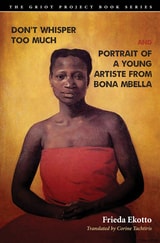
Don't Whisper Too Much and Portrait of a Young Artiste from Bona Mbella
Ekotto, Frieda
Bucknell University Press, 2019
Published by Bucknell University Press. Distributed worldwide by Rutgers University Press.
Donald Barthelme
An ExhibitionJerome Klinkowitz
Duke University Press, 1991
Klinkowitz argues that the central piece in the Barthelme canon, and the key to his artistic method, is his widely acknowledged masterpiece, The Dead Father. In turning to this pivotal work, as well as to Barthelme’s short stories and other novels, Klinkowitz explores the way in which Barthelme reinvented the tools of narration, characterization, and thematics at a time when fictive techniques were largely believed to be exhausted.
Klinkowitz, who was one of the first scholars to study Barthelme’s work and became its definitive bibliographer, situates Barthelme’s life and work within a broad spectrum of influences and affinities. A consideration of developments in painting and sculpture, for example, as well as those of contemporaneous fiction, contribute to Klinkowitz’s analysis. This astute reading will provide great insight for readers, writers, and critics of contemporary American fiction seeking explanations and justifications of Barthelme’s critical importance in the literature of our times.
Doom Patterns
Latinx Speculations and the Aesthetics of ViolenceMaia Gil'Adí
Duke University Press, 2025
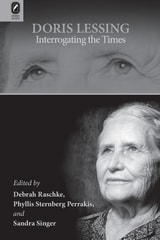
Doris Lessing
Interrogating the TimesEdited by Debrah Raschke, Phyllis Sternberg Perrakis, and Sandra Singer
The Ohio State University Press, 2010
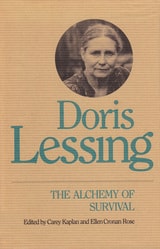
Doris Lessing
The Alchemy of SurvivalCarey Kaplan
Ohio University Press, 1988
Long neglected by the academic world because of her rejection of belletristic values and resistance to convenient literary taxonomy, Doris Lessing has nonetheless built an international following of serious, dedicated readers. Acknowledging the difficulties posed by the multiple dimensions of Lessing’s work, Kaplan and Rose have gathered eleven essays that address her artistic, philosophical, political, and psychological complexity, and so provide a welcome introduction to the extraordinary depth and diversity of this important contemporary novelist.
Lessing has been described as an “alchemical” writer, in that her work is directed toward changing people’s lives and perceptions rather than simply recording experience. Accordingly, the contributors examine her various postures and tactics for the purpose of discovering how the alchemical elements inform her various personae. Frederick C. Stern discusses Lessing’s commitment to radical humanist thought, while Carey Kaplan examines how Lessing’s imperialist past has shaped her futuristic fiction. Elizabeth Abel offers a feminist interpretation of the pattern of brother-sister incest in Lessing’s work, showing how Lessing has established Antigone as a female alternative to the Oedipal myth of male incest. Particularly insightful is Eve Bertelsen’s report of her interview with Lessing, demonstrating how Lessing’s often evasive style of adversarial dialogue works in concert with her refusal to be conveniently pigeonholed by academic analysis.
For those readers new to her work, Doris Lessing: The Alchemy of Survival will serve as a useful introduction to Lessing’s concerns and techniques. Those who have long admired her writing will find in this collection new keys to understanding Lessing’s philosophical, political, and psychological complexity.
Doris Lessing
The Poetics of ChangeGayle Greene
University of Michigan Press, 1997
Doris Lessing has been a chronicler of our age for nearly half a century, and a study of her writing career does not yield easy generalizations. Difficult though she is to categorize, she is always concerned with change, with a search for "something new" against "the nightmare repetition" of history. The feminist quest she articulated in The Children of Violence and The Golden Notebook entered the culture with the force of a new myth: these books changed lives. The Golden Notebook--together with such works as The Second Sex and The Feminine Mystique--raised the consciousness of a generation of women readers and played a major part in making the second wave of feminism. It is the power of Lessing's novels to change people's lives, the effect she had raising the consciousness of a generation of women and the effect she continues to have on young readers, that is the subject of this book.
Gayle Greene employs an eclectic range of approaches (psychoanalytic, Marxist, biographical, historical, intertextual, formalist, feminist) to shed new light on Lessing's remarkable achievement. She sees Lessing as a feminist writer, not in offering strong female role models who climb top the top of existing social structures, but in envisioning, and indeed helping to bring about, a transformation of those structures. Lessing critiques Western values of individualism, competition, and materialism in terms similar to those developed by feminism; and, in getting us to view our culture from without, in teaching us to read cultural constructs as systems, her novels perform the deconstructing and demystifying work of feminism.
Dorothy B. Hughes
A Poet Turns to CrimeEdwin L. Battistella
University of Missouri Press, 2026
Hailed by critics and fans as “The Queen of Noir” and “a prescient feminist,” Dorothy B. Hughes (1904-1993) challenged the conventions of the crime fiction genre by exploring race, class, and social justice across her fourteen novels. Edwin Battistella’s new work weaves discussion of Hughes’s literary output with the story of her life. Dorothy B. Hughes: A Poet Turns to Crime examines her work as a poet, journalist, novelist, screenwriter, and critic as well as her family and personal relationships.
Beginning with her upbringing in Kansas City, Missouri, Battistella follows the writer’s time studying journalism at the University of Missouri, her subsequent work as a newspaper reporter, the eventual publication of her first book, a volume of poetry, and her prolific output of mystery novels that spanned two decades. Battistella situates her work in the broader context of twentieth-century crime fiction and its connection to various political and social movements, including her life-long concern with racial equality, which culminated in the 1963 publication of her final novel, The Expendable Man, which appeared at the height of the Civil Rights movement and is considered by many to be her best work.
In addition to drawing from Hughes’s own work and its reception by contemporary critics, Battistella examines later critical commentaries, scholarly articles, published interviews, archival material, and interviews with friends and family to tell her life story and literary legacy. More importantly, Battistella provides insights into why Dorothy B. Hughes still matters today, making his new work an important contribution to the history of popular culture and literary history.
Dorothy Dunnett’s Lymond Chronicles
The Enigma of Francis CrawfordScott Richardson
University of Missouri Press, 2016
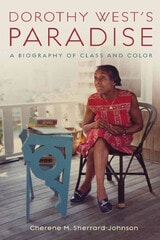
Dorothy West's Paradise
A Biography of Class and ColorSherrard-Johnson, Cherene
Rutgers University Press, 2012
Dorothy West is best known as one of the youngest writers involved in the Harlem Renaissance. Subsequently, her work is read as a product of the urban aesthetics of this artistic movement. But West was also intimately rooted in a very different milieu—Oak Bluffs, an exclusive retreat for African Americans on Martha’s Vineyard. She played an integral role in the development and preservation of that community. In the years between publishing her two novels, 1948’s The Living is Easy and the 1995 bestseller The Wedding, she worked as a columnist for the Vineyard Gazette.
Dorothy West’s Paradise captures the scope of the author’s long life and career, reading it alongside the unique cultural geography of Oak Bluffs and its history as an elite African American enclave—a place that West envisioned both as a separatist refuge and as a space for interracial contact. An essential book for both fans of West’s fiction and students of race, class, and American women’s lives, Dorothy West’s Paradise offers an intimate biography of an important author and a privileged glimpse into the society that shaped her work.

Dorsality
Thinking Back through Technology and PoliticsDavid Wills
University of Minnesota Press, 2008
In this highly original book David Wills rethinks not only our nature before all technology but also what we understand to be technology. Rather than considering the human being as something natural that then develops technology, Wills argues, we should instead imagine an originary imbrication of nature and machine that begins with a dorsal turn-a turn that takes place behind our back, outside our field of vision.
With subtle and insightful readings, Wills pursues this sense of what lies behind our idea of the human by rescuing Heidegger’s thinking from a reductionist dismissal of technology, examining different angles on Lévinas’s face-to-face relation, and tracing a politics of friendship and sexuality in Derrida and Sade. He also analyzes versions of exile in Joyce’s rewriting of Homer and Broch’s rewriting of Virgil and discusses how Freud and Rimbaud exemplify the rhetoric of soil and blood that underlies every attempt to draw lines between nations and discriminate between peoples. In closing, Wills demonstrates the political force of rhetoric in a sophisticated analysis of Nietzsche’s oft-quoted declaration that “God is dead.”
Forward motion, Wills ultimately reveals, is an ideology through which we have favored the front-what can be seen-over the aspects of the human and technology that lie behind the back and in the spine-what can be sensed otherwise-and shows that this preference has had profound environmental, political, sexual, and ethical consequences.
David Wills is professor of French and English at the University of Albany (SUNY). He is the author of Prosthesis and Matchbook: Essays in Deconstruction as well as the translator of works by Jacques Derrida, including The Gift of Death.
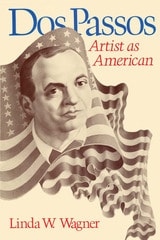
Dos Passos
Artist as AmericanBy Linda W. Wagner
University of Texas Press, 1979
In most of his half century of writing, John Dos Passos consistently tried to capture and define the American character. The complete range of his work builds to Dos Passos' concept of "contemporary chronicle," his own name for his fiction. In this first study of all Dos Passos' writing, Linda W. Wagner examines his fiction, poetry, drama, travel essays, and history—a body of work that evokes a vivid image of America meant to be neither judgmental nor moralistic.
From Manhattan Transfer to U. S. A. to District of Columbia to The Thirteenth Chronicle and Mid-century, Wagner illuminates Dos Passos' work with fresh readings and new interpretations. She makes extensive use of unpublished manuscript material so that this is a casebook of Dos Passos' interest in craft and method as well as a thematic study. In addition, this volume chronicles the years during which Dos Passos wrote—the immediate post-World War I period through the twenties and thirties and well into the fifties. This is an important book both in literary criticism and in American social history.
Dostoevsky and Romantic Realism
A Study of Dostoevsky in Relation to Balzac, Dickens, and GogolDonald Fanger
Northwestern University Press, 1998
Dostoevsky and the Affirmation of Life
Predrag Cicovacki
St. Augustine's Press, 2008
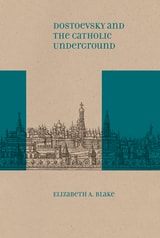
Dostoevsky and the Catholic Underground
Elizabeth A. Blake
Northwestern University Press, 2019
While Dostoevsky’s relation to religion is well-trod ground, there exists no comprehensive study of Dostoevsky and Catholicism. Elizabeth Blake’s ambitious and learned Dostoevsky and the Catholic Underground fills this glaring omission in the scholarship. Previous commentators have traced a wide-ranging hostility in Dostoevsky’s understanding of Catholicism to his Slavophilism. Blake depicts a far more nuanced picture. Her close reading demonstrates that he is repelled and fascinated by Catholicism in all its medieval, Reformation, and modern manifestations. Dostoevsky saw in Catholicism not just an inspirational source for the Grand Inquisitor but a political force, an ideological wellspring, a unique mode of intellectual inquiry, and a source of cultural production. Blake’s insightful textual analysis is accompanied by an equally penetrating analysis of nineteenth-century European revolutionary history, from Paris to Siberia, that undoubtedly influenced the evolution of Dostoevsky’s thought.
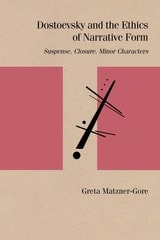
Dostoevsky and the Ethics of Narrative Form
Suspense, Closure, Minor CharactersGreta Matzner-Gore
Northwestern University Press, 2020
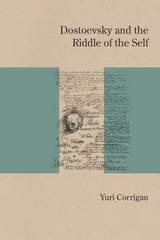
Dostoevsky and the Riddle of the Self
Yuri Corrigan
Northwestern University Press, 2017
Dostoevsky was hostile to the notion of individual autonomy, and yet, throughout his life and work, he vigorously advocated the freedom and inviolability of the self. This ambivalence has animated his diverse and often self-contradictory legacy: as precursor of psychoanalysis, forefather of existentialism, postmodernist avant la lettre, religious traditionalist, and Romantic mystic.
Dostoevsky and the Riddle of the Self charts a unifying path through Dostoevsky's artistic journey to solve the “mystery” of the human being. Starting from the unusual forms of intimacy shown by characters seeking to lose themselves within larger collective selves, Yuri Corrigan approaches the fictional works as a continuous experimental canvas on which Dostoevsky explored the problem of selfhood through recurring symbolic and narrative paradigms. Presenting new readings of such works as The Idiot, Demons, and The Brothers Karamazov, Corrigan tells the story of Dostoevsky’s career-long journey to overcome the pathology of collectivism by discovering a passage into the wounded, embattled, forbidding, revelatory landscape of the psyche.
Corrigan’s argument offers a fundamental shift in theories about Dostoevsky's work and will be of great interest to scholars of Russian literature, as well as to readers interested in the prehistory of psychoanalysis and trauma studies and in theories of selfhood and their cultural sources.
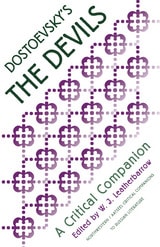
Dostoevsky's "The Devils"
A Critical CompanionWilliam Leatherbarrow
Northwestern University Press, 1999
Dostoevsky's "The Idiot"
A Critical CompanionLiza Knapp
Northwestern University Press, 1998
Dostoevsky's Dialectics and the Problem of Sin
Ksana Blank
Northwestern University Press, 2019
In Dostoevsky’s Dialectics and the Problem of Sin, Ksana Blank borrows from ancient Greek, Chinese, and Christian dialectical traditions to formulate a dynamic image of Dostoevsky’s dialectics—distinct from Hegelian dialectics—as a philosophy of “compatible contradictions.” Expanding on the classical triad of Goodness, Beauty, and Truth, Blank guides us through Dostoevsky’s most difficult paradoxes: goodness that begets evil, beautiful personalities that bring about grief, and criminality that brings about salvation.
Dostoevsky’s philosophy of contradictions, this book demonstrates, contributes to the development of antinomian thought in the writings of early twentieth-century Russian religious thinkers and to the development of Bakhtin’s dialogism. Dostoevsky’s Dialectics and the Problem of Sin marks an important and original intervention into the enduring debate over Dostoevsky’s spiritual philosophy.
Dostoevsky's Idiot
Dialogue and the Spiritually Good LifeBruce A. French
Northwestern University Press, 2001
In three chapters, French takes up in turn the narrator and narrative points of view, the author’s use of inserted narratives, and three modes of interaction French calls Monologue, Dialogue, and Dialogical Living.
Dostoevsky's Secrets
Reading Against the GrainCarol Apollonio
Northwestern University Press, 2009
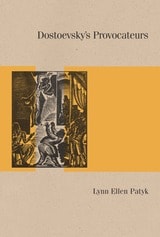
Dostoevsky’s Provocateurs
Lynn Ellen Patyk
Northwestern University Press, 2023
Confronting Bakhtin’s formative reading of Dostoevsky to recover the ways the novelist stokes conflict and engages readers—and to explore the reasons behind his adversarial approach
Like so many other elements of his work, Fyodor Dostoevsky’s deliberate deployment of provocation was both prescient and precocious. In this book, Lynn Ellen Patyk singles out these forms of incitement as a communicative strategy that drives his paradoxical art. Challenging, revising, and expanding on Mikhail Bakhtin’s foundational analysis in Problems of Dostoevsky’s Poetics, Patyk demonstrates that provocation is the moving mover of Dostoevsky’s poetics of conflict, and she identifies the literary devices he uses to propel plot conflict and capture our attention. Yet the full scope of Dostoevsky’s provocative authorial activity can only be grasped alongside an understanding of his key themes, which both probed and exploited the most divisive conflicts of his era. The ultimate stakes of such friction are, for him, nothing less than moral responsibility and the truth of identity.
Sober and strikingly original, compassionate but not uncritical, Dostoevsky’s Provocateurs exposes the charged current in the wiring of our modern selves. In an economy of attention and its spoils, provocation is an inexhaustibly renewable and often toxic resource.
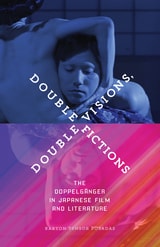
Double Visions, Double Fictions
The Doppelgänger in Japanese Film and LiteratureBaryon Tensor Posadas
University of Minnesota Press, 2018
A fresh take on the dopplegänger and its place in Japanese film and literature—past and present
Since its earliest known use in German Romanticism in the late 1700s, the word Doppelgänger (double-walker) can be found throughout a vast array of literature, culture, and media. This motif of doubling can also be seen traversing historical and cultural boundaries. Double Visions, Double Fictions analyzes the myriad manifestations of the doppelgänger in Japanese literary and cinematic texts at two historical junctures: the interwar period of the 1920s and 1930s and the present day.
According to author Baryon Tensor Posadas, the doppelgänger marks the intersection of the historical impact of psychoanalytic theory, the genre of detective fiction in Japan, early Japanese cinema, and the cultural production of Japanese colonialism. He examines the doppelgänger’s appearance in the works of Edogawa Rampo, Tanizaki Jun’ichiro, and Akutagawa Ryunosuke, as well as the films of Tsukamoto Shin’ya and Kurosawa Kiyoshi, not only as a recurrent motif but also as a critical practice of concepts. Following these explorations, Posadas asks: What were the social, political, and material conditions that mobilized the desire for the doppelgänger? And how does the dopplegänger capture social transformations taking place at these historical moments?
Double Visions, Double Fictions ultimately reveals how the doppelgänger motif provides a fascinating new backdrop for understanding the enmeshment of past and present.