Results by title
22279 books match the query 'Social Science' and 859 start with d

Defects
Engendering the Modern BodyHelen Deutsch and Felicity Nussbaum, Editors
University of Michigan Press, 2000
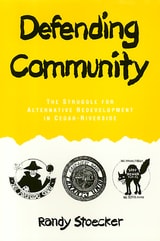
Defending Community
The Struggle for Alternative Redevelopment in Cedar-RiversideRandy Stoecker
Temple University Press, 1994
Randy Stoecker's intimate biography of Cedar-Riverside, nationally known for a period as "the Haight-Ashbury of the Mid-West," contains important lessons about the conflicts between the needs of capitalism and the needs of community. While attending graduate school at the University of Minnesota, the author moved to Cedar-Riverside, a Minneapolis neighborhood known for its determination to enact values of peace, justice, wholeness, participation, and community in its truest sense. There he experienced first-hand the clashes between a radical community and state-backed urban developers.
His narrative tells the story of a community that overcame the odds against its own survival. Slated for total demolition, the neighborhood was saved by a powerful grass-roots movement. Citizens stopped a state-capital coalition from entombing the community in concrete and went on to create one of the largest community controlled urban redevelopment projects in the country After more than twenty years of struggle, Cedar-Riverside continues to experience citizen-controlled urban redevelopment on its own terms, setting an example for other communities, urban planners, and policymakers.
In the series Conflicts in Urban and Regional Development, edited by John R. Logan and Todd Swanstrom.
Defending Diversity
Affirmative Action at the University of MichiganPatricia Gurin, Jeffrey S. Lehman, and Earl Lewis, with Eric L. Dey, Gerald Gurin, and Sylvia Hurtado
University of Michigan Press, 2004

Defending Rumba in Havana
The Sacred and the Black Corporeal UndercommonsMaya J. Berry
Duke University Press, 2025

Defending The Dinetah
Ronald H Towner
University of Utah Press, 2003
Using a database of tree-ring dates taken from beams and wood used to construct these pueblitos, Ronald Towner shows in this volume that most pueblitos are unrelated to Puebloan immigration or the re-conquest. He concludes that Navajos constructed the masonry structures and hogans contemporaneously for protection against Ute raiders and later Spanish entradas. Further, most were occupied for relatively brief periods and population density was much lower than has been assumed.
Towner points to a new model of Navajo ethnogenesis, based on a revised early population distribution and a variety of other means of incorporating non-Athapaskan elements into Navajo culture, making Defending the Dinétah a major contribution to Navajo studies.
Defending Their Own in the Cold
The Cultural Turns of U.S. Puerto RicansMarc Zimmerman
University of Illinois Press, 2011

Defending a Borderland
Canadian and American Environmental Activism in the St. Lawrence ValleyNeil S. Forkey
University of Massachusetts Press, 2026
On the morning of June 23, 1976, the NEPCO 140 barge, carrying 8.7 million gallons of thick crude oil, ruptured twice while plying the swift straits of the St. Lawrence River’s Thousand Islands region. Before the spill was halted, 300,000 gallons of oil had leaked, polluting eighty miles of the river and ruining shorelines on both the New York and Canadian sides. It was the largest inland oil spill in United States history to that date, and the clean-up took 122 days and cost around $8 million. The disaster also prompted concerned citizens to form Save the River, one of the most enduring environmental organizations in North America.
In Defending a Borderland, environmental historian Neil S. Forkey examines environmental activism along the St. Lawrence River from both sides of the international border. He focuses on the period from the 1970s to the 1990s, when numerous citizen groups activated to protect the natural environment against pollution, development, and other perceived threats. Along with reacting to the “Slick of ’76,” their actions included stopping low-level military flights, preventing government land acquisition to create an extended park, and blocking new power lines through the countryside.
By considering the St. Lawrence Valley—a shared space between Canada, the United States, and Mohawk territory—Forkey brings a rare transnational approach to environmental analysis. He also highlights rural, local, and conservative perspectives, all of which are understudied. Using deep archival research and oral histories, Forkey reveals the myriad ways US and Canadian citizens organized before social media, gathering around kitchen tables, and in school auditoriums, to determine ways to reach government officials and neighbors and make lasting changes to protect the natural areas around them for future generations.
Defiant Bodies
Making Queer Community in the Anglophone CaribbeanNikoli A. Attai
Rutgers University Press, 2023

Defining America
Through Immigration PolicyBill Ong Hing
Temple University Press, 2003

Defining Deviance
Sex, Science, and Delinquent Girls, 1890-1960Michael A. Rembis
University of Illinois Press, 2013

Defining Dominion
The Discourses of Magic and Witchcraft in Early Modern France and GermanyGerhild Scholz Williams
University of Michigan Press, 1999
". . . Williams has done an exemplary job of analyzing the intersection of the discourses of magic (as related to women and witchcraft), discovery, and religious diversity/dissidence to explain how the confluence of these discourses eventually 'determined who occupied society's center and who was forced to move to, or remain at, its margins.' . . . Gerhild Scholz Williams is no dilettante grazing in the greener pastures of other disciplines. She has been laboring assiduously in these neighboring fields for years now, and it is breathtaking to see how all of her disparate projects have come together so elegantly articulated in this one volume." --Susan L. Cocalis, German Studies Review
Gerhild Scholz Williams is Professor of German and Comparative Literature, Washington University, St. Louis.
Defining Girlhood in India
A Transnational History of Sexual Maturity LawsAshwini Tambe
University of Illinois Press, 2019
Defining Student Success
The Role of School and CultureLisa M. Nunn
Rutgers University Press, 2014
The key to success, our culture tells us, is a combination of talent and hard work. Why then, do high schools that supposedly subscribe to this view send students to college at such dramatically different rates? Why do students from one school succeed while students from another struggle? To the usual answer—an imbalance in resources—this book adds a far more subtle and complicated explanation. Defining Student Success shows how different schools foster dissimilar and sometimes conflicting ideas about what it takes to succeed—ideas that do more to preserve the status quo than to promote upward mobility.
Lisa Nunn’s study of three public high schools reveals how students’ beliefs about their own success are shaped by their particular school environment and reinforced by curriculum and teaching practices. While American culture broadly defines success as a product of hard work or talent (at school, intelligence is the talent that matters most), Nunn shows that each school refines and adapts this American cultural wisdom in its own distinct way—reflecting the sensibilities and concerns of the people who inhabit each school. While one school fosters the belief that effort is all it takes to succeed, another fosters the belief that hard work will only get you so far because you have to be smart enough to master course concepts. Ultimately, Nunn argues that these school-level adaptations of cultural ideas about success become invisible advantages and disadvantages for students’ college-going futures. Some schools’ definitions of success match seamlessly with elite college admissions’ definition of the ideal college applicant, while others more closely align with the expectations of middle or low-tier institutions of higher education.
With its insights into the transmission of ideas of success from society to school to student, this provocative work should prompt a reevaluation of the culture of secondary education. Only with a thorough understanding of this process will we ever find more consistent means of inculcating success, by any measure.

Defining the Delta
Multidisciplinary Perspectives on the Lower Mississippi River DeltaJanelle Collins
University of Arkansas Press, 2015
Here are essays examining the Delta’s physical properties, boundaries, and climate from a geologist, archeologist, and environmental historian. The Delta is also viewed through the lens of the social sciences and humanities—historians, folklorists, and others studying the connection between the land and its people, in particular the importance of agriculture and the culture of the area, especially music, literature, and food.
Every turn of the page reveals another way of seeing the seven-state region that is bisected by and dependent on the Mississippi River, suggesting ultimately that there are myriad ways of looking at, and defining, the Delta.

Deflecting Immigration
Networks, Markets, and Regulation in Los AngelesIvan Light
Russell Sage Foundation, 2006

Deflective Whiteness
Co-Opting Black and Latinx Identity PoliticsHannah Noel
The Ohio State University Press, 2022
White deflection offers a script for how social justice rhetoric and the emotions of victimization are appropriated to conjure a hegemonic White identity. Using derivative language, deflection claims Whiteness as the aggrieved social status. Through case studies of cultural moments and archives including Twitter, country music, the Black Lives Matter movement, and more, Deflective Whiteness exposes the various forms of tacit White supremacy that operate under the alibi of injury and that ultimately serve to deepen racial inequities. By understanding how, where, and why White deflection is used, Noel argues, scholars and social justice advocates can trace, tag, and deconstruct covert White supremacy at its rhetorical foundations.
Defusing Democracy
Central Bank Autonomy and the Transition from Authoritarian RuleDelia M. Boylan
University of Michigan Press, 2001
Defying Displacement
Grassroots Resistance and the Critique of DevelopmentBy Anthony Oliver-Smith
University of Texas Press, 2010
The uprooting and displacement of people has long been among the hardships associated with development and modernity. Indeed, the circulation of commodities, currency, and labor in modern society necessitates both social and spatial mobility. However, the displacement and resettlement of millions of people each year by large-scale infrastructural projects raises serious questions about the democratic character of the development process.
Although designed to spur economic growth, many of these projects leave local people struggling against serious impoverishment and gross violations of human rights. Working from a political-ecological perspective, Anthony Oliver-Smith offers the first book to document the fight against involuntary displacement and resettlement being waged by people and communities around the world.
Increasingly over the last twenty-five years, the voices of people at the grass roots are being heard. People from many societies and cultures are taking action against development-forced displacement and resettlement (DFDR) and articulating alternatives. Taking the promise of democracy seriously, they are fighting not only for their place in the world, but also for their place at the negotiating table, where decisions affecting their well-being are made.

Degraded Work
The Struggle at the Bottom of the Labor MarketMarc Doussard
University of Minnesota Press, 2013
Critics on the left and the right typically agree that globalization, the loss of manufacturing jobs, and the expansion of the service sector have led to income inequality and rising numbers of low-paying jobs with poor working conditions.
In Degraded Work, Marc Doussard demonstrates that this decline in wages and working conditions is anything but the unavoidable result of competitive economic forces. Rather, he makes the case that service sector and other local-serving employers have boosted profit with innovative practices to exploit workers, demeaning their jobs in new ways—denying safety equipment, fining workers for taking scheduled breaks, requiring unpaid overtime—that go far beyond wage cuts. Doussard asserts that the degradation of service work is a choice rather than an inevitability, and he outlines concrete steps that can be taken to help establish a fairer postindustrial labor market.
Drawing on fieldwork in Chicago, Degraded Work examines changes in two industries in which inferior job quality is assumed to be intrinsic: residential construction and food retail. In both cases, Doussard shows how employers degraded working conditions as part of a successful and intricate strategy to increase profits. Arguing that a growing service sector does not have to mean growing inequality, Doussard proposes creative policy and organizing opportunities that workers and advocates can use to improve job quality despite the overwhelming barriers to national political action.
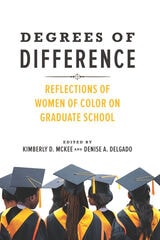
Degrees of Difference
Reflections of Women of Color on Graduate SchoolEdited by Kimberly D. McKee and Denise A. Delgado
University of Illinois Press, 2020
In Degrees of Difference, women of color from diverse backgrounds give frank, unapologetic accounts of their battles—both internal and external—to navigate grad school and fulfill their ambitions. At the same time, the authors offer strategies for surviving the grind via stories of their own hard-won successes with self-care, building supportive communities, finding like-minded mentors, and resisting racism and unsupportive faculty and colleagues.
Contributors: Aeriel A. Ashlee, Denise A. Delgado, Nwadiogo I. Ejiogu, Delia Fernández, Regina Emily Idoate, Karen J. Leong, Kimberly D. McKee, Délice Mugabo, Carrie Sampson, Arianna Taboada, Jenny Heijun Wills, and Soha Youssef

Degrees of Difficulty
How Women's Gymnastics Rose to Prominence and Fell from GraceGeorgia Cervin
University of Illinois Press, 2021
Electrifying athletes like Olga Korbut and Nadia Comăneci helped make women’s artistic gymnastics one of the most popular events in the Olympic Games. But the transition of gymnastics from a women’s sport to a girl’s sport in the 1970s also laid the foundation for a system of emotional, physical, and sexual abuse of gymnasts around the world. Georgia Cervin offers a unique history of women's gymnastics, examining how the high-stakes diplomatic rivalry of the Cold War created a breeding ground for exploitation. Yet, a surprising spirit of international collaboration arose to decide the social values and image of femininity demonstrated by the sport. Cervin also charts the changes in style, equipment, training, and participants that transformed the sport, as explosive athleticism replaced balletic grace and gymnastics dominance shifted from East to West.
Sweeping and revelatory, Degrees of Difficulty tells a story of international friction, unexpected cooperation, and the legacy of abuse and betrayal created by the win-at-all-cost attitudes of the Cold War.

Degrees of Mixture, Degrees of Freedom
Genomics, Multiculturalism, and Race in Latin AmericaPeter Wade
Duke University Press, 2017

Degrees of Risk
Navigating Insecurity and Inequality in Public Higher EducationBlake R. Silver
University of Chicago Press, 2024
Institutions of higher education are often described as “ivory towers,” places of privilege where students exist in a “campus bubble,” insulated from the trials of the outside world. These metaphors reveal a widespread belief that college provides young people with stability and keeps insecurity at bay. But for many students, that’s simply not the case.
Degrees of Risk reveals how insecurity permeates every facet of college life for students at public universities. Sociologist Blake Silver dissects how these institutions play a direct role in perpetuating uncertainty, instability, individualism, and anxiety about the future. Silver examined interviews with more than one hundred students who described the risks that surrounded every decision: which major to choose, whether to take online classes, and how to find funding. He expertly identified the ways the college experience played out differently for students from different backgrounds. For students from financially secure families with knowledge of how college works, all the choices and flexibility of college felt like an adventure or a wealth of opportunities. But for many others, especially low-income, first-generation students, their personal and family circumstances meant that that flexibility felt like murkiness and precarity. In addition, he discovered that students managed insecurity in very different ways, intensifying inequality at the intersections of socioeconomic status, race, gender, and other sociodemographic dimensions. Drawing from these firsthand accounts, Degrees of Risk presents a model for a better university, one that fosters success and confidence for a diverse range of students.

Degrees of Risk
Navigating Insecurity and Inequality in Public Higher EducationBlake R. Silver
University of Chicago Press, 2024
An ethnographic analysis of how insecurity is at the heart of contemporary higher education.
Institutions of higher education are often described as “ivory towers,” places of privilege where students exist in a “campus bubble,” insulated from the trials of the outside world. These metaphors reveal a widespread belief that college provides young people with stability and keeps insecurity at bay. But for many students, that’s simply not the case.
Degrees of Risk reveals how insecurity permeates every facet of college life for students at public universities. Sociologist Blake Silver dissects how these institutions play a direct role in perpetuating uncertainty, instability, individualism, and anxiety about the future. Silver examined interviews with more than one hundred students who described the risks that surrounded every decision: which major to choose, whether to take online classes, and how to find funding. He expertly identified the ways the college experience played out differently for students from different backgrounds. For students from financially secure families with knowledge of how college works, all the choices and flexibility of college felt like an adventure or a wealth of opportunities. But for many others, especially low-income, first-generation students, their personal and family circumstances meant that that flexibility felt like murkiness and precarity. In addition, he discovered that students managed insecurity in very different ways, intensifying inequality at the intersections of socioeconomic status, race, gender, and other sociodemographic dimensions. Drawing from these firsthand accounts, Degrees of Risk presents a model for a better university, one that fosters success and confidence for a diverse range of students.

Degrees of Separation
Identity Formation While Leaving Ultra-Orthodox JudaismSchneur Zalman Newfield
Temple University Press, 2020
Those who exit a religion—particularly one they were born and raised in—often find themselves at sea in their efforts to transition to life beyond their community. In Degrees of Separation, Schneur Zalman Newfield, who went through this process himself, interviews seventy-four Lubavitch and Satmar ultra-Orthodox Hasidic Jews who left their communities.He presents their motivations for leaving as well as how they make sense of their experiences and their processes of exiting, detailing their attitudes and opinions regarding their religious upbringing. Newfield also examines how these exiters forge new ways of being that their upbringing had not prepared them for, while also considering what these particular individuals lose and retain in the exit process.
Degrees of Separation presents a comprehensive portrait of the prolonged state of being “in-between” that characterizes transition out of a totalizing worldview. What Newfield discovers is that exiters experience both a sense of independence and a persistent connection; they are not completely dislocated from their roots once they “arrive” at their new destination. Moreover, Degrees of Separation shows that this process of transitioning identity has implications beyond religion.

Dehexing Sex
Russian Womanhood During and After GlasnostHelena Goscilo
University of Michigan Press, 1996

Deities and Divas
Queer Ritual Specialists in Myanmar, Thailand and BeyondEdited by Peter A. Jackson and Benjamin Baumann
National University of Singapore Press, 2022

Del Otro Lado
Literacy and Migration across the U.S.-Mexico BorderSusan V. Meyers
Southern Illinois University Press, 2014
In Del OtroLado: Literacy and Migration across the U.S.-Mexico Border, author Susan V. Meyers draws on her year-long ethnographic study in Mexico and the United States to analyze the literacy practices of Mexican-origin students on both sides of the border.
Meyers begins by taking readers through the historical development of the rural Mexican town of Villachuato. Through a series of case studies spanning the decades between the Mexican Revolution and the modern-day village, Meyers explores the ever-widening gulf between the priorities of students and the ideals of the public education system. As more and more of Villachuato’s families migrate in an effort to find work in the wake of shifting transnational economic policies like NAFTA, the town’s public school teachers find themselves frustrated by spiraling drop-out rates. Meyers discovers that students often consider the current curriculum irrelevant and reject the established value systems of Mexico’s public schools. Meyers debunks the longstanding myth that literacy is tied to economic development, arguing that a “literacy contract” model, in which students participate in public education in exchange for access to increased earning potential, better illustrates the situation in rural Mexico.
Meyers next explores literacy on the other side of the border, traveling to Marshalltown, Iowa, where many former citizens of Villachuato have come to reside because of the availability of jobs for unskilled workers at the huge Swift meat-packing plant there. Here she discovers that Mexican-origin families in the United States often consider education a desirable end in itself rather than a means to an end. She argues that migration has a catalyzing effect on literacy, particularly as Mexican migrant families tend to view education as a desirable form of prestige.
Meyers reveals the history and policies that have shaped the literacy practices of Mexican-origin students, and she raises important questions about not only the obligation of the United States to educate migrant students, but also those students’ educational struggles and ways in which these difficulties can be overcome. This transnational study is essential reading for scholars, students, educators and lawmakers interested in shaping the future of educational policy.

Deliberate Acts
Changing Hopi Culture Through the Oraibi SplitPeter M. Whiteley
University of Arizona Press, 1988
Drawing on oral accounts from Hopi consultants and on contemporary documents, Peter M. Whiteley argues that the split was in fact the result of a conspiracy among Hopi politico-religious leaders from both the “hostile” and “friendly” factions, a revolution to overturn the allegedly corrupt Oraibi religious order. A crucial element of Whiteley’s thesis is that, contrary to established theory, Hopi society was not egalitarian but was controlled by a ruling elite, the pavansinom, who clandestinely planned such events as the destruction of Awatovi because of its reacceptance of Franciscan priests.
Through an analysis of Bacavi social structure, Whiteley demonstrates how one fragment of a well-established society went about creating a new social order after the old one drastically fragmented. His detailed portrait of the history and social organization of a Hopi village represents an unusually rich resource for students of Hopi culture and history.

Delimiting Anthropology
Occasional Inquiries and ReflectionsGeorge W. Stocking, Jr.
University of Wisconsin Press, 2001
The first quartet focuses on the work of Franz Boas and the emergence of "Boasian Culturalism." In the second set of essays Stocking addresses the careers of three British "evolutionaries"—Lord Kames; Sir E. B. Tylor; and Sir James G. Frazer—tracking the development of cultural evolutionary thought from its origins in the Scottish Enlightenment through its early twentieth-century afterglow in Frazer's The Golden Bough.
The third group of essays looks at institutions and national traditions, including British ethnography exemplified in the fieldwork manual Notes and Queries; the humanistic Parisian Société d'Ethnographie; the early tension at the Laboratory of Anthropology in Santa Fe between aspiring local amateur anthropologists and professionals from Eastern universities; and the history of ethnographic museums in the European tradition. In closing, Stocking offers reflections on major tendencies in anthropology from the eighteenth century to the present.
"George Stocking is without rival as an historian of modern anthropology. He is trained as an historian, and he knows anthropologists from having lived among them. This collection is indispensable for any one or place concerned with the subject."—Dell Hymes, editor of Reinventing Anthropology

Delinquency in a Birth Cohort
Marvin E. Wolfgang, Robert M. Figlio, and Thorsten Sellin
University of Chicago Press, 1972
This study of a birth cohort was not originally meant to be etiological or predictive. Yet the data bearing on this cohort of nearly ten thousand boys born in 1945 and living in Philadelphia gave rise to a model for prediction of delinquency, and thus to the possibility for more efficient planning of programs for intervention. It is expert research yielding significant applications and, though largely statistical, the analysis is accessible to readers without mathematical training.
"No serious scholar of the methods of preventing and treating juvenile delinquency can properly ignore this book."—LeRoy L. Lamborn, Law Library Journal
"The magnitude of [this] study is awesome. . . . It should be a useful guide for anyone interested in the intricacies of cohort analysis."—Gary F. Jensen, American Journal of Sociology
"A book the student of juvenile delinquency will find invaluable."—Criminologist

Delinquency, crime, and society
James F. Short Jr.
University of Chicago Press, 1978

Delirious Consumption
Aesthetics and Consumer Capitalism in Mexico and BrazilBy Sergio Delgado Moya
University of Texas Press, 2017
In the decades following World War II, the creation and expansion of massive domestic markets and relatively stable economies allowed for mass consumption on an unprecedented scale, giving rise to the consumer society that exists today. Many avant-garde artists explored the nexus between consumption and aesthetics, questioning how consumerism affects how we perceive the world, place ourselves in it, and make sense of it via perception and emotion.
Delirious Consumption focuses on the two largest cultural economies in Latin America, Mexico and Brazil, and analyzes how their artists and writers both embraced and resisted the spirit of development and progress that defines the consumer moment in late capitalism. Sergio Delgado Moya looks specifically at the work of David Alfaro Siqueiros, the Brazilian concrete poets, Octavio Paz, and Lygia Clark to determine how each of them arrived at forms of aesthetic production balanced between high modernism and consumer culture. He finds in their works a provocative positioning vis-à-vis urban commodity capitalism, an ambivalent position that takes an assured but flexible stance against commodification, alienation, and the politics of domination and inequality that defines market economies. In Delgado Moya’s view, these poets and artists appeal to uselessness, nonutility, and noncommunication—all markers of the aesthetic—while drawing on the terms proper to a world of consumption and consumer culture.

Delivering Health
Midwifery and Development in MexicoLydia Z. Dixon
Vanderbilt University Press, 2020
Maternal health outcomes are a key focus of global health initiatives. In Delivering Health, author Lydia Z. Dixon uncovers the ways such outcomes have been shaped by broader historical, political, and social factors in Mexico, through the perspectives of those who are at the front lines fighting for change: midwives.
Midwives have long been marginalized in Mexico as remnants of the country's precolonial past, yet Dixon shows how they are now strategically positioning themselves as agents of modernity and development. Midwifery education programs have popped up across Mexico, each with their own critique of the health care system and vision for how midwifery can help. Delivering Health ethnographically examines three such schools with very different educational approaches and professional goals. From San Miguel de Allende to Oaxaca to Michoacán and points between, Dixon takes us into the classrooms, clinics, and conferences where questions of what it means to provide good reproductive health care are being taught, challenged, and implemented. Through interviews, observational data, and even student artwork, we are shown how underlying inequality manifests in poor care for many Mexican women. The midwives in this book argue that they can improve care while also addressing this inequality. Ultimately, Delivering Health asks us to consider the possibility that marginalized actors like midwives may hold the solution to widespread concerns in health.

Demanding Child Care
Women's Activism and the Politics of Welfare, 1940-1971Natalie M. Fousekis
University of Illinois Press, 2013
During World War II, as women stepped in to fill jobs vacated by men in the armed services, the federal government established public child care centers in local communities for the first time. When the government announced plans to withdraw funding and terminate its child care services at the end of the war, women in California protested and lobbied to keep their centers open, even as these services rapidly vanished in other states.
Analyzing the informal networks of cross-class and cross-race reformers, policymakers, and educators, Demanding Child Care: Women's Activism and the Politics of Welfare, 1940–1971 traces the rapidly changing alliances among these groups. During the early stages of the childcare movement, feminists, Communists, and labor activists banded together, only to have these alliances dissolve by the 1950s as the movement welcomed new leadership composed of working-class mothers and early childhood educators. In the 1960s, when federal policymakers earmarked child care funds for children of women on welfare and children described as culturally deprived, it expanded child care services available to these groups but eventually eliminated public child care for the working poor.
Deftly exploring the possibilities for partnership as well as the limitations among these key parties, Fousekis helps to explain the barriers to a publically funded comprehensive child care program in the United States.

Demanding Images
Democracy, Mediation, and the Image-Event in IndonesiaKaren Strassler
Duke University Press, 2019

Demanding Justice and Security
Indigenous Women and Legal Pluralities in Latin AmericaSieder, Rachel
Rutgers University Press, 2017
Featuring chapters on Bolivia, Colombia, Ecuador, Guatemala, and Mexico, the contributors to Demanding Justice and Security include both leading researchers and community activists. From Kichwa women in Ecuador lobbying for the inclusion of specific clauses in the national constitution that guarantee their rights to equality and protection within indigenous community law, to Me’phaa women from Guerrero, Mexico, battling to secure justice within the Inter-American Court of Human Rights for violations committed in the context of militarizing their home state, this book is a must-have for anyone who wants to understand the struggle of indigenous women in Latin America.

Demanding Medical Excellence
Doctors and Accountability in the Information AgeMichael L. Millenson
University of Chicago Press, 2000
"If you read only one book this year, read Demanding Medical Excellence. It's that good, and the revolution it describes is that important."—Health Affairs
"Millenson has done yeoman's work in amassing and understanding that avalanche of data that lies beneath most of the managed-care headlines. . . . What he finds is both important and well-explained: inconsistency, overlap, and inattention to quality measures in medical treatment cost more and are more dangerous than most cost-cutting measures. . . . [This book] elevates the healthcare debate to a new level and deserves a wide readership."—Library Journal
"An involving, human narrative explaining how we got to where we are today and what lies ahead."—Mark Taylor, Philadelphia Inquirer
"Read this book. It will entertain you, challenge, and strengthen you in your quest for better accountability in health care."—Alex R. Rodriguez, M.D., American Journal of Medical Quality
"Finally, a health-care book that doesn't wring its hands over the decline of medicine at the hands of money-grubbing corporations. . . . This is a readable account of what Millenson calls a 'quiet revolution' in health care, and his optimism makes for a refreshing change."—Publishers Weekly
"With meticulous detail, historical accuracy, and an uncommon understanding of the clinical field, Millenson documents our struggle to reach accountability."—Saty Satya-Murti, M.D., Journal of the American Medical Association

Demanding Respect
The Evolution of the American Comic BookPaul Lopes
Temple University Press, 2009
How is it that comic books—the once-reviled form of lowbrow popular culture—are now the rage for Hollywood blockbusters, the basis for bestselling video games, and the inspiration for literary graphic novels? In Demanding Respect, Paul Lopes immerses himself in the discourse and practices of this art and subculture to provide a social history of the American comic book over the last 75 years.
Lopes analyzes the cultural production, reception, and consumption of American comic books throughout history. He charts the rise of superheroes, the proliferation of serials, and the emergence of graphic novels. Demanding Respect explores how comic books born in the 1930s were perceived as a "menace" in the 1950s, only to later become collectors’ items and eventually "hip" fiction in the 1980s through today.
Using a theoretical framework to examine the construction of comic book culture—the artists, publishers, readers and fans— Lopes explains how and why comic books have captured the public's imagination and gained a fanatic cult following.

Demands of the Day
On the Logic of Anthropological InquiryPaul Rabinow and Anthony Stavrianakis
University of Chicago Press, 2013

Dementia Caregivers Share Their Stories
A Support Group in a BookLynda A. Markut
Vanderbilt University Press, 2005
Highlighting the ingenuity and resourcefulness of caregivers, the book brims with inspirational stories, practical advice, and creative approaches to problem-solving. Among the issues addressed are:
Becoming a caregiver, whether for a spouse or parent
Dealing with the personality changes caused by dementia, from anxiety and paranoia to hallucinations and impulsive behavior
Keeping dementia sufferers meaningfully involved in life
Handling the emotions and stresses of caregiving
Seeking help through support groups and other sources, including medical professionals, clergy, and other family members The authors, who have both been caregivers themselves, augment their interviewees' stories with connective commentary and their own personal stories. A useful resource section is included to refer readers to associations and help-lines.

Democracy Moving
Bill T. Jones, Contemporary American Performance, and the Racial PastAriel Nereson
University of Michigan Press, 2022
The project addresses how different communities choose to commemorate historical figures, events, and places through art—whether performance, oratory, song, statuary, or portraiture—and in particular, Black US American counter-memorial practices that address histories of slavery. Advancing the theory of oscillation as Black aesthetic praxis, author Ariel Nereson celebrates Bill T. Jones as a public intellectual whose practice has contributed to the project of understanding America’s relationship to its troubled past. The book features materials from Bill T. Jones/Arnie Zane Company’s largely unexplored archive, interviews with artists, and photos that document this critical stage of Jones’s career as it explores how aesthetics, as ideas in action, can imagine more just and equitable social formations.

Democracy Vouchers and the Promise of Fairer Elections in Seattle
Jennifer A. Heerwig and Brian J. McCabe
Temple University Press, 2024
Democracy Vouchers and the Promise of Fairer Elections in Seattle critically evaluates the success and impact of this program. Jennifer Heerwig and Brian J. McCabe emphasize how local elections now attract a much wider and more diverse field of both donors and candidates. They also consider external threats to the program, from litigation about the constitutionality of a voucher program to the rise of independent expenditures.
Offering important lessons on how other cities can adopt a similar program, this compelling case study also highlights the obstacles that will likely arise in its implementation.
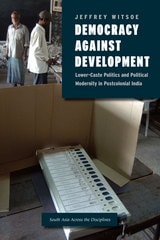
Democracy against Development
Lower-Caste Politics and Political Modernity in Postcolonial IndiaJeffrey Witsoe
University of Chicago Press, 2013
Witsoe looks at the history of colonialism in India and its role in both shaping modern caste identities and linking locally powerful caste groups to state institutions, which has effectively created a postcolonial patronage state. He then looks at the rise of lower-caste politics in one of India’s poorest and most populous states, Bihar, showing how this increase in democratic participation has radically threatened the patronage state by systematically weakening its institutions and disrupting its development projects. By depicting democracy and development as they truly are in India—in tension—Witsoe reveals crucial new empirical and theoretical insights about the long-term trajectory of democratization in the larger postcolonial world.
Democracy and Development in Mali
R. James Bingen
Michigan State University Press, 2000
During the past twenty-five years, the scholarly research and applied development work of Michigan State University faculty and students in Mali represents the most significant combined, long-term, and continuing contribution of any group of university faculty in the United States or Europe to the study of Malian society, economy, and politics. The applied nature of much of this work has resulted in a significant number of working papers, reports, and conference presentations. This volume represents a coherent and connected set of essays from one American university with a widely known and highly respected role in African development. While the essays identify and review Mali's unique historical and contemporary path to democracy and development, they also contribute to the advancement of theoretical knowledge about African development.
Democracy and Other Neoliberal Fantasies
Communicative Capitalism and Left PoliticsJodi Dean
Duke University Press, 2009
Dean’s critique ranges from her argument that the term democracy has become a meaningless cipher invoked by the left and right alike to an analysis of the fantasy of free trade underlying neoliberalism, and from an examination of new theories of sovereignty advanced by politicians and left academics to a look at the changing meanings of “evil” in the speeches of U.S. presidents since the mid-twentieth century. She emphasizes the futility of a politics enacted by individuals determined not to offend anyone, and she examines questions of truth, knowledge, and power in relation to 9/11 conspiracy theories. Dean insists that any reestablishment of a vital and purposeful left politics will require shedding the mantle of victimization, confronting the marriage of neoliberalism and democracy, and mobilizing different terms to represent political strategies and goals.

Democracy and Regulation
How the Public Can Govern Essential ServicesGreg Palast, Theo MacGregor, and Jerrold Oppenheim
Pluto Press, 2002

Democracy and the Left
Social Policy and Inequality in Latin AmericaEvelyne Huber and John D. Stephens
University of Chicago Press, 2012
Although inequality in Latin America ranks among the worst in the world, it has notably declined over the last decade, offset by improvements in health care and education, enhanced programs for social assistance, and increases in the minimum wage.

Democracy in Latin America, 1760-1900
Volume 1, Civic Selfhood and Public Life in Mexico and PeruCarlos A. Forment
University of Chicago Press, 2003
This first volume of Democracy in Latin America considers the development of democratic life in Mexico and Peru from independence to the late 1890s. Forment traces the emergence of hundreds of political, economic, and civic associations run by citizens in both nations and shows how these organizations became models of and for democracy in the face of dictatorship and immense economic hardship. His is the first book to show the presence in Latin America of civic democracy, something that gave men and women in that region an alternative to market- and state-centered forms of life.
In looking beneath institutions of government to uncover local and civil organizations in public life, Forment ultimately uncovers a tradition of edification and inculcation that shaped democratic practices in Latin America profoundly. This tradition, he reveals, was stronger in Mexico than in Peru, but its basic outlines were similar in both nations and included a unique form of what Forment calls Civic Catholicism in order to distinguish itself from civic republicanism, the dominant political model throughout the rest of the Western world.

Democracy in Mexico
Attitudes and Perceptions of Citizens at National and Local LevelEdited by Salvador Marti i Puig, Reynaldo Yunuen Ortega Ortiz, M. Fernanda Somuano Ventura, and Claire Wright
University of London Press, 2014