Results by title
2728 books match the query 'Education' and 113 start with e
ENACTing Change
A Handbook for Teaching Advocacy and Civic EngagementKathleen Cole, Robert W. Glover, Richard J. Meagher, and Katharine A. Owens
Brandeis University Press, 2025
ENACT: The Educational Network for Active Civic Transformation aims to teach college students about democracy through engagement with the state legislative process. Built on the values of knowledge, cooperation, justice, and integrity, ENACT is a national, intercollegiate nonpartisan network. The program empowers students to be active participants in democratic processes by connecting with policymakers and community organizations, conducting research and analysis, and informing public policy with evidence and expertise.
ENACTing Change introduces teachers to the philosophy and practice of the ENACT model—which includes workshops, courses, an online network, as well as pilot projects and other initiatives—while providing detailed guidance on how to incorporate the model into their courses, regardless of discipline or educational settings. The book offers instructors recommendations for developing and teaching courses that engage in state-level policy advocacy with a focus on learning outcomes. ENACTing Change takes instructors through each step of the course design process, from how to build the relationships needed to teach the class to the next steps for students to work in the community after ENACT.
ESJ vol 120 num 3
The University of Chicago Press
University of Chicago Press Journals, 2020
Each Day I Like It Better
Autism, ECT, and the Treatment of Our Most Impaired ChildrenAmy S. F. Lutz
Vanderbilt University Press, 2014
Each Day I Like It Better recounts the journeys of Jonah and seven other children and their families (interviewed by the author) in their quests for appropriate educational placements and therapeutic interventions. The author describes their varied, but mostly successful, experiences with ECT.
A survey of research on pediatric ECT is incorporated into the narrative, and a foreword by child psychiatrist Dirk Dhossche and ECT researcher and practitioner Charles Kellner explains how ECT works, the side effects patients may experience, and its current use in the treatment of autism, catatonia, and violent behavior in children.
Early Childhood in the Anglosphere
Systemic Failings and Transformative PossibilitiesPeter Moss and Linda Mitchell
University College London, 2024
Written by two leading experts in early childhood education, Early Childhood in the Anglosphere offers a unique comparison of early childhood education and care services and parenting leave across seven high-income Anglophone countries. Peter Moss and Linda Mitchell explore what these systems have in common, including the dominance of childcare services, widespread privatization and marketization, and weak parenting leave. They highlight the substantial failings of these systems and the causes and consequences of these failings. But this book is ultimately about hope, about how these failings might be made good through major changes. In other words, it is about transformation: Why transformation is both necessary and possible at this particular time? What transformation might look like? And how it might happen? Part of that transformation concerns the need for new policies and structures. Furthermore, it is about how the Anglosphere thinks about early childhood.
The authors call for a turn away from speaking of early childhood services as “childcare,” conceptualizing it in terms of business and marketized commodities. Instead, they should be envisaged as a public good with universal access for children, supported by well-paid, individual entitlements to parenting leave. Using examples from the Anglosphere and beyond, the book argues that a transformation of thinking, policies, and structures is desirable and doable.
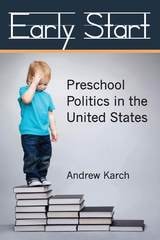
Early Start
Preschool Politics in the United StatesAndrew Karch
University of Michigan Press, 2014
In the United States, preschool education is characterized by the dominance of a variegated private sector and patchy, uncoordinated oversight of the public sector. Tracing the history of the American debate over preschool education, Andrew Karch argues that the current state of decentralization and fragmentation is the consequence of a chain of reactions and counterreactions to policy decisions dating from the late 1960s and early 1970s, when preschool advocates did not achieve their vision for a comprehensive national program but did manage to foster initiatives at both the state and national levels. Over time, beneficiaries of these initiatives and officials with jurisdiction over preschool education have become ardent defenders of the status quo. Today, advocates of greater government involvement must take on a diverse and entrenched set of constituencies resistant to policy change.
In his close analysis of the politics of preschool education, Karch demonstrates how to apply the concepts of policy feedback, critical junctures, and venue shopping to the study of social policy.
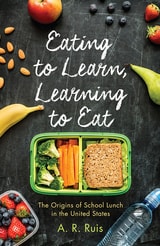
Eating to Learn, Learning to Eat
The Origins of School Lunch in the United StatesA. R. Ruis
Rutgers University Press, 2017
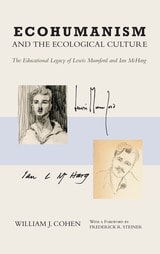
Ecohumanism and the Ecological Culture
The Educational Legacy of Lewis Mumford and Ian McHargWilliam J. Cohen
Temple University Press, 2019
Lewis Mumford, one of the most respected public intellectuals of the twentieth century, speaking at a conference on the future environments of North America, said, “In order to secure human survival we must transition from a technological culture to an ecological culture.” In Ecohumanism and the Ecological Culture, William Cohen shows how Mumford’s conception of an educational philosophy was enacted by Mumford’s mentee, Ian McHarg, the renowned landscape architect and regional planner at the University of Pennsylvania. McHarg advanced a new way to achieve an ecological culture―through an educational curriculum based on fusing ecohumanism to the planning and design disciplines.
Cohen explores Mumford’s important vision of ecohumanism—a synthesis of natural systems ecology with the myriad dimensions of human systems, or human ecology―and how McHarg actually formulated and made that vision happen. He considers the emergence of alternative energy systems and new approaches to planning and community development to achieve these goals.
The ecohumanism graduate curriculum should become the basis to train the next generation of planners and designers to lead us into the ecological culture, thereby securing the educational legacy of both Lewis Mumford and Ian McHarg.
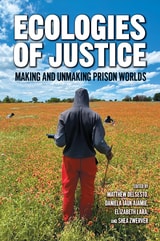
Ecologies of Justice
Making and Unmaking Prison WorldsMatthew DelSesto
Rutgers University Press, 2027
What is the role of multi-species ecologies in creating spaces that counteract the violence in carceral systems and environmental destruction? This book brings together, for the first time, contributions on issues related to prison, jail, and reentry programs, community-based interventions, environmental justice, and sustainability. Through rigorous analysis, detailed case studies, poetry, and personal reflections, the book offers ways of thinking and acting at the intersection of environmental issues and the carceral system. It gathers hard-earned wisdom and insight of researchers, activists, practitioners, and community leaders from within and beyond prison walls who have taken up their projects despite profound institutional constraints.
Approaches in the book range from reform to abolition, as authors detail both practical interventions and imaginative courses of action. More than a contribution to academic knowledge, the book also uniquely highlights voices of those who are incarcerated, survivors of crime, and institutional stakeholders. In addition to writing about the carceral system based on research and personal experience, authors describe practices that are creating transformative spaces of environmental education, building effective pipelines for green workforce development, and sustaining reciprocal relationships for eco-social healing.
Visit for more information: ecologiesofjustice.net
Economic Inequality and Higher Education
Access, Persistence, and SuccessStacy Dickert-Conlin
Russell Sage Foundation, 2007

Ed School
A Brief for Professional EducationGeraldine Jonçich Clifford and James W. Guthrie
University of Chicago Press, 1988
Drawing on case studies of leading schools of education, the authors offer a bold, controversial agenda for reform: ed schools must reorient themselves toward teachers and away from the quest for prestige in academe; they must also adhere to national professional standards, abandon the undergraduate education major, and reject the Ph.D. in education in favor of the Ed.D.
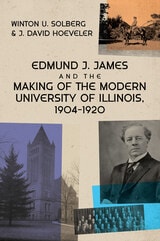
Edmund J. James and the Making of the Modern University of Illinois, 1904-1920
Winton U. Solberg and J. David Hoeveler
University of Illinois Press, 2024
In 1904, Edmund J. James inherited the leadership of an educational institution in search of an identity. His sixteen-year tenure transformed the University of Illinois from an industrial college to a major state university that fulfilled his vision of a center for scientific investigation.
Winton U. Solberg and J. David Hoeveler provide an account of a pivotal time in the university’s evolution. A gifted intellectual and dedicated academic reformer, James began his tenure facing budget battles and antagonists on the Board of Trustees. But as time passed, he successfully campaigned to address the problems faced by women students, expand graduate programs, solidify finances, create a university press, reshape the library and faculty, and unify the colleges of liberal arts and sciences. Combining narrative force with exhaustive research, the authors illuminate the political milieu and personalities around James to draw a vivid portrait of his life and times.
The authoritative conclusion to a four-part history, Edmund J. James and the Making of the Modern University of Illinois, 1904–1920 tells the story of one man’s mission to create a university worthy of the state of Illinois.
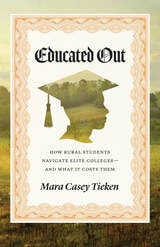
Educated Out
How Rural Students Navigate Elite Colleges—And What It Costs ThemMara Casey Tieken
University of Chicago Press, 2025
A former third-grade teacher in rural Tennessee, education researcher Mara Casey Tieken watched as her former students graduated high school. She was shocked at how few were heading to college—and none were going to elite four-year schools. These students were representative of a larger national phenomenon: In 2021, 31 percent of rural adults aged twenty-five and older held a postsecondary degree, compared to 45 percent of urban adults, and rural students are especially unlikely to pursue degrees from private, selective schools. Why, Tieken wondered? And what happens to the handful of rural students who do attend elite colleges, colleges that may feel worlds away from home?
Tieken addresses these questions in Educated Out—a study that shows how geography shapes rural, first-generation students’ access to college, their college experiences, and their postgraduation plans and opportunities. Tieken closely follows a group of nine students for their college years and beyond at an elite New England private school that she calls Hilltop. Interviews with these students reveal the critical moments in the students’ educational careers when their rural origins mattered most: when applying to college, she shows how students are hindered by limited college counseling resources. Once on campus, they learn that many of the school’s opportunities are not available to them: they cannot access spring break trips, job networks, or low-pay-but-important internships. These students discover that home and college are very different worlds with different academic, social, and political climates—and, over time, they start to question both. As they near graduation and navigate a job market in which the highest-paying and most prestigious opportunities are located in urban centers, they begin to feel the complicated burden of their schooling: they’ve been “educated out.” Their stories show the costs of college for rural students: If they do not pursue higher education, they lose the opportunity for social mobility; if they do, they face a more permanent departure. These costs are individual, but rural families and communities also suffer—they lose young people with talent and skills.
In addition to advocating for a higher education landscape that truly includes rural students, Tieken critiques a system that requires people to leave their rural homes in search of opportunities. Our current economy depends on inexpensive rural labor. Without meaningful change, some students will have to make the impossible decision to leave home—and far more will remain there, undereducated and overlooked.
Both engaging and accessible, Educated Out presents important and timely questions about rurality, identity, education, and inequality.
Educated Out
How Rural Students Navigate Elite Colleges—And What It Costs ThemMara Casey Tieken
University of Chicago Press, 2025
Through the stories of nine rural, first-generation students and their families, Educated Out shows how geography shapes college opportunities, from admission to postgraduation options.
A former third-grade teacher in rural Tennessee, education researcher Mara Casey Tieken watched as her former students graduated high school. She was shocked at how few were heading to college—and none were going to elite four-year schools. These students were representative of a larger national phenomenon: In 2021, 31 percent of rural adults aged twenty-five and older held a postsecondary degree, compared to 45 percent of urban adults, and rural students are especially unlikely to pursue degrees from private, selective schools. Why, Tieken wondered? And what happens to the handful of rural students who do attend elite colleges, colleges that may feel worlds away from home?
Tieken addresses these questions in Educated Out—a study that shows how geography shapes rural, first-generation students’ access to college, their college experiences, and their postgraduation plans and opportunities. Tieken closely follows a group of nine students for their college years and beyond at an elite New England private school that she calls Hilltop. Interviews with these students reveal the critical moments in the students’ educational careers when their rural origins mattered most: when applying to college, she shows how students are hindered by limited college counseling resources. Once on campus, they learn that many of the school’s opportunities are not available to them: they cannot access spring break trips, job networks, or low-pay-but-important internships. These students discover that home and college are very different worlds with different academic, social, and political climates—and, over time, they start to question both. As they near graduation and navigate a job market in which the highest-paying and most prestigious opportunities are located in urban centers, they begin to feel the complicated burden of their schooling: they’ve been “educated out.” Their stories show the costs of college for rural students: If they do not pursue higher education, they lose the opportunity for social mobility; if they do, they face a more permanent departure. These costs are individual, but rural families and communities also suffer—they lose young people with talent and skills.
In addition to advocating for a higher education landscape that truly includes rural students, Tieken critiques a system that requires people to leave their rural homes in search of opportunities. Our current economy depends on inexpensive rural labor. Without meaningful change, some students will have to make the impossible decision to leave home—and far more will remain there, undereducated and overlooked.
Both engaging and accessible, Educated Out presents important and timely questions about rurality, identity, education, and inequality.
Educated in Romance
Women, Achievement, and College CultureDorothy C. Holland and Margaret A. Eisenhart
University of Chicago Press, 1990
Educating Able Learners
Programs and Promising PracticesBy June Cox, Neil Daniel, and Bruce O. Boston
University of Texas Press, 1985
American education has long been under a microscope. In a time when all aspects of our school system face close scrutiny, educators, administrators, and parents are asking critical questions about how we educate those superior students we call “able learners.”
Our schools reward behavior inappropriate for an independent thinker, researcher, or artist. Programming for our most capable students is fragmented and discontinuous. And yet there are schools and programs that hold significant promise.
This four-year national study from the Sid W. Richardson Foundation provides a broad database, looks into the backgrounds of a few unusually creative individuals, and examines programs with a record of success. It argues in favor of comprehensive programming for able learners, providing a steady challenge for all students, helping to insure that no individual talent withers for want of opportunity. Included are recommendations for discovering and nurturing talent in students (including traditionally neglected groups, the economically disadvantaged, and the culturally diverse), building and administering sound programs, developing appropriately trained staff and teachers, and evaluating effectiveness of programs to assure accountability and add credibility.
Compiling data from diverse sources—including 35 MacArthur Foundation Fellows, 400 schools, 1,172 school districts, and countless school personnel and students—the study looks at programs for able learners throughout the country, from Project Pegasus in Iowa to Oaks Academy in Texas, from Bronx High School of Science in New York to Bishop Carroll High School in Alberta, Canada. The authors’ conclusions based on this broad investigation provide an impassioned call for coordinated schooling and cooperation among all segments of society to develop a new generation of creative, self-motivated students.
Educating Across Borders
The Case of a Dual Language Program on the U.S.-Mexico BorderMaría Teresa de la Piedra, Blanca Araujo, and Alberto Esquinca; Foreword by Concha Delgado Gaitan
University of Arizona Press, 2018
The authors, who themselves live and work on the border, question artificially created cultural and linguistic borders. To explore this issue, they employed participant-observation, focus groups, and individual interviews with teachers, administrators, and staff members to construct rich understandings of the experiences of transfronterizx students. These ethnographic accounts of their daily lives counter entrenched deficit perspectives about transnational learners.
Drawing on border theory, immigration and border studies, funds of knowledge, and multimodal literacies, Educating Across Borders is a critical contribution toward the formation of a theory of physical and metaphorical border crossings that ethnic minoritized students in U.S. schools must make as they traverse the educational system.
Educating Angels
Teaching for the Pursuit of HappinessTony Armstrong, Ph.D
Parkhurst Brothers, Inc., 2013

Educating Artists for the Future
Learning at the Intersections of Art, Science, Technology, and CultureEdited by Mel Alexenberg
Intellect Books, 2008
Educating At-Risk Students
Edited by Sam Stringfield and Deborah Land
University of Chicago Press, 2002
Educating Deaf Students
Global PerspectivesDes Power
Gallaudet University Press, 2005
The 19th International Congress on Education of the Deaf (ICED) in 2000, held in Sydney, Australia, brought together 1,067 teachers, administrators and researchers from 46 countries to address an extremely wide selection of topics. Experts from around the world discussed inclusion of deaf students in regular educational environments, literacy, audiology, auditory development and listening programs, hearing aids, programming for children with cochlear implants, signed communication in education, bilingual education, early intervention (including the rapidly emerging area of newborn hearing screening), education in developing countries, deaf students with multiple disabilities, and deaf students in post-secondary school education.
The 19 chapters of Educating Deaf Students: Global Perspectives present a select cross-section of the issues addressed at the 19th ICED. Divided into four distinct parts – Contemporary Issues for all Learners, The Early Years, The School Years, and Contemporary Issues in Postsecondary Education – the themes considered here span the entire student age range. Authored by 27 different researchers and practitioners from six different countries, this book can be seen as a valuable description of the zeitgeist in the field of education of the deaf at the turn of the 21st century and the millennium.
Educating Economists
David Colander and Reuven Brenner, Editors
University of Michigan Press, 1992
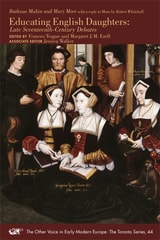
Educating English Daughters
Late Seventeenth-Century DebatesBathsua Makin and Mary More
Iter Press, 2016
This edition offers texts from Bathsua Makin and Mary More, and Robert Whitehall’s response to More’s argument. Makin describes the appropriate education for London merchants’ daughters, arguing that girls should be educated and should aspire to follow learned women in history, and that educated women improve their families and themselves. More argues that women have the right to an education, and that such an education shows that the inequality of married women under English law is a man-made institution. More’s argument drew objections from her Oxford reader, Robert Whitehall, who preserved her manuscript with his own. Makin and More enjoyed a measure of public recognition and esteem, yet after their deaths, they and their texts were largely ignored until the late twentieth century.
Educating Film-Makers
Past, Present and FutureDuncan Petrie and Rod Stoneman
Intellect Books, 2014
Educating Intuition
Robin M. Hogarth
University of Chicago Press, 2001
In Educating Intuition, Robin M. Hogarth lays bare this mysterious process so fundamental to daily life by offering the first comprehensive overview of what the science of psychology can tell us about intuition—where it comes from, how it works, whether we can trust it. From this literature and his own research, Hogarth finds that intuition is a normal and important component of thought that has its roots in processes of tacit learning. Environment, attention, experience, expertise, and the success of the scientific method all form part of Hogarth's perspective on intuition, leading him to the surprising—but natural—conclusion that we can educate our sixth sense. To this end he offers concrete suggestions and exercises to help readers develop their intuitive skills and habits for learning the "right" lessons from experience.
Artfully and accessibly combining cognitive science, the latest research in psychology, and Hogarth's own observations, Educating Intuition eschews the vague approach to the topic that has become commonplace and provides instead a wholly engaging and practical guide to enhancing our intuitive skills.
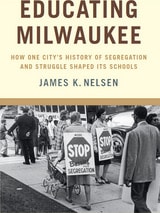
Educating Milwaukee
How One City’s History of Segregation and Struggle Shaped Its SchoolsJames K. Nelsen
Wisconsin Historical Society Press, 2015
"Milwaukee's story is unique in that its struggle for integration and quality education has been so closely tied to [school] choice." --from the Introduction
"Educating Milwaukee: How One City's History of Segregation and Struggle Shaped Its Schools" traces the origins of the modern school choice movement, which is growing in strength throughout the United States. Author James K. Nelsen follows Milwaukee's tumultuous education history through three eras--"no choice," "forced choice," and "school choice." Nelsen details the whole story of Milwaukee's choice movement through to modern times when Milwaukee families have more schooling options than ever--charter schools, open enrollment, state-funded vouchers, neighborhood schools--and yet Milwaukee's impoverished African American students still struggle to succeed and stay in school. "Educating Milwaukee" chronicles how competing visions of equity and excellence have played out in one city's schools in the modern era, offering both a cautionary tale and a "choice" example.
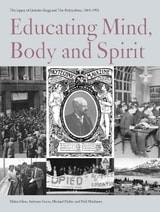
Educating Mind, Body and Spirit
The legacy of Quintin Hogg and The Polytechnic, 1864-1992Helen Glew, Anthony Gorst, Michael Heller and Neil Matthews
University of Westminster Press, 2013
The story of the Polytechnic and of the legacy of Quintin Hogg is the third publication exploring the University of Westminster's long and diverse history. A fitting tribute to the life and legacy of Hogg, his holistic approach to education and the institute he created. This book is richly illustrated with images from the University's Archive.
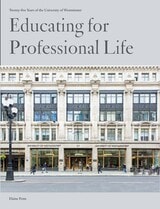
Educating for Professional Life
Twenty-five Years of the University of WestminsterElaine Penn
University of Westminster Press, 2017
The story of the University of Westminster is the fifth volume in a series of titles exploring the University's long and diverse history. This book celebrates the twenty-fifth anniversary of the institution gaining university status, the right to award its own degrees and to participate in publicly funded research. Drawing on extensive research conducted in the University of Westminster Archive this volume investigates the evolution from Polytechnic to University within the broader context of the transformation of UK higher education in the late twentieth and early twenty-first centuries.
Educating for Wisdom in the 21st Century
Darin H. Davis
St. Augustine's Press, 2019
Educating in the Divine Image
Gender Issues in Orthodox Jewish Day SchoolsChaya Rosenfeld Gorsetman and Elana Maryles Sztokman
Brandeis University Press, 2013
Educating the Enemy
Teaching Nazis and Mexicans in the Cold War BorderlandsJonna Perrillo
University of Chicago Press, 2022
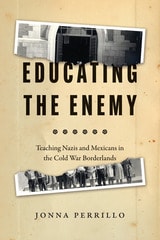
Educating the Enemy begins with the 144 children of Nazi scientists who moved to El Paso, Texas, in 1946 as part of the military program called Operation Paperclip. These German children were bused daily from a military outpost to four El Paso public schools. Though born into a fascist enemy nation, the German children were quickly integrated into the schools and, by proxy, American society. Their rapid assimilation offered evidence that American public schools played a vital role in ensuring the victory of democracy over fascism.
Jonna Perrillo not only tells this fascinating story of Cold War educational policy, but she draws an important contrast with another, much more numerous population of children in the El Paso public schools: Mexican Americans. Like everywhere else in the Southwest, Mexican American children in El Paso were segregated into “Mexican” schools, where the children received a vastly different educational experience. Not only were they penalized for speaking Spanish—the only language all but a few spoke due to segregation—they were tracked for low-wage and low-prestige careers, with limited opportunities for economic success. Educating the Enemy charts what two groups of children—one that might have been considered the enemy, the other that was treated as such—reveal about the ways political assimilation has been treated by schools as an easier, more viable project than racial or ethnic assimilation.
Listen to an interview with the author here and read an interview in Time and a piece based on the book in the Boston Review.
Educating the Masses
The Unfolding History of Black School Administrators in Arkansas, 1900-2000C. Calvin Smith
University of Arkansas Press, 2003
Educating the New Southern Woman
Speech, Writing, and Race at the Public Women's Colleges, 1884-1945David Gold and Catherine L. Hobbs
Southern Illinois University Press, 2014
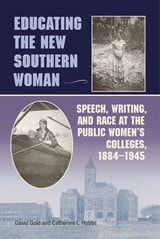
From the end of Reconstruction through World War II, a network of public colleges for white women flourished throughout the South. Founded primarily as vocational colleges to educate women of modest economic means for life in the emerging “new” South, these schools soon transformed themselves into comprehensive liberal arts–industrial institutions, proving so popular that they became among the largest women’s colleges in the nation. In this illuminating volume, David Gold and Catherine L. Hobbs examine rhetorical education at all eight of these colleges, providing a better understanding of not only how women learned to read, write, and speak in American colleges but also how they used their education in their lives beyond college.
With a collective enrollment and impact rivaling that of the Seven Sisters, the schools examined in this study—Mississippi State College for Women (1884), Georgia State College for Women (1889), North Carolina College for Women (1891), Winthrop College in South Carolina (1891), Alabama College for Women (1896), Texas State College for Women (1901), Florida State College for Women (1905), and Oklahoma College for Women (1908)—served as important centers of women’s education in their states, together educating over a hundred thousand students before World War II and contributing to an emerging professional class of women in the South. After tracing the establishment and evolution of these institutions, Gold and Hobbs explore education in speech arts and public speaking at the colleges and discuss writing instruction, setting faculty and departmental goals and methods against larger institutional, professional, and cultural contexts. In addition to covering the various ways the public women’s colleges prepared women to succeed in available occupations, the authors also consider how women’s education in rhetoric and writing affected their career choices, the role of race at these schools, and the legacy of public women’s colleges in relation to the history of women’s education and contemporary challenges in the teaching of rhetoric and writing.
The experiences of students and educators at these institutions speak to important conversations among scholars in rhetoric, education, women’s studies, and history. By examining these previously unexplored but important institutional sites, Educating the New Southern Woman provides a richer and more complex history of women’s rhetorical education and experiences.
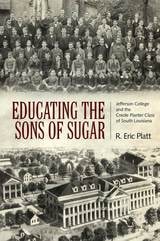
Educating the Sons of Sugar
Jefferson College and the Creole Planter Class of South LouisianaR. Eric Platt
University of Alabama Press, 2017
The education of individual planter classes—cotton, tobacco, sugar—is rarely treated in works of southern history. Of the existing literature, higher education is typically relegated to a footnote, providing only brief glimpses into a complex instructional regime responsive to wealthy planters. R. Eric Platt’s Educating the Sons of Sugar allows for a greater focus on the mindset of French Creole sugar planters and provides a comprehensive record and analysis of a private college supported by planter wealth.
Jefferson College was founded in St. James Parish in 1831, surrounded by slave-holding plantations and their cash crop, sugar cane. Creole planters (regionally known as the “ancienne population”) designed the college to impart a “genteel” liberal arts education through instruction, architecture, and geographic location. Jefferson College played host to social class rivalries (Creole, Anglo-American, and French immigrant), mirrored the revival of Catholicism in a region typified by secular mores, was subject to the “Americanization” of south Louisiana higher education, and reflected the ancienne population’s decline as Louisiana’s ruling population.
Resulting from loss of funds, the college closed in 1848. It opened and closed three more times under varying administrations (French immigrant, private sugar planter, and Catholic/Marist) before its final closure in 1927 due to educational competition, curricular intransigence, and the 1927 Mississippi River flood. In 1931, the campus was purchased by the Society of Jesus (Jesuits) and reopened as a silent religious retreat. It continues to function to this day as the Manresa House of Retreats. While in existence, Jefferson College was a social thermometer for the white French Creole sugar planter ethos that instilled the “sons of sugar” with a cultural heritage resonant of a region typified by the management of plantations, slavery, and the production of sugar.
Education
Immanuel Kant
University of Michigan Press, 1960
Education Across a Century
The Centennial VolumeEdited by Lyn Corno
University of Chicago Press, 2001
Education Behind the Wall
Why and How We Teach College in PrisonEdited by Mneesha Gellman
Brandeis University Press, 2022
An edited volume reflecting on different aspects of teaching in prison and different points of view.
This book seeks to address some of the major issues faced by faculty who are teaching college classes for incarcerated students. Composed of a series of case studies meant to showcase the strengths and challenges of teaching a range of different disciplines in prison, this volume brings together scholars who articulate some of the best practices for teaching their expertise inside alongside honest reflections on the reality of educational implementation in a constrained environment. The book not only provides essential guidance for faculty interested in developing their own courses to teach in prisons, but also places the work of higher education in prisons in philosophical context with regards to racial, economic, social, and gender-based issues. Rather than solely a how-to handbook, this volume also helps readers think through the trade-offs that happen when teaching inside, and about how to ensure the full integrity of college access for incarcerated students.
Education Of A Public Man
My Life and PoliticsHubert Humphrey
University of Minnesota Press, 1991
A candid look into the private and political life of Minnesota's native son.
Education Of A University President
Marvin Wachman, foreword by James W. Hilty
Temple University Press, 2005
Education Policy in Developing Countries
Edited by Paul Glewwe
University of Chicago Press, 2013
Surveying many aspects of education—from administrative structures to the availability of health care to parent and student incentives—the contributors synthesize an impressive diversity of data, paying special attention to the gross imbalances in educational achievement that still exist between developed and developing countries. They draw out clear implications for governmental policy at a variety of levels, conscious of economic realities such as budget constraints, and point to crucial areas where future research is needed. Offering a wealth of insights into one of the best investments a nation can make, Education Policy in Developing Countries is an essential contribution to this most urgent field.
Education System in Mexico
David Scott, C.M. Posner, Chris Martin, and Elsa Guzman
University College London, 2018
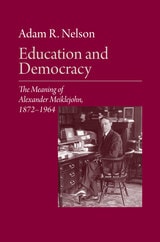
Education and Democracy
The Meaning of Alexander Meiklejohn, 1872–1964Adam R. Nelson
University of Wisconsin Press, 2001
This definitive biography of the charismatic Alexander Meiklejohn tracks his turbulent career as an educational innovator at Brown University, Amherst College, and Wisconsin’s “Experimental College” in the early twentieth century and his later work as a civil libertarian in the Joe McCarthy era. The central question Meiklejohn asked throughout his life’s work remains essential today: How can education teach citizens to be free?
Education and Democratic Citizenship in America
Norman H. Nie, Jane Junn, and Kenneth Stehlik-Barry
University of Chicago Press, 1996
Norman H. Nie, Jane Junn, and Kenneth Stehlik-Barry provide answers by uncovering the causal relationship between education and democratic citizenship. They argue that citizenship encompasses both political engagement in pursuit of interests and commitment to democratic values that temper what citizens can do to win in politics. Education affects the two dimensions in distinct ways. Especially significant is the influence of education on political engagement through occupational prominence and position in social networks. Formal education orders the distribution of social position and connections and creates an uneven political playing field.
Education and Equality
Danielle Allen
University of Chicago Press, 2016
Allen argues that education plays a crucial role in the cultivation of political and social equality and economic fairness, but that we have lost sight of exactly what that role is and should be. Drawing on thinkers such as John Rawls and Hannah Arendt, she sketches out a humanistic baseline that re-links education to equality, showing how doing so can help us reframe policy questions. From there, she turns to civic education, showing that we must reorient education’s trajectory toward readying students for lives as democratic citizens. Deepened by commentaries from leading thinkers Tommie Shelby, Marcelo Suárez-Orozco, Michael Rebell, and Quiara Alegría Hudes that touch on issues ranging from globalization to law to linguistic empowerment, this book offers a critical clarification of just how important education is to democratic life, as well as a stirring defense of the humanities.
Education and Work
Edited by Harry F. Silberman
University of Chicago Press, 1982

Education and the Creative Potential
E. Torrance
University of Minnesota Press, 1963
Education and the Cult of Efficiency
Raymond E. Callahan
University of Chicago Press, 1964
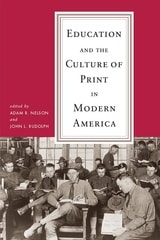
Education and the Culture of Print in Modern America
Adam R. Nelson
University of Wisconsin Press, 2010
Offering perspectives from print culture history, library and information studies, literary studies, labor history, gender history, the history of race and ethnicity, the history of science and technology, religious studies, and the history of childhood and adolescence, Education and the Culture of Print in Modern America pioneers an investigation into the intersection of education and print culture.
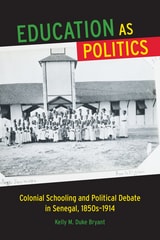
Education as Politics
Colonial Schooling and Political Debate in Senegal, 1850s–1914Kelly M. Duke Bryant
University of Wisconsin Press, 2015
Kelly M. Duke Bryant demonstrates the critical impact of colonial schooling on Senegalese politics by examining the response to it by Africans from a variety of backgrounds and statuses—including rural chiefs, Islamic teachers, and educated young urbanites. For those Africans who chose to engage with them, the French schools in Senegal provided a new source of patronage, a potentially beneficial connection to the bureaucratizing colonial state, a basis for claims to authority or power, or an arena in which to debate pressing issues like the future of Qur’anic schooling and the increasing racism of urban society under colonial rule.
Based on evidence from archives in Senegal and France, and on interviews Duke Bryant conducted in Senegal, she demonstrates that colonial schooling remade African politics during this period of transition to French rule, creating political spaces that were at once African and colonial, and ultimately allowing Diagne to claim election victory.
Education for Democracy
Essays and AddressesJohn Johnston
University of Minnesota Press, 1934
Education for Democracy
Renewing the Wisconsin IdeaEdited by Chad Alan Goldberg
University of Wisconsin Press, 2020
Using the Wisconsin Idea as a lens, Education for Democracy argues that public higher education institutions remain a bastion of collaborative problem solving. Examinations of partnerships between the state university and people of the state highlight many crucial and lasting contributions to issues of broad public concern such as conservation, LGBTQ+ rights, and poverty alleviation. The contributors restore the value of state universities and humanities education as a public good, contending that they deserve renewed and robust support.